Introduction
Schizophrenia is a common and serious mental illness that affects 1% of the population worldwide. It remains the leading cause of mental disability among young adults and is typically associated with structural (Ho et al. Reference Ho, Milev, O'Leary, Librant, Andreasen and Wassink2006; Bora et al. Reference Bora, Fornito, Radua, Walterfang, Seal, Wood, Yucel, Velakoulis and Pantelis2011) and functional abnormalities (Callicott et al. Reference Callicott, Mattay, Verchinski, Marenco, Egan and Weinberger2003; Lui et al. Reference Lui, Deng, Huang, Jiang, Ma, Chen, Zhang, Li, Li, Zou, Tang, Zhou, Mechelli, Collier, Sweeney, Li and Gong2009) of the brain. It has been suggested that the pathophysiology of schizophrenia may lie in abnormal interactions or dysconnectivity across a distributed network of brain regions (Stephan et al. Reference Stephan, Baldeweg and Friston2006; Segal et al. Reference Segal, Koschnick, Slegers and Hof2007). Consistent with this, cross-sectional studies have shown the presence of structural brain abnormalities in the early phase of schizophrenic illness (Federspiel et al. Reference Federspiel, Begre, Kiefer, Schroth, Strik and Dierks2006; Kanaan et al. Reference Kanaan, Shergill, Barker, Catani, Ng, Howard, McGuire and Jones2006; Peters et al. Reference Peters, Blaas and de Haan2010; Wang et al. Reference Wang, Deng, Huang, Li, Ma, Wang, Jiang, Lui, Huang, Chua, Cheung, McAlonan, Sham, Murray, Collier, Gong and Li2011), although several studies failed to detect structural brain anomalies in early-episode patients (Moncrieff & Leo, Reference Moncrieff and Leo2010). More extensive structural brain abnormalities were found in chronic patients with schizophrenia, which may reflect the progressive nature of this condition (Chan et al. Reference Chan, Di, McAlonan and Gong2011). However, the abnormalities found in chronic patients may be influenced by several factors, particularly medication effects, that are difficult to disentangle from disease progression (Bora et al. Reference Bora, Fornito, Radua, Walterfang, Seal, Wood, Yucel, Velakoulis and Pantelis2011).
Clinical observations and empirical studies have demonstrated that antipsychotic medications bring both benefits and side-effects to schizophrenic patients (Lewis, Reference Lewis2011). Although the majority of patients benefit from the reduction of positive symptoms after antipsychotic treatment, many continue to have negative symptoms, neurocognitive impairments and progressive brain tissue abnormalities (Lieberman et al. Reference Lieberman, Tollefson, Charles, Zipursky, Sharma, Kahn, Keefe, Green, Gur, McEvoy, Perkins, Hamer, Gu and Tohen2005; van Haren et al. Reference van Haren, Hulshoff Pol, Schnack, Cahn, Mandl, Collins, Evans and Kahn2007; Cahn et al. Reference Cahn, Rais, Stigter, van Haren, Caspers, Hulshoff Pol, Xu, Schnack and Kahn2009; Olabi et al. Reference Olabi, Ellison-Wright, McIntosh, Wood, Bullmore and Lawrie2011). However, previous studies using morphometric magnetic resonance imaging (MRI) to examine the effects of antipsychotics on cortical grey matter (GM) and white matter (WM) have yielded ambiguous results (McCormick et al. Reference McCormick, Decker, Nopoulos, Ho and Andreasen2005; Pressler et al. Reference Pressler, Nopoulos, Ho and Andreasen2005). In a systematic review, Navari & Dazzan (Reference Navari and Dazzan2009) found that antipsychotic medication acted regionally rather than globally on the brain. Because it is problematic to distinguish between the effects of medication and pathogenesis in cross-sectional studies, longitudinal designs have been used to partly overcome this difficulty. In a long-term longitudinal study of 211 patients over a 7–14-year follow-up period, Ho et al. (Reference Ho, Andreasen, Ziebell, Pierson and Magnotta2011) found that antipsychotics have a subtle but measurable influence on brain tissue losses over time, although volumetric changes do not seem to be related to the dose of antipsychotics (Hulshoff Pol & Kahn, Reference Hulshoff Pol and Kahn2008). In addition, studies on experimental animals supplement evidence that antipsychotic medications cause a reduction in brain volume (Dorph-Petersen et al. Reference Dorph-Petersen, Pierri, Perel, Sun, Sampson and Lewis2005; Konopaske et al. Reference Konopaske, Dorph-Petersen, Pierri, Wu, Sampson and Lewis2007, Reference Konopaske, Dorph-Petersen, Sweet, Pierri, Zhang, Sampson and Lewis2008).
The extent to which progressive structural brain changes are a consequence of disease or are at least partly caused by antipsychotic medication is of fundamental importance (Olabi et al. Reference Olabi, Ellison-Wright, McIntosh, Wood, Bullmore and Lawrie2011). The majority of longitudinal studies of schizophrenia have focused on macrostructural indices of volume changes in GM and WM (Koutsouleris et al. Reference Koutsouleris, Gaser, Bottlender, Davatzikos, Decker, Jager, Schmitt, Reiser, Moller and Meisenzahl2010; Ho et al. Reference Ho, Andreasen, Ziebell, Pierson and Magnotta2011; Olabi et al. Reference Olabi, Ellison-Wright, McIntosh, Wood, Bullmore and Lawrie2011). However, these approaches are limited both in terms of localizing WM ‘networks’ affected and probing acute microstructural changes. By contrast, diffusion tensor imaging (DTI) provides a useful tool for assessing WM structural integrity and connectivity in vivo. It yields a series of quantitative measures, including fractional anisotropy (FA), that reflect the integrity of WM tracts. Lower FA values have been reported in many parts of the principal WM bundles in schizophrenia, although there are differences in the locations implicated across studies (Ardekani et al. Reference Ardekani, Nierenberg, Hoptman, Javitt and Lim2003; Kubicki et al. Reference Kubicki, Westin, Nestor, Wible, Frumin, Maier, Kikinis, Jolesz, McCarley and Shenton2003; Wang et al. Reference Wang, Sun, Cui, Du, Wang, Zhang, Cong, Hong and Zhang2004). Combined volumetric MRI and DTI analyses suggest that FA decline precedes WM volume loss and DTI indices may therefore be more sensitive to WM structural changes in schizophrenia (Hugenschmidt et al. Reference Hugenschmidt, Peiffer, Kraft, Casanova, Deibler, Burdette, Maldjian and Laurienti2008; Bora et al. Reference Bora, Fornito, Radua, Walterfang, Seal, Wood, Yucel, Velakoulis and Pantelis2011). Unfortunately, few studies have focused on the effects of antipsychotic medication on DTI measures. Cross-sectional studies have reported no significant differences in DTI measures between age-matched chronic and briefly medicated patients, nor any correlation between FA values and the duration of illness (Peters et al. Reference Peters, de Haan, Dekker, Blaas, Becker, Dingemans, Akkerman, Majoie, van Amelsvoort, den Heeten and Linszen2008, Reference Peters, Blaas and de Haan2010; Kanaan et al. Reference Kanaan, Barker, Brammer, Giampietro, Shergill, Woolley, Picchioni, Toulopoulou and McGuire2009a, Reference Kanaan, Borgwardt, McGuire, Craig, Murphy, Picchioni, Shergill, Jones and Catanib). However, to assess the impact of antipsychotics on WM microstructure directly, longitudinal investigations are needed, preferably in the early stage of illness, which is free from confounds of chronicity.
Therefore, in the present study, we performed a DTI analysis of WM microstructural changes in a cohort of first-episode, drug-naive patients with schizophrenia before and after 6 weeks of treatment with standard antipsychotic medication. A matched healthy control group was included. We tested the hypothesis that patients with first-episode schizophrenia would have changes in WM microstructure in the early phase of illness within 6 weeks of treatment. We also conducted an exploratory analysis to determine whether changes in WM microstructure would be related to acute outcome in terms of changes in clinical symptoms.
Method
Participants and clinical assessments
Forty out-patients and in-patients were initially enrolled in an ongoing longitudinal study in the Mental Health Centre in West China Hospital of Sichuan University. All patients were experiencing their first episode of psychosis and were drug-naive when recruited to the study. They were assessed by one of two trained psychiatrists using the Structured Clinical Interview for DSM-IV, Patient Edition (SCID-I/P), and were found to fulfil the diagnostic criteria for schizophrenia or schizophreniform psychosis as described in DSM-IV. Among the 40 patients, three diagnosed with schizophreniform psychosis were followed up for at least 6 months and confirmed to meet the DSM-IV diagnosis criteria for schizophrenia. Twenty-three healthy controls were recruited from the local area by poster advertisement. All healthy controls were screened for the lifetime absence of psychiatric illnesses by using the SCID, Non-Patient Edition (SCID-I/NP) and were interviewed to ascertain that there was no psychiatric illness in their first-degree relatives. Participants with evidence of organic brain disorders, alcohol or drug abuse, pregnancy or any other serious medical condition, such as brain tumour or epilepsy, were excluded from the study. The 6-week time period was selected as an early phase to evaluate the impact of antipsychotic treatment relatively free from confounds of chronicity (Chua et al. Reference Chua, Deng, Chen, Law, Chiu, Cheung, Wong, Lienenkaemper, Cheung, Suckling and McAlonan2009; Deng et al. Reference Deng, McAlonan, Cheung, Chiu, Law, Cheung, Sham, Chen and Chua2009; Lui et al. Reference Lui, Li, Deng, Jiang, Wu, Tang, Yue, Huang, Chan, Collier, Meda, Pearlson, Mechelli, Sweeney and Gong2010). Before the patients started any antipsychotic treatment, they underwent assessment of psychopathology and function by an experienced psychiatrist using the Positive and Negative Syndrome Scale (PANSS; Kay et al. Reference Kay, Fiszbein and Opler1987) and the Global Assessment of Functioning (GAF; Goldman et al. Reference Goldman, Skodol and Lave1992) respectively. All patients and controls then had MRI brain scans at baseline. After 6 weeks of treatment, an MRI scan was scheduled again for both patients and healthy controls after quality controls. All patients were assessed with the PANSS and the GAF to evaluate changes in clinical symptoms and global functions after the 6 weeks of treatment. The duration of illness was measured from the onset of the first psychiatric symptoms to the first assessment.
In the present study, patients with schizophrenia received antipsychotic medication according to the case-clinician's preference. Seventeen patients were treated with risperidone, six with olanzapine, six with quetiapine, three with sulpiride, two with aripiprazole and one with haloperidol (Table 1).
Dose for each antipsychotic medication in different patients

CPZ, Chlorpromazine; s.d., standard deviation.
All participants were Han Chinese and right-handed. The handedness of the participants was assessed with the Annett Hand Preference Questionnaire (AHPQ; Annett, Reference Annett1970). This study was carried out in accordance with the Declaration of Helsinki and was approved by the Institutional Review Broad (IRB) of West China Hospital, Sichuan University. After a careful description the study, written informed consent was obtained from all participants.
MRI scans
All participants underwent MRI scanning in the Department of Radiology at West China Hospital using a Signa 3-T scanner (GE Medical Systems, USA) with an eight-channel phased-array head coil. In the MRI unit, the usual practice to ensure MRI image quality assurance is based on an in-house protocol in which phantoms are used to measure the signal-to-noise ratio (SNR) and image uniformity on a daily basis, noting the voltage of the transmitting radio frequency amplifier. High-resolution DTI data were acquired by using a single-shot spin echo–planar imaging (EPI) sequence [repetition time/echo time (TR/TE) = 10 000/70.8 ms, 3-mm axial slices with no gap, matrix = 256 × 256, field of view (FOV) = 24 × 24 cm2, acquisition time = 5 min 40 s]. The DTI sequence used in this protocol included 15 diffusion gradient directions [b = 1000 s/mm2, number of excitations (NEX) = 2] and 1 volume without diffusion weighting (b = 0, NEX = 2) for 42 slices throughout the whole brain. Anatomical three-dimensional spoiled gradient recalled (3D-SPGR) T1 data were also acquired for registration purposes [TR/TE = 8.5/3.4 ms, 1-mm axial slices, matrix = 512 × 512, FOV = 24 cm2, inversion time (TI) = 400 ms, NEX = 1]. An experienced neuroradiologist reviewed all scans to exclude obvious gross abnormalities.
Image processing
Images were processed and analysed using SPM8 software (www.fil.ion.ucl.ac.uk/spm/software/spm8/). FA maps were generated from each participant's DTI scan using the freely available DTIstudio software (http://cmrm.med.jhmi.edu/). Prior to FA calculation, the DTI scans were realigned using the built-in function in DTIstudio so that each DTI image (b = 0 s/mm2) could be corrected for motion. Three participants with schizophrenia and one healthy control were excluded from this study because of head and body motion in the baseline MRI scan and two patients were excluded from later analysis because of unsatisfactory image data in the follow-up MRI scan. Finally, this study included 35 patients and 22 healthy controls who had completed both baseline and follow-up experiments. All 3D-SPGR images were corrected for inhomogeneity, normalized, and segmented using an integrated generative model (unified segmentation) with default parameters applied. The DTI dataset was registered with the anatomical T1 images by mutual information co-registration between the b = 0 image and the T1 image. The normalization parameter of the T1 image was used to normalize the FA map to standard space. Furthermore, each subject's image at week 6 was first registered to the baseline image using a rigid body transformation and then mapped to the baseline image using a high-dimensional deformation. This yielded a follow-up image in the space of the baseline image, but with FA values reflecting the follow-up image. The normalized FA maps were resliced to 2 mm × 2 mm × 2 mm and smoothed with a 6-mm full-width at half-maximum (FWHM) isotropic Gaussian kernel (Wang et al. Reference Wang, Deng, Huang, Li, Ma, Wang, Jiang, Lui, Huang, Chua, Cheung, McAlonan, Sham, Murray, Collier, Gong and Li2011). An explicit mask for statistical analysis was created by averaging the WM mask of all subjects at a threshold of 0.2 (SPM Masking Toolbox).
Statistical analyses
First, clinical symptom scores (positive, negative and general psychopathological symptoms) and GAF scores were compared at both baseline and after 6 weeks using a repeated-measures MANOVA with gender as a covariate. Correlations between changes in symptom score and changes in FA were further examined only if there was a significant difference in symptom scores between the two time points. Second, a ‘difference map’ for each individual was calculated from the 6-week follow-up FA of DTI minus the baseline FA, which reflected the changes in the FA values between the two time points. These difference maps were then compared between cases and controls. Third, we conducted partial correlation analyses to determine whether changes in WM FA were dose dependent or related to symptom changes post-treatment, or whether duration of illness prior to treatment influenced the extent of acute changes post-treatment. The difference in PANSS scores and GAF scores between baseline and the 6-week follow-up was expressed as a ratio of the scores at follow-up and baseline, that is the ‘PANSS reduction ratio’ and the ‘GAF improvement ratio’ respectively. The significance level was set with a voxel-level threshold of p < 0.05, after family-wise error correction for multiple comparisons, and an extent threshold of p < 0.05 (uncorrected), with a minimum cluster size of 50 voxels. In all these analyses, gender was included as a covariate when appropriate. The FA values of each difference map were extracted for subsequent analyses and all correlation analyses were performed using SPSS version 12.0 (SPSS Inc., USA).
Results
Demographic characteristics
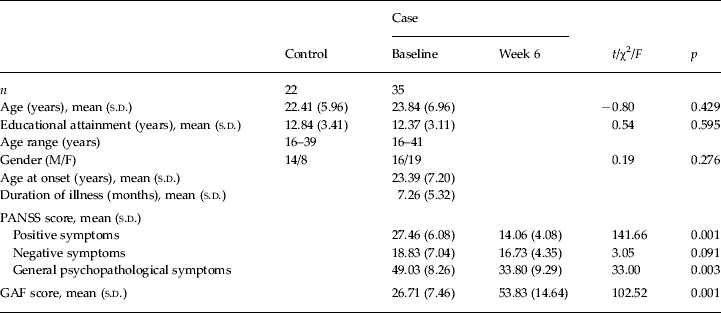
The demographic characteristics of the participants are shown in Table 2. There were no significant differences in age (t 55 = −0.80, p > 0.429), years of education (t 242 = 0.54, p < 0.595) and gender ratio (χ21 = 0.19, p < 0.276) between the patients and controls.
Demographic and clinical characteristics of healthy controls and participants with schizophrenia for baseline and follow-up data

M, Male; F, female; PANSS, Positive and Negative Symptoms Scale; GAF, Global Assessment of Functioning; s.d., standard deviation.
Comparison between cases and controls at baseline
As shown in Fig. 1, compared to healthy controls, there was a significant decrease in the absolute FA value in WM around the right posterior cingulate gyrus (x = 14, y = −42, z = 29, p = 1.13 × 10⁻⁴), and this cluster was seen to extend to the right anterior corona radiata and the precentral gyrus of the frontal lobe (x = 40, y = −2, z = 28, p = 1.75 × 10⁻⁴) in first-episode drug-naive patients with schizophrenia at baseline.
Comparsion between cases and controls at baseline. Compared to healthy controls, patients with schizophrenia had significant reduction in absolute fractional anisotropy (FA) values at baseline in white matter around the right posterior cingulate gyrus (x = 14, y = −42, z = 29, p = 1.13 × 10⁻⁴), and this cluster seemed to extend to the right anterior corona radiata and the precentral gyrus of the frontal lobe (x = 40, y = −2, z = 28, p = 1.75 × 10⁻⁴).
Longitudinal comparisons of clinical symptoms and GAF between baseline and week 6
In the repeated-measures MANOVA, there were significant differences in positive, general psychopathological symptoms and GAF scores between baseline and the 6-week follow-up time point (F = 141.66, p < 0.001; F = 33.00, p < 0.003; F = 102.52, p < 0.001 respectively). No significant difference was evident in negative symptoms between the two time points (F = 3.05, p < 0.091), and therefore negative symptom measures were not analysed further.
Absolute changes in FA values after 6 weeks of antipsychotic treatment
As shown in Fig. 2, compared to healthy controls, there was a significant decrease in absolute FA values in WM around the bilateral anterior cingulate gyrus and the right anterior corona radiata of the frontal lobe in first-episode drug-naive patients with schizophrenia following 6 weeks of treatment. The cluster in the right anterior cingulate region seemed to extend into the right frontal lobe (Fig. 2). Compared with baseline, the mean FA values at week 6, which were extracted from WM bundles of the bilateral anterior cingulate gyrus and the right anterior corona radiata of the frontal lobe (x = −16, y = 2, z = 29, p = 0.01; x = 22, y = 14, z = 33, p = 0.001; and x = 22, y = −22, z = 33, voxels = 685 respectively), decreased to about 8.45, 7.82 and 4.96% respectively. By contrast, the corresponding percentage decreases in the controls were 1.03, 0.895 and 0.015% respectively and these percentage decreases were significantly different between cases and controls.
Comparison of difference maps between patients and controls. Compared to healthy controls, patients with schizophrenia had a significant reduction in absolute fractional anisotropy (FA) values following 6 weeks of antipsychotic treatment in the bilateral anterior cingulate gyrus and the right anterior corona radiata of the frontal lobe (x = −16, y = 2, z = 29, p = 0.01, voxels = 1332; x = 22, y = 14, z = 33, p = 0.001, voxels = 1617; and x = 22, y = −22, z = 33, voxels = 685 respectively).
Correlation of change in FA value with changes in symptom scores, duration of illness, GAF score and antipsychotics dosages
There were no significant correlations between the change in FA value and the improvement in clinical symptoms, positive (r = 0.195, p = 0.277, df = 31), general psychopathological symptoms (r = 0.214, p = 0.233, df = 31), and GAF score (r = 0.040, p = 0.826, df = 31) after 6 weeks of treatment. Moreover, there were no significant correlations between change in FA value and duration of illness (r = 0.097, p = 0.592, df = 31) or between the change in FA value and the dose of antipsychotic medications (r = −0.208, p = 0.246, df = 31) after the 6 weeks of treatment. Thus, WM FA changes were dose independent and not linked to symptom changes. In addition, duration of illness did not influence vulnerability to acute changes in WM FA following drug treatment.
Discussion
In the present study we found a progressive change in WM microstructure around the bilateral anterior cingulate gyrus and the right anterior corona radiata of the frontal lobe in first-episode drug-naive patients with schizophrenia at 6 weeks of follow-up. Non-specific changes were controlled for by including a cohort of healthy controls scanned within the same follow-up period (6 weeks). During this period we found that the negative symptoms of the patients with schizophrenia remained stable whereas their positive and general psychopathological symptoms improved significantly. However, the WM FA changes did not correlate with symptom improvement, short-term outcomes or the dose of antipsychotic medication. Moreover, the duration of illness prior to treatment did not influence vulnerability to WM changes post-treatment.
Although are several possible explanations for the acute alteration in WM microstructure in patients with schizophrenia, antipsychotic medication is likely to be the major factor. Studies of the effects of antipsychotic medication on DTI measurements have generally found no relationship between FA values and dose of antipsychotic medications (Kanaan et al. Reference Kanaan, Barker, Brammer, Giampietro, Shergill, Woolley, Picchioni, Toulopoulou and McGuire2009a; Peters et al. Reference Peters, Schmitz, Dingemans, van Amelsvoort, Linszen, de Haan, Majoie and den Heeten2009; White et al. Reference White, Magnotta, Bockholt, Williams, Wallace, Ehrlich, Mueller, Ho, Jung, Clark, Lauriello, Bustillo, Schulz, Gollub, Andreasen, Calhoun and Lim2011), although small sample sizes and lack of long-term longitudinal designs have constrained interpretation. Our study, however, confirmed that the effect of antipsychotic medications on WM microstructure within 6 weeks is not dose dependent. Although we cannot rule out the possibility of disease progression in our findings, during the ‘short’ 6-week follow-up period the positive symptoms of schizophrenia improved whereas the negative symptoms remained stable. Thus, there was no evidence of symptomatic progression of disease in our patients. This suggests that the reduction in FA elicited by antipsychotic medication is not related to clinical presentation in a straightforward manner.
We acknowledge the challenge in labelling the directionality of any neuroimaging findings as ‘beneficial’ or ‘harmful’. As regional WM FA has consistently been reported to be lower in schizophrenia compared to typical control groups (Wang et al. Reference Wang, Sun, Cui, Du, Wang, Zhang, Cong, Hong and Zhang2004, Reference Wang, Deng, Huang, Li, Ma, Wang, Jiang, Lui, Huang, Chua, Cheung, McAlonan, Sham, Murray, Collier, Gong and Li2011; Cheung et al. Reference Cheung, Chiu, Law, Cheung, Hui, Chan, Sham, Deng, Tai, Khong, McAlonan, Chua and Chen2011), lower FA in schizophrenia seems to be ‘pathological’. We previously reported that FA in cingulate WM is significantly lower in patients compared to controls, even though patients with the lowest FA had the fewest positive symptoms (Cheung et al. Reference Cheung, Chiu, Law, Cheung, Hui, Chan, Sham, Deng, Tai, Khong, McAlonan, Chua and Chen2011). The direction of the present findings is similar in that positive symptoms improved while FA decreased. Thus, we cautiously suggest that our findings indicate that although medications currently used to treat schizophrenia improve positive symptoms, they cannot arrest or reverse an injurious process occurring in the brain of patients with schizophrenia, and may even worsen WM pathology.
The abnormalities we observed in cingulate gyrus WM are in line with Rosenberger's (Rosenberger et al. Reference Rosenberger, Kubicki, Nestor, Connor, Bushell, Markant, Niznikiewicz, Westin, Kikinis, Saykin, McCarley and Shenton2008) and others’ findings suggesting that this region is particularly vulnerable to damage in schizophrenia (Wang et al. Reference Wang, Sun, Cui, Du, Wang, Zhang, Cong, Hong and Zhang2004; Cheung et al. Reference Cheung, Chiu, Law, Cheung, Hui, Chan, Sham, Deng, Tai, Khong, McAlonan, Chua and Chen2011). A potential toxic effect of antipsychotic medication might include oxidative stress and excitatory neurotoxicity and previous longitudinal studies have linked antipsychotic medications to brain tissue losses (Ho et al. Reference Ho, Andreasen, Ziebell, Pierson and Magnotta2011; Olabi et al. Reference Olabi, Ellison-Wright, McIntosh, Wood, Bullmore and Lawrie2011). For example, Lieberman et al. (Reference Lieberman, Tollefson, Charles, Zipursky, Sharma, Kahn, Keefe, Green, Gur, McEvoy, Perkins, Hamer, Gu and Tohen2005) suggested that haloperidol could explain GM losses during the first 12 weeks after first time of onset and Ho et al. (2003) observed similar progressive GM losses in the brains of schizophrenic patients during the initial year after diagnosis despite ongoing antipsychotic drug treatment. They also found that typical and atypical drugs had differential effects on brain volume (Ho et al. 2003). By contrast, in animal models, typical and atypical antipsychotic medications have been reported to have an equivalent and highly significant impact causing a decrease in brain volumes. For example, in the macaque, typical and atypical medications a decrease in weight and volume of fresh brain (Dorph-Petersen et al. Reference Dorph-Petersen, Pierri, Perel, Sun, Sampson and Lewis2005), and in the rat, haloperidol and olanzapine trigger comparable decreases in whole brain volume, driven mainly by frontal lobe volume reductions (Vernon et al. Reference Vernon, Natesan, Modo and Kapur2011). A common action of both atypical and typical antipsychotics is D2/D3 receptor blockade of D2/3, which in turn increases dopamine turnover. The latter may theoretically generate free radicals and lead to oxidative damage (Carlsson & Lindqvist, Reference Carlsson and Lindqvist1963), and on integrating our study with that of Ho et al. (Reference Ho, Andreasen, Ziebell, Pierson and Magnotta2011), the evidence suggests that antipsychotic medications may have undesirable effects on brain structure. However, we balance this postulate with evidence that, in the acute phase of illness, antipsychotic medications improve positive symptoms and may ‘reverse’ the lower striatal volumes found in patients prior to drug treatment (Leung et al. Reference Leung, Cheung, Yu, Yip, Sham, Li, Chua and McAlonan2011).
There are some limitations in our study. First, during the early phase of illness presumed abnormalities in WM microstructure and the level of neuronal pathology may be not extensive enough to be detected by DTI measures and may be too subtle to be correlated with clinical symptoms, outcome and drug dosages. To exclude such false negatives, longer follow-up time periods will be needed to explore long-term brain–behaviour–medication relationships. Second, although this is the largest 6-week DTI follow-up study in drug-naive patients pre- and post-treatment to date, the sample size may still lack power to fully link changes in outcome and clinical symptoms with subtle changes in WM. Again we may have false-negative results that perhaps obscure increases or normalization of FA that relate to good clinical outcomes. Third, it is possible that there are non-linear rather than linear relationships among the changes in microstructure, clinical symptoms, outcome and drug dosages. More advanced statistical approaches, such as random effect mixed models, may be preferable for the investigation of these complex relationships (Ho et al. Reference Ho, Andreasen, Ziebell, Pierson and Magnotta2011). Finally, as with any in-vivo MRI index, we cannot definitely conclude that the underlying pathological mechanism is responsible for the changes observed. Although FA is considered as a proxy index of microstructural organization, the effect of antipsychotic medications may also be indirect through altered blood flow or neuron metabolism in the brain.
In conclusion, our findings show that, during the early phase of treatment, there is an acute reduction in WM FA in the majority of patients with first-episode schizophrenia. The changes may be caused by antipsychotic medications. However, an underlying progression of the illness, despite the improvement in some clinical symptoms in the patients with schizophrenia, cannot be fully excluded.
Acknowledgements
This work was partly funded by the National Nature Science Foundation of China (81130024, 30530300 and 30125014, T.L.; 30971056, Q.W.), the National Basic Research Programme of China (973 Programme 2007CB512301, T.L.), the Ph.D. Programmes Foundation of the Ministry of Education of China (20110181110014, T.L.), the National Key Technology R&D Programme of the Ministry of Science and Technology of China during the 12th Five-Year Plan (2011BAZ02530, T.L.), a National Alliance for Research on Schizophrenia and Depression (NARSAD) Independent Investigator Award (T.L.), the Wellcome Trust (International Collaborative award to T.L. and D.A.C.), and the China Postdoctoral Science Foundation (20090461337 and 201003699, W.D.).
Declaration of Interest
None.