INTRODUCTION
Strategic alliances are recognized as a way for firms to gain competitive advantage and develop important assets in an increasingly competitive corporate environment (Hoffmann, Reference Hoffmann2007). Prior research about how strategic alliances affect firm performance focused on the effect of a single alliance on firm performance. For example, several articles have discussed abnormal stock market returns after two firms form an alliance (e.g., Balakrishnan & Koza, Reference Balakrishnan and Koza1993; Beck, Larson, & Pinegar, Reference Beck, Larson and Pinegar1996; Das, Sen, & Sengupta, Reference Das, Sen and Sengupta1998). Their results, however, do not explain the multi-simultaneous alliance trend among modern firms.
In today's business landscape, firms no longer depend on a single alliance or partner but rather maintain multiple simultaneous alliances with different partners in order to access a broad range of resources (Hoffmann, Reference Hoffmann2005, Reference Hoffmann2007; Lavie, Reference Lavie2007; Wassmer, Reference Wassmer2010). The multiple simultaneous strategic alliances of a focal firm are termed alliance portfolios; they can also be defined as egocentric networks from a social network perspective (Baum, Calabrese, & Silverman, Reference Baum, Calabrese and Silverman2000; Rowley, Behrens, & Krackhardt, Reference Rowley, Behrens and Krackhardt2000; Ozcan & Eisenhardt, Reference Ozcan and Eisenhardt2009). Research emphasizing the multiple simultaneous strategic alliances of a focal firm has recently attracted considerable attention; studies examined how these alliances affect firm performance, since efficiently configured alliance portfolios can improve corporate performance (Lavie Reference Lavie2007; Wassmer, Reference Wassmer2010).
Studies on alliance portfolios generally focus on portfolio size; the role of alliance partners; the role of structural and relational alliance portfolio characteristics; the role of interdependencies between alliances and alliance partners; changes made by firms in the configurations of their alliance portfolios over time; the role of experience accumulation, learning, and knowledge transfer within alliance portfolios; or some combination of these topics (Wassmer, Reference Wassmer2010). This study primarily covers the role of alliance partners. So far, work on the role of alliance partners is rare; alliance portfolio analysis is a relatively new area in the widely researched field of strategic alliances, in which more empirical studies are needed (Stuart, Reference Stuart2000; Lavie, Reference Lavie2007; Wassmer, Reference Wassmer2010). This study also covers the relationship between the role of the alliance partners and the structural alliance portfolio characteristics, so we discuss the previous literature related to these topics.
Previous studies on the role of alliance partners have emphasized the importance of the resource and capability endowments of partners (Stuart, Reference Stuart2000; Lavie, Reference Lavie2007). For example, Stuart (Reference Stuart2000) concludes that ‘both from a resource access and reputation standpoint, large and innovative firms are likely to be the most valuable associates’ (Stuart, Reference Stuart2000: 808). More generally, this logic is based on the social networks literature emphasizing that the potential advantages of a relationship depend on the social and material capital possessed by a focal firm's partners (Burt, Reference Burt1992).
An objective of this study is to come up with recommendations for focal firms that may be suffering a decline in market performance because their dominant partners may be appropriating a larger share of joint value creation at the focal firms’ expense (Lavie, Reference Lavie2007). Scholars have tended to neglect the appropriation hazards that partners impose (Wassmer & Dussauge, Reference Wassmer and Dussauge2011). In this regard, partner selection for optimal performance requires a critical comparison of the characteristic differences of a focal firm and its partners, rather than the unconditional selection of larger partners and partners having generous endowments. In this study, we compare the characteristic differences between a focal firm and its partners, specifically innovativeness, reputation, and bargaining power, among the various endowments.
Another objective of this study is to examine the relationship between the characteristic differences of a focal firm and its partners, and the issues of structural alliance portfolio characteristics, spanning structural holes, and creating densely embedded networks. This objective is an issue of assessing linking social capital versus communal social capital. The concept of linking social capital emphasizes the benefits of a focal firm in a brokering position in an open network, while the concept of communal social capital emphasizes the benefits of embeddedness of a focal firm in a closed network (Granovetter, Reference Granovetter1985; Coleman, Reference Coleman1988, Reference Coleman1990). Each of these concepts has merit, but previous studies about these structural alliance portfolio characteristics differed in their conclusions of which one is preferable. In this study, we consider these structural alliance portfolio characteristics with the characteristic differences between a focal firm and its partners because these structural alliance portfolio characteristics could differ depending on other properties (i.e., innovativeness, reputation, and bargaining power), and thus, no one structural alliance portfolio characteristic is preferable for all firms. In other words, it is more realistic to conclude that the effect of these structural alliance portfolio characteristics is relative rather than absolute.
We have two reasons for selecting the three explanatory variables innovativeness, reputation, and bargaining power from among the various endowments to examine the differences between a focal firm and its partners, and the variables’ interaction with spanning structural holes. First, many past studies in the strategic alliance literature have used the partner firm's innovativeness, reputation, and bargaining power to explain the effect of the role of alliance partners on firm performance. These studies did not consider the characteristic differences between a focal firm and its partners. For example, Gulati (Reference Gulati1999), Stuart (Reference Stuart2000), Baum, Calabrese, and Silverman (Reference Baum, Calabrese and Silverman2000), and Zaheer and Bell (Reference Zaheer and Bell2005) used the partner firm's innovativeness and performance; Stuart (Reference Stuart2000), Das and Teng (Reference Das and Teng2003), Koka and Prescott (Reference Koka and Prescott2008), Lin, Yang, and Arya (Reference Lin, Yang and Arya2009), and Swaminathan and Moorman (Reference Swaminathan and Moorman2009) considered the partner firm's reputation and performance; and lastly, Inkpen and Beamish (Reference Inkpen and Beamish1997), Sarkar, Echambadi, and Harrison (Reference Sarkar, Echambadi and Harrison2001), and Lavie (Reference Lavie2006, Reference Lavie2007) used the partner firm's bargaining power. While these studies have emphasized the positive characteristics of the partner firm, namely, its innovativeness, reputation, and bargaining power, they did not consider the relative differences between the focal firm and its partners in terms of these three variables. Second, few studies considered network structural contingencies at the firm level (Zaheer & Bell, Reference Zaheer and Bell2005). Information travels not only through proximate ties in networks but also through the structure of the network itself (Gulati, Reference Gulati1998). This means that network structural contingencies with other variables that can affect firm performance could exist. Thus, we consider spanning structural holes and three other variables simultaneously to determine interaction effects.
There are two main strands of research on structural alliance portfolio characteristics – spanning structural holes and creating densely embedded networks (Wu & Wei, Reference Wu and Wei2004). The first strand of research is based on the structural hole theory of Burt (Reference Burt1992), which emphasized the importance of spanning a structural hole (Bae & Gargiulo, Reference Bae and Gargiulo2004; Zaheer & Bell, Reference Zaheer and Bell2005; Dyer, Singh, & Kale, Reference Dyer, Singh and Kale2008). Burt (Reference Burt1992) suggested that spanning a structural hole is favorable for gaining a control advantage over competitors and obtaining diverse information. Through spanning a structural hole, a focal firm enriches its pool of resources by generating greater access to mutually unconnected partners. Bae and Gargiulo (Reference Bae and Gargiulo2004) argued that spanning a structural hole positively affects a firm's return on assets (ROA) and return on equity. Zaheer and Bell (Reference Zaheer and Bell2005) showed that spanning a structural hole is positively related to a firm's market share. In particular, they emphasized that the benefits of spanning a structural hole on firm performance is brought about by the availability of novel information. In the second strand of research, which emphasizes densely embedded networks, social structures where a focal firm has numerous interconnected partners are called closed networks and are considered favorable for the firm (Coleman, Reference Coleman1988, Reference Coleman1990; Walker, Kogut, & Shan, Reference Walker, Kogut and Shan1997). Coleman (Reference Coleman1988) stated that the optimal social structure can be generated by building a network of interconnected partners. In addition, a focal firm benefits from the exchange of information, reduced opportunism, and lower monitoring costs depending on the level of trust in this dense network (Zaheer & Venkatraman, Reference Zaheer and Venkatraman1995). The interconnectivity among a firm's partners leads to a more productive collaboration in terms of resource sharing and access to novel information (Ahuja, Reference Ahuja2000).
Alliance portfolios can be classified into three main types – vertical upstream, horizontal, and vertical downstream – according to focal firm partner type, as illustrated in Figure 1 (Silverman & Baum, Reference Silverman and Baum2002; Rothaermel & Deeds, Reference Rothaermel and Deeds2006; Haeussler & Patzelt, Reference Haeussler and Patzelt2008). The aggregate portfolio combining all three types is called the comprehensive alliance portfolio (Baum, Calabrese, & Silverman, Reference Baum, Calabrese and Silverman2000). In this study, we concentrate on the technological vertical downstream alliance portfolios of Korean defense firms. Past research has concentrated on horizontal alliance portfolios (e.g., Ahuja, Reference Ahuja2000; Stuart, Reference Stuart2000; Zaheer & Bell, Reference Zaheer and Bell2005).
The comprehensive alliance portfolio and the alliance portfolios at each layer of a focal firm

In summary, considering both the objectives and alliance types covered, this study's overall aim is to shed light on the inter-corporate characteristic differences between a focal firm and its partners and to determine which portfolio structure is preferable for corporate performance in a vertical downstream alliance based on these inter-corporate characteristic differences.
We excluded vertical upstream alliance portfolios because satisfactory data related to partner characteristics (e.g., universities’ credit grade, ROA) are hard to find. We also excluded horizontal alliances because such alliances between Korean defense firms, which are segmented and specialized, are hard to find. Defense firms are often classified into seven main categories, namely maneuver; firepower; ammunition; battleship; air and guidance; communication electronics; and chemical, biological, and radiological (CBR). Thus, collaborations between defense firms are very rare, but collaborations between defense firms and firms from other industries abound. For these reasons, we focus on vertical downstream alliance portfolios. This study contributes to the current literature because research on this type of alliance portfolio is scarce.
The study focuses on the Korean defense industry, which the government has designated as a future growth sector, for two reasons. First, in this industry, developing new technologies or combining existing technologies is important for creating cutting-edge weapons systems. Thus, this industry is one of the most innovative and collaborative alongside the pharmaceutical industry, and provides sufficient data on collaboration required for this study. Second, previous research on Korea's defense industry has concentrated on the industry or national level, specifically on the industry's development strategies, features, and institutional development plans. In other words, previous research has considered Korea's defense industry as one under control of the government's institutions. Research on the defense industry at the firm level has only been recently attempted for firms in Korea and overseas and focuses on management strategy.
The principal arguments of this study are the following. First, unlike previous studies, which maintain that access to more resources affects corporate performance positively, this study emphasizes that differences between a focal firm and its partners with respect to innovativeness, reputation, and bargaining power lead to different effects on corporate performance. This argument supports a more flexible and realistic notion than that of previous studies, which simply assert that more innovative or reputable partners are always better. We argue that the driver of superior corporate performance is not simply having a good partner but also the relational capability of a focal firm and its partner. Second, this study emphasizes that the alliance portfolio structure should differ depending on the different capabilities (i.e., innovativeness, reputation, and bargaining power) of a focal firm and its corporate partners. In the debate on the connection between linking social capital and communal social capital, capability differences are essential features of the structural quest for superior performance.
In the remainder of this article, we state our hypotheses, describe our methods, and outline our results. The sections on theory and hypotheses present analogous hypotheses for the characteristic differences between a focal firm and its partners and the impact of spanning a structural hole. The results section presents the conclusions from the statistical analyses and outlines the findings. Finally, the last sections present the concluding remarks, along with implications, limitations of the study, and future research directions for managers and scholars.
THEORY AND HYPOTHESES
Differences in innovativeness between a focal firm and a partner firm
Through alliances, a focal firm can access innovative resources that it does not possess itself from its partners. Firms engage in co-development in order to use external resources for their goals (Becker & Dietz, Reference Becker and Dietz2004). When these innovative resources are necessary as complementary assets, they make alliances richer and more efficient (Nieto & Santamaría, Reference Nieto and Santamaría2007). In this case, a focal firm can leverage these external resources through value-creation mechanisms (Lavie, Reference Lavie2007). Value-creation is an economic or monetary process (e.g., it leads to increases in stock price, additional cash flows) (Wassmer & Dussauge, Reference Wassmer and Dussauge2011). A focal firm can use its alliances as opportunities for value-creation through resource combination. It can also internalize external resources, thereby enhancing its internal capabilities, which could affect firm performance positively (Lavie, Reference Lavie2006). In an examination of the Canadian biotechnology industry, Baum, Calabrese, and Silverman (Reference Baum, Calabrese and Silverman2000) showed that start-up firms involved with innovative partners tended to perform better. Stuart (Reference Stuart2000) also reported, in the case of the US semiconductor industry, that more innovative partners played an important role in delivering endowments. Additionally, alliances with innovative partners can create opportunities to learn new routines and acquire advanced technical know-how (Stuart, Reference Stuart2000; Lavie, Reference Lavie2007).
From a relative perspective, strategic alliances with partners that are more innovative than the focal firm might support better focal firm performance. Nahapiet and Ghoshal (Reference Nahapiet and Ghoshal1998) argue that the process of sharing ideas with more innovative partners is likely to generate new knowledge. When partners are more innovative, a focal firm may learn and create more from its interaction with them. Thus, a focal firm allying with relatively more innovative partners could replicate innovative ideas, thus generating additional insightful ideas that might improve corporate performance. Therefore, we propose the following hypothesis:
Hypothesis 1 : The more innovative the partner is relative to the focal firm, the better the focal firm performs.
Differences in reputation between a focal firm and a partner firm
Porter (Reference Porter1985) suggests that a good reputation may help a pioneer firm build an image of innovation in the industry. Franklin (Reference Franklin1984) proposes that corporate reputation is a global and final outcome of the process of building a corporate image. Based on past studies, reputation can be summarized as a set of attributes (e.g., innovation; customer-friendly organizational processes, systems, and structures; adequate absorptive capacity) characterizing a focal firm (Weigelt & Camerer, Reference Weigelt and Camerer1988; Nguyen & Leblanc, Reference Nguyen and Leblanc2001). An alliance partner could affect focal firm performance through its influence on an organization's reputation because a good reputation is thought of as a rent-generating asset (Fombrun & Shanley, Reference Fombrun and Shanley1990) that changes with partner reputations (Stuart, Hoang, & Hybels, Reference Stuart, Hoang and Hybels1999). The transfer of tangible and knowledge-based resources from partners enjoying good reputations may help improve the social status and profitability of a focal firm. In the process of allying, having partners with good reputations could be more beneficial based on trust because the focal firm could escape from the partners’ optimistic behaviors (Ahuja, Reference Ahuja2000). Therefore, we propose the following hypothesis:
Hypothesis 2 : The stronger the reputation of a partner is relative to the focal firm's, the better the focal firm performs.
Differences in bargaining power between a focal firm and a partner firm
Bargaining power can be defined as the ability to obtain favorable conditions in contract negotiations (Yan & Gray, Reference Yan and Gray1994). Thus, the relative bargaining power of a focal firm and its partner affects the distribution of rents in alliances (Hamel, Reference Hamel1991). If a focal firm has weaker bargaining power relative to its partner, it could lose its share in the process of sharing (Yan & Gray, Reference Yan and Gray1994), and consequently reduce its profitability. Conversely, relatively strong bargaining power could enable a focal firm to take an excessive share. Therefore, we propose the following hypothesis:
Hypothesis 3 : The stronger the bargaining power of a focal firm is relative to its partner's, the better the focal firm performs.
Contingencies exerted by spanning structural holes
Researchers have drawn attention to the contingent benefits of a network structure (Burt, Reference Burt1997; Podolny & Baron, Reference Podolny and Baron1997). In the field of sociology, for example, Burt (Reference Burt1992) considered both actors’ personal characteristics (e.g., sex, rank, and seniority) and spanning of structural holes in their personal relationships to their promotion timing. Burt (Reference Burt1992) found that both the actors’ personal characteristics and access to structural holes influenced the timing of their promotions. However, few studies considered network structural contingencies at the firm level (Zaheer & Bell, Reference Zaheer and Bell2005).
Spanning a structural hole can have social structural advantages for a focal firm (Burt, Reference Burt1992). Burt (Reference Burt1992) suggests that spanning a structural hole is favorable for obtaining diverse information. Spanning a structural hole with highly innovative partners could yield joint benefits because partner firms could offer new opportunities to enter niche markets (Zaheer & Bell, Reference Zaheer and Bell2005). Research has produced mixed results on the contingent value of spanning a structural hole in the context of innovativeness (Rowley, Behrens, & Krackhardt, Reference Rowley, Behrens and Krackhardt2000). In this context, partner firms having superior uncorrelated innovativeness could provide a focal firm with new market opportunities. Therefore, we propose the following hypothesis:
Hypothesis 4 : A focal firm that spans structural holes with relatively more innovative partners performs better.
Spanning a structural hole with partners having a good reputation could yield mutual benefits in terms of monitoring cost savings and learning (Ahuja, Reference Ahuja2000; Roberts & Dowling, Reference Roberts and Dowling2002). Sharing resources, namely skills and knowledge, benefit a focal firm and its partners. Such sharing requires a significant level of trust between a firm and its partners. Without trust, resource sharing and large joint investments are likely to be difficult and unproductive. Thus, collaboration with reputable partners from spanning a structural hole can enable a firm to save on monitoring costs, reduce optimistic behavior, and gain non-redundant endowments. Therefore, we propose the following hypothesis:
Hypothesis 5 : A focal firm that spans structural holes with partners with relatively better reputations performs better.
Joint benefits can also accrue if a focal firm with greater bargaining power spans a structural hole with its partners. According to Burt’ theory (Reference Burt1992, Reference Burt1997), networks rich in structural holes provide an individual with greater bargaining power from greater visibility and career opportunities throughout the social system. Partners who are not connected to each other cannot share information about the focal firm's bargaining skills, which are exposed only to select partners (Seibert, Kraimer, & Liden, Reference Seibert, Kraimer and Liden2001). In this sense, by spanning a structural hole, a focal firm can gain an edge over partners at the negotiating table. Therefore, we propose the following hypothesis:
Hypothesis 6 : A focal firm with relatively greater bargaining power that spans structural holes performs better.
METHODS
Weighting scheme for the alliance effect
The existence of an alliance effect has not yet been clarified in the alliance portfolio literature (Wassmer, Reference Wassmer2010). Previous studies measured the effect 1 year after the inception of an alliance (Powell, Reference Powell1990; Ahuja, Reference Ahuja2000; Koka & Prescott, Reference Koka and Prescott2002, Reference Koka and Prescott2008; Zaheer & Bell, Reference Zaheer and Bell2005; Padula, Reference Padula2008). This study adopts the method of Stuart (Reference Stuart2000), which weighs the alliance effect according to time elapsed since inception over a 5-year period. For example, the weight of a 1-year alliance is 1.0, a 2-year alliance 0.8, a 3-year alliance 0.6, and so on. This concept can be justified in terms of network decay (Burt, Reference Burt2000), where as time goes by, the alliance effect weakens. According to this scheme, partners affect a focal firm for 5 years after the formation of the alliance. We call this phenomenon the decay effect (Figure 2).
The existing alliance effect
Data
We investigate the technological alliances of 44 leading Korean defense firms. Co-patenting is used as an indicator of a technological alliance (Lecocq & Van Looy, Reference Lecocq and Van Looy2009). We assign the year of technological alliance as the date of application rather than the date of granting, as in Baum, Calabrese, and Silverman (Reference Baum, Calabrese and Silverman2000). The technological alliance data was obtained from the Korea Intellectual Property Rights Information Service online patent search of the Korea Institute of Patent Information. This search found 239 alliances from 1995–2009, with each alliance involving two to six participants. To measure the decay effect of the alliances, we collected the alliances’ financial data from the Korea Investors Service Value database for 2000–2010.
Dependent variables
We use two dependent variables – revenue growth rate and profit growth rate – for the current year database over the period 2000–2010. Revenue growth rate and profit growth rate indicate increments of growth and profitability.
Innovativeness, reputation, and bargaining power differences
Equation (1) gives the effect of the mean difference in the previous 5-year innovativeness on year t performance. P is the number of patents of a firm, and m is the number of partners to which a firm is connected.
 $${{({\rm{Innovativeness}}\;{\rm{difference}})}_{i,\;t}}\, = \,\frac{1}{5}\left(\mathop{\sum}\limits_{k\, = \,1}^5 {{{P}_{i,\;t\,{\rm{ - }}\,k}}\,{\rm{ - }}\,\frac{{\mathop{\sum}\limits_{j\, = \,1}^{{{m}_i}} {\mathop{\sum}\limits_{k\, = \,1}^5 {{{P}_{j,\;t\,{\rm{ - }}\,k}}} } }}{{{{m}_i}}}}\right)} $$
 $$\matrix{i\, = \,1, \ldots, n\;\;\;n:{\rm{number}}\;{\rm{of}}\;{\rm{firms}} \cr \hskip -54pt t\, = \,2000, \ldots, \;2009 $$
US firms’ reputations can be evaluated using the reputation score from Fortune Magazine (Swaminathan & Moorman, Reference Swaminathan and Moorman2009). In the case of Korean companies, however, this score is not available, so we use the credit grade from the Korea Investors Service Value database. This variable is calculated in the same manner as the innovativeness difference. R is the reputation score of a firm.
 $${{({\rm{Reputation}}\;{\rm{difference}})}_{i,\;t}}\, = \,\frac{1}{5}\left(\mathop{\sum}\limits_{k\, = \,1}^5 {{{R}_{i,\;t\,{\rm{ - }}\,k}}\,{\rm{ - }}\,\frac{{\mathop{\sum}\limits_{j\, = \,1}^{{{m}_i}} {\mathop{\sum}\limits_{k\, = \,1}^5 {{{R}_{j,\;t\,{\rm{ - }}\,k}}} } }}{{{{m}_i}}}}\right)} $$
 $$\matrix {i\, = \,1, \ldots, n\;\;\;n:{\rm{number}}\;{\rm{of}}\;{\rm{firms}} \cr \hskip -54pt t\, = \,2000, \ldots, \;2009 $$
ROA is used as a proxy for bargaining power (Lavie, Reference Lavie2007). The ROA shows the profitability of a company's assets. A high profitability means that the firm takes larger stakes in several projects. In this sense, ROA can represent bargaining power. This variable is calculated in the same manner as the other variables.
 $${{({\rm{Bargaining}}\;{\rm{power}}\;{\rm{difference}})}_{i,\;t}}\, = \,\frac{1}{5}\left(\mathop{\sum}\limits_{k\, = \,1}^5 {{{{({\rm{ROA}})}}_{i,\;t\,{\rm{ - }}\,k}}\,{\rm{ - }}\,\frac{{\mathop{\sum}\limits_{j\, = \,1}^{{{m}_i}} {\mathop{\sum}\limits_{k\, = \,1}^5 {{{{({\rm{ROA}})}}_{j,\;t\,{\rm{ - }}\,k}}} } }}{{{{m}_i}}}}\right)} $$
 $$\matrix{i\, = \,{\rm{1}}, \ldots, n\;\;\;n:{\rm{number}}\;{\rm{of}}\;{\rm{firms}} \cr \hskip -54pt t\, = \,{\rm{2000}}, \ldots, \;{\rm{2009}} $$
Controls
This study's analysis includes several control variables. The first control is past performance. Firms that were good performers in the past are likely to perform well in the future (Baum, Calabrese, & Silverman, Reference Baum, Calabrese and Silverman2000; Tsai, Reference Tsai2001; Kaiser, Kongsted, & Rønde, Reference Kaiser, Kongsted and Rønde2011). Thus, the analysis includes past performance measures for the years 1999–2009. The second control is firm size, which is measured by annual assets (Kim, Reference Kim2005). The third is firm age, which is calculated by counting the number of years since a firm's incorporation (Zaheer & Bell, Reference Zaheer and Bell2005; Goerzen, Reference Goerzen2007). Firms that have existed longer are more likely to perform better, owing to an established reputation, developed social networks, brand power, and recognition (Zaheer & Bell, Reference Zaheer and Bell2005). The fourth is debt-to-equity ratio, which is measured as debt divided by equity (Kim, Reference Kim2005). The fifth is the internal capability of the focal firm (Lee, Lee, & Pennings, Reference Lee, Lee and Pennings2001; Oliva, Sobral, dos Santos, de Almeida, & de Grisi, Reference Oliva, Sobral, dos Santos, de Almeida and de Grisi2011). Since this study concentrates on the impact of external effects, a firm's own internal capability must be controlled for. We calculate internal capability using the cumulative number of patents in the previous 5 years. Year dummies are also included in the models to control for economy-wide shocks (Uotila, Maula, Keil, & Zahra, Reference Uotila, Maula, Keil and Zahra2009). Last are the structural holes. Information travels not only through proximate ties in networks but also through the structure of the network itself (Gulati, Reference Gulati1998). This control variable expresses the number of partners as well as the redundancy among the partners. The higher the number of partners is, the higher the value this variable takes. The greater the redundancy among partners, the lower the value this variable takes. This measure can be calculated as shown below:
 $${\rm{Structural}}\,\,{\rm{hole scor}}{{{\rm{e}}}_i}\, = \,1\,{\rm{ - }}\,\mathop{\sum}\limits_{{j\, = \,1} \atop {i\, \ne \,j} }^n {\left({{p}_{ij}}\, + \,\mathop{\sum}\limits_{{q\, = \,1} \atop {q\, \ne \,i,\;j} }^n {{{p}_{iq}}\;{{p}_{qj}}}\right)^{\!\!2} } } $$
where pij equals the strength ration of direct ties from i to j;  $$$\mathop{\sum}\limits_{{q\, = \,1} \atop {q \,\ne \, i,\,j} }^n {{{p}_{iq}}\;{{p}_{qj}}} $$$
is the sum of the indirect tie ratio.
Data analysis
The data used in this study comes from unbalanced longitudinal data sets. The alliance data covers the period 1995–2009 and includes the decay effect. The financial data covers the period 2000–2010. We estimate the model using the two-step generalized method of moments developed by Arellano and Bond (Reference Arellano and Bond1991), which involves transforming the equation into first differences. This method allows us to control for persistence in the performance measures, using lagged values of the endogenous variables as instruments. Performing this procedure using Stata version 11.0 gives estimates for the dynamic longitudinal model. This methodology should satisfy the Sargan test and the second-order serial correlation test (Ballot, Fakhfakh, & Taymaz, Reference Ballot, Fakhfakh and Taymaz2001). The Sargan test, in which the null hypothesis is that the over-identifying restrictions are valid, is suitable when using instrumental variables. On the other hand, the autoregressive (2) (AR[2]) test, in which the null hypothesis is that there is no second-order autocorrelation in the differenced residuals, is used to determine whether there are autocorrelations in the original models. We introduce the baseline model first and then add variables for characteristic differences. Lastly, the third model is the complete model including interaction terms for the four dependent variables.
Results
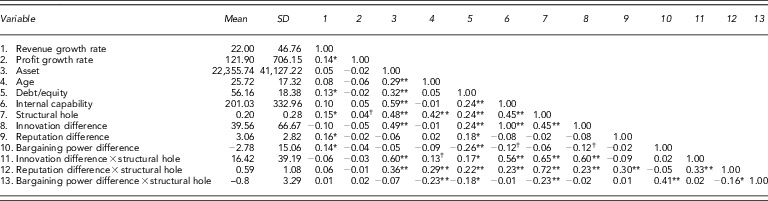
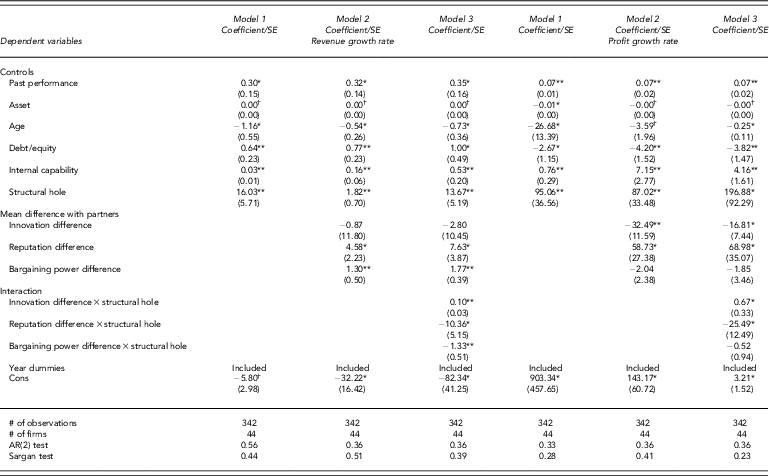
Table 1 presents the correlation matrix and descriptive statistics for the data set, while Table 2 shows the standardized coefficients for the explanatory variables. No model encountered problems with over-identifying restrictions or second-order serial correlation. Therefore, all the models are suitable for the two-step generalized method of moments.
Means, standard deviations, and correlations

Note. Year dummies are included but not shown.
†p < .1, *p < .05, **p < .01.
Two–step GMM estimates for performances
Note. p-values are reported for AR(2) and Sargan tests.
The instrumental variables in GMM used the first-third lags for the past performances.
AR(2)=autoregressive (2)
†p < .1, *p < .05, **p < .01.
Tests of hypotheses
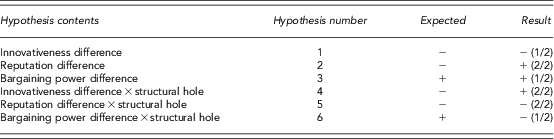
Hypothesis 1, which involves the negative effect of the relative partner's innovation capability, is supported by the growth rate of profits. Hypothesis 2, which involves the negative effect of the relative partner's reputation, is only partially supported because of the contradictory results for the revenue and profit growth rates. Hypothesis 3, which involves the positive effect of the relative partner's bargaining power, is supported by the revenue growth rate. The revenue and profit growth rates give contradictory results for Hypothesis 4, which involves the negative effect of the interaction between relatively innovative partners and spanning structural holes. Hypothesis 5, which involves the negative effect of the interaction between relative reputation and spanning structural holes, is supported by the revenue and profit growth rates. Lastly, Hypothesis 6, which involves the positive effect of the interaction between relative bargaining power and spanning structural holes, is supported by the revenue growth rate. The results are summarized in Table 3.
Summary of results of hypotheses tests
Note. Parenthesis indicates the number of estimated coefficients significant in the result direction.
DISCUSSION
Thus far, we have examined the effect of the characteristic differences between a focal firm and its partners, and the presence of structural holes on corporate performance within vertical downstream alliance portfolios in the Korean defense industry.
We obtained negative results for the hypotheses on innovativeness difference and positive results for the reputation difference and the bargaining power difference. In other words, the results of the data analysis show relatively lower innovativeness, relatively better reputation, and relatively greater bargaining power are better for performance. Figure 3 shows the impact of these differences on corporate performance.
Differences in characteristics between a focal firm and a partner that affect firm performance positively
We obtained the same results for the hypotheses on innovativeness difference and bargaining power difference between a focal firm and its partner. However, we found the reputational superiority of a focal firm is better for corporate performance. As we mentioned before, we used the credit grade from the Korea Investors Service Value database. The Korea Investors Service Value credit grade is calculated from a firm's stability, liquidity, profitability, growth, and activity indicators, which affect corporate credit, through the statistical analysis of firms that went bankrupt in the past. This credit grade has a close relationship with corporate financing. Thus, firms with low credit grades have a strong possibility of receiving financing assistance. The internal problems of a focal firm could obstruct the inflow of external resources. When a focal firm has a lower reputation than its partner does, the firm also could have difficulties accessing external resources because of these obstructions. Therefore, the reputation of a focal firm is more important than that of its partner firm when building trust.
The results concerning the interaction between the differences and spanning structural holes suggest that when a focal firm is less innovative, it should span a structural hole, and that when a firm has a relatively better reputation, it should not span a structural hole. These two results are the converse of one another (Figure 4). As a focal firm spans more structural holes, its partners could act opportunistically despite the benefits from accessing non-redundant information (Burt, Reference Burt1992; Ahuja, Reference Ahuja2000). Partner opportunism in the case of relatively stronger innovativeness could lead to the leakage of a focal firm's capability because the partner may have a larger capacity to internalize the focal firm's capability. The results show that it is preferable to have a closed, dense network to avoid partner opportunism. With regard to the reputation difference, a focal firm should avoid partners with lower reputations, since partner opportunism may arise when a partner of inferior reputation attempts to find the exit or solutions from the focal firm. In this case, the firm should not span a structural hole but rather create a closed, dense network.
The relative capabilities of a focal firm and a partner and the structure of the alliance portfolio that affect firm performance positively
Contrary to this study's results, those of previous research on the role of partners in alliance portfolios have emphasized that good partners affect corporate performance positively but have overlooked the impact of value appropriation within alliance portfolios in terms of accessible resources and value (Lavie, Reference Lavie2007). This study suggests that focusing only on having good partners can threaten a focal firm's performance. Firms should also evaluate whether a potential firm is an appropriate alliance partner and whether it presents any risks of partner opportunism (in terms of innovativeness, reputation, and bargaining power). In addition, firms should assess whether the characteristics of a potential partner and the resulting alliance portfolio structure are suitable and adequate for avoiding any opportunism risks. Although previous studies have extolled the benefits of spanning structural holes and creating densely embedded networks, this study shows that the impact of either concepts on corporate performance can vary radically depending on several factors including the relationship between a focal firm and its alliance partners.
CONCLUDING REMARKS
Work on the role of alliance partners is rare because alliance portfolio analysis is a relatively new area in the widely researched field of strategic alliances (Stuart, Reference Stuart2000; Lavie, Reference Lavie2007; Wassmer, Reference Wassmer2010). While this study is among the first to explore this relatively new area, additional empirical studies are necessary to produce useful results for researchers and managers in a variety of situations and organizations.
A firm's capability can be divided into internal and external capabilities (Zaheer & Bell, Reference Zaheer and Bell2005). Resource-based view scholars concentrated on internal capability, while network scholars focused on external capability. This study compared the capabilities of a focal firm and its partners, and explored the impact of relative capability (in terms of innovativeness, reputation, and bargaining power) and spanning structural holes on firm performance within a vertical downstream alliance portfolio in the Korean defense industry. The results show capability differences between a focal firm and its partner in terms of innovativeness, reputation, and bargaining power have negative, positive, and positive effects, respectively, on performance. In other words, relatively lower innovativeness, better reputation, and greater bargaining power of a focal firm are better for performance.
The results of this study suggest that allying with dominant partners is not always the appropriate strategy for all firms. Rather, they show that determining an appropriate partner for a focal firm depends on their capabilities. The results on the interaction between the differences on the three capabilities and spanning structural holes show the higher a focal firm's innovativeness is, the more the firm should span structural holes. On the other hand, the better a focal firm's reputation and bargaining power are, the less the focal firm should span structural holes. The results show that the alliance portfolio structure also differs depending on the capability differences between a focal firm and its partner. We hope these results will give scholars and managers new and useful insights about the role of partners within alliance portfolios in the context of corporate performance.
Limitations and directions for future research
Our study has some limitations that can serve as directions for future research. First, while our study included several factors in examining the effect of alliance portfolios on corporate performance, there are other factors that could be still be added to the analysis, such as the strength of the ties between a focal firm and its partner. Tie strength has been neglected in previous research, which assumed that all ties in an alliance portfolio are of equal strength (Lavie, Reference Lavie2007). However, the influence of a partner firm can vary depending on the tie strength. Thus, tie strength is important in the research on capability differences between focal firms and partners, but the problem is how it should be applied. Second, although we explicitly hypothesized various effects on performance of the differences in three capabilities, we focused on the Korean defense industry, and thus, the results may not be generalizable to all industries. Future research should consider other industries to obtain richer results and interpretations and should determine the ideal alliance portfolio configurations for different industries. Third, the development of other research measures that consider the roles of both alliance partners and structural alliance portfolio characteristics could also shed new light on the effects of alliance portfolios on corporate performance. Finally, co-patent data including the date of patent application are used in this study as proxy for alliance with partner firms (Baum, Calabrese, & Silverman, Reference Baum, Calabrese and Silverman2000; Lecocq & Van Looy, Reference Lecocq and Van Looy2009). Although such data have been used in previous studies, they may lead to erroneous results. Future research should thus use better data for more reliable results.