Introduction
While South Korea (hereafter Korea) has continuously impressed neighbouring countries with its economic success, a newly developed feature is the expansion of welfare state programmes. After the introduction of industrial accident compensation, health insurance, public pension schemes and employment insurance, the long-term care insurance (LTCI) bill was passed in April 2007 and implemented from July 2008, as the fifth comprehensive social insurance in Korea. Important domestic transformations have facilitated these developments, including economic crisis and recession, family breakdown, and political democratisation. In addition, a low fertility rate and a rapidly ageing population have been important drivers. The total fertility rate in Korea fell to 1.08 in 2005, which was the lowest rate among Organisation for Economic Co-operation and Development (OECD) countries, and life expectancy increased to 80 in 2007. It has been estimated that the proportion of the population aged 65 and above would reach 14 per cent of the population by 2018, 20 per cent by 2026, and one-third by 2050 (National Statistical Office 2011). This trend has alarmed the growth-oriented Korean society, and the government has responded by introducing and expanding various social policies, of which LTCI is one of the key programmes.
LTCI is a significant development for the Korean welfare state, but there have been very few scholarly studies regarding the reasons behind the introduction of the insurance-type long-term care (LTC) programme and its implications (Chung Reference Chung2009; Kwon Reference Kwon2008). This article aims to analyse the nature of LTCI in Korea and examine whether its introduction could mean a divergence from the two important policy legacies, i.e. developmentalism and Confucianism. In the first section, we will review existing studies of the Korean welfare state and discuss its characteristics. Then, the contents and the structure of LTCI will be explained. Finally, the implications of the introduction of LTCI will be discussed. It appears that the regulatory role of the government and concerns about the costs of LTCI are regarded as a developmentalist legacy, whereas Confucian legacies seem to be withering away since the LTCI shifts care responsibility from the family to the state. However, taking a closer look, this research also found that developmentalism has been significantly challenged, whereas the Confucian tradition is still alive in LTCI.
Confucianism and developmentalism in the Korean welfare state
Studies on the nature of the Korean welfare state have been conducted since the early 1990s. According to them, Korean society can be summarised as a Confucian society with a strong developmentalistic orientation. Some scholars, including Jones (Reference Jones and Jones1993), Sung (Reference Sung2003), and Rieger and Leifried (Reference Rieger, Leifried, Rieger and Leifried2004), point out the role of Confucianism as the key factor differentiating the Korean welfare state and East Asian welfare states from Western welfare states. While ‘helping others’ is justified in Confucianism with Ren (  ), ‘Humanness’ or ‘Benevolence’, which is the most important moral principle in Confucianism, it also emphasises reciprocal relationships and responsibility within the family, which is regarded as the main pillar of social order (Yao Reference Yao2000). This basic idea of Confucianism has influenced the political economy of East Asian welfare states, which can be defined as ‘conservative corporatism without (Western-style) worker participation; subsidiarity without equality; laissez faire without libertarianism …; welfare states – run in the style of a would-be traditional, Confucian, extended family’ (Jones Reference Jones and Jones1993: 214). In Confucian welfare states, the family and kinship play a primary role in providing welfare for the socially weaker, including children, older and disabled people, whereas the state is regarded as the last resort to support them. Furthermore, companies take care of their employees just as the family takes care of its members. This paternal nature of both families and companies in Korea helps in understanding the characteristics of belated welfare development and low social spending.
Confucianism can be effective for explaining the role of informal support in the LTC of older people. Respecting elders has been one of the most important teachings in Confucianism, i.e. ‘filial piety’, and the male breadwinner model and the patriarchal system of gender relations have been the underlying structure sustaining informal support. Sung (Reference Sung2003: 346) states that ‘woman's subordination to man was supposed to be a moral law and women are described as inferior to men in the Confucian patriarchal family system’. In this system, daughters-in-law of elder sons are supposed to take care of parents-in-law, which creates ‘son preference’. She also argues that the important difference of the Confucian welfare state from Western models is that key gender relationships are not only about husband and wife, as found in Western literature, but also about daughters-in-law and parents-in-law. Although Confucianism in contemporary Korean society is not as strong as it used to be, it is true that many of the traditional features – Jones (Reference Jones and Jones1993) once observed that ‘social welfare is unAsian’ (Chau and Yu Reference Chau, Yu, Walker and Wong2005) – still remain.
The Confucian argument, however, is not without problems. As White and Goodman (Reference White, Goodman, Goodman, White and Kwon1998: 7–8) point out, the absence of any clear conceptualisation of ‘Confucian values’ can result in the arbitrary use of this concept. Also, Esping-Andersen (Reference Esping-Andersen1997) questioned whether filial piety is a reflection of the Confucian culture of respect that is independent of economic need, or a forced dependency due to a lack of alternatives. In this sense, Walker and Wong (Reference Walker, Wong, Walker and Wong2005) maintain that it has been used as political rhetoric, particularly when governing authorities in East Asia do not want to expand the welfare system. It is undeniable that the lack of clear conceptualisation is problematic and that there are varieties of Confucianism in East Asia (e.g. the Japanese case, Kono Reference Kono, Walker and Wong2005). However, it is equally true that Confucianism and the emphasis on the role of family, either as an ethic or as an ideology, have been highly influential in East Asia and Korea (Chau and Yu Reference Chau, Yu, Walker and Wong2005; Sung Reference Sung2003). In order to test whether Confucianism still remains strong in LTCI, this research will examine the following two aspects: whether the family still plays an important role as a welfare provider and whether the family is responsible for care as a financier. These two questions will be asked in comparison to the role of the state.
Developmentalism has another distinctive feature frequently mentioned in the literature on the Korean welfare state. Welfare developmentalism is primarily based on the argument of the ‘developmental state’ (Deyo Reference Deyo, Applebaum and Henderson1992; Johnson Reference Johnson1982; Lee Reference Lee1999), emphasising state-driven economic development in Japan and other East Asian countries. Scholars in this school insist that the formation of these welfare states has been heavily affected by the imperatives of nation-building and political legitimation (Gough Reference Gough, Gough, Wood, Barrientos, Bevan, Davis and Room2004), in which authoritative governments and bureaucrats are key players. The main characteristics of the developmental states (Tang Reference Tang2000) are that welfare state programmes are predominantly formulated for promoting economic growth (Kwon Reference Kwon and Kwon2005). Aspalter (Reference Aspalter2006: 300) also argues that there is a strong emphasis on productive welfare programmes that are economy friendly and employment-based social security programmes and concludes that ‘social policy in East Asia is marked by its inherent support for the economic system’. As a result, benefits of welfare programmes tended to be strongly associated with labour market status, and highly limited and selected benefits and social services were given to those who were outside the labour market.
Similarly, Holliday (Reference Holliday2000) and Gough (Reference Gough, Gough, Wood, Barrientos, Bevan, Davis and Room2004) point out the subordination of social policy to economic/industrial objectives as a key feature of productivist welfare regimes. Holliday classifies Korea as a type of developmental-universalistic model together with Japan and Taiwan, in which universal programmes are partly allowed, mainly for the reinforcement of productive elements. As an example, he refers to the Korean Pension Act of 1973 designed to mobilise funds for upgrading the labour-intensive industry to the heavy-chemical industry. According to Gough (Reference Gough, Gough, Wood, Barrientos, Bevan, Davis and Room2004), relatively high spending on health and education compared to income maintenance programmes can be one feature representing productivist welfare regimes. As in the ‘developmentalism’ argument, the productivist feature contributes to being a ‘small’ welfare state and hostility towards redistributive welfare states, which make the Korean welfare state different from Western countries.
Regarding welfare developments in the last two decades, these scholars maintain their argument. For instance, Kwon (Reference Kwon and Kwon2005) observes the persistence of the developmental features in the Korean welfare state, though they have become ‘more inclusionary’ than they were during the previous decade. Also, Holliday (Reference Holliday2005) and Kwon and Holliday (Reference Kwon and Holliday2007) predict that East Asian countries are highly unlikely to move beyond productivist welfare regimes in the foreseeable future. From this position, in spite of the universalisation of social security programmes, the state is still reluctant to be involved in the financing of welfare programmes. Holliday (Reference Holliday2005) argues that the recent pension retrenchment reform, the limited benefit coverage of medical insurance, and increasing labour market flexibility reflect the survival of productivism in the Korean welfare state. Also, in the newly introduced public assistance programme, the so-called ‘support obligator’ conditionFootnote 1 is further evidence of developmentalism with Confucianism.
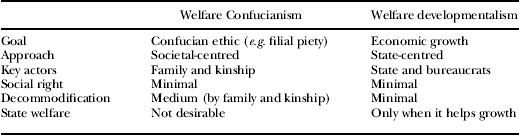
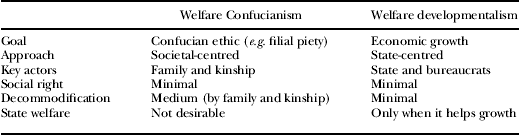
This argument greatly contributes to the understanding of the Korean welfare state, but it is not free from criticism. One of the most important comments is about how to distinguish developmental elements from elements in liberal welfare-state regimes. For instance, cost-containment measures and the emphasis on welfare-to-work and labour market flexibility are regarded as evidence of productivism, but they are also found in Western welfare states (Kim Reference Kim2008). In order to distinguish developmentalism from liberalism, two aspects need to be carefully examined. The first aspect is whether LTCI is motivated by economic concerns and the second is whether the role of the state in LTCI is a financier or a regulator. In order to prove the first question, it is important to take a closer look at who has been the key driver behind the introduction of LTCI. Since developmentalism is a historical and political concept, it is essential to examine how strong a ‘state-led’ and ‘state-designed’ element without social and political actors has been. Table 1 summarises similarities and differences between Confucianism and developmentalism.
Welfare Confucianism and welfare developmentalism
This paper will primarily examine the impact of LTCI on developmentalism and Confucianism and, conversely, the impact of these two welfare state features on the structure of LTCI. It is expected that unravelling regime characteristics and institutional legacies could contribute to enhancing the understanding of current LTCI issues, and also that the development of LTCI could provide a clue to understanding the nature of the changing Korean welfare state. In the next section, we review key institutional features of the LTCI in Korea.
The LTCI in Korea
Coverage and benefits
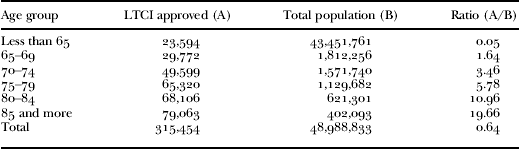
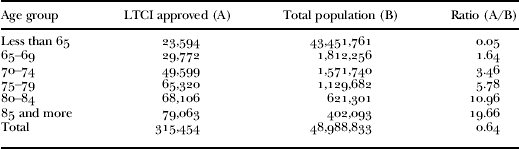
Traditionally in Korea, personal social services funded by the government have primarily and strictly targeted public assistant beneficiaries or the disabled who do not have any care-givers among family members. From the coverage point of view, the LTCI enactment meant that the state began to take its commitment seriously to provide universal care services for fragile older people. In order to be eligible for the LTCI benefit, the insured person requests a care-needs assessment from the National Health Insurance Corporation (NHIC). Then, after the assessment, care needs are classified into one of six grades – from one, very urgent, to six, near to normal. Those whose care needs are from one to three are entitled to the LTCI benefit. As of October 2010, about 6 per cent of older people, more than 300,000, were entitled to receive LTCI benefits (see Table 2). The number of beneficiaries has significantly increased from less than 150,000 in late 2008. It is interesting to note that the number of urgent beneficiaries has been slightly reduced whereas that of the second and the third grade beneficiaries has considerably increased. In 2009, the number of LTC recipients was about 200,000, and the actual take-up rate among the entitled was 78 per cent, on average.
Long-term care service recipients by age group, January 2011
Note: LTCI: long-term care insurance.
Source: Sunwoo (Reference Kwon and Kwon2011).
In terms of LTC benefits, there are three major types: institutional care, home care and cash benefits. Institutional care services provide a set of long-term nursing care and rehabilitation services. Home-care services include visiting nursing care, visiting bath and shower services, day and night care, short-term care and others. It is possible to choose between institutional and home-care services if one is eligible for LTCI benefits. The proportion of recipients receiving home-care services has increased from around 60 per cent (August 2008 to June 2009) to 71 per cent (July 2009 to June 2010), whereas the proportion of recipients receiving institutional care has dropped from around 41 per cent to 30 per cent (NHIC 2010). While the change is closely related to the reduction in the number of older people with full care needs, it also reflects the government's intention to promote home care rather than institutional care.
Korea allows cash benefits, but they are very restricted to exceptional occasions, such as when formal services are not available in the community. The proportion of cash benefit recipients was only 0.4 per cent in 2009, and the monthly payment to an informal family care-giver was limited to 150,000 won (about US $150), compared to 766,000 won (about US $766) to a qualified non-family care-giver. There are two sides to the cash benefit coin. Cash provides greater freedom and choice to recipients, but ultimately it tends to perpetuate the role of families (women) in LTC by compensating care-givers for their informal care (Lee Reference Lee2008). The Korean government recognised that allowing the cash benefit would not be appropriate in terms of relieving the LTC burden on the family. Therefore, the Korean system has moved primary care responsibility from the family to the society, if not the state, by restricting cash benefits to families.
However, the recent trend has indicated that the number of family care-givers has considerably increased. While the cash benefit to informal family care-givers is still highly limited, there are an increasing number of family members who have been qualified as a formal care-giver after short training courses that the government designed. After obtaining the care-giver qualification, they take care of their own family member who needs care. The proportion of recipients taken care of by their co-resident family member with a care-giver qualification markedly increased from 1.8 per cent in August 2008 to 23.5 per cent in March 2010 (NHIC 2010). If recipients cared for by a non-resident qualified family care-giver are included, the proportion is expected to be around 40 per cent (NHIC 2010). The reasons behind this have not been fully investigated yet, but the following two reasons are reported. While it is still true that older people with care needs still prefer to be taken care of by their family members, some fraud cases, more than 50 per cent of the total fraud-related payment, were also spotted by the Ministry of Health and Welfare where some family care-givers received the payment without providing care (Hankookilbo 2011). As a result, the government attempted to reduce the level of the payment for family care-givers, but much concern has been raised since it could negatively affect many family care-givers who actually provide care for their family members (Hangyerae 2011).
Delivery and finance
Although it is a common phenomenon that marketisation has been intensified in the area of home care, it is conspicuous that Korea's delivery system has been constructed through a purposive market-oriented strategy by the government. Initially, Korea used to depend heavily on non-profit organisations (NPOs) in delivering social services, especially when care services were targeted to low-income people. But, since the LTC services became universal, LTC services are provided regardless of the income level if recipients' care needs are approved. Upon the introduction of the LTCI, the government was aware that the LTC demands could not be met only by NPOs and government support. Therefore, Korea had to expand the capability of LTC provisions within a short time.
In 2003, when the introduction of LTCI was almost formalised, only 230 nursing homes provided 16,455 beds, which could cover only 0.4 per cent of older people. Along with a large-scale investment plan to expand LTC infrastructure, the government has also encouraged market providers to enter the LTC market through a set of incentive schemes like tax relief, reasonable LTC service pricing and deregulation. As a result, the increase in institutional care providers has been remarkable. Between 2006 and 2008, for example, 742 nursing homes were newly established and, among them, 381 homes (51 per cent) were for-profit agencies (Kim et al. Reference Kim, Lee, Park and Kim2009). Also, it is well known that for-profit providers dominate home-care services, even though there are no separate statistics for them. Therefore, we can conclude that the government's market-oriented policy has made the implementation of the LTCI possible, as scheduled. Such a rapid marketisation, however, has caused a lot of problems among market providers; severe competition, lower service quality, low payment for the care workers, and so on (Ji 2009; Kim et al. Reference Kim, Lee, Park and Kim2009; Lee and Lee Reference Lee and Lee2009).
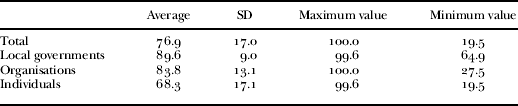
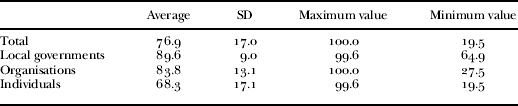
One of the significant problems is derived from the large number of small-scale for-profit home-care service providers, which are mostly run by individuals (hereafter individual providers). In 2010, 60 per cent of institutional care providers were managed by individuals, whereas 30 per cent of institutional care providers were managed by for-profit or non-profit organisations and 3 per cent by local governments. In the case of home-care services, nearly 90 per cent of providers are individuals (NHIC 2010). On the one hand, NHIC (2010) points out that severe competition among small-scale profit-seeking providers occasionally resulted in unlawful claims under the tacit agreement of recipients. On the other hand, the quality of care services by small-scale individual providers was reported to be lower than services by organisations or local governments. According to an evaluation of service quality of institutional care conducted by the NHIC (Table 3), the quality score by individual providers is the lowest, 68.9, compared to services by formal organisations (83.8) and local governments (89.6). One of the features of LTCI is that there is no significant role for the local government, not only in service provision but also in LTCI administration. LTCI is administered by a single public insurer, the NHIC.
Service quality evaluation scores by different types of institutional care provider
Note: SD: standard deviation.
Source: National Health Insurance Corporation (2010).
Total spending on LTCI was 0.07 per cent of Gross Domestic Product in 2008, but this rapidly increased to 0.26 per cent in 2010, largely because of the significant increase in the number of recipients. The spending is expected to continuously rise in line with the rapidly ageing population and the maturation of LTCI. In terms of LTC financing, social insurance contributions make up 80 per cent of public funding, and the other 20 per cent is subsidised by taxes. Regarding financing, a prominent issue has been the level of individual payment. Korea's LTCI defines the level of individual payment as 20 per cent of benefit costs for institutional care and 15 per cent for home care. Those who receive public assistance benefits are exempted from the individual payment. Although increasing, the take-up rate of care services is still less than 80 per cent, and it is argued that one of the key reasons is the individual payment. Also, the NHIC reports that the take-up rate is particularly low when one needs to make higher individual payments. Yet, not surprisingly, those who need to make higher individual payments are likely to be those who have more acute care needs (NHIC 2010). In fact, the insured in institutional care facilities need to pay around 300,000 won (US $300) by themselves, which could be a burden for older people. It is even problematic when one considers that the old-age poverty rate in Korea was more than 45 per cent in the 2000s, compared to the OECD average rate, 13.5 per cent, and old-age pensions are still immature and public assistance benefits are highly limited (OECD 2011). The evaluation and implication of the Korean LTCI is discussed in the following section.
Discussion: away from the two legacies or not?
Compared to the relatively late legislation of various social security schemes, the implementation of LTCI in Korea seems exceptionally early because the ageing level of the population remained very low until recently. While Campbell, Ikegami and Kwon argue that policy learning and cross-national diffusion have contributed to the LTCI introduction, ‘energy’ and ‘ideas’,Footnote 2 two pre-conditions for a policy change (2009: 65), are not as clearly visible in Korea as in western countries. The proportion of older people in the total population remained just above 7 per cent in 2001 when the Korean government began to examine the feasibility of LTCI, and there was very little fiscal pressure for the government. In addition, few voices were raised urging the introduction of the LTC programme by major social actors such as civil society organisations, trade unions, political parties and other interest groups, unlike other policy areas such as pensions and public assistance. Then, how could one explain this rather surprising policy development?
As Kim (Reference Kim2008) argues, a series of welfare developments, including the LTCI, cannot be easily interpreted as the product of old Confucianism and developmentalism. Basically, the introduction of LTCI contributed to shifting care responsibility from the family to the state, and there is very weak evidence that it was achieving economic objectives. Rather, this can be argued to be an important achievement by pro-welfare forces led by the two successive progressive presidents since 1998 (Campbell, Ikegami and Kwon Reference Campbell, Ikegami and Kwon2009). There are two arguments to indicate that Korea might be moving away from these two legacies. First, given that the ageing level of the population is still low compared to other OECD countries, early introduction could mean that the state's role in welfare provision has become much more acceptable than before. Secondly, as in Japan, care for older people, once women's responsibility, has come into the public domain. By restricting cash benefits, the government constrains the possibility of family involvement in care. Does this mean farewell to these two important legacies?
In order to answer this question, another thorough look is essential. Regarding the legacy of Confucianism, this has diminished to a large extent. Implementing the LTC programme through social insurance has been required to break up two crucial institutional legacies in the Korean welfare state: the selective nature of social service provisions and forced dependency on the family. Traditionally, the scope of personal social services was highly limited, but, from the coverage point of view, the LTCI enactment means that the state began to take its commitment seriously to provide universal care services for fragile elders. In other words, the state seems to have transformed itself from a mere bystander and last resort for care to an active facilitator and responsible entity. Together with highly limiting the scope of cash benefits, the role of the family and informal support has been clearly diminished. This change could imply the considerable progress of ‘de-familialisation’. However, as explained in the previous section, the number of qualified care-givers who take care of their own family members has considerably increased. It seems that older people want to be cared for by their own family members, and family care-givers choose to be a qualified care-giver because of the restriction on the cash benefit. In particular, it was also facilitated by the low threshold for being a qualified care-giver, i.e. 240 hours education without much government supervision.Footnote 3 While this partly reflects the rooted Confucian culture, the government is determined to discourage this practice by reducing the benefit level to qualified care-givers who take care of their own family members.
On the contrary, the story of developmentalism is rather complicated. In a sense, such an anticipative policy instrument itself may remind us of state-dominated policy processes in the past. In reality, Lee and Lee (Reference Lee and Lee2009) illustrate that it was the government that began to raise the LTC issue as a policy agenda item, that dominated the legislation processes, and that has implemented the programme as scheduled whereas media and even interests groups were not interested much in the issue of LTCI. Former President Kim Dae-Jung, who fully supported welfare expansion during his term of office, was the first to refer to the introduction of a comprehensive LTC programme. Also, the introduction of LTCI was one of the most important tasks for the second progressive government of Roh Moo-Hyun (2003–2008) in the arena of social policy. Even the conservative government of Lee Myung-Bak (Reference Lee2008–2013) did not postpone the timing of the LTCI implementation. The Ministry of Health and Welfare and its think tank had dominated the preparation process, insulated from political power. ‘Anticipation of the problem, policy learning, and policy implementation’ by bureaucrats seems to be frequent practices of the developmental state (Campbell, Ikegami and Kwon Reference Campbell, Ikegami and Kwon2009).
Besides the policy-making process, the adoption of insurance as the LTC programme is worth reviewing with regards to the role of the state. The Korean government has implemented LTCI without establishing a public infrastructure for care services. One of the key motives was the prediction of rising costs for elder care as well as increasing care demands. Given the rapidly ageing Korean population, it might be inevitable that the government introduced the insurance model in order to cope with predicted care demands and costs. However, Kwon (Reference Kwon2008: 127) observes that ‘the government, or more specifically, the Ministry of Finance and Economy, is reluctant to raise taxes or extend tax-based programmes because of the potentially heavy burden on government budget’. The adoption of ‘50:50’ financing by employers and employees does not add significant costs for the government. Moreover, in order to implement LTCI without public infrastructure and financial commitment, the government had to mobilise non-profit and for-profit sectors for service provision. This feature is different from the neighbouring country of Japan, in which the government is highly reluctant to introduce for-profit organisations to provide institutional care because of the possible increase in the demand and the costs of LTCI (Chung Reference Chung2009). However, the Korean government allowed the entrance of for-profit organisations while keeping the price low. In this respect, the feature of the directive state in care provision is the closest to developmentalism.Footnote 4
The regulating role without financial commitment, which can be translated as the legacy of developmentalism, has caused and could cause problems in the LTCI programme (Chung Reference Chung2009; Lee Reference Lee2008). This has led to the restricted eligibility rule excluding those who do not have major physical disabilities but need special care, such as those who suffer from dementia. Also, individual payments can be a burden for many low-income elderly people, except for public assistance beneficiaries. Although they can consist of around 15–20 per cent of the total cost of institutional care, there are also some items not covered by LTCI, such as meals. In the case of home care, there has been a series of reports that elderly people have given up home-care services because of high individual payments. The marketisation of service also caused important negative and unpredicted consequences. Problems frequently pointed out are low-quality services, poor working conditions for care workers and unequal accessibility to services (Ministry of Health, Welfare and Family 2009). Furthermore, fierce competition by for-profit providers significantly contributes to the rise of the number of care recipients, which has led to the sharp increase in LTCI spending. It turns out that the government is not a very effective regulator.
In sum, it is interesting to note that the government has struggled to achieve its intentions. On the one hand, the intention of the diminishing role of the family, away from Confucianism, has faced the unexpected increase of qualified family care-givers. While the government regards care by family members as less trustful, the long-standing ‘care’ tradition does not seem to have changed within a short period of time. On the other hand, the intention of limited financial commitment and state-led development, a legacy from developmentalism, has also been confronted with opposite outcomes. As explained before, marketisation has awoken hidden care demands and costs, and, according to the Korean Development Institute (2010), the number of the recipients could increase from around 300,000 in 2010 to nearly one million in 2020. It seems that too much reliance on the market in care provision significantly reduces the chance of effective regulation of service quality and also LTCI costs (Greve Reference Greve2009). Also, although bureaucrats designed and initiated the LTCI, once it was introduced, various political actors, including political parties, interest groups and care providers, began to actively drive the development of LTCI.
Conclusion and implications
It is the rapidly ageing Korean population that has challenged the Korean welfare state in which Confucianism and developmentalism have been embedded. Together with other socio-economic changes, including the role of family in welfare provision, the government has had to prepare a set of policy packages to deal with these trends. Then, does the new LTCI mean ‘farewell to the two old legacies’ in Korea? This research has reached an ambiguous conclusion. There has been an apparent gap or possible conflict between the goal of the policy and the actual implementation. The role of the government in the policy-making process and concerns of future care costs can be viewed as a developmentalist legacy. Also, the strong consideration for financial prudence and the role of the state as a regulator in care provision reflects developmentalism. By contrast, Confucian legacies seem to be withering away as LTCI reduces the family's care burden and expands care services for older people. But, developmentalism has not worked well as when the state has difficulty in regulating the market and democratisation empowers non-state political actors. Also, deeply embedded familialism seems difficult to be completely overcome.
Then, what does the development of the LTCI mean to the current and future Korean welfare state? Arguably, the current situation shows the consolidation of the Korean welfare state and increases the sense of welfare as a right. This could imply that the Korean welfare state is neither the developmental nor Confucian welfare state it used to be. It seems that developmentalism and Confucianism have been shifted from the centre of the Korean welfare state to the peripheral area. Regarding Confucianism, while most older people want to be taken care of by their family members, the government is in a dilemma due to some fraud cases by family care-givers. Yet, since traditional family solidarity has been quickly weakened together with the shrinking size of family (Choi Reference Choi2006), it is questionable whether family care-giving will be a sustainable option for LTCI. It also implies that current Confucian legacies might not last long. Developmentalism seems to be quickly replaced by liberal principles. Until the eve of the LTCI introduction, state actors with very little intervention from social or other political actors designed the programme, but once implemented, LTCI has been driven by the market, which the government created. As the original projection by the government in terms of beneficiaries, costs and service qualities turned out to be wrong, the regulatory capacity by the state is now called into question. Furthermore, emerging party competition highly sensitive to rising welfare demands seems to override the power of government ministries. Developmentalism, therefore, is being threatened by market and democratic politics. Yet, instead of reaching a firm conclusion on our research question, many welfare reforms are being undertaken including LTCI and, thus, more time is needed to fully answer the research question.
The analysis in this paper could also give some implications for the future of the LTCI. First of all, as old-age pensions and public assistance programmes become mature, some of the LTCI issues could be less critical. For example, co-payments by individuals seem to be a considerable burden for the current cohorts of older people whereas it might not be the case in future. Second, new political configurations seem to boost the quality of LTCI. Responding to much criticism, the government has been strengthening the LTCI in many respects including loosening the entitlement, improving service quality, tightening the qualification for being a care-giver, and the modernising delivery system (Asia Economy 2012).Footnote 5 Third, however, the government needs to find a way to establish sustainable LTCI, which could cope with rapidly rising welfare demands and cost. Relying too much on the market might not be the final answer, as Greve (Reference Greve2009) argues, and it seems to preclude the optimal mix of state and market provision with an effective governing system.
Acknowledgement
This work was supported by the National Research Foundation of Korea Grant funded by the Korean Government (NRF-2010-332-B00290).