Staphylococcus aureus is an ubiquitous bacteria commonly isolated from bulk raw milk, and from the milk of dairy cattle suffering from mastitis (Jørgensen et al. Reference Jørgensen, Mørk, Hogasen and Rørvik2005). Its presence in raw milk is a major concern for the safety and quality of traditionally produced cheeses. Some Staph. aureus strains in the natural population can produce staphylococcal enterotoxins (SEs) (Balaban and Rasooly Reference Balaban and Rasooly2000), and these were recently reported to be responsible for food poisoning associated with reconstituted milk, in Japan (Ikeda et al. Reference Ikeda, Tamate, Yamaguchi and Makino2005), and cheese consumption, in European countries (Le Loir et al. Reference Le Loir, Baron and Gautier2003) and Brazil (do Carmo et al. Reference do Carmo, Dias, Linardi, de Sena, do Santos, de Faria, Pena, Jett and Heneine2002).
A number of typing techniques are available to help trace the source and transmission rates of Staph. aureus from foods and clinical specimens: restriction fragments length polymorphism analysis (RFLP), pulse-field gel electrophoresis (PFGE), multilocus sequence typing (MLST) and multiple-locus variable-number tandem-repeat (MLVA).
RFLP analysis of the coagulase (coa) is a useful method for typing Staph. aureus isolates for epidemiological study: amplified DNA fragments of different size can be further discriminated by digestion with AluI. This genotyping method is an easy and useful tool that provides epidemiological information about Staph. aureus (Hookey et al. Reference Hookey, Richardson and Cookson1998; Moon et al. Reference Moon, Lee, Kang, Lee, Joo, Park, Kim and Koo2007).
The MLVA approach is based on the detection of the number of tandem repeats (TRs) at a specific locus in the genome of a microorganism. These can vary as a consequence of DNA polymerase enzyme slippage during replication, and these differences can be detected using PCR primers designed to anneal to the flanking regions (Keim et al. Reference Keim, Price, Klevytska, Smith, Schupp, Okinaka, Jackson and Hugh-Jones2000). The complete TR is amplified and sized using a conventional agarose gel.
MLVA has proved very efficient, not only for Staph. aureus but also for numerous bacterial pathogens such as Bacillus anthracis and Yersinia pestis (Lindstedt, Reference Lindstedt2005; Merabishvili et al. Reference Merabishvili, Natidze, Rigvava, Brusetti, Raddadi, Borin, Chanishvili, Tediashvili, Sharp, Barbareschi, Visca and Daffonchio2006). It was recently applied to human Staph. aureus isolates and its discriminatory power was comparable to PFGE and MLST (Sabat et al. Reference Sabat, Krzyszton-Russjan, Strzalka, Filipek, Kosowska, Hryniewicz, Travis and Potempa2003; Francois et al. Reference Francois, Huyghe, Charbonnier, Bento, Herzig, Topolski, Fleury, Lew, Vaudaux, Harbarth, van Leeuwen, van Belkum, Blanc, Pittet and Schrenzel2005; Malachowa et al. Reference Malachowa, Sabat, Gniadkowski, Kryszton-Russjan, Empel, Miedzobrodzki, Kosowska-Shick, Appelbaum and Hryniewicz2005). However, in contrast to the human isolates, data available in the literature about the spreading and typing of Staph. aureus isolated from bovine and from dairy products is quite limited (Vimercati et al. Reference Vimercati, Cremonesi, Castiglioni, Pisoni, Boettcher, Stella, Vicenzoni and Moroni2006; Gilbert et al. Reference Gilbert, Fromageau, Gelineau and Poutrel2006).
In the present study, coagulase gene (coa) RFLP analysis, considered easy to perform and having high levels of specimen typeability and reproducibility (Chiou et al. Reference Chiou, Wei and Yang2000) and MLVA typing (a technique not yet used for typing Staph. aureus isolated from food) were used to investigate Staph. aureus diversity in isolates from Italian dairy products.
Further information on Staph. aureus strains was found by also detecting staphylococcal enterotoxin genes (se).
Materials and Methods
Bacterial strains
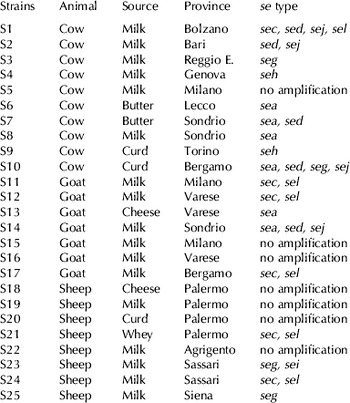
The 25 Staph. aureus investigated in the present study were obtained from different dairy products coming from different regions of Italy (Table 1). To highlight the possible differences among the isolates of different origin, only one strain for each sample was considered.
Characteristics of Staph. aureus isolates and distribution of se genes according to their origin

In order to detect coagulase-positive Staph. aureus the isolates were collected on Baird Parker RPF Agar (Biolife, Milan, Italy). The Staphylococcus genus was identified by Gram staining, catalase activity determination and the heat stable nuclease (TNase) test using Toluidine Blu Agar (Oxoid, Milan, Italy). To determine the staphylococcal species, species-specific PCR was used according to Cremonesi et al. (Reference Cremonesi, Luzzana, Brasca, Morandi, Lodi, Vimercati, Agnellini, Caramenti, Moroni and Castiglioni2005). Strains were maintained and propagated in Brain Heart Infusion (BHI, Oxoid, Milan, Italy) broth and incubated at 37°C overnight.
DNA extraction
DNA was extracted, as described by Cremonesi et al. (Reference Cremonesi, Castiglioni, Malferrari, Biunno, Vimercati, Moroni, Morandi and Luzzana2006), using 1 ml bacterial culture, incubated in BHI broth overnight at 37°C. Cell numbers were verified by total sample counts, following the ISO 6888 1/2:1999 procedure with Baird Parker RPF agar plate. An approximate average of 10 μg DNA was obtained from 108 CFU/ml.
Detection of coa gene by PCR and RFLP analysis
To detect the polymorphic region of the coa gene, a PCR assay was performed as described by Hookey et al. (Reference Hookey, Richardson and Cookson1998). The amplifications were carried out in a thermocycler (Mastercycler ep, Eppendorf, Hamburg, Germany).
For restriction endonuclease analysis, approximately 300 ng (12 μl) of PCR products were digested at 37°C for 2 h with 10 U of the restriction endonuclease AluI (New England BioLabs, Frankfurt, Germany), according to manufacturer instructions. All the digested PCR products were analysed on 3% agarose gel (GellyPhor, Euroclone, Milan, Italy) stained with Ethidium bromide (0·05 μg/μl; Sigma Aldrich, Milan, Italy). Staphylococcus aureus ATCC 25923 was used as reference strain in both PCR assays as positive control. The DNA bands were visualised on UV transilluminator (Uvitec, Cambridge, UK). To determine the exact number of tandem repeat units, 25 PCR products of the coa gene of Staph. aureus were sequenced by PRIMM services (PRIMM, Milan, Italy).
The computer software (http://tandem.bu.edu/trf/trf.basic.submit.html) developed by Benson (Reference Benson1999), which incorporates the algorithm of the Tandem Repeat Sequence Finder, was used to count the number of repeat units whose size was 81 bp.
MLVA typing
Six variable numbers of tandem repeat (VNTR) loci spa, clfA, clfB, sdr, sspA and coa were analysed in this study.
A multiplex PCR assay was performed as described by Sabat et al. (Reference Sabat, Krzyszton-Russjan, Strzalka, Filipek, Kosowska, Hryniewicz, Travis and Potempa2003), with the slight modification of Moroni et al. (Reference Moroni, Pisoni, Vimercati, Rinaldi, Castiglioni, Cremonesi and Boettcher2005) containing spa, clfA, clfB, sdr and sspA primers.
The coa gene was analysed according to Hookey et al. (Reference Hookey, Richardson and Cookson1998) separately.
In each run, a 100 bp DNA ladder (Sharpemass 100 DNA Ladder, Euroclone, Italy) was included for PCR products. All the PCR products were analysed on 3% agarose and visualized and photographed on an UV transilluminator. Strains were characterized by a MLVA profile regrouping the alleles obtained for the six primers.
Detection of se genes by multiplex PCR
Se genes, including sea, sec, sed, seg, seh, sei, sej and sel were detected by multiplex PCR assay as described by Cremonesi et al. (Reference Cremonesi, Luzzana, Brasca, Morandi, Lodi, Vimercati, Agnellini, Caramenti, Moroni and Castiglioni2005). As several studies have revealed that none of the investigated strains isolated from bovine and goat milk, and related dairy products, harbour any of the seb, see and sek genes, the primer pairs related to these three genes were not used when the amplification protocol for multiplex PCR assay was established. The present PCR assay included species-specific primers for 23S rRNA and TNase for DNA isolate control. The reference strains ATCC 700699 (harbouring sea, sec, seg, sei and sel genes), ATCC 23235 (sed, seg, sei and sej) and ATCC 19095 (sec, seh, seg and sei) were included as positive controls for the PCR assay.
Statistical analysis
The peak matrices corresponding to MLVA profiles was subjected to a cluster analysis. Binary 0/1 matrices were created based on the absence or presence of DNA bands. Pairwise distances were calculated with the SimQual option of the NTSYSpc 2.01 computer program (Applied Biostatistics Inc., USA) by employing the Jaccard coefficient for two-state data and strain clustering was performed by the UPGMA analysis. The significance of resulting UPGMA tree was checked comparing the original similarity matrix with the cophenetic similarity matrix by using Mantel test.
Results
The PCR amplification of the coa gene yielded a single amplification, the sizes ranging from 560±20 to 800±20 bp for the strains analysed.
All the Staph. aureus isolated from cow, goat and sheep dairy products were classified into four coa types on the basis of fragment size (A, B, C and D). The sizes of the fragments obtained by PCR were confirmed by sequence analysis, and the fragments showed different repeat numbers, ranging from 5 to 8.
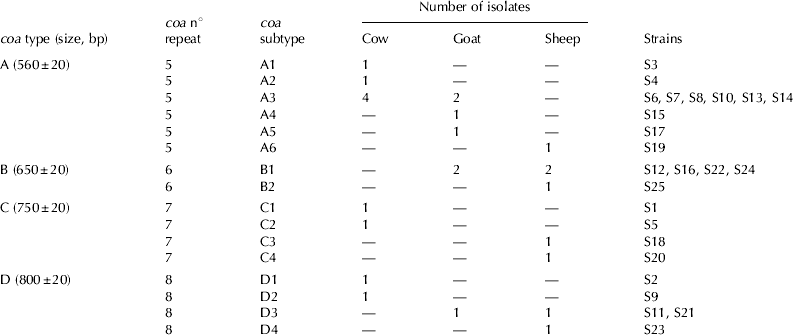
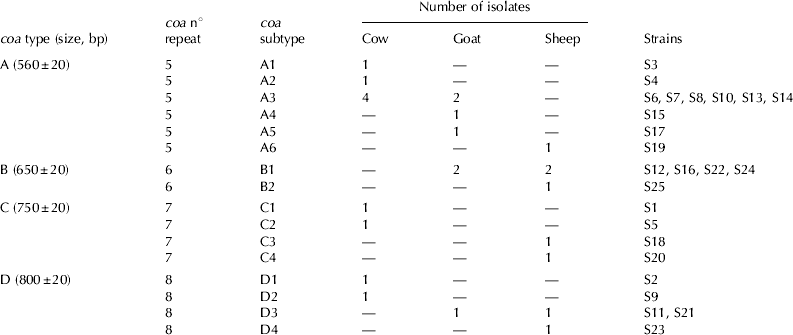
Table 2 shows the number of strains of the different animals corresponding to each polymorphism and the number of repeats. All the coa types are found in at least two ruminant species. For the cow isolates, most are in type A (6 strains), the others being equally distributed in types C and D. For the goat products, Staph. aureus is present in the A, B and D coa types. Instead the sheep isolates were distributed in all the types, from A to D.
The coa typing and coa subtypes by means of PCR and RFLP polymorphism, and number of Staph. aureus detected for each subtype
Furthermore, these coa types were subdivided into subtypes on the basis of RFLP patterns obtained by AluI digestion. The coa subtypes were arbitrarily identified by letters followed by a numerical code (e.g. A1 and A2).
From 1 to 4 fragments were produced by AluI digestion of the 25 PCR products of coa gene, the fragment size varying from approximately 128 to 600 bp. Isolates belonging to type A were subdivided into six restriction subtypes (denoted A1–A6), strains belonging to C and D types into four subtypes (named C1–C4 and D1–D4) and isolates belonging to B type into two subtypes (named B1 and B2) (Table 2).
The S3 strain belonging to type A did not show enzyme digestion and was defined as subtype A1.
A total of 16 different RFLP patterns (coa subtype) were identified, and 13 of these subtypes contained one single isolate. An analysis of the strain distribution showed that only one coa subtype (A3) contained isolates from both cow and goat, and only two coa subtype (B1 and D3) contained Staph. aureus from goat and sheep together. No coa subtype was observed to contain isolates from all ruminant species.
The polymorphic degree of the different tandem repeats was evaluated with a set of 25 Staph. aureus isolates.
The strains were subtyped on the basis of PCR amplicon fragment size. Amplification by PCR gave a single amplicon for each gene studied (spa, clfA, clfB, sdr, sspA and coa), except for one goat strain (S12) where the sdr gene showed 2 fragments (500 and 600 bp approximately).
PCR amplification produced 5 or 6 bands, approximately between 100 to 1200 bp. Indeed, 14 strains showed 5 bands, there being co-migration of the amplicons of the tested genes: 7 isolates showed the co-migration of clfA−clfB, 2 of clfB−sdr, 2 of sdr−coa and 2 of clfA−coa; on one single strain there was the co-migration of the bands of the clfB and sspA genes.
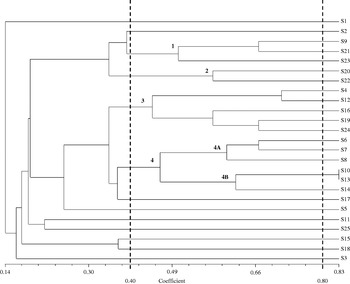
The considerable genomic variability in Staph. aureus strains is reflected by MLVA analysis. In fact MLVA produced 24 different DNA banding patterns among the 25 Staph. aureus isolates (Fig. 1).
UPGMA dendrogram derived from MLVA analysis showing the percentages of genetic similarity among 25 Staph. aureus isolates.

Using the arbitrarily chosen cut off of 80%, only one cluster comprising 2 strains (S10 and S13) was distinguished. Only by applying a 40% similarity cut-off was it possible to achieve a grouping of four clusters, designated by the numbers 1 to 4.
No link was found among the animal and enterotoxin groups. Cluster 3 contains 3 isolates belonging to the RFLP subtype B1, and 2 strains (S4 and S19) that belong to different RFLP subtypes (A2 and A6); moreover S22, differently from the other 3 strains of RFLP B1 subtype, belongs to MLVA cluster 2.
Of the 25 examined isolates of Staph. aureus, 18 (72%) were found to be positive for one or more toxin genes, and, on the basis of combined enterotoxin genes, a total of 10 se combination types were observed. Table 1 shows the distribution of toxin genes according to the origin of the strains. The more commonly detected se genotypes were sea, sec, sed and sel. Seven isolates possessed only one kind of se gene (sea, seg and seh) and 11 Staph. aureus harboured more than one toxin gene. Sej were usually identified in combination with sed in cow strains (except for strain S7), while sec and sel in combination were predominately found in goat and sheep Staph. aureus. Seh was detected only in cow strains (isolates named S4 and S9) and sei was present only in one isolate coming from sheep (strain S23).
Discussion
The results of the present study suggest a certain degree of heterogeneity among the Staph. aureus strains of different Italian dairy products.
RFLP is considered a simple and accurate method for typing Staph. aureus isolates: according to da Silva et al. (Reference da Silva, Boechat and da Silva2006) this technique is suitable for epidemiological investigations of Staph. aureus as it is very easy to execute and interpret. Indeed, the four identified PCR types and the 16 AluI RFLP patterns suggest the presence of different Staph. aureus genotypes.
The MLVA results confirmed the genetic diversity found using coa gene polymorphism. MLVA provided a higher degree of discriminatory power over the single RFLP technique: RFLP identified 16 individual subtypes while MLVA revealed 24 different profiles. Hence the MLVA typing method presented in this paper represents a robust and easy approach to characterize Staph. aureus isolates.
There was also considerable diversity in the se gene frequencies in the cow and small ruminant, as suggested by Smyth et al. (Reference Smyth, Hartigan, Meaney, Fitzgerald, Deobald, Bohach and Smyth2005). The findings that some se positive and some se negative strains generate identical or similar RFLP and MLVA patterns suggest that the genetic profile associated with toxin production is not in any way correlated with RFLP and MLVA characterization, therefore such findings could be a further element to study biodiversity.
Our finding show strains with RFLP profiles that are the same but that belong to different MLVA clusters, supporting the hypothesis that the combination of RFLP, MLVA and se genes increases discrimination, compared to using the individual methods alone.
To the best of our knowledge, the present study is the first in Italy to use the MLVA technique to study the polymorphism of Staph. aureus isolated from different dairy products. Even though only a restricted number of isolates was investigated, it was confirmed that Staph. aureus typing can benefit from the analysis of coa genes and MLVA.