The hypothesis that prenatal maternal stress and anxiety directly affect neurobehavioral development remains under scrutiny (Kofman, Reference Kofman2002). Maternal stress experience during pregnancy has been associated with an increase in perinatal risks such as preterm birth (Dole et al., Reference Dole, Savitz, Hertz-Picciotto, Siega-Riz, McMahon and Buekens2003; Wadhwa et al., Reference Wadhwa, Culhane, Rauh, Barve, Hogan and Sandman2001) and low birth weight (Paarlberg et al., Reference Paarlberg, Vingerhoets, Passchier, Dekker, Heinen and van Geijn1999; Rondo et al., Reference Rondo, Ferreira, Nogueira, Ribeiro, Lobert and Artes2003). These factors in turn may lead to adverse cognitive and developmental outcomes for the child (Talge, Neal, & Glover, Reference Talge, Neal and Glover2007; Van den Bergh, Mulder, Mennes, & Glover, Reference Van den Bergh, Mulder, Mennes and Glover2005; Wadhwa, Sandman, Porto, Dunkel-Schetter, & Garite, Reference Wadhwa, Sandman, Porto, Dunkel-Schetter and Garite1993). Stress in pregnancy has also been associated with increased risks for difficult infant temperament (Austin, Hadzi-Pavlovic, Leader, Saint, & Parker, Reference Austin, Hadzi-Pavlovic, Leader, Saint and Parker2005), poor infant motor development (Huizink, Robles de Medina, Mulder, Visser, & Buitelaar, Reference Huizink, Robles de Medina, Mulder, Visser and Buitelaar2003), attention-deficit/hyperactivity disorder (Rodriguez & Bohlin, Reference Rodriguez and Bohlin2005), and adolescent psychosis (Spauwen, Krabbendam, Lieb, Wittchen, & van Os, Reference Spauwen, Krabbendam, Lieb, Wittchen and van Os2004). In one study, maternal antenatal anxiety accounted for around 15% of the attributable load for overall behavioral problems in 4-year-old children (O'Connor, Heron, Golding, Beveridge, & Glover, Reference O'Connor, Heron, Golding, Beveridge and Glover2002).
Studies describing the associations between maternal stress during pregnancy and psychological outcomes in offspring have utilized many different measurement approaches. The measurement of stress has encompassed anything from the experience of major psychological trauma or bodily threat to the experience of more common stressors such as money or relationship problems (Glynn, Dunkel-Schetter, Wadhwa, & Sandman, Reference Glynn, Dunkel-Schetter, Wadhwa and Sandman2004). Stress has also been conceptualized as maternal anxiety (O'Connor et al., Reference O'Connor, Heron, Golding, Beveridge and Glover2002) and both state and trait anxiety (Kofman, Reference Kofman2002). The measurement of stressful life events has posed a challenge for researchers in medicine and the social sciences (Brugha & Cragg, Reference Brugha and Cragg1990; Dohrenwend & Dohrenwend, Reference Dohrenwend and Dohrenwend1978; Monroe & Reid, Reference Monroe and Reid2008; Wethington, Brown, & Kessler, Reference Wethington, Brown and Kessler1995). Stressful life events represent situations or environmental conditions requiring change or adjustment (Lobel, Reference Lobel1994). Measures range from large format life event inventories (Holmes & Rahe, Reference Holmes and Rahe1967) to short measures of stress (Cohen, Kamarck, & Mermelstein, Reference Cohen, Kamarck and Mermelstein1983), but all measures face the challenge of how to account for interpersonal differences in the appraisal and adjustment to stressful life experiences (Talge et al., Reference Talge, Neal and Glover2007).
What remains unknown is whether the (a) number, (b) type, and (c) timing of stress events have an individual or joint bearing on subsequent child behavioral development. Because of the variation in stress measurement, a dose–response relationship between the number of events experienced and behavioral outcomes has not been firmly established. Exposure to multiple stressors during pregnancy is likely to be common; not only does pregnancy incite a number of changes in the mother's life circumstances that can be stressful, but pregnancy and birth can be viewed as stressful life experiences in their own right (Geller, Reference Geller2004; Robertson, Grace, Wallington, & Stewart, Reference Robertson, Grace, Wallington and Stewart2004). Pregnancy is also a time of emotional and social upheaval and the affective and physical adjustments that are required include changes in employment, interpersonal relationships, and financial security (Saunders, Lobel, Veloso, & Meyer, Reference Saunders, Lobel, Veloso and Meyer2006; Seguin, Potvin, St-Denis, & Loiselle, Reference Seguin, Potvin, St-Denis and Loiselle1995). Therefore, an analysis of the effect of an accumulation of stress exposure is important. The type of stressful event experienced may differentially determine the impact on behavioral development, and some authors argue that failing to separate different types of stressful life events could hinder the generalization of results (Paarlberg, Vingerhoets, Passchier, Dekker, & Van Geijn, Reference Paarlberg, Vingerhoets, Passchier, Dekker and Van Geijn1995; Rudolph & Hammen, Reference Rudolph and Hammen1999). The stress-generation model of depression suggests that the nature of stressful life events differs according to whether they are independent (events whose occurrence is outside the individual's control), such as the death of a family member or friend, or dependent (events that an individual at least partly contributes to), such as relationship problems and moving house (Hammen, Reference Hammen1991; Rudolph & Hammen, Reference Rudolph and Hammen1999; Safford, Alloy, Abramson, & Crossfield, Reference Safford, Alloy, Abramson and Crossfield2007). In addition, there are conflicting results as to the importance of gestational age at the time of exposure to stress (Kofman, Reference Kofman2002), with some animal (Schneider, Roughton, Koehler, & Lubach, Reference Schneider, Roughton, Koehler and Lubach1999) and human (Glynn, Wadhwa, Dunkel-Schetter, Chicz-Demet, & Sandman, Reference Glynn, Wadhwa, Dunkel-Schetter, Chicz-Demet and Sandman2001; Laplante et al., Reference Laplante, Barr, Brunet, Galbaud du Fort, Meaney and Saucier2004; Malaspina et al., Reference Malaspina, Corcoran, Kleinhaus, Perrin, Fennig and Nahon2008; Paarlberg et al., Reference Paarlberg, Vingerhoets, Passchier, Dekker, Heinen and van Geijn1999) studies indicating greater risk earlier in pregnancy. Other studies have found that the effect of stress on behavioral outcomes is more pronounced later in gestation (Hedegaard, Henriksen, Sabroe, & Secher, Reference Hedegaard, Henriksen, Sabroe and Secher1993; O'Connor et al., Reference O'Connor, Heron, Golding, Beveridge and Glover2002). Because of critical periods of fetal development and differences in how women perceive and react to stress at different times in pregnancy, information on timing may be essential for understanding the nature and severity of outcomes due to stress exposure (Glynn et al., Reference Glynn, Dunkel-Schetter, Wadhwa and Sandman2004; Talge et al., Reference Talge, Neal and Glover2007).
Retrospective recall of stress experience is known to be unreliable (Entringer et al., Reference Entringer, Wust, Kumsta, Layes, Nelson and Hellhammer2008), and human studies on the long-term impact of prenatal stress are made difficult as many of the environmental stressors in the prenatal environment continue to exert an influence on child development in the postnatal environment (Van den Bergh et al., Reference Van den Bergh, Mulder, Mennes and Glover2005). There are only a few studies that have the capacity to examine the impact of prospectively collected stress exposure data in pregnancy on outcome measures collected through to early adolescence, and to adjust for later stress experience to isolate pregnancy-specific effects (O'Connor et al., Reference O'Connor, Heron, Golding, Beveridge and Glover2002). In this study, we used data from the Western Australian Pregnancy Cohort (Raine) Study. The aim of this study was to determine the impact of maternal stressful life events experienced during pregnancy on offspring behavioral outcomes over 14 years, with differentiation between the number, type, and timing of stressful life events as predictors of behavioral problems in children and adolescents.
Method
Study design
The Western Australian Pregnancy Cohort (Raine) Study is a prospective population-based pregnancy cohort study of 2868 live births followed from 16 weeks' gestation until the adolescent years.
Participants
Pregnancies were recruited between May 1989 and November 1991 (N = 2,900) at King Edward Memorial Hospital (KEMH; Western Australia's only tertiary obstetric centre), and nearby private clinics in Perth, Western Australia. The full summary of enrolment methods has been published elsewhere (Newnham, Evans, Michael, Stanley, & Landau, Reference Newnham, Evans, Michael, Stanley and Landau1993). In brief, the study recruited women with a pregnancy between 16 and 20 weeks' gestation (mean = 18 weeks), with sufficient English language skills, an expectation to deliver their baby at KEMH, and an intention to reside in Western Australia to allow for follow-up of the child.
Participants provided data regarding psychosocial and demographic characteristics at enrolment, which was then updated with further data collection at 34 weeks' gestation. Clinical data relating to the pregnancy and birth were collated and the families were followed up at ages 1, 2, 3, 5, 8, 10, and 14 years using questionnaires in addition to physical assessments. Each participant in the study provided informed consent at enrolment and again at each follow-up. The protocols for the study were approved by the Human Research Ethics Committees at KEMH and/or Princess Margaret Hospital for Children in Perth, Western Australia.
Attrition bias
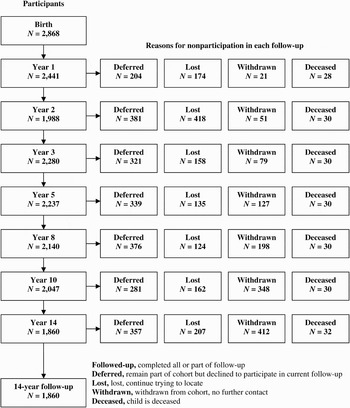
We were able to recruit 90% of those eligible for the study and the initial sample was representative of the KEMH population. Those who were socially disadvantaged were less likely to remain in the study in the early years, but by 14 years the population was similar to the Western Australian population (Li et al., Reference Li, Kendall, Henderson, Downie, Landsborough and Oddy2008; Robinson et al., Reference Robinson, Oddy, McLean, Jacoby, Pennell and de Klerk2010). At the 14-year follow-up, 1,860 study children and their families were eligible for follow-up (357 deferred participation, 207 were unable to be traced, 412 had withdrawn, and 32 were deceased). The cohort participation rates are presented in Figure 1.
The Western Australian Pregnancy Cohort (Raine) Study participation rates at each follow-up from birth to 14 years and the reasons for not participating at each follow-up.

Outcome variable
Child Behavior Checklist (CBCL)
Child behavioral data were collected at the 2-, 5-, 8-, 10-, and 14-year follow-ups. The CBCL for Ages 2–3 (CBCL/2–3), a 99-item, empirically validated measure of child behavior by parent report was used at the 2-year follow-up (Achenbach, Edelbrock, & Howell, Reference Achenbach, Edelbrock and Howell1987). At further follow-ups the CBCL for Ages 4–18 (CBCL/4–18), a 118-item instrument, was administered (Achenbach, Reference Achenbach1991). The CBCL has demonstrated good sensitivity (83% overall) and specificity (67% overall) to a clinical psychiatric diagnosis and good test–retest reliability in a Western Australian clinical calibration (Zubrick et al., Reference Zubrick, Silburn, Gurrin, Teoh, Shepherd and Carlton1997) and has been widely used internationally in peer-reviewed literature on child behavioral development (Bérubé & Achenbach, Reference Bérubé and Achenbach2007).
The raw scores produced by the CBCL were converted into T scores for total, internalizing (withdrawal, somatic complaints, anxious/depressed), and externalizing (delinquency, aggression) behavior as specified by the manual for each of the follow-up years (Achenbach, Reference Achenbach1991). The recommended clinical cutoff scores (T ≥ 60) were applied to the CBCL T scores to obtain three binary variables indicative of clinically significant scores on the total, internalizing, and externalizing problem scales (Achenbach, Reference Achenbach1991). Scoring above this clinical cutoff is referred to as behavioral morbidity in this study.
Predictor variable
Life stress events
We aimed to explore the experience of life stress events in pregnancy by examining the number, type, and timing of events experienced. Mothers were asked at 18 weeks' and 34 weeks' gestation whether or not they had experienced any of 10 major life stress events selected from the 67-item life stress inventory developed by Tennant and Andrews (Reference Tennant and Andrews1976). These included pregnancy problems, death of a close friend or relative, separation or divorce, marital problems, problems with children, job loss (involuntary), partner's job loss (involuntary), money problems, residential move, or other stressful event. The question on the 18-week gestation questionnaire asked whether any of the events had been experienced since becoming pregnant and, on the 34-week gestation questionnaire, whether any of the events had been experienced within the last 4 months, ensuring that the same event was not counted twice. As with previous studies, responses were recorded as “yes” or “no” in order to maximize effective recall (Carmichael, Shaw, Yang, Abrams, & Lammer, Reference Carmichael, Shaw, Yang, Abrams and Lammer2007).
Number of stress events experienced
We computed a total stressful life events index score by summing the number of “yes” responses to the listed events, giving equal weight to each. This index was computed for all stressful life events reported throughout pregnancy. In order to compare those mothers who experienced stressful events during pregnancy with those who experienced no stressful events, we categorized the total life stressful events index score into a categorical indicator representing those mothers who experienced zero, one, two, three, four, five, and six or more stressful events.
Type of stress events experienced
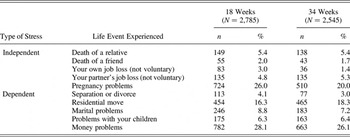
We separated events that were considered to be independent (beyond the individual's control) as opposed to dependent (at least partly within the individual's control; Hammen, Reference Hammen1991; Rudolph & Hammen, Reference Rudolph and Hammen1999; Table 1). This categorization was based on the Hammen model that differentiates between the effects of stress exposure versus stress generation (Hammen, Reference Hammen1991). The number of “yes” responses was summed and two continuous variables were created measuring (a) the number of independent stress events and (b) the number of dependent stress events experienced.
Type of stress experienced at each measured time point in pregnancy

Timing of stress events experienced
Finally we computed separate index scores for all events reported at 18 and at 34 weeks' gestation. The number of “yes” responses was summed and two continuous variables were created measuring (a) the number of stress events at 18 weeks' gestation and (b) the number of stress events experienced by 34 weeks' gestation. As already noted, the questionnaires were worded to ensure that the same event was not counted twice.
Control variables
The control variables selected for adjustment in our analysis included numerous pre- and perinatal factors known to be associated with both prenatal stress experience and mental health outcomes in children (Robinson et al., Reference Robinson, Oddy, Li, Kendall, de Klerk and Silburn2008). These variables included maternal sociodemographic characteristics from the prenatal period including maternal age (years), maternal education (highest year of secondary education completed), and maternal ethnicity (Caucasian compared with non-Caucasian; Aboriginal mothers were excluded from the study because there were too few cases). Maternal cigarette smoking during the first 18 weeks of pregnancy (cigarettes per day) was included in the model, as was the number of standard alcoholic drinks consumed per week at 18 weeks' gestation, total family income (≤$24,000 per annum compared with >$24,000 per annum), and the presence of the biological father in the family home (yes/no). We also controlled for gestational age (in weeks, centered at the mean), birth weight (in grams, centered at the mean), and breastfeeding duration in months (Li et al., Reference Li, Kendall, Henderson, Downie, Landsborough and Oddy2008). We did not have a measure of maternal psychopathology during pregnancy, but we did have a measure of whether the mother had ever been treated for an emotional or mental health problem at the child's 8-year follow-up (yes/no). Finally, we adjusted for the experience of stressful events at the 2-, 5-, 8-, 10-, and 14-year follow-ups using the same life stress event questionnaire administered during pregnancy. The primary caregiver was asked to report which events had been experienced in the previous 12 months.
Statistical analysis
Frequency data were compared for all outcome, predictor, and control variables, and the percentages of study children scoring above the clinical cutoff for total, internalizing, and externalizing morbidity at each follow-up were graphed. We used logistic regression models with generalized estimating equations (accounting for repeated observations of the same individuals over time) to examine the relationships between our predictor variables and clinically significant T scores (binary indicator, T ≥ 60) from age 2 to 14 years after establishing that there were no significant interactions between any of our predictor variables and the child's age at follow-up (p < .05). The first of our models assessed the relationship between the number of stressful events experienced, the second model compared independent stress events with dependent stress events, and the third model compared events occurring by 18 weeks' gestation with those occurring by 34 weeks' gestation. All of our three generalized estimating equations models first examined univariate relationships, followed by the inclusion of all control variables from pregnancy, and finally the inclusion of the prenatal and postnatal variables, including the experience of stress events in the 12 months preceding each follow-up. This allowed us to examine the effect of adjustment on our models. When we adjusted for maternal psychopathology at the 8-year follow-up, there was no change in the magnitude or direction of our results, and therefore we did not include this variable in our models. We also examined gender interaction effects but these were not significant, and therefore male and female offspring are combined in our models. SPSS 15.0 was used for the analyses.
Results
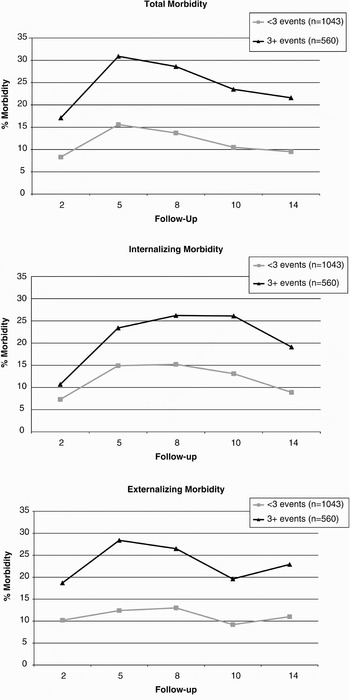
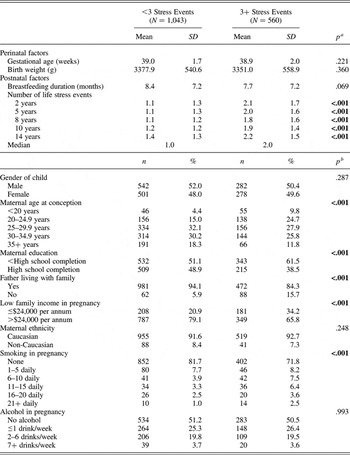
The most commonly reported stressful events experienced in pregnancy were financial difficulties, pregnancy complications, and residential moves (Table 1). Dependent stress events were more common than independent stress events, and most events were more commonly reported at 18 weeks' gestation than at 34 weeks' gestation. At each follow-up, the children born to women who experienced three or more stressful events in pregnancy (n = 929) had higher rates of behavioral problems across total, internalizing, and externalizing domains (Figure 2). The mothers who experienced greater numbers of stressful events in pregnancy were also more likely to experience stressful life events in the 12 months preceding each subsequent follow-up (Table 2). These mothers also were more likely to be younger mothers, to have completed fewer years of high school, to be living apart from the father of the child during pregnancy, to have a low family income, and to smoke more heavily (all p < .001). The dichotomization of the maternal stress experience variable (less than three stress events compared with three or more stress events) for the purposes of comparing frequency data was based on the results observed in Table 3 and Figure 3.
Total, internalizing, and externalizing morbidity (T ≥ 60) by the number of stressful events experienced throughout pregnancy (less than three events, greater than or equal to three events).

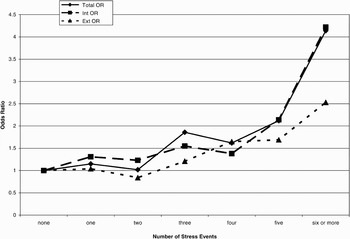
Odds ratios from the adjusted logistic regression analyses showing the effect of each additional stress event during pregnancy (compared with no events) on clinically significant Child Behavior Checklist total, internalizing, and externalizing T scores (binary indicator, T ≥ 60).

Frequency data by number of stressful life events experienced throughout pregnancy for participants in the 14-year follow-up who completed the Child Behavior Checklist/4–18 (N = 1,744)
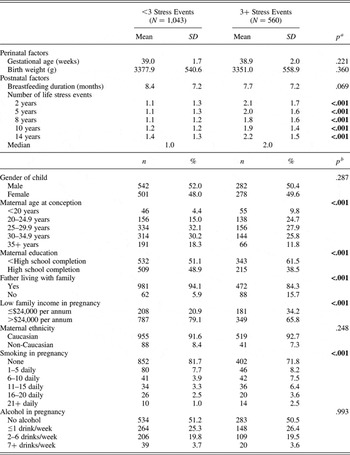
Note: Column percentages are presented, but missing data are not. The bold values indicate significant results.
aThe p value for the difference in the mean score.
bThe p value for the linear by linear trend.
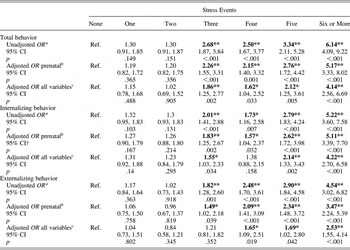
Adjusted logistic regression analysis showing effect of each additional stress event during pregnancy (compared with no events) on clinically significant Child Behavior Checklist T scores (binary indicator, T ≥ 60)

Note: OR, odds ratio; 95% CI, 95% confidence intervals. The bold values indicate significant results.
aAdjusted for child's age at follow-up (and child's age at follow-up squared).
bAdjusted for maternal smoking in pregnancy, maternal alcohol intake at 18 weeks, maternal age at conception, maternal education at pregnancy, total family income, presence of the biological father in the family home, maternal ethnicity, child's age at follow-up (and child's age at follow-up squared).
cAdjusted for maternal smoking in pregnancy, maternal alcohol intake at 18 weeks, maternal age at conception, maternal education at pregnancy, total family income, presence of the biological father in the family home, maternal ethnicity, child's age at follow-up (and child's age at follow-up squared), gestational age (weeks), birth weight (g), breastfeeding (months), and experience of life stress events within each follow-up period.
*p < .05. **p < .005.
Number of stress events experienced
The results for each additional stress event experienced during pregnancy (up to six or more events) compared with no stress events are presented in Table 3. The maternal experience of one or two stress events in pregnancy was not significantly associated with clinically significant CBCL T scores for their child to age 14 when compared with the children of mothers who had experienced no stress events. However, for total behavioral morbidity the maternal experience of three to six or more events during pregnancy was associated with increased child behavioral morbidity in the fully adjusted model. The experience of five and six or more events was associated with a significant risk for increased internalizing morbidity after adjustment for all confounding factors, whereas externalizing morbidity was higher in the children of mothers who reported four or more events when compared with the children of mothers who reported no stressful events. The odds ratios observed decreased following adjustment for potential confounders measured in the prenatal period and then again after postnatal variables were also included in the models. We graphed the adjusted odds ratios for total, internalizing, and externalizing behavioral morbidity (Figure 3) and an association between increasing stress events and morbidity was observed consistent with a log–linear relationship.
Type of stress events experienced
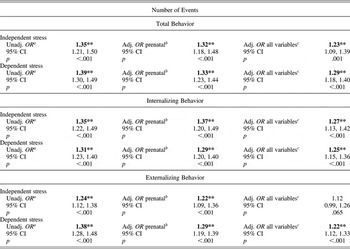
Given there was a log–linear relationship between the number of prenatal stress events experienced by the mother and child behavioral outcomes, we analyzed the total number of independent stress events and the total number of dependent stress events as continuous variables (Table 4). The number of independent and dependent events experienced were significantly positively correlated (Spearman r = .244, p < .001). The number of both independent and dependent stress events experienced showed a significant positive relationship with total, internalizing, and externalizing morbidity before and after adjustment, although the effect of independent stress events on externalizing behavioral morbidity was not significant at p < .05 (p = .065). For total and externalizing behavior, the odds ratios were higher for dependent stress events compared with independent stress events, whereas the results for internalizing behavior were similar after pre- and postnatal confounders were included in the model. There was no significant difference between the odds ratios for independent compared with dependent events for any of our outcomes.
Adjusted logistic regression analysis showing effect of the number of independent and dependent stress events during pregnancy on clinically significant Child Behavior Checklist T scores (binary indicator, T ≥ 60)

Note: OR, odds ratio; 95% CI, 95% confidence intervals. The bold values indicate significant results.
aAdjusted for child's age at follow-up (and child's age at follow-up squared).
bAdjusted for maternal smoking in pregnancy, maternal alcohol intake at 18 weeks, maternal age at conception, maternal education at pregnancy, total family income, presence of the biological father in the family home, maternal ethnicity, child's age at follow-up (and child's age at follow-up squared).
cAdjusted for maternal smoking in pregnancy, maternal alcohol intake at 18 weeks, maternal age at conception, maternal education at pregnancy, total family income, presence of the biological father in the family home, maternal ethnicity, child's age at follow-up (and child's age at follow-up squared), gestational age (weeks), birth weight (g), breastfeeding (months), and experience of life stress events within each follow-up period.
**p < .005.
Timing of stress events experienced
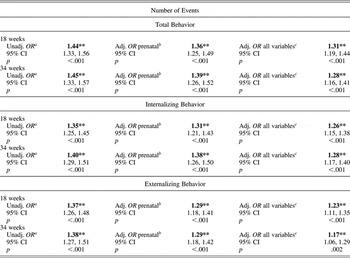
We included the total number of events experienced at 18 and 34 weeks' gestation as continuous variables in our final model (Table 5). The number of stress events experienced at 18 and 34 weeks' gestation showed a significant positive relationship with increased behavioral morbidity, and again, these relationships changed very little with adjustment for pre- and then postnatal factors. Although internalizing morbidity was similarly affected by stress events at 18 and 34 weeks' gestation, stress events experienced early in pregnancy showed slightly higher odds ratios predicting total and externalizing morbidity compared with stress at 34 weeks' gestation. There was no significant difference between the odds ratios for events at 18 weeks' compared with events at 34 weeks' gestation for any of our outcomes.
Results of logistic regression models with generalized estimating equations examining the effect of stress at 18 and 34 weeks gestation on Child Behavior Checklist morbidity from age 2 to 14 years (N surveys = 9,837)

Note: OR, odds ratio; 95% CI, 95% confidence intervals. The bold values indicate significant results.
aAdjusted for child's age at follow-up (and child's age at follow-up squared).
bAdjusted for maternal smoking in pregnancy, maternal alcohol intake at 18 weeks, maternal age at conception, maternal education at pregnancy, total family income, presence of the biological father in the family home, maternal ethnicity, child's age at follow-up (and child's age at follow-up squared).
cAdjusted for maternal smoking in pregnancy, maternal alcohol intake at 18 weeks, maternal age at conception, maternal education at pregnancy, total family income, presence of the biological father in the family home, maternal ethnicity, child's age at follow-up (and child's age at follow-up squared), gestational age (weeks), birth weight (g), breastfeeding (months), and experience of life stress events within each follow-up period.
**p < .005.
Discussion
This study on the number, nature, and timing of prenatal psychosocial stress on emotional development of the child suggests that the maternal experience of stressful events during pregnancy is associated with higher behavioral morbidity for offspring in childhood and adolescence when compared with the offspring of mothers with no experience of stressful events during pregnancy. Both independent and dependent stressors were associated with increased behavioral problems, and the effect of stress experience at 18 weeks' gestation showed a slightly higher risk than stress experienced at 34 weeks' gestation for total and externalizing behavior. The maternal experience of multiple stressful events during pregnancy was also associated with (a) an increased likelihood for the mother to be further exposed to stressful events after birth and (b) indicators of general social disadvantage. Our findings show that the effect of stress events in pregnancy remained a significant predictor of behavioral problems in children and adolescents independent of pre- and postnatal confounding variables.
Our results concerning the relationship between the number of stressful events in pregnancy and behavioral impact on the child support a linear dose–response relationship. We have previously shown that increasing numbers of prenatal stress events experienced resulted in increased behavioral problems for children in the preschool years and these data extend those findings (Robinson et al., Reference Robinson, Oddy, Li, Kendall, de Klerk and Silburn2008). Another study has found that when mothers experienced six or more life stress events problem behaviors in their children increased, but this study was not specific to stress in pregnancy (Hook, Hagglof, & Thernlund, Reference Hook, Hagglof and Thernlund1995). Increasing numbers of prenatal stressful events experienced by the mother have also been associated with a reduced length of breastfeeding (Li et al., Reference Li, Kendall, Henderson, Downie, Landsborough and Oddy2008), and an increased rate of birth defects (Carmichael et al., Reference Carmichael, Shaw, Yang, Abrams and Lammer2007). Most of the literature implicitly assumes that the effect of stress is cumulative and additive, implying that more stress leads to poorer outcomes (Carmichael et al., Reference Carmichael, Shaw, Yang, Abrams and Lammer2007; Lobel, Reference Lobel1994). Certainly, a high level of anxiety in pregnancy has been linked with adverse mental health outcomes in the early years based on evidence from a population cohort study focused primarily on maternal mental health (Field & Diego, Reference Field and Diego2008) and a prospective pregnancy cohort study similar to that reported here (O'Connor et al., Reference O'Connor, Heron, Golding, Beveridge and Glover2002).
Research on the impact of maternal stress suggests that the experience of traumatic events beyond the individual's control, such as major disasters, can influence the development of mental health-related behavioral problems in offspring (Malaspina et al., Reference Malaspina, Corcoran, Kleinhaus, Perrin, Fennig and Nahon2008). In our study, the experience of both dependent and independent psychosocial stress events impacted on the development of child behavioral problems, although stressful life events that the mother had some control over showed a slightly stronger association with the development of total and externalizing morbidity in offspring. The presence of similar effects between dependent and independent stress event exposure would indicate that events that are at least partially influenced by the actions of the individual do not vary greatly from those events beyond the individual's control in terms of impacting on behavioral outcomes for offspring.
This study observed that stress events experienced before 18 weeks' gestation as well as between 18 and 34 weeks' gestation were associated with a higher risk of problem behavior, but stress events experienced before 18 weeks' gestation had slightly more impact on total and externalizing morbidity in offspring than stress events experienced later in pregnancy. Previous reports have been divided over the effect of timing on the development of behavioral problems (Kofman, Reference Kofman2002). Those that have found time-specific stress influences in pregnancy have theorized that the effects are due to critical fetal developmental stages (O'Connor et al., Reference O'Connor, Heron, Golding, Beveridge and Glover2002), although this theory is yet to be more widely supported (Austin, Leader, & Reilly, Reference Austin, Leader and Reilly2005). Our results do not allow us to make specific comments about the relationship between the experience of the stressor and the developmental window of critical brain function underlying neurobehavioral development during childhood. In contrast, maternal responsiveness to stressful events is known to gradually dampen over time due to pregnancy-related physiological changes in stress sensitive hormones (Mastorakos & Ilias, Reference Mastorakos and Ilias2000), which may suggest that life events experienced later in pregnancy were perceived as less stressful than when experienced earlier in pregnancy (Glynn et al., Reference Glynn, Dunkel-Schetter, Wadhwa and Sandman2004; Laplante et al., Reference Laplante, Barr, Brunet, Galbaud du Fort, Meaney and Saucier2004).
Potential mechanisms
The etiological pathways of adverse neurobehavioral development appear deeply entangled. Possible causal mechanisms linking stress and neurobehavioral outcomes include (a) stress sensitivity and consequent psychoneuroendocrine changes underlying poorer behavior (Seckl & Holmes, Reference Seckl and Holmes2007), (b) inadequacies in material circumstances related to child mental health (Gravelle, Reference Gravelle1998; Wolfson, Kaplan, Lynch, Ross, & Backlund, Reference Wolfson, Kaplan, Lynch, Ross and Backlund1999), and (c) maternal deficits in psychosocial domains such as attachment quality and parenting (Leonhardt, Matthews, Meaney, & Walker, Reference Leonhardt, Matthews, Meaney and Walker2007; Paarlberg et al., Reference Paarlberg, Vingerhoets, Passchier, Dekker and Van Geijn1995).
Stress hormones are believed to contribute to the biological mechanism underlying the adverse effects of prenatal stress on fetal development and growth (Newnham, Moss, Nitsos, Sloboda, & Challis, Reference Newnham, Moss, Nitsos, Sloboda and Challis2002; Seckl & Holmes, Reference Seckl and Holmes2007). Despite pregnancy-related alterations in neuroendocrine stress markers (Kammerer, Taylor, & Glover, Reference Kammerer, Taylor and Glover2006), various self-reported prenatal psychosocial stress variables have been reported to correlate with elevated maternal adrenocorticotrophin hormone and cortisol levels at around 28 weeks of pregnancy (Field & Diego, Reference Field and Diego2008; Wadhwa, Dunkel-Schetter, Chicz-DeMet, Porto, & Sandman, Reference Wadhwa, Dunkel-Schetter, Chicz-DeMet, Porto and Sandman1996). Circulating cortisol levels exceeding basal concentrations appear able to cross the placenta (Seckl & Holmes, Reference Seckl and Holmes2007) and to have the potential to negatively affect the development of the fetal stress response system (DiPietro, Reference DiPietro2004; Sloboda, Challis, Moss, & Newnham, Reference Sloboda, Challis, Moss and Newnham2005). Premature exposure to elevated cortisol via fetal programming could prepare the developing fetus for a world that the mother perceives as stressful, and the fetal adaptation to this perceived stressful environment could alter personality and predispose to behavioral problems through compromising changes in brain neurotransmitter activity (French, Hagan, Evans, Mullan, & Newnham, Reference French, Hagan, Evans, Mullan and Newnham2004; Sloboda et al., Reference Sloboda, Challis, Moss and Newnham2005).
However, the evidence for biological pathways linking stress experienced in pregnancy and behavioral problems is less than compelling. The strong relationship between stress in pregnancy and socioeconomic disadvantage could also explain our results. Low socioeconomic status is associated with a number of social conditions that can increase children's exposure to delinquent and aggressive behaviors such as substance use, neighborhood and domestic violence, and child abuse (Baum, Garofalo, & Yali, Reference Baum, Garofalo and Yali1999). Further, mothers who experience stress in pregnancy and later in life may be more likely to have poor parenting styles (e.g., harsh and physical punishment), which provides a negative role model for the offspring resulting in the encouragement of externalizing behaviors in children. These factors can impart their own adverse influence on child behavioral development and greater exposure may increase vulnerability to the effects of stress (Baum et al., Reference Baum, Garofalo and Yali1999; Paarlberg et al., Reference Paarlberg, Vingerhoets, Passchier, Dekker and Van Geijn1995). Although we adjusted for various socioeconomic status associated factors and later stress exposure, the situation is likely to be complex (Paarlberg et al., Reference Paarlberg, Vingerhoets, Passchier, Dekker and Van Geijn1995; Talge et al., Reference Talge, Neal and Glover2007; Van den Bergh et al., Reference Van den Bergh, Mulder, Mennes and Glover2005). It is interesting that attempts to intervene in pregnancy by providing more psychosocial support have had mixed outcomes (Cowan & Cowan, Reference Cowan and Cowan2002; Urizar et al., Reference Urizar, Milazzo, Le, Delucchi, Sotelo and Munoz2004; Villar et al., Reference Villar, Farnot, Barros, Victora, Langer and Belizan1992) and the inconclusive evidence on the general effectiveness of antenatal stress reduction may point to the intricacy of the socioeconomic, psychosocial, and biological influences in pregnancy that may relate to problematic behavior in the offspring.
Our study has a number of strengths, particularly the use of prospectively collected data over 14 years that included information on a wide variety of potential confounders. A pregnancy cohort of this nature is essential for a rigorous analysis of the causal influence of stress in pregnancy on child development. The longitudinal follow-up of child behavior over time, together with the information collected on later stress exposure allowed us to examine the long-term effect on children of maternal experience of life stress events in pregnancy, plus the collection at two time points in pregnancy allowed us to determine the effects of timing without counting the same event twice. Our sample had adequate statistical power and it was population-based rather than clinical. The inclusion of maternal pregnancy concerns as a stress event was important because pregnancy and birth are often viewed as stressful experiences in their own right, particularly as they often initiate other stressful circumstances such as employment changes, financial pressures, and relationship adjustment (Saunders et al., Reference Saunders, Lobel, Veloso and Meyer2006). This inclusion may also have indirectly brought into consideration other perinatal risks that may themselves lead to poor child outcomes, such as gestational hypertension and unplanned caesarean delivery (Saunders et al., Reference Saunders, Lobel, Veloso and Meyer2006), although we controlled for gestational age and birth weight to assist in overcoming this limitation.
As a restraint to our study, we were unable to control for maternal depressive typology in pregnancy. Although there is evidence to suggest that life stress event scales are a proxy measure of maternal psychological distress, life stress scales do not specifically measure depression (Seguin et al., Reference Seguin, Potvin, St-Denis and Loiselle1995). Further, when we adjusted for whether the mother had ever been treated for an emotional or mental health problem by the 8-year follow-up our results remained the same, although we acknowledge that some women with mental health problems may not have sought treatment. The use of the mother as single informant is potentially a limitation of this study, although the parent-report CBCL has been well validated (Warnick, Bracken, & Kasl, Reference Warnick, Bracken and Kasl2008). In addition, we could not be certain that we were truly studying independent as opposed to dependent stress, as independent stress events (e.g., death of a relative or divorce) may be followed by a psychologically stressful aftermath that is influenced by the individual's response and involvement (dependent stress). Finally, we acknowledge the potential for stressful life events to have occurred between 34 weeks' gestation and birth, which had not been recorded in our cohort.
Conclusion
The maternal experience of multiple stressful events during pregnancy increases the risk of child behavioral problems during the first 14 years of life, and this effect arises from both ongoing dependent and independent stressors. Although the effect of stress in pregnancy on problem behavior later in childhood was evident at both time points studied, it is of further interest that the exposure to life stress events early in pregnancy was associated with greater risk for total and externalizing behavioral problems than stress at 34 weeks. These results clearly demonstrate the need to undertake trials of interventions designed to reduce stress for pregnant mothers, especially those at a higher risk of exposure to psychosocial stressors due to social disadvantage, in an attempt to limit the development of behavioral problems in their offspring.