INTRODUCTION
Routine screening for distress as the “sixth Vital Sign” in cancer populations (Bultz & Carlson, Reference Bultz and Carlson2005) has emerged as a best practice globally (Holland & Bultz, Reference Holland and Bultz2007; National Comprehensive Cancer Network (NCCN), 1999; Jacobsen et al., Reference Jacobsen, Donovan and Trask2005; Holland et al., Reference Holland, Anderson and Breitbart2013; Luxford & Fletcher, Reference Luxford and Fletcher2006). Routine screening for distress using valid tools is essential to ensure early detection of distress and more serious adjustment disorders since clinicians are not always accurate in their identification of distressed patients (Mitchell et al., Reference Mitchell, Hussain and Grainger2010; Fallowfield et al., Reference Fallowfield, Ratcliffe and Jenkins2001; Passik et al., Reference Passik, Dugan and McDonald1998). Distress is defined, as a normal emotional reaction of vulnerability, sadness or fear to cancer that may interfere with the person's ability to cope effectively with cancer, physical symptoms or treatment. Left untreated and dependent on related person or disease factors, this distress may result in an adjustment disorder, i.e., depression or anxiety (NCCN, 1999; Holland et al., Reference Holland, Anderson and Breitbart2013). In a study of over 44,000 cancer patients screened in Ontario, the prevalence of distress measured on a 0 to 10 severity scale (0 = not depressed to 10-worse possible depression) was 56% with about 12% of the population reporting significant distress (i.e., score ≥7) (Barbera et al., Reference Barbera, Seow and Howell2010). Although rates vary across studies, a systematic review of prevalence studies reported a rate of major depressive disorder in 10.8% of cancer patients, using the structured clinical interview for depression (SCID) (Ng et al., Reference Ng, Boks and Zainal2011).
Since the majority of cancer patients experience a moderate level of distress without meeting criteria for a psychiatric diagnosis, there is a need for the primary oncology team to provide appropriate psychosocial interventions to effectively manage distress in response to screening data (Velikova, Reference Velikova2010; Holland & Alici, Reference Holland and Alici2010). Appropriate action by the primary oncology team is essential since problems contributing to cancer distress are multifactorial, such as unrelieved symptoms or treatment side effects (i.e., fatigue, pain, sleep disturbances) and emotional reactions such as fear, worry and uncertainty about the future (Giese-Davis et al., Reference Giese-Davis, Waller and Carlson2012; Carlson et al., Reference Carlson, Amgen and Cullum2004). Most of these problems are within the scope of front-line providers (National Institute for Clinical Excellence (NICE), 2004) and an expected standard of practice for disciplines such as nursing (Fitch, Reference Fitch2011). Similarly, management of mild to moderate levels of distress is an expectation for the primary oncology team in the United Kingdom, based on a stepped-care approach for distress management (Stegina et al., Reference Stegina, Hutchinson and Turner2006). However, a gap in the use of evidence-based psychosocial and supportive care interventions by the primary oncology team is acknowledged (Jacobsen, Reference Jacobsen and Wagner2012). A lack of integration of best practices in psychosocial and supportive care is attributed to a high prevalence of unmet needs in cancer and associated with physical and psychological morbidity, and poor quality-of-life (Adler & Page, Reference Adler and Page2008).
Consequently, as part of a programmatic approach to distress screening, attention must be paid to knowledge translation if a quality response to distress screening data, and its effective management, is to be realized. The purpose of this paper is to disseminate progress in distress screening uptake in regional cancer programs across Ontario and synthesize the evidence for applying a systematic knowledge translation approach to facilitate use of best practices in distress management by the primary oncology team to ensure a quality response to distress screening data.
DISTRESS SCREENING DATA AND PSYCHOSOCIAL CARE
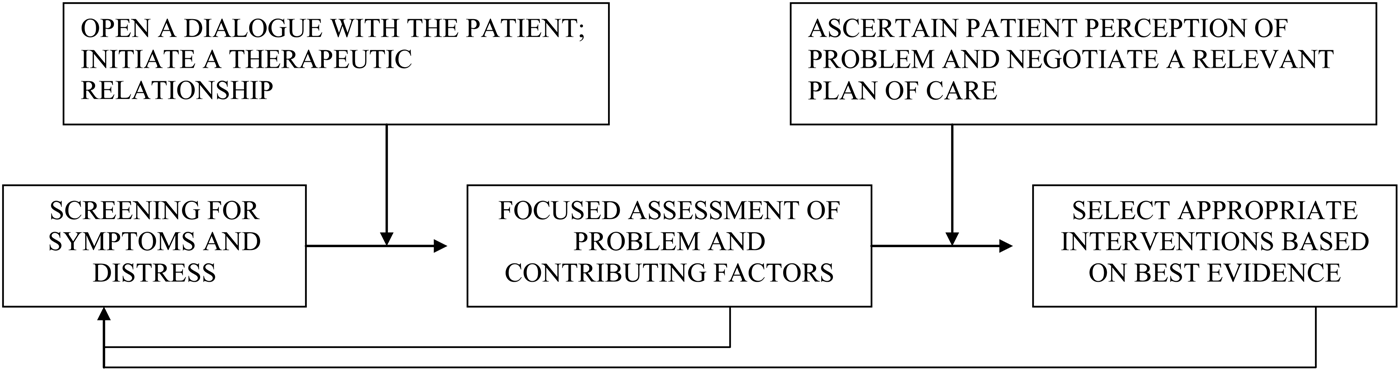
While routine screening of distress is essential in cancer programs, the identification of the occurrence and severity of distress does not fully explain the underlying reason for distress nor does it point to a specific course of action (Holland et al., Reference Holland and Alici2010). Thus, a number of steps following screening for distress are recommended, as depicted in Figure 1 (Howell et al., Reference Howell, Bultz and Fitch2012a; Reference Howell, Mayo and Currie2012b; Fitch et al., Reference Fitch, Howell and McLeod2012). Care processes by the primary oncology team should include therapeutic communication to ascertain the patient's perspective of the problem, a holistic psychosocial assessment and focused problem based assessment to identify sources and factors contributing to distress and specific problems. This should in turn lead to the appropriate selection of relevant evidence-based interventions to ensure an effective response (Howell et al., Reference Howell, Bultz and Fitch2012a; Reference Howell, Mayo and Currie2012b)
Processes of care steps following screening.

While the need for integration of psychosocial care in routine clinical practice and as a standard of care is acknowledged, the clinicians' ability to engage in therapeutic discussions to identify physical, psychological, social/practical concerns, and existential issues that can contribute to distress varies widely (Richardson et al., Reference Richardson, Sitzia and Brown2005). This is attributed to clinician attitudes that psychosocial care is not their core business (Stegina et al., Reference Stegina, Hutchinson and Turner2006), or may be due to the challenges of tailoring care to the short, visit-based ambulatory cancer care environment. Cancer patients are also reluctant in this environment to raise concerns as they fear further burdening of the busy health care team, assume emotional distress is inevitable or untreatable, are ashamed they cannot cope, or may lack the confidence or language for communicating with the medical team about their emotional reaction to cancer and related problems (Detmar et al., Reference Detmar, Aaronson and Wever2000).
Despite significant global growth in routine screening for distress and the availability of guidelines recommending evidence-based care for the management of distress, the implementation of best practices in psychosocial care remains less than ideal (Jacobsen & Ransom, Reference Jacobsen and Ransom2007). For example, the uptake of screening for distress has been growing in Ontario since its initial implementation in 2005 with over 1.5 million distress screens completed to date (see Fig. 2; Cancer System Quality Index, 2012). The provincial performance standard of 70% of patients screened has been exceeded in most of the 14 regional cancer programs. In spite of unprecedented success in the uptake of screening in many cancer programs and its perceived value by clinicians and patients in overall assessment (Gilbert et al., Reference Gilbert, Howell and Sawka2012; Braeken et al., Reference Braeken, Kempen and Eekers2011), the way these data are used by practitioners to direct distress management varies across settings and disciplines. For example, a survey of 239 providers in one regional cancer program suggested continued resistance by oncologists in the use of screening data, whereas nurses valued the data as part of their assessment (Bainbridge et al., Reference Bainbridge, Seow and Sussman2011). Similar findings were noted in a survey of oncologists in the United States, with less than a third being familiar with distress guidelines and following them in routine care (Pirl et al., Reference Pirl, Muriel and Hwang2007). A low uptake of distress guidelines was also shown for NCCN member organizations (Jacobsen & Ransom, Reference Jacobsen and Ransom2007). More recently, variability in the use of screening data and its impracticality was noted by more than a third of clinicians (Mitchell et al., Reference Mitchell, Lord and Slattery2012). There is a need to move beyond collection of screening data as a performance checklist innovation to facilitating better quality psychosocial care and distress management.
ESAS Screening Rates in Ontario, Canada
The assumption that the collection of distress screening data will automatically result in more effective care processes and better outcomes is fundamentally flawed (Greenhalgh et al., Reference Greenhalgh, Long and Flynn2005). The evidence suggests that routine screening may result in improved communication between the oncologist and patient (Velikova et al., Reference Velikova, Brown and Smith2002), but a synthesis of evidence across studies of the effect of distress screening suggests there is little high quality evidence that routine distress screening alone improves patient-reported outcomes (Howell et al., Reference Howell, Mayo and Currie2012b; Carlson et al., Reference Carlson, Waller and Mitchell2012; Greenhalgh & Meadows, Reference Greenhalgh and Meadows1999) except for those with significant distress who are referred to specialists (Carlson et al., Reference Carlson, Groff and Maciejewski2010). A synthesis of results of depression screening data from 40 years of research in the primary care system suggested that screening alone without attention to aftercare that includes engaging patients in their own care, using screening without linked treatment, and responding to clinical depression — does not generally improve outcomes (Mitchell et al., Reference Mitchell, Vahabzadeh and Magruder2011). As cancer programs plan for the implementation of routine distress screening, equal attention must be paid to the integration of this patient-reported data in clinical work flow and patient-provider decision-making (Basch & Abernethy, Reference Basch and Abernethy2011). The use of a systematic knowledge translation approach and effective strategies to facilitate uptake of best practices in psychosocial care and distress management will be essential for a quality response.
TRANSLATING KNOWLEDGE INTO ACTION FOR BETTER DISTRESS MANAGEMENT
Knowledge translation is defined as: a dynamic and iterative process that includes synthesis, dissemination, exchange and ethically sound application of knowledge to improve health, provide more effective health services and products and strengthen the health care system (Strauss et al., Reference Straus, Tetroe and Graham2009). The prominent knowledge-to-action (KTA) planning framework (see Fig. 3) can be used to guide a systematic approach to facilitate the uptake of screening data and best practices in distress management (Graham et al., Reference Graham, Logan and Harrison2006). As outlined in the KTA framework, a planned approach to knowledge translation includes a number of key steps: (1) synthesizing and adapting knowledge to the local health care context; (2) assessing supports and barriers to knowledge uptake; (3) selecting and tailoring implementation interventions to barriers identified; (4) monitoring the uptake and sustained use of best practices and evaluating effects on the organization, care processes, and patient outcomes as an iterative process.
Knowledge to Action Framework
ADAPTING KNOWLEDGE FOR LOCAL PRACTICE
As shown in the KTA framework, a central aspect of knowledge translation is knowledge creation defined as, a process by which research is distilled and refined, resulting in a product that is useful to the end user (Graham et al., Reference Graham, Logan and Harrison2006). Knowledge inquiry, knowledge synthesis, and the creation of knowledge tools and products such as clinical practice guidelines are the processes for knowledge creation. Clinical practice guidelines are, systematically developed statements to assist practitioner and patient decisions about appropriate health care for specific clinical circumstances (Field & Lohr, Reference Field and Lohr1990). Globally, various expert groups have produced psychosocial and supportive care guideline products (National Comprehensive Cancer Network, 1999; NICE, 2004; National Breast Cancer Centre and National Cancer Control Initiative, 2003). Unfortunately, a number of challenges remain to their implementation including a lack of awareness that they exist (Stegina et al., Reference Stegina, Hutchinson and Turner2006; Jacobsen et al., Reference Jacobsen and Ransom2007). However, even when clinicians are aware of guidelines, they may have little influence on practice behaviors unless effective knowledge translation strategies are used to facilitate their uptake in routine care in the context of the local care delivery system (Grol et al., Reference Grol and Grimshaw2003).
In Canada, the initial steps in the KTA framework were applied to synthesize empirical evidence in the development of practice guidelines tailored for pan-Canadian use in the management of distress and contributing problems such as fatigue. These were developed under the auspices of the Cancer Journey Portfolio of the Canadian Partnership Against Cancer, in partnership with the Canadian Association of Psychosocial Oncology (CAPO) (www.capo.ca; Howell Reference Howell, Keller-Olaman and Oliver2010). The Association has now assumed the role of guideline steward (www.capo.ca). To avoid duplicating existing psychosocial and supportive guidelines for managing distress from other health care systems, the ADAPTE methodology was used (ADAPTE Collaboration, 2007). The ADAPTE is a systematic method that is used for the adaptation of substantive recommendations in high quality guidelines for application in a specific health care context or environment. This is an essential step in facilitating the uptake of evidence and avoids de novo guideline development, which is time consuming and requires significant resources (Harrison et al., Reference Harrison, Legare and Graham2010). Tailoring or customizing a clinical practice guideline to a particular practice environment may improve acceptance, and the active involvement of guideline end-users in this tailoring process through skilled facilitation can lead to better uptake in practice (Harrison & van den Hoek, Reference Harrison and van den Hoek2012; Francke et al., Reference Francke, Smit and de Veer2008). In Canada, administrative leaders and clinical experts from different disciplines were engaged in the adaptation of psychosocial guidelines to create practice guideline products for pan-Canadian use as part of a programmatic approach to distress screening.
These pan-Canadian guidelines link evidence-based knowledge for distress management with distress screening scores in a care pathway algorithm to facilitate “ease of use.” This is a key driver in the uptake of guidelines by clinicians (Davis & Tailor-Vaisey, Reference Davis and Tailor-Vaisey1997; Margolis, Reference Margolis1983). Algorithms summarize salient evidence from a comprehensive technical review of the evidence to provide a short summary of essential assessment parameters and effective interventions to guide practice in managing problems that contribute to distress (Howell et al., Reference Howell, Bultz and Fitch2012a). Based on the conceptual model shown in Figure 4, common symptoms as measured by the Edmonton symptom assessment system (ESAS) (Bruera et al., Reference Bruera, Kuehn and Miller1991) or problems such as sleep disturbance on the Canadian problem checklist recommended for use as the minimum data set for distress screening in Canada (www.partnershipagainstcancer.ca) were linked to care pathways in the algorithms and cut-off scores as follows: green (1–3; mild), yellow (4–6; moderate), and red (7–10; severe distress). This template integrates the tiered model for management of distress as articulated in the United Kingdom (Hutchinson et al., Reference Hutchinson, Stegina and Dunn2006). For instance, mild and moderate distress scores lead to recommendations for psychosocial and supportive care for all patients by the primary oncology team, whereas higher severity scores typically lead to intervention by specialists or urgent actions. This algorithm template was developed in collaboration with guideline development groups including Cancer Care Ontario (www.cancercare.on) and adapted for remote symptom management nurse triage protocols (Stacey et al., Reference Stacey, Bakker and Ballantyne2012). The linking of patient-reported data and guidelines for best practice is recommended to improve the quality of clinician response to outcome data (Snyder & Aaronson, Reference Snyder and Aaronson2009). An example of the pan-Canadian guideline algorithm for depression is shown in Figures 5 and 6 (Howell et al., Reference Howell and Liu2011). CCO also developed a smart application (“APP”) for clinicians to download on their electronic devices as an aid to point-of-care clinical decision-making. These guidelines are the first pan-Canadian guidelines that tailor evidence for use by primary care teams to guide management of distress and related problems.
Response path to distress screening scores.
Screening and assessment-depression in adults with cancer. Part A
Care map-depression in adults with cancer. Part B, management.
IMPLEMENTATION OF GUIDELINE EVIDENCE INTO PRACTICE
Despite widespread efforts at diffusion and dissemination of guidelines, the evidence contained within guidelines is rarely implemented in clinical practice (Grimshaw et al., Reference Grimshaw, Thomas and Maclennan2004; Berwick, Reference Berwick2003; Wensing et al., Reference Wensing, Bosch and Grol2010). Practice guidelines lack details on applicability or descriptions of the changes to the practice environment required to apply the recommendations contained within them (Burgers et al., Reference Burgers, Grol and Zaat2003). Putting guideline knowledge into action is a complex process requiring a systematic approach (Graham et al., Reference Graham and Logan2004; Francke et al., Reference Francke, Smit and de Veer2008) and careful attention to theory, care processes, facilitation and organizational context (Kitson et al., Reference Kitson, Rycroft-Malone and Harvey2008; Estabrooks et al., Reference Estabrooks, Floyd and Scott-Findlay2003; Reference Estabrooks, Thompson and Lovely2006; Scott-Findlay & Golden-Biddle, Reference Scott-Findlay and Golden-Biddle2005). Implementing guideline evidence in the cancer system may be particularly challenging since each clinical disease site team may function as a microsystem of care within the larger macro system of the cancer program. More important, there is little robust evidence of the effectiveness of knowledge translation interventions on the uptake of best practices in psychosocial care and distress management in cancer programs.
The action cycle of the KTA framework (Fig. 3) is the process by which knowledge, in this case, distress management practice guidelines, is implemented or applied in a deliberate, logical and systematic manner (Graham et al., Reference Graham, Logan and Harrison2006). Implementation is defined as a “specified set of activities designed to put into practice a specified activity or program” and as “a mission-oriented process involving multiple decisions, actions and corrections” (Fixen et al., Reference Fixsen, Naoom and Blase2005). Implementation (uptake and use) of evidence-based psychosocial and supportive care evidence is a key to achieving a quality clinician response to distress screening data and improved patient outcomes. Evidence of the most effective implementation interventions according to the steps in the KTA framework that can be applied in developing a plan for improving the quality of distress management are as follows:
Step 1: Planning for Implementation
Knowledge translation (KT) is a process that emphasizes “mobilizing knowledge off the shelf into practice” and making it relevant and accessible to clinicians (Lenfant, Reference Lenfant2003). This phase of knowledge translation may involve many steps including: (1) tailoring psychosocial guidelines to the local practice environment using participatory action approaches; (2) increasing awareness of the guideline using targeted dissemination strategies and education tailored to end users and other key stakeholders i.e. administrators; and (3) identifying the barriers at the organizational, patient, or individual practitioner level that can impede or enable practice change.
Participatory Action and Facilitation
Visible support and accessible administrative leadership with clear communication about expectations for best practice and quality care is central in the uptake of guidelines and in sustaining long-term use (Gifford et al., Reference Gifford, Davies and Edwards2006). The engagement of key stakeholders and clinicians using the skills of facilitation and a participatory approach in tailoring a guideline product and facilitating practice change may increase a sense of ownership (McWilliam et al., Reference McWilliam, Kothari and Ward-Griffin2009; Graham et al., Reference Graham, Logan and Harrison2006). In addition, the involvement of designated change agents and local champions in each clinical team is central to the process of managing change effectively (Stetler et al., Reference Stetler, Legro and Rycroft-Malone2006; Hack et al., Reference Hack, Carlson and Butler2011). Change agents coordinate the implementation process using facilitation skills such as providing the right blend of support and pressure to motivate staff and maintain momentum (Buonocore, Reference Buonocore2004). Facilitation is a core skill of change agents that is defined as: “the process of enabling (making easier) the implementation of evidence into practice” (Harvey et al., Reference Harvey, Loftus-Hills and Rycroft-Malone2002, p. 579). It is a deliberate and valued process of interactive problem solving and support that occurs in the context of a recognized need for improvement and a supportive interpersonal relationship (Dogherty et al., Reference Dogherty, Harrison and Graham2010). Facilitators work with clinical teams to review their attitudes, habits, skills, ways of thinking, and working. A small pilot study of implementation of distress screening and management targeted to nurses in radiation clinics reported that providing ongoing mentorship to clinicians in integrating distress screening and management was critical to uptake in routine practice (Fulcher & Gosselin-Acomb, Reference Fulcher and Gosselin-Acomb2007).
Identify Barriers to Change
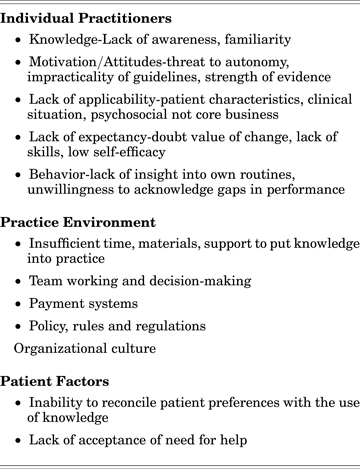
The involvement of key stakeholders in the process of change and the identification of barriers or obstacles to practice change are essential to the selection and tailoring of implementation interventions (Grol & Grimshaw, Reference Grol and Grimshaw2003; Baker et al., Reference Baker, Camosso-Stefinovic and Gillies2010). The barriers that may impact practice change occur at many levels including the patient, practitioner, clinical team, health care organization and wider environment as shown in Table 1 (Grimshaw et al., Reference Grimshaw, Eccles and Lavis2012; Grol & Wensing, Reference Grol and Wensing2004). Overcoming these barriers requires targeting implementation interventions to help minimize or remove them. Methods such as case review, focus groups, and surveys about knowledge, and practice can be used to ensure a complete understanding of the barriers that must be addressed (NICE, 2010).
Barriers to practice change
Step 2: Tailoring Implementation Interventions
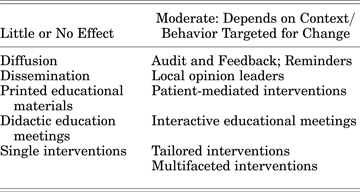
Promoting awareness of guideline evidence, stimulating the end-users interest and involvement, creating an understanding of psychosocial guidelines, and developing insights into practice routines and barriers are essential but only the first step in implementing practice change (Grilli et al., 2004; Berwick, Reference Berwick2003). A Cochrane review of data from 102 trials of implementation interventions showed that passive approaches, such as publication in peer-review journals or mailing clinical practice guidelines, are generally ineffective in promoting behavior change (Oxman et al., Reference Oxman, Thomson and Davis1995). The effectiveness of implementation strategies to facilitate practice change is summarized in Table 2. However, their effectiveness may vary by context and whether or not their selection is tailored to overcome barriers in the practice environment (Grimshaw et al., Reference Grimshaw, Eccles and Lavis2012; Cheater et al., Reference Cheater, Baker and Gillies2009).
Effectiveness of implementation interventions
Educational Interventions
Interactive education interventions that include small group learning, coaching and mentorship, practice demonstration and feedback, role modeling with clinical supervision and reflection on practice are more potent in promoting behavior change (Bero et al., Reference Bero, Grilli and Grimshaw1998; Grimshaw et al., Reference Grimshaw, Eccles and Lavis2012; Stroebel et al., Reference Stroebel and McDaniel2005; Thompson O'Brien, Reference Thompson O'Brien, Oxman and Davis2001a; Reference Thompson O'Brien, Freemantle and Oxman2001b). Appropriate training and preparation of the primary oncology team to promote application of evidence in psychosocial guidelines using case-based interactive education has been shown to result in positive changes in participants' knowledge and attitudes (Stegina et al., Reference Stegina, Hutchinson and Turner2006; Absolom et al., Reference Absolom, Holch and Pini2011) and in referral rates to psychosocial services (Grassi et al., Reference Grassi, Rossi and Caruso2011) but it is unclear if practice change or improvement in patient outcomes occurred or was sustained. Education alone is unlikely to result in sustained behavior change. Thus, a combination of strategies as part of a multi-faceted intervention approach is more likely to result in behavior change than single interventions (Grimshaw et al., Reference Grimshaw, Shirran and Thomas2001).
Audit and Feedback
Audit and feedback is not consistently effective and the content, formatting, and messaging may be important in its use (O'Brien et al., Reference O'Brien, Oxman and Davis2007; Thompson O'Brien, Reference Thompson O'Brien, Oxman and Davis2000). In Ontario, performance comparison, a type of audit and feedback approach, across the 14 regional cancer programs with designated administrative accountability for achievement of screening targets, was an important driver of screening uptake (Gilbert et al., Reference Gilbert, Howell and Sawka2012; Dudgeon et al., Reference Dudgeon, King and Howell2012). However, its application requires further development for stimulating best practices in distress management.
Psychosocial quality indicators are available and can be used to review medical records and for performance reporting to oncology practices (Jacobsen, 2011). Jacobsen noted an increase in the assessment of psychosocial well-being when practice feedback based on these psychosocial indicators was fed back to oncology practices. However, a more in-depth review of practices to reveal gaps in care processes to address problems contributing to distress (i.e., pain) was recommended. More recent studies suggest that in addition to performance reporting there must be clear mechanisms of accountability for addressing less than ideal practice (Thompson et al., 1996).
Theory-Guided Implementation
While small to moderate effects are noted for most implementation interventions, most studies seldom apply a theory of practice behavior change making it difficult to discern which intervention strategies led to the change and under what circumstances (Davies et al., Reference Davies, Walker and Grimshaw2010; Estabrooks et al., Reference Estabrooks, Thompson and Lovely2006). Linking interventions to an over-arching psychological theory of behavior change is critical to address individual practice barriers (Michie et al., Reference Michie, Johnston and Abraham2005; Reference Michie, Pilling and Garety2007). While numerous theoretical models have been proposed to guide the design of implementation interventions (Eccles et al., Reference Eccles, Grimshaw and Walker2005; McDonald et al., Reference McDonald, Graham, Grimshaw, Shojania, McDonald and Wachter2004) few have been tested (Davies et al., Reference Davies, Walker and Grimshaw2010), and rarely are applied as part of distress screening programs. Theories derived specifically using data generated in practice for facilitating organizational and systems change in the integration of depression screening and its management in primary care practices may be useful (Gunn et al., Reference Gunn, Palmer and Dowrick2010). Clear causal or theoretical linkages between care processes, clinician behavior, and outcomes are essential for evaluating the effects of implementation efforts (Greenhalgh et al., Reference Greenhalgh, Robert and Macfarlane2004).
Patient-Mediated Strategies
A number of systematic reviews suggest that patient-mediated strategies (i.e., written materials provided to patients about what they can expect of their practitioners, such as reporting pain in a daily diary or asking about pain relief) may trigger clinician behavior although findings show limited effects (Grilli et al., Reference Grilli, Ramsay and Minozzi2002). Limited implementation research has specifically integrated the role of the patient for improving health outcomes or in facilitating practice change in distress screening programs. While better communication is shown as a result of patient-reported outcome data being fed back to clinicians, the influence on shared decision-making between patients and providers for distress management is unexamined (Velikova, Reference Velikova2010). Further research is needed to examine best practices that support patient behavior change and self-management by cancer patients (Bodenheimer et al., Reference Bodenheimer, Wagner and Grumbach2002) in response to distress screening data to optimize the patient role as a co-producer of health (World Health Organization (WHO), 2007). The engagement of patients in the self-management of mild and moderate levels of depression in primary care practices has been shown to be fundamental to better depression outcomes (Mitchell et al., Reference Mitchell, Hussain and Grainger2010). This is a neglected side of the health outcome equation (Howell & Liu, Reference Howell and Liu2011) and there is increasing emphasis that simple approaches such as self-guided interventions delivered in either face-to-face or internet formats targeted to patients for managing mild and moderate depression or symptom problems such as sleep disturbance or pain may be useful (Den Boer et al., Reference Den Boer, Wiersnia and van den Bosch2005).
Step 3: Monitoring and Sustaining Change
Any systematic approach to changing practice of front-line practitioners should include plans to monitor, evaluate, and sustain practice change over the long-term (Virani et al., Reference Virani, Lemieux-Charles and Davis2009). Team engagement in the identification of the impact of implementation efforts is a key and may include indicators of use, partnership/collaboration, practice change, and program or service use, and patient outcomes. Depression care improvements in primary practice were sustained for 2 years when the clinical team was provided with education and training in facilitation and use of rapid-cycle tests of change (Nease et al., Reference Nease, Nutting and Graham2010). However, if change is to be maintained, implementation strategies must take into consideration the practice environment and context such as how decisions are made, workload and resources, system of incentives (e.g., payment incentives that promote short ambulatory cancer visits may preclude uptake of psychosocial interventions that lengthen clinic times), social factors, the differing socialization of disciplines, and the shared unwritten rules about practice (Langley & Denis, Reference Langley and Denis2011; Greenhalgh & Meadows, Reference Greenhalgh and Meadows1999).
IMPLICATIONS FOR PRACTICE AND RESEARCH
Significant progress has been made in the uptake of routine screening for distress using valid screening tools globally. While there is increasing recognition of the need for distress screening as part of routine cancer care, its under-treatment may continue unless we apply the evidence from knowledge translation science to promote the use of best practices for the effective management of distress. This approach should ensure that the primary oncology team is able to apply a range of psychosocial interventions to effectively prevent or manage distress and the multifaceted problems that contribute to its occurrence (Turner et al., Reference Turner, Kelly and Clarke2011; Reference Turner, Zapart and Pederson2005). There is consensus that models for psychosocial care in cancer should contain a number of key components including: routine screening for distress using simple, validated patient-reported measures and computerized support to handle a large volume of data collection; training front-line oncology staff to recognize, explore, and deal with distress, and available specialist psycho-oncology services with referral pathways (Holland et al., Reference Holland and Alici2010). However, to realize this vision a programmatic approach to distress screening must include attention to knowledge translation to ensure a quality response to screening data if optimal health benefits are to be achieved for cancer populations.
CONCLUSION
Little is known about the knowledge translation interventions that are effective for implementing best practices in psychosocial care and distress management in routine care. It is imperative that we move beyond checking boxes and performance measured as distress screening rates to transforming care processes and real practice change to improve the patient experience of living with cancer. There is a wealth of knowledge of implementation interventions that could be applied but there is little robust evidence in the arena of psychosocial care and distress management in routine practice.