

Introduction
Children's vocal functioning is an under-researched area (Sederholm, Reference SEDERHOLM1996; McAllister, Reference MCALLISTER1997; Rinta & Welch, Reference RINTA and WELCH2008). Moreover, there is a considerable lack of research in the fields of children's speech and voice disorders, singing and the psychological impact of the above on children. Therefore, the objective of the study was to investigate whether singing has a positive effect on children's overall vocal functioning (i.e. overall quality of voice, speaking fluency or any other form of vocalisation) and on their psychological well-being. More specifically, the intention was to investigate whether singing could be exploited in educational settings with pre-pubertal children possessing speech and voice disorders in order to achieve improvement in the children's psychological well-being through enhanced vocal functioning (i.e. a more fluent speaking and/or singing ability; generally improved voice production) and vice versa.
Speech and voice disorders in pre-pubertal children
The majority of the research concerning children's speech and voice disorders has focused on speech disorders (Bolfan-Stosic et al., Reference BOLFAN-STOSIC, YLIHERVA, WELCH and Manfredi2003; Hunt & Slater, Reference HUNT and SLATER2003). However, the prevalence of both speech and voice disorders has been increasing during past years (Sederholm, Reference SEDERHOLM1996; Bolfan-Stosic et al., Reference BOLFAN-STOSIC, YLIHERVA, WELCH and Manfredi2003). Fairly recently, it has been reported that the prevalence of such disorders is 14% within the population of 10-year-olds (Hunt & Slater, Reference HUNT and SLATER2003), whereas 40 years ago it was only 6% (Wilson, Reference WILSON1987). Due to the rising prevalence of such distortions, a number of children possessing such disorders attend mainstream schools (McAllister, Reference MCALLISTER1997). Unfortunately, not all of these children receive treatment for their distorted vocal functioning despite the fact that such distortions may have a negative impact on the child's psychological well-being in the long term (Welch & White, Reference WELCH and WHITE1993; Baker, Reference BAKER2002a, Reference BAKER2002b).
It should be noted that there are distinct differences between speech and voice disorders. Speech disorders are characterised by nonfluent speech in the form of repeating specific words, sentences or syllables (Eisenson & Ogilvie, Reference EISENSON and OGILVIE1977; Martin & Miller, Reference MARTIN and MILLER2003). In short, the process of speaking is somehow disrupted. Stuttering or stammering is the most common form of a speech disorder (Martin & Miller, Reference MARTIN and MILLER2003).
Voice disorders, on the other hand, concern the overall quality of one's voice. When a person possesses a voice disorder, his/her voice sounds noticeably unhealthy (Drennan & Watson, Reference DRENNAN and WATSON2001; Gerratt & Kreiman, Reference GERRATT and KREIMAN2001). ‘The listener's ear is alerted’: something does not sound right in the child's voice. For example, the child may speak with a distinctively high-pitched voice, or the voice may sound excessively rough to the listener (Mathieson & Greene, Reference MATHIESON and GREENE2003). Voice disorders can concern a single vocal element or a number of vocal elements (Andrews, Reference ANDREWS1991). Examples of such elements are: hoarseness, roughness, nasality and hyperfunctioning. Such distortions can be evident in both speech and singing.
In general, people are more aware of speech disorders than voice disorders (Sederholm, Reference SEDERHOLM1996) and, therefore, speech disorders are usually diagnosed more easily (Andrews, Reference ANDREWS1991). However, all vocal functioning (i.e. speaking, singing, uttering of any sounds) is interconnected and any particular disorder (such as stuttering) is further connected to one's overall vocal functioning (Thurman & Welch, Reference THURMAN and WELCH2000; Sundberg, Reference SUNDBERG and Potter2001). It may then be that even a greater number of children than what has officially been reported possess some form of voice distortions. Due to the above arguments, both speech and voice disorders are taken into consideration in the current study. More specifically, in this study, the impact of singing on hoarse voice quality, hyperfunctioning in speaking (i.e. placing great strain on one's voice when speaking) and stuttering in speaking (i.e. nonfluent speaking) were investigated due to the fact that these particular disorders were the most prevalent distortions within the participant population, evidenced through the outcomes from assessing the children's vocal functioning. Therefore, the findings from the study provide implications for only these specific distortions.
Speech and voice disorders are interconnected in the sense that they have an influence on the child's communication abilities (Hunt & Slater, Reference HUNT and SLATER2003; Martin & Miller, Reference MARTIN and MILLER2003). Such distortions are likely to interfere with the child's ability to express his/her ideas, thoughts and feelings, subsequently influencing the child's psychological well-being (Baker, Reference BAKER2002a, Reference BAKER2002b). Frustration, anxiety and negative thoughts towards oneself, as well as lack of confidence, are connected to speech and voice distortions (Andrews, Reference ANDREWS1991; Koivusaari, Reference KOIVUSAARI1998; Alpert et al., Reference ALPERT, PPUGET and SILVA2001). For example, when a child finds it difficult to formulate intelligible sentences, frustration may arise, which inevitably influences the child's psychological state (Baker, Reference BAKER2002a, Reference BAKER2002b). In the long term, such influences may result in permanent negative psychological states (such as low self-esteem) (Baker, Reference BAKER2002a, Reference BAKER2002b).
Causal factors for speech and voice disorders
The original causal and contributing factors for children's speech and voice disorders need to be treated in order for speech or voice therapy treatment to be effective. A number of factors originating from different sources may be the underlying causes for such disorders (Koivusaari, Reference KOIVUSAARI1998; Thurman & Welch, Reference THURMAN and WELCH2000; Hunt & Slater, Reference HUNT and SLATER2003; Mathieson & Greene, Reference MATHIESON and GREENE2003). These factors can be divided into three broad categories: those of physiological origin; those of sociological origin; and those of psychological origin (Mathieson & Greene, Reference MATHIESON and GREENE2003).
Physiological factors concern the voice mechanism (i.e. throat, lungs, shoulders, neck and trachea) and the neural networks involved in the acts of processing and producing one's vocal sounds (Thurman & Welch, Reference THURMAN and WELCH2000; Peretz et al., Reference PERETZ, CAGNON, HEBERT and MACOIR2004). An example of a physiological causal factor would be excessive tension in the voice mechanism, which has resulted in forced voice production and subsequently in unhealthy voice quality or nonfluent speaking ability (Mathieson & Greene, Reference MATHIESON and GREENE2003).
Sociological factors concern any external factors around the individual that play a role in shaping one's vocal functioning (McAllister, Reference MCALLISTER1997). Such factors include: local environment (such as family environment), global environment (such as school environment) and cultural environment (such as cultural norms in one's society) (Bolfan-Stosic et al., Reference BOLFAN-STOSIC, YLIHERVA, WELCH and Manfredi2003; McAllister, Reference MCALLISTER1997). An example of a sociological causal factor would be cultural conditioning to talk loudly, which results in excessive tension and fatigue in the voice mechanism, subsequently causing one's voice to become distorted (Mathieson & Greene, Reference MATHIESON and GREENE2003).
Psychological factors concern our mental state and psychological well-being (Baker, Reference BAKER2002a, Reference BAKER2002b). Various psychological factors may be causing a child's speaking ability or his/her voice quality to become unhealthy (Alpert et al., Reference ALPERT, PPUGET and SILVA2001; Baker, Reference BAKER2002a, Reference BAKER2002b; Hunt & Slater, Reference HUNT and SLATER2003; Mathieson & Greene, Reference MATHIESON and GREENE2003). One's psychological well-being and mental state are reflected in one's vocal output, in a way that negative emotions and mental states pose a distorting influence on the child's overall vocal output (Butcher et al., Reference BUTCHER, ELIAS, YEATMAN and LITTLEJOHNS1987; Murray et al., Reference MURRAY, EMPSON and WEAVER1987; Alpert et al., Reference ALPERT, PPUGET and SILVA2001; Angsuwaransee & Merrison, Reference ANGSUWARANSEE and MERRISON2001; Baker, Reference BAKER2002a). A depressive mental state, anxiety or stress may result in nonfluent speech patterns or unhealthy voice quality (Eisenson & Ogilvie, Reference EISENSON and OGILVIE1977; Alpert et al., Reference ALPERT, PPUGET and SILVA2001; Hunt & Slater, Reference HUNT and SLATER2003).
One's psychological state is mainly connected to one's vocal output through the voice mechanism (Thurman & Welch, Reference THURMAN and WELCH2000; Baker, Reference BAKER2002a, Reference BAKER2002b). The physiological elements in the voice mechanism (i.e. lungs, tongue, mouth, thorax) are influenced by one's psychological state via particular neural networks that connect the mind to the body (Pert, Reference PERT1986). For instance, when an individual is undergoing stress, neural networks send signals from the brain to other parts of the body in order to alert the body of the stress. As a result, greater amounts of specific hormones are produced in order for the body and the mind to be able to function under such circumstances (Butcher et al., Reference BUTCHER, ELIAS, YEATMAN and LITTLEJOHNS1987). When such a state is prolonged it starts to influence the body in a negative way, potentially resulting in tiredness and tension in the body (Butcher et al., Reference BUTCHER, ELIAS, YEATMAN and LITTLEJOHNS1987; Thurman & Welch, Reference THURMAN and WELCH2000). Such processes may be further reflected in one's overall vocal functioning through the physiological mechanisms that generate one's vocal output.
It should be noted, however, that it may be difficult to determine whether a psychological factor is causing a child's overall vocal functioning to be distorted or whether a speech or voice disorder is posing negative impact on the child's psychological well-being (Baker, Reference BAKER2002a). It seems that there is a complex network in operation between physiological and psychological factors, with all of such factors influencing one's vocal functioning (Hunt & Slater, Reference HUNT and SLATER2003). Consequently, it may be difficult to determine which factor in the network is influencing which. It may be that the factors forming the network interact in a variety of ways (Hunt & Slater, Reference HUNT and SLATER2003). For example, stress in one's life may be causing one to feel anxious, which in turn may result in stuttering. Alternatively, one's tendency to stutter may result in anxiety and low self-esteem. In this way, a circle of cause and effect is born.
The psychological impact that speech and voice disorders have on children has been minimally investigated (Koivusaari, Reference KOIVUSAARI1998; Baker, Reference BAKER2002a, Reference BAKER2002b; Bolfan-Stosic et al., Reference BOLFAN-STOSIC, YLIHERVA, WELCH and Manfredi2003; Hunt & Slater, Reference HUNT and SLATER2003; Mathieson & Greene, Reference MATHIESON and GREENE2003). A number of sufferers experience significant impact on the quality of their lives due to their distorted vocal functioning (Hunt & Slater, Reference HUNT and SLATER2003; Mathieson & Greene, Reference MATHIESON and GREENE2003). Moreover, children's behaviour, biography and ability to learn may be greatly influenced by such distortions (Baker, Reference BAKER2002a, Reference BAKER2002b). For instance, a greater number of speech- and voice-distorted children possess dyslexia or difficulties with concentration in comparison to their peers who possess healthier overall vocal functioning (Koivusaari, Reference KOIVUSAARI1998). Such findings provide implications for educational practice. They imply that children with speech and voice distortions may require additional attention from the teacher, modification of the standard curriculum or specifically designed homework.
Assessment of speech and voice disorders
Speech and voice disorders are diagnosed by a speech or voice professional once the child has been referred to therapy. First of all, a speech or voice therapist needs to assess the child's ability to speak and his/her overall vocal functioning. In principle, all potential causal factors (those of physiological, sociological, and psychological origins) should be taken into consideration when assessing the child's voice (Hunt & Slater, Reference HUNT and SLATER2003; Mathieson & Greene, Reference MATHIESON and GREENE2003). For example, excessive physiological tension or significant psychological stress may cause one to stutter. Since factors of both natures can contribute to speech and voice distortions, all potential underlying causal factors need to be considered in speech and voice disorder treatment (Mathieson & Greene, Reference MATHIESON and GREENE2003).
However, a relatively significant number of therapists place main importance on physiological causal factors in both the assessment and the treatment of speech and voice disorders (Rinta, Reference RINTA2005). As a result of this, children whose distortions originate from a different type of a causal factor are not always administered with appropriate intervention (Hunt & Slater, Reference HUNT and SLATER2003). Such a finding provides further evidence for the importance of treating children with such distortions through alternative intervention strategies, potentially in educational settings. Even when the underlying psychological causal factors have not been formally diagnosed, activities targeting such factors can be administered to children with speech and voice disorders since their distortions are nevertheless likely to have some impact on their psychological well-being on a long-run.
Potential speech and voice disorder treatment in educational settings
Traditional speech and voice disorder treatment approaches have focused on improving the functioning of the physiological elements generating one's vocal output (Andrews, Reference ANDREWS1991; Hunt & Slater, Reference HUNT and SLATER2003; Mathieson & Greene, Reference MATHIESON and GREENE2003). For instance, specific articulation exercises may have been used in treating stuttering, and exercises on how to project one's voice have been used in treating hoarse voice quality (Eisenson & Ogilvie, Reference EISENSON and OGILVIE1977). Such treatment has customarily been performed in formal therapy sessions, implying that the treatment is limited both in its approaches and the settings in which it can be performed.
Based on the above arguments and the fact that the prevalence of speech and voice disorders is rising within the child population, alternative intervention strategies are needed. Strategies potentially targeting a variety of possible causal factors behind such disorders could be exploited in counteracting the negative psychological influences of speech and voice disorders (Baker, Reference BAKER2002a; Mathieson & Greene, Reference MATHIESON and GREENE2003). Singing, for example, could potentially be exploited in educational settings. Evidence for such an argument is provided below.
Singing and its psychological impact
A limited amount of research has been conducted on the potential interconnections between speaking and singing behaviours. Nevertheless, the same voice is used for generating both vocal behaviours (Thurman & Welch, Reference THURMAN and WELCH2000; Sundberg, Reference SUNDBERG and Potter2001). Therefore, it would be sensible to view children's voices and vocal functioning in holistic terms (i.e. speaking and singing behaviours as connected) (Thurman & Welch, Reference THURMAN and WELCH2000). The connections between the two vocal behaviours can be investigated through the psychological perspective, as demonstrated below.
Since musical elements generally have a positive effect on one's psychological state (Seashore, Reference SEASHORE1967; Rossi, Reference ROSSI2000; Montello, Reference MONTELLO2002), music and singing can potentially be used as a means to achieve positive change in one's vocal functioning, based on their positive impact on one's psychological state. In adults, singing has been reported to possess mood-elevating properties, evidenced in the fact that the majority of adults engaged in singing activities on a regular basis have reported to be feeling happier, more confident and relaxed subsequent to their singing sessions (Beck et al., Reference BECK, CESARIO, YOUSEFI and ENAMOTO2000; Unwin et al., Reference UNWIN, KENNY and DAVIS2002).
Furthermore, studies with adults have demonstrated that singing has a positive impact on one's mental state and psychological well-being (Andrews, Reference ANDREWS1991; Bunch, Reference BUNCH1997; Beck et al., Reference BECK, CESARIO, YOUSEFI and ENAMOTO2000; Deem & Miller, Reference DEEM and MILLER2000; Thurman & Welch, Reference THURMAN and WELCH2000; Valentine & Evans, Reference VALENTINE and EVANS2001; Unwin et al., Reference UNWIN, KENNY and DAVIS2002; Grape et al., Reference GRAPE, SANDGREN, HANSSON, ERIKSON and THEORELL2003; Mendes et al., Reference MENDES, BROWN, ROTHMAN and SAPIENZA2004; Welch, Reference WELCH, Miell, MacDonald and Hargreaves2005). The benefits have been diverse: from relaxing to uplifting properties, from increased confidence to decreased feelings of anxiety. As an example, singing can perform an emotionally expressive function (Baars & Gabrielsson, Reference BAARS and GABRIELSON1997; Baroni et al., Reference BARONI, CATERINA, REGAZZI and ZANARINI1997). Therefore, it may help a speech or voice disorder sufferer to release negative emotions potentially causing one's voice to be distorted (Bonet & Cason, Reference BONET and CASON1993; Welch, Reference WELCH, Miell, MacDonald and Hargreaves2005). More specifically, a child may find it stressful to speak when (s)he has a tendency to stutter, subsequently creating emotional blocks. Such blocks can potentially be released through singing.
Singing has also been reported to increase the sense of well-being in amateur singers, evidenced in such singers reporting to be feeling better after being engaged in singing on a continuous basis (Grape et al., Reference GRAPE, SANDGREN, HANSSON, ERIKSON and THEORELL2003). Additionally, positive psychological effects from taking part in choral singing sessions have been recorded at both psychological and physiological levels (Clift & Hancox, Reference BUTCHER, ELIAS, YEATMAN and LITTLEJOHNS2004). Benefits have been reported in choir-participants’ sense of well-being, enhanced breathing patterns, enhanced physical posture and improved social interaction skills.
However, the psychological impact of singing on children has not been systematically investigated and, therefore, such impact on children is not known. In theory, singing could be exploited as a means to achieve improvement in speech- and voice-disordered children's overall vocal functioning and psychological well-being, subsequently resulting in improved behaviour and learning abilities.
Research questions
Based on the literature review, the following research questions were proposed for the study:
1. Does singing have a positive effect on children's overall vocal functioning (i.e. speaking, singing, uttering of any voiced sounds) and indirectly on their psychological well-being (and vice versa)?
2. Could singing activities be a beneficial addition to educational settings with pre-pubertal children possessing speech or voice disorders, based on a psychological perspective?
Methods
Sample
Purposive sampling was used as a method for recruiting the participants since the participants were required to be pre-pubertal and for a number of them to possess noticeable speech or voice disorders. The diagnoses for all such disorders were conducted by the researcher and two professional speech and voice therapists.
Seventy-six children between the ages of 7 and 10 formed the participant group; 39 participants were female and 37 were male. Half of the children were from a primary school located in western London and the other half were from a primary school located in southern Finland. The schools had been selected on the basis of prior professional contact.
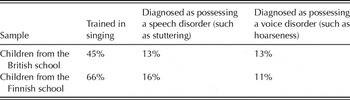
Half of the participant children had undergone formal singing training, whilst half had not undergone any formal singing training. Hence, the first half of the group is subsequently referred to as ‘singing group’ and the latter half of the group is referred to as ‘non-singing group’. The singing training had consisted of a 2-hour-long choral class twice a week for the children in the British school and 15 minutes of singing every day for the children in the Finnish school. The singing activities had been an additional activity to regular singing activities that took place during school music classes (see Table 1 for details).
Background information for the participants

Ethical guidelines
Ethical guidelines of the British Educational Research Association (BERA) were followed throughout the study. Parental and teacher approval were requested prior to data collection.
Instruments
Speaking and singing tasks were used as a means to collect voice data from the children. The tasks were formulated on the basis of literature reviewing the tasks that professional speech and voice therapists used in their practice when assessing a child's voice (Welch & White, Reference WELCH and WHITE1993; Sederholm, Reference SEDERHOLM1996; McAllister, Reference MCALLISTER1997; White, Reference MENDES, BROWN, ROTHMAN and SAPIENZA2001; Whiteside & Hodgson, Reference WHITESIDE and HODGSON1999). Three speaking tasks (reading, speaking spontaneously and sustaining vowels) and two singing tasks (pitch-glides and singing a song) were used in gathering the voice data.
Information on potential psychological background factors was gathered via interviews, questionnaires and a personality inventory. The interviews focused on the children's attitudes and perceptions of singing and their vocal functioning. The survey questions focused on the children's background characteristics (such as leisure hobbies and interests). The interview and survey items were formulated on the basis of a pilot study with a smaller sample of children (n = 22). The personality inventory used was the Eysenck Junior Test (see Appendices for the full schedules).
Procedure
The researcher spent a month at the London school prior to commencing any data collection. The intention was to observe the participant children during this month in order to design the study appropriately. Due to time constraints, the researcher did not have a chance to spend as long a time at the Finnish school and she only spent 2 days at the school prior to commencing data collection.
The data collection procedure consisted of different parts: experiments, interviews, questionnaires and a personality test. In the experiments, each child was taken into a quiet room at their time. (S)he was instructed to sit by a table. The researcher adjusted a small microphone on the child's shirt at the distance of 10 centimetres from the child's mouth. The researcher provided the child with instructions as to how the tasks were to be performed. The experiment was approximately 15 minutes long and was recorded with an MP3-player.
Subsequent to the experiment, an interview was conducted with each child. The interview was approximately 10 minutes long. A survey was conducted with all the participants in the classroom. This took approximately 10 minutes. The children were also asked to fill in the personality test. This also took approximately 10 minutes.
Finally, an interview was conducted with each classroom teacher. In the interview, the teacher was asked to comment on each child separately.
Data analyses
A perceptual voice assessment protocol was used in analysing the voice data perceptually (see Appendices for the protocol). The protocol was designed on the basis of existing perceptual voice assessment protocols (Wilson, Reference WILSON1987; Andrews, Reference ANDREWS1991; Sederholm, Reference SEDERHOLM1996; McAllister, Reference MCALLISTER1997; Mathieson & Greene, 2002; Hunt & Slater, Reference HUNT and SLATER2003). The main difference between the new protocol and the existing protocols was that all the existing formally established perceptual voice assessment protocols were focused on speaking behaviour, whilst the new protocol consisted of sections for both speech and singing. The new protocol contains two sections with 13 identical voice elements – one for assessing singing and one for assessing speaking.
For each child, their speaking and singing was rated by three independent judges with the use of the protocol. The researcher and two professional speech therapists acted as the judges. Each judge performed the ratings at their workplaces with the use of a high-quality recorder and a pair of headphones. The reliability was high (Pearson correlation, r = 0.89, P < .05), indicating that the protocol was a reliable assessment tool.
Each parameter was rated on a seven-point continuous scale. Thus, each child was given a separate score for each of the 13 parameters in speech and in singing. Based on the scores, a rating for overall voice quality for both speaking and singing was calculated for each child (i.e. the mean rating of the 13 scores). Cross-child and cross-group comparisons between overall voice qualities were also carried out.
The data from the interviews, the questionnaires and the personality test were analysed qualitatively with NVivo-software and quantitatively with SPSS, version 14.0. The data from the interviews and the questionnaires were analysed according to four broad categories, designed on the basis of the findings from the pilot study. These categories were: learning and behavioural difficulties; vocal identity; self-esteem and self-worth; and psychological impact of singing. Learning and behavioural difficulties were assessed for by observation, interviews and questionnaires. Information on vocal identity was gathered through questionnaires. The level of self-esteem and self-worth were investigated via a personality inventory. The psychological impact of singing on the children was investigated via interviews and observations prior to and subsequent to singing sessions.
Results
The findings were divided into five sections: voice quality ratings; learning and behavioural difficulties; vocal identity; self-esteem and self-worth; and psychological impact of singing. The sections were formulated on the basis of the literature review (see above) and the findings from the pilot study.
Voice assessment ratings
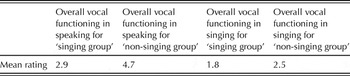
The impact of singing on the children's overall vocal functioning was investigated via comparing voice ratings in speech to those in singing. Such comparisons were made: within individual children; between children possessing healthier overall vocal functioning and those possessing unhealthier overall vocal functioning; and between children in ‘singing group’ and children in ‘non-singing group’. Initial differences between the distributions of the ratings for ‘singing group’ and those for ‘non-singing group’ were recorded. The ratings were healthier for ‘singing group’ than for ‘non-singing group’ (see Table 2).
Mean ratings for overall vocal functioning in speech and those in singing for ‘singing group’ and ‘non-singing group’

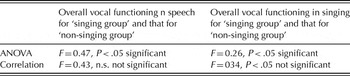
The findings were verified by parametric statistical analyses. Voice ratings in speech for children in ‘singing group’ were compared to those for children in ‘non-singing group’ through the use of repeated measures ANOVA and Pearson correlation. The analyses were replicated for the ratings in singing. The results were statistically significant for the ANOVA (for speech: F = 0.47, p < .05; for singing: F = 0.262, p < .05) but not for the correlation (speech: r = 0.430, n.s.; singing: r = 0.342, n.s.). Such findings indicate that overall vocal functioning in speech and in singing was significantly healthier for the children in ‘singing group’ than for children in ‘non-singing group’.
When comparing the voice ratings in speech for ‘singing group’ to those in singing for the same group, no statistically significant difference was found (F = 0.42, n.s.). For ‘non-singing group’, the result was statistically significant (F = 0.62, P < .05), with the ratings for speech being significantly healthier (mean rating for the whole group: 1.8) than those for singing (mean rating for the whole group: 2.5). Such a finding indicates that singing training may have an enhancing effect on children's overall vocal functioning (see Table 3).
Statistics for ratings for overall vocal functioning in speaking and those in singing for ‘singing group’ and ‘non-singing group’

In summary, the main finding was that the children who had undergone singing training possessed healthier overall vocal functioning in both speaking and singing than the children who had not undergone singing training did. An additional finding was that the children in ‘non-singing group’ possessed healthier overall vocal functioning in speaking than in singing.
Learning and behavioural difficulties
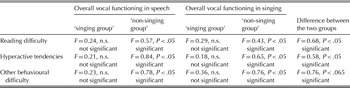
Subsequent to the above findings, comparisons were made between children in ‘singing group’ and those in ‘non-singing group’ since the first group possessed healthier overall vocal functioning than the latter group did. The intension was to investigate whether there was a significant difference as to the prevalence of learning and behavioural difficulties between the two groups. Repeated-measures ANOVA was used as the method of analyses.
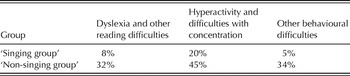
The results indicated that the prevalence of such difficulties was higher amongst children in ‘non-singing group’. The difference between the distributions of the ratings for the two groups was significant (see Table 4). Such findings indicate that the prevalence of learning and behavioural difficulties was higher within the children belonging to ‘non-singing group’ than children belonging to ‘singing group’.
Test-statistics for overall voice quality ratings in speech and in singing for ‘singing group’ and ‘non-singing group’

In addition, qualitative analysis was carried out on the data that had been gathered through the interviews conducted with the children and the classroom teacher. The findings from the interviews supported the outcomes from the statistical analyses in the sense that a greater number of the children in ‘non-singing group’ possessed dyslexia or another form of a reading difficulty when compared with the children in ‘singing group’ (see Table 5). In addition, a greater number of children in ‘non-singing group’ exhibited a greater deal of hyperactive behavioural tendencies and difficulties with concentration than the children in ‘singing group’ did. The findings from the interviews indicate that children in ‘singing group’ felt better about their voices and subsequently better about themselves (see section on ‘vocal identity’ for more details). Such a finding may provide an indication as to why children in ‘singing group’ possessed fewer learning and behavioural difficulties than children in ‘non-singing group’ did.
Percentages for learning and behavioural difficulties in ‘singing’ and ‘non-singing groups’

Percentages for adjectives by which children from ‘singing’ and children from ‘non-singing’ groups described their voices

In summary, the findings indicate that the children possessing unhealthier overall vocal functioning may be more likely to possess learning and behavioural difficulties than their peers with healthier overall vocal functioning.
Vocal identity
Vocal identity can be defined as ‘the way in which one identifies with one's voice’ and it is connected to how good or bad one feels about one's voice, as well as oneself (Andrews, Reference ANDREWS1991; Bolfan-Stosic et al., Reference BOLFAN-STOSIC, YLIHERVA, WELCH and Manfredi2003). Data for vocal identity were gathered via a questionnaire, and they were analysed qualitatively.
The first finding was that the children from ‘singing group’ stated that they liked the way their voices sounded in both speech and singing. The children from ‘non-singing group’, on the other hand, stated that they only liked the way their voices sounded when they spoke, not when they sang. For instance, a child from ‘singing group’ stated:
I like my voice when I speak . . . It sounds normal. It also sounds wonderful when I sing.
A child from ‘non-singing group’ claimed:
I don't really think about my voice. I don't mind it when I speak . . . But when I sing . . . Hmm . . . I don't know . . . I just don't like it.
Such findings indicate that children from ‘singing group’ identified with their ‘singing voices’ in more positive terms than the children from ‘non-singing group’ did.
The second finding was that the majority of the children from ‘singing group’ were able to describe their voices in both speech and singing, whilst the majority of the children from ‘non-singing group’ were able to describe their voices only when speaking. For example, a boy from ‘singing group’ stated:
My voice sounds so powerful and beautiful when I sing. Also, when I speak, it sounds normal and good.
A girl from ‘non-singing group’ claimed:
My voice is ok when I speak. It sounds good and ok. I can't really say when I sing. I never really pay attention to it. I just don't know.
Such findings indicate that children who have not undergone singing training may find it difficult to describe their ‘singing voices’. Children who have undergone singing training do not generally demonstrate the same difficulty.
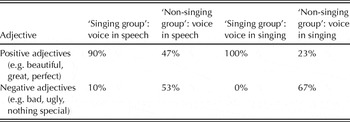
The third finding was that children from ‘singing group’ described their voices in more positive terms than children from ‘non-singing group’ did (see Table 6). The majority of the children in ‘singing group’ stated that their voice sounded good and normal in speech and beautiful in singing. The majority of the children in ‘non-singing group’ stated that their voices sounded alright in both vocal behaviours. For instance, a child from ‘singing group’ stated:
My voice sounds good when I speak. When I sing, it sounds really great.
A girl from ‘non-singing group’ claimed:
My voice is ok when I speak. It is ok when I sing too. I like it more in speaking though. It is a bit more ok then.
Such findings indicate that the children from ‘singing group’ viewed their voices in more positive terms than the children from ‘non-singing group’ did. Such perceptions may potentially be reflected in the way they view themselves.
Self-esteem and self-worth
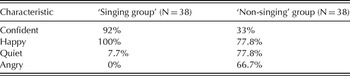
Since self-esteem and feelings of self-worth are connected to one's vocal identity and how one perceives oneself (Mathieson & Greene, Reference MATHIESON and GREENE2003), they were investigated in more detail. The first finding was that children from ‘singing group’ viewed themselves in more positive terms than children from ‘non-singing group’ did (see Table 7). Children from ‘singing group’ described themselves as confident, happy and talkative. Children from ‘non-singing group’ described themselves as quiet and angry. Such findings imply that the better children feel about their voices, the better they also feel about themselves.
Percentages for self-reflection statements for ‘singing group’ and ‘non-singing group’

Percentages for self-worth and self-esteem statements

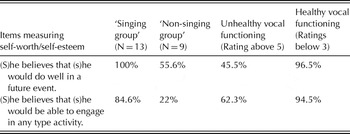
The second finding was that children from ‘singing group’ believed in themselves and their abilities more than the children from ‘non-singing group’ did (see Table 8). For instance, children in ‘singing group’ were more likely to state that they believed they were able to do well in any new activity, whilst the children from ‘non-singing group’ stated that they felt that it was fairly unlikely that they would do well in any activity. Such findings imply that the unhealthier one's overall vocal functioning is, the less confident the child is. Alternatively, it may be that singing training raises children's self-esteem and feelings of self-worthiness. Higher levels of such domains may subsequently have an impact on one's overall vocal functioning.
Psychological impact of singing
Observation and interviews with the children and the classroom teachers were used as a means to gather data on the potentially psychological impact of singing. The data were analysed qualitatively. The first finding was that children from ‘singing group’ stated that they felt relaxed and uplifted after a singing session. They also stated that they found singing enjoyable, with singing sessions offering them with something fun to do. Children from ‘non-singing group’, on the contrary, stated that they found singing activities anxiety-provoking and daunting. They stated that they felt that such activities were not suitable for them. For instance, a girl from ‘non-singing group stated:
I don't feel very comfortable when I sing. My throat hurts and I feel stressed out. It is tiring.
A girl from ‘singing group’ stated:
I love to sing. It makes you feel so relaxed and cheerful. It is so much fun.
The second finding was that, in the mornings when the children in ‘singing group’ undertook singing, their behaviour was more manageable in the classroom throughout the whole day. The singing sessions seemed to influence their learning mode so they were more able to learn effectively. Singing appeared to possess a long-lasting, relaxing and psychologically pleasing effect on the children. For example, a boy from ‘singing group’ stated:
I feel relaxed and better after singing. I feel better in the classroom too. Then it is not so boring to read and write. It is a lot nicer to do that after you have been singing and you can do it better then too.
Another girl from ‘singing group’ stated:
I feel I can learn better after singing. I feel my brain is relaxed and working better.
In summary, the findings indicate that singing sessions served a positive function for the children who regularly took part in singing sessions. Singing seemed to influence their psychological well-being and mental states significantly.
Discussion
Speech and voice disorders are more and more common amongst pre-pubertal children (Sederholm, Reference SEDERHOLM1996; McAllister, Reference MCALLISTER1997; Hunt & Slater, Reference HUNT and SLATER2003). Despite the fact that such disorders can have significant impact on a child's psychological well-being and quality of life (Bolfan-Stosic et al., Reference BOLFAN-STOSIC, YLIHERVA, WELCH and Manfredi2003), alternative treatment strategies focusing on psychological factors remain under-researched. More specifically, potential use of music and singing as intervention strategies has not been researched (Rinta & Welch, Reference RINTA and WELCH2008).
According to a number of studies, adults have benefited from singing activities, based on their influence on one's psychological well-being (Grape et al., Reference GRAPE, SANDGREN, HANSSON, ERIKSON and THEORELL2003; Mendes et al., Reference MENDES, BROWN, ROTHMAN and SAPIENZA2004). The findings from the current study with children support such claims, as singing seems to possess an enhancing effect on children's psychological state and well-being through enhanced overall vocal functioning (and vice versa). Significant improvements for the children in ‘singing group’ were recorded in both speaking and singing behaviours. However, from the statistical analyses alone, it did not become clear whether the positive effect of singing manifested themselves through psychological factors or whether they were more concerned with the physiological factors connecting one's speaking behaviour to one's singing behaviour (Rinta & Welch, Reference RINTA and WELCH2008).
From subsequent findings as stated below, the psychological impact of singing became clear. Firstly, the children in ‘non-singing group’ (i.e. children with unhealthier overall vocal functioning) possessed a higher prevalence of learning and behavioural difficulties than the children in ‘singing group’ did (i.e. children with healthier overall vocal functioning). The finding supports the claims from the literature that learning and behavioural difficulties are connected to speech and voice disorders (Koivusaari, Reference KOIVUSAARI1998; McAllister, Reference MCALLISTER1997; Sederholm, Reference SEDERHOLM1996). The findings also support the arguments that the majority of children possessing speech or voice distortions find it frustrating to communicate with others, frequently resulting in psychological stress and subsequently influencing behavioural and learning patterns (Sederholm, Reference SEDERHOLM1996; McAllister, Reference MCALLISTER1997).
The finding indicates that speech or voice disorders have an impact on the sufferer's sense of identity and feelings of self-worthiness. Such factors may indirectly influence the individual's learning and behavioural patterns. Alternatively, it may be that children with learning and behavioural difficulties develop speech and voice disorders more easily than their peers with fewer or no learning and behavioural difficulties do. Nevertheless, it seems that there is a network of different psychological factors in play, which seem to be interconnected and influencing one another. It seems that singing has an impact on the inter-play of these factors. Based on such findings, singing could potentially be exploited in counteracting any negative interaction between the above factors in the form of an informal intervention strategy.
Secondly, the children from ‘non-singing group’ possessed poor and negative vocal identities. Such a finding supports the literature that claims that vocal identity may be linked to the overall quality of one's voice and one's overall vocal functioning (Wilson, Reference WILSON1987; Bolfan-Stosic et al., Reference BOLFAN-STOSIC, YLIHERVA, WELCH and Manfredi2003). The finding supports the claims that speech and voice disorders may have a negative impact on the sufferer's self-esteem and feelings of self-worth (Sederholm, Reference SEDERHOLM1996; Bolfan-Stosic et al., Reference BOLFAN-STOSIC, YLIHERVA, WELCH and Manfredi2003; Mathieson & Greene, Reference MATHIESON and GREENE2003).
Previous studies have also indicated that singing can potentially increase the level of one's self-esteem and feelings of self-worthiness (Thurman & Welch, Reference THURMAN and WELCH2000; Grape et al., Reference GRAPE, SANDGREN, HANSSON, ERIKSON and THEORELL2003; Mendes et al., Reference MENDES, BROWN, ROTHMAN and SAPIENZA2004). The findings from the study support such claims. Children in ‘singing group’ possessed higher levels of self-esteem and self-worth than the children in ‘non-singing group’ did. Singing training seems to have an impact on the children's identity and vocal identity. Through singing training, children may develop healthier views of their voices and themselves, based on their enhanced overall vocal functioning. The findings indicate that the better one feels about his/her voice, the better one feels about him/herself, which is likely to be reflected in other psychological functions too.
The findings from the study indicate that a network of psychological factors is connected to overall vocal functioning. Therefore, from the findings it becomes evident that new and effective treatment strategies targeting potential psychological causal factors behind children's speech or voice disorders need to be developed.
Treating pre-pubertal children's speech or voice distortions could potentially be carried out in educational settings, based on the fact that children attend a school on a more regular basis than they attend a speech or voice therapy session. Undiagnosed distortions could also potentially be treated in educational settings in an indirect way through enhancing the children's vocal functioning, vocal identity and psychological well-being. In such settings, the children would not necessarily feel like they are undergoing therapy but rather that they are engaged in enjoyable activities. Singing activities could easily be exploited in such settings, as they do not require any specific professional training on behalf of the teacher. Moreover, singing seems to have direct educational implications. For instance, singing can be exploited as a means to achieve improved concentration and learning abilities. In general, singing activities are perceived to be enjoyable and fun by the majority of children and can, therefore, be exploited in achieving states of relaxation in the children, further being reflected in their educational outcomes.
Implications for practice and for further research
In practical terms, there are a variety of ways in which singing can be implemented in educational settings with children. For instance, two songs that the teacher is comfortable teaching could be undertaken at the beginning of the school day in order to enable the children to relax and, subsequently, to maximise their learning for the school day. Group songs or songs in pairs could also be sung during break time or straight after break time in order for children to focus on their school work again. Singing could also be integrated as a teaching method in other subject disciplines (such as teaching new words in English lessons through singing). The teacher could adopt different ways of integrating singing in the classroom, depending on their teaching experience in singing.
As to further research, a larger-scale longitudinal study consisting of a treatment group undergoing specific singing training and a control group not undergoing such training should be conducted in order to be able to draw firmer conclusions from the current study. Various types of speech and voice disorders should be included in such a study. Such singing activities would be specifically designed to suit pre-pubertal children. Voice recordings and assessment for psychological factors would be performed at the start and at the end of the intervention, as well as within short intervals throughout the intervention in order to assess for any particular impact that singing may have on the children.
Acknowledgements
The research was carried out with financial assistance from the Economics and Social Research Council (UK), the Finnish Cultural Foundation (Finland) and the Finnish Government (Finland). Many thanks to Graham Welch and Johan Sundberg for their on-going support and encouragement.
Appendices
1. Questionnaires
Name:
1. Do you have many friends?
2. What do you like to do with your friends?
3. Please circle the terms below that you think describe your personality.

4. What do you like doing after school and during the weekends?
5. What do you like doing most at school?

Name:
1. How old are you?
2. What is your nationality?
3. Are you a boy or a girl?
4. Which language or languages do you speak at home?
5. Do you speak any other languages?
6. How many older brothers or sisters do you have?
7. How many younger sisters or brothers do you have?
8. Do you like singing?
9. Why do you or do you not like singing?
10. Do you have any other musical hobbies?
11. What other musical hobbies do you have?
12. Do you sing in your hobby?
13. How long have you had this hobby for?
14. Do you sing at school?
15. Do you sing in a choir?
16. Do you sing in music lessons?
17. Do you sing in the assembly?
2. Interview schedule
Name:
1. What is the main instrument you use for speaking?
2. What is the main instrument you use for singing?
3. Do you like the way your voice sounds when you speak?
4. How would you describe your voice when you speak?
5. Do you like the way your voice sounds when you sing?
6. How would you describe your voice when you sing?
7. Do you think your voice is different when you speak in comparison to when you sing?
8. How do you feel after your singing session?
9. How does singing make you feel?
10. Do you learn differently in the classroom after you have engaged in singing?
11. Do you concentrate better in the lessons after you have been engaged in singing?
12. Do you think singing has an impact on how you behave in the classroom?
3. Interview with the classroom teacher
1. Does this particular child have any diagnosed speaking difficulties?
2. Do you feel that the child has problems with his/her speaking or voice use?
3. Do you feel that the problems disturb the child's learning in the classroom?
4. Do you think that the problem has an effect on the child's behaviour?
5. Do you think this particular child has any behavioural problems?
6. Do you think that this child has any particular difficulties with learning?
7. Do you feel that this child has any difficulties with reading?