INTRODUCTION
The notion that head lice (Pediculus humanus var. capitis) are readily transmissible via fomites, such as combs, hats or headphones, is a widespread view amongst the public. However, accurate studies have not confirmed a frequent role of objects in the transmission of head lice (Canyon et al. Reference Canyon, Speare and Muller2002; Pollack and Kiszewski, Reference Pollack and Kiszewski2010). Direct head-to-head contacts provide the main route for transmitting head lice. This prompts the question why do people touch their heads together?
One can easily get a pictorial guide to this aspect of human behaviour by typing the phrase ‘touching heads’ into a Google image search. The vast majority of these ‘touching heads’ photos illustrate pairs of people who seemingly love each other (Fig. 1). Participants involve children and adults of all human races, either as friends or colleagues, within heterosexual or homosexual pair-bonds, and also within parent-offspring and grandparent-grandchild relationships. Apparently, people who love each other often express their positive emotions by leaning their heads to each other. We do not mean a kiss on the lips or the face, neither an ‘aerial kiss’; loving people just lean head-to-head so that their hairy scalps may touch each other. The temple region is often involved in this behaviour i.e. the area most frequented by head lice. And indeed, infested children often say that they have got their lice either from close relatives or from their best friends.
The ‘touching heads’ behaviour in humans. People who like or love each other, either within the context of collegial friendship, genetic kinship, or even pair bond, often express their emotions by leaning their heads so that their hairy scalps may touch each other. This human behaviour is exemplified here by evolutionary psychologist Professors Griet Vandermassen and Satoshi Kanazawa posing for a conference photo at a science meeting. When this photo was taken, they were not aware of the hypothesis presented in this paper. (Published in the present context with their kind permission.)

Here, we propose a new evolutionary hypothesis to interpret the adaptive value of this human behaviour. We claim that it serves to enhance the transmission of head lice. Theoretically, transmitting pathogens to conspecifics could act as a means of intraspecific aggression (Rózsa, Reference Rózsa2000; Dionisio, Reference Dionisio2007). Contrary to this situation, however, in the case of host-facilitated head lice transfer the donor and the recipient are typically engaged in a positive emotional bond.
THE HYPOTHESIS
We propose that transmitting head lice to friends and relatives might have been adaptive because head lice played a mutualistic role during the human evolutionary past. This claim is based on the following points.
First, blood-sucking insects inject saliva into the hosts with proteins that manipulate local blood flow and host response. These proteins may provoke an immune response in the hosts (Wang et al. Reference Wang, Paesen, Nuttall and Barbour1998). This can possibly explain why many head lice-infested people without secondary infections show cervical lymphadenopathy (Heukelbach et al. Reference Heukelbach, Wilcke, Winter and Feldmeier2005). Not surprisingly, the rabbit – a model host for human body lice (Pediculus humanus var. humanus) – can be immunized against body lice (Ben-Yakir et al. Reference Ben-Yakir, Mumcuoglu, Manor, Ochanda and Galun1994; Mumcuoglu et al. Reference Mumcuoglu, Ben-Yakir, Ochanda, Mille and Galun1997). Lice feeding on immunized hosts take smaller bloodmeals, produce fewer eggs and have a higher rate of mortality. Furthermore, Mumcuoglu et al. (Reference Mumcuoglu, Ben-Yakir, Gunzberg, Ochanda and Galun1996) have shown that several antigens of human body lice are identical to those carried by the cattle lice Haematopinus africanus and the goat lice Linognathus stenopsis. Therefore, the authors proposed that domestic animals could be immunized against their specific lice simply by infesting them by human lice.
Second, human head lice and body lice belong to the same biological species. They are very closely related genetically and may interbreed with each other (Light et al. Reference Light, Toups and Reed2008) while they still affect different, though overlapping, age classes and socio-economic classes of human societies (Li et al. Reference Li, Ortiz, Fournier, Gimenez, Reed, Pittendrigh and Raoult2010). Although they occupy different areas of the human body surface, they feed, however, on the same food resource, i.e. human blood. It seems conceivable that the immune response provoked by head lice can affect body lice negatively and vice versa. Thus we presume that a certain level of immune-mediated negative interaction (often termed as cross-immunity) may arise between head lice and body lice.
Third, although it is theoretically possible for head lice and pubic lice (Pthirus pubis) to transmit microbial pathogens, they have no epidemiological significance as vectors of human diseases (Maunder, Reference Maunder1983). Contrarily, throughout human history, body lice regularly spread highly virulent bacteria causing epidemic typhus (Rickettsia prowazekii), trench fever (Bartonella quintana), and relapsing fever (Borrelia recurrentis) (Buxton, Reference Buxton1946). Moreover, body lice probably also played a major role as a vector of the classical plague (Yersinia pestis) of medieval ages (Drancourt et al. Reference Drancourt, Houhamdi and Raoult2006). This difference between the epidemiological roles of head versus body lice might have existed through long evolutionary periods and likely to have exerted strong selective pressure upon our ancestors.
Based on the above points, we hypothesize that since the first differentiation between body lice and head lice, about 83 000 and possibly as early as 170 000 years ago (Toups et al. Reference Toups, Kitchen, Light and Reed2010), people enjoyed an adaptive benefit from carrying head lice infestations that reduced the threat exposed by lethal bacterial infections transmitted by body lice. This presumed former mutualistic role of head lice is still indicated by the present-day human behaviour to transmit head lice preferentially to friends and relatives. Naturally, the adaptive value of head lice infestations disappeared in modern societies where medical care has greatly reduced or even totally eliminated the threat of louse-borne epidemics.
PREDICTIONS
Imagine an archaic society where both head lice and body lice may infest anybody at any accidental period of his/her life cycle. Individuals who acquire head lice earlier than others would gain a selective advantage by developing some defence against body-louse-borne diseases for a longer period of their life. Therefore, we predict that people were selected to get head lice as early as possible. Indeed, Pediculosis capitis behaves like a paediatric pandemic in all human societies, being much more prevalent in the age class 4–14 years than later on.
Alternatively, one could argue that the high prevalence of head lice among school children is not an inherent characteristic of this particular age-class but purely an artefact of the schooling system itself. This view is not supported by observational evidence. Several authors (e.g. Meinking, Reference Meinking1999; Frankowski and Bocchini, Reference Frankowski and Bocchini2010) argue that the high prevalence of head lice in school children can be attributed to the high amount of head-to-head contacts while playing. Evidently, children's motivation to play is not caused by the school system but characterize the age-class. Furthermore, a study by Poudel and Barker (Reference Poudel and Barker2004) describes an exceptional case where the effect of age classes can be viewed separately from the effect of the schooling system as they provide separate prevalence data for school children and street children representing the same age classes. By adding their data for head lice infested and double infested (head lice + body lice) children, one can conclude that (i) head lice prevalence is lower among school children than among street children, and (ii) that prevalences tend to decline with the children's age in both groups as they approach maturity. This pattern suggests that the decline of head lice infestations above 14 may take place even without any medical interventions probably due to the ontogeny of the human immune system.
Contrarily, body lice infestations are more characteristic in adulthood (Li et al. Reference Li, Ortiz, Fournier, Gimenez, Reed, Pittendrigh and Raoult2010). Thus during the course of a human life cycle, head lice infestations may precede body lice infestations. We presume that childhood head lice infestations lasting through several years and then finally disappearing spontaneously may reduce the threat posed by body-louse-borne infections later on.
We need not presume that this immune response would necessarily prevent someone from getting body lice. Nevertheless, an increased mortality and reduced natality of body lice can still yield a direct and an indirect benefit for immunologically experienced persons. Louse-borne pathogens are not found in the louse saliva, thus they cannot infest humans by means of blood sucking. They can enter the human body when a skin wound is scratched or scraped and either the feces of infected lice, or the haemolymphs from crushed, infected lice accidentally contaminate this wound (Roux and Raoult, Reference Roux and Raoult1999). Arguably, this is a relatively slow mode of transmission, not necessarily taking place during the first blood-sucking attempts. Thus the human immune response may probably reduce the chance of bacterial infections by killing infected lice before the bacteria could enter the human body. Even a slight reduction of this chance would yield a direct adaptive benefit for the louse-infested persons. Moreover, even if the immunologically experienced people would still carry reduced burdens of body lice, their potential to transmit body lice to conspecifics would be reduced considerably. Given that body lice mostly transmit through shared clothes and beds, it is reasonable to predict that this results in a benefit for the friends and relatives of the immunologically experienced persons. In this case, childhood immunological experience with head lice would gain an indirect benefit through kin selection (in the sense of Hamilton, Reference Hamilton1963) or, alternatively, within the context of reciprocal altruism (Trivers, Reference Trivers1971).
Moreover, louse-borne infections may still expose a recent, or even a present, threat in economically underdeveloped Third World countries where body-louse transmitted diseases recently were, or presently are, virulent and prevalent. We predict that the attitudes towards head lice infestations in these societies are not necessarily negative. This is supported by a recent study carried out in a rural village society in sub-Saharan Africa. Heukelbach et al. (Reference Heukelbach, Ugbomoiko, Ande and Oliveira2010) found that 74% of the population were presently or formerly infested. Of the 142 individuals with active infestations, the vast majority (>97%) had no or indifferent feelings about being infested, while only 4 persons were surprised or felt ashamed. This figure is markedly different from the negative view currently experienced in rich and modern societies (Heukelbach, 2010).
The split of human lice (P. humanus) into the varieties (ecotypes) called head lice and body lice is a relatively modern evolutionary event (Toups et al. Reference Toups, Kitchen, Light and Reed2010) that did not occur in the lice parasitizing non-human apes. Thus each non-human primate species hosts only one, if any, louse species that is not subdivided into separate subspecies, varieties or ecotypes (Reed et al. Reference Reed, Light, Allen and Kirchman2007). Thus apes cannot benefit from transmitting one type of lice to reduce infestations by another type of lice. Therefore, although the expression of emotions in apes is markedly similar to that in humans (Darwin, Reference Darwin1872), we predict that the ‘touching heads’ behaviour should be absent from the ape behavioural repertoire. This corresponds nicely to the apparent lack of the ‘touching heads’ behaviour from the chimp behavioural repertoire (see e.g. McGrew, Reference McGrew2004; Nishida et al. Reference Nishida, Zamma, Matsusaka, Inaba and McGrew2010).
AN APPARENT CONTRADICTION
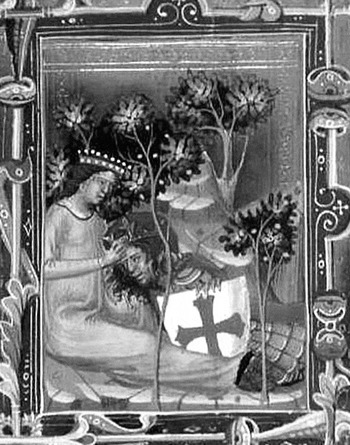
Several illustrations from the medieval and also from more recent centuries depict European, African or Asian people grooming head lice off the hair of each other (Fig. 2). At a first glance, this appears to contradict our hypothesis provided that these people lived under a permanent threat exposed by body-louse-borne diseases. However, this behaviour is apparently the result of a cognitive decision based on the understanding of causality between the insects observed in the hair and the itching bites emerging on the skin. Unlike many animals, humans do not exhibit instinctive and unconscious allogrooming behaviours to remove lice from their fellows' hair, body or clothes. This is interesting, because apes, monkeys, other mammals, birds, and even eusocial insects exhibit frequent allogrooming (Sparks, Reference Sparks and Morris1967). Thus, on the one hand, humans do exhibit an unconscious behaviour to transmit head lice to friends and relatives – i.e. touching the heads. On the other hand, however, the behaviour to remove lice (i.e. allopreening) is a matter of conscious decisions.
Human allogrooming. Several pre-modern illustrations depict people removing lice from the hair of each other. This behaviour is apparently a result of a cognitive decision based on the understanding of causality between the insects observed in the hair and the itching bites emerging on the skin. Removing head lice may be adaptive or not, depending on the actual epidemiological environment. Saint Ladislaus I of Hungary as illustrated in the Anjou Legendarium (Anonymous, 1330).

Finally, the most important prediction of our hypothesis is that people who were infested by head lice through their childhood and got rid of them spontaneously would be less prone to body lice infestations in their adult life. Unfortunately, this prediction cannot be directly tested in rich and modern societies with advanced health care systems. In these societies, infested children typically get treatments soon after diagnosing P. capitis so that their immune system cannot develop long-lasting responses. Moreover, adults are typically not exposed to body lice except for the homeless people. Potentially, the future emergence of a human vaccine against head lice (Wikel, Reference Wikel, Marshall Clark and Ohkawa2005) may give us a chance to test whether or not cross-immunity occurs between head lice and body lice. We predict that children vaccinated against head lice will grow up into adults more resistant against body lice. Presently, a direct experimental test of the hypothesized cross-immunity between head lice and body lice could be carried out only in Third World countries with underdeveloped or non-existing health services.
CONCLUSIONS
Above, we argued that the human head lice might have been a mutualistic partner of humankind up until recently. This may explain why present-day people still go on unconsciously enhancing its transmission to friends and relatives as if the infestation would be advantageous.
Apparently, the ‘touching head’ behaviour is an inherent and characteristic aspect of the human emotional expressions that is absent from chimps and bonobos. Above, we hypothesized that one particular adaptive benefit of this behaviour is the enhancement of the transmission of mutualistic head-lice. Naturally, we do not exclude the possibility that other adaptive benefits of this behaviour may also exist.
The available facts, such as immunological, epidemiological and behavioural observations do not exclude the scenario that head lice infestations were adaptive for humans since they reduced the threats exposed by body-louse-borne diseases. Pediculosis capitis is currently one of the most prevalent paediatric pandemics on Earth that is widespread in poor and in rich societies as well. Therefore, elucidating the immunological, evolutionary, behavioural, and even cultural aspects of its past and present spread would be essential. We believe that the idea of facultative mutualism between humans and head lice is a powerful thought in the sense that, if verified in the future, it can perhaps provide a comprehensive evolutionary interpretation of the nature of this peculiar host-parasite system.