“There can be no concurrent power respecting such a subject-matter [policies regarding freedom of movement]. Such a power is necessarily discretionary. Massachusetts fears foreign paupers; Mississippi, free negroes.”
—Frederich Kapp, New York City Commissioner of Emigration, 1870Footnote 1I. INTRODUCTION
In a federal system, does the national government or do the states and localities regulate immigration policy? The fact that there was a tough political and legal fight over Arizona's controversial S.B. 1070 immigration law, which culminated in the Supreme Court decision Arizona v. United States Footnote 2 in 2012, illustrates that the answer to that question is not an obvious one. Long before Arizona v. United States grabbed headlines, probably the best-known immigration policy of the U.S. national government was carrying out the exclusion of an entire ethnic group via the Chinese Exclusion Act of 1882. This infamous law was followed by the imposition of discriminatory national origins-based laws that lasted until 1965. But where was the national government on migration policy in the 104 years before this infamous show of the coercive power of the American State in 1882?Footnote 3 Indeed, it may surprise many that, before the Civil War, the states drove and implemented migration policy—not the national government. Why was there a long delay before federal consolidation of migration policies?
Contemporary discussions about immigration federalism, including the arguments made in Arizona v. United States, paint a deceptively parsimonious and definitive portrait of the division of national and subnational power over this policy area, when in fact, the balance of power between the national government and subnational units in any policy area is an ongoing political negotiation. The federal system in the United States, which is enshrined in the U.S. Constitution, lays out only a general framework for the distribution of power and authority between the national and subnational governments. In every period of U.S. history, the location of the line dividing national and subnational authority, as well as the specific details of power-sharing arrangements between the levels of government, is largely determined by politics, and these forces and constraints are temporally specific. A reexamination of state policies over the freedom of movement in the nineteenth century will help us understand the timing and sequencing of which level of government had control over the policies regarding freedom of movement. In turn, these conclusions urge scholars to rethink how the American State itself is conceptualized.
In the nineteenth century, the national government did not control “immigration policy” as we conceive of it today. Contemporary immigration policy pertains to the ability of the national government to manage the entry and exit of persons from its geographical territory, and what we commonly understand today as deportation or removal policy. Meanwhile, “immigrant policy” refers to the policies that govern the rights, privileges, and benefits immigrants have once they are within U.S. territory.Footnote 4 These two terms, “immigration policy” and “immigrant policy,” are thoroughly contemporary constructs and devoid of meaning in the nineteenth-century lexicon. During the nineteenth century, the two concepts bled together almost seamlessly. Using only contemporary conceptions provides an incomplete inventory of the historical breadth of State power over the movement of people.
In the nineteenth century, the subnational units, the states and localities, had virtually exclusive control over a broad set of policies that affected the ability of certain classes of persons to enter and travel in U.S. territory. These classes included: free African Americans, black sailors from foreign ships, the poor, the sick, the disabled, and criminally convicted immigrants from Europe.Footnote 5 It is true that the United States had what can be regarded as a generous immigration policy in that it never did exclude immigrants based on race (like Australia's white-only policy), and the United States never did implement literacy tests to screen out immigrants upon entry.Footnote 6 But for certain classes of persons deemed undesirable, there were extensive subnational restrictions on their freedom of movement. Only with a systematic examination of subnational controls over what is known today as immigration policy can one appreciate the severe and widespread limitations against an individual's ability to move into and within the United States before the Civil War. Such an examination allows us to recognize that the early American State was more robust and coercive toward certain groups of persons.
In the instance of policies regarding the movement of peoples, the very existence of the federal system underwrote a vast system of control over the liberty of movement of many groups of people, not solely immigrants, but also others who were deemed dangerous or undesirable by the states and localities. Instead of one set of laws that created barriers to the freedom of movement, the federal system worked to multiply permutations of restrictive policies via a phalanx of state laws. Political scientist William Riker has cautioned that it is an “ideological fallacy” that “federal forms are adopted as a device to guarantee freedom.”Footnote 7 As the case of antebellum migration policy in both the North and South will show, sectional differences accommodated by a federal system before the Civil War greatly affected states' regional perceptions of who should be given freedom of movement.
In this article I explain why the subnational level, not the national government, led the way in migration policies before the Civil War and why the national government did not take over migration policy until after 1882. Although the national government had previously passed the Alien and Sedition Acts in 1798, these acts were viewed as highly partisan, and were repealed by 1802. The Page Act of 1875 was a piece of federal legislation that sought to bar unfree labor (coolie and indentured), prostitutes, and other criminals. However, at the time of passage of that act, the future and scope of federal immigration control was entirely unclear and unsettled; indeed after the Page Act, states still remained the central players in making and implementing migration policy.Footnote 8 Of course there are also the federal laws regarding naturalization, such as the first, passed in 1790. This fact is not surprising, since naturalization is the only enumerated aspect of migration policy that appears in the Constitution, but naturalization policy had a distinctive developmental path of federalization from entry/exit policy and, for that reason, is beyond the scope of this essay. My choice of 1882 as the turning point for transition to federal control is based on the fact that key aspects of the 1882 acts (a federal head tax, and exclusion of paupers) were replications of state policy, and that federal control over migration was actively lobbied for by the northeastern states by the late 1870s.Footnote 9
Both northern and southern states had very strong, albeit dissimilar, incentives to guard closely for themselves any policies regarding the liberty of movement—which each region viewed as central to their self-preservation. The northeastern states were trying to protect themselves against an influx of the poor, sick, and convicted, who could become local economic and social liabilities. The southern states wished to preserve and upkeep their slavery system, so ceding control to the national government over policies that impinged on the movement of persons was unthinkable. Those regionally specific incentives dissipated by the late 1870s. However, before the Civil War, many policies that directly affected the freedom of movement were considered part and parcel of other matters, such as slavery, poor laws, and public health laws, to name a few areas that ostensibly had nothing to do with immigration. Similar to legal scholar Gerald Neuman's groundbreaking article “The Lost Century of American Immigration Law (1776–1875),” this article focuses on a range of policies that impinged upon freedom of movement, even if these policies do not resemble contemporary immigration policy.Footnote 10
Operating under the assumption that having no national policy on migration was equivalent to the United States having open borders, most studies of immigration history gloss over the pre–Civil War period. Aristide Zolberg's elegant synthesis of immigration policy in A Nation by Design: Immigration Policy in the Fashioning of America is one of the few studies of immigration history that includes analysis of the role of the colonies and then the states in immigration policy. Zolberg noted that “However powerful, the effects of social forces, external and internal, are not automatically translated into policy outcomes, but are mediated by political structures.” He went on to name some of these structures, including “the allocation of decision-making authority and power between levels and branches of government,” but his goal was not to produce a study of the federal system.Footnote 11 With regard to the body of scholarship on immigration policy itself, most has focused on national institutions and policies, and the comparisons to European models have been comparisons to countries with unitary systems.Footnote 12
As this case study of nineteenth-century policies on the movement of persons shows, an exclusive focus on the national government's policies on entry/exit procedures would produce an incomplete assessment of true State strength in the nineteenth century as well as erroneously suggest that before the national government took over immigration policy in 1882, there was total freedom of movement.Footnote 13 An examination of this time period also makes clear that scant federal migration policy by no means meant open borders for foreign and domestic migrants, given the wide array of state-level restrictions of movement.
This article is organized into five main sections, including the introduction and conclusion. Section two begins with a call to reassess the way scholars conceptualize the early American State. The third section delves into the distinct regional and political priorities in the nineteenth century that drove northeastern and southern states' desire to retain control over policies implicating liberty of movement. That section also itemizes the factors that preserved equilibrium for the roughly one hundred years of state-run migration policy. The fourth section explains the disruptions to this equilibrium, and how a confluence of factors in both the northeastern and southern states worked to eventually pave the way for the transition to federal control over immigration policy.
II. THE FALACY OF ADMINISTRATIVE CAPACITY OF THE NINETEENTH-CENTURY CENTRAL GOVERNMENT
In evaluating State power, sociologist Michael Mann's distinction between “despotic power” and “infrastructural power” is useful. Mann advocated assessing State power on two dimensions: despotic power, which he described as “the range of actions which the elite is empowered to undertake without routine, institutionalized negotiation with civil society groups,” and, by contrast, infrastructural power, which is defined as “the capacity of the state actually to penetrate civil society, and to implement logistically political decisions throughout the realm.”Footnote 14 With respect to policies governing the movement of people into and across U.S. territory, different parts of the early American State exercised dissimilar dimensions of power; the antebellum central government barely enjoyed despotic power, but infrastructural power was widely exercised through the state governments.
The most common theory about why the national government did not assume power over migration policy in the nineteenth century is the assumption that it simply lacked administrative capacity to do much of anything, much less manage its borders. But in defining State capacity, many assessments of the early republic never quite define what exactly “the State” is, with most scholars defaulting to considering only the powers of the national government, not how power and authority were actually allocated, thereby ignoring the subnational levels.Footnote 15
Accounts of the early American State often focus on “administrative capacity” as a measure of State strength without also discussing the federal system and how authority was divided.Footnote 16 One may have adequate administrative capacity and still no authority to act, just as much as one may have authority but no capacity to carry it out. The former characterization better explains nineteenth-century migration policy being housed at the subnational level. While an analysis of administrative capacity is a start, it should not be the end of the analysis. As the next section explains, nineteenth-century political cultural and popular understandings dictated that public welfare reigned supreme over individual rights, that laws were tools to “maintain social order,” and that that local government could best attend to the public welfare according to the local political culture and practices.Footnote 17
Historian Brian Balogh disagrees with the prevailing scholarly understanding that the national government was absent and did not have significant influence over the lives of citizens until the twentieth century. He does agree that in the nineteenth century, to the extent citizens felt the influence of the government on their lives, it was usually the effect of subnational government, but, Balogh argues, the national government's power in the nineteenth century was “hidden” and “out of sight” from the view and perception of average citizens.Footnote 18 He also contends that, during that time, power was “inverted,” in that the nation's capital was not the locus of power; the national government's power was most visible in the periphery as the young nation expanded into new territories. Indeed, in U.S. territories that had not become states, the national government had plenary power and did not have to share authority with the states or any local government.Footnote 19
Balogh's important observation that the expansion of national government power was most successful where there was the least state resistance to it can be applied to understanding migration policies.Footnote 20 He was writing about the frontier and the territories, where the national government did not have to share power with the states, but his point could also be applied to subject-matter jurisdictions. The national government could not expand into migration policies because the states viewed those policies as properly the province of the state and local governments. It is a supreme irony that as the national government was aggressively pushing westward in an expansionist mode, it simultaneously did not have infrastructural power to control who entered into and traveled across U.S. territory.
Legal scholar Jerry Mashaw has also rejected political scientist Walter Dean Burnham's classic assertion that “there was no state” before 1861.Footnote 21 Mashaw contested the view that “the national government did not do anything significant until it built up its administrative capacity in the twentieth century.” In fact, the administrative State started very early. He noted, “From the earliest days of the Republic, Congress delegated broad authority to administrators, armed them with extrajudicial coercive powers, created systems of administrative adjudication, and provided for judicial review of administrative action.” The first Congress was apparently very busy, establishing the Departments of War, Foreign Affairs, Treasury, and Navy, as well as the Post Office. Other legislation was passed dealing with navigation (from providing lighthouses to registering vessels, to establishing a system of seamen's hospitals), the Customs Service, and the Bank of the United States.Footnote 22 The sheer range of activities of the fledgling central government was stunning.
One can get a sense of the scale of the early central government's administrative capacity through two institutions: the U.S. Postal Service and the marine hospital network. By 1828, the U.S. Postal Service was built up enough that there were seventy-four post offices for every 100,000 inhabitants, compared to Great Britain's seventeen and France's four for the same number of citizens. Richard John describes the U.S. postal services as “the linchpin of the postconstitutional communications infrastructure and the central administrative apparatus of the early American state.”Footnote 23 The national government was able to finance and spread the mail service throughout the vast and expanding territory it had control over. Meanwhile, as early as 1798, the national government created a network of marine hospitals to care for “sick and disabled seamen.” These hospitals were financed through “taxing sailors' wages—at the rate of twenty cents per month—to finance health care for ailing sailors in ports throughout the country.” Most impressively, federal customhouse officials kept track of and administered these funds, including determining eligibility criteria for the mariners' stays at the hospitals. As historian Gautham Rao observed:
The federal customhouses efficiently collected the marine hospital tax. Rough estimates suggest that from 1800 to 1812, mariners' wages fluctuated from fifteen to twenty dollars per month. Marine hospital taxes constituted a withholding of between 1 and 1.33 percent per month. In these years, tax collection peaked in 1809 at $74,192, the majority of which came from New York, Boston, Philadelphia, Baltimore, and Charleston—a trend that would continue throughout most of the century. On the strength of the marine hospital tax, the federal government established a network of hospitals and other health care facilities for the merchant marine.Footnote 24
This network of hospitals treated “several thousand” mariners each year due to the importance of the status of mariners to the early American economy. The Customs officials were also charged with determining the eligibility of admission into these hospitals via keeping and checking records of whether mariners had actually paid their hospital money through their garnished wages. Administrative apparatuses and procedures were also put in place to determine whether mariners once admitted to a hospital retained eligibility status based on their health status.Footnote 25 The U.S. Postal Service and the marine hospitals are examples of the scale and sophistication of the national government's administrative capacity. This was no weakling central government when it came to marshaling manpower and gathering economic resources. The question is why those resources were applied to some policy areas and not others.
In addition to beginning to create national agencies and administrative capacities in these areas, the central government also executed a widespread economic embargo against Britain and France from 1807–1809, which gave a glimpse of its infrastructural power. In the name of foreign policy concerns, the national government, under the Republican administration of Thomas Jefferson, delegated discretion to lower-level administrative and executive branch officials who in turn carried out this unpopular practice on the citizenry.Footnote 26 The Jefferson embargo has also been called a use of “regulatory authority of astonishing breadth and administrative discretion of breathtaking scope.” The embargo required that no American ships could sail for a foreign port unless cleared by the president. The president designated his authority to carry out this act to “officers of the revenue, and of the navy and revenue cutters of the United States.”Footnote 27
These administrative officials were designated by the president, not approved by Congress, and the national navy was pressed into service of enforcing the embargo. Although the number of officials required to carry out this act was inadequate to prevent all evasion of the law, the states and American merchants and shippers who exported many of their products abroad complained bitterly of the national government's overreach and oppressiveness with the embargo. Mashaw describes it as requiring “the use of domestic coercive authority that was more aggressive and intrusive than the Federalists' hated Alien and Sedition Acts.”Footnote 28 Balogh describes the embargo as eliciting “visceral reactions” among the citizenry, and claims that although the embargo was not comprehensive in implementation, “[w]herever the embargo was enforced, it was despised.”Footnote 29 The widespread nature of the negative reaction suggests that the national government had quite a bit of power. Balogh also highlights this embargo as an example of the national government's power in the nineteen century being limited when attempting to enforce “unpopular legislation.”Footnote 30 Notably, these national powers were not brought to bear on interdicting the migration of persons on international ships.
Even in an area, welfare policy, where the United States is commonly viewed as a laggard compared to its European counterparts, scholars have shown that the national government was more active before the New Deal than previously believed. Sociologist Theda Skocpol has argued in Protecting Soldiers and Mothers that the welfare state as we know it did not begin during the New Deal and in fact has its roots far before 1930, beginning in the aftermath of the Civil War with pension programs for soldiers and their families. Similarly, sociologist Michelle Landis Dauber has argued in The Sympathetic State: Disaster Relief and the Origins of the American Welfare State that the long history of federal disaster relief began in 1790 when direct payments were made to fire victims via private relief bills. However, by 1822, payments were disseminated to “general relief bills benefiting a defined class of claimants” by bureaucrats in the national government. As Dauber explains, “Beginning in 1794, with the relief of distress caused by the Whiskey Rebellion, these funds were most often administered through centralized federal relief bureaucracies appointed by the executive branch, which evaluated applicants and distributed benefits according to statutory eligibility criteria.”Footnote 31 There was administrative capacity and central government coordination to collect and distribute a very large amount of funds for pensions, marine hospitals, and disaster relief long before the modern welfare state. Why were there no parallel central agencies for the regulation of the movement of people and the care for the welfare of immigrants?
The creation of the international embargos, marine hospitals, post office, pension plans, and disaster relief have little to do with the regulation of the entry, exit, and movement of immigrants, but these programs illustrate the tremendous range of the national government's administrative activities. The variety of federal agencies highlight the absence of the national government resources allocated toward migration controls at a time when the central government had its fingers in so many other subject-matter pies. It may well be that the national government's administrative capacity was stretched thin by its other priorities and not enough was left to devote to migration policies. However, the scant federal policy alongside extensive state policies cannot be explained by a lack of federal administrative capacity alone. For the purposes of understanding migration policy, what looks to be more salient than just the extent of administrative capacity is which level of government was perceived to have authority over these policies.
III. REGIONAL INTERESTS DRIVING STATE CONTROL OVER MIGRATION
In the nineteenth century, the motivation for both the northern and southern states to retain control over polices regarding migration came down to self-preservation and guarding the public welfare, which each region perceived quite differently. In the North, the main motivation for restriction on liberty of movement was to mitigate the social and economic effects of large-scale immigration. In the South, the imperative was preserving slavery and its concomitant white supremacist social hierarchy. And even with these regionally specific concerns, there was an overlay of a strong political cultural inclination and tradition of deference to the public interest, which was understood to be appropriately served by subnational, not national, authorities.Footnote 32
Regional priorities for self-preservation translated into the passage of myriad laws penalizing migrants and those who transported them. Two general forms of colonial policy were adopted and perpetuated by the states after the Revolutionary War: local government authority and control over the movement of people into and out of the colonies, and national government deference to the local governments on this front.Footnote 33 Many states excluded outright the entry of convicts. The northeastern states tried to hold ship owners accountable through head taxes or bonding for the financial cost of sickly, disabled, or poor immigrants. Most seaboard states “from Maine to Florida” enacted between 1819 and 1822 some sort of measure to reimburse themselves for the economic expenses posed by the poor, disabled, and sick.Footnote 34 Neuman has cautioned that it is very easy to miss some of these types of nineteenth-century laws that affected immigrants because those laws were not aimed at immigrants, but “rather at the persons responsible for transporting them.” For example, manifesting laws, originating in the colonial period, required the shipmaster to provide not just a list of passengers' names, but also their ages, physical conditions, and known occupations.Footnote 35 Meanwhile, Southern states erected barriers to the movement of free blacks and also black sailors from foreign ships. Neuman adds that immigration historians have often missed laws regarding slavery, and statutes that regulated the movement of citizens and noncitizens alike across international and even interstate borders, even though such policies severely impeded individual movement.Footnote 36 In the nineteenth century, it is likely that the distinction was not made between immigration and immigrant policy because the states had virtually unilateral authority to exclude, relocate, and deport persons at will. Talk of immigrant policies, the treatment of immigrants once they enter the United States, probably developed in more systematic fashion after control of entry/exit decisions transitioned to the federal government.
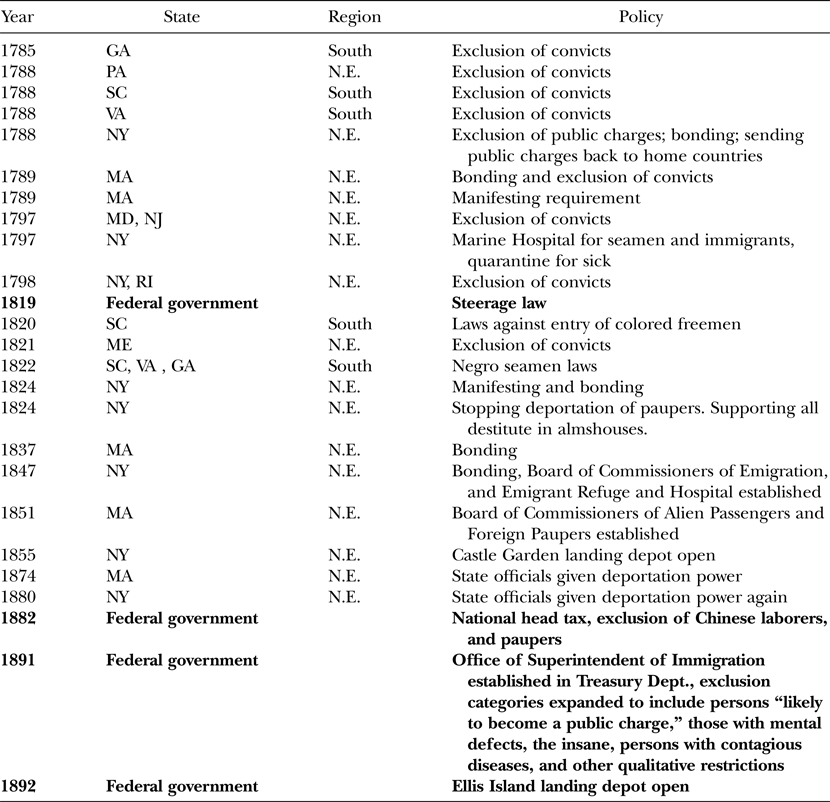
Scholars of American political development are often interested in the timing as well as the sequence of events. Table 1 catalogs the broad array of policies restricting the freedom of movement undertaken by both northeastern and southern states. It shows the first year a state adopted that kind of law, although some policies date back to the colonial and Articles of Confederation period.Footnote 37
Varieties of State and Federal Restrictions on Migration

Two things stand out from Table 1: first, the variety of state-level migration restrictions, and second, the delayed entry of federal action in migration policy (the federal government's activities are in bold). Indeed, when the national government finally arrived on the scene in 1882, federal immigration law was mostly a replication of long-standing state practices. The rest of this article explains the reasons for the timing and sequencing of state and federal laws.
A. The Northeastern States: Managing the Poor, Diseased, and Criminal
From the colonial period to the 1800s, in the northeastern seaboard states, which received the lion's share of immigration, there was no significant bureaucratic infrastructure in place at the state level, much less the federal level, to process or to provide any services or protections to arriving immigrants or to screen them. It was not until the mid-1800s that state control over immigration was beefed up.Footnote 38 In theory, the states' initial foray into immigration regulation was precipitated by their concern over foreign pauperism. In practice, the regulation of immigration through the creation of a bureaucracy and of new regulations and other infrastructure was shouldered by a few states that were home to large and busy ports such as Massachusetts, New York, Pennsylvania, and Maryland, who were hit by the brunt of the social and financial cost of the huge immigrant flow.Footnote 39 Historian Hidetaka Hirota notes that an exclusion policy of some kind was adopted “by most of the coastal states prior to the 1880s, including Pennsylvania, Louisiana, California, and New England,” but that only New York and Massachusetts “pursued pauper exclusion most rigorously by creating state agencies devoted to that purpose—the Commissioners of Emigration in New York in 1847 and the Commissioners of Alien Passengers and Foreign Paupers in Massachusetts in 1851.”Footnote 40
One way to understand why the states and localities made laws regarding public health, the poor, and morality as well as the zeal with which they carried out these laws is that, in the early nineteenth century, there was not yet any kind of welfare state or extensive social service agencies to manage the poor, the sick, and the criminal. Like the English poor laws, the poor and sick were the economic and social responsibility of the local community where they were “legally settled.” Also, the poor were left to the care of private charities and churches since relief to the poor was viewed as a religious or philanthropic responsibility. Therefore, states and localities had tremendous interest in creating laws and policies that kept the poor and sick out of their jurisdiction. As well, states during this period were motivated by financial considerations to “remove” or “banish” some poor in their jurisdiction to somewhere else such as the hometown where the person presumably was “legally settled,” including back to their home country.Footnote 41 Before 1847, the subject of the care and support of diseased, disabled, or destitute immigrants was left either to general quarantine and poor laws or to local ordinances.Footnote 42 Connecticut, Oregon, and Washington, “which had no foreign passenger traffic to speak of” were the only seaboard states never to have legislated on the subject of indigent immigrants.Footnote 43
More importantly, political and legal culture greatly influenced which level of government had the authority to administer migration laws. These local laws also fell under the general social and political understanding of the broader rubric of laws regarding “the people's welfare” and the public interest. As Novak has argued in his very comprehensive study, The People's Welfare: Law and Regulation in the Nineteenth Century, that century marked a distinctive point in time preoccupied with public society and the common good, which were prioritized over individual liberties and commercial rights. In both North and South, a premium was also placed on conformance to social rules and expectations and on a preservation of social order, which was a necessary element of the overall public welfare. Rights at this point in time were “relational” in that there were no absolute rights, and there was little appreciation for individual or commercial rights because the rights of the local community and the public interest were paramount.Footnote 44 This view in large part explains why there was little regard given to violating an individual's right to liberty, privacy, commercial rights, or even due process, as states aggressively implemented their policies restricting certain people's freedom of movement.
Another feature of nineteenth-century governance was that it was marked primarily by local rule. States and localities enforced many aspects of slavery and liquor laws, two legal areas that show the extensiveness and invasiveness of subnational exercises of power.Footnote 45 Novak persuasively argues that the nineteenth-century American state was far from weak and “Stateless,” even though the national government had limited administrative capacity, because subnational units were carrying out extensive regulation of private property, the economy, use of public spaces, alcohol, and of classes of people who were deemed to be poor, sick, disorderly, or dangerous. In the name of the common law maxim salus populi suprema lex est (“the people's welfare is the supreme law”) and the related concept sic utere tuo (“Use your own property so as not to injure another's property”), states regulated many aspects of private life.Footnote 46 They did this through many categories of laws, such as those about morality and public health (fire safety/quarantine/occupational licensing), nuisance laws (about the use of public spaces), poor laws (including laws aimed at those who allegedly transported the poor and the sick to the United States), and a large body of laws about slavery. Indeed, of the three threats to a well-regulated society that Novak names: invasion and insurrection, public health, and fire, two of the three touch upon policies related to the freedom of movement.Footnote 47
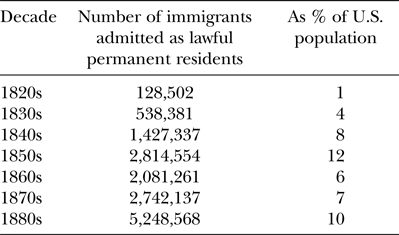
The age of mass migration in the mid-nineteenth century pushed eastern seaboard states into a balancing act to adopt policies to encourage hardworking immigrants who would be an economic boon, while simultaneously restricting the kinds of immigrants who would become a social and economic liability. No time period in history saw the magnitude of movement of people as in the period from 1812 to 1914, the age of mass migration to the United States. The federal government began collecting data on immigration in 1820, and these data indicate that each decade registered a dramatic increase in immigration arrivals, as shown in Table 2.
Entrants in the Age of Mass Migration
Sources: The numbers are derived from two sources: U.S. Department of Homeland Security, Yearbook of Immigration Statistics, 2013, “Table 2: Persons Obtaining Legal Resident Status by Region and Selected Country of Last Residence: FY 1820–2013,” (Available at: http://www.dhs.gov/yearbook-immigration-statistics-2013-lawful-permanent-residents), and official U.S. Census Data (Available at https://www.census.gov/history/www/through_the_decades/fast_facts/1820_fast_facts.html). Several caveats hold: The federal government did not collect any immigration statistics until 1820. The Census did not start recording persons by nativity until 1850. And the Homeland Security numbers reflect only those admitted to lawful permanent resident status and may not capture unauthorized migrants.
We can also gain some sense of the scale of immigration by assessing the immigrant entrants as a percentage of the overall U.S. population. Between 1820 and 1860, the U.S. population tripled, from 9.6 million to 31.5 million, and immigration was a great contributor to this increase.Footnote 48 The figures in Table 2 are national, and the local effects would have been more exaggerated in heavy immigrant-receiving states and cities. For example, the 1860 Census showed that almost one-half of residents of New York City were foreign born, and well over one-third of the population of Boston was foreign born.Footnote 49
Managing Convicted and Poor Immigrants
Among undesirable immigrants, foreign convicts were at the top of the list, and they were excluded outright from entry in the colonial period. Upon the recommendation of the national government, after the American Revolution convict exclusion laws were adopted by Georgia (1785), Massachusetts (1789), Pennsylvania (1788), South Carolina (1788), and Virginia (1788). After the ratification of the Constitution, more states either copied laws from other states or devised their own, including Maine (1821), Maryland (1797), New Jersey (1797), New York (1798), and Rhode Island (1798). After 1788, this problem became less of a concern because the British abandoned their efforts to try to ship convicts to the United States and instead established the penal colony at Botany Bay in Australia.Footnote 50
Many policies against the poor were driven by the widespread belief that foreign countries and their governments were concertedly dumping not just convicts, but also paupers into the United States, so that their home countries would not have to support them.Footnote 51 In 1855, Fernando Wood, mayor of New York, wrote to President Pierce asserting that, “[t]he inherent right of every community to protect itself from dangers arising from such [pauper] immigration cannot be questioned.”Footnote 52 Later, in 1870, Friederich Kapp, a New York commissioner of Emigration, charged that, “the unscrupulous conduct of European governments and cities in transferring to our country aged and decrepit paupers, and occasionally even criminals” resulted in financial and social problems for New York.Footnote 53 New York for a time felt completely under siege.
Historian Benjamin Klebaner contests the claim that foreign governments were dumping their poor into the United States by noting that foreign laws prevented the transportation of paupers. Klebaner also notes the actual number of paupers in the official statistics of imported foreign paupers from the sending countries was much smaller than the public believed, and that one must be careful to distinguish between “needy foreigners who had been sent over at the expense of their native community” and those who had “come without assistance of public funds but subsequently had to apply for relief in their new homeland.”Footnote 54 Yet the fact remained that in any city or area where immigrants congregated, a large proportion of those dependent upon government assistance were indeed foreign born. One estimate showed that from 1845 to 1860, between one-half and two-thirds of Boston's paupers were immigrants, while in New York in 1860, “no fewer than 86 percent of those on relief were foreign born.”Footnote 55 Zolberg similarly reports that in New York, “from the turn of the century onward the foreign-born constituted about one-third of poorhouse inmates” and, by 1825, “when immigrants constituted 4.6 percent of the city's population, they amounted to 40 percent of almshouse admissions.”Footnote 56 Klebaner does acknowledge that “the greatest burden [to care for indigent immigrants] fell on the important ports of entry” since the “most diligent and well-to-do of the immigrants pushed into the interior, while the poorer, less desirable foreigners tended to remain” at or near the ports where they arrived.Footnote 57
State Methods of Control of the Disabled and the Sick
Given the great number of immigrant arrivals at their ports, Massachusetts and New York, not surprisingly, also led the way in the effort to pass laws requiring steamship captains to provide bonds for passengers who were found likely to become a public charge. An 1876 New York Emigration Commission report explains the eastern seaboard states' thinking:
Ever since the tide of immigration first set strongly toward the United States, the city of New York has been its chosen gateway. Statistics show that the immense benefits of European immigration have been shared by many of the old and by all of the new States, while the disadvantages have been principally borne by those on the Atlantic…the poorer, the weaker, or the less enterprising remain behind at or near their port of arrival. Whatever burden is imminent by the indolence of this latter class and whatever danger is threatened by their diseases, the seaport states must first encounter.Footnote 58
The goal of the laws passed by these states was not just to screen out the diseased, but also, “to compensate the receiving communities and philanthropic bodies for some of the social costs imposed on them by the screen's imperfections.”Footnote 59 New York and Massachusetts especially saw it as a crucial act of social and financial self-preservation.
The actual form of state-level migration controls was determined by several factors, including the constitutional text and the long tradition of state control over policies regarding health, safety, and morals described by Novak. Without passport controls and predeparture checks, the limited administrative capacity and a lack of systematic and institutionalized procedures to screen a large number of arrivals led to manifesting, head taxes, and bonding. As Zolberg stated, “Since under the prevailing rudimentary regulatory regime it was almost impossible to inspect individuals and hold them accountable, colonial legislatures and port-of-entry bodies sought to deter their entry by imposing head taxes and security bonds, to be paid by shippers or prospective employers, and whose proceeds were sometimes used for the support for charitable institutions.”Footnote 60 New York, where two-thirds of the new arrivals landed, had the most extensive and elaborate inspection and welfare laws. For example, New York added refinements to the shipmaster reporting system, known as “manifesting,” a practice that began in the colonial period, by backing up the practice with economic assurances through head taxes and bonds if manifesting failed to detect the disabled, sick, and poor.
Further, with the ratification of the U.S. Constitution in 1787, another limit was applied to the method and scope of restriction by the Constitution's migration and importation clause that stated the national Congress would not interfere with state policies regarding the “migration and importation” of persons until 1808. As Zolberg explained, “Given America's self-imposed constraint against barring ‘migration or importation’ prior to 1808, regulation was largely aimed at producing revenue to offset the costs incurred by city and charitable organizations.”Footnote 61
The lack of manpower to thoroughly inspect and interrogate each and every passenger at length explains why, in addition to exclusion laws, states also sought to ease the financial burden on local communities. The migration and importation clause in the original Constitution partially explains why migration policy took shape subnationally rather than as a national-level exclusion of the poor, diseased, disabled, or convicted.
On March 7, 1788, a New York act, continuing colonial practices, required shipmasters to transport back to the “place from whence he came” or “enter into bond to the mayor, alderman and commonality of the city of New York” the sum of 200 pounds to guard against persons likely to become a public charge.Footnote 62 New York followed up with several other pieces of legislation to protect itself from bearing the cost of indigent persons, including four subsequent acts passed in 1797, 1824, 1827, and 1847 that stipulated various financial punishments of shipmasters who transported indigent immigrants.Footnote 63 The New York State Passenger Act of 1824 required shipmasters to report to the state the name, birthplace, last legal settlement, age, and occupation of each arriving passenger. The shipmaster's endorsement of the signed report “with the signature of two sureties” constituted a “bond up to $300 for each alien passenger to indemnify the city in case such immigrants or their children became public charges within two years.”Footnote 64
Massachusetts passed similarly tough legislation to protect itself from the burden of poor immigrants. It passed a settlement act like New York did in 1789 and also had a manifesting requirement authorizing “overseers or Selectmen” to “set to work” for one year any persons, immigrant or not, “able of body, who have no visible means of support.”Footnote 65 Other acts passed in Massachusetts in 1794, 1810, 1830, 1835, 1837, and 1848. Most of these acts were variations of laws that held shipmasters financially responsible for transporting persons found upon inspection to be “lunatic, idiot, maimed, aged or infirm persons incompetent in the opinion of the officer examining, to maintain themselves, or who have been paupers in any other country.”Footnote 66
In later years, in many states, the bond could also be commuted in favor of a flat tax. In fact, the bonds were “nearly always commuted in favor of a fixed rate head tax,” which went to fund immigrant hospitals and other services. Many states allowed for the option of a tax or bond. In Massachusetts (1837–1849) and New York (1847–1849), the ship owner had to “bond defective passengers and pay the head money [tax] for the others.” The Massachusetts law was later invalidated in 1849 by The Passenger Cases, 48 U.S. 283 (1849), and several states had to amend their laws. Thereafter, Massachusetts and New York allowed the shipmaster the option of choosing bond or commutation for healthy passengers (and later for all passengers).Footnote 67 The eventual ruling of even those bonds unconstitutional led to the process of transition from state to national control of migration policies that is described in Section IV of this article.
The frequent and varied attempts of New York and Massachusetts to pass restrictionist legislation eventually brought constitutional challenges against state action in this area vis-á-vis the national government.Footnote 68 By the mid-1800s, New York and Massachusetts had to staff almshouses, multiple medical facilities, and a full-scale immigration landing depot at Castle Garden. The local institutions New York alone illustrate the extensive administrative capacity and the specialized bureaucracies that were built up at the local level in the nineteenth century to manage the immigrant disabled, sick, and poor.
In addition to offices to collect taxes and bonds for immigrants, and to buy property for the care of immigrants, state immigration officials were empowered and had tremendous discretion to relocate persons deemed undesirable to other parts of the state or to other parts of the U.S., to deport them to their country of origin, or to place them in almshouses. An 1877 Massachusetts Board of Charity report, for example, credits the state's settlement law of 1874, “which removed from the state's list at one end almost as many paupers as were added at the other end by immigration.” The same report makes note of the numbers and destinations of those subject to “the transportation of persons to transatlantic ports and the British provinces.” Meanwhile, this board's New York counterpart in 1880 was also authorized to deport to their origin any disabled, sickly, or poor immigrants, which was in addition to the removal power they previously had to relocate immigrants to other states.Footnote 69 The elaborate network of state-level bureaucracies puts into sharp relief the national government's lack of legislation, parallel institutions, and bureaucracy to manage migration during this time period.
State Agencies for the Immigrant Poor and Sick
Dealing with sickly, disabled, and poor immigrants also required the creation of state and local institutions. Starting in 1797, New York maintained a Marine Hospital on Staten Island for the dual purpose of caring for sick and disabled seaman and quarantining immigrants with contagious or infectious diseases. But immigrants who contracted noncommunicable diseases after their arrival were not usually admitted. The care of immigrants at the Marine Hospital was financed by a state head tax on passengers and crews entering the port, set in 1845 as two dollars for cabin passengers and fifty cents for steerage passengers. In its peak year in 1852, the Marine Hospital treated almost 9,000 patients, and the “official capacity was listed as 556 beds and the emergency capacity at 776.”Footnote 70 Since the Marine Hospital was supposed to be one of the first mechanisms for screening and quarantining sick immigrants to prevent them from entering the city, jurisdiction of the hospital was transferred in 1847 from the Health Officer to the Emigration Commissioner, which illustrates the blending together of public health policy and immigration policy. In April 1849, the facility became formally restricted to treating people with contagious diseases.Footnote 71
One of the first things that the Commissioner of Emigration did upon the creation of the commission in 1847 was to establish the Emigrant Refuge and Hospital on Ward's Island, which was technically an almshouse. For a brief time between 1853 and1855, the Ward's Island hospital complex “formed the largest hospital center in the world.” The collection of “hospital money” that funded all these institutions stopped when the Supreme Court declared the tax unconstitutional in 1849 in the Passenger Cases.Footnote 72 Before the “hospital money” head tax was invalidated, the state quarantine law provided for the care of sick and destitute immigrants who received free medical care at Ward's Island upon arrival for one year. They were transferred to the almshouse if, at the end of the year, they were not well enough to leave.Footnote 73 Despite the financial setback of having the head tax invalidated, by 1852 the state of New York, through a network of about half a dozen specialized medical facilities, was caring for over 20,000 patients, a large proportion of whom were immigrants.Footnote 74
After 1875, the states continued to regulate quarantine, and the Supreme Court continued to approve of this arrangement.Footnote 75 Exclusion of immigrants on the grounds of contagious disease did not happen under federal law until 1891, after “the exclusion of Chinese laborers, convicts, and persons likely to become a public charge.” As Neuman explains, “This delay does not indicate the public health regulation of migration was a novelty, but rather reflects the strength of the tradition of federal deference to state regulation of migration in that area, exercised for most of the nineteenth century through the mechanism of quarantine.”Footnote 76 It was not a lack of administrative capacity that delayed federal management of quarantine laws, it was federal deference based on the very strong tradition of prioritizing the public welfare and concomitant local rule.
Quarantine is not usually synonymous with immigration policy, and indeed quarantine laws are often missed in studies of immigration when in fact they play a huge role in regulating the entry and exit of persons. Neuman wrote, “Quarantine laws, for example, operated by delay and not by permanent exclusion. In times of perceived peril, quarantine was more likely to be strictly enforced. Maritime quarantine might lead to the death of the would-be immigrant who was stopped at the port, rather than deportation to another country, or to admittance of the immigrant after she had survived the disease. But as a barrier to free migration it had serious practical significance.”Footnote 77 Kapp, a former New York Commissioner of the Emigration Board, described the authority of the quarantine officer this way: “It was then, and still is, the law of the State of New York that a vessel arriving at Quarantine is under the control of the health officer, and that consequently the ship-owners can exercise no control over their own vessels until they pass out of the hands of that officer.”Footnote 78 State quarantine officers then had the authority to override control of the vessel from even the ship owners and officers, and the ship could not unload any passengers or goods until they were cleared by the state official. Additionally, Novak stated that the legal status of quarantine (both landed and sea) was unquestioned, even in the face of challenges by commercial interests that the policies were burdensome.Footnote 79 The power wielded by the health officer is also an example of why authority in this time period may have mattered more than administrative capacity. Literally one person could hold up the docking, unloading of goods, and disembarking of passengers of an entire ship and, in so doing, abridge many persons' commercial interests and individual liberties.
It is one thing to pass laws restricting migrants, but it is another to have the expertise and specialized bureaucracy to keep track of compliance and to execute the laws. There was virtually no national immigration policy until 1819, when the federal government took a nominal step by requiring state officials to report information about arriving immigrants to the Secretary of State. Up to this point, the states collected data on immigrant arrivals, but there was no nationwide or systematic collection of immigration data.Footnote 80 In the mid-1800s, states, especially those with high immigration arrivals, started setting up more formal governmental structures to manage immigrants. New York established a Board of Commissioners for Emigration in 1847 and Massachusetts centralized its immigration bureaucracy and receipt of funds in the state Board of Commissioners of Alien Passengers and State Paupers in 1851.Footnote 81
In response to the calls from immigrant benevolent societies to the state to more systematically provide for poor and sick immigrants and to oversee the bonding system, New York created its Board of Commissioners of Emigration.Footnote 82 The Board of Commissioners of Emigration had ten members and included ex officio members who were leaders in the German and Irish emigrant aid societies. The members were either appointed by the governor or the mayors of New York and Brooklyn, or were the presidents of the German Society and Irish Emigrant Society. Footnote 83 From May 1847, when the Board of Commissioners was established, to the end of 1875, over 500,000 immigrants had benefited from the services of the Commission's many offices, a smaller number had been “fed and lodged temporarily and supplied with cash relief in the city,” and another 250,000 had been assisted by counties that were paid directly by the Board of Commissioners' office.Footnote 84
The Commissioners was not only in charge of overseeing the bonding system but also the system of reporting passengers, as well as “the protection of immigrants from fraud and abuse.” Therefore, the function of this commission was a mixture of regulatory and social services. The Commissioners were also authorized to use their funds to help immigrants find jobs and to remove/deport them from any part of the state to another part of the state, or to remove them altogether from the state, or deport them to their home country, in order to prevent them from becoming a public charge. By the end of 1875, Klebaner reports, “over 58,000 persons” had been “forwarded to a destination in the United States or returned to Europe at their own request” via funds of the Commissioners.Footnote 85
Castle Garden Landing Depot in New York
Based on a New York investigation into the abuses of immigrants, and the feeding frenzy on the docks by a plethora of unsavory people who sought to rob new immigrants of their earnings and savings, New York established the Castle Garden Depot in 1855 to receive immigrants; it was an entirely New York–run operation. The state legislature had passed an act to lease the space that sat at the bottom of Manhattan Island.Footnote 86 At Castle Garden, there was an elaborate bureaucracy set up, with different departments to process immigrant arrivals, in contrast to the open docks, which were a free-for-all. The commissioner of Castle Garden, as well as the almost all-voluntary staff, served without pay and were guided by “a spirit of benevolence” rather than restriction.Footnote 87 Klebaner described Castle Garden as “a miniature welfare state.”Footnote 88
At Castle Garden, there were seven official departments that systematically processed and landed immigrants, including departments that conducted reception and orientation, as well as a hospital where sick immigrants could recuperate, an inexpensive restaurant, free baths, baggage-carrying services, and a communal kitchen.Footnote 89 In his 1870 Board of Commissioners of Emigration report, Kapp enumerated the benefits of Castle Garden to multiple entities. He noted that, for the immigrants, the establishment of Castle Garden created an environment in which they could be landed in a “more safe and speedy” manner, and that their person and effects, “having been put on shore, predators being limited to fellow-passengers, and but slight opportunity existing for successful pillage by them. In relief from the importunities and deceptions of runners and brokers.” For the shippers, he noted the greater efficiency of being able to unload all the passengers and merchandise at once. For the Board of Commissioners, Castle Garden meant a more systematic procedure for discovering persons who were ill or likely to become a public charge and who would require a bond. For the statistician, Castle Garden allowed the opportunity to “furnish reliable data” of arriving immigrants. And for the general community of New York, Kapp stated that the benefit of Castle Garden was to contribute to the “diminution of human suffering” by reducing “calls on the benevolent throughout the country; and in the dispersion of a band of outlaws attracted to this port by plunder, from all parts of the earth.”Footnote 90
I now provide a detailed description of the functions of the various departments and services offered at Castle Island to illustrate the extensive specialized bureaucracy set up by the State of New York. When ships arrived in New York harbor, the first stop was the quarantine station, six miles from shore, where a state official who had first contact via the Boarding Department would board the ship to check how many passengers had died during the voyage, the number and nature of the sick, and then make an official report to the general agent and superintendent at Castle Garden. The boarding agent would then ride with the ship until it docked, making sure that those on the ship could have no communication with those on shore until it was officially docked and cleared, as required by state law.Footnote 91
Upon the ship anchoring, the boarding agent was replaced by a Metropolitan police officer on detail to Castle Island. A landing agent and customs inspector, who inspected the baggage, greeted the ship. The immigrants were then inspected by a medical inspector, and anyone who was sick who did not get flagged on the quarantine inspection were transferred to one of the medical facilities on either Ward's or Blackwell's Island.Footnote 92 The Registration Department would then record the immigrants' names, nationalities, former places of residence, intended places of residence, and other information. They were then directed to agents of railroads who would provide transportation to different locations within the United States. The immigrants' previously tagged baggage was then delivered to the railroad companies directly. Those remaining in the New York City could arrange to have their baggage delivered to a local address or be stored until they could locate lodging. There was also a currency exchange (with rates clearly posted), information department, letter-writing department staffed by scribes fluent in many immigrant languages, and a forwarding department that would keep all letters and remittances from the friends and family of immigrants. Boardinghouse keepers, who were duly licensed and certified by the mayor, were allowed into the rotunda where the processed immigrants waited. Possibly one of the most useful services was a labor exchange, where an intelligence officer sought to put immigrants with certain skills in touch with employers from all over the country who needed those skills and who had been vetted for “character and other necessary qualifications.” Finally, there was a Ward's Island agent, assisted by two physicians, who would take applications for the refuge and hospital for those who were sick and could not afford to pay for medical care.Footnote 93
Castle Garden, a tiny city unto itself, was open daily, and at night if necessary. Annual rent for the facility was $12,000. The total number of staff of Castle Garden and of the Marine Hospital at Staten Island was seventy-six officers and employees. The yearly salary of the paid staff of both facilities totaled $82,894.Footnote 94 From its opening in 1855 to its closing in 1890, Castle Garden landed and distributed 9,725,430 immigrants supervised and processed by state officials.Footnote 95 Castle Garden was run not as a detention station, but as “a protective charity foundation” providing “safety from swindlers and confidence men, a hospitable reception for newcomers, practical advice and social services.”Footnote 96
From 1876 to 1882, the eve of the federal transition to Ellis Island, New York state taxpayers spent over one million dollars for institutions to care for immigrants.Footnote 97 Kapp, also reported that the New York Emigration Commission's reimbursement to counties in the state for the care of immigrants from May 5, 1847, to December 31, 1869, was $994,279, and the reimbursement to hospitals was $163,371, bringing the grand total to $1,169,651 in a twenty-two-year period, quite a large sum of money spent on immigrants.Footnote 98
The State of New York had developed by far the most elaborate network of institutions and services for the care and regulation of immigrants. Only Massachusetts came close to having a comparable setup. Other coastal states also established immigration boards staffed by social reformers and humanitarians who served without pay to manage immigrants.Footnote 99 Given the prevailing nineteenth-century understanding of the public welfare as outlined by Novak, it is not surprising to find that the management of the disabled, sick, poor, and convicted were considered local concerns.Footnote 100 Even after the technical takeover of immigration policy by the federal government, state officials continued to play a key role. While the federal Ellis Island facility was being built, state officials continued to operate Castle Garden with federal authorities, because the federal workers had no experience with immigration. Even after the opening of Ellis Island, much of the staff of that solely federal facility was hired from among former Castle Garden employees.Footnote 101 The absence of federal legislation or of a federal immigration landing facility such as Ellis Island until 1892 is testament to the fact that until that time the national government had shared states' understandings about local control over regulating immigrants.
B. The Southern States: Preserving Slavery and Preventing Slave Insurrections
While the northeastern seaboard states' primary concern was protecting themselves against the worst effects of poor, sickly, and convicted immigrants, the southern states' view of migration policy was driven by a decidedly different set of concerns. As Balogh noted, “nobody questioned the constitutional authority of Congress to clear local barriers to interstate trade.”Footnote 102 Meanwhile, federal criticism of any state policies erected to guard against dangerous or undesirable persons was vigorously countered. Aside from the focus on the general public welfare, in the southern states the big consideration that drove the balance of power between the national government and the states was the existence of slavery, or more precisely the cost of maintaining that peculiar institution. The concerns were two-fold. First, slave states were very vigilant about protecting state power against federal encroachment.Footnote 103 Any perceived or actual expansion of federal power was met with virulent resistance, and there was a perception of a constant threat of the national government becoming so powerful that it would overwhelm the states and their choice to practice slavery. Second, there were ongoing internal challenges to the social order of the southern racial hierarchy.Footnote 104 Policing the boundaries of the mixing of the races as well as guarding against internal slave insurrections accounted for much of the motivation for state and local policies that affected immigrants and even citizens of African descent.
Any expansion of federal power was viewed with suspicion for fear that it would “interfere with the slave economy.” Writing about the debates over internal improvements in the nineteenth century, including developing the Army Corps of Engineers and the postal service, Balogh indicated that the defenders of federal power cited not only the “general welfare” and the “necessary and proper” clause of the Constitution in support, but also “national defense” and “commercial benefits.” Meanwhile, the opponents of these expansions of the national government's power questioned whether these projects were really national in scope and why they would not be better executed at the state level. More tellingly, they “pointed to the growing sectional divide over federal powers that might one day threaten slavery.” Indeed the National Bank and internal improvements were all cause for alarm in the South.Footnote 105 Similarly, national disaster relief, which saw a huge drop-off in the twenty years leading up to the Civil War, was also regarded as a threat to state power. The thinking in the South was that even federal disaster relief portended unwanted expansion of federal power and the possibility of “inciting secessionist sentiments” in the Democratic Party that might split the party.Footnote 106
In the lead up to the Civil War, the drive to preserve the institution of slavery in the South brought new imperatives for controlling the migration of certain classes of persons and extended the states' rights view to an extreme. Riker points out that, despite the frequent argument that federalism encourages freedom, in the case of the Civil War and Jim Crow, “states' rights” was used “as a veiled defense first of slavery, and then of civil tyranny.” He added, “Here it seems that federalism may have more to do with destroying freedom than with encouraging it.”Footnote 107 Antebellum migration polices in the South confirm Riker's suspicion and show that slave states used the federal system to their advantage and to the detriment of free blacks, slaves, and “negro seamen” (the terminology of the time for black sailors).
The racial imbalance in some states presented a variety of problems. In South Carolina for instance, in the 1800s, blacks, free and slave together, outnumbered whites, leading to psychological nervousness among the white population. Historian William W. Freehling reports that throughout many districts in South Carolina in the 1830s, “the ratio of Negroes to whites reached unsettling proportions . . . No other area in the Old South contained such a massive, concentrated Negro population.”Footnote 108 Of course a racial imbalance by itself does not lead to a call for restriction of mobility, but the issue was slavery, which led to other complications.
Slavery was obviously not just an economic system, but also a social order predicated on a belief in white supremacy. Law can enforce social order. As Novak wrote, the “well-regulated society” presumed a correspondence between laws and “community standards.” Many laws were passed in the South with the goal of preventing racial mixing, which constituted a disturbance to the racial order and a violation of community standards. Novak added, “Race and class hierarchies powerfully shaped, and in some cases determined, antebellum conceptions of immorality and disorder.” In the pursuit of the public good, laws in both the North and South often turned on unequal enforcement: based on the race of the clientele or owners, certain businesses were shut down as “illegal” or “disorderly nuisances.” In the North, some activities, when performed by whites, such as drinking, cursing, and noise, were little cause for concern, but blacks that were engaging in the same type of activity were guilty of “disorder.” But in the South, the tolerance was even lower. Any racial mixing, including dancing and just meeting together, was suspect, and ran afoul of laws against “disorder.” Allegations of “drunken negroes” apparently “triggered disorderly [public and private] house prosecutions” especially in the South. The question was not so much what is the public welfare as whose public welfare was being protected.Footnote 109
Given the large percentage of the black population that was enslaved, a constant worry in the slave states was rebellion. Conceptions of the public welfare were alive and well in the South, including the particular notion that “self-defense” and “self-preservation” are the individual's ultimate concerns.Footnote 110 The fear of insurrection became even more acute after the Denmark Vesey rebellion, organized by Vesey, a slave who bought his own freedom after winning a lottery. Vesey, along with other members of the African Methodist Episcopal Church plotted to bring together free and slave blacks in a revolt in Charleston, South Carolina on July 14, 1822. He and at least 34 others were caught and hanged when some in their group betrayed them and leaked the information of the uprising to their white masters. Even though the conspiracy was crushed, when details spread about the elaborate plans and the extent of the participation, South Carolinian residents grew nervous. As Freehling indicated, the memory of the rebellion remained “long thereafter a searing reminder that all was not well with slavery in South Carolina.” He adds that the “most pervading legacy” of the Denmark Vesey rebellion “was a compulsion to check abolitionist propaganda and to stop congressional slavery debates.” The Denmark Vesey affair was followed by disturbances in 1826, 1829, and then 1831 with the Nat Turner Revolt in Virginia and its high number of causalities. Even though that revolt did not spread to South Carolina, “the possibility of contagion created a serious panic over insurrection.”Footnote 111 With good reason, many of the white residents of slave states were fearful of slave insurrections.
The response of southern states the threat of insurrection was brutal and varied and included “Negro laws” and Black Codes, which further infringed on the civil liberties of blacks. A primary goal was to prevent the infusion of free blacks into the area, who might spread incendiary ideas and whose very presence as free blacks was a constant reminder to the slave population of their lack of freedom. Around 1820, South Carolina and many area states began passing laws designed to limit the population of free blacks: South Carolina masters could not free their slaves, “and colored freeman were denied the right to enter the state.”Footnote 112 Black citizens' right to travel and even manumission were abridged, based on the white population of South Carolina's overriding social fear of slave insurrections and their concern for self-preservation and self-defense.
Negro Seamen Laws
South Carolina bolstered its practice of minimizing the numbers of free blacks in the population and their interactions with the local slave population by also restricting the movement of negro seamen. The problem of interaction arose because ships from the North and international destinations would dock in Charleston for days and, in 1822, Freehling reported, “Negro sailors who stepped ashore had free run of the city. This permissive arrangement invited contact between northern Negro abolitionists and the lowcountry slaves. It also allowed colored seamen from San Domingo to stride through the streets of Charleston.” The uneasiness of the “gentry” with the intermixing of free blacks and slaves led South Carolina in 1822 to pass a law that required all black sailors to be “seized and jailed” for the duration of their ship's docking in Charleston.Footnote 113 The penalty for violation of the law was a fine of “not less than $1,000 and imprisonment of not less than two months.” A more serious consequence was that the black sailors who were detained “shall be deemed and taken as absolute slaves, and sold . . . by the state.”Footnote 114
This law, and similar ones in Virginia and Georgia, created a major federalism conflict because these laws violated the federal government's treaty obligations with foreign powers. In this case, Great Britain strenuously objected to the imprisonment and possible sale of its citizens in violation of its international treaty.Footnote 115 State officials enforced negro seamen laws over repeated and vigorous objections by the Adams administration. The issue caused much diplomatic embarrassment to the national government, which was powerless to stop the practice. In response to the Adams administration's and British officials' requests to repeal the negro seamen laws, the governor of South Carolina in 1824, in a letter to the state senate, asserted:
South Carolina has the right to interdict the entrance of such persons into her ports whose organization of minds, habits, associations, render them peculiarly calculated to disturb the peace and tranquility of the state, in the same manner as she can prohibit those afflicted with infectious diseases from touching her shores…This necessity of self-preservation alone is to be determined by the power to be preserved.Footnote 116
It is clear from this quote that the governor viewed South Carolina's raising barriers to free blacks and Negro seamen as akin to the northeastern states keeping out diseased travelers, since the admission of any of these individuals was adverse to the public welfare. Eventually, British and French diplomats chose to bypass the Adams administration altogether and to negotiate with the local officials to lift the seamen ban, in one case attempting to bribe them with a case of expensive champagne.Footnote 117 The Negro seamen laws are a stark example of a state, in contravention of federal law, successfully blocking the entry and passage of free blacks into its territory and abrogating treaties signed between the national government and foreign nations.
The crisis came to a head in a case before the Supreme Court, when a free black man from Jamaica, Harry Elkinson, was imprisoned on his ship in Charleston harbor. He submitted a writ of habeas corpus to the Supreme Court. His argument was based on the fact that his incarceration contradicted the Constitution, which states that all treaties would be the supreme law. In Elkinson v. Deliesseline (1823), the circuit court invalidated South Carolina's Negro seamen law as a violation of the Commerce Clause, but it had no way to enforce its decision.Footnote 118 The slave states became even more apprehensive of federal authority after the Supreme Court decision in Gibbons v. Ogden (1824) was handed down a year later. Gibbons was a case about New York State's steamship monopoly, which the Supreme Court decided was an unconstitutional interference in interstate commerce. In that decision, a passage was of particular concern to the slave states. Chief Justice Marshall had made clear reference to the migration and importation clause that was in the original Constitution. He noted in the Gibbons opinion that he read that clause as meaning the migration and importation of slaves by the states would not extend past the year 1808. As historian Charles Warren indicated, “It was this phrase of his opinion which caused great alarm in the South, for that specific question had already arisen in two cases in the United States circuit courts. Virginia and South Carolina had enacted statutes directed against the entrance of free Negroes into the state, and providing for their detention in custody until the vessel on which they arrived should leave port.”Footnote 119 Marshall had invalidated the New York steamship monopoly based on his belief that it violated the Commerce Clause.
The states of South Carolina and Virginia, however, insisted that the intent of their Negro seamen laws was not about impeding commerce, but was about the state's right and obligation to guard the public safety against free Negroes from the North who may incite rebellion in the local slave population, a justifiable exercise of police power. South Carolina's legislature passed a resolution reiterating this view: “Resolved, that it is as much the duty of the State, to guard against insubordination or insurrection among our colored population, or to control and regulate any cause which might excite or produce it, as to guard against any other evil, political or physical, which might assail us.” South Carolina viewed their laws as arising from the “supreme and permanent law of nature, the law of self preservation” and also asserted that their right to self-defense even superseded, “all laws, all treaties, all constitutions.”Footnote 120
Years after the state lost the Elkinson case, South Carolina continued to imprison black sailors. Despite repeated entreaties from northern states and foreign governments, the national Congress also refused to act to stop South Carolina's flouting of federal law.Footnote 121 Therefore, as Freeling argues, South Carolina's assertions were upheld. Historian Phillip Hamer described the Negro seamen laws this way: “Whatever its theoretical authority, the Federal government was without power, practically, to compel the states to repeal their laws regarding negro seamen. It was without influence sufficient to persuade them [the states] to accede to Great Britain's wishes. In 1848, it was unwilling to compel or to persuade.” Finding repeated negotiations with the federal government unproductive, British diplomats were reduced to lobbyists who sought to influence state-level officials.Footnote 122 This was a fight the federal government simply was not going to win, given such strong and sustained state resistance.
Censoring the Mail
Southern states viewed both keeping out unwanted black sailors and preventing the entry of objectionable mail as consistent with their concept of self-defense, since, in their view, the two worked hand in hand to spread revolutionary ideas. Footnote 123 Andrew Kull reports that, in 1829, Georgia strengthened its existing Negro seaman laws upon the discovery of the distribution of the abolitionist pamphlet Walker's Appeal…to the Coloured Citizens of the World, published in Boston. After the discovery of this cache of pamphlets, William T. Williams, the mayor of Savannah, wrote a letter to Governor George R. Gilmer. In the letter, dated December 16, 1829, Williams wrote:
We are aware our right to pass such laws has been questioned. When the torch is ready to be applied to our houses and the assassins dirk drawn upon our breast is not a time when we can stop in our defence to dispute with causists about the rights of other states—the fact of a vessel belonging to the state carrying negroes on board, ought to be made itself sufficient evidence that it carries contagion dangerous to our people.Footnote 124
Both Georgia and South Carolina saw their right to self-defense against “contagions,” whether these took the form of black sailors or unwanted mail, as transcending the issue of constitutionality.Footnote 125
A central part of the southern strategy to keep the peace was to censor the mail, since it was widely believed that northern abolitionists were behind the slave insurrections. Richard R. John, who has written about the U.S. postal service and its importance to the commercial development of the nation as well as the institution's role in the rise of party politics, has argued that the best index to measure the strength of a government institution in the early republic “was the extent to which they bound together in a national community millions of Americans, most of whom would never meet in person.”Footnote 126 What John and others viewed as an institution that had the capacity to bind and spread the civic culture of the new republic was viewed by the southern states as a potential threat to public peace. Their justification for censoring the mail, very much in line with the notions of self-defense and regard for the people's welfare of the era, were of course attempts by the slave states to keep incendiary ideas about freedom at bay. For example, historian Clement Eaton noted, “The Southern censorship of the mails during the last three decades before the Civil War could be justified only on the ground that the safety of the people is the supreme law . . . Southerners feared that, if abolition publications were allowed free circulation in the South, eventually these inflammatory writings would fall into the hands of some brooding Nat Turner or Denmark Vesey.”Footnote 127 The national government, hailed by scholars for its vaunted postal system, could spread the postal service to cover most of its geographical territory, but could not prevent the southern states from censoring the mail at will. Or, as Easton and others suggest, the national government yielded and “took the path of least resistance,” since states like South Carolina fought so hard, and the national government acquiesced to censorship based on the understanding that states had a right to self-defense.Footnote 128 In addition to flouting federal law on the issue of black sailors, South Carolina also successfully abridged federal law by censoring the mail.
In the South, considerations of the public peace, self-preservation, and perpetuation of slavery drove policies regarding migration. The same salus populi conception of upholding the public welfare that northeastern states embraced when they felt under siege by poor, disabled, and sick immigrants, was the same doctrine relied upon by southern states to claim the right of self-defense against any policy or persons that threatened the public well-being. This belief meant that the southern states were extremely wary of any policy, however innocuous looking, that might be a subterfuge for an expansion of federal power or that might bring unwanted ideas into their region. The self-preservation mentality also led the South to justify outright violation of federal laws when it came to policies about the movement of persons, specifically free blacks, both foreign and domestic, and even of inanimate objects like mail. One could see, given the wish to preserve slavery, why the South might find any federal policies that attempted to regulate the movement of people to be a threat. As a result, black citizens and foreign blacks alike suffered curtailment of their basic liberties. Despite having gained authority in other areas, the national government still lacked infrastructural power to honor some of its international treaty obligations and to deliver the mail unimpeded because of strong state resistance on these subject matters.
IV. THE TRANSITION TO FEDERAL CONTROL OF MIGRATION POLICY
Ultimately the zeal among states to recruit the desirable immigrants and the jealousies between states led to the unraveling of state control altogether. Zolberg has referred to this competition among states as “a classic ‘prisoners’ dilemma': all would be better off if they imposed restrictions, but each had an interest in lowering them to maximize its share of the traffic. New Jersey notoriously kept its landing requirements very low so as to attract traffic destined for New York, to which the passengers were then transported by lighter.”Footnote 129 The lack of standardized policies worked to the benefit of shipping companies, which could forum shop for the best rates.
As the eastern seaboard states became more overwhelmed by the high volume of immigrants and as each of their means to offset the costs was invalidated by the Supreme Court one by one, they asked the national government for relief. None was forthcoming until New York threatened to close down Castle Garden and cease all immigration screening altogether until the national government helped defray some of the costs for poor and sick immigrants.Footnote 130 Hirota argues that “The federalization of immigration control was therefore a gradual process at best, and the actions of officials in the northeastern states set the condition for the introduction of general deportation by the federal government in 1891.”Footnote 131 In addition to threatening to close Castle Garden, New York and Massachusetts took the lead in corralling the other northern states to call for federal legislation.
Jealousies had run high among the states. New York had drawn the ire of many other states because they believed that New York was only interested in shipping policy because of the amount of shipping revenue it was receiving and not because it was actually concerned about the condition of immigrants. Many others also criticized Castle Island for being an extension of the corrupt Tammany Hall political machine. Still other states saw New York and Massachusetts as getting in the way of railroad reform.Footnote 132 New York of course saw itself as on the frontlines of immigration and of providing a great service to the rest of the other states by sifting the weakest immigrants out before they headed into other states. As former Commissioner of Emigration Kapp maintained:
While New York has to endure nearly all of its evils, the other states reap most of the benefits of immigration…Our State acts, so to speak, as a filter in which the stream of immigration is purified: what is good passes beyond; what is evil, for the most part remains behind. Experience shows that it is the hardy, self-reliant, industrious, wealthy immigrant who takes his capital, his intelligence, and his labor to enrich the Western or Southern states.Footnote 133
Of course the other states did not see it that way and were envious of the economic boon immigration brought. Non-coastal states viewed New York and Massachusetts as only concerned about steamship revenues and less about the living conditions of immigrants. For this reason, other noncoastal states had earlier advocated a federal centralization of immigration in which the revenues collected from immigrants would then be redistributed equally to all the states, a suggestion New York and Massachusetts fought, until their means of protecting themselves from the undesirable immigrants were invalidated by the Supreme Court.Footnote 134
The actions of the Supreme Court also played a key role in spurring the transition of migration authority and power from the states to the federal government. A series of Supreme Court rulings that erased the ability of states to collect head taxes or bonds on arriving immigrants to defray the cost of caring for poor, disabled, and sickly immigrants was the impetus for the northeastern states to actively lobby the federal government to take control over immigration. Beginning with The Passenger Cases (1849), which were a combination of two cases, one originating in Boston and the other in New York, the Court struck down head taxes, but did not provide a coherent reason. The majority of the justices saw the New York and Boston laws as violations of Congress's purview of regulating international commerce, but they could not agree on which categories of people and what circumstances would constitute allowable exceptions to that rule. When the head taxes were struck down, many states replaced them with bonds, but unfortunately for them, in Chy Lung v. Freeman (1875) and Henderson v. Mayor of the City (1876) the Supreme Court also invalidated bonding systems as unconstitutional violations of the Congress's right to regulate interstate commerce.Footnote 135 Responding to Henderson v. NY, which the New York Emigration Commission referred to as an “adverse decision,” the Board lamented the consequences of the ruling to Atlantic states:
This decision affects not only the State of New York but all other Atlantic states and throws their ports wide open and leaves them unprotected against the introduction, and subjects their people to the expenses of immigrants who, at the time of their disembarkation, may be sick, diseased, disabled, or who, before they leave the State in which they may have arrived, become from any cause a public charge. It also removes from the interior states, to which many of the immigrants have gone, the right to return them, when necessitous, to the port or State of arrival. The reason which justified such return consisted in the receipt of commutation money and the pledge implied thereby. It has now been swept away by this [Supreme Court] decision and ceases to exist.Footnote 136
An 1876 Massachusetts Board of Charities reached the same conclusion and called immediately for federal immigration laws, as it noted the effect of Henderson was to, “leave in doubt as to what State legislation might be had to protect the several communities from an influx of paupers and criminals.”Footnote 137 The eastern seaboard states feared that the invalidation of the head tax in the Passenger Cases would lower the prices of passage and encourage even more poor people to come to their states.Footnote 138
With the primary ability of these states' efforts to protect themselves from the ills of mass migration gone, New York and Massachusetts coordinated efforts with other states in advocating transitioning migration controls to the national level for the purpose of transferring the worst economic effects of mass migration caused by poor, sickly, and criminal immigrants to federal control. Hirota notes that the state campaign to transition migration controls to federal authorities began “[i]mmediately after the Henderson decision” and that, “the course of the campaign suggests that the essence of national immigration legislation came from state policies in New York and Massachusetts.”Footnote 139 He finds that soon after the Henderson decision, Franklin Benjamin Sanborn, chairman of the Massachusetts State Board of Charities, “went to Albany by invitation to collaborate with the New York States Commissioners of Emigration as they crafted a national immigration bill” that was modeled on New York and Massachusetts state laws.Footnote 140
The 1876 report from the Massachusetts State Board of Charities confirmed this interstate collaboration and noted, “Immediately upon the [Henderson] decision becoming known, communication was had, and conferences had, with various boards and commissions intrusted [sic] by their respective states with the duty and inquiry of investigation into matters incident to, or growing out of immigration, which resulted in agreement to certain principles of legislation which were later embodied in the bill introduced in the National House of Representatives by Mr. Cox of New York.” Although officials of the states of Massachusetts and New York led the way in the push to transition migration control to the national government, other states consulted and collaborated as well. The same Massachusetts report indicated, “After much consultation and correspondence in which the Boards of Charities of New York, Massachusetts, Pennsylvania, Rhode Island, Michigan, Wisconsin, and Illinois have taken part, the bill above cited was agreed upon as satisfactory in substance and open to modification in some of its details.” That proposed national law included features of long-running state-level policies including national exclusion of criminals and paupers, a $2 head tax on immigrant passengers, and a federal reimbursement fund to the states for “expenses incurred for such immigrants as may fall into distress within five years of their landing.”Footnote 141 The northeastern states repeatedly wrote draft legislation that would have the national government assume control over immigration until the 1882 federal act was passed.
During this effort, it appeared that shipping and railroad companies strongly protested the move to transition migration controls to the central government. While the states had control over these policies, the companies had the option of going to the least financially restrictive state or most lax port of entry, but this choice was gone with one standard national policy. The 1876 Massachusetts Board of Charities report noted:
If in caring for these classes the [national government] should be found to have lessened the profits of capitalists who control railroad and steamship lines… and who seek to shape legislation in their own pecuniary interests…It is the duty of the State to watch over all persons and property; but the claim of the poor to protection in matters of this kind, is more pressing than the claim of corporations to large dividends. So far as can be learned, the main opposition to the enactment comes from such corporations.Footnote 142
Eventually, the northeastern states prevailed. Their wish for national legislation was granted in 1882 with the passage of a federal immigration law that, in addition to excluding Chinese laborers, established a federal head tax on each immigrant passenger to be used for the care of sickly, disabled, or convicted immigrants, and excluded paupers.Footnote 143 A subsequent federal law passed in 1891 expanded the grounds of exclusion to other qualitative restrictions, including persons who had committed certain crimes and the diseased. That act also set aside funds to build Ellis Island, which in 1892 opened as a fully federally controlled immigrant landing depot, albeit with many staff members who were formerly state employees.
While it was the Supreme Court cases invalidating head taxes and bonding systems led the northeastern states' to assent to and even call for a transition to federal migration control, the Civil War caused the southern states' to reavaluate their approach to migration policies. Novak has called the Civil War the “midwife to the American liberal state” because it created “new definitions of individual freedom, state power, nationalism, and constitutionalism.”Footnote 144 The Civil War also had several effects on migration policy. Most importantly, it settled the slavery question for once and for all in the southern states. With slavery outlawed, the main motivation of the southern states fighting so hard to preserve their prerogative on all policies regulating the freedom of movement was greatly lessened. When the states stopped fighting to preserve control over any and all policies regarding the movement of persons, the national government was able to move into that space.Footnote 145
Additionally, with the conclusion of the Civil War, the question of where sovereignty was located was also settled. The southern states had long asserted that there were multiple and coequal loci of sovereignty to justify any of their own policies that came into conflict with the federal government. After the war, the new political reality was that “the union had primacy over the states” and that the primary location of sovereignty was in the national government.Footnote 146 That development enhanced national power at the expense of the states even though it did not wipe out state sovereignty altogether.
Finally, the Reconstruction Amendments, for the first time, created individual rights that led to the weakening of the nineteenth-century political culture's routine prioritization of the public good over individual rights. Shortly thereafter, the strong tradition of salus populi and its attendant local rule also faded.Footnote 147 Prior to that, there really was no concept of the right to privacy or civil liberties until the passage of the Reconstruction Amendments created substantive due process, or the idea that there are certain rights so fundamental that no government has the right to ever take these away. The creation and recognition of individual rights and fundamental rights served as a strong counterweight to the principles of the public welfare, which in turn eased the way for the transition to federal control of migration policy.
V. CONCLUSION
Riker was right when in 1964 he wrote, “Clearly the relationship, if any, between federalism and freedom is not immediately clear and deserves further investigation.”Footnote 148 Especially in the nineteenth century, the federal system was a safety valve that accommodated tremendous sectional strain. But that system's political accommodations came at the expense of politically unpopular groups who were severely limited in their freedom of movement. Regarding the proper division of labor between the national government and subnational units on immigration, the case study of the nineteenth century illustrates several points about federalism and other political phenomena. There is no correct or permanent division of labor. Even though the Constitution provides guidelines, the constitutional text is a set of suggestions, not hard-and-fast rules. The location of that dividing line and details of power-sharing arrangements depend on politics and are temporally specific. In this instance, the North and South had distinct reasons for wishing to preserve control over policies governing the movement of many types of persons. The northern and southern states reserved their prerogative on regulating the liberty of movement until it became economically unsustainable in the Northeast and politically unfeasible in the South. Federalist arrangements of national and subnational power can be fluid, even as there are long periods of equilibrium.
Any assessment of the strength of the American State must take into account not only which level of government had authority over subject-matter areas, but also how all levels of government were actually exercising power. In the instance of nineteenth-century immigration federalism, the national government's lack of monopoly of either despotic or infrastructural power and its late entry in to the field did not mean more liberty for immigrants—far from it, given the array of state and local restrictions on the freedom of movement of a number of politically unpopular groups.
For immigration scholars, examining the nature of migration policies of the nineteenth century brings to light a range of policies that impinged on the freedom of movement, whether they were directed at individuals or at the persons or entities that transported them, or whether they bear any resemblance to our present-day immigration policies. Moreover, examining the nineteenth-century time period cautions us against using contemporary concepts and constructs such as “immigration” and “immigrant policy,” when the distinction between those terms is highly time bound and absolutely meaningless in the antebellum period, when the two blended together into an indistinguishable mass.