The 1896 Supreme Court case Plessy v. Ferguson upheld the doctrine of “separate but equal.” Through this ruling the nation's highest court legally enshrined the existing reality of segregated institutions throughout the United States, ranging from separate schools for Black and white children to separate military units for Black and white soldiers at war. Segregationist policies were not unique to the US, with historical parallels ranging from the German Nuremberg laws prohibiting marriage between “Aryan” and “non-Aryan” individuals to the policies of apartheid South Africa. Militaries frequently enshrined similar divisions, whether along ethnic or class lines in India,Footnote 1 a Druze-only battalion in the Israeli Defense Forces,Footnote 2 or through ethnic militias operating outside national forces as in post-Saddam IraqFootnote 3 or during the Second Chechen War.Footnote 4 In each case, the institutional decision to separate individuals based upon their race or ethnicity created the opportunity for inequality in outcomes. How do differences in the way states design military institutions affect who bears the costs of war?
We answer this question, which is central to the choice to initiate war,Footnote 5 by studying how segregation in military units affects who dies fighting for their state in war. We focus on racial segregation in the Korean War. Theoretically, this conflict provides a unique opportunity to evaluate not only whether segregation allowed a racial fatality gap between Black and white combat soldiers, but also whether these fatality rates changed following the integration of military units mid-war. This allows us to unpack how different policies regarding unit composition affect who pays the greatest cost that states ask of their inhabitants while holding fixed contextual attributes of the conflict such as the adversary or type of war being fought. Our theoretical interest in studying the relationship between military institutional design, race, and casualties necessitates studying segregation and integration where it mattered most in practice: within military units engaged in an active war effort. We construct a micro-level data set that combines individual-level information on the race and unit assignment of all US Army soldiers killed in Korea with materials we collected from the National Archives on the racial composition of military units. The new data enable analyses at the battalion-level, allowing a more granular study of the relationship between military institutions and discrepancies in battlefield experiences than previously possible. We answer three theoretically distinct questions at the intersection of international security and race and ethnic politics.
First, were Black soldiers more likely to die in combat roles when serving in segregated units than their white counterparts? Building on prior research about the historical role of Black soldiers in the military, we highlight how the divergent implications of racism produce opposing empirical predictions. On one hand, if commanders perceive Black lives to be less valuable than white lives they will provide Black soldiers with poorer training and assign them to more risky missions, effectively using them as “cannon fodder.” If true, Black fatality rates will exceed white fatality rates. On the other hand, if commanders perceive Black soldiers to be less competent, then they might relegate Black units to strategically unimportant missions further from the front lines. Such behavior decreases Black units’ exposure to fighting; thus Black fatality rates will trail white fatality rates. Using the newly acquired historical data, we find that Black and white soldiers died at essentially identical rates under segregation. The average white battalion lost 0.89 percent of its soldiers each half-month of fighting. The comparable figure for Black units was a similar 0.84 percent.
Qualitative evidence provides one potential explanation for the null finding: acute manpower demands during the segregated part of the conflict necessitated sending military units wherever soldiers were needed regardless of their race. Further quantitative analysis, which distinguishes between periods of attack, defense, and stalemate, buttresses this claim. Black and white soldiers died at similar rates during segregation regardless of the fighting phase. Despite the presence of a discriminatory military institutional policy in an era of widespread racial prejudice, it appears the logistical necessities of war overrode the myriad reasons we might observe differential fatality rates in segregated units. This military context highlights an important constraint that biased political and military leaders face: while these actors create policies and institutions that discriminate against groups on a racial or ethnic basis, they also commonly need battlefield contributions from these groups. War intensity and the necessity of extracting contributions from all personnel varies across contexts, which is a point we return to when addressing the external validity of the findings.
Second, did Black soldiers die at different rates than white soldiers when serving in integrated military units? We expect that fighting alongside one another links the fates of Black and white soldiers more closely together and thus we should not observe differences in fatality rates. Employing the same micro-level data set on the rates of combat fatalities in the Korean War as integration unfolded, we again find similar fatality rates across racial lines. Third, how did the institutional shift toward integration affect the short-term variability in casualty rates between Black and white soldiers? Although we find only minuscule aggregate differences in racial fatality rates under segregation and integration, the aggregate patterns mask important heterogeneity. Under segregation there are greater opportunities—whether intentional as a result of commanders’ choices or by chance—for either Black or white units to incur a disproportionately large number of fatalities in any given period. When soldiers are fighting in either all-Black or all-white units, a single high-casualty battle or operation disproportionately affects the individuals in the engaged military unit. Under integration, the costs from high-casualty events (e.g., intense battles) are more likely to be evenly distributed. We provide evidence consistent with this argument, showing that some periods under segregation had large absolute discrepancies, sometimes with white soldiers dying at higher rates and other times with Black soldiers dying at higher rates. Following unit integration, we observe no such spikes of disproportionate burden sharing.
Our research note makes two main contributions to the field of international relations. The first is studying a distinct outcome variable—the distributional consequences of conflict—as part of a growing body of research considering how inequality and diversity within militaries and international peacekeeping forces affects their performance. Recent work debates whether inequality within militaries decreases battlefield performanceFootnote 6 or is made moot by the extreme demands that combat imposes on its participants.Footnote 7 A related area of inquiry shows how the aggregate diversity of national troop contributions boosts the efficacy of peacekeeping operations,Footnote 8 but notes that the effects of local integration of national forces remains open to further study.Footnote 9 We extend this prior work on military inequality and integration to areas beyond battlefield performance, analyzing the potential and real ramifications for who ultimately bears the costs of war. Importantly, this highlights that while unequal militaries might perform worse than more equal ones, this does not necessarily mean that the costs of war are unequally distributed.
Second, we contribute to research on how who bears the costs of conflict shapes whether states go to war.Footnote 10 The distribution of the costs of conflict and regime type shapes whether a leader makes (im)prudent choices in waging war.Footnote 11 Broadly borne costs theoretically induce caution among democratic leaders who must appeal to the broad populace to remain in power. However, precisely who bears the costs may moderate the relationship between regime type and leader prudence. We highlight how military staffing policies can also shape war's cost distribution. If groups with low political efficacy—such as African Americans in the 1950s—shoulder undue costs, democratic leaders may confront fewer constraints in their decision to initiate conflict. We document how military necessities can provide at least one check on the ability of democratic governments to disproportionately target members of underrepresented groups. Identifying the determinants of who suffers the ravages of war is an important part of understanding when states are more likely to wage it.Footnote 12
US Military Segregation and Integration
On 26 July 1948, President Truman issued Executive Order 9981, which was widely understood to call for integration in the US military. Truman issued the order in an environment with a growing civil rights movement pushing for racial equality in the armed forces on one side, and military resistance to racial integration on the other. Despite the military's resistance, domestic and international considerations compelled Truman's action.Footnote 13 Domestically, the increasingly organized Black vote represented a sizable voting bloc that Democratic candidates sought to win. Before the 1948 election, Truman's advisers urged him to take concrete actions to court the Black vote. Internationally, the emerging threat of the Soviet Union highlighted the importance of maintaining and strengthening the US military which was shrinking in the aftermath of World War II. Black individuals represented a sizable amount of US military manpower.
Despite Truman's executive order, implementation was slow and units were still segregated when the Korean War began on 25 June 1950. They remained segregated during the North Korean push south toward Pusan, the landing in Incheon, and counteroffensive north of the thirty-eighth parallel, as well as the Chinese entry into the war and gradual stabilization of the front. Commanders finally took on the task of integration during an active war in the summer and fall of 1951. Our analysis and robustness checks that compare the segregated and integrated periods of the war take into account how the timing of integration intersects with a general decline in the war's intensity and overall fatality rates.
Competing Logics of Racism and Casualties Under Segregation
Drawing on historical evidence, we describe countervailing reasons to expect that unit segregation increased or decreased the relative fatality rate of Black soldiers. We highlight two factors suggesting that Black soldiers should die at higher rates, before turning to offsetting considerations.Footnote 14 First, perceptions that Black lives are worth less than whites lives would lead commanders to assign Black soldiers to difficult and dangerous tasks within war. Several events illustrate the prevalence of such beliefs in US military history.Footnote 15 One account of the Union's attack on Fort Wagner in the American Civil War contends that the commanding officer let the all-Black Massachusetts Fifty-fourth Regiment lead the charge precisely because the fatalities would be high. The account describes Major General Truman Seymour stating, “Well, I guess we will let Strong lead and put those d—d n—[sic] from Massachusetts in the advance; we may as well get rid of them one time as another.”Footnote 16 Many decades later, a battalion commander echoed these sentiments during an interview for Project Clear, a major military opinion survey on attitudes to desegregation before the Korean War.
If we are going to have all-colored units, I would suggest they be assault troops and not defense troops. In defense they have to sit still day or night and the darkness finally gets them. They get to thinking too much and imagining too much and they're apt to get panicky so my idea is to use them as assault troops.Footnote 17
Second, Black soldiers recounting their experiences serving in segregated units allege unequal treatment on and off the battlefield.Footnote 18 Summarized interviews of Black soldiers for Project Clear note that “The all-Negro unit is alleged to receive discriminatory treatment in equipment, supplies, recreational opportunities, promotions, tough unit assignments, rest rotation, food, clothing, PX rations, medical care, leadership, and publicity.”Footnote 19 It continues: “Calls by all-Negro units for airstrikes were ignored; they get more ‘short rounds’ from our artillery; their wounded must be carried off hills by other men, since they are not given helicopter evacuations.”Footnote 20 Some allege that poorly performing white officers were assigned to command Black units, thus putting Black soldiers at greater risk.Footnote 21 More difficult assignments coupled with worse battlefield support suggests Black soldiers in segregated units would die at higher rates than white counterparts.
In contrast to the reasoning we described, several factors lead to the opposite empirical prediction: Black combat soldiers should die at lower rates than white soldiers. Proponents of segregation justified the policy's continuation on the grounds that Black soldiers were less competent soldiers than their white counterparts.Footnote 22 They also noted that Black enlistees generally performed poorly on the standardized military aptitude tests. Governments that have greater trust in a privileged group—white soldiers in the US case—can assign them a disproportionately high share of the combat burden.Footnote 23 If deemed less competent, Black units could be assigned trivial tasks away from the front lines.
These attitudes were present in the enlisted and officer ranks of the military at the onset of the Korean War. One divisional deputy commander explains his preference for keeping Black soldiers away from combat, “In my opinion, they serve better, they perform better, in service type units where they're not in physical contact with the enemy … They've been very successful as artillerymen, and I believe in antiaircraft. If I were just looking for efficiency, I would just put them in those types of units.”Footnote 24 A white enlisted service member echoed these sentiments: “I think they all ought to be in Truck Companies … They're no good in combat. We had to retreat through their position many a time because they bugged out.” Footnote 25
The described attitudes suggest a preference for keeping Black units away from strategically vital tasks. Assigned easier and less-important missions, Black units’ fatalities would trail white fatalities. In the context of the Korean War, this could mean assignments away from likely North Korean attack points along the Pusan Perimeter where any weaknesses in the US response could allow North Korean forces to drive US forces off the peninsula. Such zones, for instance, along the Naktong Bulge, were likely to see high fatality numbers. If commanders disproportionately assigned white units such tasks, they would die in higher numbers than Black counterparts.
We stress that outcomes from segregation could look quite different in a military context compared to other contexts, such as schooling. In most contexts, the distributional consequences of discriminatory policies are clear: privileged groups benefit while targeted groups suffer. In many instances, anticipation of asymmetric outcomes motivates the implementation of discriminatory policies in the first place. However, the implications of institutional discrimination in the military, at least in the form of personnel segregation, are more ambiguous in terms of its battlefield consequences. Those imposing segregation in the military want something from the underprivileged group—battlefield contributions supporting the US war effort. Demands for contributions from all personnel could override other considerations and lead to no racial fatality gap under unit segregation.
Micro-Level Data on the Racial Distribution of Combat Fatalities Under Segregation
To adjudicate between the theorized possibilities we use new micro-level data on the race, date of death, and military unit assignment of all US soldiers who died during the Korean War. The data set includes an observation for each army infantry battalion deployed in Korea for each half-month period of the segregated portion of the war. An observation captures the battalion's specified race and fatalities for that period. Here we set the temporal scope for the segregated period of the war, justify the unit of analysis, and describe the multiple data sources.
The Infantry Battalion-Period as the Unit of Analysis
The segregated-era analysis covers the start of the war until 1 November 1951. By this date, nearly 75 percent of units were integrated and the all-Black Twenty-fourth Regiment was disbanded.Footnote 26 The unit of analysis during segregation is the infantry battalion-period, which we adopt for three reasons. First, infantry units provide a natural analytical focus given that they bore the lion's share of the war's costs. Second, we use the battalion because this was the lowest organizational level at which segregation occurred in infantry units. Infantry battalions were nested within regiments which were nested within divisions. Third, the “period” portion of the infantry battalion-period spans half-month increments—that is, there are separate observations for the first and second halves of September 1950. The temporal granularity mirrors the Army personnel reporting standards during the war. In particular, each half-month infantry units provided detailed manpower reports to G-1 staff, who manage personnel issues and planning for the Army. Additionally, half-month increments allow us to account for time-varying factors that affect fatality rates. These include whether a given battalion was deployed in Korea, as opposed to stationed in the US or Japan, and the intensity of fighting which fluctuated wildly throughout the war.
Constructing the Data
Generating infantry battalion-period measures requires individual and unit data. We collect the individual-level data from two sources. First, the National Archives maintains digitized files on all US military fatalities during the war.Footnote 27 These records detail each casualty's name, date of death or declared dead, race, and service number. The database includes 33,642 records for all those who died as a result of hostilities. The Korean War Project is the second individual-level data source. It is a privately maintained site that contains individual records with a soldier's name, service number, and date of loss.Footnote 28 The vast majority of pages include the soldier's unit assignment, typically down to the company, which is even more granular than the battalion. We scraped the pages for all 36,896 individuals. The number exceeds that from the National Archives as a result of the inclusion of fatalities from nonbattle causes—for example, accidents and illness. We merged the National Archives and Korean War Project data using service numbers which uniquely identify each individual.Footnote 29 In total, the data set has 19,840 combat fatalities with known infantry battalion assignments, of which 15,188 occurred during the segregated period of the war.Footnote 30
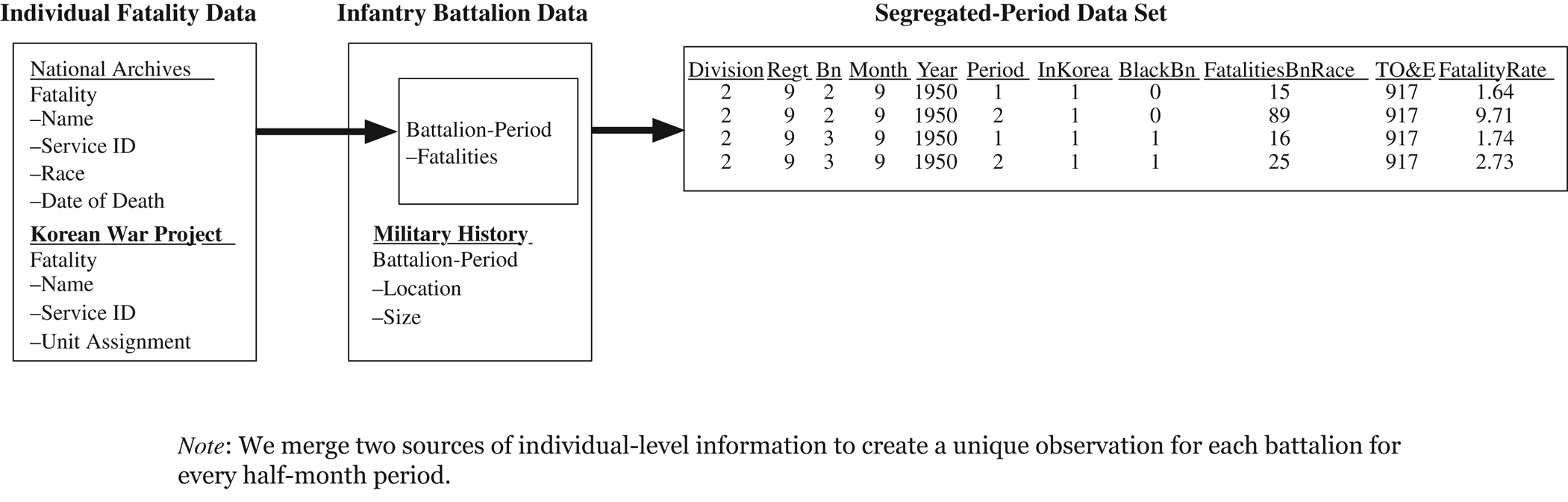
We aggregate all individual fatalities to the battalion-period level. At the unit level, for each battalion that fought during the segregated portion of the war, we collect its date of arrival (and departure if relevant) on the peninsula from an exhaustive chronology of the Korean War.Footnote 31 In total, sixty-four different infantry battalions fought during the segregated part of the war. Of these sixty-four, five were Black battalions: all three battalions of the Twenty-fourth Infantry Regiment of the Twenty-fifth Infantry Division (ID), the Third Battalion of the Ninth Infantry Regiment, Second ID, and the Third Battalion of the Fifteenth Infantry Regiment, Third ID. The final step calculates the fatality rate for each battalion-period, which we multiply by 100 to ease interpretation. For the denominator, we use the benchmark strength levels set forth in the Tables of Organization and Equipment (T/O&E),Footnote 32 which stipulate that a battalion consists of 917 soldiers. Admittedly, there was variation in overall size—for instance, a battalion might be smaller after recent heavy battlefield losses. Additionally, some evidence suggests that Black battalions were larger because of a dearth of units to which Black soldiers could be assigned. While noting potential discrepancies, the appendix shows that variation in unit size is highly unlikely to alter the findings. Substantive results remain similar even if battalions of one race averaged 100 more soldiers than battalions of the opposite race. The numerator for the fatality rate equals the number of fatalities within that battalion-period whose race matches the putative race of the battalion. Occasionally, some units contained soldiers of different races before the designated cut point between segregation and integration—such as white officers in Black units. We exclude those fatalities whose race did not align with the designated race of the battalion though the appendix shows results are similar when including those fatalities.
Figure 1 summarizes the data-construction process. Merging two sources of individual-level data allows us to aggregate fatalities by race and date to the battalion-period. Reference guides for the military history of the Korean War provide arrival (and exit) dates for each battalion. Put together, we obtain an observation for each infantry-battalion period when battalions were in Korea.
Summary of data construction

Results for Casualty Rates Under Segregation
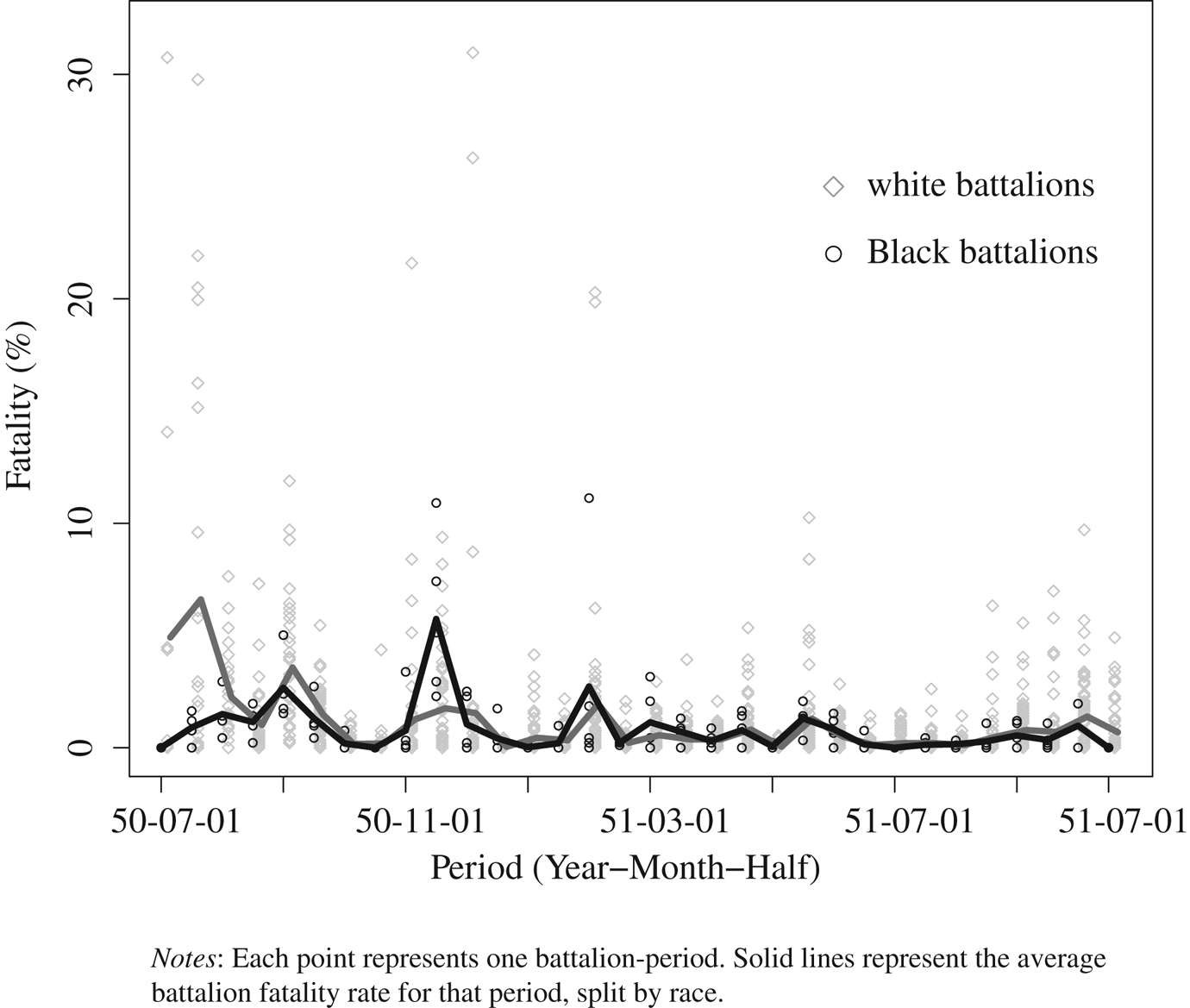
The first analysis addresses whether Black infantry battalions deployed in Korea experienced higher fatalities than white units. Figure 2 plots the fatality rates for each battalion in Korea through the segregated portion of the war. Solid lines represent mean battalion fatalities for a given period, split by battalion race. Several takeaways emerge from the figure. First, in accordance with known combat patterns, the war's intensity fluctuated over time. US fatalities spiked during the initial months as North Korean forces pushed opposition forces south and again in the final months of 1950 with China's full entry into the war. During these and other periods, costs were distributed unequally across battalions with some losing over 30 percent of their soldiers while others saw no losses.Footnote 33
US battalion combat fatality rates through the segregated portion of the Korean War

Most saliently, the figure does not provide clear evidence of a racial fatality gap. Black and white battalion fatality averages largely track one another. However, sharp disjunctures punctuate the otherwise parallel pattern. Among these disjunctures, white units sometimes bore the heavier costs and other times Black units did. There is no immediate evidence supporting a racial fatality gap in either direction. That said, the presence of disjunctures between fatality averages is noteworthy and a point we return to later.
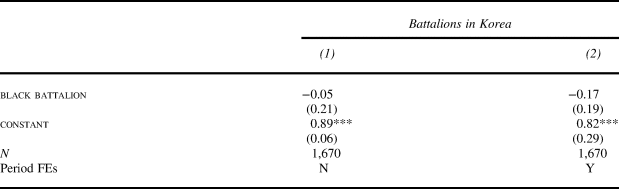
Regression analyses in Table 1 corroborate overall impressions from the descriptive snapshot. All models use OLS with the battalion-period as the unit of analysis.Footnote 34 Model 2 includes period fixed effects to capture any unmeasured time-specific factors that affect casualty rates, such as combat intensity. Consistent with Figure 2, the difference in fatality rates between Black and white battalions is not statistically or substantively significant. In model 1, for the average half-month period white units suffered fatality rates of 0.89 percent, which amounts to just over eight deaths. By comparison, the fatality rate for Black units was only 0.05 percent lower, ±0.41 percent at the 95 percent confidence level, which is equivalent to a range between 4.2 fewer deaths and 3.3 more deaths per period. The evidence does not support the conclusion that one race died at higher rates than the other. Including period fixed effects yields generally similar results. Although it shows a slightly larger gap in fatality rates, we again cannot preclude the null hypothesis of zero difference. While theorizing various reasons to expect divergent fatality rates, we intriguingly find no gaps.
Fatality rate by race: segregation

Notes: OLS regression with the battalion-period as the unit of analysis where each half-month is a period. Standard errors in parentheses. Period fixed effects not shown. Outcome is probability of fatality multiplied by 100. *p < .10; **p < .05; ***p < .01
Discussion of the Null: Highlighting Potential Mechanisms
Black and white battalions suffered similar fatality rates in Korea. This finding is consistent with two plausible explanations: either (1) none of the theorized mechanisms linking race to combat casualties is operative (i.e., commanders are deploying Black battalions in a race-blind fashion), or (2) offsetting mechanisms are operative, with the dual race-based aspects canceling out. The latter would be most likely if Black units were primarily used on attack, while white units where charged with defensive missions. Qualitative and quantitative evidence is consistent with the first explanation: dire battlefield circumstances overrode the theorized mechanisms linking race to casualties.
The US military confronted bleak conditions at the war's outset, finding itself overstretched throughout the war's segregated portion. These factors generated intense manpower demands that limited commander discretion in determining unit assignments and positioning. The US Eighth Army arrived in Korea understrength, undertrained, and underequipped after years of Japanese occupation dampened its combat readiness. One member of the Twenty-seventh Regiment recalls being “attacked and overrun on an almost daily basis.”Footnote 35 Realities on the ground limited commanders’ options. For example, from the outset Major General Ned Almond began designing an offensive counterattack behind enemy lines. He targeted a 16 July launch date, only weeks after US forces arrived. Almond's plan “was very quickly discarded, the troops too desperately needed for a much more immediate task—keeping the North Koreans from running American forces off the peninsula.”Footnote 36 Limitations on where units could be allocated persisted. When initiating the incursion into North Korea, many units were forced to hold back because of an inability to provide logistical support north of the thirty-eighth parallel.Footnote 37 As late as January 1951, once again in retreat, US forces remained understrength and desperate for more personnel. Speaking of potential unit integration, though more broadly applicable, a private shared, “we need every man we can get in the present crisis, and it's not time to fool around with where he will serve.”Footnote 38 The extreme dictates of war necessitated the use of whatever forces could be mustered, largely overriding potential discriminatory intentions. Section 1.7 in the appendix further qualitatively assesses whether Black and white units were deployed differently during the segregated part of the war by diving deeper into the periods when short-term fatality gaps emerged.
To refine our understanding of the mechanism(s) behind the null results, we quantitatively evaluate whether racial fatality gaps emerged under different fighting conditions. We code each period of the segregated portion of the war as being one of defense, offense, or stalemate from the US perspective. Coding details are provided in the appendix and follow well-known phases of the Korean War. No statistically significant difference in racial fatality rates emerges in any of the three modes of combat. Substantively, Black units suffered slightly lower fatality rates than white units on defense (−0.09%, ±0.84% at the 95% confidence interval, n = 662) and slightly higher fatality rates on offense (0.08%, ±0.55% at the 95% confidence interval, n = 546). Whether on defense or offense, Black and white battalions bore proportionally similar costs. Higher aggregate fatalities and higher single-period racial fatality gaps emerged when on defense, but these periods offset one another as the qualitative discussion notes. In sum, we do not observe a racial fatality gap under unit segregation. Extreme manpower requirements coupled with stochastic elements of war—such as which unit happens to absorb an enemy's surprise offensive—better explain casualty patterns during the Korean War's segregated portion.
Integration: Expectations, Data, and Results
After extensive delays, the Army began implementing Executive Order 9981 during the Korean War. By 1 November 1951, which marks the starting point of our integration-period analysis, 75 percent of units were integrated.Footnote 39 With integrated units, are there still reasons to expect a racial fatality gap? We suggest there are not. Having soldiers of different races serving side by side renders many of the potential causes of disparate racial fatalities moot. Commanders’ choices about positioning units, at least at the battalion-level, will not generate racially distinct outcomes. Issues of battlefield support, whether from flanking units or the air, dissipate with segregation's end. We thus expect Black and white soldiers to die at similar rates in integrated units.
Data After Integration
Analyzing post-integration fatality rates requires amendments to the approach used for the segregated period of the war. All individual-level data still come from the National Archives and the Korean War Project. The complication is establishing a denominator for each race within each battalion. The segregated period could use the TO&E specification of 917 soldiers per battalion. The integrated period requires racial demographics within battalions. This is important since if, for example, we observe ten Black fatalities within a given battalion-period, we do not know whether this is a high or low fatality rate. The implications are quite different if the unit has ten versus 500 Black soldiers.
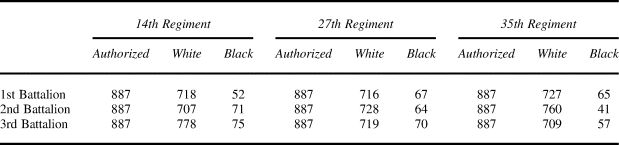
We collected new archival data from the National Archives in College Park, Maryland, which provides information on the degree of racial integration across battalions. Regular personnel reports provided to the G-1 staff indicate overall manpower for each unit, typically down to the battalion level, as well as the racial breakdown of manpower. Table 2 depicts a typical report. It includes authorized and actual personnel levels, plus a column often labeled “Class II” personnel which reports the number of Black soldiers. We collected and digitized all available personnel information on intra-unit racial breakdowns for infantry units across the integrated portion of the war. Data were available for 594 battalion-periods, which represents 19 percent of total battalion-periods.Footnote 40 Based on the available data, Black soldiers constituted 13.7 percent of battalion personnel on average with a standard deviation of 4.6 percent.Footnote 41
Battalion strength report for the 25th infantry division as of 1 February 1953

The unit of analysis after integration becomes the racial battalion-period. For each battalion-period we record total Black and white soldiers and total Black and white fatalities. For instance, the First Battalion, Seventeenth Regiment, of the Seventh ID in the first half of February 1953 has two observations—one for white and one for Black soldiers. In the main analyses, we calculate total Black and white soldiers assuming each battalion had the TO&E prescribed number of 917 soldiers and that Black soldiers represented 13.7 percent of the unit—that is, the observed sample mean. Secondary analyses limit the sample to only those 594 observations with archival personnel strength levels. The secondary analyses have over 1,100 observations because each battalion-period generates Black and white observations. Results are similar with either specification.
Results After Integration
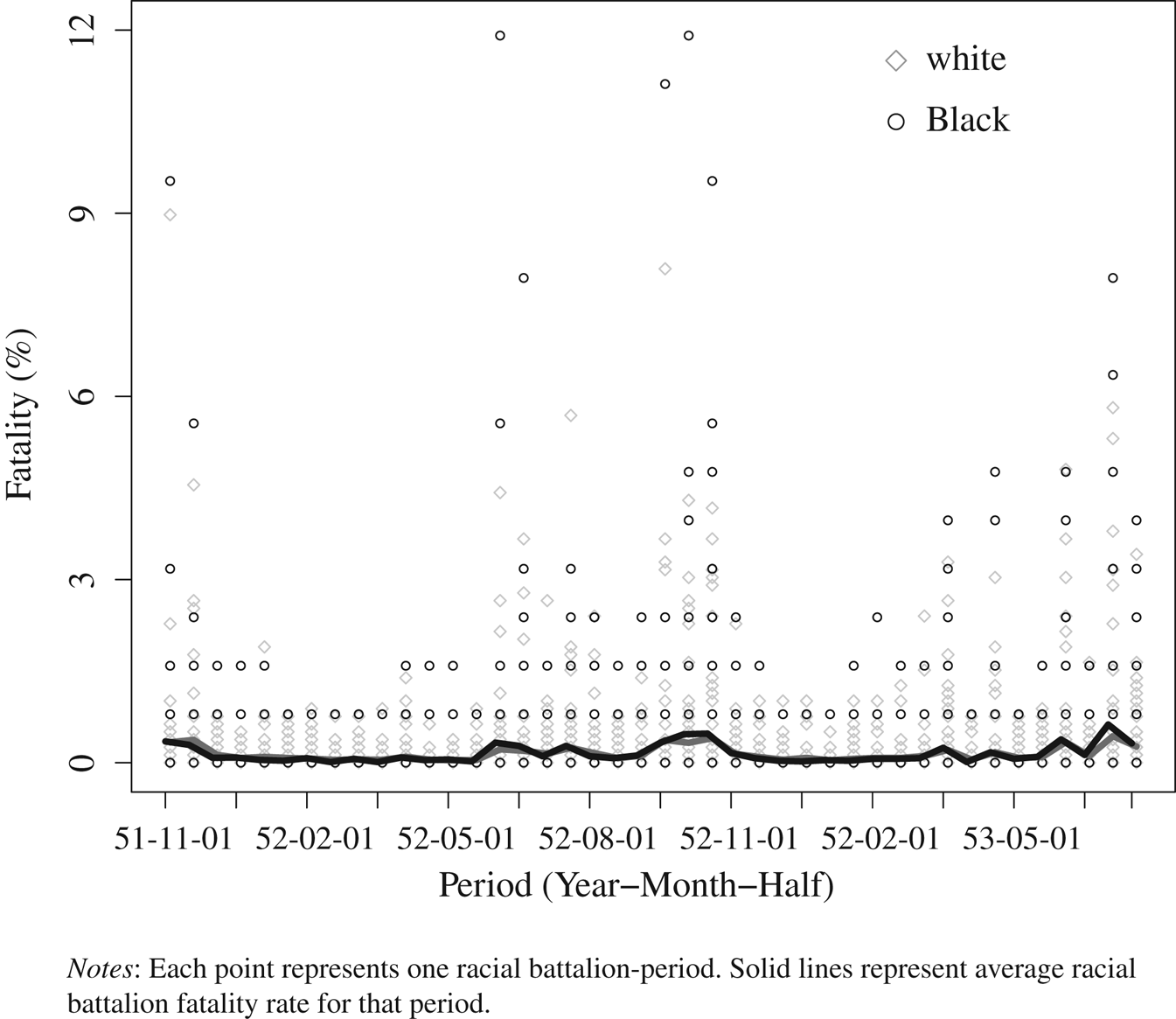
We now address our second questions: did Black and white fatality rates differ after integration? Figure 3, which plots the probability of dying for each racial battalion-period, offers initial evidence that they did not. Solid lines represent the period averages by race. Two takeaways emerge. First, overall fatality rates are lower during the integrated phase (0.15%) than during the segregated phase (0.89%). This accords with the known history where the war's final two years consisted of stalemate punctuated by sporadic fighting. Second, the racial averages closely track each other with no sizable disjunctures. While variation across units is evident with some units losing nearly 12 percent of personnel in a given half-month, the aggregate patterns indicate no race-based fatality gap after integration.
Probability of US combat fatalities by race for each battalion during the integrated portion of the Korean War

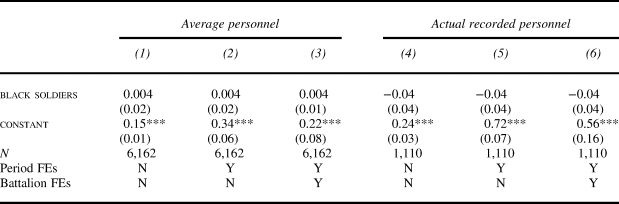
Regression results in Table 3 confirm the descriptive takeaways. Across specifications, fatality rates are similar for Black and white soldiers. Models 1 to 3 include all racial battalion-periods from the integrated phase of the war. To facilitate interpretation, we multiply the outcome variable by 100.
Fatality rate by race: integration

Notes: OLS regression with the racial battalion-period as the unit of analysis where each half-month is a period. Standard errors in parentheses. Period and battalion fixed effects not shown. Outcome is probability of fatality multiplied by 100. Models 1–3 use the observed average for unit sizes while models 4–6 include only observations where archival personnel data were available and that had at least fifty Black soldiers. *p < .10; **p < .05; ***p < .01.
Model 1 shows that 0.15 percent of white soldiers died in the average half-month period following unit integration. Black soldiers died at essentially identical rates (0.004% coefficient). The marginal effect of moving from white to Black soldiers remains negligible across specifications including period or period and unit fixed effects. The latter specification (model 3) compares Black and white fatality rates within the same battalion during the same period. As theorized, the difference in fatality rates post-integration is statistically insignificant. Models 4 to 6, which restrict the sample to observations with archival material on intra-unit racial demographics, yield similar results.Footnote 42 The marginal effect of moving from white to Black soldiers remains statistically insignificant, regardless of included fixed effects. Fatality rates were similar for Black and white soldiers after integration, which accords with our expectation that their fates converged once serving in close proximity.
Fatality Gap Variance: Segregation and Integration
Black and white soldiers died at similar rates regardless of whether they fought in segregated or integrated units. Aggregate parity in fatality rates, however, masks important heterogeneity in fatality patterns depending on military staffing policies. Here we answer our third question: did the shift from segregation to integration change the variability of racial fatality rates? Our analysis highlights the potential for unequal distribution of costs in the short term under segregation which disappeared under integration. The finding holds when accounting for the higher overall fatalities during the segregated period of the war.
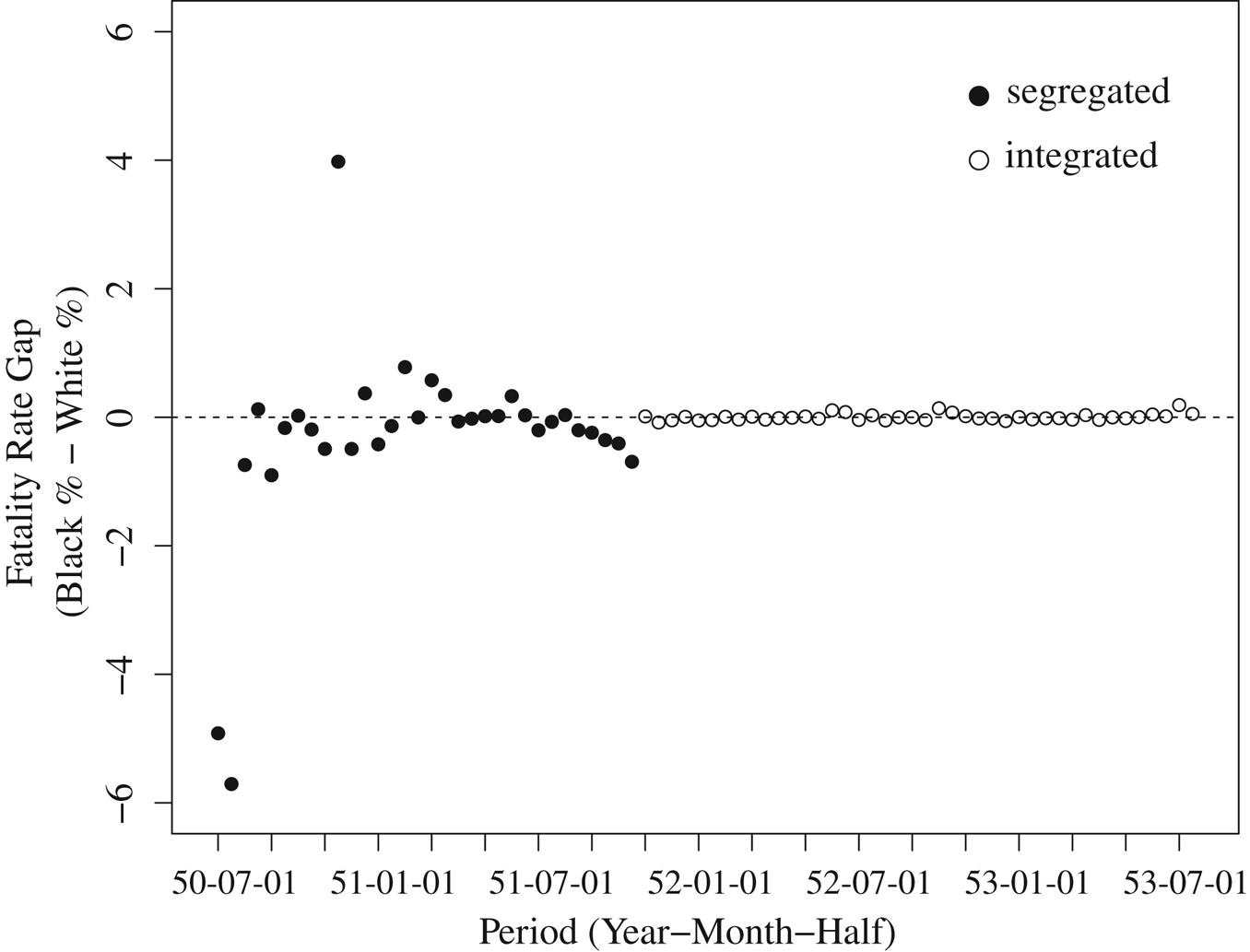
Figure 4 demonstrates how segregation affected fatality patterns. It plots the difference in mean fatality rates for Black and white units in each period with positive values on the y-axis indicating that Black units suffered higher fatalities. The variance of mean differentials was far higher under segregation than under integration. In July 1950, white units bore the higher costs. In November 1950, Black units did. The wild swings that occurred under segregation disappear after integration. Three statistical tests demonstrate that the difference in variances between segregation and integration is unlikely due to chance (results are presented in the appendix). The first is a regression with the absolute fatality rate difference for each period as the outcome variable and an indicator for segregation as the explanatory variable. Absolute racial fatality rate gaps were higher during the segregated portion of the war (p < 0.01). The second is Levene's test which shows that the variance of two vectors (segregated versus integrated periods) differs (p < 0.01). A third test employs randomization inference which does not rely on distributional assumptions.Footnote 43 Only 2 percent of 10,000 iterations produce a larger gap in fatality rate variance than the one observed in the actual data. A potential concern is that the war's integrated portion coincided with stalemate and a decline in combat intensity. Tests in the appendix address the possibility that variance differentials between the segregated and integrated portions of the war stem from the integrated period's lower aggregate fatalities. First, using the previously discussed coding of fighting phases under segregation, we compare only those segregated periods of stalemate to periods under integration which holds fixed the nature of combat. We still find higher absolute racial fatality gaps and higher variance in these gaps under segregation than under integration. Second, we conduct an analysis that inflates fatality rates under integration to match the rates under segregation (a roughly six-times increase). All results hold when using inflated numbers. Higher short-term fatality rate gaps under segregation cannot be attributed to the higher overall fatalities during that portion of the war.Footnote 44 The sacrifices soldiers paid in the Korea War happened to net out to roughly equivalent levels across racial lines during the segregated portion of the war. However, that should not obscure the imbalanced short-term consequences that segregation made possible. Segregating Black and white soldiers provided a permissive environment for substantial interracial differences in the costs of war. In aggregate, these short-term differences offset one another. Nevertheless, the pattern highlights potentially steep consequences of institutional staffing policies.
Difference in racial fatality rates across the Korean War

Conclusion
Dying in combat is often heralded as the ultimate act of sacrifice for one's state. This research note examines the consequences of segregationist policies as measured by the distribution of war's highest cost. We highlighted a tension in whether unit segregation would drive higher or lower Black fatality rates. Using newly collected and constructed battalion-level data, we empirically assess these competing possibilities. Ultimately, Black and white combat units suffered fatalities at similar rates during both segregation and integration. Qualitative and quantitative evidence evaluating units’ operational assignments suggests that the acute manpower demands of the Korean War limited the potential for discriminatory commander discretion. Despite similar aggregate fatality rates, closer inspection reveals the contingent nature of that result during the segregation period. Racial fatality gaps fluctuated widely from period to period. In some months, white units bore the brunt of war's costs. In other periods, Black units did. It seems at least partly due to chance that these fluctuations offset one another, yielding similar aggregate fatality rates. These fluctuations essentially disappear after the integration of units. Consequently, race-based personnel policies opened the door to a skewed cost distribution within the military.
The Korean War's context highlights two potential scope conditions for the results. The first is the nature of the conflict being fought. The Korean War typifies conflicts where intense battlefield needs facing militaries—when caught off guard, unprepared, and undermanned—create conditions increasing the importance of obtaining contributions from all service members, regardless of race. Wars of choice or those with lower manpower demands may grant commanders greater leeway in how they employ military units. In less dire conditions, discriminatory intent could generate differential fatality rates. Whereas prior scholarship connects war's extreme stakes to transformations of the state and resource extraction,Footnote 45 this study reveals another consequence of wars fought under grim circumstances: battlefield imperatives incentivize allocating available societal resources (in this case military personnel) to wherever they are most needed. How states mobilize and employ military capabilities depends on how desperate a military situation they confront.
The second scope condition relates to the substance of discriminatory attitudes. The content of these attitudes varies across groups, generating different implications for the battlefield. For example, recent debates about whether women ought to serve in combat roles commonly highlight how women's lives are valued more, rather than less, than those of men.Footnote 46 These attitudes are emblematic of a “protective paternalism,”Footnote 47 which contrasts markedly with the empirical observation that Black lives were commonly perceived to be worth less than white lives for much of US military history.
This study highlights several areas for future research. Most obviously, scholars can test the scope conditions we discussed. Taken together, the two points indicate that fatality distributions might differ if studying the same underlying question but if either segregation occurs along different demographic lines or combat intensity differs from that confronting the US military in Korea. Instances that vary along these dimensions might include segregation on the basis of gender in World War I Russia, class in India, sect in contemporary Iraq, state of origin in the Union Army during the American Civil War, citizenship (versus foreign nationals) in the United Arab Emirates, colonial (versus metropole) origins in the French military in Indochina, or ethnicity in recent conflicts engaging Chechen and Israeli forces. Studying the issue in earlier US wars could also prove instructive. This approach holds fixed the racial dimension of segregation while allowing variation in combat desperation from comparatively high—for example, World War II—to comparatively low—for example, the Spanish-American War. If unit positioning operates as posited, we would expect commander biases to be evident during the Spanish-American War and muted during World War II.
Additionally, while we focus on the ramifications of discriminatory institutional policies for wartime fatality patterns, future work could reverse the question studied. The idea that sacrifice on the battlefield can affect perceptions of equality at home is one manifestation of the international relations concept of the second image reversed.Footnote 48 During the Korean War, politicians and civil rights activists used the successes of Black soldiers in their efforts to enact policies affording African Americans greater equality.Footnote 49 Krebs demonstrates how variation in the roles filled during military service—combat versus support—affect a group's ability to make civil rights gains.Footnote 50 New work might push these distinctions further by considering how differences in battlefield outcomes such as performance and cost bearing, as opposed to only differences in military roles, factor into efforts to transform military sacrifice into domestic equality. Just as domestic discrimination can spill over to the battlefield, so too can battlefield events reverberate back to domestic politics.
Data Availability Statement
Replication files for this research note may be found at <https://doi.org/10.7910/DVN/SVMFIQ>.
Supplementary Material
Supplementary material for this research note is available at <https://doi.org/10.1017/S002081832100014X>.
Acknowledgments
We thank Laia Balcells, Stephen Biddle, Jonathan Homola, Tyler Jost, Richard Lacquement, Ashley Leeds, Jonathan Mummolo, Noah Nathan, Jacob Shapiro, Brad Smith, Ariel White, and participants at ISA 2017, APSA 2018, MPSA 2019, Peace Science 2019, and the Conflict and Data Science Conference at Columbia University for helpful feedback throughout the development of this project.