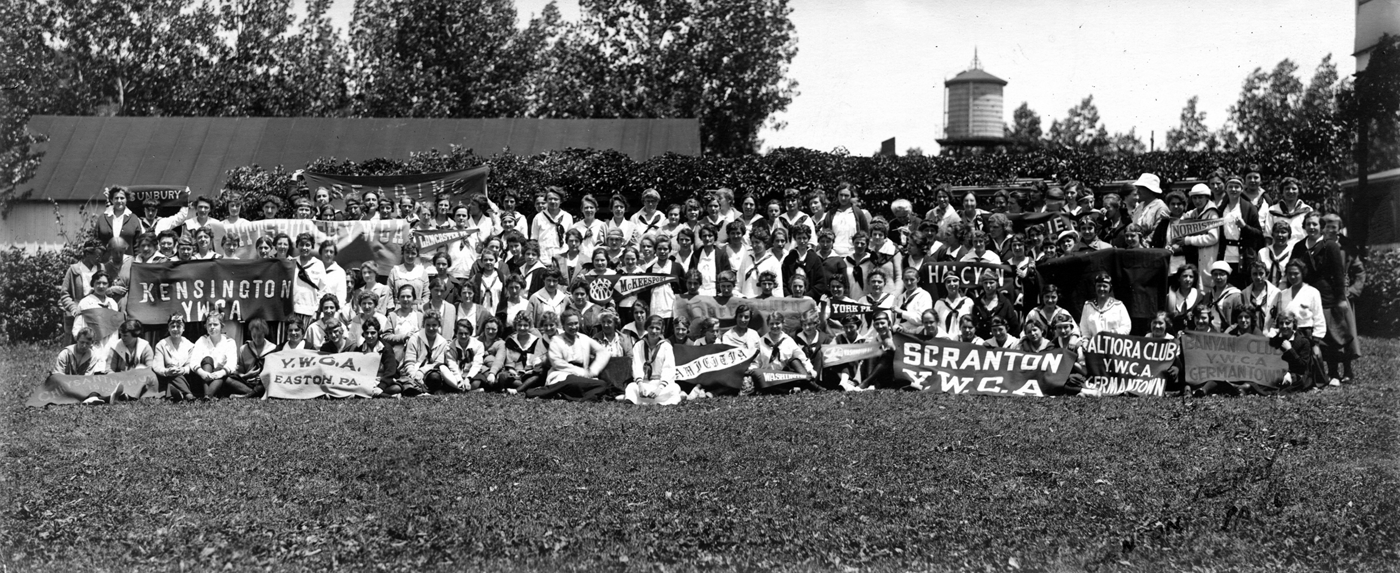
In July 1918, Mary E. Jackson, the Young Women's Christian Association's first Industrial Secretary for Colored Work, reported her positive experiences at a YWCA industrial conference for White working-class women at Camp Nepahwin in Canton, PA. Upon arrival she had found “the question of the white girl's responsibility to the colored girl” being discussed and a notable “spirit of justice and fair play … among the girls” evident. She observed that “the climax of the entire week was a resolution … ‘That we take an interest in the colored girl in industry.’”Footnote 2
White working women at the conference had mixed feelings about racial issues. Another recommendation, to “have a democratic attitude toward immigrant[s] … and …the colored girls of our country,” was received with less aplomb than the one to “take an interest.” Immigrant women garnered little if any discussion, but vigorous debate ensued about what a democratic attitude toward “colored girls” required. Some White workers refused to be in the same room with an African American woman. Most agreed that Black women needed “good living and working conditions,” although some argued that “democracy did not necessitate the admission of colored girls into daily relationships with white girls in industrial and social life.”Footnote 3
In the end, both resolutions passed. Delegates both deeply disagreed over race and saw the issue as crucial for all working women; this was one of the few debates the conference proceedings mention. The following summer, the 200 or so Nepahwin conference delegates passed a resolution supporting “no distinction between the races in privileges of employment.”Footnote 4 A rhetoric of interracial labor solidarity was developing in the YWCA's Industrial Program during a period of great racial turmoil. [Fig. 1]
Nepahwin Industrial Council, 1918. YWCA of the U.S.A. Records, Sophia Smith Collection, Smith College, Northampton, Massachusetts.

These are not the behaviors we might expect from a group of young White working-class women in the World War I era, a period best known for racial violence and White resistance to Black advances. Organized labor was unfriendly to Black workers: at its 1917 convention, the American Federation of Labor had rebuffed a resolution asking it to help fight for African Americans' rights, and had only “[g]rudgingly, unwillingly, almost insultingly,” in W.E.B. Du Bois's words, passed resolutions to send Black organizers to organize more unions for Black workers.Footnote 5 Black workers had hardly been allowed to claim a share in what Joseph McCartin has called the wartime “triumph of an ideal—industrial democracy” that factory workers experienced when the federal government briefly protected labor rights.Footnote 6 Many White Americans responded hostilely to Black people's migration, their wartime entry into industries previously closed to them, and even—perhaps especially—their military service. During and after the war, hundreds of Black Americans died in racist riots in East St. Louis, Chicago, and other Northern cities, as well as Southern ones, adding to the death toll from lynching.Footnote 7 Black soldiers endured searing racism during and after the war.Footnote 8 In the few places where AFL organizers had briefly tried to organize Black workers during the war, postwar riots destroyed the possibilities for interracial organizing.Footnote 9 Yet at a YWCA conference, White working women discussed their obligations to Black women and endorsed equal employment opportunity.
This engagement with racial issues was the fruit of efforts by a group of YWCA staff, who seized the opportunities of World War I to advance a racial justice agenda through YWCA programs for working women. Part of a new generation in the YWCA, they used an organization identified with genteel uplift to create labor organizing for Black women and to promote working-class anti-racism among White women. Eva Bowles, the African American director of a new wartime Colored Work Committee, created the first national YWCA program work for Black working women and appointed as its director Mary Jackson, an experienced club woman and labor specialist. Drawing strength and skills from the extensive Black women's club network, Jackson, Bowles, and others pursued multiple strategies, as Kate Dossett notes many Black women did in the interwar period, building separate institutions to foster leadership while also demanding equal treatment and nonsegregation policies.Footnote 10 They worked primarily with two White YWCA Industrial Program staff, Grace Coyle and Annetta Dieckmann, who supervised work in the YWCA's mid-Atlantic region. Together, these women took advantage of new resources and a changed political climate to advance social change goals through the YWCA.Footnote 11
Jackson and her staff created YWCA Industrial Program work for Black working women, serving thousands and paralleling the formal Industrial Program, which served only White women before the war. With help from Dieckmann and Coyle, they created a conference where Black working women could network and develop leadership skills. Thus, they created separate spaces within the YWCA for Black women.
Besides directing YWCA resources to Black working women, they also advanced a new discourse about racial justice. During and after the war, they made claims for social justice based on Black women's wartime labor contributions. Rather than focusing on the accomplishments of the “better sort,” as had been reformers' strategy for decades, they placed Black working-class women discursively and literally at the center of the racial justice claims that had been heightened by World War I's strains and opportunities. This approach continued a Black reform tradition of citing women's accomplishments as a critical marker of racial progress, but their rhetoric represented a shift in what Evelyn Brooks Higginbotham termed the “politics of respectability,” which cited educated, cultured women as evidence of African Americans' respectability and racial abilities. Black club women's role in late nineteenth- and early twentieth-century “racial uplift” has been well explored by scholars such as Paula Giddings, Dorothy Salem, Deborah Gray White, Stephanie Shaw, and Glenda Gilmore.Footnote 12 While historians' common understanding of respectability politics includes an emphasis on women's cleanliness, sexual restraint, thrift, and domestic skills, these YWCA activists emphasized women's patriotic contributions through labor. The arguments Jackson made in defense of Black working women's respectability represented a shift from the earlier tendency of African American elites to represent working-class urban migrants as less moral and as sources of disorder.
Because Jackson, Bowles, and their allies based their justice claims on arguments about working women's patriotic contributions rather than on either elite women's accomplishments or men's military service, they also complicate our understanding of what World War I meant for the Black Freedom Struggle. Recent scholarship emphasizes the significance of Black men's World War I service for shifting civil rights strategies. Well known as a turning point in the history of African Americans' claims for justice, World War I raised, and then dashed, expectations for full citizenship rights, prompting bitterness and more militant demands. During and after the war, numerous scholars have found, the earlier politics of respectability and female uplift work were superseded by a masculinist black nationalism that grounded full citizenship claims on Black men's military service.Footnote 13 Characterizing World War I as a turning point toward more radical, mass-based black politics and culture, historians have for some time highlighted the symbolic significance of Black soldiers and veterans as icons of the disjuncture between patriotic sacrifice and ongoing disfranchisement, violence, and discrimination.Footnote 14
However, women as both actors and symbols continued to play an important role for YWCA Colored staff and White Industrial Program allies. Rather than focusing racial justice rhetoric around soldiers' service and manhood rights, these women focused on the rights of Black working women and the duties of White working women. Thus we can see them responding to the gendering of New Negro politics, in which, as Nikki Brown puts it, the postwar “drive toward black political equality … narrowly defined black women's political space and power.”Footnote 15 Their story highlights both women's activism and women's persistent discursive importance.
Jackson, Bowles, and their Industrial Program allies also constructed a standard of patriotic anti-racism, calling on White working women to consider racial justice as their own responsibility. They forged institutional ties between precarious wartime “colored” industrial work and the vibrant, more entrenched Industrial Program. When postwar cuts defunded “colored” industrial work, the Industrial Program became one of the foremost sites for interracial contact and racial justice discourse within the YWCA, just as African Americans' hopes for postwar advances were collapsing amid White people's hostility, rioting, and conservative government policies.Footnote 16 Arguing that cooperation between working people of different races was crucial to social progress, they made African American laboring women and White working-class allies both symbolically and literally crucial to wartime and postwar civil rights efforts, in ways that have garnered little attention from historians.
My subjects' activities in the YWCA, then, also can be understood as an early example of shifts in racial justice strategies toward a focus on the civil rights unionism that would be most apparent in the 1930s and 1940s. Recent studies by Virginia Wolcott, Michael Honey, Beth Thomas Bates, and William Jones, among others, have emphasized the significance of a labor-oriented shift, locating it in working-class activism in the interwar period.Footnote 17 In the wartime period, when most Black leaders remained neutral on whether Black workers should join unions, Jackson and Bowles built ties to a part of the YWCA that was dedicated to women's labor unionism, and enlisted help from White labor-oriented allies. Indeed, my findings also suggest the deeper historical roots of the civil rights and citizenship claims that Megan Taylor Shockley found that Black women developed extensively in the context of the Second World War.Footnote 18 This effort within the YWCA, then, also suggests an underexplored role of women in a critical chapter of the long civil rights struggle.
Bowles, Jackson, and the other Black YWCA wartime workers who argued for industrial women's importance constitute part of the shift that Nikki Brown has skillfully explored, in which Black club women's “political consciousness evolved to include working-class black women in a groundswell of war-related activism” even as postwar riots and their representation in the black press reinforced the “masculinizing effects” of postwar militancy.Footnote 19 Through the YWCA Industrial Program, Black women and their antiracist White allies sought labor-based Black equality through an all-female space.
Finally, their efforts also contribute to our historical understanding of race in working-class American life. We know more about interracial labor organizing, and working-class race relations overall, among men than among women.Footnote 20 White women in this period often reinforced their racial privileges to keep women of color out of their workplaces and to enjoy superior eating, changing, and washroom facilities when they did share a workplace, while employers reinforced and profited from racial tensions.Footnote 21 We need to learn more about why women who could reinforce such privileges sometimes did not, and under what circumstances interracial cooperation occurred.
SEIZING WARTIME OPPORTUNITIES FOR INDUSTRIAL WORK
Jackson's experience at the 1918 industrial conference was not the norm in the YWCA, which the sole Black woman at the 1915 National Convention had deemed a “spiritual farce, not a spiritual force.”Footnote 22 Though Colored YWCAs had formed outside the South by 1870, White national and local leadership had marginalized them, treating Black women as a “Southern problem,” and accepting segregation as part of any solution, ostensibly out of deference to Southern White women's concerns. Black women had been vocal in contesting their exclusion.Footnote 23
World War I provided Black YWCA women unprecedented access to association resources, both in service to soldiers and because tens of thousands of Black women joined many White women in entering factory work.Footnote 24 In 1917, as one of seven national organizations called to help the U.S. government deal with wartime upheavals, the YWCA created a War Work Council to target the cultural and demographic disruptions caused by the huge surge in women's manufacturing employment.Footnote 25 War work included the YWCA's first commitment to national African American program work, a wartime Colored Work Committee headed by Eva D. Bowles.Footnote 26
Bowles, who had overseen Colored Work in cities since 1912, used the committee's budget to greatly expand YWCA work for African American women, especially around war centers.Footnote 27 She recruited dozens of staff through the National Association of Colored Women, which had provided education and other services since the late nineteenth century, and she organized training for new staff at the YWCA's National Training School. The Colored Work Committee was interracial, but Black women ran and staffed most work, gaining access to national YWCA finances for the first time. Bowles quickly established Black women's control over this first YWCA national program designed for Black women.Footnote 28
Among other projects, Bowles set up YWCA services for Black working-class women who had been excluded from the YWCA's Industrial Program. The Industrial Program had, for more than a decade, provided tens of thousands of working women with recreation, meeting spaces, education, and political allies. Serving the most working women of any organization, it operated hundreds of industrial clubs all over the country, and held conferences planned by the working women themselves.Footnote 29 The Industrial Program was experiencing its own wartime surge in membership and resources. However, since industrial clubs followed the national YWCA's broader segregation practices, Black women were generally unwelcome at club meetings in White associations. Poor funding for Colored YWCAs and the lack of a national staff member to coordinate Black industrial work had left Black working women underserved.
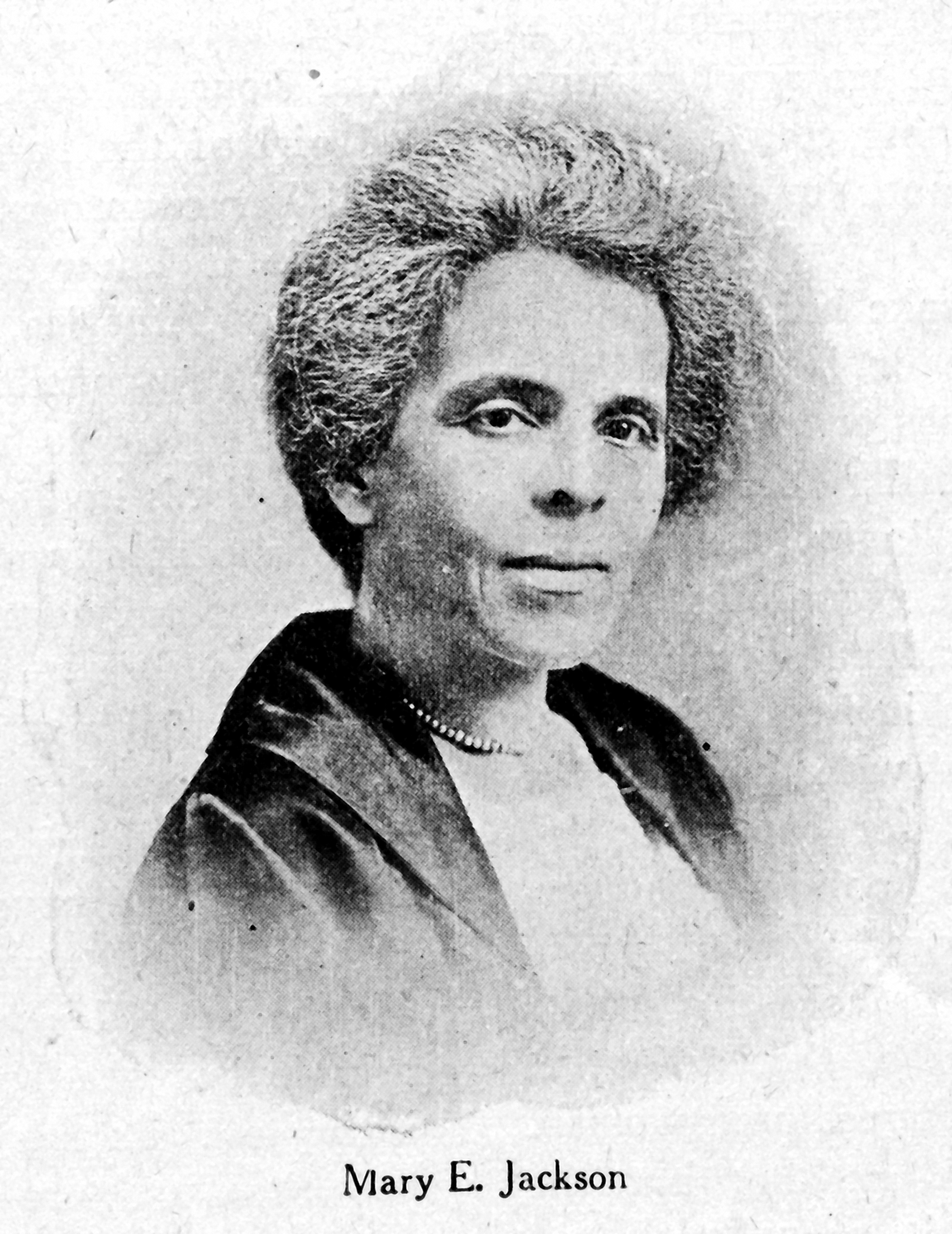
Bowles appointed Mary E. Jackson as national Industrial Secretary for Colored Work. Jackson, a Rhode Island club woman and state labor official, brought significant experience and skills in both labor and racial issues to the new position.Footnote 30 [Fig. 2] Jackson and her national staff could circumvent local White resistance to Black industrial work. They used wartime Colored Work Council funds to create an African American parallel to the Industrial Program.
Mary Jackson portrait photo, from “Colored Girls in the Second Line of Defense,” Association Monthly (Oct. 1918): 363.
Jackson fought Black women's invisibility as war workers, arguing for their inclusion in the YWCA's dramatic wartime expansion of resources for working women. War Work Council reports omitted information on Black women from the “Industrial War Work” section, as though they were not part of the factory workforce. Jackson launched a series of investigations, surveying government officials and labor groups about racial attitudes and cataloguing areas in which industrial workers were most needed.Footnote 31 She documented material and ideological barriers to Black women's full and equal participation in the labor force. She gathered information about employment numbers, occupational statistics, wages, unionized status, and whether Black and White women workers shared workspace or restrooms. In reports to various YWCA committees and national leaders, Jackson pointed out the large numbers of Black wage-working women, their range of occupations, and their often brutal working conditions.Footnote 32 She, like other Black staff, also carved out a role for Black women as trained YWCA professionals.Footnote 33 Jackson vividly rendered Black women's dramatic entry into new occupations and their need for YWCA support.
Jackson and others also drew on a growing wartime network of reformers and government staff interest in Black people's industrial labor and women's wage labor. Woodrow Wilson's administration had introduced segregation into the civil service soon before the war, signaling a grim racial climate. Jackson's wartime network, in which some members held positions in both government and reform groups, created lonely outposts of more progressive thinking on race and gender. Jackson and Black YWCA worker Elizabeth Ross Haynes, in particular, forged ties with a range of social reformers, government workers, and educators. Staff in the Labor Department's Division of Negro Economics and the Women-in-Industry Service of the War Administration Board (later the Women's Bureau) helped support arguments to White YWCA leaders.Footnote 34 The DNE and the WIS cooperatively researched Black women's working conditions, investigated major changes in Black working life, coordinated Black workers in war industries, and advised the government and private organizations. Nongovernmental reformers also were engaged in trying to make visible and remedy Black women's significant workplace disadvantages.Footnote 35 For instance, in Chicago, whose African American population was large and growing, Jackson obtained detailed information about Black women in factories from Women's Trade Union League organizer Irene Goins, who had been organizing Black women stockyard workers.Footnote 36 Jackson used the information to advocate for increased funding for Colored YWCA industrial work, and built up a significant Chicago program. The industrial committee she created included renowned anti-lynching crusader Ida Wells-Barnett, who was, Jackson noted, “prominently connected with all forward movements” for racial justice.Footnote 37
This critical interracial research network, inside and outside the government, contributed racial and labor expertise that, as Mark Hendrickson has argued, would help expose the uneven benefits of the labor market during the conservative 1920s.Footnote 38 Their studies and discussions, which highlighted Black women's growing presence in industry and the particularly brutal conditions they faced, also helped increase the wartime YWCA budget for Colored Work.
Mary Jackson and her staff created YWCA Industrial Program work for thousands of Black working women where none had existed before. They launched industrial work in dozens of cities and towns in Illinois, Indiana, Kentucky, Maryland, Minnesota, Missouri, New York, New Jersey, North Carolina, Ohio, Pennsylvania, Virginia, South Carolina, Tennessee, Texas, and West Virginia, sometimes building on existing YWCA work and often organizing the first YWCA effort for African American women. They created dozens of industrial clubs for domestic workers, laundresses, seamstresses, and women in tobacco and garment factory work. [Fig. 3] The clubs' emphasis on safe and wholesome recreation sometimes reflected earlier YWCA emphases on uplift, but they also provided young Black women encouragement about their right to industrial jobs, which offered them relief from the sexual vulnerability and isolation of the household occupations to which they had been largely confined.Footnote 39 Unlike the Industrial Program work for White women, the industrial work carried out by the wartime Colored Work Committee entailed fighting racism at every turn and creating committees to educate the public about Black women's right to decent work conditions and wages. Like the Industrial Program, it also provided working women a place to discuss their problems and seek solutions, and created rare recreational and social opportunities, as in Louisville, where 1,000 women attended “industrial girls' parties” in 1918.Footnote 40
“A new day for the colored woman worker: skilled work and skilled workmen's wages” from Jane Olcott, The Work of Colored Women (Woman's Press: 1919). YWCA of the U.S.A. Records, Sophia Smith Collection, Smith College, Northampton, Massachusetts.
YWCA workers also sought to increase Black women's job opportunities. In St. Louis, for instance, the new industrial secretary, Nellie Agee, visited 125 factories, urging employers to hire African American women. Some refused, but many were “willing to try out colored girls and the girls made good as a rule when given a chance.”Footnote 41 However, employers were not the only barrier. The federal director of the U.S. Employment Bureau of Connecticut emphasized the need “to protect the white workers from close association with colored people” and “felt it a very definite part of his personal responsibility,” Jackson reported, “to prevent colored and white workers from association on terms of equality.”Footnote 42 Jim Crow was enforced in the North, here, by the very official in charge of employment policies.
All this hard work produced a dramatic increase in Black YWCA industrial members, who gained access to safe spaces, education about labor issues, and recreational opportunities. By war's end, fifty-seven industrial clubs in twenty-two cities served about three thousand Black working-class YWCA members, and another seven thousand women attended club meetings without joining. Ten local industrial secretaries focused on African American women.Footnote 43 Wartime efforts by dozens of local workers, regional field workers, and national workers created institutional structures and resources for thousands of Black working women, who had little access to labor unions and were likely to face significant racism from most White-led organizations.Footnote 44
RACIAL JUSTICE AND AMERICAN DEMOCRACY
Jackson explicitly linked YWCA industrial “Colored Work” to the civil rights struggles Black soldiers were waging. Articulating a widespread hope among African Americans that wartime service would earn better treatment, Jackson celebrated Black women workers' contributions. “Everyone realizes,” she wrote, “that both justice and efficiency demand that white and colored soldiers be treated alike. We are just beginning to awake to the necessity of giving colored girls fair” working conditions and wages.Footnote 45
In fact, “everyone” did not acknowledge that Black soldiers should be treated equally. Black men's military service aroused deep anxieties among white supremacists and evoked responses ranging from petty denials of cake and hot chocolate from the Red Cross, to newspaper attacks on the “Negro in uniform [who] wants the whole sidewalk,” to attempts to keep overseas troops from interacting with French women, to assigning troops the worst and most difficult labor, to attacks by White soldiers. “Jim Crow sailed to Europe” on the same ships that transported African American troops, Adriane Lentz-Smith has observed, and military service entrenched rather than weakened racial hierarchies.Footnote 46
When Jackson referred to Black soldiers' equal treatment, then, she was invoking a dramatic, highly visible struggle between the ideals of democracy for which soldiers fought and the reality of racism, placing Black women discursively into the battle as home-front soldiers in service of the nation. Writing in the Association Monthly, another Black YWCA war work staff member observed: “The same grave questioning is taking place among women, which one hears from the soldiers back from the front.” She wondered whether “the soldiers in the trenches waiting for the grenades” would have agreed that a Black woman, denied a job, was unfit to work in a grenade factory, and noted that the woman's grandfather had fought for American independence.Footnote 47
Jackson connected this struggle with the wartime discourse that encouraged working people to claim citizen rights based on their labor. The Black woman was “no longer a ward of America, but a citizen with the rights, duties, and responsibilities of citizenship”—willing to work hard for the war effort, and worthy of full citizenship in return. Wartime labor agencies were less supportive of Black workers than of White female workers, but nonetheless they created conditions that helped Jackson make her claims.Footnote 48 She linked Black working women's status with racial progress, writing that present labor responsibilities built “future opportunities … a future hope of economic freedom and industrial democracy.” Like the NAACP, whose wartime rhetoric Steven Reich has skillfully explored, Jackson used a language of patriotism and sacrifice to demand democracy at home.Footnote 49 However, unlike NAACP leaders, Jackson based her claims neither on military service nor on men's labor, but on women's patriotic labor contributions, making them symbolically and literally central to civil rights claims.
Dating the claims further back, though, Jackson also pointed out the “skilled and unskilled woman labor of the South” performed under slavery, work that had been repaid “neither in gold nor in gratitude.” (The term “skilled” countered portrayals of Black women as unskilled and therefore deserving lower wages.) Even aside from Black women's war service, she suggested here, postwar economic rights were due as reparations, because much of the U.S. economy had been built by the labor of enslaved Black women. “Is this not the day,” she asked, “for the nation to repay to the daughters of to-day its debt to the mothers of yesterday” by allowing Black women equal economic opportunities?Footnote 50
Mary Jackson's reports and articles assumed Black women's permanence in industry and argued that they should not be penalized for their earlier lack of opportunity; rather, their occupational segregation had created problems that must be remedied in the face of wartime labor shortages.Footnote 51 Her “carefully … workable plan through which to reach and develop the colored industrial girl” emphasized equal treatment and appropriate training.Footnote 52 No less moral than White women, Black women needed the same protections. They also needed and deserved “vocational training on the same basis as … the white girl.”Footnote 53 Unlike many middle-class (and nearly all White) observers in the early twentieth century who viewed Black working-class people as struggling to enter the modern industrial age, she insisted on solutions beyond training women for household service.Footnote 54 She argued for identical workplace conditions regardless of race, and insisted that any mistakes Black working women might make were due to “inexperience and human weakness rather than to some racial defect.”Footnote 55 Emphasizing the need for Black women to have safe housing and protection, Jackson countered stereotypes of Black women—particularly Black working women—as sexually loose and morally dangerous, an image common beyond the YWCA as well as in it.Footnote 56 Here she invoked the working-class respectability of laboring women. Emphasizing the inherent capabilities and morality of African American working-class women was a rare position at the time, when even elite African Americans often blamed their laboring migrant counterparts for what they saw as inappropriate behavior.Footnote 57
Jackson's rhetoric advanced a long effort, within and beyond the YWCA, to defend the respectability of African American women. The association's White national leaders portrayed Black and White women in quite different ways. They emphasized keeping young White working women out of trouble during leisure hours and safeguarding the moral condition of women and girls affected by war conditions.Footnote 58 The Association Monthly argued for the YWCA's “wholesome influence” on “inexperienced young folks during the tumultuous, bewildering period of war,” with the threat of the “irresponsible khaki hero” waiting to “look after her good times.”Footnote 59 It also focused on protecting them through good working conditions and wages.Footnote 60
However patronizing their language, these authors did not raise the specter of masses of idle, dependent, diseased, and criminal women, as did some association portrayals of Black women. One article warned that inefficient or untrained migrant Black working women might “through misguidance … drift into inefficiency, disease and lawlessness.” The author emphasized the need to “discourage in every way the transfer of the undesirable and unfit from one community to another” and warned of the potential “menace to society.” The source of feared irresponsibility here was not a “khaki hero”; the protection evoked was from, not for, the working women, and, as Judith Weisenfeld has documented, invoked Whites' stereotypes of venereal disease as particularly common among black people.Footnote 61
White association national leaders treated Black working women's presence as a temporary and a moral problem. A Social Morality Committee sent women physicians touring the country, targeting “those who are innocent, emotional and in most cases, actually ignorant,” a War Work Bulletin put it.Footnote 62 However, the War Work Council suggested it was especially important for Black women, who were deemed less innocent. While council publications claimed to treat Black and White workers equally, they presented Black working-class women as morally weak and dangerous to others. Fundraising efforts depicted Black women as an excessively sexualized threat to Whites, urged war work in “colored” communities to contain Black women's threat to White and Black soldiers in cantonments, and emphasized its “social morality talks” for them.Footnote 63 The Colored Work Committee protested negative stereotypes such as a War Work Council bulletin that portrayed African Americans in stereotypically menial positions.Footnote 64
By war's end, Jackson had helped shift how Black women workers were portrayed in the YWCA. Noting that war emergency had “created the demand for colored labor,” a December 1918 War Work Bulletin article argued for “the permanence of that demand.” The article noted that the YWCA's purpose included educating “the white worker to her responsibility to the colored girls.” Accompanying the article was a photograph of a row of “white and colored girls working together in perfect amity,” making Red Cross buttons, with a caption that the war had given African American women “the chance to show they are as good Americans as white girls.”Footnote 65 Such interracial cooperation, a goal Bowles signaled early on, was one of the cornerstones of Jackson's civil rights rhetoric.Footnote 66 While the photograph and article may have promoted a rosy view of working women's race relations, Bowles, Jackson, and White Industrial Program staff members Annetta Dieckmann and Grace Coyle had been working hard to promote interracial labor cooperation.
FROM SOCIAL SERVICE TO SOCIAL SCIENCE: WHITE WORKING WOMEN'S RESPONSIBILITIES
A wartime YWCA document laid out White working women's role in welcoming Black women who were newly entering many industries. Though likely a talk Mary Jackson gave at White industrial conferences, but possibly by Grace Coyle, it noted the wartime labor shortage as the “greatest national problem.” Inverting Black women's double burden of race and gender, the document emphasized White women's double duty, asking “what is the white woman's supreme test of patriotism industrially expressed?” The task, argued the author, included both recognizing her responsibility for war production “and also the more difficult and delicate task of unifying the womanhood of the country regardless of race, to supply needed output.” Invoking the wartime emphasis on work's patriotic aspects, the author concluded:
One gravely questions the true patriotism of that class of women who hysterically rush into the frontline trenches of the industrial battle but throw down their arms and refuse to go into action if they find colored women seeking places as their comrades.Footnote 67
As radical Black labor leaders such as A. Philip Randolph and Frank Crosswaith would argue in the postwar period, the document urged that interracial cooperation among working people was essential to achieve workplace justice.Footnote 68
This language illustrates what may be the least known aspect of wartime YWCA work: its insistence that White working women challenge their own racial prejudices and treat Black coworkers as equals. In October 1918, the Colored Work Committee formally asked the Industrial Committee “to take up the matter of industrial discrimination among colored girls and women,” and to make it “a national matter and brought to the attention of the government.”Footnote 69 After the war, Jackson and her allies astutely harnessed Industrial Program resources to make up for a postwar decimation of YWCA Colored Work funding. At a time when national leaders of the YWCA, the nation's largest women's organization, signaled a lack of commitment to Black women, the Industrial Program's White national staff proved more receptive. Just when many Whites were attacking African Americans who sought economic equality, and when conservative Blacks and White supremacists both feared interracial labor cooperation, the Industrial Program became a site for civil rights struggles that demanded White working women's participation.Footnote 70
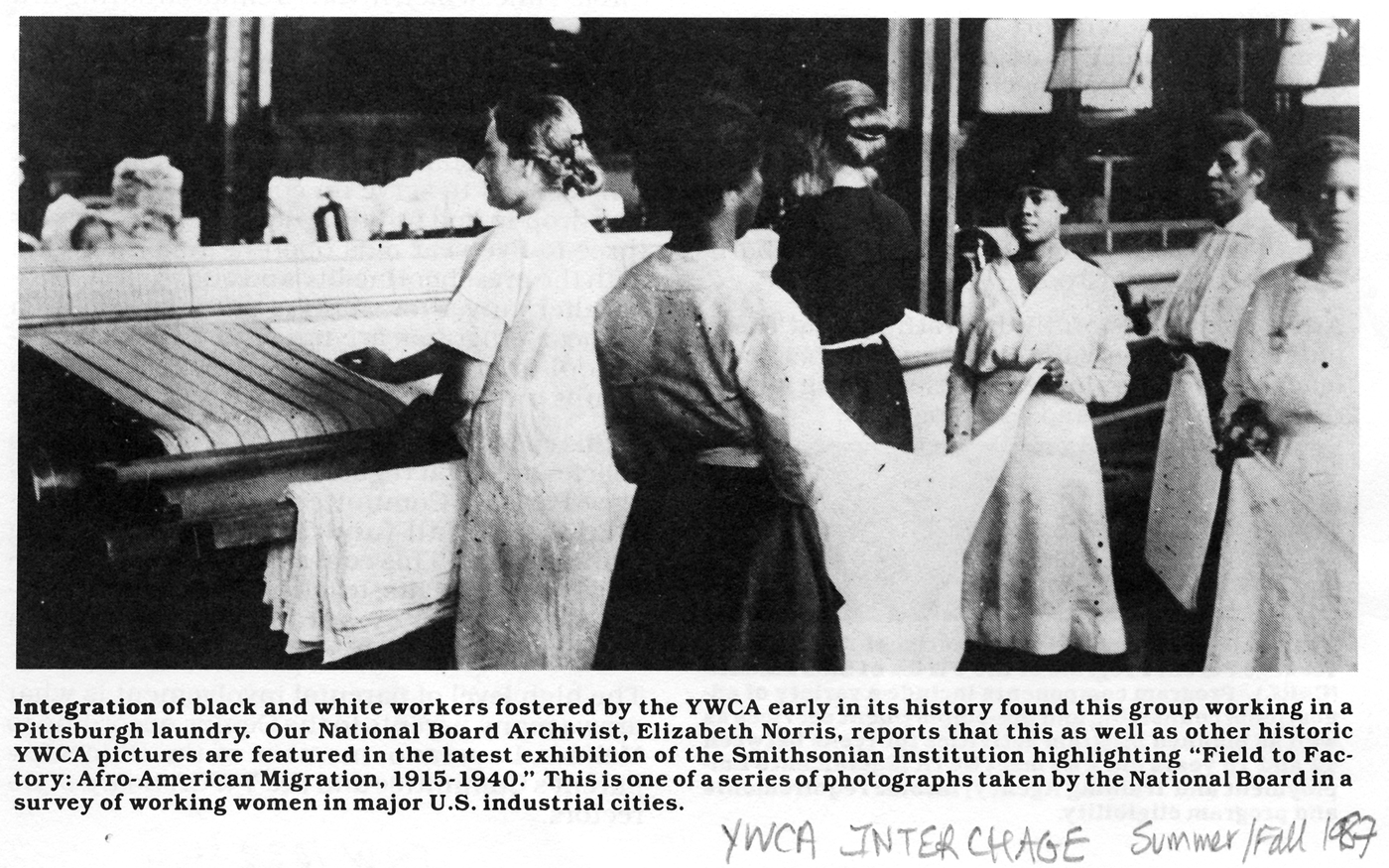
As we have seen, some YWCA industrial members already were considering this issue in summer 1918. At the mid-Atlantic regional conference that opened this article, some White women urged their conference colleagues to cast aside prejudice. They cited various reasons: to protect wages and standards; because “Christianity demanded a sisterly attitude”; because in wartime, “a democracy for which colored men were willing to die should be vital enough to ensure their sisters a chance to work side by side with white girls,” especially because Black women were crucial to home-front production.Footnote 71 Grace Coyle, the conference executive, reported with pleasure that soon thereafter, in a laundry where Black women had begun to work, a White woman who had attended the 1918 conference “has felt herself responsible for seeing that there was as friendly an attitude as she could bring about toward these girls. She has been quite successful.”Footnote 72 [Fig. 4]
Photograph of black and white laundry workers. YWCA of the U.S.A. Records, Sophia Smith Collection, Smith College, Northampton, Massachusetts.
Coyle was part of a new generation of YWCA staff, trained in social work and inspired by the Social Gospel, and she and Annetta Dieckmann, the national Industrial Program executives for the East Central field (the mid-Atlantic region), represent some of the most ambitious early efforts by White staff to include race in the Industrial Program. Their social work training predisposed them to search for concrete solutions, and changing religious currents in the YWCA influenced their goals. Inspired by John Dewey's emphasis on building democracy through education, staff deeply interested in social change flocked to the Industrial Program by the late 1910s. Grace Coyle would go on to be a pioneer social worker, after years in the YWCA Industrial Department, and Annetta Dieckmann followed decades of YWCA work with an illustrious career in the Illinois American Civil Liberties Union.Footnote 73 They and other Industrial Program staff were shaped by contact with working women and by the more radical strand of the Social Gospel movement, which urged engagement with social problems.Footnote 74
Grace Coyle, a new Special Industrial Secretary for war work, quickly rebutted Black working women's portrayal as a source of disorder, emphasized the need for more attention to their problems, and reported a sense of interracial class solidarity. In one of her first reports, Coyle wrote that time and experience were disproving the stereotype that Black women were unsuited to factory work. In garment work, Black and White women belonged to the same union, had joint meetings, and were “working out their economic problems together,” and a White member had told her that Black women were “especially loyal members.” Most White women, she reported, did not plan to engage in hate strikes if workplaces were racially integrated.Footnote 75 These Black women were hardly the diseased forces of social disorder, the “menace to society,” that figured elsewhere in YWCA coverage, and the portrayal of interracial cooperation contrasted with the race riot accounts that filled the news.
The YWCA Industrial Program's East Central Field soon became the most important site of interracial cooperation.Footnote 76 In December 1918, Jackson met in Pittsburgh with the local Industrial Committee and with Coyle, Dieckmann, and other regional field workers and was pleased by the “interest shown in the colored industrial girls by” the field executives. Jackson continued attending the Nepahwin industrial conference, and Dieckmann and Coyle consulted extensively with her throughout the year about Black women workers' needs.Footnote 77 Dieckmann incorporated her strong interest in Black working women's problems into her broader YWCA work.Footnote 78
Meanwhile, the Nepahwin delegates showed signs of the “democratic attitude” they had pledged in 1918. In 1919, they reported that Black industrial club members sometimes used their local facilities. One reported that her club had admitted African American women “to teach them how to form and lead clubs for colored girls,” and the Religious Work Commission proposed members “make a special effort to know and understand … and help the colored girl all we can” and “help them organize industrial clubs for themselves.”Footnote 79 Despite overtones of uplift and a language of segregation, these were attempts to share resources with Black women and to incorporate them into the Industrial Program.Footnote 80 Indeed, Black women may have epitomized the Industrial Program's broader shift toward politics: a White delegate reported that the two clubs of black women who used the YWCA library and gymnasium “were the first clubs in Wilkes-Barre to endorse the eight-hour bill for women.” The 1919 Nepahwin Social Service Commission, evolving from a charitable to a political focus, recommended all clubs endorse a set of industrial standards that included “Equal pay for equal work and no distinction between the races in privileges of employment.”Footnote 81
Racial justice appeared in other Industrial Program conferences. The 1919 Northeastern summer industrial conference passed a resolution “that Colored Girls should be given the same opportunity in industry as the White Girls.”Footnote 82 The Industrial Program's first national conference, in November 1919, was the place where “interracial instead of bi-racial clubs were first suggested” in the YWCA, a YWCA staff member later noted.Footnote 83
These ties between Colored Work and the Industrial Program proved crucial at war's end, when a resource crisis hit both federal resources for Black women and YWCA industrial work for Black women. At the federal level, the government eliminated the Labor Department's appropriations for Colored Work. Within the YWCA, postwar cuts in Colored Work affected working women, because YWCA industrial work for Black women had been organized and funded under the auspices of the Colored Work Council rather than the Industrial Program. Mary Jackson's position was eliminated in 1921, leaving no national staff assigned to Black industrial work, and still no Black national staff in the Industrial Program itself.Footnote 84 Conditions were bad, and wartime advances were eroding. Black working women faced layoffs, closed doors, and discrimination on all sides, as Jackson warned in one of her last reports. All across the nation, even in areas considered racially progressive, employers were reneging on promises to hire Black women, and the government was little help.Footnote 85 Just as returning Black soldiers found White hostility, Black women war workers faced dismal postwar prospects.
Within the YWCA, African American members still lacked autonomous structures after the war. They remained in separate local “branches,” in charge of daily operations but under the direction of White-led “affiliating committees” at the “central” White branch. They lacked a structural base at national conventions, and reports on their programs fell under “city work” or “student work.” Most White YWCA leaders continued to emphasize education, rather than legislation, insisting racial problems could be solved when the “better sorts” reached “mutual understanding.” Many Black women despaired of the association's commitment to interracial work after the 1920 National Convention, where the all-White National Board rebuffed and silenced their attempts to raise racial issues.Footnote 86
By contrast, the Industrial Program emerged from the war significantly larger and institutionally stronger than it had been. Before the war, working-class members and progressive staff had begun reshaping its initial goals of protection and moral uplift to focus on education, class-based solidarity, and self-determination. By the late 1910s, program activities had shifted from sewing and Bible study to study of economics, history, trade unions and labor laws. Considered full YWCA members, industrial members also found their distinct needs and interests acknowledged in the Industrial Program. In local associations, they had their own clubs but could participate in other programs. At the regional level, they had organized federations and held conferences. Wartime work dramatically increased membership, strengthened regional program structures, and highlighted members' interest in organized working-class power.Footnote 87
After the war, industrial members and staff allies convinced the national YWCA to endorse legislative solutions to labor problems, a dramatic shift and one that national White leaders refused to make on racial issues. At the same 1920 National Convention where White leaders dismissed Black members' concerns, industrial members pushed through a platform supporting labor unions and other workers' rights.Footnote 88 Members ran their own governing council, based on the program's philosophy of “self-governance,” and by 1922, met separately in an Industrial Assembly at National Conventions.
Amid the postwar YWCA funding crisis for Black women, Bowles emphasized the need to racially integrate local industrial programs, and called on national industrial staff to help. She drew on the Industrial Program's staff and conference structure to compensate for low Colored Work staffing levels and black members' lack of a structure through which to bring concerns to the entire YWCA. In her 1922 annual report to the City Department, she recommended that White national industrial staff who traveled to oversee local programs spend time with local staff for African American working women and “help to develop in that community a working relationship with the city wide Industrial program to include the Colored girl.”Footnote 89
The Industrial Program provided crucial spaces and relationships that staff used to protect and extend the political and economic gains that that they had claimed for Black working women during World War I. Coyle and Dieckmann reported on Black working women and helped organize conferences. Dieckmann showed particular enthusiasm, viewing the YWCA's Industrial Program as a rare opportunity to build better race relations. Her reports to the national Industrial Program staff included extensive descriptions of Black industrial work in her region, and thoughts on how to improve underfunding and difficult situations.Footnote 90 Dieckmann studied the myriad factors that shaped possibilities for interracial cooperation among working-class people. She noted in her master's thesis that groups of “influential white and colored leaders” such as the Commission on Interracial Cooperation only reached a few thousand people directly, and called the “continuous contact of a large and increasing number of whites and Negroes” in industry a crucial factor in race relations.Footnote 91
Dieckmann and colleagues organized an industrial conference in 1919 designed to offer Black working women what white working women had been getting for years from Industrial Department conferences: a sense of solidarity and a group setting in which to relax, discuss common interests, gain skills, and read and hear from key figures in American reform.Footnote 92 Conference attendees discussed why factory work was preferable to domestic work; affirmed a commitment to strengthen trade unions despite their sometimes discriminatory practices; and agreed “that colored women do not have equal opportunity to secure desirable work.”Footnote 93 The conference likely provided the sort of “space for homo-social camaraderie, black self-organization, and critical intellectual engagement” that Chad Williams has found Black male veterans were enjoying through such sites as the radical Messenger, during a period of growing claims for racial justice.Footnote 94
By 1920, this group of YWCA staff had developed an annual Conference of Colored Business and Industrial Girls in Cheyney, PA. The conference served as a Black parallel to the White Nepahwin conference, and was the only place Black working women in the YWCA could meet regionally to discuss common problems, forge club strategies, gain leadership skills, and feel part of the YWCA industrial movement. Cheyney drew dozens of women from a range of occupations, including elevator operators, teachers, clerks, laundry workers, and domestic workers.Footnote 95 Delegates sought to nurture both pride in cultural heritage and a sense of belonging to a larger group of working women, urging local clubs to study “Negro history, current events, literature and art” and “industrial movements of the world.”Footnote 96 Reflecting Industrial Program goals, various committees recommended building working-class solidarity abroad as well.Footnote 97 Members returned with enthusiasm and sought new challenges “such as special study of Negro history or of industrial and interracial problems” to keep things fresh for long-standing members.Footnote 98 The Cheyney conference helped solidify a sense of unity among Black working women in YWCAs across the country in the postwar period, when their local program work struggled for lack of national support.Footnote 99 It reinforced ties among BlackYWCA women and created and publicized program ideas.
Cheyney also made African American women a part of the broader YWCA Industrial Program. It drew Black and White staff from all over the country and helped develop greater commitment to racial issues among White staff.Footnote 100 Cheyney exchanged greetings with other YWCA industrial conferences, reminding them that Black women had a place in the movement. Cheyney delegates maintained contact with national and regional industrial staff, with “colored” industrial clubs outside their region, and with the YWCA industrial movement at national conventions. The East Central staff played an especially key role this progress, staffing both East Central conferences, helping to build ties between them, and fostering local program work.Footnote 101 Dieckmann also reported closely to the national Industrial Program on Black industrial work in the region, and worked to remedy harmful staff situations in the region's YWCAs, for instance removing a local industrial committee member hostile “to allowing Colored women to serve” on the committee.Footnote 102
All of this organizing created possibilities for Black working women's leadership just as industrial members' power within the Y increased. In 1922, industrial members gained their own separate, autonomous body within the YWCA, the National Industrial Assembly. When they created a National Industrial Council, an executive committee of industrial members to work with the National Board's Industrial Committee, they voted to guarantee African American women two out of the fourteen elected council seats.Footnote 103 By contrast, no Black woman served on the YWCA's National Board until Elizabeth Ross Haynes joined it in 1924 after intense pressure from African Americans within and beyond the YWCA.Footnote 104
Besides facilitating the creation of an interracial national council, the conference structure fostered regional contacts among Black and White working women. In the early 1920s, the two East Central conferences, Cheyney and Nepahwin, began exchanging delegates, and the Eastern region's conference included “Colored” delegates in 1924.Footnote 105 White YWCA industrial members began treating African American industrial club members as colleagues, with Social Service recommendations shifting from 1922's “volunteer service in … colored branches” to 1923's “[c]ooperation” with them.Footnote 106 In 1924, a list of social science classes held in local White clubs included “Race Relations” for the first time.Footnote 107 White delegates had shifted from viewing African American women as subjects for “Social Service” to partners in “Social Science.” These changes were evident at the local level as well.Footnote 108
By the mid-1920s, all YWCA industrial conferences except the Southern one had begun admitting African American women. In 1924, Black and White delegates agreed to merge into a cooperatively planned joint East Central conference, and a conference executive described the integrated 1925 conference as “so natural and accepted so as a matter of course that it needed no further discussion”Footnote 109 By contrast, Black women remained unwelcome at the YWCA Business and Professional Girls' summer conferences.Footnote 110 In the Industrial Program, Black women gained conference leadership positions and national council slots, not only as racial representatives but also as general leaders.
Discussions of race at regional and national conferences spread to local clubs and led even Southern White industrial members to question their conference's racial exclusivity by the late 1920s. In some locations, industrial members led the charge against YWCA racism.Footnote 111 They also challenged segregation in the lively 1920s labor education movement, resulting in the desegregation of the Bryn Mawr Summer School and the Wisconsin Summer School. Footnote 112 The National Industrial Assembly, the institutional voice of working women in the YWCA, advanced racial justice and fostered interracial organizing for the next three decades. Black women came to constitute 20 percent of the industrial membership, the highest proportion anywhere in the YWCA. These efforts helped create a new interracial space for working-class women that became, from the 1920s through the 1940s, a site of coalition-building and of critical discussion of race issues among tens of thousands of women from many ethnic, racial, religious, and occupational backgrounds, well before the YWCA became a better-known site of interracial justice organizing.Footnote 113
These developments fostered early, critical links between labor and racial justice movements through both members and staff. For instance, Floria Pinkney, a Brooklyn member active through at least the 1930s, joined the Brotherhood of Sleeping Car Porters and became the first Black organizer for the International Ladies Garment Workers Union (which, as Daniel Katz has demonstrated, was building its own multicultural labor movement). Perhaps she had met Black labor leader and BSCP founder A. Philip Randolph when he spoke at a 1925 planning conference for Black industrial members. Annetta Dieckmann closely followed landmark efforts to form Black labor organizations, and other staff helped push the NAACP toward support of labor unions in the 1930s.Footnote 114 Thus, the YWCA Industrial Program was part of that critical transition in Black Freedom Struggle strategies.
CONCLUSION
The YWCA Industrial Program was not a space free of any racism, nor was the interracial work easy or straightforward. As late as 1921, Jackson had to warn White staff away from minstrelsy, an activity common in and beyond the YWCA clubs.Footnote 115 Eva Bowles struggled for greater resources for Black industrial work until she left the association in the 1930s, and local YWCAs differed considerably in their policies and funding. However, the program did become a rare and significant site for interracial socializing and political strategizing, during a low point in American race relations. Not free of racial tensions or prejudice, the YWCA Industrial Program was, nonetheless, a rare place where working women met in interracial settings, had difficult conversations about race and racism, and respected Black leadership in its organizational structures.
The interracial connections and labor-based racial justice discourse that developed in the YWCA Industrial Program suggest we need more attention toward the World War I era and the 1920s, and particularly to women's role and the place of working women. The current historiographic debate over the “long civil rights movement” chiefly centers on whether the liberal and radical interracial labor efforts of the 1930s should be considered part of the civil rights movement or a separate antecedent, but here we have a yet earlier antecedent.Footnote 116 Wartime conditions highlighted the distance between America's rhetoric of democracy and African Americans' lived reality, and recent scholarship documents how Black soldiers and male veterans contributed to shifting civil rights strategies in response. Women did so as well. In an era of Black women's waning political influence as “race leaders,” amid efforts that presented Black men's military service as the basis of civil rights claims and emphasized Black masculinity, these YWCA women placed Black working women at the center of their claims. During the rise of what A. Philip Randolph termed “New Crowd” activism, which emphasized mass politics over “Old Crowd” elite leadership, a group of women founded claims to justice upon African American women's labor contributions and invoked White working women's responsibility in the struggle.