Introduction
Depressive symptoms are common throughout adulthood. These symptoms often impair daily function, especially in older adults, even when their total number does not meet criteria for clinical diagnosis (Judd et al. Reference Judd, Schettler and Akiskal2002). Both cross-sectional and longitudinal reports have observed U-shaped relations between depressive symptom scores and age (Kessler et al. Reference Kessler, Foster, Webster and House1992; Sutin et al. Reference Sutin, Terracciano, Milaneschi, An, Ferrucci and Zonderman2013). Additionally, at most ages, women report more depressive symptoms than men, although the difference may diminish in very old age (e.g. Berkman et al. Reference Berkman, Berkman, Kasl, Freeman, Leo, Ostfeld, Cornoni-Huntley and Brody1986; Forlani et al. Reference Forlani, Morri, Ferrari, Dalmonte, Menchetti, De Ronchi and Atti2014).
In older twins, genetic influences generally account for up to 30% of the variance in symptom scores (Johnson et al. Reference Johnson, McGue, Gaist, Vaupel and Christensen2002; Schnittker, Reference Schnittker2014). Possible age and sex differences in heritability of depressive symptoms have been considered using twin designs. Most find similar heritability estimates of depressive symptoms for men and women (Gillespie et al. Reference Gillespie, Kirk, Evans, Heath, Hickie and Martin2004). Some studies have observed greater heritability of depressive symptoms with higher age (e.g. Carmelli et al. Reference Carmelli, Swan, Kelly-Hayes, Wolf, Reed and Miller2000), although others did not find significant age differences in heritability (McGue & Christensen, Reference McGue and Christensen1997; Johnson et al. Reference Johnson, McGue, Gaist, Vaupel and Christensen2002). Because heritability estimates represent the relative proportions of genetic and environmental variance components, greater heritability may be a function of reduced environmental influences, increased genetic influences, or both.
Physical illness is a well-established risk factor for depressive symptoms, particularly in later life (e.g. Meeks et al. Reference Meeks, Murrell and Mehl2000; Djernes, Reference Djernes2006), with these observations not simply due to overlap with somatic symptoms used in diagnosing depression (Sutin et al. Reference Sutin, Terracciano, Milaneschi, An, Ferrucci and Zonderman2013). Depressive symptoms and depressive disorders are elevated among medical inpatients and primary-care outpatients (Blazer, Reference Blazer2003). The association between depression and physical illness may lie in vascular, neuroendocrine, or inflammatory manifestations of physical illness that also contribute to risk for explicit depressive symptoms (Steptoe, Reference Steptoe2007; Fiske et al. Reference Fiske, Wetherell and Gatz2009). There may be common factors such as low education or high neuroticism that predispose to both physical illness and depression (Steptoe, Reference Steptoe2007). Physical illness may occasion emotional distress and existential struggles that lead to elevated depressive symptoms (Steptoe, Reference Steptoe2007). Moreover, physical illness may impose functional limitations and disruptions to daily living that potentiate depression, representing a behavioral pathway (Fiske et al. Reference Fiske, Wetherell and Gatz2009).
Twin studies can be valuable in illuminating the extents to which genetic and environmental sources of influence explain observed covariation between depressive symptoms and physical illness. Vulnerability factors in common to physical illness and depressive symptoms, as well as proposed physiological pathways linking the two, suggest the possibility that genetic factors account for some of the association. Behavioral explanations support roles for environmental factors. Physical illness may also moderate genetic and environmental vulnerabilities to depressive symptoms, either uniquely or via shared pathways (Johnson, Reference Johnson2007).
In this paper, we explored the cross-sectional interplay among depressive symptoms, physical illness, sex, and age. Prior twin studies of depressive symptoms have not considered the role of physical illness, and research pointing to co-occurring physical illness and depressive symptoms in older adults has not addressed how genetic and environmental influences interplay. We thus examined whether genetic and environmental variance in depressive symptoms varies with sex, age, and different levels of physical illness.
Method
Participants
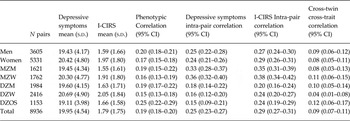
Summarized in Table 1, the sample was drawn from ten independent studies from the Interplay of Genes and Environment across Multiple Studies (IGEMS) Consortium (Pedersen et al. Reference Pedersen, Christensen, Dahl, Finkel, Franz, Gatz, Horwitz, Johansson, Johnson, Kremen, Lyons, Malmberg, McGue, Neiderhiser, Peterson and Reynolds2013). A total of 24 436 individual twins (53.1% women) had relevant data. Depressive symptom data were taken from the first occasion at which each participant answered self-report depressive symptom questionnaires. Incomplete twin pairs were included, as they are informative about age differences in means and variances. Demographic characteristics in Table 1 include numbers of monozygotic (MZ), same-sex dizygotic (SSDZ), and opposite-sex dizygotic (OSDZ) pairs. Demographics by study are given in Supplementary Table S1.
Mean scores on depressive symptoms and physical illness (with standard deviations), phenotypic correlations between depressive symptoms and physical illness, intra-pair correlations, and cross-twin cross-trait correlations (with 95% confidence intervals)

I-CIRS, IGEMS revision of Cumulative Illness Rating Scale; MZM, monozygotic male pairs; MZW, monozygotic female pairs; DZM, same-sex dizygotic male pairs; DZW, same-sex dizygotic female pairs; DZOS, opposite-sex dizygotic pairs.
Twins in the Swedish Adoption Twin Study of Aging (SATSA; Finkel & Pedersen, Reference Finkel and Pedersen2004), Origins of Variance in the Oldest-Old (OCTO-Twin; McClearn et al. Reference McClearn, Johansson, Berg, Pedersen, Ahern, Petrill and Plomin1997), Ageing in Women and Men: A Longitudinal Study of Gender Differences in Health Behaviour and Health among Elderly (GENDER; Gold et al. Reference Gold, Malmberg, McClearn, Pedersen and Berg2002), and Twin and Offspring Study in Sweden (TOSS; Neiderhiser & Lichtenstein, Reference Neiderhiser and Lichtenstein2008) were ascertained from the population-based Swedish Twin Registry. SATSA includes all same-sex twins from the Swedish Twin Registry who were reared apart and a matched sample who were reared together, with baseline depressive symptoms assessed at the first questionnaire follow-up in 1987. OCTO-Twin includes same-sex pairs who both survived until age 80, with baseline in 1991. GENDER consists of OSDZ twin pairs born 1906–1925, with baseline in 1994. Baseline for TOSS was 1997 or 2004.
Longitudinal Study of Aging Danish Twins (LSADT; Christensen et al. Reference Christensen, Holm, McGue, Corder and Vaupel1999) and Middle-Age Danish Twins (MADT; Skytthe et al. Reference Skytthe, Christiansen, Kyvik, Bødker, Hvidberg, Petersen, Nielsen, Bingley, Hjelmborg, Tan, Holm, Vaupel, McGue and Christensen2013) were ascertained from the Danish Twin Registry. LSADT includes same-sex twin pairs aged ⩾70 years, with baseline in 1995. MADT includes both same- and opposite-sex twin pairs born 1931–1952, with baseline in 1998.
The Minnesota Twin Study of Adult Development and Aging (MTSADA; Finkel & McGue, Reference Finkel and McGue1993) includes same-sex twin pairs aged ⩾60 years ascertained through Minnesota state birth records, with baseline data collected 1984–1994. The Vietnam Era Twin Study of Aging (VETSA; Kremen et al. Reference Kremen, Thompson-Brenner, Leung, Grant, Franz, Eisen, Jacobson, Boake and Lyons2006) includes male twins aged 51–60 at baseline in 2003–2007. The twin subsample of Midlife in the United States (MIDUS; Kendler et al. Reference Kendler, Thornton, Gilman and Kessler2000) includes same- and opposite-sex twin pairs, with depressive symptoms collected at follow-up in 2007.
The older Finnish Twin Cohort (FTC; Kaprio & Koskenvuo, Reference Kaprio and Koskenvuo2002) is a registry of same-sex Finnish twin pairs with age range comparable to the Swedish and Danish twin registries. Depressive symptom data reported here come from wave 4 in 2011 (Kaprio, Reference Kaprio2013).
Previous publications from SATSA (Gatz et al. Reference Gatz, Pedersen, Plomin, Nesselroade and McClearn1992), LSADT (McGue & Christensen, Reference McGue and Christensen1997), MADT (Johnson et al. Reference Johnson, McGue, Gaist, Vaupel and Christensen2002), VETSA (Franz et al. Reference Franz, Lyons, O'Brien, Panizzon, Kim, Bhat, Grant, Toomey, Eisen, Xian and Kremen2011), and FTC (Takkinen et al. Reference Takkinen, Tolvanen, Kaprio, Berg, Koskenvuo and Rantanen2004; Korhonen et al. Reference Korhonen, Broms, Varjonen, Romanov, Koskenvuo, Kinnunen and Kaprio2007) have presented results from behavior genetic analyses of depressive symptoms. The benefits of the IGEMS Consortium are a large sample of twins offering increased power to detect potentially small moderation effects of physical illness, age, and sex and inclusion of a large number of opposite-sex twin pairs to explore potential sex differences in genetic and environmental influences on depressive symptoms.
Zygosity
Specific methods for zygosity determination varied across studies, but in most cases involved use of standard questionnaires about physical similarity between twins and DNA analysis to resolve uncertain cases.
Measures
Depressive symptoms
Two measures of depressive symptoms were used in IGEMS studies: the Center for Epidemiologic Studies –Depression (CES-D) scale (Radloff, Reference Radloff1977) and a modified version of the Cambridge Mental Disorders of the Elderly Examination (CAMDEX; Roth et al. Reference Roth, Tym, Mountjoy, Huppert, Hendrie, Verma and Goodard1986). The CES-D score is the sum of 20 items, each scored from 0 to 3 to indicate frequency of experiencing the symptom during the past week. Four positively worded items were reverse-scored so that higher scores indicated more severe depressive symptoms. Previous research supports a four-factor structure representing depressed mood, psychomotor retardation/somatic symptoms, lack of well-being (the four reverse-scored items), and interpersonal difficulties (Radloff, Reference Radloff1977; Gatz et al. Reference Gatz, Pedersen, Plomin, Nesselroade and McClearn1992).
The CAMDEX was administered only to Danish twins and consists of 16 items assessing frequency of depressive symptoms. Items were scored from 1 to 3 to indicate frequency of experiencing the symptom, except for two items rated on a ‘yes/no’ scale. Items were scored so that higher scores indicate more severe depressive symptoms. The CAMDEX consists of two factors: affective and somatic symptoms (McGue & Christensen, Reference McGue and Christensen1997).
To create a common depressive symptom metric, CES-D and CAMDEX scales were administered to a separate data-harmonization sample. Item-response theory methods were applied to compare items from the two measures and create a conversion table between the scales (Gatz et al. Reference Gatz, Reynolds, Finkel, Hahn, Zhou and Zavala2015b ). For substantive comparability, we retained only the 14 CES-D items that loaded onto the depressed mood and psychomotor retardation/somatic symptoms subscales. The co-calibrated score was expressed in CAMDEX units, such that the total score could range from 16 for someone who endorsed no symptoms of depression to a maximum of 46 for someone who endorsed the most severe frequency of depressive symptoms. Because the harmonized measure did not include the same items for those who completed different scales, we calculated separate reliabilities for each scale's harmonization-relevant items. For those who completed the CES-D, α = 0.90 (N = 16 177), while for those who completed the CAMDEX, α = 0.84 (N = 8718).
Physical illness
To create a harmonized index of physical illness (I-CIRS; Gatz et al. Reference Gatz, Petkus, Reynolds, Franz, Kaprio and Christensen2015a ), we created a revised version of the Modified Cumulative Illness Rating Scale (CIRS; Salvi et al. Reference Salvi, Miller, Grilli, Giorgi, Towers, Morichi, Spazzafumo, Mancinelli, Espinosa, Rappelli and Dessì-Fulgheri2008). I-CIRS is a list of 13 body systems, with a score that represents the number of systems with moderate disability or morbidity. All studies had self-reported lists of physical illnesses that we recoded to be consistent across IGEMS studies. I-CIRS categories included cardiac; hypertension; vascular (circulatory); respiratory; eye, ear, nose and throat; upper gastrointestinal; hepatic; renal; musculoskeletal; neurological (excluding stroke which was rated in a separate category); endocrine/metabolic; cancer; and stroke. Each participant received a score from 0 to 13, with higher scores indicating more systems affected by illness.
Statistical analysis
Depressive symptoms and I-CIRS were positively skewed, so scores were log-transformed to approximate assumptions of multivariate normality. Depressive symptoms and I-CIRS further were standardized (mean = 0, s.d. = 10) to ease computational burden. Twin pairs younger than 40 (240 complete pairs) or older than 90 (10 complete pairs) were removed from analyses due to sparse coverage.
We examined the phenotypic means of depressive symptoms by sex and linear, quadratic, and cubic continuous age using SAS Proc Mixed (SAS Institute Inc., 2013) to account for dependencies between members of twin pairs. Intra-pair correlations for depressive symptoms and cross-twin cross-trait correlations for depressive symptoms and physical illness were calculated by sex, age (by decade), and zygosity (see Supplementary Table S2). To evaluate cohort effects, we formed a sample of 50- to 59-year-olds tested between 1987 and 1991 (comprised of SATSA and MTSADA) and a sample of 50- to 59-year-olds tested between 2003 and 2007 (comprised of TOSS twins from 2004, MIDUS twins, and a random sample from VETSA to make the two samples similar in size).
Twin studies allow variance in a measure to be decomposed into additive genetic variance (A), shared environmental variance (C), dominant genetic variance (D), and non-shared environmental variance including error (E). Shared environment refers to environmental influences that contribute to twin pair similarity, such as rearing environment or contact as adults; non-shared environment encompasses influences contributing to differences within a pair. Conventional twin methods possess too few degrees of freedom to estimate all ACDE components, but preliminary models suggested no evidence of dominant genetic influences. Variance decomposition relies on assumptions that SSDZ and OSDZ twins share 50% of their segregating genes, on average, while MZ twins share 100% of their genes; and that genetic and environmental biometric components are independent. Based on these assumptions, twin (‘ACE’) models specify three sets of equations based on degree of genetic relationship:
 $$\eqalign{{\rm MZ} &= {\rm cov\ MZ} = V_a + V_c ; \cr {\rm SSDZ} &= {\rm cov\ SSDZ} = 0.5 \times V_a + V_c ; \cr {\rm OSDZ} &= {\rm cov\ OSDZ} = 0.5 \times V_a + V_c.}$$
All multivariate twin models were estimated in OpenMx 2.2.6 (Neale et al. Reference Neale, Hunter, Pritikin, Zahery, Brick, Kickpatrick, Estabrook, Bates, Maes and Boker2016).
Qualitative sex differences (i.e. different sources of influences) were tested in univariate biometric models by freely estimating the genetic correlation in OSDZ pairs instead of constraining it to be 0.50 as well as freely estimating the shared environmental correlation instead of constraining it to be 1.00. An estimated genetic correlation between OSDZ twins significantly <0.50 suggests qualitative sex differences. Due to documented problems estimating quantitative sex-limitation in bivariate models (Neale et al. Reference Neale, Roysamb and Jacobson2006), bivariate moderation models were estimated separately for males and females using only SSDZ twins. To test significance of sex differences we constrained parameter estimates for women to equal those for men. We compared this constrained model to the model allowing women's parameter estimates to be freely estimated.
We fitted age-moderated univariate biometric models (van der Sluis et al. Reference van der Sluis, Posthuma and Dolan2012) to address whether and how continuous age moderated genetic and environmental variance components underlying depressive symptoms. Preliminary results suggested nonlinear age differences in depressive symptom scores. These were best characterized as two slopes with a turning point at age 75 (see Supplementary Fig. S1). Therefore, we estimated two linear age effects centered at age 75 – with age recoded into two variables: aged 40–75 (i.e. AgeA = age 75; if age ⩾ 75 then AgeA = 0) and aged 75–90 (AgeB = age 75; if age < 75 then AgeB = 0).
Under the model, additive genetic, shared environmental, and non-shared environmental variances are expressed as:
 $$\hbox{A} = \hbox{a} + (\beta _{\rm a40} \times \hbox{AgeA}) + (\beta _{\rm a75} \times \hbox{AgeB}),$$
 $$\hbox{C} = \hbox{c} + (\beta _{\rm c40} \times \hbox{AgeA}) + ({\beta} _{\rm c75} \times \hbox{AgeB}),$$
 $$\hbox{E} = \hbox{e} + ({\beta} _{\rm e40} \times \hbox{AgeA}) + ({\beta} _{\rm e75} \times \hbox{AgeB}).$$
The ‘a’ parameter is the estimated additive genetic variance at the age-75 turning point, β a40 is the estimate of the linear slope on additive genetic variance for participants aged 40–75, and the β a75 is the second linear slope for participants aged 75–90. The C and E variance components are computed in the same way. Likelihood-ratio tests were used to compare nested models.
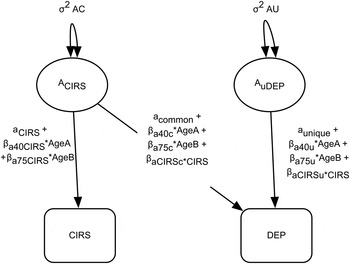
We fitted continuous age and I-CIRS-moderated bivariate biometric models to test whether I-CIRS and age moderated genetic and environmental variance between I-CIRS and depressive symptoms (Johnson, Reference Johnson2007). Fig. 1 depicts the additive genetic variance components of this model, which were expressed analogously for the shared and non-shared environmental components (not presented). The model estimated the genetic variance of I-CIRS (aCIRS), the genetic covariance between I-CIRS and depressive symptoms (acommon), and a genetic variance component unique to depressive symptoms (aunique). Age-moderating terms for 40–75 and 75–90 years age groups on depressive symptoms and I-CIRS were included in the I-CIRS, common, and unique depressive symptoms paths. Genetic (r G) and environmental (r C and r E) correlations between I-CIRS and depressive symptoms were calculated to aid in interpreting the covariance. The equation for genetic correlation, for example, is:
 $$\eqalign{rG = \; \displaystyle{\matrix{(\hbox{a}_{\rm common} + (\beta _{\rm a40c} \times \hbox{AgeA} ) + (\beta _{\rm a75c} \times {\rm AgeB}) \cr + (\beta_{\rm aCIRSc} \times \hbox{CIRS}))} \over \matrix{\sqrt{\left(({\rm a}_{\rm c} + \left(\beta_{\rm a40c} \times {\rm AgeA} \right) + \left(\beta_{\rm a75c} \times {\rm AgeB} \right) \right.} \cr \left. + \left(\beta_{\rm aCIRSc} \times {\rm CIRS} \right) \right)^2 +\, (\hbox{a}_{\rm unique} + \left(\beta_{\rm a40u} \times {\rm AgeA} \right) \cr \left. \left. + \left(\beta_{\rm a75u} \times \hbox{AgeB} \right) + \left(\beta_{\rm aCIRSu} \times {\rm CIRS} \right) \right)^2 \right)}}}$$
Diagram of the additive genetic components from the age and I-CIRS moderated bivariate biometric model examining physical health (CIRS) and depressive symptoms (DEP). Note that slope a40 pertains to individuals age 40–75 while slope a75 pertains to individuals aged ⩾75. The equation for calculating the genetic covariance between I-CIRS and depressive symptoms is the product of the pathway shared between CIRS and depressive symptoms and the genetic pathway on CIRS. The equation can be written as: (acommon + β a40c × AgeA + β as75c × AgeB + β aCIRSc × CIRS) × (aCIRS + β a40CIRS × AgeA + β a40CIRS × AgeB).

A possible alternative explanation to the variance moderation model is the uniform nonlinear main effects model. To address this possible explanation we ran a nonlinear main effects model of I-CIRS on depressive symptoms (Van Hulle et al. Reference Van Hulle, Lahey and Rathouz2013) and compared this model to the variance moderation model.
Ethical standards
The authors assert that all procedures contributing to this work comply with the ethical standards of the relevant national and institutional committees on human experimentation and with the Helsinki Declaration of 1975, as revised in 2008.
Results
Descriptive statistics
Harmonized depressive symptom scores and I-CIRS scores by age group and sex, pooled across studies are shown in Table 1, and by age group in Supplementary Table S2. Depressive symptom scores were positively correlated with physical illness. Results from mixed-effects regression models indicated significant age and sex associations with depressive symptoms. Women scored significantly higher than men, and both sexes showed accelerating (cubic) score increases with age (Supplementary Fig. S1). The variability of depressive symptoms was greater in women than in men and was larger at older ages than at younger ages for both men and women (Supplementary Table S2). There was no significant interaction between age and sex. I-CIRS scores increased quadratically with age in both sexes. The phenotypic association between depressive symptoms and physical illness was linear, and correlations showed no systematic differences with age.
There were differences in mean depressive symptom scores across participating studies (Supplementary Table S3). However, differences were not systematic by country or by original measure of depressive symptoms, and adding study to the biometric models did not affect findings.
Next, we evaluated whether there were cohort differences in depressive symptoms (Supplementary Table S4). We compared 50- to 59-year-olds tested between 1987 and 1991 with 50- to 59-year-olds tested between 2003 and 2007 and found no significant differences between the earlier cohort (mean = 20.09, s.d. = 4.76, N = 402) and the later cohort (mean = 20.05, s.d. = 4.56, N = 400). There was no evidence of interaction between sex and cohort.
Twin correlations (shown in Table 1) suggested genetic and non-shared environmental influences on both depressive symptoms and I-CIRS in male and female twins. For most ages there was little evidence of shared environmental influences; however, there was some evidence for them (i.e. DZ correlation greater than half the MZ correlation) on depressive symptoms at ages 80–90 (Supplementary Table S2). The small but significant MZ and DZ cross-twin cross-trait correlations were similar for men but not for women. Similar correlations indicate overlapping shared environmental influences, while larger correlations for MZ than for DZ twins suggest that additive genetic effects likely mediate the association between the two traits.
Biometric model-fitting results
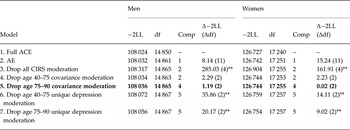
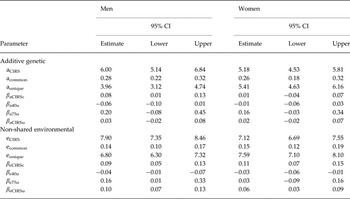
Age-moderated univariate biometric models with qualitative sex-limitation suggested no qualitative sex differences in genetic influences or shared environmental influences on depressive symptoms [r G = 0.50, 95% confidence interval (CI) 0.39–0.50; r C = 1.00, 95% CI 0.91–1.00]. This result was expected given the similar correlations for OSDZ and SSDZ pairs. Consistent with greater variance in women, magnitudes of genetic and environmental influences could not be constrained equal without significant deterioration of model fit (see Supplementary Table S5, with parameter estimates for the full univariate model in Supplementary Table S6). Therefore, separate age-moderated bivariate biometric models were calculated for men and for women. Bivariate model-fitting results are shown in Table 2 (with additional details in Supplementary Tables S8 and S9 for males and females, respectively). For both sexes, shared environmental influences were very small, not significantly different from 0.00, and could be dropped without significant reduction in model fit (see Table 2, model 2). Table 3 presents the unstandardized parameter estimates from the best-fitting model, which was model 5 (parameter estimates for the full bivariate model are given in Supplementary Table S9).
Model fitting results for I-CIRS and age-moderated bivariate biometric models of depressive symptoms

More complete model-fitting results are given in Supplementary Tables S7 and S8.
I-CIRS, IGEMS revision of Cumulative Illness Rating Scale; −2LL, negative log likelihood multiplied by 2; df, degrees of freedom; Comp, model to which compared, Δ−2LL (Δdf), the difference in log likelihood by difference in degrees of freedom between the model being fit and its comparison model; A, additive genetic variance; C, shared environmental variance; E, non-shared environmental variance; ACE, full model estimating additive genetic, shared environmental, and nonshared environmental variance components; AE, constrained model estimating only additive genetic and nonshared environmental variance components.
** Significant deterioration in fit compared to comparison model. Best-fitting model is shown in bold.
Unstandardized parameter estimates (95% confidence intervals) from the best fitting bivariate biometric model from Table 2 (model number 5) of depressive symptoms

aCIRS, Additive genetic genetic path estimate to the additive genetic I-CIRS factor at age 75; acommon, common pathway estimate of the additive genetic contributions of I-CIRS on depressive symptoms; aunique, estimated variance unique to depressive symptoms at age 75; β aCIRSc, estimate of the moderating effect of I-CIRS on the additive genetic covariance. β a40u, estimate of the linear slope on the additive genetic variance unique to depressive symptoms for participants aged 40–75; β a75u, estimate of the linear slope on the additive genetic variance unique to depressive symptoms for participants aged 75–90; β aCIRSu, estimate of the moderating effect of I-CIRS on the additive genetic variance unique to depressive symptoms. The parameters denoted with an e represent corresponding parameter estimates for the non-shared environmental contributions.
Genetic and environmental influences on depressive symptoms
Results for sex and age moderation of depressive symptoms were similar in the univariate analyses of depressive symptoms and for influences unique to depressive symptoms in the bivariate model. In the full univariate model (Supplementary Table S6), additive genetic influences were greater for women than for men; in the best-fitting bivariate model (Table 3), this pattern held but with the confidence intervals somewhat overlapping.
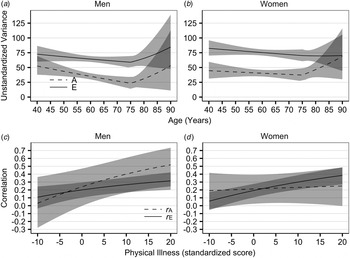
Fig. 2(a,b) presents total (common plus unique) unstandardized A and E variance of depressive symptoms as a function of age. Although age moderation of influences unique to depression could not be dropped, the effects were quite small. Specifically, for both men and women, non-shared environmental variances were smaller with greater age until age 75. After age 75, for men only, non-shared environmental contributions accounted for larger amounts of variance at older than at younger ages. Heritability estimates, which represent relative proportions of genetic and environmental variance, were not significantly different for men and women: At age 75, h2 for men was 28.6% (95% CI 21.7–33.7) and for women 34.7% (95% CI 30.6–37.8).
Graphs of the estimated unstandardized genetic and environmental variance components for depressive symptoms for men (a) and women (b) by age from combining the common and unique raw variance estimates from the AE age and I-CIRS moderated bivariate biometric model. Graphs of the estimated genetic, and non-shared environmental correlations between I-CIRS and depressive symptoms by I-CIRS score for men (c) and women (d) shown at age 75 for purposes of illustration. A, Additive genetic variance; E, non-shared environmental variance; r G, genetic correlation between depressive symptoms and I-CIRS; r E, non-shared environmental correlation between depressive symptoms and I-CIRS. Shaded area represents 95% confidence interval of the estimate. The I-CIRS score was standardized so the mean CIRS score equals zero and with standard deviation equal ±10.

Gene–environment interplay in association between depressive symptoms and physical illness
Physical illness significantly moderated genetic and environmental contributions to depressive symptoms. There was significant overlap in both genetic and non-shared environmental influences between I-CIRS and depressive symptoms. From the information in Table 3, we calculated the proportion of variance in depressive symptoms that was shared with physical illness. For men, at age 75, with a mean I-CIRS score, 15% (95% CI 12–18) of the genetic variance and 2% (95% CI 1–4) of the non-shared environmental variance in depressive symptoms was shared with physical illness. The analogous figures for women were 6% of the genetic variance (95% CI 3–8) and 2% (95% CI 1–3) of the non-shared environmental variance. These figures reflect both the greater phenotypic correlation in men and greater I-CIRS variance moderation.
Consistent with variance moderation, genetic correlations varied with level of physical illness for men but not women (Fig. 2 c,d). That is, for men there was greater overlap in additive genetic influences underlying I-CIRS and depressive symptoms at higher I-CIRS scores than at lower I-CIRS scores, regardless of age. The genetic correlation ranged from near 0.00 for the least physical illness to nearly 0.60 with physical illness 2 s.d. above the mean. Also referring to Fig. 2(c,d), environmental factors contributing to twin differences in I-CIRS scores accounted for more of the environmental variation in depressive symptoms at higher I-CIRS scores than at lower I-CIRS scores in both sexes. Moreover, referring to β eCIRSu in Table 3, for both men and women, greater physical illness was associated with greater non-shared environmental contributions unique to depressive symptoms.
Nonlinear and linear means moderation did not provide better model fit in either sex, suggesting that nonlinear uniform main effects of I-CIRS on depressive symptoms were not explaining the moderation detected in these models.
Discussion
We explored the cross-sectional interplay among depressive symptoms, physical illness, sex, and age in a combined sample of 24 436 twins aged 40–90. We highlight five findings. First, although additive genetic variance in depressive symptoms was greater in women than men, heritability of depressive symptoms was not significantly different for men and women. Finding no sex differences in heritability is consistent with past work with depressive symptoms (e.g. Johnson et al. Reference Johnson, McGue, Gaist, Vaupel and Christensen2002; Gillespie et al. Reference Gillespie, Kirk, Evans, Heath, Hickie and Martin2004) although some research has reported greater heritability of depressive disorders in women than men (e.g. Bierut et al. Reference Bierut, Heath, Bucholz, Dinwiddie, Madden, Statham, Dunne and Martin1999; Kendler et al. Reference Kendler, Gardner, Neale and Prescott2001, Reference Kendler, Gatz, Gardner and Pedersen2006). The sex-limitation model indicated that the same genes influenced depression in women and men, although others have reported that different genes influenced depressive illness in men and women (Kendler & Gardner, Reference Kendler and Gardner2014).
Second, for men but not for women, non-shared environmental variance in depressive symptoms (i.e. influences on depressive symptoms unique to one individual in a twin pair) was greater at higher ages. Some have suggested that men, in particular, may be increasingly sensitive to stressful life events – including health issues – with age (Sonnenberg et al. Reference Sonnenberg, Beekman, Deeg and van Tilburg2000; Kendler & Gardner, Reference Kendler and Gardner2014; Forlani et al. Reference Forlani, Morri, Ferrari, Dalmonte, Menchetti, De Ronchi and Atti2014). This account might explain the patterns of non-shared environmental variances after age 75.
Third, physical illness significantly moderated non-shared environmental influences unique to depressive symptoms. Regardless of sex, greater self-reported physical illness was associated with greater non-shared environmental influences on the unique variance in depressive symptoms.
Fourth, overlap in genetic influences between physical illness and depressive symptoms was greater for men than for women. In men, as well, the genetic correlation between depressive symptoms and physical illness was higher with greater physical illness. These effects did not differ with age. Analyses of genetic correlations derived from summary statistics of common disorders from genome-wide association studies indicate shared genetic effects of major depressive disorder with multiple psychiatric, neurological and cardiovascular traits and risk factors (Anttila et al. Reference Anttila2016).
Fifth, non-shared environmental influences mediated the association between physical illness and depressive symptoms, suggesting small but potentially directly causal influences (Heath et al. Reference Heath, Kessler, Neale, Hewitt, Eaves and Kendler1993; Turkheimer & Harden, Reference Turkheimer, Harden, Reis and Judd2014). These environmental influences did not vary with age; however, they were stronger with greater physical illness. With poorer health, environmental influences that make people ill (e.g. poor diet, lack of physical exercise) may also contribute to experiencing more depressive symptoms.
We note several limitations. First, the data were cross-sectional so intra-individual changes in depressive symptoms over time could not be observed. Cohort differences, however, were not statistically significant. Additionally, previous research does not suggest secular diminution of CES-D scores in younger cohorts (Radloff, Reference Radloff1977; Berkman et al. Reference Berkman, Berkman, Kasl, Freeman, Leo, Ostfeld, Cornoni-Huntley and Brody1986; Ehrlich & Isaacowitz, Reference Ehrlich and Isaacowitz2002; Twenge, Reference Twenge2015).
Second, reverse causality remains an alternative possibility in this study, including reciprocal processes between depressive symptoms and physical illness (Steptoe, Reference Steptoe2007; Scott et al. Reference Scott, Lim, Al-Hamzawi, Alonso, Bruffaerts, Caldas-de-Almeida, Florescu, de Girolamo, Hu, de Jonge, Kawakami, Medina-Mora, Moskalewicz, Navarro-Mateu, O'Neill, Piazza, Pasada-Villa, Torres and Kessler2016). Here, longitudinal data are preferable to cross-sectional data to disentangle direction of causation (Heath et al. Reference Heath, Kessler, Neale, Hewitt, Eaves and Kendler1993) and dual change mechanisms (McArdle & Hamagami, Reference McArdle and Hamagami2003). Third, twins’ histories of depression were unknown. Onset of depressive symptoms in late life might have different etiologies than chronic or recurring depressive symptoms (Fiske et al. Reference Fiske, Wetherell and Gatz2009). Fourth, other potential risk factors for depression such as personality characteristics, smoking, use of alcohol, and stressful life events unrelated to illness were not included in the models. Fifth, results may have been influenced by differences in measurement or recruiting procedures among the IGEMS studies, although we were not able to identify any. Sixth, while the sample was large and diverse in many respects, population-based, and not selected for depressive symptoms or physical illness, ethnic and racial compositions were fairly homogenous.
Overall, results showed that co-occurring physical illness and depressive symptoms in older adults reflects both genetic and environmental mechanisms. Results suggesting shared genes may indicate common pathogenic pathways. Those for non-shared environmental influences suggest that physically ill twins may face experiences (e.g. functional limitations, pain, disruptions to daily living) that lead to decreased physical and social engagement, elevating depressive symptoms compared to their physically healthy co-twins. One implication is that alterations in physically ill older adults’ environments, such as better chronic-pain treatment, sleep therapy, assistive devices, and better overall disease management may offset these effects. Interventions directed at the physical symptoms might be paired with behavioral therapies for depression that emphasize learning new skills to adapt to physical limitations and challenges.
Appendix. Consortium on Interplay of Genes and Environment across Multiple Studies (IGEMS)
Members of IGEMS include: Nancy L. Pedersen (Department of Medical Epidemiology and Biostatistics, Karolinska Institutet, Stockholm, Sweden, and Department of Psychology, University of Southern California, Los Angeles, CA), Kaare Christensen (Department of Epidemiology, University of Southern Denmark, Odense, Denmark), Anna Dahl Aslan (Institute of Gerontology, School of Health Sciences, Jönköping University, Jönköping, Sweden), Deborah Finkel (Department of Psychology, Indiana University Southeast, New Albany, IN), Carol E. Franz (Department of Psychiatry, University of California, San Diego, La Jolla, CA), Margaret Gatz (Department of Medical Epidemiology and Biostatistics, Karolinska Institutet, Stockholm, Sweden, and Department of Psychology, University of Southern California, Los Angeles, CA), Briana N. Horwitz (Department of Psychology, California State University, Fullerton, CA), Boo Johansson (Department of Psychology, University of Gothenburg, Gothenburg, Sweden), Wendy Johnson (Department of Psychology and Centre for Cognitive Ageing and Cognitive Epidemiology, University of Edinburgh, Edinburgh, UK), Jaakko Kaprio, Department of Public Health, University of Helsinki, Helsinki, Finland), William S. Kremen (Department of Psychiatry, University of California, San Diego, and VA Center of Excellence for Stress and Mental Health, La Jolla, CA), Robert Krueger (Department of Psychology, University of Minnesota, Minneapolis, MN), Michael J. Lyons (Department of Psychological and Brain Sciences, Boston University, Boston, MA), Matt McGue (Department of Psychology, University of Minnesota, Minneapolis, MN), Miriam A. Mosing (Department of Medical Epidemiology and Biostatistics, Karolinska Institutet, Stockholm, Sweden), (Jenae M. Neiderhiser (Department of Psychology, The Pennsylvania State University, University Park, PA), Matthew S. Panizzon (Department of Psychiatry, University of California, San Diego, La Jolla, CA), Inge Petersen (Department of Epidemiology, University of Southern Denmark, Odense, Denmark), and Chandra A. Reynolds (Department of Psychology, University of California-Riverside, Riverside, CA).
Supplementary material
The supplementary material for this article can be found at https://doi.org/10.1017/S0033291717000290.
Acknowledgements
IGEMS is supported by the National Institutes of Health (grant no. R01 AG037985). SATSA was supported by the National Institutes of Health (grant nos. R01 AG04563, R01 AG10175), the MacArthur Foundation Research Network on Successful Aging, the Swedish Council for Working Life and Social Research (FAS; 97:0147:1B, 2009-0795) and Swedish Research Council (825-2007-7460, 825-2009-6141). OCTO-Twin was supported by the National Institutes of Health (grant no. R01 AG08861). Gender was supported by the MacArthur Foundation Research Network on Successful Aging, The Axel and Margaret Ax:son Johnson's Foundation, The Swedish Council for Social Research, and the Swedish Foundation for Health Care Sciences and Allergy Research. TOSS was supported by the National Institutes of Health (grant no. R01 MH54610). The Danish Twin Registry is supported by grants from The National Program for Research Infrastructure 2007 from the Danish Agency for Science and Innovation, the Velux Foundation and the National Institutes of Health (grant no. P01 AG08761). The Minnesota Twin Study of Adult Development and Aging was supported by the National Institutes of Health (grant no. R01 AG 06886). VETSA was supported by National Institutes of Health (grant nos. R01 AG018384, R01 AG018386, R01 AG022381, and R01 AG022982) and resources of the VA San Diego Center of Excellence for Stress and Mental Health. The Cooperative Studies Program of the Office of Research & Development of the United States Department of Veterans Affairs has provided financial support for the development and maintenance of the Vietnam Era Twin (VET) Registry. MIDUS was supported by the John D. and Catherine T. MacArthur Foundation Research Network on Successful Midlife Development and by the National Institutes of Health (grant no. P01 AG20166).
Declaration of Interest
None.