Implications
To increase the economical profitability of dairy farms in Europe, information is required on nutrient digestibility of maize silages that are commonly fed to dairy cows. The present study describes the relationship between chemical composition and rumen degradation characteristics of dietary fractions or nutrients of maize silages. This information will assist in the rapid assessment of the nutritive value of maize silages used in practice. This information is important for the formulations of dairy rations to meet the nutrient requirements and to improve animal health, welfare and production.
Introduction
Maize silage is an important component of the diet of dairy cows in Europe and North America (Ettle and Schwarz, Reference Ettle and Schwarz2003). The chemical composition of maize varies between different cultivars, ensiling processes, growth conditions and stages of maturity (Fernandez et al., Reference Fernandez, Nozière and Michalet-Doreau2004; Jensen et al., Reference Jensen, Weisbjerg, Nørgaard and Hvelplund2005; González et al., Reference González, Faría-Marmol, Arroyo, Centeno and Martínez2010). This variation results in variable rumen degradation of dietary nutrients (Ali et al., Reference Ali, Weisbjerg, Cone, van Duinkerken, Blok, Bruinenberg and Hendriks2012) that should be taken into account when determining the feeding value of maize silages. A number of techniques are commonly used to determine the nutrient availability of feedstuffs (Habib et al., Reference Habib, Khan, Ali and Bezabih2013). The in situ nylon bag technique has been extensively applied to determine the rumen degradation characteristics of feedstuffs for dairy cows (Ørskov and McDonald, Reference Ørskov and McDonald1979; Vanzant et al., Reference Vanzant, Cochran and Titgemeyer1998; Harazim et al., Reference Harazim, Třináctý and Homolka2002). The in situ nylon bag technique is preferred over in vitro methods because the feeds are incubated in the actual rumen environment (Nocek, Reference Nocek1988).
The nutritive value of a ruminant feed is determined not only by its rate and extent of degradation but also by the variation in the concentration of chemical components of that feed (Getachew et al., Reference Getachew, Robinson, DePeters and Taylor2004). Therefore, information on the relationship between chemical composition and rumen degradation is important to determine the nutritive value of the feedstuffs. Information on the relationship between chemical composition and in situ rumen degradation characteristics of dry matter (DM), organic matter (OM), CP, starch and neutral detergent fiber (NDF) of maize silages in the scientific literature is scarce. Several in situ studies have been conducted on maize silages to determine the effect of individual factors such as maturity stage (Johnson et al., Reference Johnson, Harrison, Hunt, Shinners, Doggett and Sapienza1999; Di Marco et al., Reference Di Marco, Aello, Nomdedeu and Van Houtte2002; Jensen et al., Reference Jensen, Weisbjerg, Nørgaard and Hvelplund2005), chop length (Fernandez et al., Reference Fernandez, Nozière and Michalet-Doreau2004) and ensiling (González et al., Reference González, Faría-Marmol, Arroyo, Centeno and Martínez2010) of maize crop on the rumen degradation of specific nutrients like DM (Von Keyserlingk et al., Reference Von Keyserlingk, Swift, Puchala and Shelford1996), OM (Arieli et al., Reference Arieli, Mabjeesh, Shabi, Bruckental, Aharoni, Zamwel and Tagari1998), CP (Von Keyserlingk et al., Reference Von Keyserlingk, Swift, Puchala and Shelford1996; Shannak et al., Reference Shannak, Südekum and Susenbeth2000), starch (Fernandez et al., Reference Fernandez, Nozière and Michalet-Doreau2004; Hindle et al., Reference Hindle, Van Vuuren, Klop, Mathijssen-Kamman, Van Gelder and Cone2005) and NDF (Varga and Hoover, Reference Varga and Hoover1983; Stensig et al., Reference Stensig, Weisbjerg and Hvelplund1994; Jensen et al., Reference Jensen, Weisbjerg, Nørgaard and Hvelplund2005). In addition, often in these studies only a limited number (n=1 to 12) of samples were investigated and compared with other feedstuffs. Moreover, those studies were performed under different experimental conditions (incubation protocols, chemical analyses procedures, nylon bag quality, etc.) that result in a large variation in the rumen degradation characteristics of dietary fractions or nutrients of maize silages. No comprehensive study has been conducted to determine the combined effects of parameters that caused variation in the chemical composition of maize silages.
The objectives of this study were to determine and describe the relationships between the chemical composition and the in situ rumen degradation characteristics of DM, OM, CP, starch and aNDFom (NDF assayed with a heat stable amylase and expressed exclusive of residual ash) of maize silages.
Material and methods
Samples collection and processing
In all, 75 maize silage samples (~5 kg/silage) were collected during 2007, 2008 and 2009 from 25 Dutch farms (three samples from each farm) located throughout the Netherlands. The samples were collected by trained staff of a commercial laboratory (BLGG Research, Wageningen, The Netherlands) using a hollow drill. After collection, the samples were stored at −20°C. Frozen samples were cut using a bread slicer (JAC Duro BEL 450; ABO, Leek, The Netherlands) with a distance of 11 mm between the discs, thoroughly mixed by hand and divided into three parts. One part (~2.5 kg) was subjected to chemical analysis after freeze drying and grinding over a 1 mm sieve (200 AN-797002; Pepping, Deventer, The Netherlands), another part (~1.5 kg) was stored at −20°C for nylon bag incubations and the third part (~1 kg) was stored (−20°C) as a reserve for possible future reanalysis.
In situ rumen incubations
Three multiparous (second or third lactation) Holstein Friesian cows, producing >15 kg milk/day, fitted with permanent ruminal cannulas were used. The cows were fed a total mixed diet (for composition see Supplementary Material 1) twice a day and had 24 h/day access to water. The maize samples were incubated in the rumen at the research farm ‘Waiboerhoeve’ (Wageningen UR Livestock Research, Lelystad, The Netherlands) according to the procedure used by Ali et al. (Reference Ali, Weisbjerg, Cone, van Duinkerken, Blok, Bruinenberg and Hendriks2012). Maize silage samples (~5 g DM/sample) were weighed into 10×19 cm nylon bags (porosity 24%, pore size 37 µm; Nybolt, Zurich, Switzerland) and incubated in the rumen of the three cows for 2, 4, 8, 16, 32, 72 and 336 h. For 2, 4, 8, 16 and 32 h six bags (two per cow) per maize silage were incubated. Owing to a low recovery of rumen incubated residues per bag for the rumen incubation periods of 72 and 336 h, nine bags (three per cow) were incubated. A maximum of 35 bags were incubated in a cow at once. After removal from the rumen, bags were stored at −20°C for at least 24 h, after which the bags were thawed and washed in the washing machine (AEG-Electrolux Öko Turnamat 2800; Stockholm, Sweden) for 40 min using tap water at 25°C. The 0 h bags were washed in the washing machine, as described above, without incubation in the rumen and residues were used to calculate the washout (W) fraction. The washed bags were freeze-dried and the rumen incubation residues of each maize silage sample from the three cows at one incubation time were individually weighed and afterwards pooled. The pooled rumen incubated residues were ground (200 AN-797002) over a 1 mm sieve and stored at 4°C until chemical analyses.
Chemical analysis
The ground freeze-dried maize silage samples were analyzed for DM, ash, CP, crude fat (CFat), sugar, starch, aNDFom, ADFom (ADF expressed exclusive of residual ash) and lignin (sa, lignin determined by solubilization of cellulose with sulphuric acid). The ground pooled rumen incubated residues were analyzed for DM, ash, CP, aNDFom and starch. The DM content was determined by oven drying at 103°C for 4 h (ISO 6496, 1999) and ash content by incineration at 550°C for 4 h (ISO 5984, 2003). The N content was determined using the Kjeldahl method (ISO 5983, 2009) and CP was calculated as N×6.25. The aNDFom was determined according to the modified method by Van Soest et al. (Reference Van Soest, Robertson and Lewis1991), using amylase and expressing values exclusive of residual ash (ISO 16472, 2006). The ADFom was determined by boiling with acid detergent reagent and expressed exclusive residual ash (ISO 13906, 2008). Lignin (sa) was determined after boiling with acid detergent reagent and pre-treatment of sulphuric acid (ISO 13906, 2008). Starch was determined using the amyloglucosidase method (ISO 15914, 2005) after dissolving in 100% dimethyl sulfoxide. The CFat and sugar contents were determined according to ISO 6492 (1999) and the Luff–Schoorl method (NEN 3571, 1974, nl), respectively.
Calculations
The fractional degradation rate (k d , h−1) of DM (k d−DM), OM (k d−OM), CP (k d−CP) and starch (k d−starch) was calculated according to the first-order model of Robinson et al. (Reference Robinson, Fadel and Tamminga1986):
 $$R_{t} =U{\plus}D{\times}{\rm exp}\left( {{\minus}k_{d} {\times}{\rm }t} \right)$$
where R t is the residual fraction at time t, U the rumen undegradable fraction, D the potentially rumen degradable fraction and t the time of incubation (h).
The k
d
of aNDFom (
 $$k_{{d{\minus}{\rm aNDF}{{{\rm om}}} }} $$
) was calculated by the same model including a lag time (L):
 $$R_{t} =U{\plus}D{\times}{\rm exp }\left( {{\minus}k_{d} {\times}\left( {t{\minus}L} \right)} \right)$$
The effective rumen degradation of DM (EDDM), OM (EDOM), starch (EDstarch) and aNDFom (
 $${\rm ED}_{{{\rm aNDF}{{{\rm om}}} }} $$
) was calculated according to the equation given by Ørskov and McDonald (Reference Ørskov and McDonald1979):
 $${\rm ED}=W{\plus}(k_{d} /(k_{d} {\plus}k_{p} )){\times}D$$
where W is the washout fraction and k p the fractional passage rate (h−1).
A total of 5% of the W fraction of CP of forages was assumed to escape rumen degradation (Van Duinkerken et al., Reference Van Duinkerken, Blok, Bannink, Cone, Dijkstra, Van Vuuren and Tamminga2011) and considered to be part of rumen escape protein (REP). Therefore, the ED of CP (EDCP) and REP were calculated by:
 $$\eqalignno{ & {\rm ED}_{{{\rm CP}}} =0.{\rm 95}{\times}W{\plus}(k_{d} /(k_{d} {\plus}k_{p} )){\times}D \cr & {\rm REP}=U{\plus}(k_{p} /(k_{d} {\plus}k_{p} )){\times}D{\plus}0.0{\rm 5}{\times}W $$
The k p values of 0.045 and 0.06 h−1 for CP and starch, respectively, were adopted from the DVE/OEB2010 system (Van Duinkerken et al., Reference Van Duinkerken, Blok, Bannink, Cone, Dijkstra, Van Vuuren and Tamminga2011). A k p value of 0.020 h−1 was used for aNDFom of maize silages, based on the results of Pellikaan (Reference Pellikaan2004). The EDDM and EDOM in the present study were calculated using a k p value of 0.05 h−1.
Statistical analysis
Rumen degradation data of DM, OM, CP, starch and aNDFom of maize silages after incubation in the rumen for different periods (2, 4, 8, 16, 32, 72 and 336 h) was summarized by the descriptive statistics of SAS 9.2 (2009). Rumen degradation data were not corrected for possible series effects, as differences in k d of DM, OM, CP and aNDFom for two reference samples incubated in five series were small (Supplementary Material 2). To evaluate single relationships between chemical parameters and rumen degradation parameters, a correlation matrix was calculated (Supplementary Material 3). Multiple regression equations were derived to predict the in situ rumen degradation characteristics from chemical parameters using PROC REG procedure of SAS 9.2 (2009). The backward stepwise procedure was followed to derive the regression equations with significant predictors (P<0.05).
Results
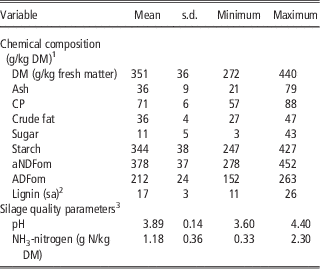
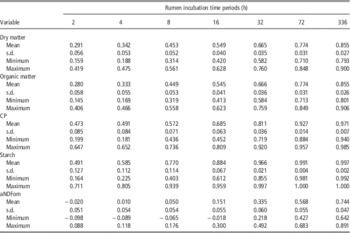
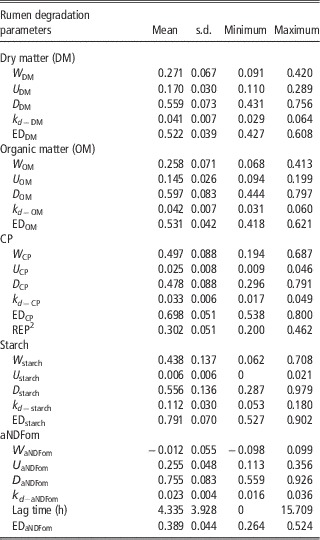
The data of chemical composition and silage characteristics of the 75 maize silages, presented in Table 1, showed a broad range in quality. The average rumen degradable fractions of DM, OM, CP, starch and aNDFom of the maize silages incubated in the rumen of the three cows for 2, 4, 8, 16, 32, 72 and 336 h are shown in Table 2. The range in the values for the rumen degradable fraction of DM, OM, CP and starch was smaller in case of longer (32, 72 and 336 h) incubation periods, compared with short periods (2, 4, 8, and 16 h). In case of aNDFom, the range in the rumen degradable fraction was, however, larger for 16, 32, 72 and 336 h (Table 2). The mean values and range for W, U, D, k d and ED of DM, OM, CP, starch and aNDFom of the 75 maize silage samples are shown in Table 3. The REP fraction of samples ranged from 0.200 to 0.462, with an average value of 0.302 (Table 3). The lag time for aNDFom ranged from 0 to 15.71 h, with an average value of 4.34 h (Table 3).
Chemical composition of maize silages (n=75)

DM=dry matter; aNDFom=NDF assayed with a heat stable amylase and expressed exclusive of residual ash; ADFom=ADF expressed exclusive of residual ash.
1 Determined in freeze-dried material.
2 Lignin determined by solubilization of cellulose with sulphuric acid.
3 Predicted through near infrared reflection spectroscopy (NIRS) by BLGG, Wageningen, the Netherlands.
Mean and range of rumen degradable fractions of dry matter, organic matter, CP, starch and aNDFom of maize silages (n=75) incubated for different periods of time (2, 4, 8, 16, 32, 72 and 336 h)

Mean and range of rumen degradation parametersFootnote 1 of dry matter, CP, starch and neutral detergent fibre (aNDFom) of maize silages

aNDFom=NDF assayed with a heat stable amylase and expressed exclusive of residual ash.
1
W=washout fraction (the fraction disappeared by washing with tap water in a washing machine at 25°C for 40 min), U=rumen undegradable fraction, D=potentially rumen degradable fraction (calculated as D=1 – (W+U)), k
d
=degradation rate (h−1) and ED=effective rumen degradability. The EDDM and EDOM were calculated by using passage rate (k
p
) value of 0.05 h−1. The EDCP, EDstarch and
 $${\rm ED}_{{{\rm aNDF}{{{\rm om}}} }} $$
were calculated using k
p
values of 0.045, 0.06 and 0.020 h−1, respectively.
2 Rumen escape protein. 5% of the W fraction was added in REP.
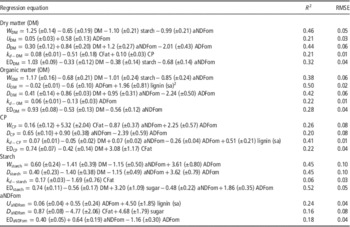
Regression equations describing relationships between the chemical composition (independent variable) and the in situ rumen degradation characteristics of DM, OM, CP, starch and aNDFom (dependent variable) of the maize silages are presented in Table 4. The D
DM fraction was affected by the content of DM, aNDFom and ADFom in maize silages. The EDDM was mainly influenced by the contents of DM, starch and aNDFom, whereas the k
d−DM was only affected by the CFat and CP contents. Regression analysis shows that the EDOM was influenced by the DM and aNDFom (Table 4). The regression analysis also identified significant relationships between the chemical parameters and the W
CP, D
CP, k
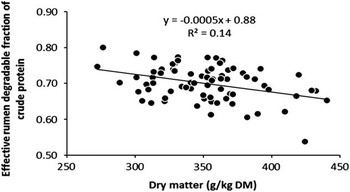
d−CP and EDCP. Figure 1 shows a negative linear relationship between the EDCP and the DM content in maize silages. The W
starch and D
starch fractions were influenced mainly by the DM, aNDFom and ADFom, whereas the EDstarch was influenced by the presence of DM and CFat in maize silages. Relationships were also found between different degradation parameters of aNDFom and the chemical composition (Table 4). The
 $${\rm ED}_{{{\rm aNDF}{{{\rm om}}} }} $$
was positively related to aNDFom, whereas negatively related to ADFom present in maize silages.
Relationship between the dry matter content and the effective rumen degradable fraction of CP in maize silages (n=75).

Multiple regression equations to predict rumen degradation parametersFootnote 1 of dry matter, organic matter, CP, starch and neutral detergent fibre (aNDFom) with chemical parameters (expressed as fraction)

RMSE=root mean square error; aNDFom=NDF assayed with a heat stable amylase and expressed exclusive of residual ash; ADFom=ADF expressed exclusive of residual ash; CFat=crude fat.
1
W=washout fraction (the fraction disappeared by washing with tap water in a washing machine at 25°C for 40 min), U=rumen undegradable fraction, D=potentially rumen degradable fraction (calculated as D=1−(W+U)), k
d
=degradation rate (h−1) and ED=effective rumen degradability. The EDDM and EDOM were calculated by using passage rate (k
p
) value of 0.05 h−1. The EDCP, EDstarch and
 $${\rm ED}_{{{\rm aNDF}{{{\rm om}}} }} $$
were calculated using k
p
values of 0.045, 0.06 and 0.020 h−1, respectively.
2 Lignin determined by solubilization of cellulose with sulphuric acid.
Discussion
The samples used in the present study were collected from different farms in the Netherlands during 2007, 2008 and 2009 to cover a broad range in quality owing to growing seasons, weather conditions, soil quality, fertilization, sowing dates, varieties, maturity stages and ensiling practices. The broad range in the chemical composition and quality parameters is reflected in a large variation in the rumen degradation characteristics of the maize silages. The in situ rumen degradation characteristics of DM, OM, CP, starch and aNDFom was determined under uniform experimental conditions, that is, the same cows, the same incubation protocol and the same chemical analysis procedures. This makes these data more representative than the data for maize silages currently used by different feed evaluation systems in Europe, for example, the DVE/OEB2010 system (Van Duinkerken et al., Reference Van Duinkerken, Blok, Bannink, Cone, Dijkstra, Van Vuuren and Tamminga2011) in the Netherlands, Feed into Milk system (Thomas, Reference Thomas2004) in the United Kingdom and the NorFor Nordic feed evaluation system (Volden, Reference Volden2011) used in Denmark, Sweden, Iceland and Norway. The data used by these feed evaluation systems were compiled from different in situ experiments performed at different places for different scientific purposes, under different experimental conditions and with various chemical analysis procedures.
More than 0.95 of the starch fraction was degraded in the rumen after 32 h of rumen incubation and after 336 h, actually, all starch (0.997 to 1.0) was degraded. Fernandez et al. (Reference Fernandez, Nozière and Michalet-Doreau2004) reported that 0.713 to 0.954 of the starch fraction of maize silages was degraded in the rumen after 24 h. The large range in the values of k
d
and ED of DM, OM, CP, starch and aNDFom was also owing to the broad range in the chemical composition of maize samples. In the present study, the values for D
OM and k
d−OM were 0.597 and 0.042 h−1, respectively. Arieli et al. (Reference Arieli, Mabjeesh, Shabi, Bruckental, Aharoni, Zamwel and Tagari1998) reported in vivo values of 0.292 and 0.049 h−1 for D
OM and k
d−OM, respectively. The difference in the observed values between the present study and the study by Arieli et al. (Reference Arieli, Mabjeesh, Shabi, Bruckental, Aharoni, Zamwel and Tagari1998) might be owing to different techniques (in situ v. in vivo) and the number of samples used (75 v. 2) in both studies. In the present study, the results of the regression analysis demonstrated moderate and weak relationships between the chemical composition and the rumen degradation characteristics of DM, OM, CP, starch and aNDFom. The EDDM was positively related to DM and negatively related to aNDFom content in maize silages, indicating that the presence of insoluble fibre content, especially hemicellulose of the stover restricts the DM degradation. Regression analysis shows that the EDCP was negatively related to the DM and positively related to CFat content. This is related to maturity of maize crop at harvest. It means that the EDCP of maize silages that were ensiled from early cut maize crop was higher than the late maturity cut maize crop. The W
starch and D
starch showed negative relationships with DM and aNDFom contents. This relationship varied at different maturity stages of the maize crops. The starch content of maize crops increases but the aNDFom content decreases with maturation of the maize crop. The EDstarch was positively related to the sugar and ADFom but negatively related to DM and aNDFom contents in maize silages. The DM content of the maize silages can influence the starch degradation in the rumen (Offner et al., Reference Offner, Bach and Sauvant2003). In the present study, the
 $${\rm ED}_{{{\rm aNDF}{{{\rm om}}} }} $$
was positively related to aNDFom and negatively related to ADFom content. This result may highlight the limitation of the use of stepwise regression. No relationship was found between the
 $$k_{{d{\minus}{\rm aNDF}{{{\rm om}}} }} $$
and lag time, but the lag time varied between different samples. Because of lower R
2 values, most of the developed regression equations are of limited use for the prediction of rumen degradation characteristics of dietary nutrients.
Conclusions
The new database on rumen degradation characteristics of maize silages obtained in the present study is more reliable because it is obtained under uniform experimental conditions and the variation in the chemical composition of maize silages used in practice is covered. The present study reports moderate and weak relationships between the chemical composition and the in situ rumen degradation characteristics of dietary fractions or nutrients of maize silages used in practice.
Acknowledgements
The authors are grateful to the Higher Education Commission (HEC), the Dutch Product Board Animal Feed (PDV, Zoetermeer, The Netherlands) and the Dutch Dairy Board (PZ, Zoetermeer, The Netherlands) for financial support and BLGG AgroXpertus (Wageningen, The Netherlands) for performing the chemical analysis.