INTRODUCTION
The hallmark of palliative end of life care is holistic, relationship-centered, and compassionate care of people living and dying with life-threatening conditions and their families. A number of curricula (Bednash & Ferrell, Reference Bednash and Ferrell2000; Emanuel et al., Reference Emanuel, Ferris and von Gunten2002; Back et al., Reference Back, Arnold and Tulsky2003; Liao et al., Reference Liao, Amin and Rucker2004; Browning & Solomon, Reference Browning and Solomon2005; Ferrell et al., Reference Ferrell, Virani and Grant2005; Han et al., Reference Han, Keranen and Lescisin2005; Ogle et al., Reference Ogle, Mavis and Thomason2005; Sullivan et al., Reference Sullivan, Lakoma and Billings2005; Paice et al., Reference Paice, Ferrell and Virani2006; Kelly et al., Reference Kelly, Ersek and Virani2008) using different teaching methods (Williams et al., Reference Williams, Lipsett and Shatzer2001; Browning & Solomon, Reference Browning and Solomon2005; Fryer-Edwards et al., Reference Fryer-Edwards, Arnold and Baile2006; Ferrell et al., Reference Ferrell, Dahlin and Campbell2007; Weissman et al., Reference Weissman, Ambuel and von Gunten2007; Meyer et al., Reference Meyer, Sellers and Browning2009) have been developed to give health care professionals the knowledge and skills to care for dying people.
Despite the development of these curricula, health care professionals report a lack of skills in psychosocial and spiritual care of dying people, high levels of moral distress, grief, and burnout (Institute of Medicine, 1997, 2003; Rashotte et al., Reference Rashotte, Fothergill-Bourbonnais and Chamberlain1997; Papadatou, Reference Papadatou2000; Oberle & Hughes, Reference Oberle and Hughes2001; Papadatou et al., Reference Papadatou, Martinson and Chung2001; Redinbaugh et al., Reference Redinbaugh, Sullivan and Block2003; American Association of Critical Care Nurses, 2004; Meltzer & Huckabay, Reference Meltzer and Huckabay2004; Gutierrez, Reference Gutierrez2005; Gunther & Thomas, Reference Gunther and Thomas2006; Hamric & Blackhall, Reference Hamric and Blackhall2007; Mobley et al., Reference Mobley, Rady and Verheijde2007; Rice et al., Reference Rice, Rady and Hamrick2008), and loss of meaning and professional gratification (Barnard, Reference Barnard1995; Geller et al., Reference Geller, Bernhardt and Carrese2008). These data suggest that palliative care professionals need more than technical skills and intellectual content acquisition to care compassionately for others and to sustain themselves in their caregiving roles (Wasner et al., Reference Wasner, Longaker and Fegg2005). To address some of these concerns, the “Being with Dying: Professional Training Program in Contemplative End-of-Life Care” (BWD) was created (Halifax et al., Reference Halifax, Dossey and Rushton2006).
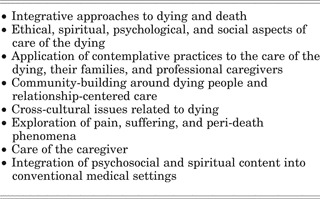
BWD addresses the need for health care professionals to develop knowledge, skills, and practices in the psychosocial, ethical, and spiritual aspects of dying using a contemplative approach. Table 1 lists the core content of the program. The curriculum builds on contemplative practices that regulate attention and emotion, promote calm and resilience, reduce stress, and cultivate emotional balance. The premise of BWD is that cultivating stability of mind and emotions enables clinicians to respond to others and themselves with greater empathy and compassion.
Core content of the BWD program (Halifax et al., Reference Halifax, Dossey and Rushton2006)

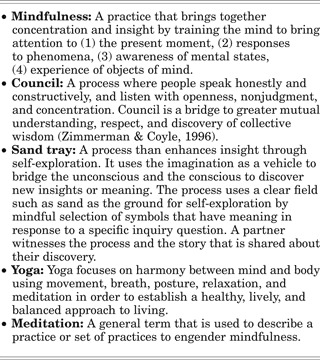
BWD, delivered continuously since 1996, provides an opportunity for participants to discover wisdom and insight from their peers and an interdisciplinary team of facilitators that includes contemplative practitioners, clinicians, and educators. The 8-day residential program uses many learning modalities (e.g., didactic teaching, self-directed learning, inquiry, and creative processes) to enhance awareness of the importance of the inner life and professional responsibility. The nondenominational contemplative practices described in Table 2 are integral to the program.
Definitions of contemplative practices (Halifax et al., Reference Halifax, Dossey and Rushton2006)

This article reports the impact, both professional and personal, of the BWD program as retrospectively perceived by BWD participants.
METHODS
As an initial step in understanding the influence of BWD on those who participate, confidential open-ended telephone interviews and an anonymous online survey with previous BWD participants were conducted. The study design, methods, survey instrument, interview guide, and recruitment materials were reviewed by the Johns Hopkins University Institutional Review Board.
The Sample
From 1996 to 2006, 447 people participated in 14 BWD retreats that include 23–53 participants per retreat. Approximately three fourths were female; 20% were physicians, 30% nurses, 25% therapists/social workers, 15% chaplains, and 10% other disciplines. No details are available regarding ethnicity or age. As part of the registration process, participants provided contact information, including e-mail addresses.
In 2006, the e-mail addresses of 191 participants were verified by e-mail or telephone contact. In January 2007, these 191 participants were asked by e-mail to (1) complete an anonymous online survey and (2) participate in a confidential telephone interview.
Data Collection and Analysis
The survey, developed by the research team, included closed-form questions about how the program influenced the respondent, what parts of the program the respondent incorporated into their lives, and what barriers impeded and what additional training would enhance their incorporation of the program content. Survey responses were 5-point Likert scales (1 = strongly disagree to 5 = strongly agree or 1 = not at all to 5 = very much/a great deal). Personal (gender, age, education, and religious affiliation) and professional (years of experience and number of patients who died in the past 12 months) characteristics of survey respondents were also obtained. Standard descriptive statistics were used to summarize the survey responses.
Confidential, open-ended, audiotaped telephone interviews were conducted using an interview guide that focused on the impact of BWD on the interviewees' professional and personal activities.
The qualitative interview data was analyzed using a standard analytic approach of an iterative process of open coding of the transcribed interview recordings (Marshall & Rossman, Reference Marshall and Rossman1989; Miles & Huberman, Reference Miles and Huberman1994; Weiss, Reference Weiss1994; Kvale, Reference Kvale1996; Strauss & Corbin, Reference Strauss and Corbin1999). The key objective was identifying, describing, and comparing themes in the data (Miles & Huberman, Reference Miles and Huberman1994). Codes were used to organize the data into categories that could be retrieved and linked to each other (Miles & Huberman, Reference Miles and Huberman1994). As coding proceeded, second-level pattern coding was applied to organize the data into relationships among emerging themes (Miles & Huberman, Reference Miles and Huberman1994).
RESULTS
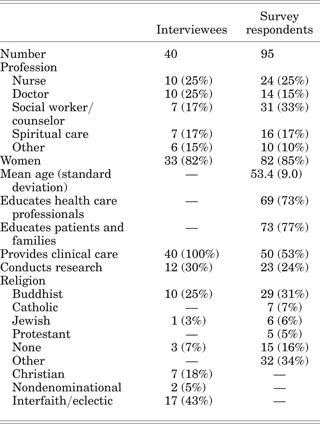
Ninety-five individuals (49% of participants with verified e-mail addresses) completed the anonymous survey. Sixty-one individuals volunteered to complete a telephone interview. From this pool of 61, 40 individuals were selected to ensure representation from the four main health care disciplines that care for the dying (physician, nurse, social worker, and chaplain) as well as different practice settings and geographic locations. Table 3 describes the survey respondents and interviewees.
Characteristics of interviewees and survey respondents

Four main themes emerged in the interviews: the power of presence, cultivating balanced compassion, recognizing grief, and the importance of self-care. These themes and relevant findings from the survey data supporting the concurrence of the themes among survey respondents are described below. The methods BWD participants reported learning and using personally and professionally and the ongoing impact of the BWD program on the participants are described.
The Power of Presence
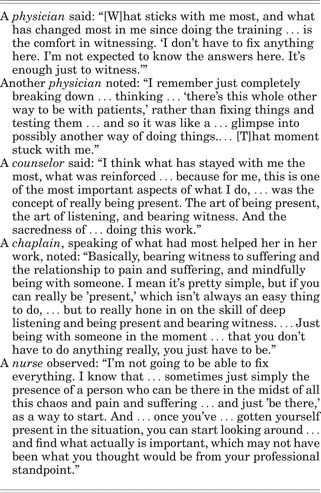
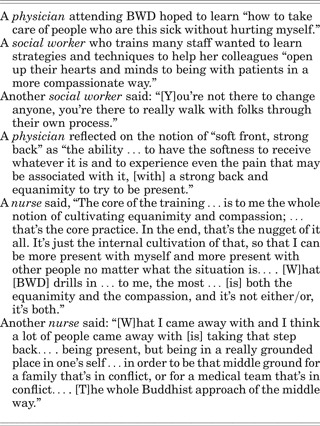
Presence refers to the capacity to be fully there with a quality of attention and authenticity that informs relationships and actions. A prominent theme in the interviews was the recognition that the mandate in modern medicine “to do” and “to fix” and hopefully cure may no longer be appropriate when people are dying and, in fact, may require balancing with the quality of being present with those who are suffering. Interviewees said that BWD had helped them realize that being present with dying patients and their families and bearing witness to suffering are healing acts in themselves and are often “enough.” This theme, illustrated by interview quotes in Table 4, was supported in the survey when 90% of respondents agreed or strongly agreed that “Compared to before I participated in BWD, the program helped me to cultivate my ability to be fully present with those I serve.” More respondents agreed with this item than with any of the other 38 items assessing the professional impact of the BWD program.
The power of presence

Survey respondents also reported that the qualities of presence, including skillful listening (76%), ability to stay centered (77%), and achieving balance in the face of change (65%), were enhanced by their participation in the BWD program. Compared to before BWD, 59% reported greater skills in listening deeply and approximately three quarters agreed or strongly agreed that the program helped to improve their listening skills with patients and families (78%) and with interdisciplinary colleagues (73%).
Cultivating Balanced Compassion
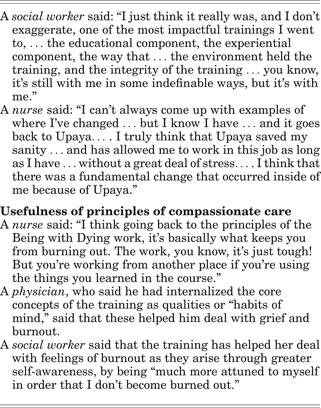
A core element of the BWD program is cultivating a stable internal foundation that supports compassion—the ability to be present to all levels of suffering, to experience it, and to aspire or to act to transform it without being overwhelmed by emotions or circumstances. As illustrated in Table 5, many interviewees described the attitudes and approach to patient and family care modeled in BWD as having an important impact on their work, including concepts such as “not knowing” (being open to inquiry and discovery), developing a “soft front” of compassion balanced with a “strong back” of stability and resilience, maintaining an attitude of “nonjudgment,” and “being with things just as they are.”
Cultivating balanced compassion

This theme was supported by survey respondents who agreed or strongly agreed that BWD helped them to have greater compassion toward self (83%) and others (81%). In addition, 88% reported having more balance as they face the suffering and pain of others; they reported that following BWD, they felt more balanced and caring in relationship to dying people (80%), patients and families (70%), and colleagues (72%).
Recognizing Grief
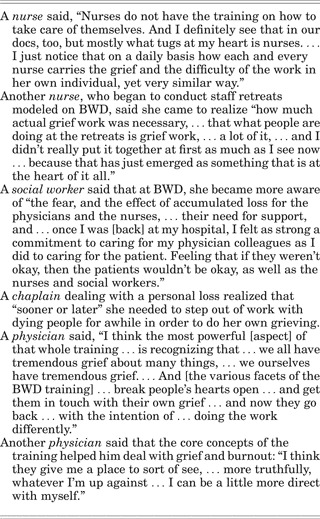
Grief, the intense emotional and spiritual suffering caused by loss, is part of the human condition and inherent in the roles of health care professionals. As illustrated in Table 6, two thirds of the interviewees talked about how BWD helped them recognize or deal with grief in themselves and others. Several interviewees remarked on the tremendous and often unacknowledged grief and loss that they and their colleagues experienced in caring daily for dying people. Some (27%) stated that the BWD training helped them express and deal with their own grief. The 79% of survey respondents who reported agreeing or strongly agreeing that BWD helped them to “be more aware of my own grief and grieving” also affirmed the role of BWD in helping them recognize or deal with grief.
Recognizing grief

Importance of Self-care
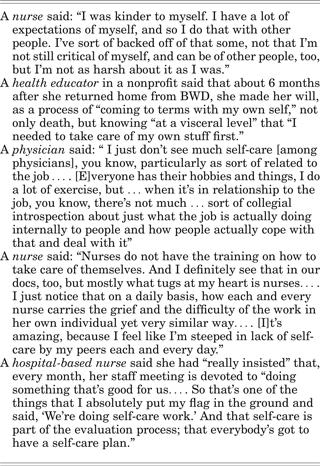
Self-care, an individual's recognition and responsiveness to his or her unique needs for renewal, is an active process aimed at facilitating well-being and personal integrity. Attention to self-care was an important component of BWD for many of the interviewees. Almost half (47.5%) of the interviewees considered it among the most valuable aspects of the training, and some wished that more time had been devoted to it. Table 7 provides illustrative quotes.
The importance of self-care
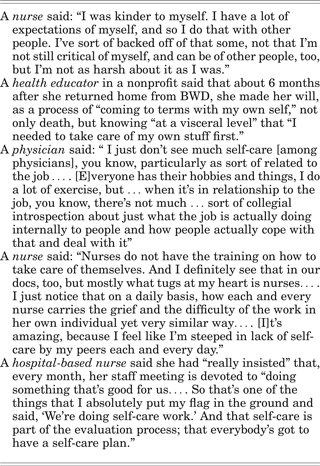
The interviewees mentioned a number of ways in which they take care of themselves (e.g., stopping throughout the day to breathe, being kinder to and more forgiving of themselves and others, taking more time off, getting massages, playing music, exercising, journaling). More than two thirds of the interviewees (67.5%) had enhanced or increased their self-care since the training.
Survey respondents also reported the importance of self-care: 87% agreed or strongly agreed that “compared to before I participated in BWD, the program helped me to be more compassionate toward myself in acknowledging my own limitations.” Two thirds of survey respondents also agreed or strongly agreed that the program helped them to have a greater commitment to self-care, and 57% reported that the program helped them to adopt a new self-care practice. Half agreed or strongly agreed that following the training they experienced fewer moments of feeling “burned out”; 72% reported feeling more resilient in giving care. Compared to before BWD, 88% of survey respondents reported feeling more inspired by their work with dying people and 80% reported having a renewed sense of meaning in their work.
Methods to Facilitate Presence, Compassion, Grief Recognition and Self-care
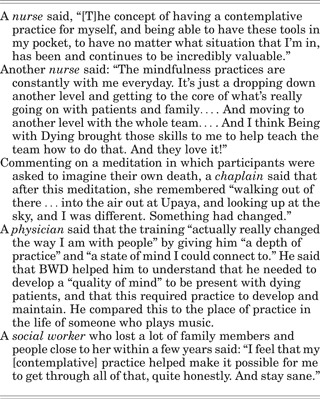
As illustrated in Table 8, all of the interviewees said that the contemplative and reflective practices were among the most meaningful, useful, and valuable aspects of the BWD experience, though they acknowledged that maintaining an attitude of valuing self-care and the practices that sustain it is an ongoing, challenging process. When asked how much participation in the BWD program increased their use of contemplative or self-care practices, 35% of survey respondents reported that they had increased their use of mindfulness practice since participating in the BWD program. In addition, 72% of survey respondents circled 4 or 5 (on the 5-point scale from 1 = not at all to 5 = very much) for their use of mindfulness practice.
Methods for facilitating presence, compassion, grief, and self-care

Ongoing Impact
Overall, as illustrated in Table 9, the interviewees reported that BWD had “seeded” them with skills, attitudes, behaviors, and tools with which to change how they understand the death and the dying process (70%), how they work with the dying and bereaved (90%), and how they conduct themselves personally (72%) and with colleagues (62%). Many interviewees credited BWD with being an “opening” (30%) or “affirming” (50%) experience. More than one third (38%) said it had been transformative (a “watershed” experience, as one doctor put it) and had changed their lives. The changes stimulated or enhanced by the training affected the participants' methods and style of caring for patients and families, their career focus, and their personal lives. Whether the changes they made were large or small, the interviewees acknowledged that what they had learned at the training continues to influence them and to reverberate years later in their personal and professional lives.
Ongoing impact of BWD program

DISCUSSION
The BWD training integrates three primary foci: mindfulness, compassion, and self-care. First, the development of a foundation of mindfulness provides the stability of mind and emotions to support clinicians to engage more deeply in addressing the reality of living and dying (Wasner et al., Reference Wasner, Longaker and Fegg2005; Halifax, Reference Halifax2008). Second, the direct cultivation of compassion is integral to providing holistic end-of-life care. Compassion denotes the presence of an relationship appropriate to suffering and the capacity to respond to suffering without being overwhelmed by it and to transform it in beneficial ways. The third emphasizes self-care; in order for clinicians to provide compassionate end-of-life care, it is necessary for them to be self-aware, recognize their own difficulties, and to make a commitment to address their own suffering by nurturing physical, emotional, mental, spiritual, and social dimensions of their own lives and relationships to others (Institute of Medicine, 1997). These data suggest that the foundation of contemplative practice, compassion, and self-care offers clinicians a grounding for their work that allows them to cultivate ways of being that are congruent with their aspirations, moral sensibilities, and professional roles.
The findings from both the quantitative and qualitative studies highlight that bringing a present moment quality of presence to interactions has the potential to transform the care of dying people as well as the caregivers themselves. Cultivating this quality within themselves and others allows clinicians to explore alternatives to exclusively intellectual, procedural, and task-oriented approaches when caring for dying people. Although research has documented the positive impact of presence on patients and families and presence is suggested as an element of caring for dying people, there are few opportunities to engage in practices and methods that cultivate the stability of mind and emotions necessary to bring this quality to compassionate care of patients, families, and each other (Pettigrew, Reference Pettigrew1990; Pederson, Reference Pederson1993; Fredriksson, Reference Fredriksson1999; Stanley, Reference Stanley2002) Clinicians often lack competence in this vital aspect of clinical care (Koener, Reference Koener2007).
Over the past two decades, there has been an increasing interest in how to apply contemplative practices to a diverse range of secular settings, including health care, education, business, and law (Duerr, Reference Duerr2004). One of the most widely used meditation techniques is Mindfulness-Based Stress Reduction (MBSR) (Kabat-Zinn, Reference Kabat-Zinn2003). The qualities developed by mindfulness practice—self-reflection, deep listening, and moment-to-moment presence—are foundational to relationship-centered care, a core element of compassionate end-of-life care (Connelly, Reference Connelly1999, Reference Connelly2005; Epstein, Reference Epstein1999). Our findings infer that cognitive approaches alone are insufficient to create the possibility of shifting one's awareness and way of being with others; experiencing and using contemplative practices can be instrumental in altering how clinicians care for dying people.
These data further support the premise that it is not possible for clinicians to care compassionately for others unless they are able to care compassionately for themselves (Reich, Reference Reich1989; Rushton, Reference Rushton1992, Reference Rushton, Carter and Levetown2004; Rushton et al., Reference Rushton, Reder and Hall2006; American Nurses Association, 2009). As caretakers of others, clinicians find that their needs of are often set aside in order to fulfill their commitments to others, especially in situations where the needs are boundless and the systems are faulty. The personal costs that accompany abandoning their own needs and failing to care for themselves are often unaddressed. Data from both the survey and interviews in our study confirm that health care professionals need support and skills in compassionate care of themselves and others. The absence of compassion toward oneself may be a contributing factor in burnout, moral distress, secondary trauma, and compassion fatigue (Power & Sharp, Reference Power and Sharp1988; Whippen & Canellos, Reference Whippen and Canellos1991; Figley, Reference Figley1995; Rushton, Reference Rushton1995; Sundin-Huard & Fahy, Reference Sundin-Huard and Fahy1999; Jezuit, Reference Jezuit2000; Chen & McMurray, Reference Chen and McMurray2001; Gundersen, Reference Gundersen2001; Mealer et al., Reference Mealer, Shelton and Berg2007). Lack of self-compassion may also contribute to the way clinicians resolve questions about care and take responsibility for decisions and outcomes for dying patients and may mute emotional responses (Meier et al., Reference Meier, Back and Morrison2001; Redinbaugh et al., Reference Redinbaugh, Sullivan and Block2003; Ruopp et al., Reference Ruopp, Good and Lakoma2005). Our findings are consistent with related findings that (1) spiritual well-being (related to self-compassion and meaning) has a positive impact on job satisfaction and ultimately may decrease staff turnover (Clark et al., Reference Clark, Leedy and McDonald2007) and (2) that significant increases in self-compassion occur among health care professionals who participated in MBSR courses (Shapiro et al., Reference Shapiro, Astin and Bishop2005).
Clinicians who care for dying people are themselves experiencing grief, although it is not routinely acknowledged or addressed (Behnke et al., Reference Behnke, Reiss and Neimeyer1987; Papadatou et al., Reference Papadatou, Bellali and Papazoglou2002; Redinbaugh et al., Reference Redinbaugh, Sullivan and Block2003; Serwint et al., Reference Serwint, Rutherford and Hutton2006). When grief is not acknowledged, processed, or supported, it can become “disenfranchised,” leading to a variety of physical, emotional, and spiritual responses (Doka, Reference Doka2002; Moss et al., Reference Moss, Moss and Rubinstein2003). Grief is addressed in the BWD training through guided meditations, experiential practices such as sand tray, small group councils exploring various dimensions of grief, and peer-to-peer learning. These data support efforts by palliative care and hospice programs to develop mechanisms for acknowledging and supporting clinicians in processing their own grief (Papadatou, Reference Papadatou2000; Serwint et al., Reference Serwint, Rutherford and Hutton2006).
Skills in self-care and renewal are essential for clinicians who care for dying people. These skills, coupled with strategies for cultivating authenticity through self-reflection and contemplation, offer promising opportunities for creating personal and professional support systems. The skills offered in the BWD training can be used to cultivate inner stability and resilience that allow clinicians to be with suffering and death without being overcome by their own or others' emotions (Behnke et al., Reference Behnke, Reiss and Neimeyer1987; Scherwitz et al., Reference Scherwitz, Pullman and McHenry2006; Halifax, Reference Halifax2008). Alignment between individual values for self-care and a practice environment that supports clinicians to practice with integrity through self-care and renewal have the potential to enhance clinician satisfaction and ultimately improve patient care (Koener, Reference Koener2007; Ulrich et al., Reference Ulrich, O'Donnell and Taylor2007). Ways of sustaining one's commitment to his or her own well-being after the training is an area for further exploration.
To support the cultivation of authenticity and the quality of presence, it is necessary to create a safe learning environment where clinicians can reflect on their deepest motivations for choosing a career as health care professionals, can reflect on who they are as people and as professionals, and can explore their own suffering and the suffering of their patients and families. This requires an alternative learning approach that models interdisciplinary collaboration, discovery learning, and supportive facilitation. The data in our study suggest that engaging in contemplative practices that stabilize the mind and cultivate emotional well-being—key elements in BWD—are supportive to clinicians who want to deepen their work with dying people. These data also suggest that the design and content of a contemplative end-of-life professional training program is beneficial to clinicians as individuals and as professionals (Scherwitz et al., Reference Scherwitz, Pullman and McHenry2006). This has implications for educators and leaders in palliative care who are replicating or designing programs that continue to rely on didactic methods alone. These findings are consistent with other approaches that have called for experiential and relational teaching formats and greater attention to cultivating self awareness (Behnke et al., Reference Behnke, Reiss and Neimeyer1987; Fins et al., Reference Fins, Gentilesco and Carver2003; Wasner et al., Reference Wasner, Longaker and Fegg2005; Browning & Solomon, Reference Browning and Solomon2006; Scherwitz et al., Reference Scherwitz, Pullman and McHenry2006).
Limitations of This Study
The ability to generalize from the findings in this study is limited by the fact that the survey and interview samples may not be representative of all those who have participated in BWD and the lack of a comparison to a similar group of nonparticipants. The preponderance of women among the survey and interview participants reflects their preponderance in the sample and the greater number of women than men who have attended the BWD training over the years. In addition, the respondents' ethnicity was not asked about. Self-report is a limitation because it relies on the participant's affective experiences and recall, for some, many years since attending the training. Finally, those who participated in the survey and/or interview may have been more likely to have experienced a positive impact from the program than those who did not complete the survey and/or an interview.
Conclusion
This study reports the perceived impact of a unique training program incorporating contemplative, experiential and creative practices on the interdisciplinary health care clinicians who participated. Our findings suggest that an alternative learning model has the potential for a positive effect on clinicians as individuals and as professionals in the care they give to themselves and others. The findings are consistent with empirical evidence that meditative and contemplative practices can aid in relieving the acute symptoms of compassion fatigue and burnout (Cohen-Katz et al., Reference Cohen-Katz, Wiley and Capuano2005; Galantino et al., Reference Galantino, Baime and Maguire2005) including depression and anxiety (Shapiro et al., Reference Shapiro, Schwartz and Bonner1998) and physiological symptoms such as insomnia and a weakened immune system (Davidson et al., Reference Davidson, Kabat-Zinn and Schumacher2003). Additionally, these practices help to cultivate cognitive and physiological capacities that support overall well-being and strengthen the resiliency of care providers (Shapiro et al., Reference Shapiro, Astin and Bishop2005). Further studies of the long-term effects of this type of training on clinicians (and thereby on patients and families) are warranted in order to determine how best to ensure compassionate and sustainable end of life care.
ACKNOWLEDGMENTS
The authors express deep gratitude to all the former participants in the BWD programs, those who participated in the study, and the past and current faculty and facilitators. We are deeply grateful to Kelly Wilson-Fowler and Jean Wilkins for their technical support. This study and ongoing CEOLC programs are made possible by the generosity of Ann Down, John and Tussi Kluge, Hershey Family Foundation, Grant Couch, Louise Pearson, and the Hunt Foundation. The BWD program has been generously supported by The Nathan Cummings Foundation, the Soros Foundation's Project on Death in America, and Laurance Rockefeller.