





Non-technical Summary
We describe the first fossil antlion (lacewing order Neuroptera, family Myrmeleontidae) from the Fossil Butte Member of the early Eocene Green River Formation of Wyoming, USA, and name the new genus and species Protopalpares lindgrenae based on it. It is the first reported fossil of the modern antlion subfamily Palparinae. Analysis of its wing venation indicates that Palparinae is closely related to the Cretaceous lacewing family Palaeonleontidae.
Introduction
The Myrmeleontidae (antlions) is the most speciose family of Neuroptera today, with ~ 1700 species (Oswald and Machado, Reference Oswald, Machado, Foottit and Adler2018) distributed nearly worldwide, more diverse in warm, arid regions. Adults are typically relatively large, including the largest living neuropterans, with a wingspan to 170 mm in some Palparinae (Hevin et al., Reference Hévin, Kergoat, Clamens, Le Ru, Mansell and Bruno2023). Many of their predatory larvae are remarkable for constructing conical pitfall traps in sand to capture arthropods walking on the ground (Mansell, Reference Mansell1999).
Our current understanding of their Mesozoic history is confusing and contradictory. They are speciose and diverse in the Cretaceous, with 58 generally accepted species described based on adults, none in extant subfamilies (see list of species not belonging to Palaeonleontidae by Lu et al., Reference Lu, Xu and Liu2022, and Bueno et al., Reference Bueno, Machado, Liu and Ribeiro2025a, Reference Bueno, Machado, Martins and Ribeirob; Lu et al., Reference Lu, Wang, Zhuo and Liu2026; species of Palaeonleontidae are not summarized in any single work, so see Menon and Makarkin, Reference Menon and Makarkin2008; Millet and Nel, Reference Millet and Nel2010; Shi et al., Reference Shi, Béthoux, Shih and Ren2012; Myskowiak and Nel, Reference Myskowiak and Nel2016). The oldest myrmeleontoid species are from the Barremian/Aptian Yixian Formation in China (Choromyrmeleon othneius Ren and Guo, Reference Ren and Guo1996; C. aspoeckorum Ren and Engel, Reference Ren and Engel2008) and the probably Barremian/Aptian Bon-Tsagaan locality in Mongolia (Baissopardus banksianus Ponomarenko, Reference Ponomarenko1992). These genera are currently considered to belong to Myrmeleontidae subfamily incertae sedis (see Lu and Liu, Reference Lu and Liu2022; Bueno et al., Reference Bueno, Machado, Almeida-Silva and Ribeiro2026) and Palaeonleontidae (see Myskowiak and Nel, Reference Myskowiak and Nel2016), respectively.
Three myrmeleontoid family-level taxa have been proposed for these genera (Araripeneuridae/-nae, Palaeonleontidae/-nae, and Pseudonymphinae/-dae), but these are not universally recognized. Although Araripeneuridae and Palaeonleontidae are often treated as subfamilies of Myrmeleontidae (e.g., Stange, Reference Stange2004; Machado et al., Reference Machado, Gillung, Winterton, Garzón‐Orduña, Lemmon, Lemmon and Oswald2019; Bueno et al., Reference Bueno, Machado, Liu and Ribeiro2025a, Reference Bueno, Machado, Martins and Ribeirob), they are quite distinct and are better considered as separate families (see e.g., Makarkin et al., Reference Makarkin, Wedmann and Heads2018). We consider Pseudonymphinae (as defined by Makarkin et al., Reference Makarkin, Wedmann and Heads2018) to be paraphyletic, with genera probably belonging to stem Myrmeleontidae sensu lato within it. However, some mid-Cretaceous genera (see Huang et al., Reference Huang, Azar, Engel, Garrouste, Cai and Nel2016; Lu et al., Reference Lu, Hu, Wang, Zhang, Ohl and Liu2019, Reference Lu, Wang, Zhuo and Liu2026; Lu and Liu, Reference Lu and Liu2022) appear more closely related to extant Myrmeleontidae than to other Cretaceous taxa and are currently treated as Myrmeleontidae subfamily incertae sedis (Lu et al., Reference Lu, Wang, Zhuo and Liu2026). In general, the systematics of Cretaceous antlions needs revision.
Only three species of Myrmeleontidae are confidently known from the Cenozoic, belonging to one and possibly two modern subfamilies: Epignopholeon sophiae Makarkin, Reference Makarkin2017 (Myrmeleontinae: ?Gnopholeontini) from the early Eocene Green River Formation, Colorado, USA; Dendroleon septemmontanus Statz, Reference Statz1936 (?Dendroleontinae) from late Oligocene Rott (Germany), and Porrerus dominicanus Poinar and Stange, Reference Poinar and Stange1996 (Myrmeleontinae: Myrmeleontini: Porerenina) from early/middle Miocene Dominican amber (Poinar and Stange, Reference Poinar and Stange1996; Engel and Grimaldi, Reference Engel and Grimaldi2007; Makarkin, Reference Makarkin2017).
The modern subfamily Palparinae has no reported fossil occurrences. It has >140 species today distributed in subtropical and tropical regions of the Old World (mainly in Africa), and rarely in South America. It has traditionally been divided into four tribes (Stange, Reference Stange2004), i.e., Dimarini with Echthromyrmex McLachlan, Reference McLachlan1867 (southern Asia), Dimares Hagen, Reference Hagen1866 (South America), Millerleon Stange, Reference Stange1989 (South America); Palparidiini wth Palparidius Péringuey, Reference Péringuey1910 (South Africa); Pseudimarini with Pseudimares Kimmins, Reference Kimmins1933 (Morocco and Iran), and Palparini (15 genera distributed in Africa and southern Eurasia). The genus Echthromyrmex has often been treated as constituting the monotypic tribe Echthromyrmecini (e.g., Markl, Reference Markl1954; Hölzel, Reference Hölzel, Gepp, Aspöck and Hölzel1986) or even the subfamily Echthromyrmecinae (Krivokhatsky, Reference Krivokhatsky1998).
However, in recent years the taxonomy of extant Myrmeleontidae has been significantly revised. The morphological analysis of Badano et al. (Reference Badano, Aspöck, Aspöck and Haring2017) supported two tribes of Palparinae: Stilbopterygini (subtribes Stilbopterygina and Pseudimarina) and Palparini (subtribes Palparina, Palparidiina, Dimarina and Echthromyrmecina). The phylogenomic analysis of Machado et al. (Reference Machado, Gillung, Winterton, Garzón‐Orduña, Lemmon, Lemmon and Oswald2019) synonymized Ascalaphidae with Myrmeleontidae, and eliminated Palparinae, considering its genera as belonging to two tribes (Palparini and Dimarini) in Ascalaphinae, and Pseudimares as Ascalaphinae incertae sedis. The molecular analysis of Hévin et al. (Reference Hévin, Kergoat, Clamens, Le Ru, Mansell and Bruno2023) subsequently restored the Palparinae, composed of Palpirini, Palparidiini, and Pseudimarini (genera of Dimarini were not analyzed). We accept the synonymization of Ascalaphidae with Myrmeleontidae proposed by Machado et al. (Reference Machado, Gillung, Winterton, Garzón‐Orduña, Lemmon, Lemmon and Oswald2019), but consider Ascalaphinae to consist of the tribes Stilbopterygini, Albardiini, Ululodini, Haplogleniini, and Ascalaphini, without genera of the Palparinae.
Here, we describe the first fossil species of Palparinae and the first neuropteran from the Fossil Butte Member of the early Eocene Green River Formation (Wyoming, USA) and compare its characters with those of the Cretaceous Palaeonleontidae.
Materials and methods
Terminology of wing venation follows Breitkreuz et al. (Reference Breitkreuz, Winterton and Engel2017) except treatment of CuA, which we and other authors (see e.g., Lu et al., Reference Lu, Wang, Zhuo and Liu2026) follow Tillyard (Reference Tillyard1915): the proximalmost branch of CuA is CuA2 (Tillyard’s ‘Cu2’); other branches of CuA considered to be fused with MP are MP+CuA1 (Tillyard’s ‘Cu1+M2’). See captions of Figures 3–5 for abbreviations used in the text. Contrary character states of taxa compared in diagnoses are provided in brackets.
We follow the traditional understanding of Palparinae systematics of Stange (Reference Stange2004) above the tribal level. Relationships are less confident at the tribe level and below.
Locality information
The Green River Formation consists of highly fossiliferous lacustrine shale deposited between ~ 53.5 and 48.5 Ma (Smith et al., Reference Smith, Singer and Carroll2003) in a large lake system of Lake Gosiute and Fossil Lake in southwestern Wyoming and Lake Uinta in northeast Utah and northwestern Colorado (see summaries of its geology and paleontology by Grande, Reference Grande1984, Reference Grande1994, Reference Grande2013). This was during the Early Eocene Climatic Optimum, the globally warmest sustained temperatures of the Cenozoic (e.g., Inglis et al., Reference Inglis, Bragg, Burls, Cramwinckel and Evans2020). Analysis of leaf physiognomy gives Fossil Butte mean annual temperature estimates from 18.3°C to 19.6°C (with 4 °C standard errors) at its Little Mountain locality (Wilf, Reference Wilf2000, Fricke and Wing, Reference Fricke and Wing2004).
The Fossil Butte Member is famous for its rich vertebrate assemblage of reptiles, amphibians, birds, mammals, and diverse and abundant fish (Grande references above). The specimen was collected in the Fossil Butte Member ~ 6 m below the K-spar tuff in the 18-in (45.7-cm) layer, 17.7 km west of Kemmerer, Lincoln County, Wyoming, USA, in Clear Creek Valley. The K-spar tuff near the top of the Fossil Butte Member is dated mid-Ypresian, 51.97 ± 0.09 Ma (Smith et al., Reference Smith, Chamberlain, Singer and Carroll2010).
Samuel Scudder (Reference Scudder1878, Reference Scudder1890) described 191 species of Green River insects in the late nineteenth century, mostly from Grande’s (Reference Grande1984, fig I.4) Lake Gosiute locality G-1 and a lesser number from Fossil Lake locality F-1 and 53 from Scudder’s White River locality in Utah near the Colorado border, apparently the Lake Uinta U-4 locality of Grande. Other authors, notably Cockerell in the early twentieth century (e.g., Cockerell, Reference Cockerell1925), also described insects from the Lake Uinta Parachute Creek Member of the Piceance Basin in Colorado. In recent years, there has been an increase in works published on insects of the Parachute Creek Member (e.g., Makarkin, Reference Makarkin2017; Archibald and Makarkin, Reference Archibald and Makarkin2021), Lake Gosiute Laney Member (Archibald et al., Reference Archibald, Johnson, Mathewes and Greenwood2011), and Fossil Butte Member (e.g., Archibald et al., Reference Archibald, Aase and Nel2021, Bechly et al., Reference Bechly, Garrouste, Aase, Karr, Grande and Nel2020). Previously, Neuroptera (and Raphidioptera) have only been reported from the Parachute Creek Member.
Repositories and institutional abbreviations
The type specimen is deposited in the collection of Fossil Butte National Monument, Kemmerer, Wyoming, USA (FOBU). Other repositories cited in the text are Paleontological Institute of the Russian Academy of Sciences, Moscow, Russia (PIN), and the Staatliches Museum für Naturkunde, Stuttgart, Germany (SMNS).
Systematic paleontology
Order Neuroptera Linnaeus, Reference Linnaeus1758
Family Myrmeleontidae Latreille, Reference Latreille1802
Subfamily Palparinae Banks, Reference Banks1911
Genus Protopalpares new genus
Type species
Protopalpares lindgrenae new genus, new species.
Diagnosis
As for the type species by monotypy.
Etymology
The generic name is formed from the Greek protou, ‘before’ or ‘in former times,’ and the genus-group name Palpares Rambur, Reference Rambur1842. Gender masculine.
Remarks
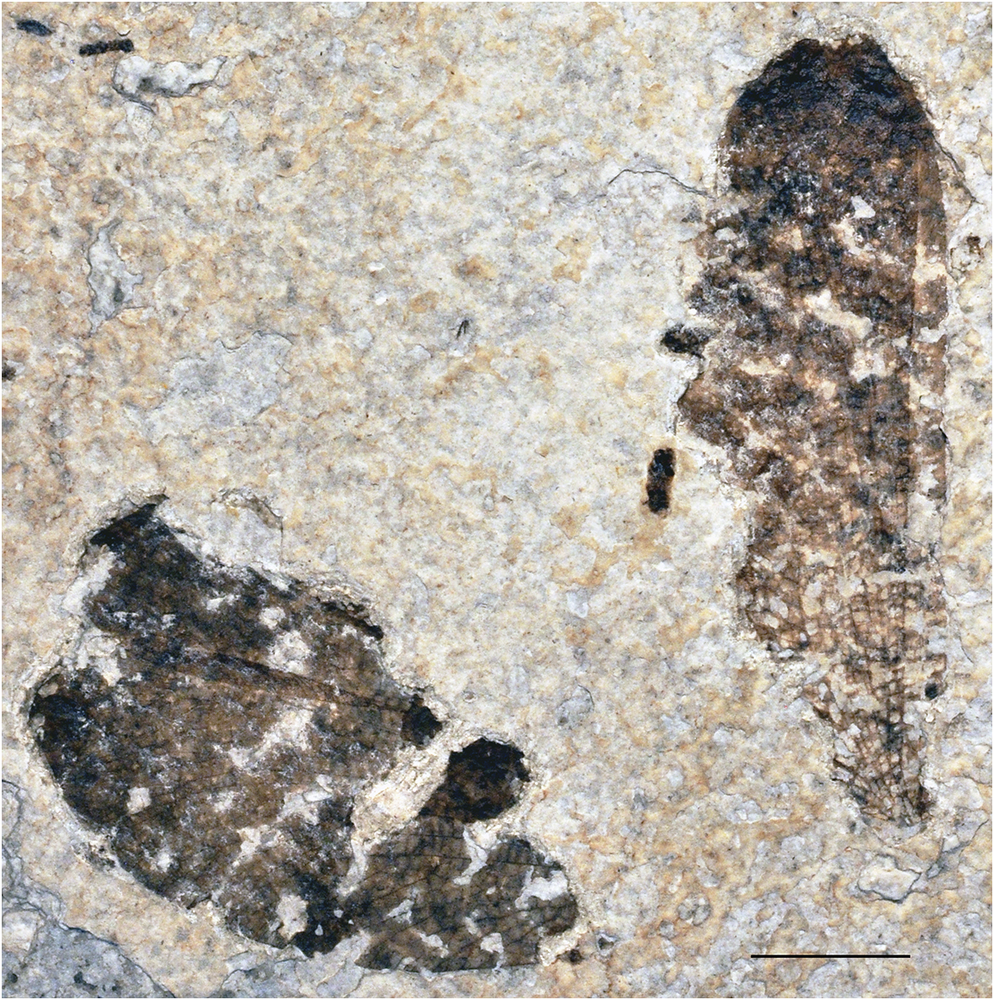
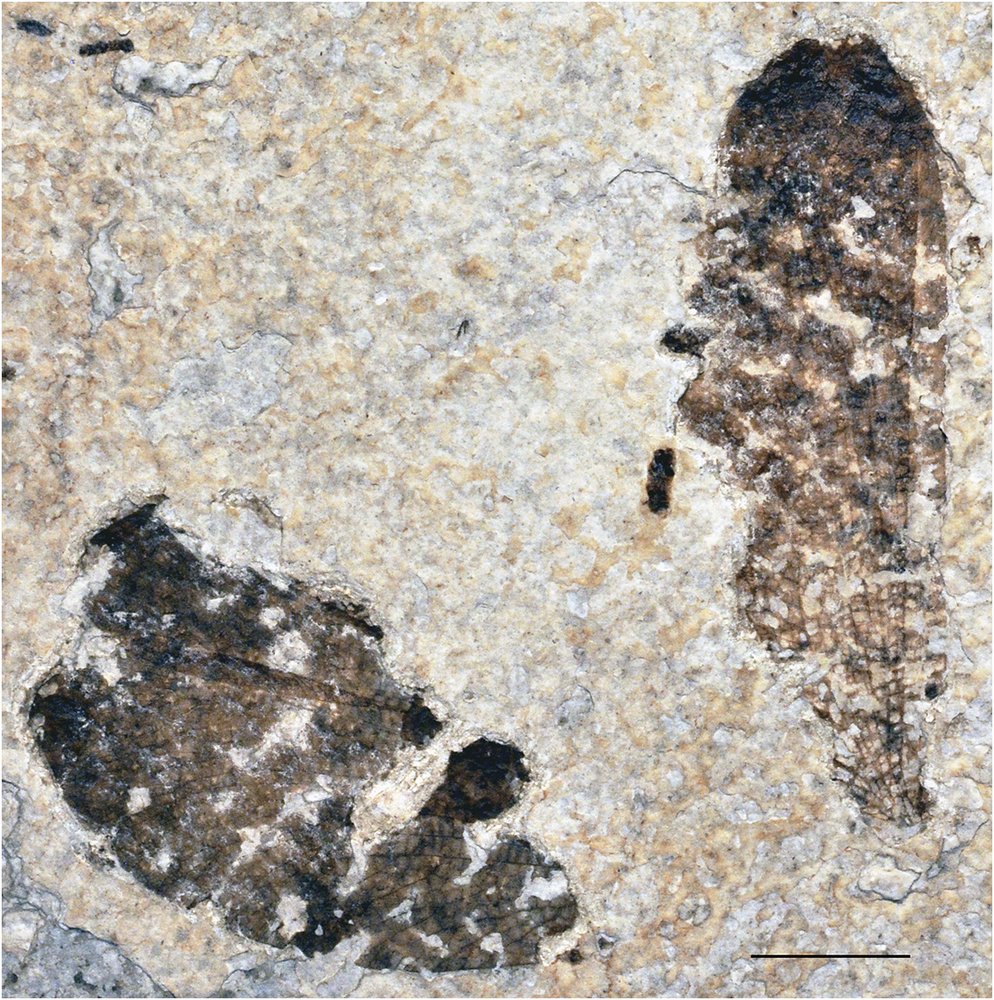
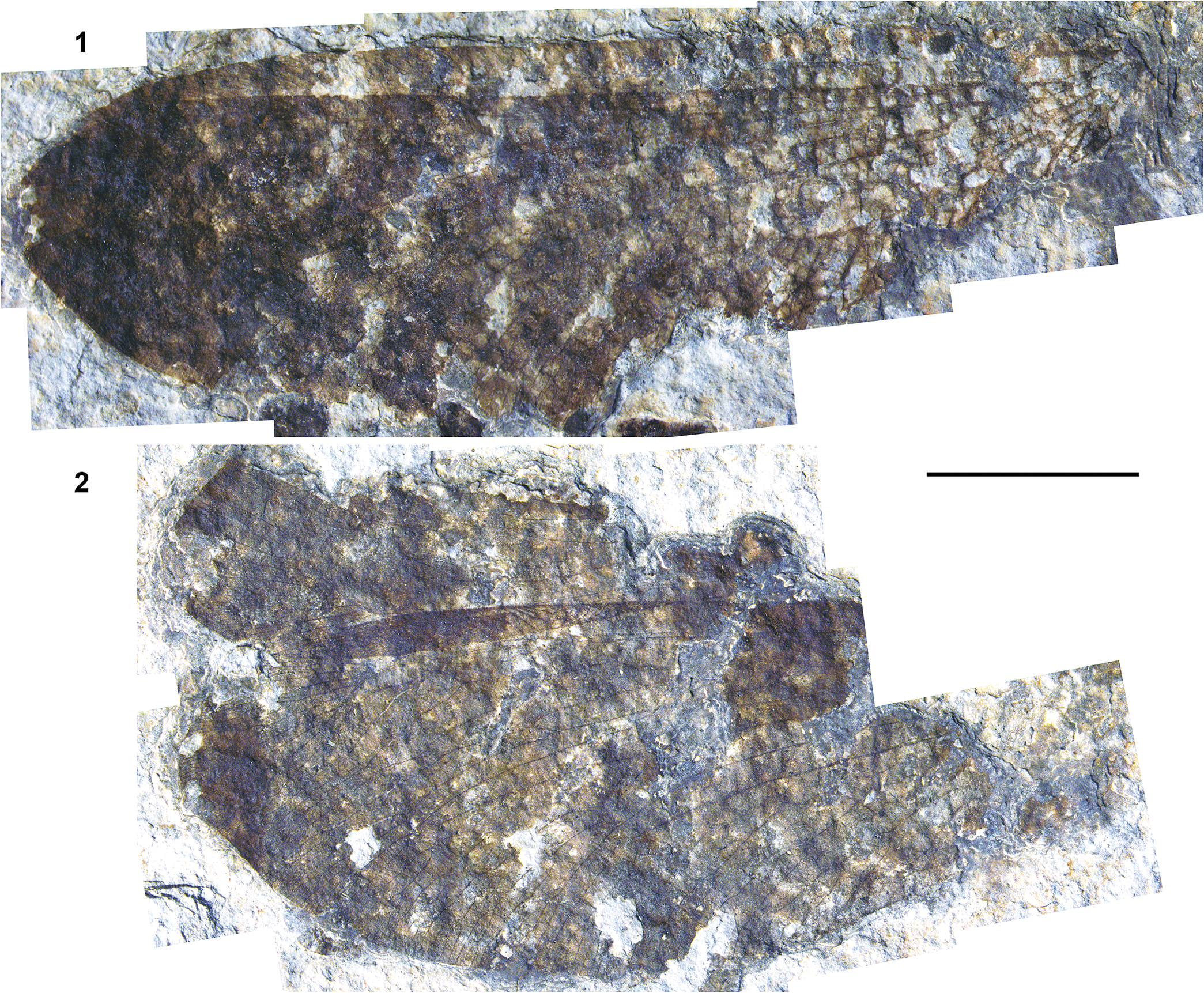
All wings most likely belong to the same specimen, although both forewings and both hind wings are preserved with their apex to the left; we assume that one of each has been folded over (Figs. 1, 2).
Protopalpares lindgrenae n. gen. n. sp., holotype FOBU 13564 as preserved before preparation. Scale bar = 10 mm.
Protopalpares lindgrenae n. gen. n. sp., holotype FOBU 13564 after preparation. (1) Both positioned as right wings. (2) Both positioned as left wings. Scale bar = 10 mm.
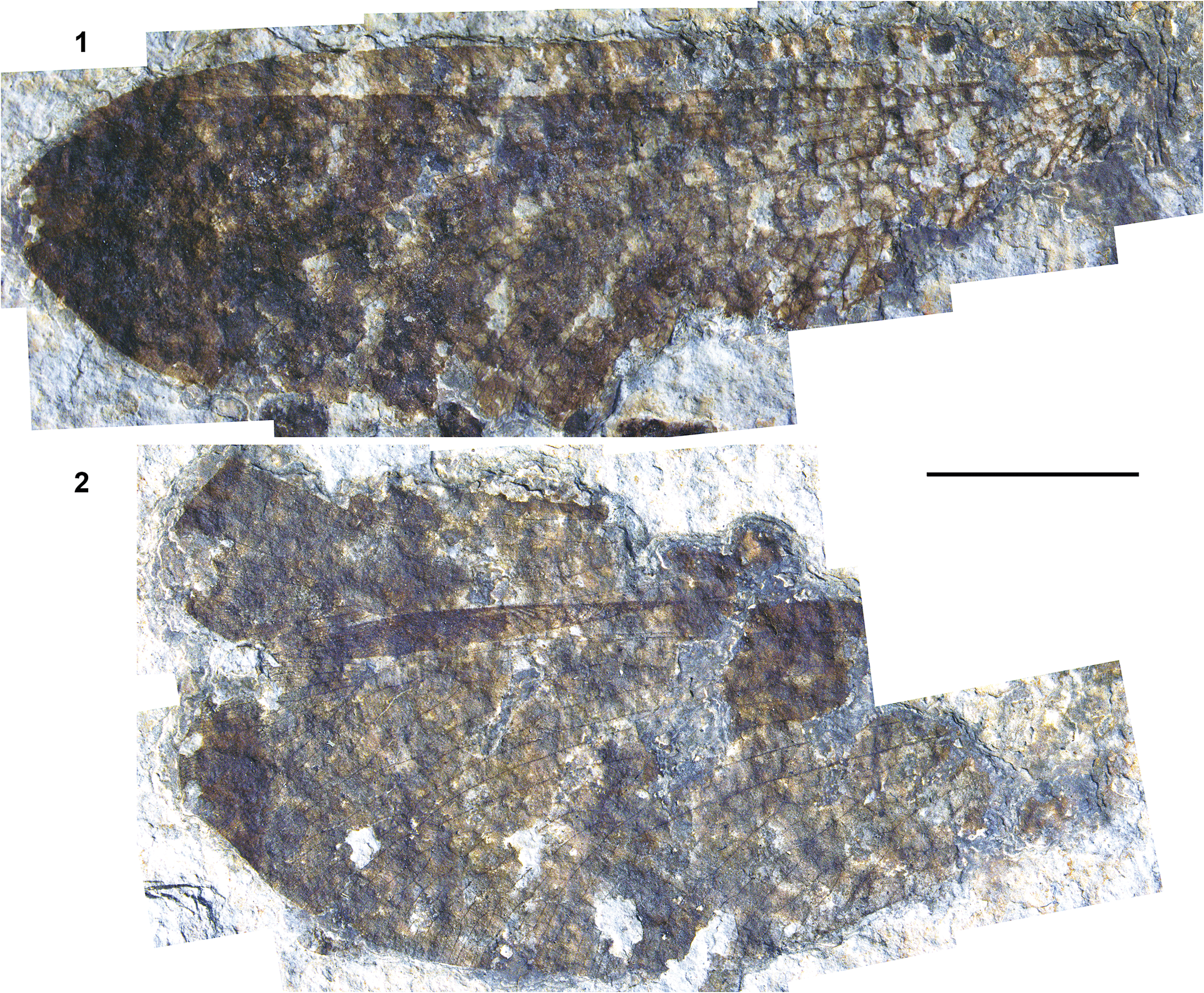
Figure 2. Long description
Panel 1, located at the top, shows a fossilized wing oriented as a right wing. The wing is elongated and dark brown with a complex network of venation. The proximal end is narrower and more fragmented, while the distal end is rounded and broader. The wing surface is mottled with lighter patches against the dark fossilized tissue.
Panel 2, located at the bottom, shows the fossilized wings oriented as left wings. This specimen appears more fragmented than the first, with two distinct sections of wing material visible. The venation is still apparent, showing a grid-like pattern of longitudinal and cross veins.
A black horizontal scale bar is positioned to the right of the panels, representing 10 mm. The background for both panels is a light gray, textured rock matrix with visible sediment grains.
Protopalpares lindgrenae new genus new species
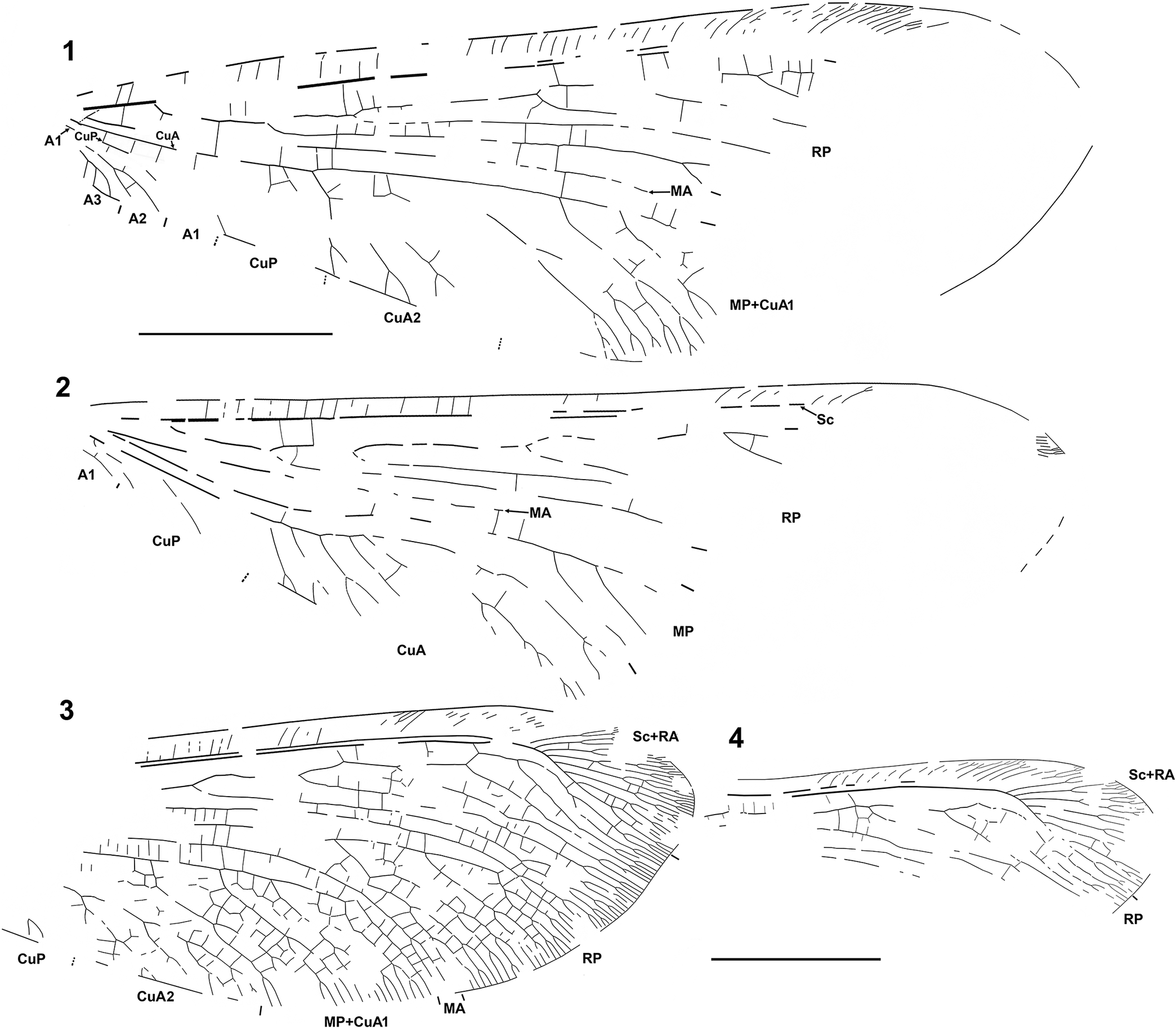
Wing venation of Protopalpares lindgrenae n. gen. n. sp., holotype FOBU 13564 (all shown in standard right view). (1) Conditionally right forewing. (2) Conditionally right hind wing. (3) Conditionally left forewing. (4) Conditionally left hind wing. A1–A3, first to third anal veins; CuA, anterior cubitus; CuP, posterior cubitus; MA, anterior media; MP, posterior media; RA, anterior radius; RP, posterior radius; Sc, subcosta. Scale bar = 10 mm.
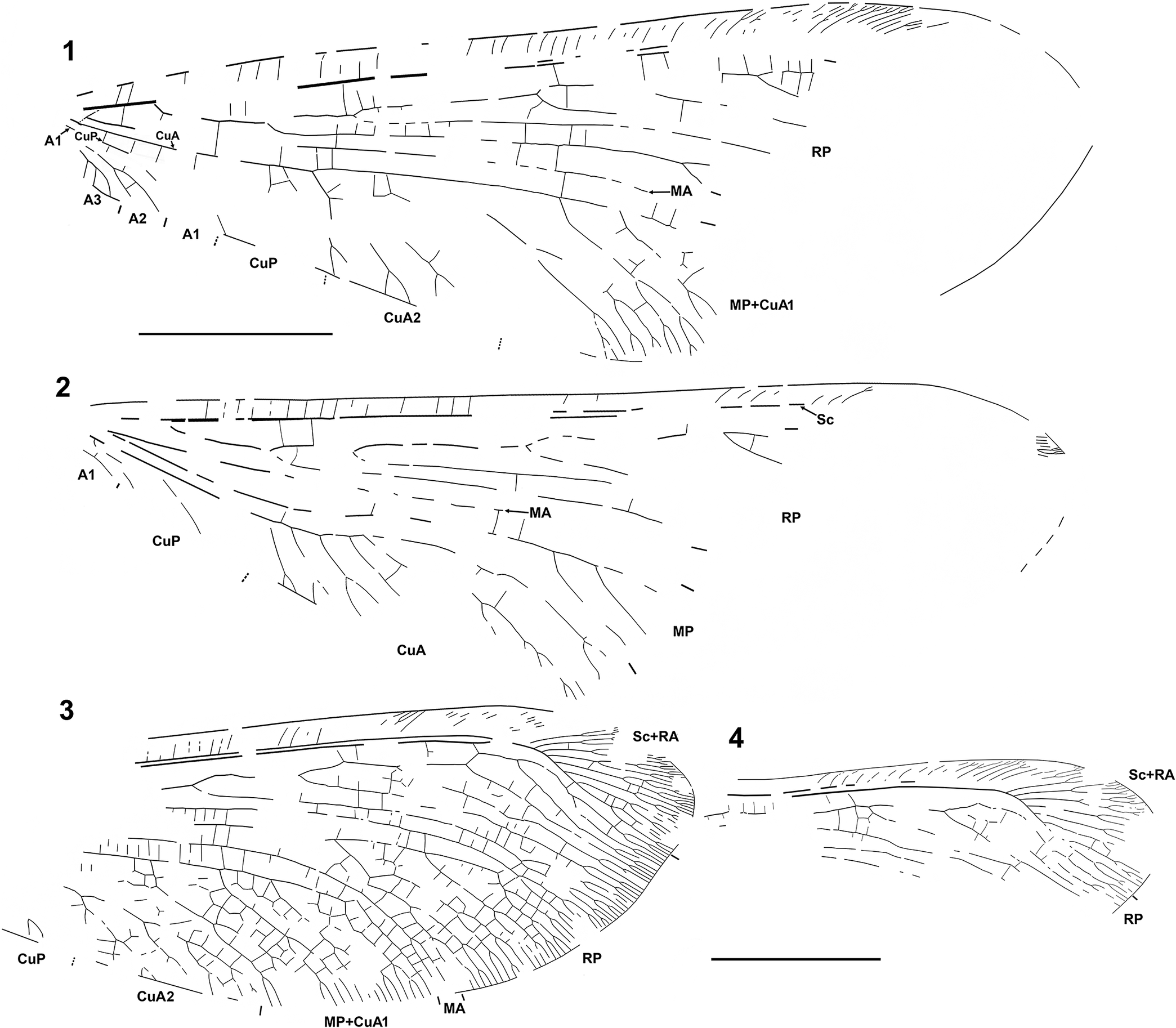
Figure 3. Long description
The four panels show the venation of the right forewing (1), right hind wing (2), left forewing (3), and left hind wing (4). A 10 mm scale bar is provided below panel 1 and panel 4.
* Panel 1 (Right Forewing): Shows a complex network of veins. At the proximal base, labels A 1, A 2, and A 3 identify the anal veins. Moving distally along the posterior edge are C u P, C u A 2, and M P plus C u A 1. The central area contains M A and R P, while the anterior margin shows the C u A and R A regions.
* Panel 2 (Right Hind Wing): Displays a more elongated shape. The anterior margin is marked by S c. The posterior margin includes A 1, C u P, C u A, and M P. The distal interior is dominated by the R P vein network.
* Panel 3 (Left Forewing): Features a dense, reticulated pattern of cross-veins. Labels along the posterior and distal margins include C u P, C u A 2, M P plus C u A 1, M A, and R P. The anterior distal corner is labeled S c plus R A.
* Panel 4 (Left Hind Wing): A partial view of the distal wing section. The anterior margin is labeled S c plus R A, and the distal branching network is labeled R P.
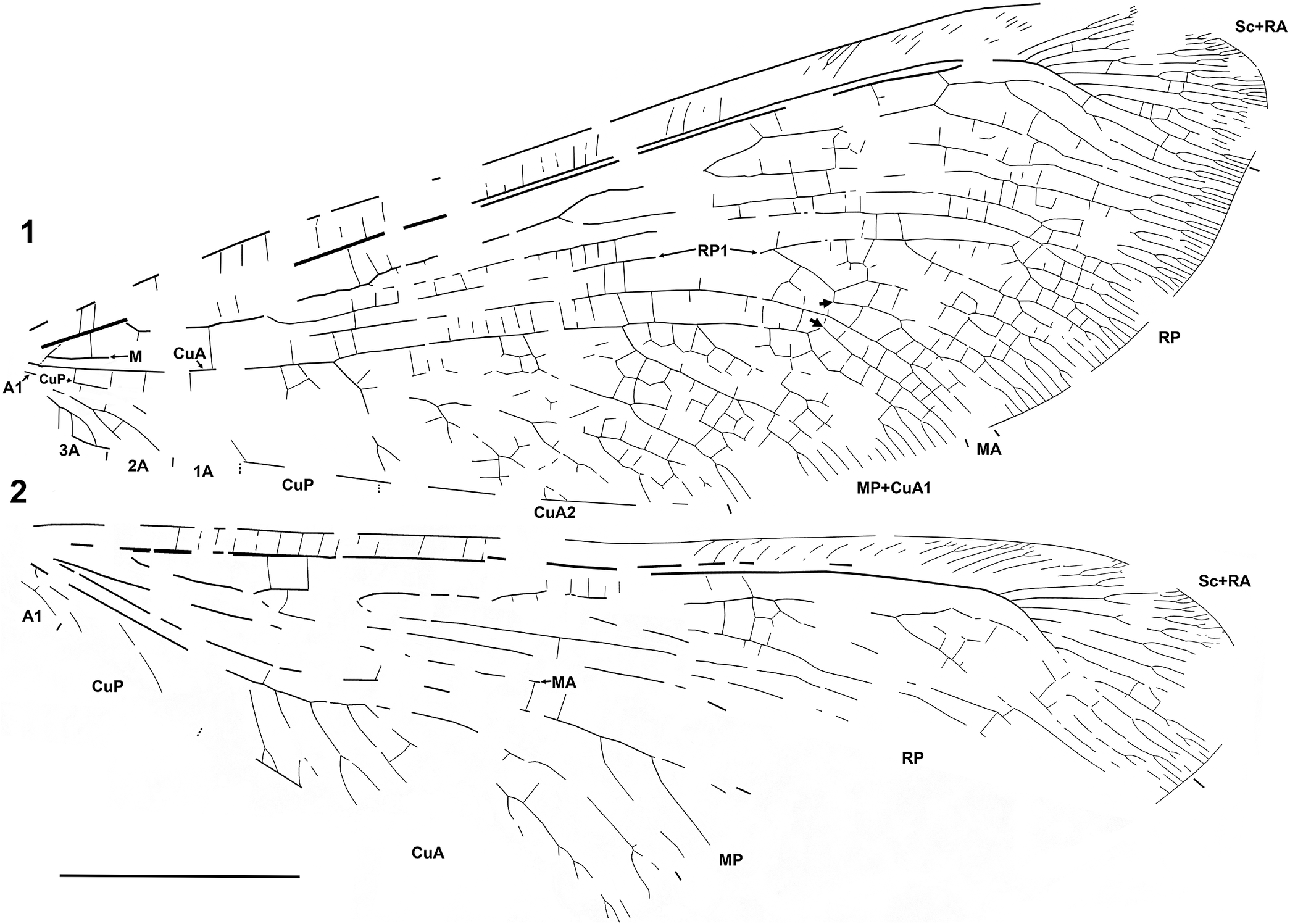
Preserved venation of Protopalpares lindgrenae n. gen. n. sp. based on all wings. (1) Forewing. (2) Hind wing. Thick arrows show the curvatures of the forewing RP1 (proximalmost branch of RP) and MP+CuA1. 1A–A3, first to third anal veins; M, media; other abbreviations as in Figure 3. Scale bar = 10 mm.
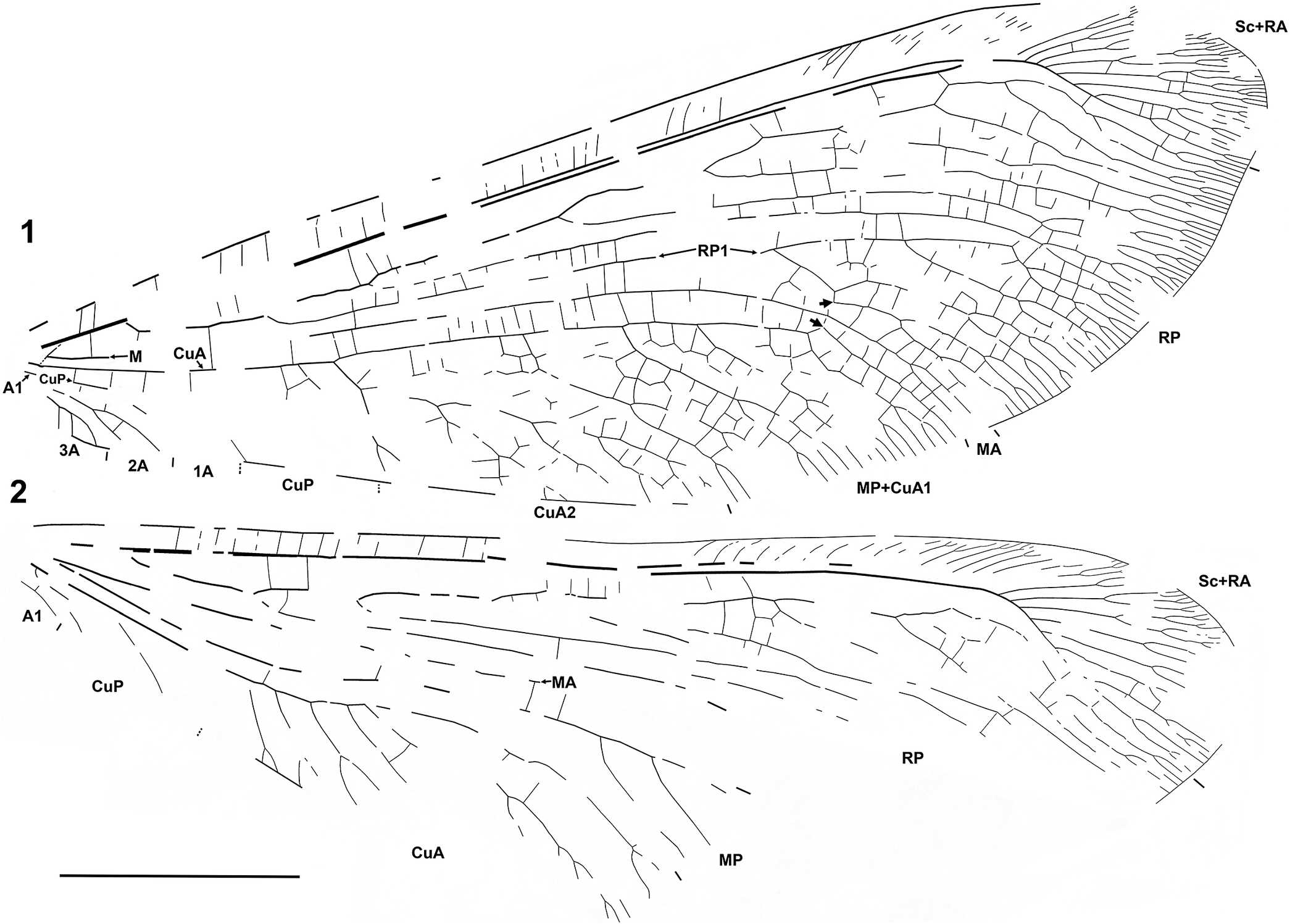
Figure 4. Long description
The drawing consists of two panels labeled 1 and 2. A 10 mm scale bar is located at the bottom left.
Panel 1 shows the forewing. At the proximal base on the left, labels include A 1, C u P, 3 A, 2 A, 1 A, and M. Moving distally toward the center, labels indicate C u A and C u A 2. The anterior margin at the top right is labeled S c plus R A. The distal area contains the R P network, with a specific branch labeled R P 1. Two thick black arrows in the center-right point to the downward curvatures of R P 1 and M P plus C u A 1. The posterior margin is labeled M A and M P plus C u A 1.
Panel 2 shows the hind wing. At the proximal base on the left, labels include A 1 and C u P. Moving toward the center, labels indicate C u A, M A, and M P. The anterior margin at the top right is labeled S c plus R A. The distal region is dominated by the R P branching network. The venation in the hind wing appears less dense than in the forewing.
Holotype
FOBU 13564, two isolated pairs of wings most likely belonging to the same specimen: one pair (positioned as right wings) is nearly complete but poorly preserved, especially distally; the other pair (positioned as left wings) are distal portions of wings in relatively good condition.
Diagnosis
Distinguished from other species of Palparinae by the following forewing character states: one presectorial crossvein (between R and M proximad the origin of RP) [more than one in other genera]; posterior branch of CuA (CuA2) long, with its anterior trace pectinately forked (shorter, often with its posterior trace pectinately forked in other genera); branches of MP+CuA1 widely spaced with crossveins between them connecting with numerous additional crossveins [see Materials and Methods: “Contrary character states of taxa compared in diagnoses are provided in brackets.” more closely spaced with no or few additional crossveins in other genera].
Occurrence
Ypresian, as above in locality information.
Description
Forewing ~ 52 mm long, 17.2 mm wide. Costal space relatively narrow, slightly dilated toward wing apex. Preserved subcostal veinlets simple proximally; some forked distally; rather closely spaced. Subcostal space very narrow. Sc, RA fused distally. Sc+RA terminated well posterior to wing apex; with long, dichotomously forked branches; several irregularly spaced crossveins detected between them. RA space narrow, with preserved crossveins rather densely spaced; hypostigmal cell long. RP originating near wing base, with eight branches. RP1 originating relatively close to origin of RP, deeply, profusely dichotomously forked; RP2, RP3 much less deeply dichotomously forked; other RP branches relatively shallowly forked one to three times. Discernible crossveins between RP branches very rarely connecting with other crossveins. One presectorial (between R, M before RP) and basal aligned oblique crossveins 1r-m and 1m-cu rather well discernible. Fork of M indiscernible. MA smoothly curved backward, distally forked once. Basal part of MP indiscernible. Cu forked very close to wing base (poorly preserved). CuA forked slightly distad origin of RP1. Anterior branch of CuA (CuA1) fused with MP; MP+CuA1 pectinately forked, with four widely spaced branches (three proximal ones dichotomously forked; distalmost forked twice); many crossveins between these branches connect with additional crossveins (as in extant Acanthaclinini). Proximal branch of CuA (CuA2) long, with four long branches (one deeply dichotomously forked; others forked once); crossveins between them connect with few other crossveins. CuP and A1 fragmentarily preserved; their fusion not preserved. A2 deeply forked once. A3 short, pectinately forked, with two simple branches.
Hind wing ~ 50 mm long, 16 mm wide as preserved (very slightly wider when complete). Costal space relatively narrow, dilated apically. Subcostal veinlets simple for most part; forked once in distal part; rather closely spaced. Subcostal space very narrow. Sc, RA probably fused distally (poorly preserved). Sc+RA terminating on margin well posterior to, beyond wing apex, with long, dichotomously forked veinlets; few crossveins detected between them. RA space with preserved crossveins rather dense. RP originating near wing base; anterior trace forked once distally, apparently with seven branches, all poorly and incompletely preserved except distal branch, which is forked once. RP1 originating relatively close to origin of RP. Crossveins between branches of RP poorly preserved; few preserved crossveins connecting by additional crossveins. No presectorial crossveins detected. M forked near wing base. MP long, its anterior trace slightly sinuous in proximal half; pectinately forked distally (two branches discernible); apical part poorly discernible. CuA long, its anterior trace slightly sinuous, with at least seven pectinate branches (one preserved branch dichotomously forked); few crossveins clearly discernible. CuP very poorly discernible. A1 incompletely preserved, connecting with CuP by relatively long crossvein.
Etymology
The specific epithet lindgrenae is a patronym formed from the surname of fossil preparator Elizabeth Lindgren, honoring her support and love of her husband Anthony Lindgren, who found the holotype and donated it to Fossil Butte National Monument.
Remarks
The holotype of the new species is rather poorly and fragmentarily preserved, and attempts to expose more of it were unsuccessful.
Subfamily and tribe affinities of the new genus
The venation of Protopalpares is generally similar to that of Palparinae. In Myrmeleontidae, the long and slightly sinuous CuA in the hind wing as found in this genus is present only in five genera of three tribes of Palparinae: Dimarini (Echthromyrmex, Dimares, and Millerleon), Palparidiini (Palparidius), and Pseudimarini (Pseudimares) (see Péringuey, Reference Péringuey1910, pl. 8, fig. 5; Kimmins, Reference Kimmins1933, pl. 6; Markl, Reference Markl1954, fig. 62; Stange, Reference Stange1989, figs. 6–10; 2010, fig. 1; Khrivokhatsky, 1998, fig. 6; Aspöck and Aspöck, Reference Aspöck and Aspöck2009, fig. 8; Tauber et al., Reference Tauber, Simmons and Tauber2019, fig. 89).
A similarly long, sinuous CuA in the hind wing is also characteristic of some Ascalaphinae (i.e., Stilbopterygini, Albardiini, and Ululodini, including one fossil species from the middle Eocene Kishenehn Formation, Montana, USA: Jepson and Makarkin, Reference Jepson and Makarkin2023), and all Palaeoleontidae (see e.g., Ponomarenko, Reference Ponomarenko1992, fig. 5; Heads et al., Reference Heads, Martill and Loveridge2005, fig. 1; Shi et al., Reference Shi, Béthoux, Shih and Ren2012, figs. 2E, F). However, in all ascalaphines, RP originates far from the wing base, there is a short, dark pterostigma (with all pterostigmal veinlets simple), and Sc+RA curves immediately after the fusion of Sc and RA and runs in a straight line. In Protopalpares, these characters are different. In all Palaeoleontidae, RP originates very close to the wing base and presectorial crossveins are absent.
This form of hind wing CuA is probably plesimorphic. We did, however, find a character state of Protopalpares venation that we consider apomorphic. The forewing posterior branch of RP1 and the stem of MP+CuA1 curve toward each other and are connected by two aligned crossveins where they are closest (Fig. 4). This character state is similar to that in most extant Palparinae of three tribes: Palparidini (e.g., Palparidius capicola Péringuey, Reference Péringuey1910); Palparini (e.g., Palpares hispanus Koçak, Reference Koçak1976; Pamares damarus Mansell, Reference Mansell1990); and Dimarini—e.g., Dimares elegans (Perty, Reference Perty1833 [1830–1834]), Echthromyrmex orientalis McLachlan, Reference McLachlan1873—(Mansell, Reference Mansell1990, fig. 43; Krivokhatsky, Reference Krivokhatsky1998, fig. 6; Stange, Reference Stange2010, fig. 1; Khabiev and Krivokhatsky, Reference Khabiev and Krivokhatsky2014, fig. 6; Tauber et al., Reference Tauber, Simmons and Tauber2019, fig. 89). There are no such curvatures in other Myrmeleontidae s.l. (including Cretaceous taxa), and we consider this to be a synapomorphy of Palparinae.
Thus, it is certain that Protopalpares belongs to Palparinae, but what tribe it belongs to remains unresolved due to the incomplete preservation of the specimen. The new genus definitely does not belong to Palparini, in which the hind wing CuA is strongly curved at its junction with the posterior branch of M (e.g., Mansell, Reference Mansell1990, fig. 43; Reference Mansell1992, figs. 1–5; 2018, figs. 2, 3; Krivokhatsky, Reference Krivokhatsky1998, fig. 4; Michel, Reference Michel1999, figs. 13, 14; Hassan et al., Reference Hassan, Akhtar, Zheng and Liu2023, figs. 1, 2, 6, 9, 12, 13).
All three tribes with a long and slightly sinuous CuA in the hind wing (Dimarini, Palparidiini, and Pseudimarini) have rather similar venation. However, the configuration of the forewing CuA (see below) and the presence of numerous crossveins connecting crossveins in the MP+CuA1 space of Protopalpares indicate that this genus might not belong to any of these tribes.
Palparinae and Palaeonleontidae
The myrmeleontid subfamily Palparinae is clearly similar to Palaeonleontidae by wing shape, size, and venation. The wings of all other Cretaceous myrmeleontoids have less dense venation (sometimes much less). Nine genera (15 species) of Palaeonleontidae are known from the Barremian/Aptian of Baissa (Russia: Transbaikalia) and Yixian Formation (China); the late Aptian Crato Formation (Brazil); the Albian/Cenomanian of Redmond (Canada); the Turonian of the Ora Formation (Israel); and the Coniacian of Antibes (Russia: southern Siberia) (Rice, Reference Rice1969; Makarkin, Reference Makarkin and Akimov1990; Martins-Neto, Reference Martins-Neto1992, Reference Martins-Neto1997, Reference Martins-Neto1998; Ponomarenko, Reference Ponomarenko1992; Dobruskina et al., Reference Dobruskina, Ponomarenko and Rasnitsyn1997; Martins-Neto and Vulcano, Reference Martins-Neto and Vulcano1997; Heads et al., Reference Heads, Martill and Loveridge2005; Menon and Makarkin, Reference Menon and Makarkin2008; Martins-Neto and Rodrigues, Reference Martins-Neto and Rodrigues2010; Millet and Nel, Reference Millet and Nel2010; Shi et al., Reference Shi, Béthoux, Shih and Ren2012; Myskowiak and Nel, Reference Myskowiak and Nel2016).
Palaeonleontidae is usually treated as a family (e.g., Dobruskina et al., Reference Dobruskina, Ponomarenko and Rasnitsyn1997; Heads et al., Reference Heads, Martill and Loveridge2005; Menon and Makarkin, Reference Menon and Makarkin2008; Michel et al., Reference Michel, Clamens, Béthoux, Kergoat and Condamine2017; Lu et al., Reference Lu, Wang and Liu2021, Reference Lu, Xu and Liu2022; Bueno et al., 2025a, b) and rarely as a primitive subfamily of Myrmeleontidae (e.g., Martins-Neto, Reference Martins-Neto1997; Stange, Reference Stange2004; Ren and Engel, Reference Ren and Engel2008; Machado et al., Reference Machado, Gillung, Winterton, Garzón‐Orduña, Lemmon, Lemmon and Oswald2019). The venation of its oldest (Early Cretaceous) genera (e.g., Baisopardus Ponomarenko, Reference Ponomarenko1992; Parapalaeoleon Menon and Makarkin, Reference Menon and Makarkin2008; Guyiling Shi et al., Reference Shi, Béthoux, Shih and Ren2012) are more similar to Palparinae than to the youngest (Late Cretaceous) genera (Metahemerobius Makarkin, Reference Makarkin and Akimov1990; Samsonileon Ponomarenko in Dobruskina et al., Reference Dobruskina, Ponomarenko and Rasnitsyn1997), which are clearly more derived (see Makarkin, Reference Makarkin and Akimov1990, fig. 5; Dobruskina et al., Reference Dobruskina, Ponomarenko and Rasnitsyn1997, fig. 4).
The genus Guyiling was described as Myrmeleontiformia insertae sedis (Shi et al., Reference Shi, Béthoux, Shih and Ren2012) but was later classified as belonging to the Palaeonlentidae (e.g., Myskowiak and Nel, Reference Myskowiak and Nel2016; Lu et al., Reference Lu, Wang and Liu2021, Reference Lu, Xu and Liu2022). We agree with this assignment, because the only species of this genus has venation similar to that of other members of the family, especially to Parapalaeoleon, although its antennae are slightly dilated distally.
In addition to the general similarity of venation in these groups, A1 and CuP are separated along their entire length in both Palaeonleontidae and most Palparinae (except Dimarini) (a plesiomorphic character state). In other extant Myrmeleontidae, CuP is short and ends in a fusion with A1; all Cretaceous taxa of antlions also have this plesiomorphic state.
Within the Palparinae, the venation of Protopalpares is most similar to that of the Early Cretaceous genera of Palaeonleontidae (cf. Figs. 4, 5). First, the forewing configuration of CuA2 as found in the new genus is similar to that of most Palaeonleontidae, being clearly pectinate (see e.g., Menon and Makarkin, Reference Menon and Makarkin2008, fig. 4B; Martins-Neto and Rodrigues, Reference Martins-Neto and Rodrigues2010, fig. 3A; Shi et al., Reference Shi, Béthoux, Shih and Ren2012, fig. 2C, D). In other Palparinae, the forewing CuA2 is never so long and clearly pectinate.
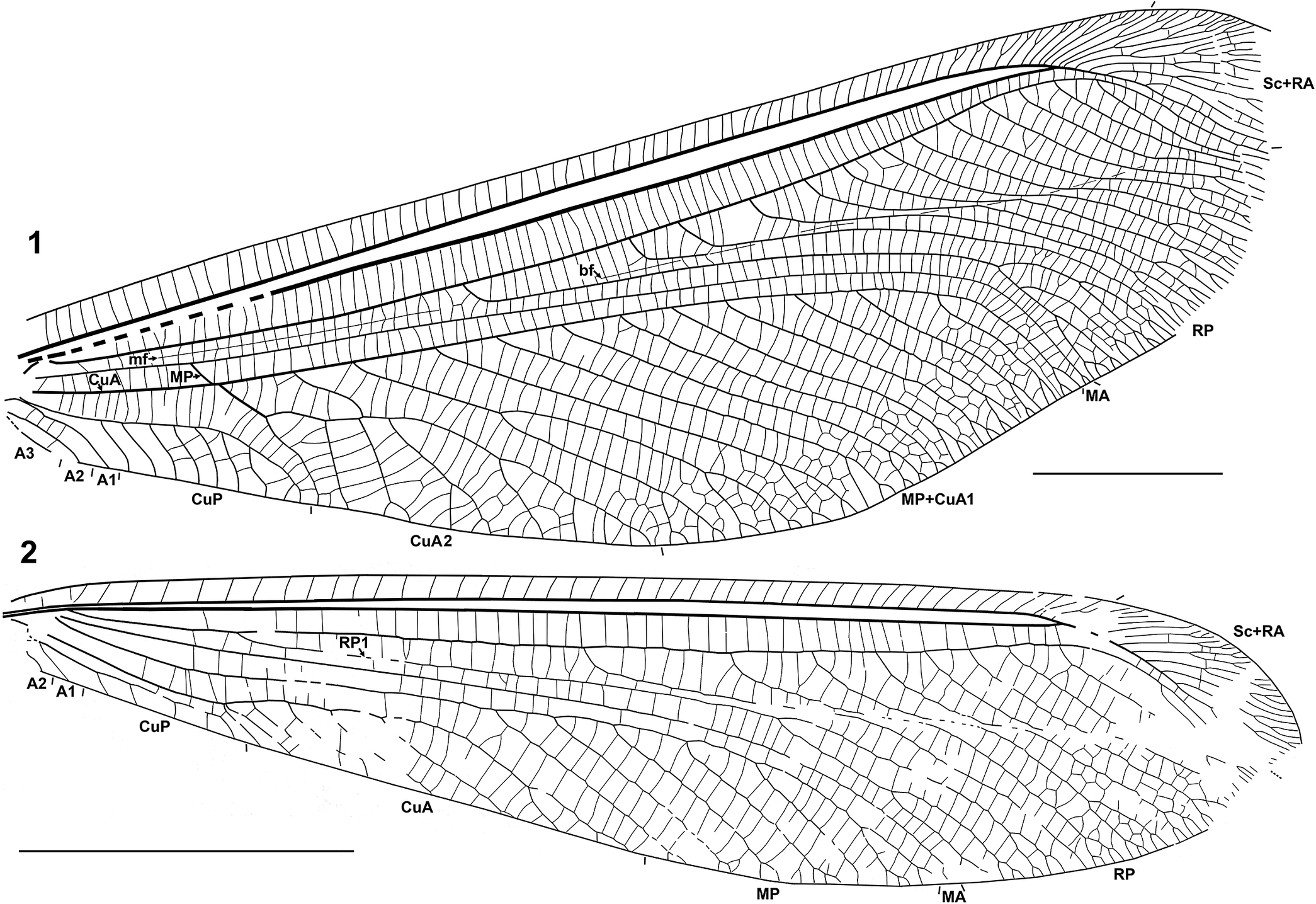
Well-preserved wings of the Early Cretaceous Palaeoleontidae. (1) Forewing of Parapalaeoleon magnus Menon and Makarkin, Reference Menon and Makarkin2008 (holotype SMNS 66000/268) from the Crato Formation, Brazil (redrawn from Menon and Makarkin, Reference Menon and Makarkin2008, with insufficient changes based on photographs). (2) Hind wing of Baisopardus banksianus Ponomarenko, Reference Ponomarenko1992 (holotype PIN 1989/51) from Baissa, Transbaikalian Russia (original drawing based on photographs by A. Khramov). bf, anterior Banksian flexion fold/line; mf, medial (radiomedial) flexion fold/line; other abbreviations as in Figure 3. Scale bars = 10 mm.
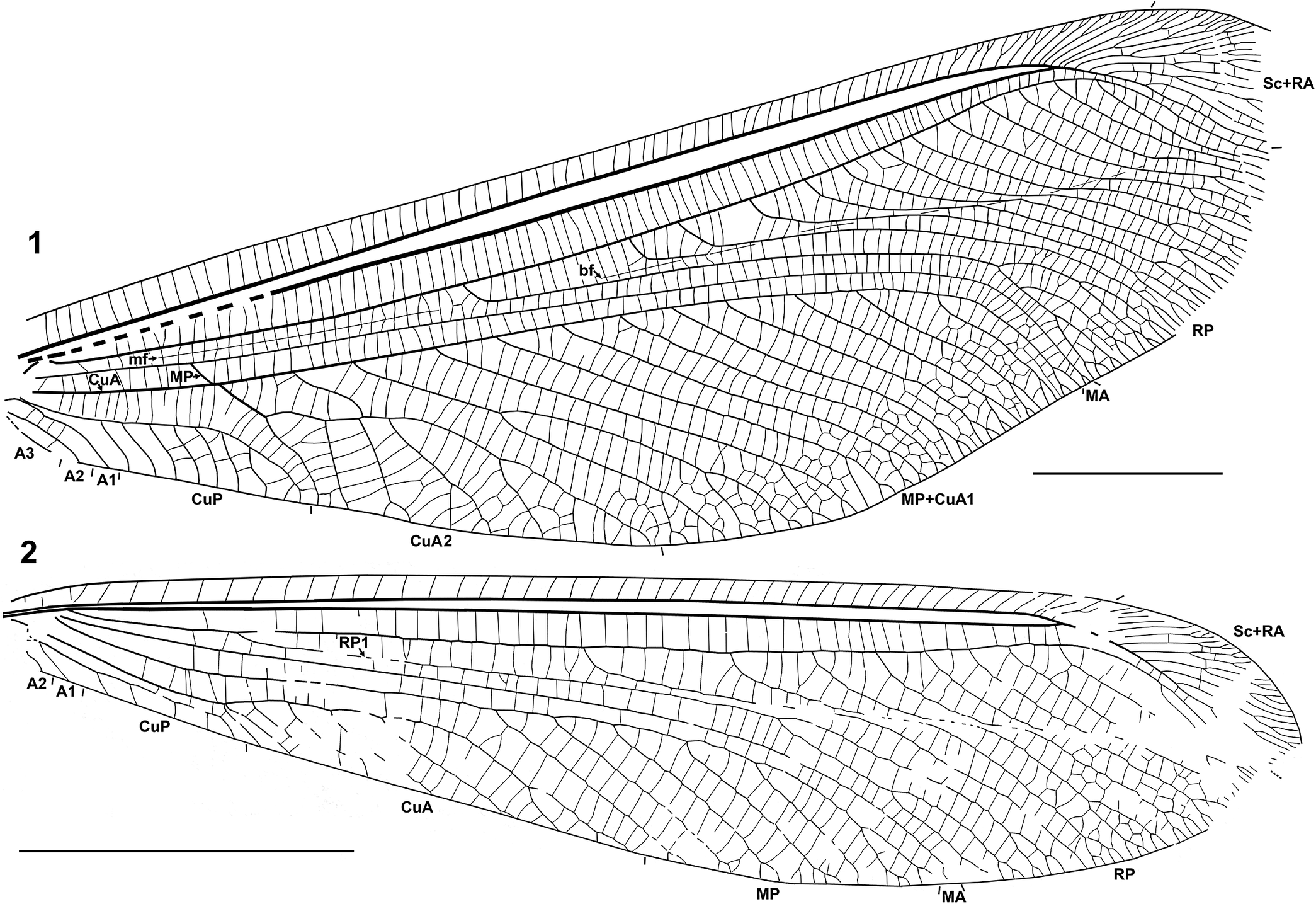
Figure 5. Long description
The two-panel illustration displays detailed wing venation.
Panel 1 shows the forewing of Parapalaeoleon magnus. At the proximal base on the left, labels A 3, A 2, and A 1 mark the anal veins. Moving along the posterior margin toward the right, labels include C u P, C u A 2, and M P plus C u A 1. The distal tip is labeled R P and S c plus R A. In the central-proximal region, small arrows point to m f (medial flexion line) and b f (anterior Banksian flexion line). The wing is characterized by a dense network of cross-veins forming a mesh-like pattern. A 10 mm scale bar is located at the bottom right.
Panel 2 shows the hind wing of Baisopardus banksianus. Similar to the first panel, the proximal base on the left is labeled with A 2, A 1, and C u P. Along the posterior margin, labels move from C u A to M P, M A, and R P at the distal end. The anterior margin terminates at S c plus R A. A specific vein in the upper-middle section is labeled R P 1. The venation in this wing appears slightly more elongated than in the forewing. A 10 mm scale bar is positioned at the bottom left.
However, it is unclear yet if this condition is plesiomorphic or apomorphic in Myrmeleontoidea. In all Cretaceous genera of Araripeneuridae (including the oldest), CuA2 is deeply bifurcate and rarely shallowly forked (see e.g., Makarkin et al., Reference Makarkin, Wedmann and Heads2018, figs. 2, 4, 5; Bueno et al., Reference Bueno, Machado, Almeida-Silva and Ribeiro2026, fig. 1). But in a few Cretaceous genera of unclear subfamily position, CuA2 is clearly pectinate, e.g., Blittersdorffia Martins-Neto and Vulcano, Reference Martins-Neto and Vulcano1989 from the late Aptian Crato Formation, and Babinoleon Lu et al., Reference Lu, Wang, Zhuo and Liu2026 from mid-Cretacious Kachin amber (Bueno et al., Reference Bueno, Machado, Martins and Ribeiro2025b, figs. 14, 15; Lu et al., Reference Lu, Wang, Zhuo and Liu2026, fig. 2). In some extant and Cenozoic Ascalaphinae (especially Stilbopterygini) and other Myrmeleontidae (including Epignopholeon sophiae from the Green River Formation), CuA2 is also clearly pectinate (see e.g., Kimmins, Reference Kimmins1940, fig. 3; Makarkin, Reference Makarkin2017, figs. 5A, B; designated as CuA1).
Secondly, RP originates more proximally in Protopalpares than in other Palparinae, with only one presectrial crossvein (between R and M proximad the origin of RP).
In general, the venation of Palaeonleontidae differs from that of Myrmeleontidae s. str. (without the vast majority of Cretaceous genera) only by RP originating very close to the wing base, leaving no room for presectrial crossveins; by the absence of a long hypostigmal cell (between RA and RP below the pterostigmal area); and the presence of a medial flexion fold/line.
All of these character states are plesiomorphic. The origin of RP very close to the wing base is never found in other Myrmeleontidae s.l. (i.e., including all Cretaceous taxa), but is shared with Nymphidae, the only group of Myrmeleontoidea known in the Jurassic. Also, in the Myrmeleontoidea, the medial flexion fold/line occurs only in Palaeonleontidae (see Fig. 5.1; Menon and Makarkin, Reference Menon and Makarkin2008); it is not detected even in Nymphidae. But in other Neuroptera, this is detected in the basal Jurassic Kalligrammatidae and Parakseneuridae, and in the Hemerobiidae (Yang et al., Reference Yang, Makarkin, Winterton, Khramov and Ren2012, fig. 13; Makarkin and Perkovsky, Reference Makarkin and Perkovsky2020, fig. 2A).
All extant and Cenozoic taxa of Myrmeleontidae (including the new genus) have presectrial crossveins. The absence of these crossveins is characteristic of the vast majority of Cretaceous taxa, including all Palaeonleontidae and most Araripeneuridae.
A long hypostigmatic cell is characteristic of Myrmeleontidae s.l., i.e., including Araripeneurinae (Stange, Reference Stange2004), but also Nymphidae, some Nemopteridae, and Mesochrysopidae. Its absence occurs not only in Palaeonleontidae, but also in Ascalaphinae, most Mesochrysopidae, and some Nemopteridae. We assume that this characteristic is of little significance.
The anterior Banksian flexion fold/line is absent in Palparinae, but present in most Palaeoleontidae, with the exception of the Coniacian Metahemerobius kalligrammus Makarkin, Reference Makarkin and Akimov1990, the Aptian Araripeleon alphonsei Millet and Nel, Reference Millet and Nel2010, and an undescribed species from the Crato Formation (unpublished data, Makarkin, 2018). In other Myrmeleontidae this fold is often present (e.g., Zheng et al., Reference Zheng, Badano, Aspöck, Aspöck, Hayashi and Liu2025, fig. 12A).
The discovery of Protopalpares supports Palparinae as more similar to Palaeonleontidae. Given this, should Palaeonleontidae be considered a subfamily of Myrmeleontidae?
Palaeonleontidae species do not have diagnostic features of Myrmeleontidae, even considering Myrmeleontidae s.l. (i.e., with Cretaceous taxa and including Ascalaphidae). Unfortunately, recent studies of the phylogenetic relationships within Myrmeleontoidea based on molecular data usually do not recognize synaphomorphies or other morphological characteristics of Myrmeleontidae (e.g., Haring and Aspöck, Reference Haring and Aspöck2004; Winterton et al., Reference Winterton, Hardy and Wiegmann2010, Reference Winterton, Lemmon, Gillung, Garzon and Badano2018; Wang et al., Reference Wang, Liu, Garzón-Orduña, Winterton, Yan, Aspöck, Aspöck and Yang2017; Machado et al., Reference Machado, Gillung, Winterton, Garzón‐Orduña, Lemmon, Lemmon and Oswald2019; Vasilikopoulos et al., Reference Vasilikopoulos, Misof, Meusemann, Lieberz and Flouri2020).
Lu et al. (Reference Lu, Wang, Zhuo and Liu2026) stated that the monophyly of Myrmeleontidae s.l. (i.e., including Ascalaphidae) is supported by: (1) antennae strongly dilated distally; (2) RP originating distad the wing base, and (3) elongated tibial spurs. Previously, Stange (Reference Stange1994) identified as synapomophies of Myrmeleontidae s.l.: (4) the presence of the pilula axillaris (‘Eltringham’s organ’: a projection at the base of hind wings in males) as an autapomorphy of Myrmeleontidae (including Stilbopteryginae); and (5) the absence of the basal subcostal crossvein in both wings.
Palaeonleontidae does not conform to any of (1–4) and possibly (5): (1) the antennae are not dilated distally (except in Guyiling, in which they are slightly dilated); (2) RP originates very close to the wing base; (3) tibial spurs are relatively short and straight in the Cretaceous Parapalaeoleon magnus Menon and Makarkin, Reference Menon and Makarkin2008 and Guyiling jianboni Shi et al., Reference Shi, Béthoux, Shih and Ren2012 (Menon and Makarkin, Reference Menon and Makarkin2008, fig. 4A; Shi et al., Reference Shi, Béthoux, Shih and Ren2012, fig. 2B). These are quite similar to those of Ascalaphinae (see e.g., Tjeder, Reference Tjeder1992, fig. 32). In most extant Myrmeleontidae, the spurs are longer and usually curved (see e.g., Vshivkova and Makarkin, Reference Vshivkova, Makarkin, Devetak, Lipovšek and Arnett2010, fig. 40). Such spurs were also detected in the mid-Cretaceous Babinoleon jinmingae Lu et al., Reference Lu, Wang, Zhuo and Liu2026; Nanoleon wangae Hu, Lu, and Liu in Lu et al., Reference Lu, Hu, Wang, Zhang, Ohl and Liu2019; Xiaoleon amoena Lu and Liu, Reference Lu and Liu2022 (Lu and Liu, Reference Lu, Xu and Liu2022, fig. 1C; Lu et al., Reference Lu, Hu, Wang, Zhang, Ohl and Liu2019; fig. 9B; 2026, fig. 1D). Thus, the shape of the tibial spurs in Palaeoleontidae is more plesiomorphic than in most Myrmeleontidae. Their presence is generally normal in all Neuroptera, but are usually short. (4) A pilula axillaris is not detected; and (5) the absence of the basal subcostal crossvein is difficult to establish with certainty due to preservation, but numerous subcostal crossveins are present at least in Metahemerobius (Makarkin, Reference Makarkin and Akimov1990, fig. 5).
There are other character states considered diagnostic by Aspöck et al. (Reference Aspöck, Plant and Nemeschkal2001), Zimmermann et al. (Reference Zimmermann, Randolf, Metscher and Aspock2011), and Randolf et al. (Reference Randolf, Zimmermann and Aspöck2014), but these are difficult identify in fossils. For example, tergite 9 divided ventrolaterally, closed anterior tentorial pits, and the anterior tentorial arms as flat tubes were considered by these authors to be synapomorphies of Myrmeleontidae+Ascalaphidae.
Therefore, we agree that the genera of Palaeonleontidae constitute a distinct family, although they do not possess any known synapomorphies. However, judging by their strong similarity to Palparinae, it can be assumed that Palparinae had a close relationship with Early Cretaceous Palaeonleontidae.
Conclusions
The discovery of the first fossil Palparinae is important because its venation is most similar to that of the Early Cretaceous Palaeonleontidae, indicating that they are likely closely related. The presence of two genera belonging to completely different lineages of Myrmeleontidae (Epignopholeon Makarkin, Reference Makarkin2017 and Protopalpares, of Myrmeleontinae and Palparinae, respectively) in the early Eocene Green River Formation supports the idea that the family diversified deep in the Cretaceous (e.g., Hevin et al., Reference Hévin, Kergoat, Clamens, Le Ru, Mansell and Bruno2023).
Acknowledgments
We thank A. Lindgren who found the fossil for donating it to FOBU; A. Aase (FOBU) for alerting us to this specimen, loaning it to us, and helpful discussion; and A.V. Khramov (Paleontological Institute, Moscow) for photographs of Baisopardus banksianus. Research of SBA was funded in part by Natural Sciences and Engineering Grant 2020-05026 to R. Mathewes (Simon Fraser University, Burnaby, Canada). The research of VNM was carried out within the framework of the state assignment of Ministry of Science and Higher Education of the Russian Federation (theme No. 124012400285-7).
Competing interests
The authors declare none.

 Open access

