Working memory (WM) impairment has been a central focus of clinical cognitive neuroscience research in schizophrenia for over two decades. Interest in this area has been driven by the important role that WM is thought to play in many forms of complex cognition (Baddeley, Reference Baddeley2012; Luck and Vogel, Reference Luck and Vogel2013). Maintaining representations in an activated, easily accessible state is needed for a broad range of cognitive tasks such as reasoning and language comprehension (Engle et al., Reference Engle, Tuholski, Laughlin and Conway1999; Unsworth et al., Reference Unsworth, Redick, Heitz, Broadway and Engle2009). Thus, an impairment of WM is a plausible candidate mechanism for the broad cognitive impairment observed in people with schizophrenia (PSZ). This theoretical possibility has received empirical support: individual differences in WM capacity are highly correlated with general measures of cognitive performance in PSZ, as they are in healthy populations (Johnson et al., Reference Johnson, McMahon, Robinson, Harvey, Hahn, Leonard, Luck and Gold2013).
WM performance is commonly quantified in two different ways in the literature: storage capacity and precision. Studies of storage capacity using paradigms such as the N-Back and Complex Span tasks have shown reduced accuracy in patients as WM load increases (Callicott et al., Reference Callicott, Bertolino, Mattay, Langheim, Duyn, Coppola and Weinberger2000; Perlstein et al., Reference Perlstein, Carter, Noll and Cohen2001; Gold et al., Reference Gold, Barch, Feuerstahler, Carter, MacDonald, Ragland, Silverstein, Strauss and Luck2018). It is straightforward to imagine how reductions in the amount of information that can be maintained would impact other cognitive functions that require the use multiple activated representations. Other studies have assessed the precision of WM representations, primarily using spatial WM tasks, and have reported that PSZ have less precise representations (Badcock et al., Reference Badcock, Badcock, Read and Jablensky2008; Starc et al., Reference Starc, Murray, Santamauro, Savic, Diehl, Cho, Srihari, Morgan, Krystal, Wang, Repovs and Anticevic2017). Again, it is easy to imagine how ‘noisy’ representations could negatively impact cognitive functions that rely on WM.
The present study asks a somewhat different question about WM: when an item is successfully maintained in WM for one task, how does this impact other ongoing cognitive activity? For example, if you are cooking from a recipe, how does maintaining the needed amount of an ingredient in WM impact your ability to search for the spoon you need to measure this ingredient? That is, we focused on the interaction between the WM system and other cognitive systems, a different issue than addressed by measures of WM capacity or precision. However, this issue may be particularly informative about the consequences of WM impairment for the operation of other cognitive systems. For example, if an item is maintained in WM with greater intensity in PSZ than in HCS (Leonard et al., Reference Leonard, Kaiser, Robinson, Kappenman, Hahn, Gold and Luck2013; Hahn et al., Reference Hahn, Harvey, Gold, Ross and Stein2017, Reference Hahn, Robinson, Leonard, Luck and Gold2018), this item may cause more interference with other ongoing cognitive processes. Similarly, if maintaining an item in WM leaves less remaining capacity available in PSZ than in HCS, this could also slow the processing of other information.
The effects of WM encoding/maintenance on subsequent processing has previously been addressed using Attentional Blink paradigms. In the Attentional Blink, subjects are shown a very rapid series of visual stimuli at fixation (typically 100 ms per stimulus with no gap between successive stimuli) and are asked to report one or two target stimuli out of the series. In many experiments, the targets are letters that are presented amidst a stream of numeric stimuli. People show reduced accuracy for reporting the second target if it closely follows the first target (within 200–500 ms) (Dux and Marois, Reference Dux and Marois2009). It is thought that processing of the second target is impaired if it appears while attention is still focused on the first target. Thus, the processing of the first target produces a brief ‘blink’ of attention that compromises the ability to detect the second target. This blink is reliably increased in magnitude and/or prolonged in PSZ, suggesting greater interference between focusing attention and WM encoding processes on the first target and the second target (Cheung et al., Reference Cheung, Chen, Chen, Woo and Yee2002; Mathis et al., Reference Mathis, Wynn, Breitmeyer, Nuechterlein and Green2011; Jimenez et al., Reference Jimenez, Lee, Wynn, Cohen, Engel, Glahn, Nuechterlein, Reavis and Green2016). However, the interpretation of this effect is not straightforward because PSZ performed at lower levels of baseline accuracy in these studies, which makes it difficult to compare the magnitude of the AB across groups (see Su et al., Reference Su, Wyble, Zhou, Wang, Wang, Cheung, Bowman and Chan2015). Thus, while impaired performance in AB tasks are robust in PSZ, the nature of the impairment remains unclear.
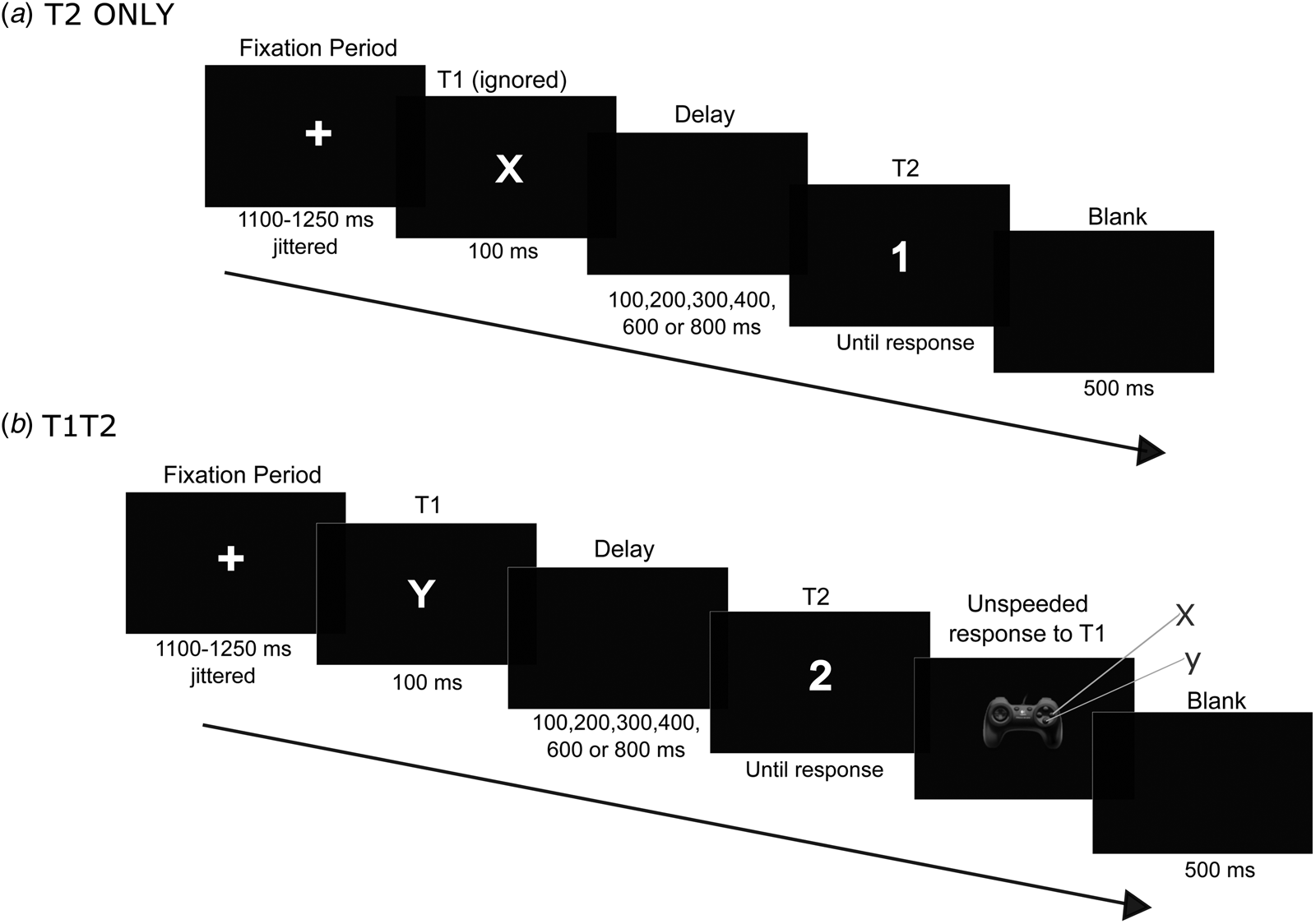
Our paradigm (see Fig. 1) is designed to avoid the challenges arising from different baseline accuracy rates by using response time (RT) measures to examine the consequences of holding an item in WM. Two target stimuli are presented on each trial, a letter (X or Y) followed after a delay by a number (1 or 2). In one trial block, the subject is instructed to ignore the first target (T1) and just make a speeded response to the second target (T2). We refer to this as the T2-only condition. In another trial block, subjects are asked to store T1 in WM and make a speeded button press to T2. After making the speeded response to T2, the subject is asked to report the remembered identity of T1. We refer to this as the T1T2 condition. The RT for T2 should be increased in the T1T2 condition relative to the T2-only condition to the extent that maintaining T1 in WM interferes with the processing of T2. ERP, fMRI, and eye tracking studies from our group suggest that PSZ represent a single item in WM more intensely than do controls (Leonard et al., Reference Leonard, Kaiser, Robinson, Kappenman, Hahn, Gold and Luck2013; Luck et al., Reference Luck, McClenon, Beck, Hollingworth, Leonard, Hahn, Robinson and Gold2014; Hahn et al., Reference Hahn, Harvey, Gold, Ross and Stein2017, Reference Hahn, Robinson, Leonard, Luck and Gold2018). Thus, we predicted that the cost of holding a single item in WM would be greater in PSZ than in HCS, as assessed by examining slowing of T2 processing. At short T1-T2 delays, such an effect could reflect interference caused by T1 encoding, but at long delays this effect would reflect interference caused by the maintenance of T1 in WM.
Schematic illustration of the two experimental conditions. (a). shows the T2 only condition where the T1 letter is ignored, and the subjects makes a speeded response to the T2 numeric stimulus. (b) shows the T1T2 condition where the subject must remember the T1 letter stimulus and report it using the gamepad after first making a speeded response to the T2 numeric stimulus.

Methods
Participants
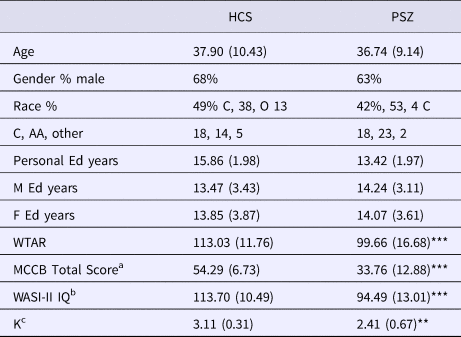
We report results from 37 healthy controls (HCS) and 43 PSZ. We excluded one patient participant who did not appear to understand task instructions. The PSZ were recruited from the two outpatient clinics at the Maryland Psychiatric Research Center, other local outpatient clinics and by word of mouth among study participants. There were no significant differences between HCS and PSZ in age, race, sex, or parental education (see Table 1). As is typically found, PSZ completed significantly fewer years of education than HCS, likely due to disease onset in late adolescence/early adulthood. Material from past medical records, collateral informants (when available), and the results of the Structured Clinical Interview for DSM-IV-TR Axis 1 Disorders (First et al., Reference First, Spitzer, Miriam and Williams2002) were combined to make a diagnosis based on the standard operational criteria in the Diagnostic and Statistical Manual of Mental Disorders IV (DSM-IV; APA, 2000). Final diagnoses were reached at a consensus conference chaired by author J.M.G. All PSZ were clinically stable outpatients who had been receiving the same medications, at the same dose, for at least 4 weeks prior to study participation. In terms of medication use, clozapine was the most frequently used antipsychotic either as antipsychotic monotherapy (N = 18) or combined with a second antipsychotic (N = 6). Six PSZ were receiving monotherapy with a second generation antipsychotic other than clozapine. Three PSZ were taking a first generation antipsychotic. Ten patients were taking two different antipsychotics (not including clozapine). Antidepressants were widely used (N = 27) as were anxiolytics (N = 16). In addition, 8 PSZ were taking an anticholinergic and 9 were taking a mood stabilizer.
Demographic and cognitive characteristics of the sample

*** = p < 0.001, ** = p < 0.01.
aHC N = 31, PSZ N = 41; bHC N = 30, PSZ N = 41; cHC N = 26, PSZ N = 37.
C, Caucasian; AA, African American; O, Other; M, Mother; F, Father; Ed, Education; WTAR, Wechsler Test of Adult Reading; MCCB, Matrics Consensus Cognitive Battery; WASI, Wechsler Abbreviated Scale of Intelligence II, K is a measure of visual working memory capacity.
HCS were recruited via online advertisements, wall notices in local libraries and businesses, and word of mouth. They were screened using the complete Structured Clinical Interview for DSM-IV Axis 1 Disorders (SCID-I; First, et al., Reference First, Spitzer, Miriam and Williams2002) and Axis II Personality Disorders (SIDP-R; Pfhol et al., Reference Pfohl, Blum, Zimmerman and Stangl1989). All had no current diagnosis of any Axis I disorder or any Axis II schizophrenia-spectrum disorder, and all denied a lifetime history of psychosis or any family history of psychotic disorders in first-degree relatives.
We administered the Brief Psychiatric Rating Scale (BPRS, Overall and Gorham, Reference Overall and Gorham1962) to quantify symptom severity, the Clinical Assessment Interview for Negative Symptoms (Kring et al., Reference Kring, Gur, Blanchard, Horan and Reise2013) to quantify negative symptoms, the Specific Levels of Function informant report (SLOF) to measure level of community function (Schneider and Struening, Reference Schneider and Struening1983), and the UCSD Performance-Based Skills Assessment-Brief (UPSA-B) to quantify functional capacity (Patterson et al., Reference Patterson, Goldman, McKibbin, Hughs and Jeste2001). In addition, all subjects received the Wechsler Test of Adult Reading (Wechsler, Reference Wechsler2001), the Wechsler Abbreviated Scale of Intelligence-II (Wechsler, Reference Wechsler2011), and the MATRICS Consensus Cognitive Battery (MCCB, Nuechterlein et al., Reference Nuechterlein, Green, Kern, Baade, Barch, Cohen, Essock, Fenton, Gold, Goldberg, Heaton, Keefe, Kraemer, Mesholam-Gately, Seidman, Stover, Weinberger, Young, Zalcman and Marder2008) and completed a visual change localization test to measure WM capacity (termed K) (Johnson et al., Reference Johnson, McMahon, Robinson, Harvey, Hahn, Leonard, Luck and Gold2013). In this task, participants first see an encoding array of four colored rectangles for 100 ms, followed by a 900 ms delay. A four-item test array follows and participants are asked to identify the rectangle that changed color. As seen in Table 1, HCS showed better performance than PSZ on all of the cognitive measures.
All participants (PSZ as well as HCS) were free of other medical or neurologic comorbidity that could reasonably influence test performance, including substance abuse or dependence within the last 12 months. This protocol was approved by the Institutional Review Board at the University of Maryland, Baltimore, and all participants gave written informed consent before taking part in this study.
Task and design
Stimuli were presented on a Dell U2412 M display with a black background at a viewing distance of 70 cm. Each trial began with the presentation of a fixation cross for 1.10–1.25 s, followed by the T1 and T2 stimuli. The T1 stimulus was either an ‘X’ or a ‘Y’ (approximately 0.8° of visual angle) and was presented at fixation for 100 ms. This was followed by a blank delay period with equal numbers of trials at 100, 200, 300, 400, 600, or 800 ms delays. Following the delay, the T2 stimulus (a ‘1’ or a ‘2’, 0.8°) was presented at fixation and stayed on-screen until a response was made. The 1 required a left index finger response on a game pad whereas the 2 required a right index finger response. Participants were instructed to respond to T2 as quickly and accurately as they could. The response was followed by a 500 ms blank screen.
In the T1T2 condition, a T1 response cue then appeared, indicating that participants should report the remembered identity of T1. This cue showed a diagram of the game pad and indicated which response should be made for each of the two possible T1 stimuli. The T1 response was unspeeded and was followed by a blank display. Thus, the total delay for reporting the T1 stimulus includes both the initial 100–800 ms delay and the RT to the T2 stimulus plus the time that is taken to make the T1 response. In the T2-only condition, subjects were instructed to ignore T1, and the T1 report cue was not presented.
To avoid carryover effects, the T2-only condition always preceded the T1T2 condition. Each condition started with 12 practice trials to ensure task comprehension and was comprised of 5 blocks of 48 trials each.
The main measure of interest was the RT to the T2 stimulus when either ignoring or remembering the T1 letter stimulus. We calculated median RTs to minimize the impact of outlier trials. Data were analyzed using ANOVA, and the degrees of freedom and p values were adjusted with the Greenhouse-Geisser correction for nonsphericity for any effects involving a factor with more than two levels (i.e. the T1–T2 delay). Considering that the RT distributions for each of the conditions were skewed, (as revealed by a Shapiro Wilk test of normality, p < 0.001 for all), we also subjected raw RTs to a log transformation to reduce the impact of long response times. These transformed data were subjected to an ANOVA, and we observed the same pattern of results as when we used untransformed median RTs. For reasons of interpretability, and considering that our results hold true even with log-transformed RTs, descriptive statistics and ANOVA results in the manuscript will be shown for untransformed RTs.
Results
This task was designed to put minimal stress on WM storage capacity so that we could examine the effects of successful maintenance of T1 on the processing of T2. Consistent with this goal, T1 was correctly reported at the end of the trial in the T1T2 condition on 92.1% of trials in PSZ and on 96.7% of trials in HCS. The difference in accuracy between groups was numerically small but statistically significant (Mann-Whitney U = 1105.50, p = 0.003). Given that the T1T2 task required storing only a single item in WM, this difference likely reflects lapses of attention rather than differences in WM storage abilities (Gold et al., Reference Gold, Barch, Feuerstahler, Carter, MacDonald, Ragland, Silverstein, Strauss and Luck2018). To minimize any effects of the difference in T1 accuracy on the RT analyses, trials with an incorrect T1 response were excluded from further analysis of the T1T2 condition.
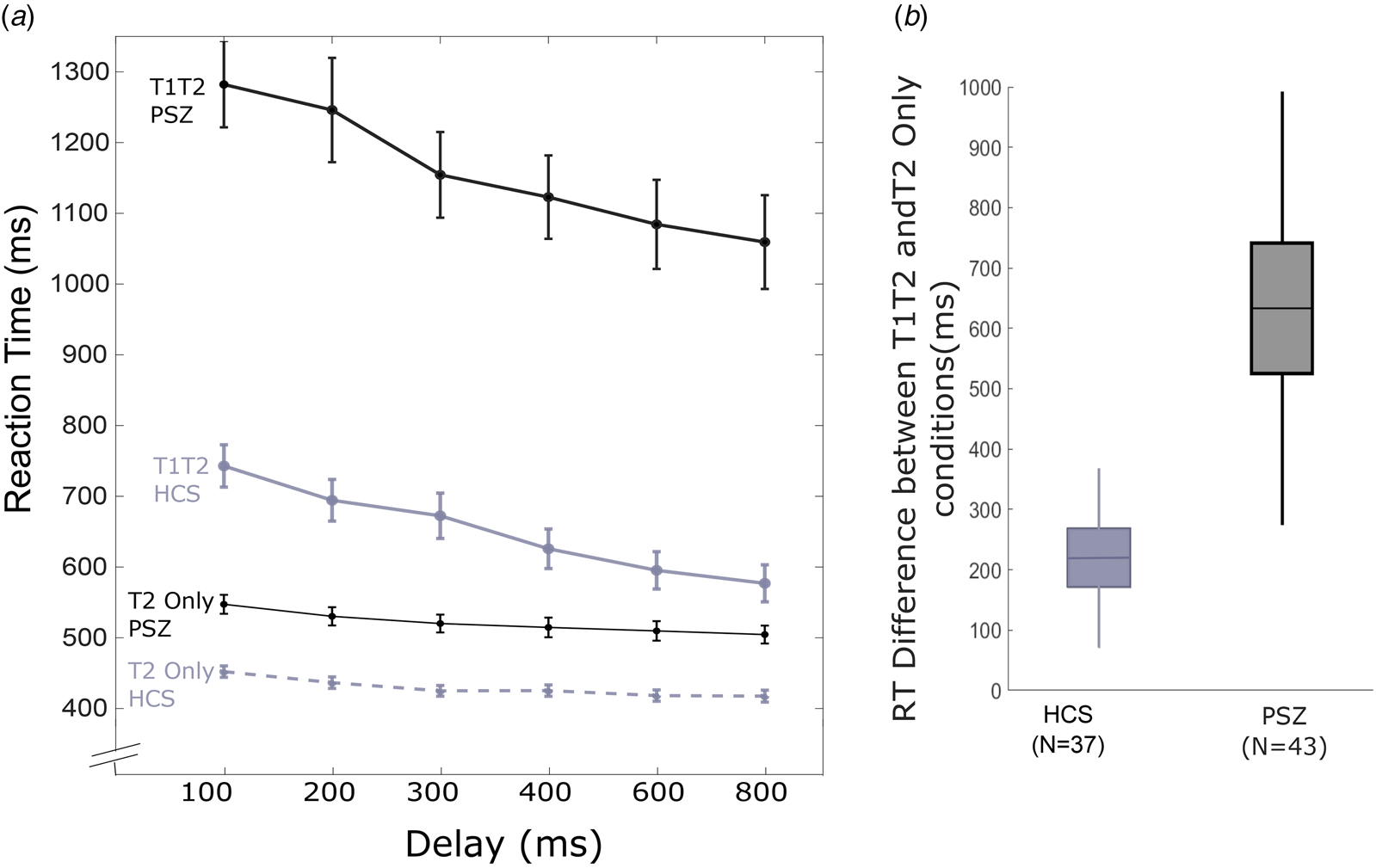
Figure 2 shows several large main effects: (1) RTs were generally faster in HCS than in PSZ across all conditions; (2) RTs were substantially slower in the T1T2 condition than in the T2-only condition in both groups; and (3) RTs were slowed at the shortest T1–T2 delays in both groups. An ANOVA with a between-subjects factor of group and within-subjects factors of condition (T2-only v. T1T2) and T1-T2 delay confirmed significant main effects for group [F (1, 78) = 55.71, p < 0.001, η 2p = 0.42], condition [F (1, 78) = 178.26, p < 0.001, η 2p = 0.70], and delay [F (3.55, 276.77) = 59.34, p < 0.001, η 2p = 0.43].
Reaction time results. (a) Mean of median RTs, with standard error bars, in the T2-only and T1T2 conditions. (b) Mean difference score between the T1T2 and T2-only conditions. The box encompasses one standard deviation around the mean difference while the lines extend to the 95% confidence interval of the mean difference.

These main effects were qualified by two significant interactions. The key finding was a significant group by condition interaction [F (1,78) = 41.57, p < 0.001, η 2p = 0.35], which resulted from PSZ showing greater slowing in the T1T2 condition relative to the T2-only condition than did HCS. This is illustrated on the right side of Fig. 2, which shows that the overall difference between the T1T2 and T2-only conditions (collapsing across delays) was approximately 3 times greater in PSZ (633.3 ± 359.7; mean ± s.d.) than in HC (219.3 ± 148.8), [t (1, 71) = 6.53, p < 0.001, Cohen's d = 1.47, 95% CI (0.97–1.96)].
There was also a significant Condition by Delay interaction [F (3.43, 267.69) = 28.11, p < 0.001, η 2p = 0.27), which reflected greater RT slowing at short delays in the T1T2 condition relative to the T2-only condition. Neither the Delay by Group interaction [F (3.55, 276.77) = 1.94, p = 0.11, η 2p = 0.02], nor the Condition by Delay by Group interaction were significant [F (3.43, 267.69) = 1.55, p = 0.19, η 2p = 0.02].
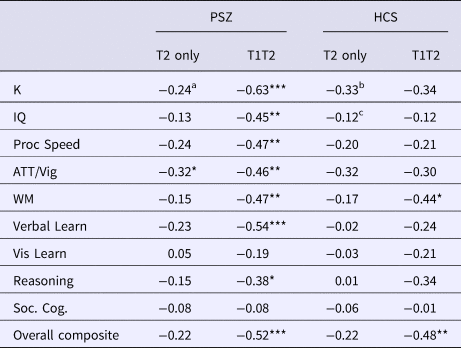
We also examined correlations between RT in the T2-only and T1T2 conditions and independent cognitive measures (see Table 2). If the RT slowing in the T1T2 condition is related to the differential use of WM relative to the T2-only condition, we would expect to see significant correlations between this RT slowing and WM. Indeed, the measure of visual WM memory capacity from the change localization test described above correlated significantly with the relative RT slowing in the T1T2 condition in PSZ (r = −0.55) and to a lesser degree in HCS (r = −0.34, p = 0.09). In PSZ, 8 of the 10 possible correlations were significant with T1T2 RT whereas only 2 of 10 were significant with T2-only RT. We compared the magnitude of the correlations between T2-only and T1T2 RT in the PSZ, focusing on the visual WM capacity score (K) from the change localization test, estimated IQ, the MCCB Working Memory domain score and the MCCB overall composite score as each of these would be expected to have a robust relationship with the a measure involving WM. There was a significant difference in the magnitude in each case, with a more robust correlation with T1T2 RT than with T2-alone RT (all p < 0.05 after multiple correction) (Steiger Reference Steiger1980; Benjamin & Hochberg Reference Benjamini and Hochberg1995; Olkin & Finn, Reference Olkin and Finn1995). In HCS, 2 of 10 possible correlations were significant with T1T2 RT whereas none were observed with T2-only RT. However, these correlations did not differ statistically, nor were there any significant differences in correlation magnitude across the two groups. We observed no correlations between T1T2 RT and measures of symptom severity on the BPRS or CAINS or functional outcome measures (UPSA-B and the SLOF informant report).
Correlations of T2 only, T1T2 RT with K, IQ, and MCCB domain and overall composite T scores

aN = 37, otherwise N = 41 for PSZ; In HCS, bN = 26, cN = 30, for MCCB, N = 31.
*p < 0.05, **p < 0.01, ***p < 0.001.
To examine the effects of antipsychotic medication, we used the dose conversion approach of Gardner et al. (Reference Gardner, Murphy, O'Donnell, Centorrino and Baldessarini2010). We found non-significant trend correlations between medication dose and T2-only RT (r = 0.26, p = 0.10) and with T1T2 RT (r = 0.30, p = 0.06). Thus, there was suggestive evidence that higher dose of antipsychotics were related to general RT slowing, but at similar levels whether or not an item was being held in WM.
Discussion
The present paradigm opens a new window on the nature of WM impairment in PSZ: PSZ show an almost threefold increase in choice RT when concurrently maintaining a single item in WM. Thus, maintaining information about a single item in WM dramatically impairs the operation of other cognitive systems in PSZ. We suggest that this is a new window because prior WM research has focused primarily on reductions in WM capacity or on imprecise encoding of WM representations, rather than on the interaction between WM and the operation of other cognitive systems. However, the study of WM has had such a central role in cognitive neuroscience research precisely because WM storage is a resource that is needed by many other cognitive systems, and because the interactions between WM and other systems are fundamental to complex cognition. Here we demonstrated that the successful maintenance of a single, highly familiar item has a profoundly disruptive impact on the ability to carry out a second, simple, unrelated task.
It is worth noting that this new paradigm is much simpler than complex span or N-back tests but still yielded very large between-group differences. The enhanced cost of maintaining a single item in WM demonstrated in this new paradigm in PSZ is very likely implicated in the deficits observed in more commonly used WM measures such as complex span and the N-Back, where individual items need to be maintained and updated. That is, increased storage costs should also impact the ability to manipulate material maintained in WM. Further, given that many cognitive tasks require maintaining more than a single item to support ongoing processing, it seems reasonable to suspect that the effects documented here may be magnified in more complex tasks. Thus, the increased cost of the storage of items in WM should be expected to have broad cognitive consequences.
The issue of differential difficulty is a perennial issue in studies of cognitive impairment in PSZ (Chapman and Chapman, Reference Chapman and Chapman1978). That is, the T1T2 condition is clearly ‘harder’ than the T2-only condition, producing longer RTs in both groups, and it is quite plausible that this greater difficulty explains the larger between group difference in the T1T2 condition than in the T2-only condition. However, the factor that makes the T1T2 condition more difficult is the need to maintain information about T1 in WM while responding to T2. The pattern of correlations with other WM and cognitive measures is consistent with the idea that the T1T2 RT slowing is related to the demand to maintain information in WM. Thus, we are not arguing that PSZ show a selective, specific deficit in the T1T2 condition relative to the T2-alone condition. Instead, we suggest that the ‘differential difficulty’ of the T1T2 condition is attributable to the demand to maintain information about a single item in WM, which exacts a remarkable RT cost in PSZ.
Why might the demand to hold a single item in WM slow processing in HCs? Here, it is necessary to speculate because we are unaware of other experiments with this precise design. The current design differs from the Attentional Blink paradigm in that it minimizes perceptual demands and uses RT rather than accuracy as the outcome measure. It is more similar to the psychological refractory period (PRP) paradigm, in which subjects make immediate speeded responses to both T1 and T2. However, we do not require a speeded response to T1, which is crucial for observing slowed T2 responses in the PRP task (Pashler, Reference Pashler1994). Instead, our task requires information about T1 to be maintained in WM through all stages of T2 processing. Moreover, the exaggerated RT slowing exhibited by PSZ in the T1T2 condition occurred even at long T1–T2 delays, indicating that the patient deficit was a result of the maintenance of T1 rather than the initial perceptual processing or WM encoding of T1. Thus, the available literature serves as a poor guide for understanding the precise mechanisms implicated in the clear slowing of T1T2 RT.
One possibility is that the observed deficit reflects processes involved in moving information in and out of active storage. That is, T1 may need to be moved from active storage to an ‘activity silent’ passive state (Stokes, Reference Stokes2015) when T2 appears, and the time required for this may slow down the T2 response. It is also possible that the requirement to maintain two task sets in WM (one for T1, the other for T2) is responsible for the longer RTs in the T1T2 condition. In addition, it is conceivable that subjects immediately begin preparing the T1 response, which thereby slows RT to T2. While differing from the simple cost of storing a single item in WM, these explanations all suggest a performance cost due to the need to maintain either a task set or response plan.
Another alternative is that the RT increase is the result of a larger task switching cost in PSZ than in HCS. That is, it takes time to switch from trying to store T1 in WM to performing a choice RT on T2, and this time might be greater in patients. However, task switching effects are greatly magnified at short delays (Monsell, Reference Monsell2003). Consequently, if switch costs were greater in PSZ than in HCS, then one would expect to see patient performance move towards control performance as the T1–T2 delay increases in the T1T2 condition. As seen in Fig. 2, that does not appear to be the case, as RT slope over the delay periods was similar in both groups, and the slowing of RTs in PSZ relative to HCS was similar across T1-T2 delays. Moreover, there is inconsistent evidence of increased task switching time in PSZ (Meiran and Henik, Reference Meiran and Henik2000; Grenzang et al., Reference Greenzang, Manoach, Goff and Barton2007; Ravizza et al., Reference Ravizza, Moua, Long and Carter2010; Wylie et al., Reference Wylie, Clark, Butler and Javitt2010).
A third alternative is that, because WM capacity is reduced in PSZ (Johnson et al., Reference Johnson, McMahon, Robinson, Harvey, Hahn, Leonard, Luck and Gold2013; Gold et al., Reference Gold, Barch, Feuerstahler, Carter, MacDonald, Ragland, Silverstein, Strauss and Luck2018), PSZ have less remaining capacity available to process T2 when T1 is being held in WM. This would be consistent with our finding that the degree of T2 slowing was correlated with WM capacity. Note, however, that the T2 choice RT task makes minimal demands on WM other than maintaining a simple task set, reducing the likelihood of this explanation. Finally, an additional possibility is our recent proposal that that PSZ allocate their attention overly narrowly and intensely, which we have termed ‘hyperfocusing’ (Luck et al., Reference Luck, McClenon, Beck, Hollingworth, Leonard, Hahn, Robinson and Gold2014). For example, we have observed greater levels of neural activation in PSZ (relative to HCS) when storing a single item in WM using both ERPs and fMRI (Leonard et al., Reference Leonard, Kaiser, Robinson, Kappenman, Hahn, Gold and Luck2013; Hahn et al., Reference Hahn, Harvey, Gold, Ross and Stein2017, Reference Hahn, Robinson, Leonard, Luck and Gold2018; Kreither et al., Reference Kreither, Lopez-Calderon, Leonard, Robinson, Ruffle, Hahn, Gold and Luck2017). By this account, hyperfocusing on T1 slows the processing of T2. This hyperfocusing account can potentially account for both behavioral as well as neurophysiolgical findings in an integrated framework.
We acknowledge three limitations of this experiment. First, we always administered the T2-only condition first so that subjects would not have experienced storing T1 in memory before performing the T2-only condition (which might have led to automatic storage of T1 in WM). Consequently, it is possible that the exaggerated RT slowing exhibited by PSZ in the T1T2 condition was a result of time on task rather than the need to maintain T1 in WM. Given the magnitude of the slowing and the relatively short duration of task administration, this seems a rather unlikely explanation. Second, it is unclear which specific cognitive mechanisms are responsible for the exaggerated slowing; we will pursue this question in subsequent research. Third, all of the patients were receiving antipsychotic medications. Although we did not find any evidence that medication dosage was specifically associated with the exaggerated slowing observed in the T1T2 condition, we cannot rule out the possibility that this effect was impacted by medications in a dose-independent manner.
In summary, using a new experimental paradigm, we found that PSZ exhibit an increased cost of storing a single item in WM on the performance of another unrelated task. This issue has not previously been discussed in the voluminous literature on WM in PSZ, where the focus has been on measures of WM capacity and precision. The ability to maintain representations during, and in the service of, other cognitive operations is the critical function of WM. An increased cost of successful WM storage on concurrent cognitive processing is likely implicated in the deficits observed in more complex WM paradigms and broad measures of intellectual function in PSZ.
Author ORCIDs
James M. Gold, 0000-0002-0109-9554
Acknowledgements
We gratefully acknowledge the contributions of Leeka Hubzin and Sharon August.
Financial support
This work supported by NIMH R01 MH065034-16.
Conflict of interest
None of the authors have any financial disclosures related to this manuscript.