Introduction
Various studies have demonstrated that longer birth intervals are better for the health of the mother and the child (Conde-Agudelo & Belizán, Reference Conde-Agudelo and Belizán2000; DaVanzo et al., Reference DaVanzo, Peterson and Jones2004; Rutstein, Reference Pollak and Watkins2005). Recently, the WHO technical consultation group on birth spacing agreed that after a live birth a mother should wait at least 24 months before attempting the next pregnancy (WHO, Reference Rutstein2006). However, the consultation group also noted that it is up to the individuals and couples to make their own choices for the timing of the next pregnancy.
Decision-making regarding fertility and family planning involves a complex process of discussion and negotiation by married couples. Decisions may be influenced by the attitudes and intentions of one or both spouses. Yet, discussion on waiting time to next birth between spouses remains uncommon. A study in Uganda by Blanc and others found relatively little evidence of negotiation about spacing births compared with stopping childbearing altogether. Overall, only 39% of men and 31% of women ever discussed the timing of the next birth with their spouse, compared with 47% of men and 45% of women who discussed having no more children (Blanc et al., Reference Blanc, Wolff, Gage, Ezeh, Neema and Ssekamatte-Ssebuliba1996).
In sub-Saharan Africa, women have a widespread desire to have longer birth intervals than they currently have (Blanc et al., Reference Blanc, Wolff, Gage, Ezeh, Neema and Ssekamatte-Ssebuliba1996; Rafalimanana & Westoff, Reference Nyblade and Menken2001). Studies that investigated reproductive preferences in relation to actual reproductive behaviour in sub-Saharan Africa have found that birth spacing preferences influence actual birth intervals and fertility in some but not all countries (Rafalimanana & Westoff, Reference Nyblade and Menken2001). If realized, the desire to avoid short birth intervals may translate into benefits for the lives of women and children. DaVanzo and others (Reference DaVanzo, Peterson and Jones2003) used longitudinal data from Malaysia and found that couples where both partners wanted another child tended to have a subsequent child sooner, i.e. had a shorter waiting time to next birth, than couples where the partners disagreed on wanting another child.
Previous research has shown that women's education, number of living children, women's work status, and household wealth affect reproductive preferences and behaviours (Fapohunda & Poukouta, Reference Dodoo, Nii-Amoo1997; Rafalimanana & Westoff, Reference Nyblade and Menken2001; Bhargava, Reference Bhargava2007). More specifically, the number of living children has been shown to influence waiting time to next birth (Rafalimanana & Westoff, Reference Nyblade and Menken2001). Differences in age and educational attainment between the husband and the wife are measures of relative power that have also been shown to affect reproductive preferences and behaviours (Wolff et al., Reference Wolff, Blanc and Gage2000; Beegle et al., Reference Beegle, Frankenberg and Thomas2001; Barbieri & Hertrich, Reference Barbieri and Hertrich2005).
Spousal discussion and negotiation about reproductive preferences and choices occur within specified social contexts. Social norms and values are known to influence individual reproductive preferences and behaviours, such as spacing of births, stopping child bearing and practising contraception (Pollak & Watkins, Reference Hogan, Berhanu and Hailemariam1993). Marriage as a social institution has also been shown to influence reproductive preferences and behaviours. A number of studies have examined the impact of polygyny on contraceptive use and fertility behaviour at the individual level (Nyblade & Menken, Reference Hogan, Berhanu and Hailemariam1993; Hogan et al., Reference Hogan, Berhanu and Hailemariam1999).
Previous research has demonstrated the value of using couples' data to better understand reproductive preferences and behaviours in developing countries (Dodoo, Reference DaVanzo, Razzaque, Rahman, Hale, Ahmed, Khan, Mustafa and Gausia1993; Becker, Reference Becker1996; Greene & Biddlecom, Reference Fapohunda and Poukouta2000). In this study, matched couples' data from recent Demographic and Health Surveys in ten sub-Saharan African countries were used to explore how various social, demographic and economic factors influence spousal agreement on preferred waiting time to next birth. The way in which infecundability and spousal education and age differences, as well as economic well-being, influence spousal agreement on waiting time to next birth was assessed.
Data and Methods
The data were from ten recent Demographic and Health Surveys in sub-Saharan Africa: namely Benin, Burkina Faso, Ghana, Guinea and Mali from west Africa; and Ethiopia, Kenya, Mozambique, Zambia and Zimbabwe from eastern and southern Africa. These surveys were conducted between 2003 and 2006. In each country, the survey interviewed adult women age 15–49 and adult men age 15–59 (15–54 in Kenya and 15–64 in Benin). Women and men were interviewed using similar questionnaires.
Spousal agreement on waiting time to next birth was measured using matched information from each spouse's response to the question, ‘How long would you like to wait from now before the birth of another child?’ This question was asked if the respondent indicated that she/he intends to have (a/another) child in the future and the woman was not pregnant at the time of the interview. For women or men who responded ‘as soon as possible’, a value of 9 months was imputed. Using the difference between the duration of waiting time to next birth of the husband and that of the wife, in months, a three-category variable was generated: (1) both husband and wife indicating the same waiting time to next birth, i.e. if the difference is 0 months; (2) the husband wanting a longer duration of waiting time, i.e. if the difference is 1 month or more; and (3) the wife wanting a longer duration of waiting time, i.e. if the difference is −1 month or less. The first category represents spousal agreement, while the latter two represent disagreement between the partners.
In this study, a woman was defined as infecund if she was in a stable union (married only once), was sexually active (had sex in the last 12 months), did not use any contraceptive method and did not have a childbirth in the last five years.
The influence of key social, economic and demographic characteristics of couples on spousal agreement on preferred waiting time to next birth was examined using binary logistic regression. The characteristics included: urban/rural residence, wife's education, husband's education, spousal education difference, wife's age, husband's age, spousal age difference, type of marital union, difference between ideal number of children and number of living children, fecundity and household wealth status. Separate logistic regressions were run for each country.
One of the caveats of the matched couples' data is that for some polygynous unions multiple wives were matched with one husband to form multiple couples. Although the proportion of such couples is likely to be small in our samples, it raises the concern regarding statistical independence of responses from a polygynous husband (Speizer & Yates, Reference Rafalimanana and Westoff1998; Bankole & Singh, Reference Bankole and Singh1998). Speizer & Yates (Reference Rafalimanana and Westoff1998) have further suggested that inferences made in studies that did not account for correlated observations are likely to be correct provided that the number of repeated men in the sample is small and these men are not matched with many wives.
Results
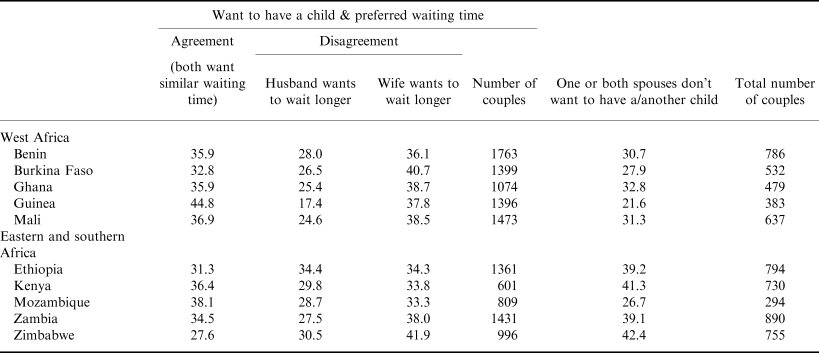
Considering couples in which both partners want to have another child, the proportion wanting the same waiting time to next birth ranges from 28% in Zimbabwe to 45% in Guinea ( Table 1). Only about a third of couples in most countries reported that both partners have the same waiting time to next birth. In all ten countries (Benin, Burkina Faso, Ghana, Guinea, Mali, Ethiopia, Kenya, Mozambique, Zambia and Zimbabwe) a higher proportion of wives want a longer waiting time to next birth compared with their husbands.
Spousal agreement on preferred waiting time to next birth and disagreement to have a child by country (percentage)
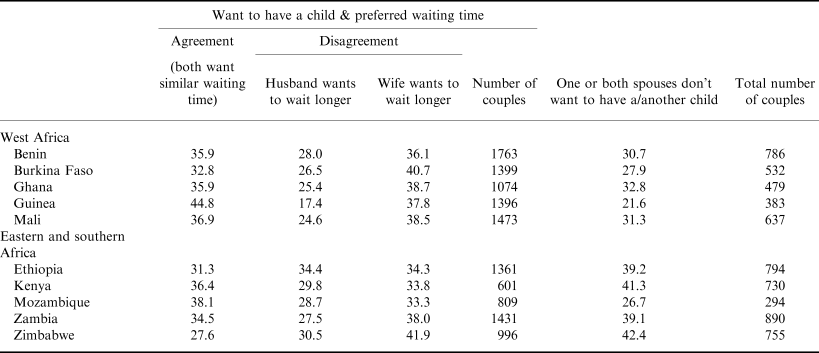
Table 1 shows that the proportion of couples where one or both partners did not want to have a/another child ranges from 22% in Guinea to 42% in Zimbabwe. Overall, the proportion of such couples was higher in eastern and southern Africa than in west Africa, with the exception of Mozambique. Couples where one or both partners did not want to have a/another child were excluded from this study since the preferred waiting time to next birth for this group was unknown.
Selected characteristics of couples where both partners wanted to have a/another child (thus have a preferred wait time to next birth and included in the analysis) were compared with those of couples where one or both partners did not want to have a/another child (thus the preferred wait time is unknown and excluded from the analysis). Comparison of the two groups was based on: female partner's age, number of living children, percentage with female partner having primary or higher education and percentage living in urban areas. In all ten countries in this study, couples where one or both partners did not want to have a/another child were on average older and had a larger number of living children compared with couples where both partners wanted to have a/another child (data not shown). This is to be expected because a considerable proportion of couples where one or both partners did not want to have additional children are likely to have already achieved their desired family size and therefore were older and had a higher parity than couples where both partners wanted a/another child. However, the two groups of couples do not appear to have any substantial differences with respect to female partner's education and urban residence.
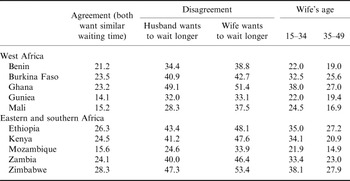
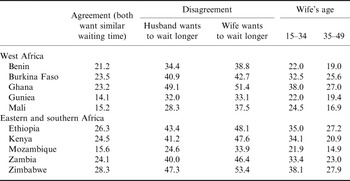
Table 2 presents the mean waiting time to next birth for couples by whether both spouses want a similar waiting time, the husband wants to wait longer or the wife wants to wait longer. Since waiting time can be affected by age, the average waiting time to next birth is also presented by the age of the wife. In most countries, when both partners agree, the average waiting time to next birth is 24 month or shorter; the shortest waiting time is 14 months in Guinea. However, when the husband and the wife disagree on waiting time to next birth, the average waiting time tends to be longer in all countries. In addition, in all ten countries, couples in which the wives are 15–34 years old prefer longer waiting time to next birth (22–38 months) than couples with wives aged 35–49 (15–28 months).
Average preferred waiting time to next birth (in months) by spousal agreement and by age of wife
Differentials in spousal agreement on waiting time to next birth
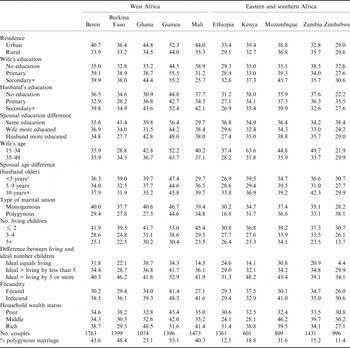
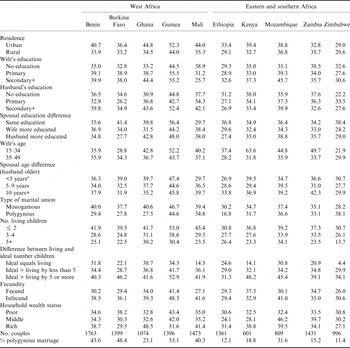
Table 3 presents the social, economic and demographic differentials in the percentage of couples in which both spouses agree to have the same waiting time to next birth. In eight of the ten countries, the percentage of couples in which both spouses want the same waiting time to next birth is higher in urban areas compared with rural areas; exceptions are Zambia and Zimbabwe.
In Benin, Ghana and Mozambique, the percentage of couples in which both partners want the same waiting time to next birth increases with increasing level of wife's education. In contrast, in Mail, Zambia and Zimbabwe the percentage of couples with both spouses wanting the same waiting time to next birth is higher when the wife has no formal education. In Mail, for example, in 39% of the couples where the wife has no education both partners want the same waiting time to next birth, compared with 26% of the couples where the wife has secondary or higher education. However, there is no clear relationship between husband's education and spousal agreement on waiting time to next birth.
In all countries, except Benin, Burkina Faso and Zimbabwe, spousal agreement on waiting time to next birth is greater among couples with wives aged 15–34 than among those with wives aged 35–49. There is no clear relationship between age gap and spousal agreement on waiting time to next birth. In Burkina Faso, Ghana, Guinea and Kenya spousal agreement on waiting time to next birth is highest when the spousal age gap is less than 5 years, but in Benin, Mali, Ethiopia and Zambia it is highest when the age gap is 10 or more years.
In nine of the ten countries, spousal agreement on waiting time to next birth is greater among monogamous couples than among polygynous couples. Zimbabwe stands out as a country where spousal agreement on waiting time is much greater among polygynous couples than among monogamous couples.
In all countries, spousal agreement on waiting time to next birth is lower among couples with more living children. In addition, the percentage of couples in which both spouses want the same waiting time to next birth is higher when the ideal number of children is greater than the number of living children by five or more. In all countries except Kenya, spousal agreement on waiting time to next birth is greater among couples where the wife was infecund. There is no clear relationship between household wealth status and spousal agreement on waiting time to next birth. In six of the ten countries (Benin, Ghana, Guinea, Mali, Ethiopia and Kenya) spousal agreement is greater among couples living in wealthier households.
Background characteristics
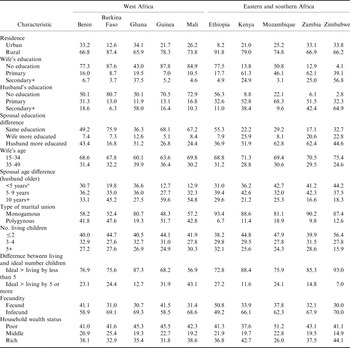
Table 4 shows the distribution of couples in the analysis by selected background characteristics. The proportion of couples residing in urban areas ranges from 8% in Ethiopia to about one-third in Benin, Ghana, Zambia and Zimbabwe. The proportion of couples where wives/female partners have no education varies widely from only 4% in Zimbabwe to as high as 88% in Guinea. On the other hand, the proportion of couples where wives/female partners have secondary or higher education ranges from 3% in Mozambique to 57% in Zimbabwe. Similarly, the proportion of couples where husbands have no education ranges from only 3% in Zimbabwe to 81% in Burkina Faso. In all countries, a higher proportion of husbands have secondary or higher education compared with their wives/female partners.
Proportion of couples in which both spouses agree to have similar preferred waiting time to next birth by demographic, social and economic characteristics
a Overall, this includes 5.5% of husbands who are the same age or younger than their wives.
Demographic, social and economic characteristics of couples (percentage)

a Overall, this includes 5.5% of husbands who are the same age or younger than their wives.
In a majority of couples in all countries included, husbands tend to be 5 or more years older than their wives/female partners. Large age differences (10 years or more) are more common in countries in west Africa compared with countries in eastern and southern Africa. In four of the five countries in west Africa (Benin, Burkina Faso, Guinea and Mali), 33–60% of wives have a husband who is at least 10 years older than they are.
Polygyny is common in sub-Saharan Africa, but wide variations exist. The prevalence of polygyny is much higher in west Africa, where more than 40% of couples are in polygynous unions in four of the five countries studied, compared with less than 20% of couples in all five countries in eastern and southern Africa. The proportion of couples with two or fewer living children ranges from 38% in Ethiopia to 56% in Zimbabwe. In all countries except Zimbabwe, about a quarter to a third of couples have five or more living children. The proportion of couples with a difference of five or more children between the ideal and living number of children ranges from 7% in Zimbabwe to 43% in Mali.
Multivariate analysis
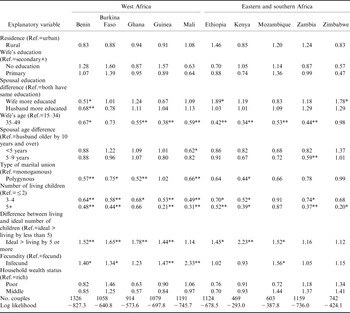
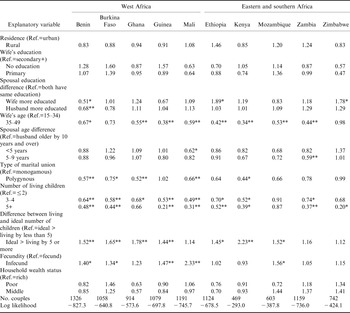
With other factors controlled, urban/rural residence has no significant association with spousal agreement on waiting time to next birth in any of the ten countries included in the multivariate analysis (Table 5). Wife's education also does not have any significant association with the likelihood of both partners wanting the same waiting time to next birth. However, the education gap between the husband and wife is significantly associated with spousal agreement on waiting time to next birth in Benin, Ethiopia and Zimbabwe. In Ethiopia and Zimbabwe, couples are more likely to agree on waiting time to next birth if the wife had more education than her husband, whereas in Benin couples are significantly more likely to agree on waiting time to next birth if both spouses have the same level of education than if either partner is more educated than the other.
Odds ratios from binary logistic regressions predicting spousal agreement on similar preferred waiting time to next birth
* p<0.05;
** p<0.01.
Independent of other factors, wife's age is significantly negatively associated with spousal agreement on waiting time to next birth in eight of the ten countries: Benin, Ghana, Guinea, Mali, Ethiopia, Kenya, Mozambique and Zambia. The association is particularly strong in Kenya (aOR=0.34; p<0.01), Guinea (aOR=0.38; p<0.01), Ethiopia (aOR=0.42; p<0.01) and Zambia (aOR=0.44; p<0.01), where couples with wives aged 15–34 are 2.3 to 2.9 times more likely to have spousal agreement on waiting time to next birth than couples with wives aged 35–49. The age gap between the partners has no significant relationship with spousal agreement on waiting time to next birth, except in Zambia and Mali. In these two countries, couples in which the husband is older than his wife by less than 10 years are less likely to agree on waiting time compared with couples in which the husband is older than his wife by 10 or more years.
In Benin, Burkina Faso, Ghana, Mali and Kenya spouses in polygynous marriages are significantly less likely to agree on waiting time to next birth than those in monogamous marriages. The difference between wife's ideal number of children and number of living children has a significant positive association with spousal agreement on waiting time to next birth in seven of the ten countries (Benin, Burkina Faso, Ghana, Guinea, Ethiopia, Kenya and Mozambique). In these countries, the likelihood of spousal agreement on waiting time to next birth ranges from 1.4 times in Guinea to 2.2 times in Kenya, when the difference between ideal and living number of children is five or more than when it is less than five children. In the remaining three countries (Mali, Zambia and Zimbabwe) the association is positive but not statistically significant.
Infecundibility is significantly positively associated with spousal agreement on waiting time to next birth in five of the ten countries (Benin, Burkina Faso, Guinea, Mali and Mozambique). With other factors controlled, spousal agreement was 1.3 to 2.3 times more likely in couples where the wife was infecund than in couples where the wife was fecund. It is noteworthy that in these countries polygynous marriages account for more that 30% of all unions. In four of the five remaining countries (Ghana, Ethiopia, Zambia and Zimbabwe) the association between infecundability and spousal agreement is positive but not statistically significant.
The relationship between household wealth status and spousal agreement on waiting time to next birth is not significant in any of the ten countries.
Discussion
This study found that in sub-Saharan Africa spousal agreement on preferred waiting time to next birth is associated with wanting the next child sooner. When the spouses disagree on waiting time to next birth, the wives want to wait longer than their husbands in most cases. Additionally, it is found that demographic factors are the primary determinants of spousal agreement on waiting time to next birth, not socioeconomic factors. The strongest predictors of spousal agreement on waiting time to next birth are number of living children, difference between wife's ideal and living number of children and wife's age. Couples with fewer children, younger wife and those with a difference of five or more children between ideal and living number of children are more likely to agree on waiting time to next birth. Effects of socioeconomic factors, such as education, urban residence and wealth status, on spousal agreement on waiting time to next birth are generally weak and inconsistent.
There are several limitations of the analysis that should be kept in mind when interpreting these findings. First, the analysis was based on reported birth spacing preferences, not actual behaviours. Reported preferences are subject to rationalization bias. Another limitation is that couples in which one of the spouses indicated that she/he does not want another child were excluded from the analysis. When partners disagree on having another child, one of the partners has an undefined (unknown) length of preferred wait time to next birth. In such cases, it is not possible to compute spousal agreement or disagreement on waiting time to next birth.
Our measurement of agreement on preferred waiting time to next birth (based on the response of the co-resident wife) may be biased to the extent a polygynous husband refers to a wife or partner not residing with the husband at the time of the survey. However, such bias could go in either direction, and from available data, it is not possible to determine the direction or extent of such bias. Moreover, the results of an analysis excluding polygynous couples were similar in both direction and magnitude (not shown), indicating that any measurement error due to inclusion of polygynous couples, where some husbands may refer to a non-co-resident wife when answering questions about preferred waiting time to next birth, is likely to be small.
Finally, the analysis was based on cross-sectional data, so the results only show an association and do not imply any causality.
Despite these limitations, the findings have important implications. The finding that spousal agreement on waiting time to next birth is associated with wanting shorter birth intervals, not longer intervals, poses a challenge for fertility and family planning programmes attempting to promote male participation and spousal communication in reproductive health decision-making. The finding that demographic factors, such as wife's age, number of living children and the difference between ideal number of children and number of living children are more strongly associated with spousal agreement than socioeconomic factors also poses a challenge to the extent that demographic factors are more difficult to modify. However, a positive association between having fewer children and spousal agreement on waiting time to next birth is consistent with family planning programme objectives of reducing fertility. The finding that husbands are generally more likely than wives to want a child sooner calls for the programmes to be gender-sensitive.
Acknowledgments
This study was supported by a post-doctoral fellowship to Tesfayi Gebreselassie from the United States Agency for International Development (USAID) through the MEASURE DHS project at Macro International Inc.