INTRODUCTION
Information of body mass and length is important to understand some biological aspects of a species, as mass and length reflect the body condition factor and contribute to studies of comparative anatomy. The body weight/length relationship is extensively used to monitor the growth and the condition factor of several animal species (Santos, Reference Santos1978; De Mello et al., Reference De Mello, Vidal, Gonzalez-Bergonzoni and Iglesias2009; Edwards et al., Reference Edwards, Lauridsen, Armand, Vincent and Jones2009; Pinheiro & Fiscarelli, Reference Pinheiro and Fiscarelli2009; Sivashanthini et al., Reference Sivashanthini, Charles and Thulasitha2009). This relationship has been calculated for some aquatic mammals (Trites & Pauly, Reference Trites and Pauly1998; Rosas et al., Reference Rosas, Barreto and Monteiro-Filho2003, Reference Rosas, Rocha, Mattos and Lazzarini2009), and is a useful tool for estimating the body mass and length of wild animals, and for monitoring the nutritional condition of an animal (comparing its mass with normative values of length in healthy animals).
In sirenians, that relationship was established for dugongs Dugong dugon (Müller, 1776) (Adulyanukosol et al., Reference Adulyanukosol, Prasittipornkul, Man-Anansap and Boukaew2007) and for Florida manatees Trichechus manatus latirostris (Harlan, 1824) (Odell et al., Reference Odell, Forrester and Asper1978). However, the weight/length relationship of Amazonian manatees Trichechus inunguis (Natterer, 1883) has only been calculated for calves up to three months old (Rosas et al., Reference Rosas, Silva, Sousa-Lima, d'Affonseca Neto and Mattos2001).
Apart from total length, the use of other morphometric measurements such as curvilinear length and body girth are also important tools in estimating body weight in predictive models. These measurements have been extensively used in pinnipeds, which is a more accurate tool for estimating weight (Castellini & Calkins, Reference Castellini and Calkins1993; Ireland et al., Reference Ireland, Garrott, Rotella and Banfield2006; McFadden et al., Reference McFadden, Worthy and Lacher2006; de Bruyn et al., Reference Bruyn, Bester, Carlini and Oosthuizen2009).
The Amazonian manatee is the only exclusively freshwater sirenian and endemic to the Amazon basin. The species was hunted extensively during the last centuries (Domning, Reference Domning1982), and currently, although protected by law, Amazonian manatee meat can be found in popular markets of the Amazonian region (Rosas & Pimentel, Reference Rosas, Pimentel, Fowler and Cubas2001). The species is classified as ‘Vulnerable’ in the Red List of IUCN (The World Conservation Union) (IUCN, 2010) and in the Red Book of Brazilian Threatened Species (da Silva et al., Reference Silva, Rosas, Catanhede, Machado, Drummond and Paglia2008).
Since 1974, the Aquatic Mammals Laboratory of the National Institute of Amazonian Research—LMA/INPA, Manaus—Brazil, has rescued and rehabilitated orphan Amazonian manatee calves from illegal hunting, and their biological data are important tools in the monitoring of the rehabilitation process. On the other hand, hunted animals are a way to get biological information about free-ranging manatees.
According to Husar (Reference Husar1977) and Rosas (Reference Rosas1994), the Amazonian manatee is the smallest living sirenian, measuring up to 3 m in length and weighing up to 450 kg. Although Amazonian manatee calves are easily handled and weighed, handling adult individuals is a difficult task, limiting one to get reliable data on weight, and sometimes unviable without the appropriate equipment. Therefore, considering the importance of body mass data on the husbandry of Amazonian manatees as well as in the interpretation of ecological aspects of free-ranging manatees, the aim of this study was to define the body weight/length relationship in Amazonian manatees, and define an equation for mass estimation using morphometric measurements.
MATERIALS AND METHODS
This study was conducted with 91 captive healthy Amazonian manatees (46 males and 45 females) and eight free-ranging individuals (6 males and 2 females).
Captive manatees were housed at the Aquatic Mammals Laboratory of the National Institute of Amazonian Research—LMA/INPA, Manaus—Brazil. The age of these manatees varied from less than a year to over 27 years. Calves (up to two years old) were fed with an artificial milk formula (calves from the rescue programme) or natural milk (captive-born calves). Juveniles and adults were fed daily with paragrass (Brachiaria mutica), lettuce, cabbage, and other vegetables at a level not less than 8% of their body mass.
All captive individuals are weighed and measured periodically by experienced animal keepers. However, for this study only the last data of each animal were used. The morphometric measurements were made using a metric tape with 0.5 cm of precision. The body measurements were made according to the Brazilian Action Plan for Aquatic Mammals (IBAMA, 2001). Total length (TL, cm) was measured in a straight-line from the tip of the snout to the tip of the fluke, and maximum girth (MG, cm) was measured at the umbilicus scar. The animals were weighed (M, kg) using one of the three hanging scales (50, 200 or 500 kg), according to what was appropriate for each individual. The precision of the scales was 200 g, 1 kg and 2 kg, respectively.
The free-ranging Amazonian manatees were captured during the end of the flooded season for a radio tracking study (Rosas et al., Reference Rosas, Marmontel-Rosas and Best1985). The TL and M were obtained as explained previously. The MG was not obtained from these individuals.
Three regression equations using body measurements were calculated. The first equation determined the weight/length relationship. The parameters for the equation M = a * TLb (Santos, Reference Santos1978) were estimated by linear regression, after a natural logarithm transformation of the M and TL. This relationship was adjusted separately for both sexes of the captive animals, and also for the captive and free-ranging animals. The regression coefficients (‘b’ or slope of the line) were compared with the Student's t-test (P < 0.05). Similarly, for the second equation we adjusted the natural logarithm data of M, TL and MG and analysed their relationship by multiple linear regression. For the third regression, assuming that the manatee's body shape was geometrically similar to two abutting cones with a common base, the body volume was calculated using the MG and TL data. Thereupon, the data were analysed by linear regression. The data from free-ranging manatees were used only for the first regression.
The residues between real and estimated mass values by equations were calculated. All statistical analyses were undertaken using the statistical program SPSS 15.0 for Windows (SPSS Inc., Chicago, IL, USA).
RESULTS
The ranges of TL and M observed were 7.5–346.5 kg and 76.0–255.5 cm for captive males, 8.1–379.5 kg and 71.0–266.5 cm for captive females, and 120.0–270.0 kg and 162.0–230.0 cm for free-ranging animals, respectively. The ranges of MG were 51.0–192.5 cm for captive males and 42.0–207.0 cm for captive females.
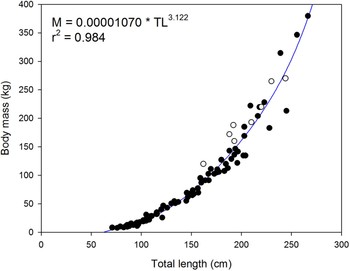
The intercepts (‘a’, or y-intercepts) and regression coefficients (‘b’, or slopes) from the linear regressions of the weight/length relationships were a =−11.387, b = 3.103 (r 2 = 0.979) for captive males; and a =−11.230, b = 3.081 (r 2 = 0.990) for captive females. There was no significant difference between sexes (t = 0.2895; df = 87; P = 0.773), therefore, we calculated a single linear regression for captive manatees (a =−11.281; b = 3.086; r 2 = 0.984) (Figure 1). The intercepts and slopes for the free-ranging manatees' linear regression were a =−6.499, b = 2.217 (r 2 = 0.921), and there was no significant difference between captive and free-ranging animals (t = 1.9664; df = 95; P > 0.05). Therefore, we calculated a single linear regression for the Amazonian manatee (a =−11.445; b = 3.122; r 2 = 0.984).
Scatter plot of log body mass on log total length for male (white circles; N = 46) and female (black circles; N = 45) captive Amazonian manatees Trichechus inunguis. Lines fitted by linear regression (blue dash line, males; pink dash line, females; and black solid line, both sexes).

In this way, the allometric equation of weight/length relationship for Amazonian manatees (Equation I) was defined as M = 0.00001070 * TL3.122 (Figure 2).
Relation between body mass (M) and total length (TL) in Amazonian manatees Trichechus inunguis (N = 99). Black circles, captive animals; white circles, free-ranging animals.

The two equations calculated to determine the body mass of manatees based on other morphometric measurements were defined as follows:


The residues between observed body mass values and estimated mass values from Equations I, II and III at the 90 percentile were 26.2%, 14.4% and 11.3%, respectively.
DISCUSSION
According to Best (Reference Best and Sioli1984), Amazonian manatee calves are born weighing 10–15 kg and 85–105 cm long. Nevertheless, we observed newborn individuals weighing 7.5 kg and 71.0 cm long. However, as most of the sampled animals were rescued, we cannot discount the possibility that these small animals were premature as a consequence of some stressful situation during pregnancy. The ranges of body mass and total length at birth (11.0–18.0 kg and 85.0–99.0 cm) of four animals born at the LMA/INPA (unpublished data) are in accordance with the data reported by Best (Reference Best and Sioli1984).
The biggest values of total length and body mass observed in this study (266.5 cm and 379.5 kg) were also smaller than previously reported data for the species (300 cm and 450 kg) by Husar (Reference Husar1977) and Rosas (Reference Rosas1994). The maximum length of an Amazonian manatee was originally reported by Vosseler (Reference Vosseler1924), who cited a male Amazonian manatee of 280 cm. However, it was a single animal and was measured following the curves of the body (curvilinear length) and the values reported by Husar (Reference Husar1977) and Rosas (Reference Rosas1994) (280–300 cm) were an extrapolation of Vosseler's datum. However, curvilinear length is not a reliable measurement, because individuals with the same total length can have different curvilinear lengths depending on their nutritional condition (Rosas, Reference Rosas1994). With this in mind, the Amazonian manatee from Vosseler's paper was certainly smaller than 280 cm. The other free-ranging Amazonian manatees (21 males and 14 females) captured for a radio tracking study measured up to 256 cm of total length (Rosas et al., Reference Rosas, Marmontel-Rosas and Best1985). On the other hand, the maximum total length in a sample of 70 captive Amazonian manatees (age range 0–29 years old) analysed by Albuquerque (Reference Albuquerque2003) was 236 cm and the asymptotic length estimated by the von Bertalanffy growth model was 228.6 cm. Thus we present the largest Amazonian manatee (266.5 cm) measured in a straight line, which allows us to suggest that the maximum length of Amazonian manatees probably is not greater than 275 cm.
According to Ayres & Best (Reference Ayres and Best1979), an adult Amazonian manatee can weigh between 400 and 500 kg. However, these data were at best tentative, as they were not calibrated on a scale. The maximum actual Amazonian manatee weight is the 379.5 kg here reported. Therefore, extrapolating our data, we believe that an Amazonian manatee probably does not reach much more than 420 kg.
According to Rosas (Reference Rosas1994), Amazonian manatees do not show size differences between sexes, which corroborates the absence of a significant difference between the male and female regressions observed in the present study.
Most of the animal species show a regression coefficient (slope) of weight/length relationship close to 3 (Santos, Reference Santos1978), which is also the rule for several aquatic mammals (Odell et al., Reference Odell, Forrester and Asper1978; Trites & Pauly, Reference Trites and Pauly1998; Rosas et al., Reference Rosas, Barreto and Monteiro-Filho2003, Reference Rosas, Rocha, Mattos and Lazzarini2009; Adulyanukosol et al., Reference Adulyanukosol, Prasittipornkul, Man-Anansap and Boukaew2007), including the Amazonian manatee (slope = 3.122). Nevertheless, the regression coefficient observed in this study was smaller than that previously reported for the Amazonian manatee (slope = 4.41; Rosas et al., Reference Rosas, Silva, Sousa-Lima, d'Affonseca Neto and Mattos2001). However, in that study Rosas et al. (Reference Rosas, Silva, Sousa-Lima, d'Affonseca Neto and Mattos2001) analysed only manatee calves up to three months old. Notwithstanding, it is well known that during the first year of life, most mammalian species gain more weight than length, and only after weaning, the longitudinal growth increases in proportion to the weight, and the regression coefficient tends to come closer to 3 (Rosas et al., Reference Rosas, Silva, Sousa-Lima, d'Affonseca Neto and Mattos2001).
Comparing the three equations obtained here, we observed that Equation III (using the body volume) predicted best, with the highest correlation coefficient and smallest residues. An equation that uses the maximum girth as one of the variables, such as Equation III, gives a more accurate mass estimation, because individuals with the same total length but different body mass will show a different maximum girth.
Thus the equation M = 1.070 * 10−5 * TL3.122 (Equation I) can express the weight/length relationship for the Amazonian manatee and is useful in husbandry when trying to assess the condition of specimens. However, mass estimation from Equation III (M = 1.506 + 3.477 * 10−5 * TL * MG2) was more accurate than the others. Therefore, these equations are useful tools for the husbandry of Amazonian manatees in rehabilitation centres, as well as for free-ranging Amazonian manatee studies.
ACKNOWLEDGEMENTS
We thank the PREVET staff for their help in data collection, Petra Löttker for translating the work of Vosseler (Reference Vosseler1924) and Dr George Nakamura and Kesä K. Lehti for reviewing the English version of the manuscript. The Amazonian Manatee Project (Projeto Peixe-boi) is supported by grants from PPG-7/FINEP, the Ministry of Science and Technology of Brazil (MCT), INPA, CNPq, AMPA, and the Programa Petrobras Ambiental through the Project Mamíferos Aquáticos da Amazônia: Conservação e Pesquisa.