Introduction
The problem of elder abuse in residential long-term care institutions has received increased attention in recent years (Shinan-Altman and Cohen, Reference Shinan-Altman and Cohen2009; Harnett and Jönson, Reference Harnett and Jönson2010) but few studies have examined its scope and correlates (e.g. Shinan-Altman and Cohen, Reference Shinan-Altman and Cohen2009; Harnett and Jönson, Reference Harnett and Jönson2010). Broadly defined, elder abuse in nursing homes encompasses physical, psychological and sexual abuse, financial exploitation, passive or active neglect, and violations of rights such as lack of privacy, de-individuation and disrespectful behaviors (Cohen et al., Reference Cohen, Halevy-Levin, Gagin, Priltuzky and Friedman2010). For the most part elder abuse in nursing homes is kept hidden inside the institution, which makes it difficult to determine its extent (Cooper et al., Reference Cooper, Selwood and Livingston2008).
According to the professional literature, nursing aides in nursing homes are a population at risk of engaging in abusive acts against the residents due to their being in daily direct contact with them and due to the work stressors they experience (Pillemer and Bachman-Prehn, Reference Pillemer and Bachman-Prehn1991; Ahmad and Lachs, Reference Ahmad and Lachs2002). Furthermore, negative attitudes among nursing staff at nursing homes may contribute to the frequency and severity of the abuse (Pillemer and Moore, Reference Pillemer and Moore1989; Harris, Reference Harris, Palmore, Branch and Harris2005). A growing body of literature demonstrates a connection between abusive behaviors and attitudes, since behavior appears to stem from an individual's own attitudes and values (Kogan, Reference Kogan1979; Patterson and Malley-Morrison, Reference Patterson and Malley-Morrison2006). Attitudes may therefore serve as predictors of a proclivity to elder abuse (Yan and Tang, Reference Yan and Tang2003). However, few studies have examined the factors affecting professionals’ attitudes to elder abuse generally, and in nursing homes in particular (Shinan-Altman and Cohen, Reference Shinan-Altman and Cohen2009; Almogue et al., Reference Almogue, Weiss, Marcus and Beloosesky2010).
Attitudes may develop in a cultural context, while they are also related to situational characteristics (Ajzen and Fishbein, Reference Ajzen and Fishbein1980; Aarons and Sawitzky, Reference Aarons and Sawitzky2006). Cultural factors may affect the views of diverse ethnic populations as to what constitutes abuse (Moon and Williams, Reference Moon and Williams1993; Anetzberger et al., Reference Anetzberger, Korbin and Tomita1996), yet few studies have examined how cultural groups differ in their attitudes to it (e.g. Moon and Williams, Reference Moon and Williams1993; Anetzberger et al., Reference Anetzberger, Korbin and Tomita1996; Tam and Neysmith, Reference Tam and Neysmith2006). For example, in a three-group comparative study of women's perceptions of elder abuse, Moon and Williams (Reference Moon and Williams1993) found that older Korean immigrant women were significantly less sensitive to potentially abusive situations than were Caucasian or African American women; Tam and Neysmith (Reference Tam and Neysmith2006) reported differences between American-Chinese immigrants’ definitions and Western definitions of abusive behaviors. A study in Israel found that the Ashkenazi sample stressed physical and economic abuse as forms of moderate abuse, and neglect and disrespect as forms of mild abuse, more than the Sephardic sample did (Rabi, Reference Rabi2006). Also, Anetzberger et al. (Reference Anetzberger, Korbin and Tomita1996) found differences in perceptions of elder abuse across four ethnic groups in the USA. No study assessing these differences among nursing aides could be identified.
Scrutiny of nursing aides’ attitudes to elder abuse in the multicultural Israeli population may foster a unique understanding of the cultural and situational context of these attitudes. Israeli society consists of two main cultural groups: Jews and Arabs. Israeli-Jewish society is mostly Western in its culture, norms, and attitudes to the elderly (Lavee and Katz, Reference Lavee and Katz2003) but is also characterized by family-oriented values, familial ties, and norms of care for the older family members (Lowenstein et al., Reference Lowenstein, Katz, Daatland, Silverstein and Schaie2005). Israeli-Arab society has a collectivist orientation and gives higher priority to needs of the family (nuclear and extended) than to those of the individual. Arab people absorb values of loyalty to and respect for their families (Dwairy and Achoui, Reference Dwairy and Achoui2006) as the elderly are perceived as the link between past and present and as a primary means for the transfer of knowledge and values (Sharon and Zoabi, Reference Sharon and Zoabi1997).
Attitudes to elder abuse may be affected by situational contexts, such as immigration. In Israel many of the nursing aides are new immigrants from the former Soviet Union (Harel-Bash, Reference Harel-Bash2003). Immigration often imposes many stressors on the individual, such as the experience of being uprooted from entire systems of meaning (Marris, Reference Marris, Coelho and Hamed1980), communication difficulties, changes in the family system, economic stress, diminished professional status, intolerance by the host society, social isolation, anxiety, and uncertainty regarding the future (Yakhnich, Reference Yakhnich2008). New immigrants in Israel encounter disparity between their occupational potential and the structural opportunities offered by the economy. Most of them undergo a temporary process of marginalization in the host society, and many have little chance of regaining their former status (Remennick, Reference Remennick1999). Often they take low-paid jobs with poor rewards, such as a nursing aide (Lowell and Gerova, Reference Lowell and Gerova2004), because of lack of job opportunities in their original occupation (Harel-Bash, Reference Harel-Bash2003).
According to Durkheim (Reference Durkheim, Spaulding and Simpson1961), social change can cause uncertainty and anomie if traditional norms fail to serve as formal or informal social structures and are unable to maintain solidarity, stability, trust and continuity. Immigration and resettlement are frequently fraught with conflict, ambivalence, adjustment difficulties and multiple psychological and vocational consequences (Iecovich, Reference Iecovich2005).
New immigrant nursing aides experience the enormous stressors of being newcomers (Patterson and Malley-Morrison, Reference Patterson and Malley-Morrison2006) and the multiple stressors of nursing aide work (Harel-Bash, Reference Harel-Bash2003). Among other things, the latter stressors may stem from the direct care the nursing aides render the residents, and from their work conditions. Most of what nursing aides do has been referred to as the “bed and body work” of changing linen and bathing, toileting, dressing and feeding the residents (Gubrium, Reference Gubrium1975). The demands of these human interactions are intensified by the difficulties of providing care to residents with multiple nursing needs who may have difficulty in communicating (Cohen-Mansfield and Noelker, Reference Cohen-Mansfield, Noelker, Cohen-Mansfield, Ejaz and Werner2000). They are involved in intense daily interaction with residents, who often exhibit behavioral problems; they earn low wages and generally enjoy no fringe benefits, they have low status, inferior employment conditions, and few or no opportunities for continuing education and development within the occupation (Harel-Bash, Reference Harel-Bash2003). In addition, nursing aides’ financial and family worries are likely to be personal sources of stress that can carry over to the work setting (Stone and Weiner, Reference Stone and Weiner2001).
Scholars previously grouped work stressors into three categories: role conflict, role ambiguity and work overload (Zellars et al., Reference Zellars, Perrewe, and Hochwarter2000). Role conflict occurs when conflicting demands at the job have to be met, whereas role ambiguity occurs when there is a lack of adequate information on how to do the job well (Maslach et al., Reference Maslach, Schaufeli and Leiter2001). Work overload is manifested by long or double shifts and weekend work schedules (Geiger-Brown et al., Reference Geiger-Brown, Muntaner, Lipscomb and Trinkoff2004). Role conflict, role ambiguity and work overload are frequently documented in the literature as determinants of burnout among healthcare workers (Jawahar et al., Reference Jawahar, Stone and Kisamore2007). Burnout is defined as a prolonged response to chronic emotional and interpersonal stressors encountered on the job (Maslach et al., Reference Maslach, Schaufeli and Leiter2001) and it consists of three components: emotional exhaustion, depersonalization, and reduced sense of personal accomplishment (Maslach and Jackson, Reference Maslach, Jackson, Maslach and Jackson1996).
Studies indicate that burnout and work stressors such as role conflict, role ambiguity and work overload are associated with attitudes condoning elder abuse by nursing aides (Pillemer and Moore, Reference Pillemer and Moore1989; Shinan-Altman and Cohen, Reference Shinan-Altman and Cohen2009). Pillemer and Moore (Reference Pillemer and Moore1989) found that burnout is related to physical abuse of patients, and it is believed to create negative job attitudes to, and perceptions of, elder patients.
Presently, Western countries are experiencing increasing immigration, and many of the new immigrants turn to work as nursing aides. They experience dual stressors, due to immigration and acculturation difficulties and to the stressful nature of this work. So examining the relation of culture and immigration to nursing aides’ attitudes to elder abuse is important, because these are possible risk factors for executing abusive behaviors against elder people (Pillemer and Moore, Reference Pillemer and Moore1989). However, to date no studies have examined these aspects of nursing aides.
The present study focuses on the multicultural nursing-aide workforce in Israel, which consists of three groups: veteran Israeli Jews, Israeli Arabs, and new immigrants, who differ in their cultural background and in the nature of the stressors experienced. The study set out to expand the limited body of knowledge of factors associated with attitudes to elder abuse, in respect of these three groups; in particular, its purpose was to contribute new knowledge about the influence of the unique stressors of immigration and acculturation on nursing aides’ attitudes to elder abuse. Our intention was to examine the attitudes of the veteran Jewish, Arab, and new immigrant nursing aides to elder abuse, and to examine demographic and work-related factors associated with these attitudes in the three groups.
Methods
Participants
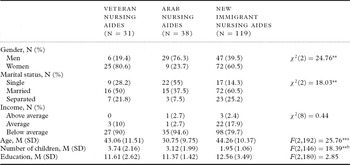
Participants were 188 nursing aides (31 veteran Israeli Jews, 38 Israeli Arabs, 119 new immigrants) at 18 nursing homes in central Israel. This distribution is similar to that of these groups among nursing aides in Israel generally (Harel-Bash, Reference Harel-Bash2003). For the purpose of the study, a new immigrant from the former Soviet Union is defined as a person who immigrated to Israel in the previous 20 years (Lerner et al., Reference Lerner, Kanevsky and Witztum2008). Table 1 presents the demographic characteristics of the veteran Jewish, Arab, and new immigrant nursing aides. More of the veteran Jewish and the new immigrant nursing aides were women, and more were married, than the Arab nursing aides; these were mostly men, and a higher percentage of them were single. The Arab aides were significantly younger than the other two groups, while the new immigrants had on average fewer children than the veteran Jewish and the Arab participants. The groups were similar in all the other demographic characteristics.
Nursing aides’ sociodemographic characteristics, by group

SD = standard deviation
*p<0.05; **p<0.01; ***p<0.001; aArabs < Veteran, new immigrants; bNew immigrants < Veteran, Arabs
Questionnaires
The work stressors questionnaire was developed by Rizzo et al. (Reference Rizzo, House and Lirtzman1970) and has been used in previous studies (Gonzales-Roma and Lloret, Reference Gonzalez-Roma and Lloret1998; Shinan-Altman and Cohen, Reference Shinan-Altman and Cohen2009). Participants were asked to rate the extent to which they experienced role ambiguity, role conflict and work overload (Gonzales-Roma and Lloret, Reference Gonzalez-Roma and Lloret1998). Each item was rated on a 5-point Likert scale from 1 = completely disagree, to 5 = completely agree. The role ambiguity subscale consisted of four items (e.g. “Explanations are clear of what has to be done”). The role conflict subscale consisted of five items (e.g. “I work with two or more groups who operate quite differently”) and the work overload subscale consisted of one item (“I never seem to have enough time to get everything done”). Six items were worded positively, and five negatively and reversed. A mean score for each subscale (Cronbach's α = 0.83 for role ambiguity; Cronbach's α = 0.56 for role conflict) and a total mean score of the work stressors were calculated (Cronbach's α = 0.51), with higher scores indicating higher levels of work stressors.
The emotional exhaustion and depersonalization subscales of the Maslach Burnout Inventory (Maslach and Jackson, Reference Maslach, Jackson, Maslach and Jackson1996) were used; seven items of the former subscale (e.g. “I feel that I work too hard”) and four of the latter (e.g. “I have become more rigid with others through my work in nursing homes”) were included, while items with low item-scale correlations were omitted. Each item was rated on a 5-point Likert scale from 1 = completely disagree, to 5 = completely agree. A mean score for each subscale (Cronbach's α = 0.84 for emotional exhaustion; Cronbach's α = 0.76 for depersonalization) and the total mean burnout scale were calculated (Cronbach's α = 0.87), with higher scores indicating higher levels of burnout. Owing to the high correlation between the subscales (r = 0.71), the total burnout score was used.
The Attitudes to elder abuse questionnaire has been previously described (Shinan-Altman and Cohen, Reference Shinan-Altman and Cohen2009). In brief, participants were presented with case vignettes portraying seven types of abuse of dependent elderly residents (physical, sexual, and psychological abuse; financial exploitation, active neglect, passive neglect, and violation of rights). The purpose was to probe the degree of granting legitimization to elder abuse. Participants were asked to answer two questions for each described situation: to what extent did they justify the described behavior; to what extent did they perceive this behavior as offensive to the elder person. Each item was rated on a 4-point Likert scale from 1 = not at all, to 4 = very much. Answers to the second question were reversed and a mean score was calculated: the lower the score, the less legitimization was accorded to abusive behaviors. Internal consistency (α) was 0.85.
The sociodemographic and work-related questionnaire collected data on characteristics such as gender, age, place of birth (Israel, Asia/Africa, Europe/America, other), year of immigration, and years of education. Work-related items included number of years in the profession, full- or part-time job, shift work (morning or evening), years of seniority in the profession and in the workplace, and case load (number of patients on each shift).
Procedure
Data reported here are part of a larger study investigating factors that influence nursing aides’ attitudes to elder abuse (Shinan-Altman and Cohen, Reference Shinan-Altman and Cohen2009). Before the interview process started, the face validity of the vignettes was assessed by three recognized professionals in the field of elder abuse, and a pre-test was conducted. Participants were interviewed face-to-face in a structured interview format. After receiving an explanation of the aims of the study, and giving informed consent, participants were presented with the questionnaires. The study was approved by the University of Haifa Ethics Board.
Statistical analysis
Data were analyzed with the SPSS program for Windows. Descriptive statistics (i.e. percentages, means, and standard deviations) were used to describe the sample and the main variables. Analysis of variance was used to assess differences between the study groups, followed by the post hoc Scheffe test for multiple comparisons to identify differences between pairs of groups. Correlations between study variables were assessed by Pearson or Spearman tests. Hierarchical regression analysis was conducted to assess the contribution of demographic and/or study variables to the explained variance of attitudes condoning abusive behaviors. In the first step the demographic variables that were significantly associated with attitudes condoning elder abuse were entered. Two dummy variables were constructed based on the group variable. The first consisted of new immigrants vs. veteran Jews and Arabs, the second of veteran Jews and new immigrants vs. Arabs. These two dummy variables were also entered in the first step. In the second step, work stressors and burnout were entered. In the third step, the interaction of work stressors × new immigrants (vs. veteran Jews and Arabs) and burnout × new immigrants were added. Variables were entered by the enter method. P values of 0.05 or lower were considered significant.
Results
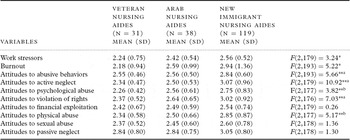
Table 2 shows means (SD) and differences in study variables between the veteran Jewish, Arab, and new immigrant groups. High levels of burnout (on a 1–5 scale) were reported by the new immigrants, compared to medium levels reported by the Arabs and lower levels reported by the veteran Jews. Participants reported a medium level of stressors at work (mean level about 2.5) with no significant differences between the groups.
Means (SDs) and differences between groups in study variables

SD = standard deviation.
*p < 0.05; **p <0.01.
aNew immigrants > Arabs> veterans; bNew immigrants > veterans
The overall score of attitudes condoning elder abuse was significantly higher in the new immigrant group than in the other two. As for attitudes to specific forms of abuse, new immigrant participants significantly condoned active neglect the most, while the veteran Jews did so the least. The differences were significant for each pair of groups. The new immigrants also condoned psychological abuse the most; the difference between their attitudes and that of the veteran Jews, who condoned it the least, was significant. The new immigrants condoned violation of rights and physical abuse significantly more than did the other two groups. All groups reported a medium level of attitudes condoning financial exploitation, sexual abuse, and passive neglect, with no significant differences among them.
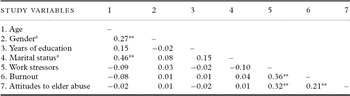
Associations between the study variables (age, gender, education, marital status, work stressors, burnout and attitudes to elder abuse) are presented in Table 3. Age, marital status and years of education were not significantly associated with the study variables. Work stressors and burnout were significantly and positively associated with attitudes condoning elder abuse: the higher the levels of work stressors and burnout, the greater the tendency to condone elder abuse. The work stressors variable was significantly and positively associated with burnout: the higher the levels of work stressors, the higher the levels of burnout.
Associations between study variables

aSpearman correlation
*p < 0.05; **p < 0.01.
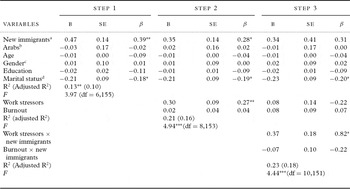
Table 4 shows the results of the multivariate regression analysis to assess the explained variance of the overall score of attitudes condoning elder abuse. Group and demographic variables were entered in the first step, and explained 13% of the variance. The variable of new immigrants (vs. veterans and Arabs) was significantly associated with attitudes condoning elder abuse, indicating greater condoning by the new immigrant group even after controlling for the other demographic variables. Being single was also associated with more condoning of abuse. In the next step work stressors and burnout were entered, adding 8% to the explained variance of attitudes condoning abuse. While the group variable and being married remained significantly associated with attitudes condoning elder abuse, work stressors, but not burnout, were also positively associated with attitudes condoning abuse. In the third step the interaction of work stressors and burnout with the group variable (new immigrants vs. veteran Jews and Arabs) was entered and added 2% to the explained variance. The group and work stressors variables ceased to be significantly associated with attitudes condoning elder abuse, while being married and the interaction of work stressors and new immigrant group was significantly associated with attitudes to elder abuse. Higher work stressors mainly in the new immigrant group were associated with attitudes condoning elder abuse.
Multivariate regression of attitudes to elder abuse

aNew immigrants = 1 (vs. veterans and Arabs) = 0; bArabs = 1, veterans and new immigrants = 2; cmen = 1, women = 0; dmarried = 1, single = 0.
*p<0.05, **p<0.01
Discussion
The main findings of the present study are that new immigrant nursing aides reported stronger attitudes condoning abusive behaviors than did veterans and Arab nursing aides. Controlling for demographic variables, greater condoning of elder abuse was associated with belonging to the new immigrant group, being unmarried, and reporting higher work stressors; the effect of work stressors on attitudes to elder abuse was especially prominent for the new immigrant group. While burnout was correlated with more condoning of elder abuse, this association was not significant when the other variables were controlled for in the regression analysis.
The higher condoning of elder abuse by new immigrants may be explained in several ways. First, perceptions of what constitutes elder abuse develop in relation to cultural and social values, traditions and beliefs (Nerenberg, Reference Nerenberg2000). Specific behaviors considered as abuse and neglect in Israel may be perceived as more legitimate in some immigrant cultures (Iecovich, Reference Iecovich2005). Other cross-cultural studies on attitudes to abuse revealed differences in how abuse is perceived and defined in different cultures (Moon and Williams, Reference Moon and Williams1993; Anetzberger et al., Reference Anetzberger, Korbin and Tomita1996; Tatara, Reference Tatara1999; Tam and Neysmith, Reference Tam and Neysmith2006). For example, the use of an older person's allowance by other needy family members may be acceptable in some cultures, while in others it will be seen as financial exploitation (Nerenberg, Reference Nerenberg2000).
The stronger tendency to condone elder abuse in the new immigrant group may be related to the stressors of immigration, such as communication difficulties, changes in the family system, economic stress, and uncertainly regarding the future (Yakhnich, Reference Yakhnich2008); likewise the stressors related to their work are characterized by low status and low pay (Harel-Bash, Reference Harel-Bash2003). Together, all these stressors may well take new immigrant nursing aides to the point where their problems and difficulties blunt their sensitivity to abusive behavior. Furthermore, condoning abusive behaviors may derive from unfamiliarity with definitions of what constitutes elder mistreatment and not from premeditated malice towards older people.
Unmarried nursing aides harbored more marked attitudes condoning elder abuse. It was previously reported that single people enjoy fewer support systems (Datta et al., Reference Datta, Neville, Kawachi, Datta and Earle2009) and suffer from higher levels of psychological stress (Goldzweig et al., Reference Goldzweig, Andritsch, Hubert, Brenner, Walach, Perry and Baider2010). Also, previous studies found that lower social support was a risk factor for elder abuse among family caregivers (Cohen et al., Reference Cohen, Halevy-Levin, Gagin and Friedman2006) and among nursing aides (Goergen, Reference Goergen2001).
In line with our previous report, attitudes condoning abuse were found also to be related to higher burnout (Shinan-Altman and Cohen, Reference Shinan-Altman and Cohen2009), but when the demographic and other study variables were controlled for, the association ceased to be significant. However, higher work stressors were significantly associated with stronger tendency to condone elder abuse. These findings support previous studies which demonstrated a connection between work stressors and elder abuse among nursing aides in nursing homes (Pillemer and Moore, Reference Pillemer and Moore1989; Shinan-Altman and Cohen, Reference Shinan-Altman and Cohen2009). However, in the present study we demonstrate an effect of the interaction between work stressors and being part of the immigrant group on attitudes to abuse, namely higher work stressors were especially related to greater condoning of elder abuse in the new immigrant group. This highlights yet again the impact of the combined stressors of being immigrants with the specific work stressors of the nursing aide job. Furthermore, language and communication problems, economic stress, reduced professional status, social isolation, anxiety, uncertainty regarding the future and unfamiliarity with codes of behavior can increase role ambiguity and conflicts with staff, residents and family members.
As many cultures are experiencing expanding immigration processes, the present results call for attention to the unique stressors of immigrant nursing aides and their effect on attitudes to abusive behaviors, and perhaps on actual abuse as well. Further studies are needed to examine the effect of immigration on nursing aides’ attitudes and behaviors.
The results of this study have significant implications for organizations that provide services for elderly people, and for policy-makers as well. Careful planning of the professional guidance and support provided to new immigrant nursing aides may significantly clarify what is expected of them, which in turn will reduce work stressors. Interventions with new immigrant nursing aides should aim to buttress their self-image and broaden their knowledge of caring for elder persons. Attention should be paid to increasing knowledge of identifying elder abuse and coping with complicated situations that may arise in the interaction with older patients. These skills will serve nursing aides in contending with multiple stressors. Such interventions will help to empower new immigrant nursing aides and enhance their work satisfaction and well-being.
The present results should be interpreted with caution because of several limitations. The study was based on a convenience sample and the number of participants in each group might hinder generalization of the findings to other groups of nursing aides. Secondly, the study was based on self-reporting, which allows the possibility that the nursing aides’ answers might have been biased due to social desirability or fear of revealing their attitudes. These limitations notwithstanding, the present study is the first to assess attitudes to elder abuse in different cultural groups of nursing aides and in relation to work stressors characteristic of nursing homes. Further studies assessing associations between attitudes and actual behaviors are needed.
Conflict of interest
None.
Description of authors' roles
Each author made an equal contribution to the research.
Acknowledgments
This study was partially supported by a grant from Myers-JDC-Brookdale Institute of Gerontology and Human Development, and Eshel, the Association for the Planning and Development of Services for the Aged in Israel.