Introduction
The growing literature on immigration has mainly focused on acculturation and upward mobility of working-age immigrants and their children (Leach Reference Leach2008). The experience of older foreign-born populations, which represents a crucial intersection of ageing and immigration, has been largely under-studied (Treas and Torres-Gil Reference Treas and Torres-Gil2008). Older immigrants are an important sector of both immigrant and older populations. In the United States of America (USA), 12 per cent of immigrants are older adults, a population that has nearly doubled between 1990 (2.7 million) and 2007 (4.5 million), accounting for one of every nine older individuals in the USA (Terrazas Reference Terrazas2009). Due to fewer opportunities to assimilate, older immigrants have different experiences than both younger immigrants and native-born older Americans (Johnson Reference Johnson2008). Ignoring older adults in immigration studies may result in an incomplete picture of immigrants in the USA.
Family is a crucial setting to explore the adjustment and wellbeing of older immigrants. The life and wellbeing of older immigrants are intrinsically linked with their families, in general, and adult children, in particular. Most older immigrants come to the USA to join their children (Leach Reference Leach2008). Older immigrants often remain very much the responsibility of their adult children as a result of the elders' limited English skills, unfamiliarity with US society, and lack of access to public resources or programmes (Glick Reference Glick2010). Maintaining close relationships with children, therefore, serves as an important buffer against various stressors that older immigrants encounter in the new society (Katz and Lowenstein Reference Katz and Lowenstein1999). Younger immigrants also benefit from close parent–child relationships by receiving assistance such as child care and help with household work from their parents (Johnson Reference Johnson2008). The success of many immigrant families exemplifies the benefits of such close intergenerational relationships. Identifying predictors of close parent–child relationships in immigrant families has important theoretical and practical implications. Such knowledge would not only contribute to theoretical understanding of immigrant and ethnic ageing in a family context, but also help identify older immigrants in specific families that are at risk of adverse wellbeing outcomes. Because older immigrants without strong family ties may prefer to rely on formal care rather than informal support from the family when assistance is needed, a better understanding of the family relations among older immigrants will help inform policy makers to prioritise public resources to address better the needs of this rapidly increasing population.
Despite the importance of this issue, there has been rather limited attention to family relationships among older immigrants as compared to other populations such as children and adolescents (Glick Reference Glick2010). The existing knowledge of parent–child relationships in older immigrants has been exclusively derived from qualitative studies (e.g. Ajrouch Reference Ajrouch2005; Ip, Lui and Chui Reference Ip, Lui and Chui2007; Lowenstein and Katz Reference Lowenstein and Katz2005; Wong, Yoo and Stewart Reference Wong, Yoo and Stewart2005). We are not aware of any previous quantitative studies examining this topic. Although qualitative studies have provided valuable information on family dynamics of older immigrants, they have been limited by small sample sizes, lack of generalisability and inability to test specific hypotheses.
To fill this research gap, this study explored the factors contributing to close parent–child relationships among older Chinese immigrants in the USA. Several characteristics of Chinese immigrants make them an interesting population to study. Chinese immigrants constitute the second-largest immigrant group in the USA (McCabe Reference McCabe2012). On average they are older than both native-born and foreign-born Americans (McCabe Reference McCabe2012). Among Chinese older adults living in the USA, more than 80 per cent are foreign born and more than 30 per cent immigrated after age 60 to reunite with their children (Mui and Shibusawa Reference Mui and Shibusawa2008). Chinese immigrants are characterised by a strong sense of family and cultural norms of filial piety, i.e. expectations that adult children will defer and provide care to their ageing parents (Li et al. Reference Li, Hodgetts, Ho and Stolte2010). Although deeply rooted in the traditional Chinese culture, the value of filial piety may be challenged and altered upon arrival in a new society, influencing the ways in which family members interact. Focusing on older Chinese immigrants and examining the potential linkage between filial piety and parent–child relationships will shed light on how attitudes and beliefs of immigrant families may adapt to the host society. In addition, inquiry of this topic is timely. A recent comprehensive review of studies on various aspects of family relations among older Chinese immigrants found that only two of the 36 identified articles investigated the issue of quality of parent–child relationships (Lin et al. Reference Lin, Bryant, Boldero and Dow2014). Both studies were qualitative and descriptive and did not explain why some older immigrants were emotionally close to their children whereas others were not.
To address this issue systematically, we first reviewed empirical findings on factors relating to parent–child relationships, in general, and in immigrant families, in particular. Based on existing knowledge, we developed five hypotheses.
Factors affecting parent–child relationships in later life
The multi-disciplinary body of literature on family proximity, helping behaviour and support exchange has identified the following factors that affect relationship quality between older parents and adult children: living arrangement, frequency of interaction, intergenerational support exchange and commitment to meeting filial obligations.
Living arrangement and parent–child relationships
Living arrangement is one of the most important predictors of kinship interaction. Although strong parent–child ties often correspond to close proximity (Aquilino Reference Aquilino1999; Selvarajah Reference Selvarajah2004), research has also found a lack of differences in relationship quality between older parents with local and distant children (Guo, Chi and Silverstein Reference Guo, Chi and Silverstein2009; Shapiro Reference Shapiro2004). In the context of immigration, forming multigenerational households is a widespread strategy used by immigrant families to cope with challenges faced in the host society. Although most US-born White older adults live alone or with a spouse only, many older immigrants live in extended households with their children due to high rental costs, insufficient personal income, the need for mutual help and cultural preference (Gurak and Kritz Reference Gurak and Kritz2010). Older Asian immigrants, in particular, tend to live almost exclusively with their adult children, regardless of gender or marital status (Hsueh, Hu and Clarke-Ekong Reference Hsueh, Hu and Clarke-Ekong2008; Kritz, Gurak and Chen Reference Kritz, Gurak and Chen2000). This type of living arrangement helps both generations share economic resources, facilitate support exchanges, access information and maintain cultural identity (Lowenstein and Katz Reference Lowenstein and Katz2005).
Despite the benefits associated with co-residence, it may place stress on intergenerational relationships by creating tensions and a sense of lost identity, status and control among older immigrants (Wilmoth and Chen Reference Wilmoth and Chen2003). Intergenerational conflicts appear to be common in co-residing immigrant families because the younger generation more readily adapts to American-oriented values, attitudes and lifestyles that often conflict with the world-views of the older generation (Choi Reference Choi2000; Miranda et al. Reference Miranda, Bilot, Peluso, Berman and Van Meek2006). Although an extended household is traditionally the ideal living arrangement of older adults from more collectivist cultures, there is evidence of divergence from this traditional view and preference for independent living among older Chinese, Korean and Latino immigrants (Beyene, Becker and Mayen Reference Beyene, Becker and Mayen2002; Kauh Reference Kauh1997; Lai Reference Lai2005; Lan Reference Lan2002; Mackinnon, Gien and Durst Reference Mackinnon, Gien and Durst1996). For instance, a study of more than 2,000 older Chinese immigrants in Canada found that half of the respondents preferred not to live with their children (Lai Reference Lai2005).
Given the negative and positive aspects of co-residence, it is not surprising that research findings regarding the influence of co-residence on parent–child relationships among older immigrants have been inconclusive. A study with older Russian immigrants in Israel reported that quality of relationships with children did not differ between separate or shared households (Lowenstein and Katz Reference Lowenstein and Katz2005). However, a joint living arrangement was found to be associated with closer mother–child relationships and more distant father–child relationships among older Korean immigrants (Kauh Reference Kauh1997). Both the studies were qualitative. Given the prevalence of co-residence among immigrant families, more quantitative studies are needed to understand the ways in which it may influence parent–child relationships. In this study, we hypothesised that co-residence is associated with poor parent–child relationships as a result of increased potential for conflict in co-habiting immigrant families and the changing preference for independent living among older Chinese immigrants.
Frequency of contact and parent–child relationships
Contact from children demonstrates their greater involvement with older parents, potentially increasing the quality of parent–child relationships. Again, research findings regarding this assumption have been mixed. Although frequent interactions were found to strengthen family ties (Mercier, Shelley and Wall Reference Mercier, Shelley and Wall1997), they do not necessarily predict close parent–child relationships. A longitudinal study of older Welsh adults found that despite increased contact from children over time, fewer older adults felt emotionally very close to their children (Burholt and Wenger Reference Burholt and Wenger1998).
Frequent intergenerational contact is common among immigrant families as a result of co-residence and need for mutual support. A study of older Chinese immigrants in Queensland found that more than 60 per cent of the elders had frequent in-person or telephone contact with their children (Ip, Lui and Chui Reference Ip, Lui and Chui2007). Another study of older Chinese immigrants in Britain showed that about a quarter of the elders had at least one monthly visit from children (Chiu and Yu Reference Chiu and Yu2001). Such frequent contact, however, does not necessarily induce intimate relationships. Older Chinese immigrants in both studies indicated a sense of loneliness and lack of quality communications with their children despite routine interactions. In this study, we hypothesised that frequency of contact with children is not associated with parent–child relationships because such contact may be simply a result of co-residence and need for support exchanges in immigrant families.
Intergenerational support exchange and parent–child relationships
Intergenerational support may strengthen family ties by sharing resources, buffering stress and providing assistance when needed. Studies on support from adult children to older parents reported both positive (Burholt and Dobbs Reference Burholt and Dobbs2010) and negative (Silverstein, Chen and Heller Reference Silverstein, Chen and Heller1996) effects and a lack of influence (Rook and Ituarte Reference Rook and Ituarte1999) of such support on parent–child relationships. Challenges associated with immigration may make intergenerational support more desirable for both generations. Although the family interactions of older Americans usually involve a delicate balance of intimacy and independence, immigrant families are characterised by greater intergenerational interdependence (Kritz, Gurak and Chen Reference Kritz, Gurak and Chen2000; Treas Reference Treas2008b ). Without personal income and familiarity with the foreign culture, older immigrants rely heavily on their adult children for practical support such as transportation, language brokering and financial assistance (Chun and Lee Reference Chun and Lee2006; Wong, Yoo and Stewart Reference Wong, Yoo and Stewart2005). Older Asian immigrants, for instance, were reported to rely heavily on their adult children to meet economic and care needs (Choi Reference Choi2000). Although support from children plays a critical role in helping older immigrants adapt to the new environment, older immigrants relying on their children for financial or practical support reported worries of becoming a burden to them (Dong et al. Reference Dong, Chang, Wong, Wong, Skarupski and Simon2010; Wong, Yoo and Stewart Reference Wong, Yoo and Stewart2005). Such concern seemed to strain their relationships with adult children (Ip, Lui and Chui Reference Ip, Lui and Chui2007; Mackinnon, Gien and Durst Reference Mackinnon, Gien and Durst1996). Given both the importance of children's support for older immigrants and the potential strains it may place on family relations, we hypothesised that receiving support from children is associated with parent–child relationships, with no specified direction of influence.
Older parents also provide various forms of help to their children. Older immigrants actively contribute to their families through help with child care and household work (Treas and Mazumdar Reference Treas and Mazumdar2002). Many duty-bound older immigrants come to the USA with the sole purpose of helping their children succeed in the new society. Some older immigrants take over child care and housework to ensure their children can concentrate on work (Kauh Reference Kauh1997; Treas Reference Treas2008a ). Although there is a lack of research on how providing support to children might influence older immigrants' rating of intergenerational relationships, studies with older adults in general have reported mixed findings. On one hand, providing assistance to adult children may improve family relationships by fostering a sense of gratification and fulfilment among ageing parents (Ingersoll-Dayton, Neal and Hammer Reference Ingersoll-Dayton, Neal and Hammer2001; Silverstein, Cong and Li Reference Silverstein, Cong, Li, Powell and Cook2007). On the other hand, offering financial and practical support to children was also found to be associated with lower ratings of relationship quality and a greater sense of ambivalence towards children when older parents had limited resources and such support reflected asymmetrical helping relationships across generations (Guo, Chi and Silverstein Reference Guo, Chi and Silverstein2013; Phinney et al. Reference Phinney, Horenczyk, Liebkind and Vedder2001). Given these inconclusive findings, we hypothesised that providing support to children is associated with parent–child relationships, but again, with no clear direction of influence.
Sense of filial piety and parent–child relationships
Filial piety, a cultural norm rooted in Confucianism, is a defining character of Chinese culture. The conceptualisation of filial piety involves two principles: to respect one's parents and to care for one's parents (Sung Reference Sung1995). To respect older adults means children should treat parents with ‘deference, courtesy, esteem, and earnest and sincere consideration’ (Sung Reference Sung1995: 245). It is a core idea of filial piety and is considered essential to harmonious parent–child relationships (Sung Reference Sung1995). To care for one's parents involves a series of practical behaviours, including providing physical and financial support (Zhan Reference Zhan2004). Whereas practical support can be easily assessed and readily provided, behaviours that show respect such as using polite language, seeking advice from parents and keeping them informed of happenings are more nuanced expressions of children's filial piety, indicating their acknowledgement of their parents' status in the family (Choudhry Reference Choudhry2001). An old Chinese saying emphasises the importance of children's deference in parent–child relations: baixiao shun wei xian, or ‘among the hundred ways of showing filial piety, deference is of first importance’.
Theories of acculturation have been used extensively to study immigrants' adaptation and modification of values and attitudes from their countries of origin in the receiving context (Glick Reference Glick2010). Compared to younger immigrants, individuals who migrate at an older age may be less willing to accept changes in family relationships that occur in the host country (Glick Reference Glick2010). After migrating, older Chinese adults maintain relatively high filial expectations of their children (Lin et al. Reference Lin, Bryant, Boldero and Dow2014). In a study of older Chinese immigrants in Britain, the vast majority of participants agreed that children should take care of their older parents (Chiu and Yu Reference Chiu and Yu2001). Despite such high filial expectations, there seems to be a disconnection between parental expectations and actual receipt of care (Dong et al. Reference Dong, Chang, Wong and Simon2012). Some young Chinese immigrants used paid care instead of providing direct care to fulfil their filial obligations (Lan Reference Lan2002). A recent study suggested that the main source of old-age support might be shifting from adult children to community service centres among Chinese immigrants (Dong, Zhang and Simon Reference Dong, Zhang and Simon2014). In addition, power dynamics can shift in immigrant families as older immigrants gradually lose authority and roles in the family that they used to hold and become peripheral to the nuclear family (Wong, Yoo and Stewart Reference Wong, Yoo and Stewart2006). Older immigrants appear alienated when it comes to conversations regarding important matters with their adult children, and they often have little influence in family decision making (Lin et al. Reference Lin, Bryant, Boldero and Dow2014). With these changes, a sense of children's deference might be particularly beneficial to parent–child relationships among older immigrants. Thus, we hypothesised that perception of children being deferential is associated with close parent–child relationships.
The present study
Overall, research explaining the quality of older parent–adult child relationships have been limited and findings have been inconclusive. Family relationships are altered upon immigration, making co-residence, intergenerational contact and support exchanges more common among immigrant families. The traditional norm of filial piety is also challenged in the new social context. Given these new family realities, this study asked the question: in what ways are these family-related factors (i.e. co-residence, frequency of contact, support exchanges and sense of children's deference) associated with parent–child relationships among older Chinese immigrants? Based on the reviewed literature, we developed the following hypotheses:
-
• Hypothesis 1: Co-residence with children is associated with poor parent–child relationships.
-
• Hypothesis 2: Frequency of contact with children is not associated with parent–child relationships.
-
• Hypothesis 3: Receiving support from children is associated with parent–child relationships (no specific direction of influence).
-
• Hypothesis 4: Providing support to children is associated with parent–child relationships (no specific direction of influence).
-
• Hypothesis 5: Perception of children being deferential is associated with close parent–child relationships.
Methods
Sample and procedure
The study adopted a purposive sampling method to recruit Chinese older adults in the Los Angeles metropolitan area who were: (a) 60 years old or older, (b) born in mainland China and (c) had at least one child living in Los Angeles. Potential locations to recruit eligible participants included senior housing and social service agencies in Chinese communities such as senior centres, adult day-care centres and Chinese churches. Human subject research approval was obtained from the University of Southern California Institutional Review Board. Between summer 2010 and autumn 2012, 236 eligible older Chinese immigrants were recruited in the study.
Bilingual students were trained to administer a structured survey questionnaire through face-to-face interviews in either Mandarin or Cantonese. Participants were provided with either written or verbal informed consent before the interviews. The focus of the interviews was on family relationships between the participants and their children who also lived in Los Angeles. Participants discussed each child at length, beginning with the eldest child living in Los Angeles and moving to the same set of questions about the second-eldest child in Los Angeles, and so on. Information regarding socio-demographic characteristics of both parents and children was also collected. The average length of the interviews was approximately 50 minutes. Upon completion of the questionnaire, each participant received a gift card worth US $20. The 236 participants provided information regarding 365 children.
Measures
The dependent variable – quality of relationships in each parent–child dyad – was assessed by three questions adapted from the Intergenerational Solidarity Inventory (Mangen, Bengtson and Landry Reference Mangen, Bengtson and Landry1988). Respondents were asked to answer the following questions: (a) ‘Taking everything into consideration, how close do you feel to this child?’ (b) ‘How much do you feel that this child would be willing to listen when you need to talk about your worries and problems?’ and (c) ‘Overall, how well do you and this child get along together?’ For each question, the responses ranged from 0 to 2 (0 = not at all, 1 = somewhat, 2 = very). An additive score was calculated for each child, ranging from 0 to 6, with higher scores indicating closer parent–child relationships. The scale has been validated among Chinese older populations (Silverstein, Cong and Li Reference Silverstein, Cong and Li2006). In this study, the reliability of this scale was 0.74.
Independent variables included living arrangement, frequency of contact, intergenerational support exchanges and parental perceptions of children's deference. Living arrangement was a dichotomous variable, with 1 = living together with the child (co-residence). Frequency of contact was indicated by either in-person or telephone contact: 1 = rarely, 2 = a few times a year, 3 = monthly and 4 = weekly. Because almost 60 per cent of the children in the study had weekly contact with their parents, this variable was recoded as 1 = weekly contact. Intergenerational support included monetary and instrumental support. Monetary support was assessed by the value of money and gifts that the parent received from and provided to each child during the previous year. Natural logarithms of the values plus one were used due to the skewed distribution of the variables. Instrumental support from children to parents was assessed by a dummy variable indicating whether the child helped the parent with personal care or household chores during the previous year (1 = yes). A dummy variable indicating whether the parent helped the child with child care in the past year (1 = yes) was used to assess instrumental support from parents to children. To assess perceived children's deference, participants were asked to rate how willing the child was to accept their suggestions or requests, with 1 = not willing, 2 = sometimes willing and 3 = always willing.
Control variables included demographic characteristics and socio-economic status (SES) of both parents and children. Demographic attributes included age, gender and length of residence in the USA. Age and length of residence in the USA were measured in years. Gender was a dichotomous variable with female = 1. SES was assessed by levels of education and economic status. For both parents and children, levels of education included: 1 = junior high school or below, 2 = senior high school or vocational training and 3 = college or above. Economic status of the parents was determined by the total income that the respondent (and spouse, if married) had received from work or pension during the previous year. For monetary support, the natural logarithm of the value plus one was used to represent income. Respondents reported children's economic status as 1 = having financial difficulties, 2 = sufficient and 3 = having a surplus.
Data analysis
We first provide descriptive statistics of the sample characteristics and key variables. Because the dependent variable (i.e. quality of parent–child relationships) was reported for 365 children nested within 236 parents, two-level regression models were estimated in three steps. The first (Model 1) and second (Model 2) steps examined the effect of children's and parents' socio-demographic attributes on parent–child relationships, respectively. The third step (Model 3) added the independent variables. This sequence allowed us to examine the unique contribution of the independent variables on quality of parent–child relationships beyond the possible effect of children's and parents' personal characteristics. The regression analyses were carried out in Stata using the xtmixed command (Albright and Marinova Reference Albright and Marinova2010; StataCorp 2005).
Results
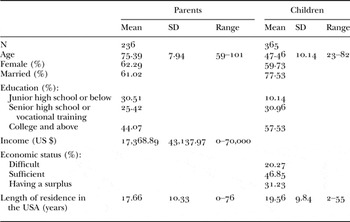
Sample characteristics are reported in Table 1. The average age of the parents and children was 75 and 47 years old, respectively. A majority of both parents (62%) and children (60%) were women. More than 40 per cent of the parents had college-level education or above, compared to 58 per cent of the children. The average annual income of the parents was US $17,369 (SD = 43,139). Of adult children, 20 per cent were reported to have financial difficulties; nearly half (47%) were reported as having sufficient economic resources; and 31 per cent were reported as having a surplus. Overall, both the parents and children had stayed in the USA for almost two decades (mean = 18 and 20 years, respectively).
Sample characteristics of the parents and children in the Los Angeles study

Notes: SD: standard deviation. USA: United States of America.
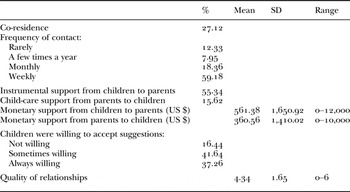
Table 2 summarises parent-reported dyadic relationships with their children. Accordingly to the parents, 27 per cent of their children lived with them; the majority of children contacted their parents at least weekly (59%) and had provided instrumental support to them during the previous year (55%). About 16 per cent of the children also received help with child care from their parents during the last year. On average, children had provided more monetary support to their parents (mean = US $561, SD = 1,651) than they received from them (mean = US $361, SD = 1,410). The majority of children (79%) were reported to be either sometimes or always willing to take suggestions or requests from their parents. The average emotional cohesion score between the generations was 4.34 on a scale of 0–6.
Parent-reported dyadic relationships in the Los Angeles study

Notes: N = 365. SD: standard deviation.
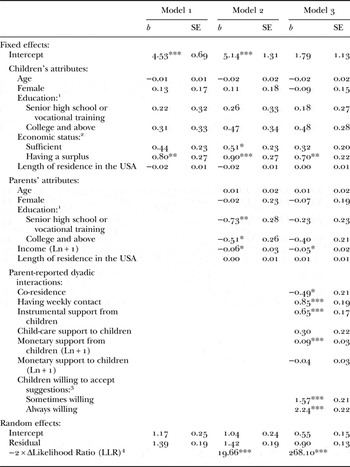
Table 3 summarises the results of the regression analyses predicting quality of parent–child relationships. Model 1 showed that older adults in this study reported closer relationships with children who had better economic status. Adding parental characteristics, Model 2 showed that higher level of education and income among older adults were related to poorer relationships with their children. When the key study variables were added in Model 3, co-residence was found to be associated with poorer parent–child relationships. In addition, parents reported closer relationships with children who had at least weekly contact with them, who had provided instrumental support to them, who provided greater amounts of monetary support and who showed greater levels of deference.
Two-level regressions predicating quality of parent–child relationships

Notes: N = 358. SE: standard error. USA: United States of America. 1. Reference category is junior high school or below. 2. Reference category is having financial difficulties. 3. Reference category is not willing. 4. Compared to the previous model.
Significance levels: * p < 0.05, ** p < 0.01, *** p < 0.001 (two-tailed).
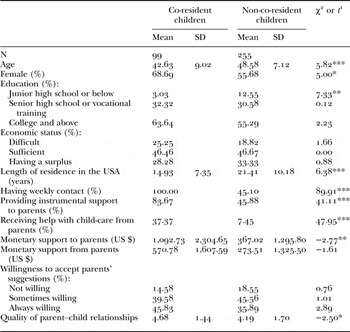
To understand further why co-residence was related to poorer parent–child relationships, we conducted chi-square tests and t-tests to compare children who lived with and without parents in terms of personal attributes and patterns of intergenerational interactions. As shown in Table 4, compared to non-co-residing children, those who lived with parents were significantly younger, more likely to be women, more likely not to be married and had lived for significantly shorter periods in the USA. Not surprisingly, co-residing children were significantly more likely to have weekly contact with parents, to provide instrumental support to them, and to receive child-care assistance from them. In addition, on average, co-residing children provided almost three times more monetary support to their parents (US $1,093 versus US $367, respectively), but also received twice the amount of monetary support from parents (US $571 versus US $274, respectively) than non-co-residing children. Although in the multivariate analyses, co-residence was associated with poorer parent–child relationships, it was positively related to relationship quality in the bivariate analyses.
Personal attributes and intergenerational interactions of Chinese immigrant children by living arrangement

Notes: USA: United States of America. 1. Chi-square test for categorical variables; t-test for continuous variables.
Significance levels: * p < 0.05, ** p < 0.01, *** p < 0.001.
Discussion
International migration involves a permanent change in the social and cultural environment of individuals and their families. These changes require adaptation by all generations in the family, inevitably generating stress in intergenerational relationships. Focusing on older Chinese immigrants – a group of older adults that strongly endorses collectivist family values and norms of filial piety – this study examined factors associated with close parent–child relationships in immigrant families.
Our first hypothesis, that co-residence is associated with poor parent–child relationships, was supported. This is an important finding because it demonstrates that this prevalent living arrangement among immigrant families may actually compromise intergenerational relations. In this study, co-residence represented both resources and threats to family relations. On one hand, the bivariate analyses indicated that co-residence ensured more regular contact with and greater support from children (Table 4). Both factors were associated with closer relationships with children (Table 3). On the other hand, when the benefit of frequent contact and greater support was controlled for in the multivariate analyses, co-residence became a risk factor for poorer parent–child relationships, regardless of parents' and children's socio-demographic characteristics (Table 3). Conflict across generations, a factor not included in this study, might have contributed to this finding. Living with children may mean living with conflicts (Moon and Cho Reference Moon, Cho, Chang and Downey2012). Living separately from children may help families avoid intergenerational conflicts and tensions. In this study, non-co-habiting dyads had limited support exchanges in terms of housework and child care, and thus might have little to disagree or argue about and were able to maintain harmonious relationships. The possible negative interactions in co-residing immigrant families warrants future research.
It is also possible that the decision to live together was not made freely but rather forced by economic imperative and housing constraints (Lowenstein and Katz Reference Lowenstein and Katz2005). Living arrangements are shaped by availability of choices and resources. Forming multigenerational households might be a survival strategy of immigrant families in response to limited income and lack of resources (Gurak and Kritz Reference Gurak and Kritz2010). Co-residing children in this study seemed to be relatively recent immigrants with greater dependence on their parents. Compared to children who did not live with parents, children living with parents were younger, relatively newer to the country and more likely to be women. A quarter of the co-residing children were reported by their parents to have economic difficulties, as compared to less than 20 per cent among non-co-residing children (Table 4). In addition, on average, older adults in this study reported being poorer than older Americans in general. The median income of the sample was US $9,600, as compared to the national medians of US $27,707 for older men and US $15,362 for older women (Administration on Aging 2012). Without economic alternatives, older immigrants in this study may not be able to live independently from their children even if they wished. Although co-residence is the traditionally preferred living arrangement of older Chinese adults, this customary norm may be different in American society, where maintaining independence and autonomy are commonly desired goals in later life (Burholt and Dobbs Reference Burholt and Dobbs2010). Our finding suggests that having privacy and asserting control over their own lives might be essential to close parent–child relationships among older Chinese immigrants.
Our findings failed to support the second hypothesis, showing that frequent contact with children was associated with closer parent–child relationships after controlling for co-residence and intergenerational support in the multivariate analyses. This result indicates the importance of maintaining regular contact with ageing parents in immigrant families. Although the content and the quality of contact were not assessed in this study, simply making contact appeared to be beneficial to parent–child relations. The findings may reflect a sense of loneliness and isolation that is commonly experienced by older immigrants (Treas and Mazumdar Reference Treas and Mazumdar2002). Even a routine phone call to check on older immigrants may make them feel cared for.
Although previous qualitative studies have reported that depending on children for practical support might be viewed by older immigrants as placing a burden on their children and that parents who received such support felt they needed to please or comply with their children (Mackinnon, Gien and Durst Reference Mackinnon, Gien and Durst1996; Yoo and Kim Reference Yoo and Kim2010), our study did not find that such support harmed parent–child relations among older immigrants. Instead, our findings showed that receiving support from children was associated with older immigrants' favourable rating of relationships with them, even among long-term immigrants like our respondents (average length of residence was 18 years). Practically speaking, such support represented an important resource for these older immigrants, who had lower-than-average income. From the cultural perspective, receiving support from children may help fulfil their filial expectations. Legal enforcement of familial responsibility for older immigrants by government may also shape family norms and expectations for adult children in terms of supporting their ageing parents (McDonald Reference McDonald2011). Such informal support will likely remain at the centre of care for older immigrants to bridge the gap between government resources and needed assistance among immigrant populations.
Regarding our fourth hypothesis, we did not find significant relationships between support provision and relationship quality in our sample. The finding seems to be contradictory to the literature, which has emphasised reciprocity and mutuality in family relations in later life (Kulis Reference Kulis1992; Schwarz et al. Reference Schwarz, Trommsdorff, Albert and Mayer2005), particularly given that these older people rely heavily on their children for various forms of support. Again, we speculate that these findings reflect different expectations and norms of family interactions in immigrant families. Although native-born White older Americans tend to provide more monetary support to children than they receive (Lye Reference Lye1996), such assistance may be less available and not expected among older immigrants, who commonly rely on children for financial support due to limited economic resources and lack of access to social services such as Social Security and Medicare (Treas Reference Treas2008b ). In our review of literature on family relations among older Chinese immigrants, none of the studies reported financial support from parents to children (Lin et al. Reference Lin, Bryant, Boldero and Dow2014). Although older immigrants in our study did provide financial support to children, the average amount was modest (US $360 per year). Such assistance might be in the form of gifts, not necessarily implying closer relationships with the child.
Helping children with child care was not associated with closer parent–child relations either. Providing such support is very common among Chinese immigrant families. Many older Chinese adults make their first trip abroad for the sole purpose of helping care for grandchildren. Because it is commonly expected, assistance with child care may not necessarily enhance the quality of intergenerational bonds. Instead, the grandparenting role can be stressful and exhausting, leaving older adults with little time of their own and limited opportunities for social activities outside the home (Treas and Mazumdar Reference Treas and Mazumdar2002). Generational differences in beliefs and practices of raising children are also common in immigrant families, which may result in conflict and disagreement across generations. In sum, although numerous studies have reported the psychological benefits of providing child-care support to children among urban and rural Chinese older adults (Chen and Liu Reference Chen and Liu2012; Xu et al. Reference Xu, Wu, Chi and Hsiao2012), our study failed to find such benefits for parent–child relationships among older Chinese immigrants.
Our last hypothesis, that parental perceptions of children being respectful is associated with better relationship quality ratings, was supported, revealing that older Chinese immigrants still maintained relatively high filial expectations for children despite drastic changes in social and cultural environments in the host society. It appears that the moral value associated with respect for parents has not been undermined in the immigration context, at least from the perspective of older adults. This result echoes findings from studies conducted in rapidly changing societies in East Asia. For instance, studies have shown that although Chinese older adults reported lower expectations of filial piety than younger generations had for themselves (Yue and Ng Reference Yue and Ng1999; Zhan Reference Zhan2004), perceived respect from children was still the most important filial behaviour according to ageing parents (Cheng Reference Cheng2009). Our finding also suggests that children's respectful attitude towards parents is a different dimension or indicator of filial piety than the actual instrumental or monetary support they provide to their parents. All of these factors (i.e. instrumental and monetary support, sense of children's deference) were significant predictors of closer relationships in the multivariate analysis (Table 3). As summarised by Sung (Reference Sung1995), deference to parents is correlated with the attitudinal construct of filial piety, whereas actual support are behavioural expressions of filial piety. Although the two are closely interrelated, they do not necessarily co-exist. For instance, adult children may embrace a respectful attitude towards their parents but may not be able to provide practical support as a result of limited time or economic resources. On the other hand, children may provide instrumental and monetary support to parents to meet their care needs, but such support may not necessarily accompany a sense of deference. According to filial teachings, providing care to a parent without the expression of reverence is not pious conduct (Sung Reference Sung1995). In the context of immigration, because many young adults in immigrant families obtain better language skills and greater economic and social resources than their parents, it is essential for them to treat their parents with respect to maintain cohesive family relationships.
There are several limitations of this study worth noting. First, many respondents were recruited from senior housing and adult day-care centres that provided services to permanent residents or citizens only. Therefore, the findings may not fully reflect the family patterns of relatively recent immigrants. Second, the experience of older Chinese immigrants in Los Angeles is very different from those living in smaller cities with less-established Chinese communities. Families may play an even more important role for those older adults, and more studies are needed to address this issue in the future. Third, limited by the cross-sectional design of this study, some of the findings need to be clarified with longitudinal data. For example, it is possible that close parent–child relationships fostered frequent support provision from children, not vice versa. Fourth, our study relied on accounts from older parents only. There is abundant evidence suggesting that parents and adult children often evaluate their relationships with each other in different ways (Giarrusso, Feng and Bengston Reference Giarrusso, Feng and Bengston2004; Shapiro Reference Shapiro2004). Future research should include adult children's perspectives to understand fully family dynamics in immigrant families. Lastly, information was not available regarding in whose household the co-residing parents and children lived, which may influence power dynamics in the family and perceived relationship quality across generations. Future studies should include this question when investigating the potential consequences of co-residence on family relations.
Despite these limitations, this study contributes to the literature regarding first-generation, ethnic minority, older immigrants by illustrating how new family realities in the host society may influence intergenerational relationships in this population. Several practical implications can be drawn from the findings of this study. The findings of this study are useful in understanding the preference of living arrangements among older immigrants. Instead of promoting multigenerational households, policy makers and service providers need to search for and develop meaningful alternative housing options for older immigrants to help them maintain autonomy and independence. Such housing options are still largely unavailable, even in large metropolitan areas with established ethnic communities. It is important to engage both older individuals and their children in the development of these viable living arrangements to support the preferences of both generations (Diwan, Lee and Sen Reference Diwan, Lee and Sen2011). Developing ways of enhancing the independence of older adults while preserving their close relations with their children is the key for such planning (Ajrouch Reference Ajrouch2005).
Findings of this study also suggest that even among long-term older immigrants, support from adult children remained the norm of care; families may continue to form the centre of support for older Chinese immigrants. The rapid growth of ageing foreign-born populations will present great challenges for immigrant families. More culturally sensitive community-based services and programmes are needed to support informal care-givers in immigrant families. Efforts also should be made to increase awareness of available community resources for family care-givers among both young and older immigrants.
Given the benefit of frequent contact for family relations, intergenerational programmes to enhance communication between older immigrants and their children are needed. Understanding cultural expectations of filial piety might be of special importance for young immigrants and should be taken into account by service providers and programme planners. These educational programmes should focus on fostering children's attitudes of deference towards parents, which may include behaviours such as seeking advice from parents, involving parents in decision making and informing parents of happenings. These behaviours tend to be less common than practical support among young immigrants, who often have better language skills and greater social and economic resources than older immigrants. Expression of deference to older parents may contribute to more culturally affirmative relationship quality in immigrant families.
Findings of this study also suggest directions for future research on older immigrants. As shown in the study, assumptions about family relationships based on the experience of non-immigrant families may not hold true for immigrant families. There is considerable room for theory development regarding family dynamics in different social contexts. To understand better family patterns along with the immigration process, research needs to move from focusing on immigrant families to include families in both immigrant sending and receiving areas. Comparing the experiences of immigrants with those of native populations in both contexts is essential to illustrate to what extent individuals and their families adapt to the host society while maintaining their culture of origin. Along the same line, more longitudinal studies are needed to capture better the changes in family processes during immigration. Ideally, information would be collected prior to the first migration, during the migration and upon settlement. Existing knowledge on ageing in immigrant families is predominated by qualitative data, and more quantitative studies are needed to advance what has been learned from the qualitative information. Research using mixed methods will be particularly helpful in testing specific hypotheses while providing in-depth meaning to the findings. Including assessment of conflictual relationships is also needed to provide a more complete picture of family dynamics in immigrant families. Finally, spatial factors have been overlooked in studies of older immigrants (Gurak and Kritz Reference Gurak and Kritz2010). Our knowledge of experiences in this population has been largely based on studies conducted in megacities such as New York, Los Angeles and Chicago. Given that more Asians now live in places without ethnic enclaves and that social norms are more difficult to reinforce and endure in those communities (Gurak and Kritz Reference Gurak and Kritz2010), more effort should be made to recruit older immigrants in smaller cities and towns and to compare their family patterns to counterparts living in big cities to understand better the diverse ageing experience in this population.