




No CrossRef data available.
Perceptive evaluation of Levenshtein dialect distance measurements using Norwegian dialect data
Published online by Cambridge University Press: 08 November 2004
Abstract
The Levenshtein dialect distance method has proven to be a successful method for measuring phonetic distances between Dutch dialects. The aim of the present investigation is to validate the Levenshtein dialect distance with perceptual data from a language area other than the Dutch, namely Norway. We calculate the correlation between the Levenshtein distances and the distances between 15 Norwegian dialects as judged by Norwegian listeners. We carry out this analysis to see the degree to which the average Levenshtein distances correspond to the psychoacoustic perception of the speakers of the dialects.The present article reports on part of a study supported by NWO, the Netherlands Organization for Scientific Research. We are grateful for the permission from Kristian Skarbø and Jørn Almberg to use their material and for the help of Jørn Almberg during the whole investigation. We thank Saakje van Dellen for her obliging help with the data entry and Peter Kleiweg for letting us use the programs that he developed for the visualization of the maps and dendrograms in this article. Finally, we would like to thank John Nerbonne for valuable comments and for correcting our English.
Information
- Type
- Research Article
- Information
- Copyright
- © 2004 Cambridge University Press
In 1995, Kessler introduced the use of the Levenshtein distance as a tool for measuring linguistic distances between language varieties. He applied the algorithm to the comparison of Irish dialects. The Levenshtein distance is a string edit distance measure. On the basis of linguistic distances between dialectal varieties, dialect areas can be found. More innovative is the possibility of drawing dialect maps that reflect the fact that dialect areas should be considered as continua and not as areas separated by sharp borders. Its application to the Dutch language area has produced convincing results (see Heeringa, 2004; Nerbonne & Heeringa, 1998). The results are partly similar to the map of Daan and Blok (1969), which may be considered as the most authoritative Dutch dialect map up till now. Still, it is desirable to validate the method further.
In this article we validate the Levenshtein distance. We will investigate to what extent dialect distances found with Levenshtein distance correlate with distances as perceived by the dialect speakers themselves. We will try to find an answer to the following question: May Levenshtein distance-based dialect distances be considered as a good approximation of the perceptual distances? To answer this question, we will use a set of 15 Norwegian varieties. Results for Dutch may be impressive, but the Dutch dialect area is a flat, regularly populated landscape. In contrast with this, the Norwegian dialect area is less regular, because of the mountains. This may make the test harder, but more revealing.
In the next section, “Material,” the data is described on the basis of which both the perception experiment and the Levenshtein distance measurements were performed. In the section “Perceptual Distance Measurements,” the perception experiment will be presented, which was carried out to calculate the psychoacoustic distances between 15 Norwegian dialects. In the following section, the Levenshtein distance will be presented and applied to data from the same 15 Norwegian dialects. Then, the results of the two kinds of distance measures will be compared and explanations for the results will be suggested. Finally, some general conclusions will be drawn.
MATERIAL
To carry out our investigation we needed to obtain suitable material. This means that we needed to have access to recordings of the same text in a fair number of dialects from one language area to carry out the perception experiments. At the same time, we needed digitized transcriptions in a form that could be used in already existing computer programs for calculating the Levenshtein distances.
Dialects
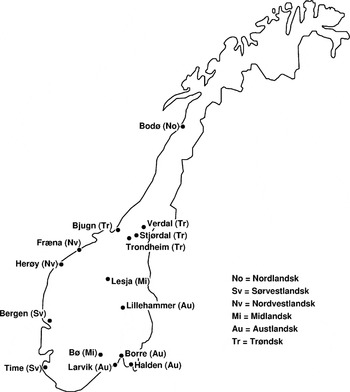
We chose to focus on the Scandinavian language area because the Scandinavian countries have a strong tradition of research in the area of dialectology. This has resulted in maps similar to the traditional Dutch dialect maps (for an overview, see Skjekkeland, 1997). These maps are useful for the interpretation of the results. Norway seems to be particularly interesting because of the strong position of the dialects in this country. In contrast to many European countries, the dialect is used by people of all ages and social backgrounds, not only in the private domain, but also in official contexts (Omdal, 1995). This makes it easy to use recent recordings of young people from all over the country without the risk that some of the speakers might use a more standardized variant of their dialect or a variety that is no longer being used in everyday life. Also, it does not feel unnatural for Norwegian people to read aloud a text in their own dialect. This allowed us to use read texts, which was necessary as we needed the same text in different dialects. In Figure 1, the 15 dialects that were used in the investigation are shown. The dialects are spread over a large part of the Norwegian language area, and they cover most major dialect areas, as found on the traditional map of Skjekkeland (1997:276). On this map, the Norwegian language area is divided into nine dialect areas. In our set of 15 varieties, six areas are represented.

Map of Norway showing the 15 dialects used in the present investigation. The abbreviation after the name of each location indicates the dialect area to which the variety belongs, according to Skjekkeland (1997). The same abbreviations are used in other figures in this article. Skjekkeland (1997) gave a more global division in which Norwegian dialects are divided into Vestnorsk (covering No, Sv, and Nv) and Austnorsk (covering Mi, Au, and Tr).
Text
It is time-consuming to make recordings of dialects and to transcribe the texts phonetically. Fortunately, we were able to use already existing recordings of Norwegian dialect speakers. The speakers all read aloud the same text, namely, the fable “The North Wind and the Sun.”1
The recordings and the transcriptions (in IPA as well as in SAMPA) were made by Jørn Almberg in cooperation with Kristian Skarbø at the Department of Linguistics, NTNU, Trondheim and are available at http://www.ling.hf.ntnu.no/nos/.
Speakers
There were 4 male and 11 female speakers. Thirteen of the speakers had filled in a questionnaire about their background. From this we know that the average age of these speakers was 30.5 years, ranging between 22 and 35, except for one speaker who was 66. All 13 speakers attended university or already had a university degree. No formal testing of the extent to which the speakers used their own dialect was carried out. However, they had all lived at the place where the dialect is spoken until the mean age of 20 (with a minimum age of 18), and they all regarded themselves as representative speakers of the dialects in question. All speakers, except one, had at least one parent speaking the dialect.
Recordings
The recordings were made in a soundproof studio in the autumn of 1999 and the spring of 2000. The speakers were all given the text in Norwegian beforehand and were allowed time to prepare the recordings in order to be able to read aloud the text in their own dialect. Many speakers had to change some words of the original text for the dialect to sound authentic. The word order was changed in three cases. When reading the text aloud, the speakers were asked to imagine that they were reading the text to someone with the same dialectal background as themselves. This was done to ensure a reading style that was as natural as possible and to achieve dialectal correctness.
The microphone used for the recordings was a MILAB LSR-1000, and the recordings were made in DAT format using a FOSTEX D-10 Digital Master Recorder. The recordings were edited by means of Cool Edit 96 and are available on the World Wide Web.
These recordings were used in the perception experiment described in the following section.
Transcriptions
On the basis of the recordings, phonetic transcriptions were made of all 15 dialects. The transcriptions were made in IPA as well as in X-SAMPA (Speech Assessment Methods Phonetic Alphabet). This is a machine-readable phonetic alphabet that is still human-readable. Basically, it maps IPA symbols to the 7-bit printable ASCII/ANSI characters. All transcriptions were made by the same person, which ensures consistency. Most Norwegian dialects distinguish between two tonal patterns on the word level, often referred to as tonemes. Some dialects even have a third toneme, the circumflex (e.g., Kristoffersen, 2000). In our material, four dialects (Bjugn, Fræna, Verdal, and Stjørdal) have circumflex tonemes on one word (mann meaning ‘man’). In the transcriptions, toneme transcriptions were included, and it was indicated where the different tonemes occurred in the text. We know from the literature that the realization of the tonemes can vary considerably across the Norwegian dialects. However, no information was given about the precise realization of the tonemes in the transcriptions.
The Levenshtein distance measurements are based on the transcriptions and are presented later in the article.
PERCEPTUAL DISTANCE MEASUREMENTS
Perceptual data have often been used in dialectology (e.g., Daan & Blok, 1969; Gooskens, 1997; Preston, 1999) and have proved that listeners without linguistic training are quite able to make judgments, for example, about distances between dialects. Perceived linguistic distances are likely to be at least partly based on objective linguistic distances. However, a number of factors other than linguistic distances might influence the way in which listeners perceive distances between dialects. We will return to this point later. To be able to investigate how well the Levenshtein distances correspond to the perceived linguistic distances, we carried out a perception experiment on the basis of 15 Norwegian dialects. Next, we will describe the listening experiment and the results will follow.
Experiment
Manipulations
To investigate the dialect distances between 15 Norwegian dialects, as perceived by Norwegian listeners, for each of the 15 varieties the corresponding recording of the fable “The North Wind and the Sun” was presented to Norwegian listeners in a listening experiment. The running text provides the listeners with more kinds of information than the information used for the calculation of the Levenshtein distances. One important difference is that the listeners based their judgments on spoken material that contains prosody, whereas this is not the case for the Levenshtein distances. For this reason, we decided to include a monotonized version of all fragments. Because in these fragments the pitch contour is not present like in the Levenshtein distances, we expect the correlation of these two distance measures to be higher than when Levenshtein distances are correlated with the original fragments.
In the listening experiment described next, each of the 15 dialect recordings were presented in the following two versions:
- Monotonized version. By means of electronic monotonization the intonation (including word tones) is removed from the signal.
- Original version. This version has the original prosodic and verbal information, but is processed in the same way as the monotonized version.
The manipulations were carried out with the program PRAAT.2
The program PRAAT is a free public-domain program developed by Paul Boersma and David Weenink at the Institute of Phonetic Sciences of the University of Amsterdam and is available at http://www.fon.hum.uva.nl/praat.
Listeners
The listeners were 15 groups of high school pupils, one group from each of the places where the 15 dialects are spoken (see Figure 1). Each group consisted of 16 to 27 listeners (with a mean of 19). Their mean age was 17.8 years; 52% were female and 48% were male. Only the responses of listeners who had lived the major part of their lives in the place where the dialect is spoken were used for the analysis. On average, these listeners had lived in the place in question for 16.7 years. Nine of the 290 listeners (3%) said that they never speak the dialect, the rest spoke the dialect always (60%), often (21%), or seldom (16%). A large majority of the listeners (83%) had one or two parents who also spoke the dialect.
Procedure
The two versions (monotonous and original) of the 15 dialects were presented in two blocks, with the dialects randomized within each block. First the block with the monotonized version was presented, and after a short break the block with the original version was presented. Each block was preceded by a practice recording (a speaker from Stjørdal, but not one of the 15 recordings used in the real experiment). Between each two recordings there was a pause of 3 seconds.
While listening to the dialects, the listeners were asked to judge each dialect on a scale from 1 (similar to own dialect) to 10 (not similar to own dialect). The whole experiment lasted approximately 20 minutes, followed by a questionnaire. In this questionnaire the listeners were asked questions about their individual characteristics, such as language background, age, and sex. The listeners were paid for their participation.
Results
Distances
The mean perceptual distances between the 15 Norwegian dialects are presented in Table 1, obtained on the basis of the experiment in which the original, nonmanipulated recordings were presented. Each group of listeners judged the linguistic distances between their own dialect and the 15 dialects, including their own dialect. In this way, we get a matrix with 15∗15 distances. The fact that the listeners also had to judge their own dialect resulted in varying diagonals (between 1.0 and 3.4). Some groups of listeners judged the recorded sample of the own dialect to be more than minimally distant. This might be explained by the fact that the recorded speakers were not equally representative for the dialect in question. It might, however, also be the case that some dialects show more variation than others. Finally, the differences can also be caused by the fact that the groups of listeners differ in some respect. For example, some groups might be more familiar with their own dialects than others or more tolerant as to what they are willing to accept as a good representation of their dialect.
Mean perceptual distances between all pairs of 15 Norwegian dialects as perceived by 15 groups of listeners when listening to the nonmanipulated recordings (judged on a scale from 1 = similar to own dialect to 10 = not similar to own dialect)

There are two mean distances between each pair of dialects. For example, the distance that the listeners from Bergen perceived between their own dialect and the dialect of Trondheim (mean judgment is 7.8) is different from the distance as perceived by the listeners from Trondheim (mean judgment is 8.6). Different explanations can be given for the fact that different groups perceive the same linguistic distances differently. For example, it is likely that the attitude toward a dialect influences the perception of the linguistic distance. We will return to this point later.
Classification
On the basis of the distance matrix, the dialects can be classified with cluster analysis. The goal of a cluster analysis is to identify the main groups. The groups are called clusters. Clusters may consist of subclusters, and subclusters may in turn consist of subsubclusters, and so on. The result is a hierarchically structured tree in which the dialects are the leaves (Jain & Dubes, 1988). Several alternatives exist. We used the Unweighted Pair Group Method using Arithmetic Averages (UPGMA), because we found that dendrograms generated by this method reflected distances that correlated most strongly with the original distances in the distance matrix (see Sokal & Rohlf, 1962).
Because the cluster program expects only one value for each pair of different elements, distances of dialects with respect to themselves are not used, and the average of the two mean distances is used when classifying the varieties. For example, the average of the distance between Bergen–Trondheim and Trondheim–Bergen is used.
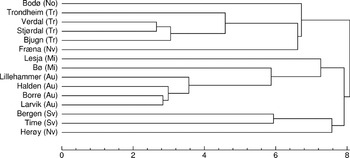
The dendrogram (Figure 2) is obtained on the basis of Table 1 and accords rather well with the map of Skjekkeland (Figure 1). Sørvestlandsk, Austlandsk, and Trøndsk groups can clearly be identified. However, the Midlandsk dialects, Bø and Lesja, do not form a close cluster. Geographically they are rather distant, so they may be rather different, although they should be in the same group according to the traditional division. The Nordvestlandsk dialects (Fræna and Herøy) seem to be very different from each other, although they are geographically rather close. Possibly the fact that these dialects belong to the same group on the map of Skjekkeland may be explained by the fact that Skjekkeland based the characterization on a limited number of phenomena, which are (partly) different from those found in the text “The North Wind and the Sun.” In our sample, the Nordlandsk area is represented by only one variety (Bodø). This variety is grouped with the varieties of the Trøndsk area, which is not unexpected geographically.

Dendrogram derived from the 15∗15 matrix of perceptual distances showing the clustering of (groups of) Norwegian dialects. On the horizontal scale, distances are given in the scale as used by the listeners.
LEVENSHTEIN DISTANCE MEASUREMENTS
Method
Traditional dialectology has aimed to divide language areas into dialect areas mostly by drawing sharp borders between the areas on a map. The choice of the borders has often been based on the knowledge and intuition of the investigators of the areas in question. The application of isoglosses has been another widely used means of dividing language areas into dialect areas. Coinciding isoglosses are interpreted as borders. However, the use of isoglosses gives rise to a number of problems. First, isoglosses do not always coincide. They can run parallel, forming vague bundles, or even cross each other, describing contradictory binary divisions. In practice, well-known isoglosses that form bundles are selected, but this makes this aspect of the method subjective. Second, the use of isoglosses gives a very categorical view of dialect differences. Either a dialect is different from another dialect or it is not, no degrees of differences can be expressed. Finally, dialects might be dispersed by migration or war so that closely related dialects are no longer adjacent to each other. This causes problems when drawing the isoglosses and borders on the dialect map (see Chambers & Trudgill, 1998:89–103; Kessler, 1995).
To solve some of the problems we have outlined, several (computational) methods for measuring the linguistic distances between language varieties have been developed since the beginning of the 1970s (Heeringa, 2004:14–24). In this investigation, we wish to evaluate one of the methods, the Levenshtein distance method, which has been applied successfully to Irish Gaelic (Kessler, 1995) and Dutch dialects (Heeringa, 2004:213–278; Nerbonne & Heeringa, 1998). The basic algorithm has been described in detail in Kruskal (1999). Compared to traditional methods (for instance the isogloss method), this approach has the advantage that varieties are compared and classified in an objective way and on the basis of the aggregate of many phenomena rather than on the basis of just single phenomena. In contrast to other computational methods, Levenshtein distance yields gradual word pronunciation differences, and the method uses the data exhaustively, which makes it most sensitive.
Algorithm
Using the Levenshtein distance, two dialects are compared by comparing the pronunciation of words in the first dialect with the pronunciation of the same words in the second. It is determined how one pronunciation is changed into the other by inserting, deleting, or substituting sounds. Weights are assigned to these three operations. In the simplest form of the algorithm, all operations have the same cost. For example, assume afternoon is pronounced as

in the dialect of Savannah, Georgia, and as

in the dialect of Lancaster, Pennsylvania.
3The data is taken from the Linguistic Atlas of the Middle and South Atlantic States (LAMSAS) and is available via: http://hyde.park.uga.edu/lamsas/.
The example should not be interpreted as a historical reconstruction of the way in which one pronunciation changed into another. From that point of view, it may be more obvious to show how

changed into

. We just show that the distance between two arbitrary pronunciations is found on the basis of the least costly set of operations mapping one pronunciation into another.

In fact, many sequence operations map

. The power of the Levenshtein algorithm is that it always finds the cost of the cheapest mapping. Comparing pronunciations in this way, the distance between longer pronunciations will generally be greater than the distance between shorter pronunciations. The longer the pronunciation, the greater the chance for differences with respect to the corresponding pronunciation in another variety. Because this does not accord with the idea that words are linguistic units, the sum of the operations is divided by the length of the longest alignment that gives the minimum cost. The longest alignment has the greatest number of matches. In our example we have the following alignment:
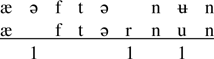
The total cost of 3 (1 + 1 + 1) is now divided by the length of 9. This gives a word distance of 0.33 or 33%.
Gradual weights
The simplest versions of this method are based on a notion of phonetic distance in which phonetic overlap is binary: nonidentical phones contribute to phonetic distance, identical ones do not. Thus the pair [a,p] counts as different to the same degree as [b,p]. In more sensitive versions, phones are compared on the basis of their feature values, so the pair [a,p] counts as more different than [b,p]. However, it is not always clear what weight should be attributed to the different features. The version that we use in this article is based on the comparison of spectrograms of the sounds. A spectrogram is the visual representation of the acoustical signal, and the visual differences between the spectrograms are reflections of the acoustical differences. When using spectrograms it is not necessary to make decisions about the weight of the different features. The spectrograms were made on the basis of recordings of the sounds of the International Phonetic Alphabet (IPA) as pronounced by John Wells and Jill House on the cassette The Sounds of the International Phonetic Alphabet, from 1995.5
See http://www.phon.ucl.ac.uk/home/wells/cassette.htm.
Logarithmic weights
In perception, small differences in pronunciation may play a relatively strong role in comparison to larger differences. Therefore, we used logarithmic segment distances. The effect of using logarithmic distances is that small distances are weighed relatively more heavily than large distances. Because the logarithm of 0 is not defined, and the logarithm of 1 is 0, distances are increased by 1 before the logarithm is calculated. To obtain percentages, we calculate:

Allowed matches
To reckon with syllabification in words, the Levenshtein algorithm is adapted so that only a vowel may match with a vowel, a consonant with a consonant, the [j] or [w] with a vowel (or opposite), the [i] or [u] with a consonant (or opposite), and a central vowel (in our research only the schwa) with a sonorant (or opposite). In this way unlikely matches (e.g., a [p] with a [a]) are prevented.
Results
Distances
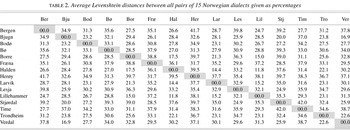
The Norwegian text consists of 58 different words, which proved to be a sufficient basis for a reliable Levenshtein analysis (Cronbach's α = 0.86; see Heeringa, 2004:170–173). Some words occur more than once in the text. In these cases, the mean distance over the variants of the word is used for calculating the Levenshtein distances (see Heeringa, 2004:134–135 for more details). So when comparing two dialects, we get 58 Levenshtein distances. Now the dialect distance is equal to the sum of 58 Levenshtein distances divided by 58. When the word distances are presented in terms of percentages, the dialect distance will also be presented in terms of percentages. All distances between the 15 language varieties are arranged in a 15 × 15 matrix. The average Levenshtein distances between the 15 dialects are presented in Table 2. The diagonal is always zero and the lower half is the mirror image of the upper half.
Average Levenshtein distances between all pairs of 15 Norwegian dialects given as percentages

Classification
Just as we did on the basis of the perceptual distances, we performed cluster analysis on the basis of the average Levenshtein distances, as well. Because the matrix is symmetric, only one half is used, and the zero values on the diagonal from upper left to lower right are not used.
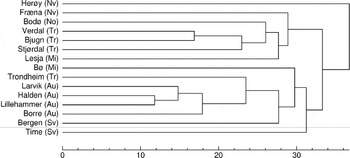
Comparing our computational dendrogram (Figure 3) with the perceptual dendrogram (Figure 2), both show an Austlandsk group, which contains the varieties of Larvik, Halden, Lillehammer, and Borre, and a Trøndsk group, which contains the varieties of Verdal, Bjugn, and Stjørdal. Although the two dendrograms do not cluster the Midlandsk varieties (Bø and Lesja) as one group, in the perceptual dendrogram they appear to be more related than in the computational dendrogram. In the perceptual dendrogram, the Midlandsk dialect of Lesja is clustered with the Austlandsk varieties, although not very close. In the computational dendrogram, this dialect belongs to the Trøndsk varieties. Geographically, the variety is located about midway between the two areas. In both the perceptual and computational dendrograms Bø is clustered with the Austlandsk varieties, but in the perceptual dendrogram the relation appears to be stronger. The Sørvestlandsk varieties of Bergen and Time form one (rather loose) cluster in the perceptual dendrogram. In the computational dendrogram they do not form one cluster. In the two dendrograms the two Nordvestlandsk varieties do not form one cluster. In both, Fræna is clustered with the Trøndsk varieties. However, Herøy is clustered with the Sørvestlandsk varieties in the perceptual dendrogram, whereas in the computational dendrogram it belongs to none of the groups, but appears to be distinct from all the other varieties. In both dendrograms Bodø is clustered with the Trøndsk varieties. However, in the computational dendrogram Bodø looks as if it were closer to the Trøndsk varieties than in the perceptual dendrogram. However, the cluster with Verdal, Bjugn, and Stjørdal is geographically not impossible. A striking difference can be found with regard to the dialect of Trondheim, which is clustered with the Trøndsk varieties in the perceptual dendrogram, but in the computational dendrogram it is clustered with Austlandsk varieties. Possibly the listeners recognized the recording of Trondheim as the dialect of Trondheim and let geography influence their judgments. However, the dialect of larger cities may be in contrast with their surroundings and more related to more geographically distant varieties. We conclude that the two dendrograms are rather similar, especially because of the fact that the closer clusters in the one dendrogram are also found in the other one.

Dendrogram derived from the 15∗15 matrix of average Levenshtein distances showing the clustering of (groups of) Norwegian dialects. The scale distance is given as a percentage.
PERCEPTUAL VERSUS LEVENSHTEIN DISTANCES
The aim of the present study was to validate the Levenshtein method by investigating the degree to which the Levenshtein distances between 15 Norwegian dialects correlate with the same distances as perceived by groups of listeners from the 15 places where the dialects are spoken. As already made clear, the dendrograms (Figures 2 and 3) show many similarities.
A measure of the degree of similarity is the correlation coefficient between the perceptual distances and the Levenshtein distances. To find the correlation coefficient, we used Pearson's correlation coefficient (Sneath & Sokal, 1973:137–140). We correlated the average Levenshtein distances with both perceptual distances based on monotonized recordings and perceptual distances based on the original recordings. In the first case, we found a correlation r = .78, and in the second case, we found a correlation r = .80. To find the significance of a correlation coefficient, we used the Mantel test (see Heeringa, 2004:74–75 for more details). For both cases we found that p < .001, so the correlations are significant, at least at the level α = .001. In the next section we will explain why the average Levenshtein distances correlate better with the original recordings-based perceptual distances than with the monotonized recordings-based perceptual distances.
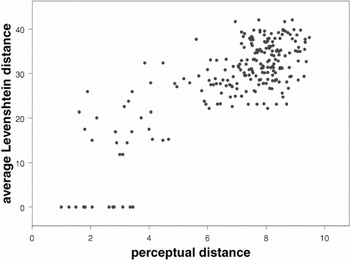
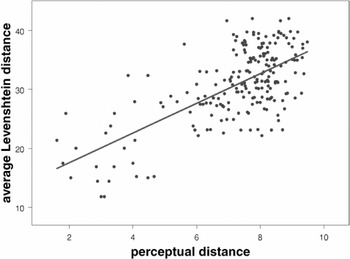
In Figure 4, a scatterplot is shown in which the average Levenshtein distances are plotted against the sorted perceptual distances based on the original recordings. In the lower left corner of this graph, we find 15 dots on a line, for which the average Levenshtein distance is equal to 0. The dots correspond with the values in the diagonal from the upper left to lower right in Tables 1 and 2. In the graph, the 15 dots appear to be outliers, which may increase the correlation coefficient mistakenly. Therefore, we calculated correlation coefficients again, excluding distances of varieties with respect to themselves (see Figure 5). In that way, we get a correlation of 0.62 (perceptual distances based on monotonized fragments) and 0.67 (perceptual distances based on original distances). In both cases p < .001. Although these correlation coefficients are lower, they are still quite significant. This shows that the Levenshtein distances are a good representation of the distances between dialects as perceived by listeners. On the other hand, it also shows that listeners base their judgments of dialectal distances on the linguistic information used in the algorithm to a great extent.

Scatterplot showing perceptual distances versus average Levenshtein distances, including distances of dialects with respect to themselves (r = .80, p < .001).

Scatterplot showing perceptual distances versus average Levenshtein distances, excluding distances of dialects with respect to themselves (r = .67, p < .001). The linear regression line is shown, as well.
FACTORS INFLUENCING THE CORRELATION BETWEEN PERCEPTUAL DISTANCES AND LEVENSHTEIN DISTANCES
Even though the correlation between the Levenshtein distances and the perceptual distances turned out to be high, it is still interesting to look for explanations for the fact that the correlation is not perfect. On the one hand, there are several nonlinguistic factors that might influence the perceptive judgments of the distances and result in a negative influence on the correlation. Such factors could be the attitude of the listeners toward the different dialects and their knowledge about the geographical position of the dialects.
On the other hand, there are also several linguistic factors that might influence the correlations. When judging the dialects, the listeners had all linguistic information (lexical, phonetic, intonational, morphological, and syntactical) at their disposal, because they are confronted with recordings of spoken texts. However, the Levenshtein distances are calculated only on the basis of lexical, phonetic, and morphological material. Therefore, we next discuss the intonation and syntax in more detail.
Intonation
Intonation is one of the most important characteristics of the various Norwegian dialect areas (Christiansen, 1954; Fintoft & Mjaavatn, 1980; Leitre, Lundeby, & Torvik, 1981; Sandøy, 1993), and it can be expected to play an important role in the perception of the distances between the 15 dialects. Minimal word pairs can be distinguished by means of tonemes (toneme I, toneme II, and in some dialects, circumflex) at the accented syllables. The use of tonemes and the precise pitch contour of the tonemes may differ per dialect.
Using Levenshtein distance, tonemes are not processed. Therefore, listeners in the perception experiment were first asked to give judgments on the basis of monotonized recordings, and then on the basis of original recordings. It is striking that the Levenshtein distances correlate stronger with the perceptual distances based on unmodified recordings than with the perceptual distances based on monotonized recordings. When looking at the two perceptual matrices, it appeared that the mean judgments were almost the same (7.19 for the monotonous fragments and 7.25 for the original fragments). However, the standard deviation is smaller in the case of the monotonous fragments (1.38) than in the case of the original fragments (1.68). Three explanations suggest themselves.
First, the absence of intonation yields unnatural speech. In particular, the absence of intonation makes tonemes imperceptible in Norwegian, which makes the fragments even more unusual. The consequence may be that this makes listeners insecure. This leads to “safe” judgments, resulting in values which are found closer to the middle of the scale.
Second, the lower standard deviation for the monotonous distances may have to do with the setup of the experiment. After the first session, the listeners know the extremes (i.e., the most similar and most different varieties). This knowledge may be used when judging distances in the second session.
Third, it is also possible that the results do indeed reflect the distances as perceived by the listeners, with dialects close to the listeners own dialect being perceived as more deviant, and the dialects that are very deviant being perceived as less deviant, when there is no information present about intonation.
However, no matter which explanation is correct, we can establish that the dispersion of the data is smaller in the case of the monotonous fragments than in the case of the original fragments. The representation on a smaller scale is less precise. This seems to us to be the explanation for the fact that the correlation with the Levenshtein distances is lower for the monotonous fragments.
Syntax
As far as the syntactical differences are concerned, there are hardly any differences between the 15 dialects. In a number of cases, an adverb has been moved from the beginning to the end of the sentence. Little research has been carried out on syntactic differences between Norwegian dialects. However, the placement of the adverbs in our material does not seem to be characteristic of the dialects in question. Therefore, the fact that syntactic differences are not reflected in the average Levenshtein distances is probably not the main explanation for the fact that no perfect correlation between perceptual and average Levenshtein distances was found.
CONCLUSIONS
The aim of the present investigation was to validate the Levenshtein distance in a language area other than the flat Dutch area by comparing the Levenshtein distances with comparable distances as perceived by listeners from the places where the dialects are spoken. Fifteen Norwegian dialects were included in the study. Perceptual distances were obtained on the basis of a perception experiment, and comparable distances were calculated using Levenshtein distance.
On the basis of both the perceptual and the Levenshtein distances, the 15 varieties were classified. Although differences can be found, in general the two classifications are rather similar. In both, a north–south division was found. The northern cluster is dominated by a group of central varieties, and the southern cluster by a group of southeastern varieties.
To validate the Levenshtein distances, they were correlated with perceptual distances. Prosody plays an important role in Norwegian dialects, but it is not processed when using Levenshtein distances. Therefore, the Levenshtein distances were correlated with perceptual distances that were obtained on the basis of an experiment in which monotonized recordings were used, and with perceptual distances obtained on the basis of an experiment in which original, nonmanipulated recordings were used. In both cases, we got a high, strongly significant correlation (r = .62 and r = .67, respectively, p < .001 for the two cases). This shows that dialect distances calculated with Levenshtein distance approximate perceptual distances rather well. We see this as a confirmation of the usefulness of the Levenshtein method, as has been shown before for Dutch dialects. Now we know that the method is also applicable in a language area with a less simple geographic situation than the Dutch one.
Intonation has been repeatedly mentioned as a very important cue for the perceptual differentiation between Norwegian dialects. Intonational cues are not represented in the Levenshtein distances and, therefore, correlation with perceptual data might be expected to be higher when intonation is removed from the data. However, we found that the Levenshtein distances correlate more strongly with the original recordings-based perceptual distances than with the monotonized recordings-based perceptual distances. We argue that this might be attributed to methodological deficiencies.
References
REFERENCES
Chambers, J. K., &
Trudgill, Peter.
(1998).
Dialectology
(2nd ed.).
Cambridge:
Cambridge University Press.
Christiansen, Hallfrid.
(1954).
Hovedinndelingen av norske dialekter. In
Maal og Minne.
Oslo:
Bymålslaget.
30–41.
Daan, Jo, &
Blok, D. P.
(1969).
Van randstad tot landrand. Toelichting bij de kaart: Dialecten en
naamkunde. In
Bijdragen en mededelingen der dialectencommissie van de Koninklijke
Nederlandse Akademie van Wetenschappen te Amsterdam.
Amsterdam:
Noord-Hollandse Uitgeversmaatschappij.
37,
9–41.
Fintoft, Knut, &
Mjaavatn, Per-Egil.
(1980).
Tonelagskurver som målmerke. In
Maal og Minne.
66–87.
Oslo:
Bymålslaget.
Gooskens, Charlotte.
(1997).
On the role of prosodic and verbal information in the perception of
Dutch and English language varieties.
Doctoral dissertation,
University of Nijmegen, the Netherlands.
Gooskens, Charlotte, &
Heeringa, Wilbert.
(2004).
The position of Frisian in the Germanic language area. In
Dicky Gilbert,
Maartje Schreuder, &
Nienke Knevel (eds.),
On the boundaries of phonology and phonetics.
Groningen:
Klankleergroep, Faculty of Arts, University of Groningen. Dedicated
to Tjeerd de Graaf. Available at:
http://www.let.rug.nl/∼heeringa/dialectology/
papers/.
61–87.
Heeringa, Wilbert.
(2004).
Measuring dialect pronunciation differences using Levenshtein
distance.
Doctoral dissertation.
University of Groningen.
Available at:
http://www.let.rug.nl/∼heeringa/dialectology/thesis/.
International Phonetic Association.
(1949).
The principles of the International Phonetic Association: Being a
description of the International Phonetic Alphabet and the manner of
using it, illustrated by texts in 51 languages.
London:
International Phonetic Association.
International Phonetic Association.
(1999).
Handbook of the International Phonetic Association: A guide to the
use of the International Phonetic Alphabet.
Cambridge:
Cambridge University Press.
Jain, Anil K., &
Dubes, Richard C.
(1988).
Algorithms for clustering data.
Englewood Cliffs, NJ:
Prentice Hall.
Kessler, Brett.
(1995).
Computational dialectology in Irish Gaelic.
Proceedings of the European ACL.
Dublin:
ACL.
60–67.
Kristoffersen, Gjert.
(2000).
The phonology of Norwegian.
Oxford:
Oxford University Press.
Kruskal, Joseph B.
(1999).
An overview of sequence comparison. In
David Sankoff &
Joseph Kruskal (eds.),
Time warps, string edits, and macro molecules: The theory and
practice of sequence comparison.
Stanford:
CSLI.
1–44.
Leitre, Arild,
Lundeby, Einar, &
Torvik, Ingvald.
(1981).
Språket vårt før og no. Språkhistorie,
norrønt, dialektar, nyislandsk.
Hestholm:
Gyldendal Norsk Forlag.
Nerbonne, John, &
Heeringa, Wilbert.
(1998).
Computationele vergelijking en classificatie van dialecten.
Taal en Tongval, Tijdschrift voor Dialectologie,
50(2):164–193.
Available at:
http://www.let.rug.nl/∼heeringa/dialectology/papers/.Google Scholar
Omdal, Helge.
(1995).
Attitudes toward spoken and written Norwegian.
International Journal of the Sociology of Language
115:85–106.Google Scholar
Preston, Dennis.
(1999).
Handbook of perceptual dialectology.
Amsterdam:
Benjamins.
Sandøy, Helge.
(1993).
Talemål.
Oslo:
Novus Forlag.
Skjekkeland, Martin.
(1997).
Dei norske dialektane. Tradisjonelle særdrag i
jamføring med skriftmåla.
Kristiansand:
Høyskoleforlaget.
Sneath, P. H. A., &
Sokal, R. R.
(1973).
Numerical taxonomy, a series of books in biology.
San Francisco:
W. H. Freeman and Company.
Sokal, R. R., &
Rohlf, F. J.
(1962).
The comparison of dendrograms by objective methods.
Taxon
11:33–40.Google Scholar
Map of Norway showing the 15 dialects used in the present investigation. The abbreviation after the name of each location indicates the dialect area to which the variety belongs, according to Skjekkeland (1997). The same abbreviations are used in other figures in this article. Skjekkeland (1997) gave a more global division in which Norwegian dialects are divided into Vestnorsk (covering No, Sv, and Nv) and Austnorsk (covering Mi, Au, and Tr).

Mean perceptual distances between all pairs of 15 Norwegian dialects as perceived by 15 groups of listeners when listening to the nonmanipulated recordings (judged on a scale from 1 = similar to own dialect to 10 = not similar to own dialect)
Dendrogram derived from the 15∗15 matrix of perceptual distances showing the clustering of (groups of) Norwegian dialects. On the horizontal scale, distances are given in the scale as used by the listeners.
Average Levenshtein distances between all pairs of 15 Norwegian dialects given as percentages
Dendrogram derived from the 15∗15 matrix of average Levenshtein distances showing the clustering of (groups of) Norwegian dialects. The scale distance is given as a percentage.
Scatterplot showing perceptual distances versus average Levenshtein distances, including distances of dialects with respect to themselves (r = .80, p < .001).
Scatterplot showing perceptual distances versus average Levenshtein distances, excluding distances of dialects with respect to themselves (r = .67, p < .001). The linear regression line is shown, as well.
 You have
Access
- 69
- Cited by