The three motets by Guillaume de Machaut built on secular songs represent the end of a tradition. Like earlier motets of this type, they present their borrowed melody in full, with its form and rhythm intact and often with its text as well, so they tend to be experienced as true melodies, without the stratification between slowly moving tenor and faster moving upper voices characteristic of most chant-based motets, especially by the fourteenth century. Machaut's song tenors, like those of his predecessors, include extensive repetition of small rhythmic and melodic motives. Jared Hartt has shown that Machaut avoids harmonic stagnation by selectively crossing the motetus below the tenor.Footnote 1 In other words, Machaut uses the upper voices to counteract potential difficulties inherent in his borrowed song tenors. At the same time, Machaut's examples transform the genre: his motets do not use the tenor's sectional form to determine the form of the motet, as many of the earlier examples do.Footnote 2 In these three motets, however, Machaut sets up a kind of hybrid approach, combining the song-based tenor with upper voices that use the talea principle found in chant-based motets. Here, however, these upper-voice talea units are independent of the tenor's form and interact with it in interesting ways.Footnote 3
Although the three motets in question do not appear together in Machaut's complete-works manuscripts, they have been grouped together by modern scholars because of their use of song tenors. In addition, both Jacques Boogaart and Thomas Brown see a proportional relationship in their ordering of the motet corpus in those manuscripts, suggesting a connection between the three pieces in Machaut's mind as well, at least when it came to compiling the contents of his books.Footnote 4 Here I am not directly interested in issues of ordering, but rather in the interaction of song and talea principles in these three motets, which creates hybrid forms that can express aspects of the fundamental idea of the motet in which they appear. We will begin at the end, with the final motet in Machaut's first corpus, because this motet provides the simplest combination of structural elements.
Trop plus est bele / Biauté paree de valour / Je ne sui mie certeins (M20)
Trop plus est bele / Biauté paree de valour / Je ne sui mie certeins (M20) is based on a rondeau that does not survive elsewhere, but was probably borrowed by Machaut.Footnote 5 Its refrain consists of two phrases of different lengths: an A section of seven breves (ending with a semibreve rest) and a B section of five (including a breve rest), so its full realisation (AB aA ab AB) creates an irregular succession of phrase lengths. This tenor is combined with the most up-to-date rhythms in the upper voices: Lawrence Earp notes that this is the only motet where Machaut uses syncopation on the semibreve level in major prolation, in a recurring motive involving a single minim followed by a series of semibreves.Footnote 6 This motive appears five times in the motetus and three in the triplum, usually outlining a descending fourth.
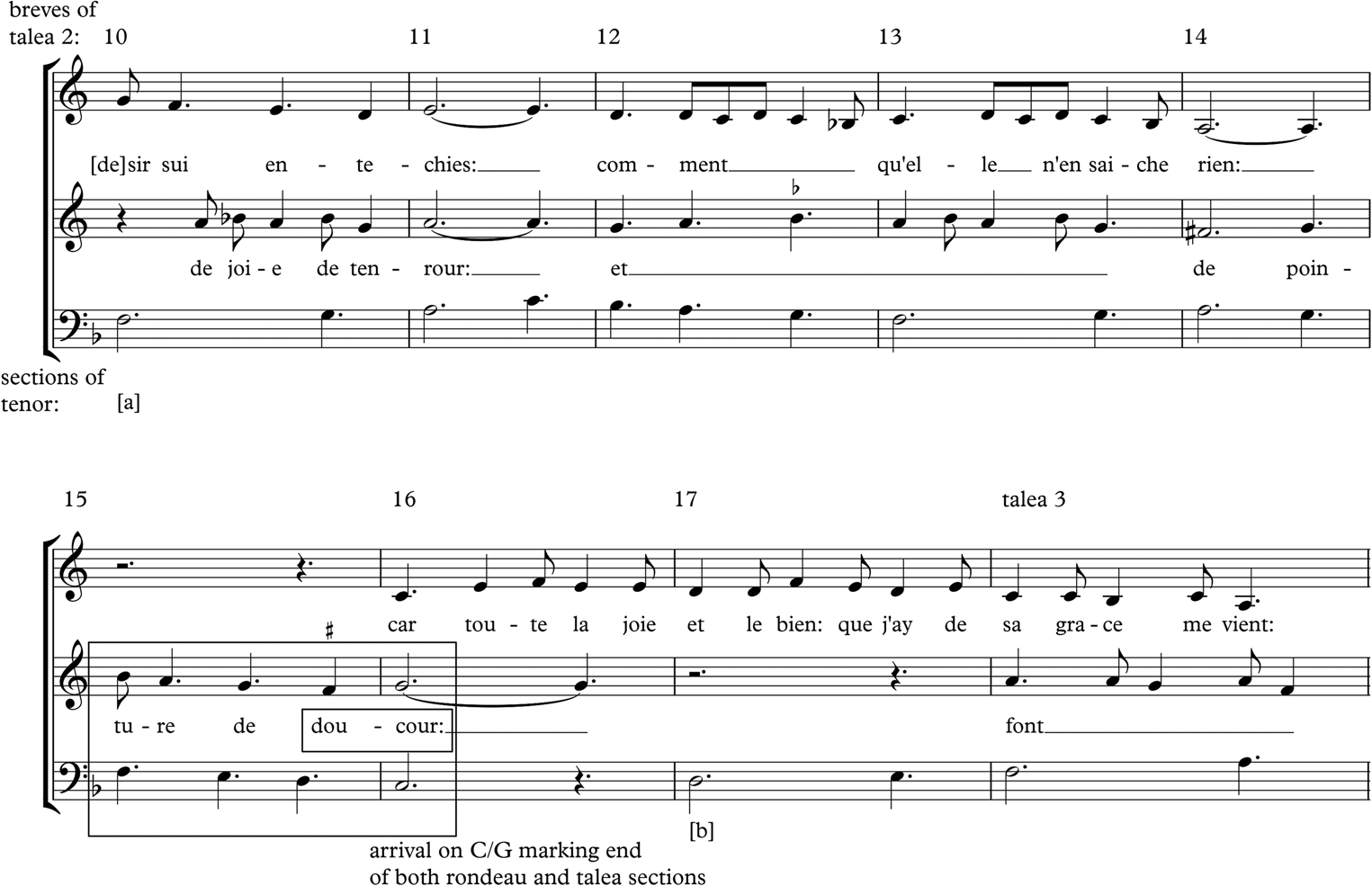
The beginning of the motet at first suggests a polyphonic form closely aligned with its rondeau tenor. The ends of upper-voice text lines are coordinated with each other and with the phrases of the tenor, and all three voices cadence together: first at the caesura of the tenor's first line (b. 4, on F), then at the end of both tenor lines (bb. 7, on c, and 11, on F). (See Ex. 1 for the last of these.Footnote 7) At the two ‘internal’ cadences in bars 4 and 7, one of the upper voices immediately continues motion away from the point of arrival, but this is not surprising, nor is the use of an imperfect sonority at the end of the A section (b. 7). The cadence at the end of the refrain (b. 11, given in Ex. 1) is slightly weakened by the ascending motion in the tenor (the descending motion to the final is relegated to the motetus, resolving to a unison with the tenor), but since this is apparently a feature of the pre-existing tenor, it is a necessity.Footnote 8 Moreover, any apparent weakness in voice leading is balanced by approaching the cadence through the use of hocket (bb. 8–9) and syncopation (triplum b. 10), both of which strengthen the sense of arrival through rhythmic means. Each of the three cadences in this opening is preceded by the syncopated rhythmic motive: the motetus moves in descending lines that parallel the tenor in bars 3–4 and 6–7, while the triplum syncopation in bar 10 (given in Ex. 1) moves in contrary motion to the tenor, settling on the fifth above the cadential goal. Up to this point, then, a listener would hear upper voices that are closely coordinated with the tenor refrain, setting up an expectation that the motet will continue to follow the structural lead of its tenor.
Guillaume de Machaut, Trop / Biauté / Je ne sui (M20), end talea 1 (bb. 8–17).

At this point, however, the triplum and motetus set up their own competing structure, based on regularly recurring rhythmic units like the taleae of chant-based motets. This seventeen-breve talea is delineated by a regularly recurring hocket (breves 8–10 of each unit), a statement of the syncopated motive in the triplum (breve 11) and a triplum rest in breve 15 highlighting a statement of the syncopated motive in the motetus, leading to a rest in breve 17, the end of the talea unit (see Ex. 1).Footnote 9 The final unit is slightly modified to accommodate the final cadence.Footnote 10
The notion that the upper voices might create a structure distinct from that of the tenor is rare, but it does happen, as Anna Zayaruznaya has shown.Footnote 11 The two planes of this motet – rondeau and talea – begin with some degree of unity before diverging, as we have seen, but they move independently of each other through the middle portion of the motet.Footnote 12 This is the part of the tenor that has regular seven-breve phrases, as the A section appears three times in a row, so the disjunction between formal units may help disguise the melodically static tenor. Passing harmonic arrivals occur, on the F and C that we have already seen, but also occasionally on A. These moments, however, are often in the middle of a text line and/or marked by melodic continuation in at least one voice, so their cadential force is weakened.
The end of the second talea aligns more or less with the end of the fourth statement of the A section in the tenor, the moment when B is about to return for the first time since the opening refrain (see Ex. 2). An unstable sonority in bar 31 (breve 14 of the talea) leads eventually to a cadence on C/G in the motetus and tenor in bar 33 (breve 16 of the talea), marking both the motetus's final note of talea two (approached by the familiar syncopated motive) and the final pitch of the tenor's A section. The third upper-voice talea corresponds to the final refrain statement of the tenor, plus most of its preceding B section. From this time, the three lines begin to become better coordinated, and all cadences are on F or C. The result balances the opening union between song and talea forms, showing that these two different and seemingly contradictory formal principles can in fact coexist in harmony.Footnote 13
Guillaume de Machaut, Trop / Biauté / Je ne sui (M20), transition taleae 2–3 (bb. 27–35).

The texts are similarly positive in tone. The triplum narrator opens with a statement of the Lady's perfection, from which follows his own love for her. This text appears in the opening section when upper-voice talea and tenor rondeau work together: the refrain cadence sets the words ‘celle que desir’ (‘the one whom I desire’), while the extension that fills out the first upper-voice talea also extends the thought to emphasise that his desire is not unworthy (‘nul vilain desir’, l. 6) (these words are boxed in Ex. 1).Footnote 14 The doubling of the rhyme on ‘desir’ at both formal articulations underlines the dual structure Machaut sets up at this moment. After this, in what becomes the second upper-voice talea, there are passing mentions of pain, but even these provide opportunities to speak of the Lady's help in curing that pain (‘garison’ l. 9, ‘leesse, confort, guerredon / et secours’ ll. 10–11). The third upper-voice talea, which gradually returns to a common conclusion with the rondeau refrain, likewise returns to the Lady's positive qualities: any pain the narrator may feel the Lady does not know about, so she is blameless, and his joy comes from thinking about her. He prays to Love, not for relief, but simply that she take him as her friend, ending this prayer with ‘Amen’. This is the epitome of the kind of hopeful loving urged by Esperance (Hope) in Machaut's Remede de Fortune, another text associated with Bonne, in which the lover sublimates Desire through what Elizabeth Eva Leach characterises as ‘an ongoing memorialization of the lady and her good qualities’.Footnote 15
The motetus shows even more clearly the fruits of Hope's lesson, for the speaker looks for no recompense at all, simply outlining the myriad features that cause him to love. The prayer that follows is not for a response from his Lady, but simply that he ‘may serve her beyond any folly’ (‘la puisse servir sans folour’, l. 12). His singlemindedness in this regard may be reflected by the use of a single rhyme throughout. Where the first two upper-voice taleae are marked by references to desire in the triplum, the motetus speaks of sweetness: the words ‘douce ardour’ (‘sweet passion’, l. 4) are set to the cadence of the first talea, and ‘pointure de douçour’ (‘sting of sweetness’, l. 8) appear at the second. Just as the talea structure grows out of the rondeau refrain and remains in balance with it, the desire that grows from the Lady's good qualities is not the ‘base’ type, but rather is properly regulated by Hope, Memory, Sweetness, and Loyalty. Any seeming divergence between elements is held in perfect harmony.
Lawrence Earp once characterised this motet, the final piece of music copied into MS C, as a ‘memorial benediction’ to Bonne of Luxembourg, daughter of Machaut's long-time patron John of Bohemia, for whom the manuscript was likely originally intended. Bonne married the son of the French king Philip VI in 1332 and died in 1349, the year before her husband became king as Jean II. More recently, Earp argued that the motet was probably written in her honour during her lifetime, and the celebratory connection with Bonne here, as elsewhere in Machaut's output, is clear.Footnote 16 Forms of ‘bonne’ and ‘bonté’ appear four times in the triplum text,Footnote 17 usually combined with forms of ‘belle’ and ‘biauté’, which is also the first word of the motetus. Indeed, the connection of ‘bonté’ and ‘biauté’ is so strong that Machaut rhymes those two words in the first lines of the text, a combination that he also uses in two other motets.Footnote 18 These words, however, are not foregrounded musically, except perhaps on the final use, ‘n'autre bonté’ (b. 37), when the triplum rises to its highest pitch on a motive that is subsequently imitated in the motetus (but on the transitional word ‘or’). Both upper voices end with the word ‘Amen’, a final benediction that can serve as the narrator's acceptance of Esperance's dictum to love truly, focusing not on the resolution of desire but on memory and hope.
Laurence Wright's analysis of the texts may further support this association with Bonne, though his publication predates Earp's connection of the motet with her. For instance, Wright argues that while each of the upper-voice texts first enumerates reasons to love the Lady and then concludes with a prayer, the triplum (the text that most strongly ‘names’ Bonne) uses language similar to that of feudal service, appropriate for the relationship of a poet to his patron.Footnote 19 He further distinguishes between the upper voices, with their common structure (reasons to love followed by a prayer), and the tenor with its focus on loyalty: a distinction that here becomes musically marked by the use of two different structural principles – the rondeau in the tenor and the talea in the upper voices.
The focus on Hope as remedy to Desire also opens the door to spiritual interpretations. Indeed, Elizabeth Eva Leach notes that one name for the Virgin Mary is ‘Nostre Dame de Bonne Esperance’, a formulation that conveniently combines Mary, Bonne and Hope.Footnote 20 Anne Walters Robertson does not include this motet in the spiritual journey she traces in motets 1–17, arguing that its separation from the larger narrative by the Latin-texted motets 18 and 19 reinforces its topical connection to Bonne.Footnote 21 Yet, it may also be possible to look at the sacralised love for Bonne as an exemplum of the perfect love of Wisdom that Robertson's pilgrim seeks.
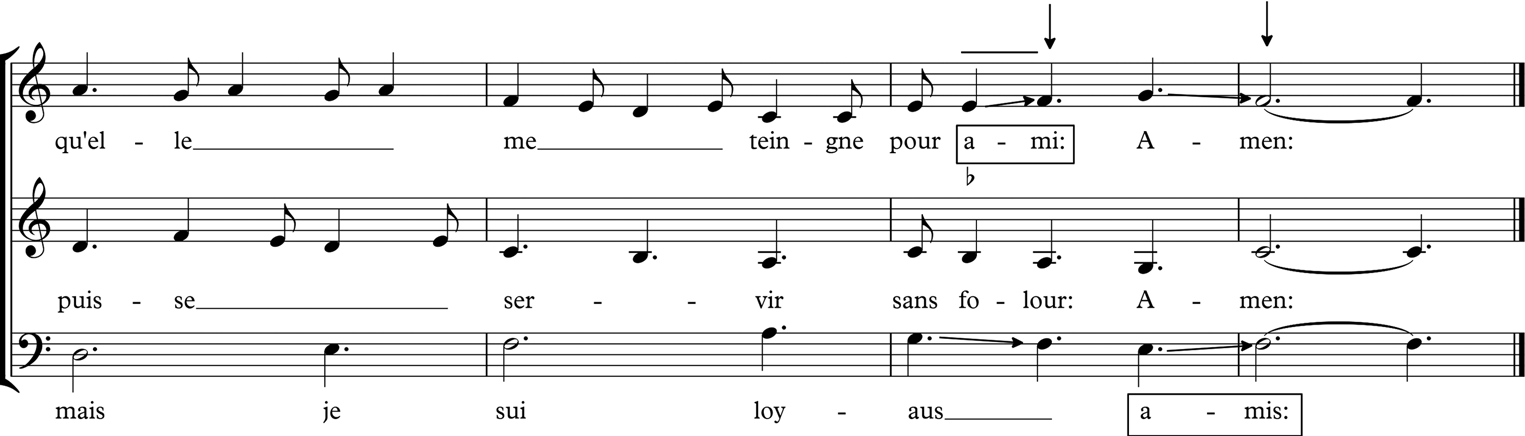
A seemingly small feature of the end of the motet may support the ability to read this motet as both dedicatory and sacralised. In the strongest type of cadence, the tenor would descend a step while the triplum would ascend, but that motion is reversed here. By contrast, Hartt observes that there is in fact directed motion to the final in the normal manner immediately before the final cadence: in the first two beats of bar 48 the tenor falls to F while the triplum rises to the octave above (see Ex. 3).Footnote 22 The force of this pseudo-cadence is weakened by the motetus, which has a third rather than fifth above the final, and, as Hartt shows, it is metrically weak because it falls within a breve unit, so this progression really has no cadential force in its own right. What this pseudo-cadence in bar 48 does, though, is lead to the final cadence that follows, creating in a sense a twofold cadence: a transitory one for the secular French text and a stable one for the added ‘Amen’, which is not part of the motet text as defined by rhyme and line length. These two moments are linked not only harmonically, melodically and rhythmically, but also phonetically, because the last word of the triplum, ‘amis’, has a sonic relationship to ‘Amen’, and this word is immediately repeated in the tenor to underpin the ‘amen’ of the upper voices. The second part of this twofold cadence, metrically stronger but less harmonically directed, Hartt characterises as ‘more calm … especially fitting for the “Amens”’ and ‘nicely complement[ing] the secular/sacred aspects of the poetry’.Footnote 23 This extended cadential meditation can be seen as a further means of balancing the dedicatory and spiritual interpretations of the motet as a whole.
Guillaume de Machaut, Trop / Biauté / Je ne sui (M20), end (bb. 46–9).

The perfect love expressed in the texts, balanced between sacred and secular, dedicatory and devotional, is reflected by the balance between seemingly contradictory musical elements brought into harmony: the use of up-to-date rhythms with an older melody, and the combination of a rondeau tenor with talea-like upper voices.Footnote 24 The perfection even extends to the mensuration, which is triple on the level of both tempus and prolation.Footnote 25 The placement of this motet at the end of Machaut's initial corpus (and of his first complete-works manuscript as a whole) can be seen as the consummation of both amatory and spiritual journeys, the arrival at the goal of both Esperance and Wisdom, and a kind of fusion of motet and song styles.
Lasse! comment oublieray / Se j'aim mon loyal ami / Pour quoy me bat mes maris? (M16)
Lasse! comment oublieray / Se j'aim mon loyal ami / Pour quoy me bat mes maris? (M16) also combines a song-based tenor with talea-like upper voices that imply a different structure – or, in this case, two different structures. An irregular virelai (Ab1b2aA), with a long A section and short B sections that share rhythm and text but not pitch, is combined with a motetus of ten five-long phrases (fifteen breves) and a triplum that divides into twenty-five-breve units.Footnote 26 Unlike the taleae of Trop / Biauté / Je ne sui (M20), the upper-voice units do not share hockets or other significant rhythmic repetition: they are delineated solely by their ends, with a note of at least one breve in length followed by a rest of at least one breve.Footnote 27 There are no other rests in either part. The story becomes more complicated. The motetus phrases are paired, the first ending with a breve followed by a long rest (bb. 13–15), the second with a long (or combination of notes with equivalent value) followed by a breve rest (bb. 28–30). This creates five ten-long (thirty-breve) taleae that do not map consistently onto the triplum's twenty-five-breve units. Each voice therefore has its own structure: while the upper voices are both based on the talea principle, they in fact have different taleae.
Like Trop / Biauté / Je ne sui (M20), this motet gives an initial impression of upper-voice phrases aligned with the tenor: the tenor refrain has natural cadence points at long 5 and long 8, and each is marked by a cadence in three parts at the first appearance of the refrain (bb. 13 and 22), slightly weakened by forward motion in at least one voice. After that, however, the three voices, with their separate formal principles, begin to diverge, weakening most potential cadence points, and unlike Trop / Biauté / Je ne sui they remain on separate tracks.Footnote 28
Upon further examination, the triplum's talea units seem particularly strange. First of all, at twenty-five breves they go beyond the perfect long units that govern the motet's mensuration; the second unit begins on the second breve of long 9, the third on the third breve of long 17, and so on. Second, they have three distinct forms: the first two consist of twenty-four breves followed by one breve rest, the third is twenty-five breves long without rest, and the final three have one breve rest followed by twenty-four breves. This idea of theoretically regular talea units with irregular forms is unusual if not unique, and in combination with two competing structures in the other voices it verges on formal incoherence.
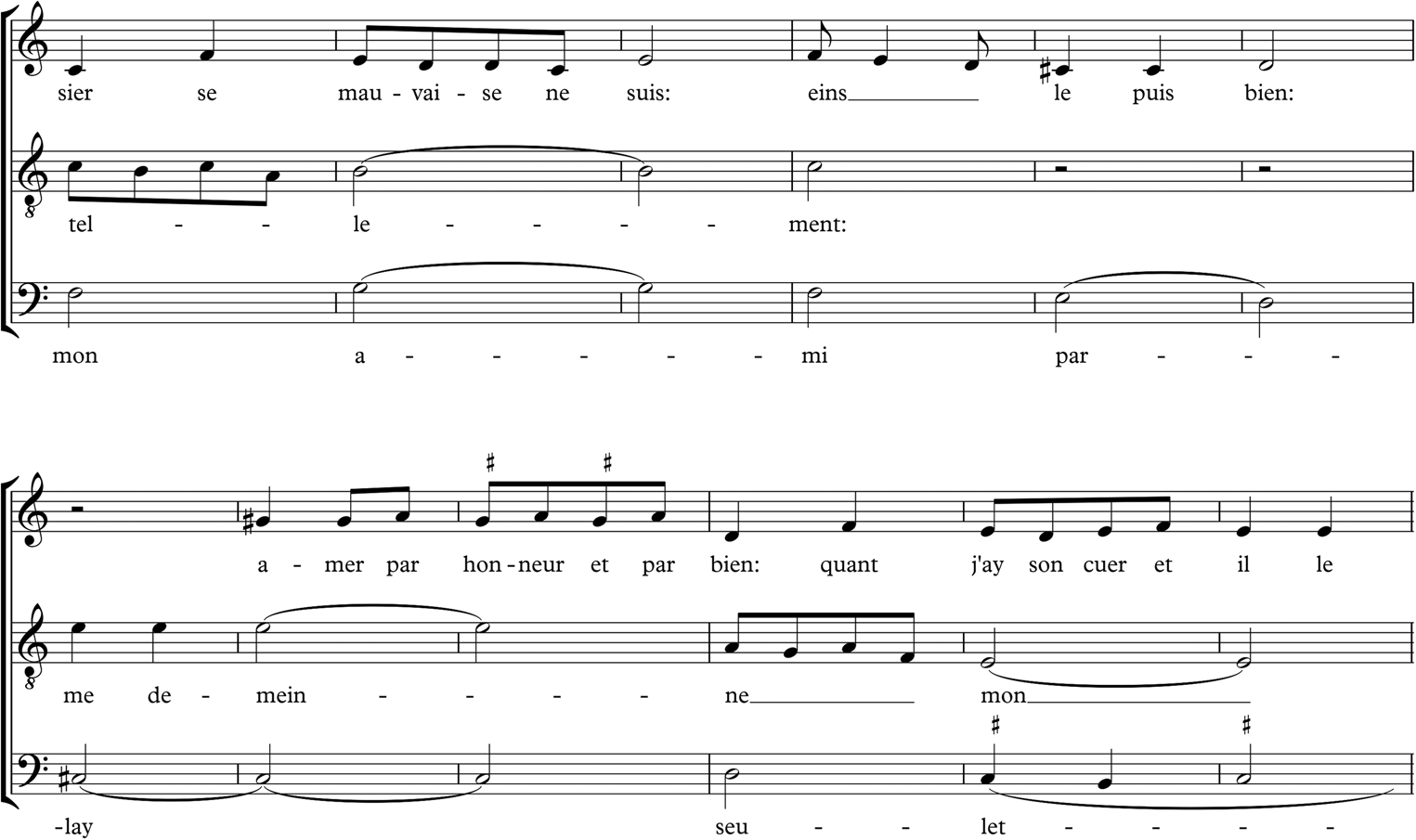
The key moment in the triplum structure should be the motet's midpoint, where the talea units shift (see Ex. 4): the third could (and arguably should) end like the first two, with a rest at bar 75. Rather, the fourth triplum unit begins with a rest.Footnote 29 The reason for this shift is surely in part the fact that the motetus rests in bars 74–5, so a rest in the triplum here would leave the tenor as the only sounding voice in bar 75. Midpoints often serve a critical structural and rhetorical function,Footnote 30 but here Machaut seems to undercut its power: while bar 75 is marked by a cadential sonority of sorts (an octave properly prepared in triplum and tenor), it not only falls on a rhythmically weak position, on the third breve of a long unit, but also in the middle of a tenor phrase.Footnote 31 The tenor continues to an unstable sonority with a C♯ in the tenor in bar 76 (which itself coincides with a triplum rest) to begin the second half of the motet. What we have here appears to be a deliberate collision of the regular and the irregular, the strong and the weak, the expected and the unexpected, creating what Boogaart calls an expression of ‘both the impossibility of dividing and the inevitability of the separation’.Footnote 32 Where the disparate elements of Trop / Biauté / Je ne sui (M20) seemed held in balance, reflecting an ideal of perfect love, the anomalies apparent here seem to clash with each other and even point in opposite directions, reflecting the Lady caught in the middle between her abusive husband and her beloved. Indeed, the octave D/d that falls at the midpoint (b. 75) is itself bookended by mirror images of the same sonority: E/c♯ in tenor and triplum before, C♯/e in tenor and motetus after.
Guillaume de Machaut, Lasse! / Se j'aim / Pour quoy (M16), midpoint (bb. 70–81).

All three texts are in a female voice, each narrator criticizing her husband for punishing her because she loves another man. The tenor bemoans the fact that her husband beats her, although she has not done more than speak with her beloved. The motetus argues that her husband (who in fact does not appear in the first half of the text) has no right to ask her to forget a love that is so faithful, while the triplum declares that, while she would be wrong to fall in love after her marriage, she is completely justified in continuing a love that originated before that marriage.Footnote 33 All three voices are therefore poised between a prior love that continues into the present and a husband whose jealousy the narrator argues is inappropriate. The midpoint that is both highlighted and undercut sets these two against each other. It is bridged by the tenor's words ‘[mon ami] parlay’, arguing that the Lady's only crime is speaking to her beloved, while the triplum argues that her adulterous love is in fact honourable.
This aspect of pivoting, of looking in two different directions at the same time, can be seen in the structures of each text as well. The tenor refrain, which consists of only two lines in its only other source,Footnote 34 is expanded in Machaut's hands to five, by repeating the couplet and inserting an exclamation: ‘Pour quoy me bat mes maris? / Lassette! / Aymi, Diex! / Pour quoy me bat mes maris? / Lassette!’ (‘Why does my husband beat me? Alas! Poor me, Oh God! Alas, dear God!’).
The exclamation ‘Aymi, Diex!’ becomes the central element of the refrain, and it is set to a melody that extends the neighbouring motion around the final pitch, D, both giving strength to that final and seeming unable to move away from it. Machaut's triplum stanza consists of three eight-syllable lines followed by one of four syllables, rhyming a a a b, where the b rhyme of one stanza becomes the a rhyme of the following one. The four-syllable b lines therefore create a kind of pivot, formally belonging to both the previous and the following stanza, and they are not consistently linked semantically to one or the other.
The motetus text can be read with a constant line length of seven syllables, but it can also be divided into more complex units:Footnote 35
(If I love my faithful lover, and he does me so faithfully that he is all mine, and no buts, and I, just the same, completely, with no base thought, willingly grant myself to him, because he has for a long time gladly served me with his whole heart.)
The ability to divide this text in two ways looks both to earlier motet texts, which often have irregular patterns of line length and frequent short lines, and to other fourteenth-century examples, which more often have regular line length. Here only two rhymes are used throughout, in alternating quatrains that rhyme either abab baba (with constant seven-syllable lines) or a7a3b4a7a3b4 b7b3a4b7b3a4. As with the triplum, the four-syllable lines in this reading serve as pivots between one unit and the next. Both texts therefore embed within them aspects of pivoting or turning in two different directions, of a sort that would seem to fit the motet's subject of a woman turning between her first love and her jealous husband.
The motetus melody also has a kind of pivoting role. It generally moves at the rhythmic speed of the triplum but the harmonic speed of the tenor, and it uses a wide range that crosses both below the tenor and above the triplum. The crossing of the motetus below the tenor is a feature Hartt has noted is relatively common in all three of Machaut's secular-song motets, and he attributes it to a need to provide harmonic variety in the face of the repetition of small units that is at the heart of the formes fixes. Here, however, it also seems to embody the bifocal effect that is the expressive aim of the motet as a whole.Footnote 36
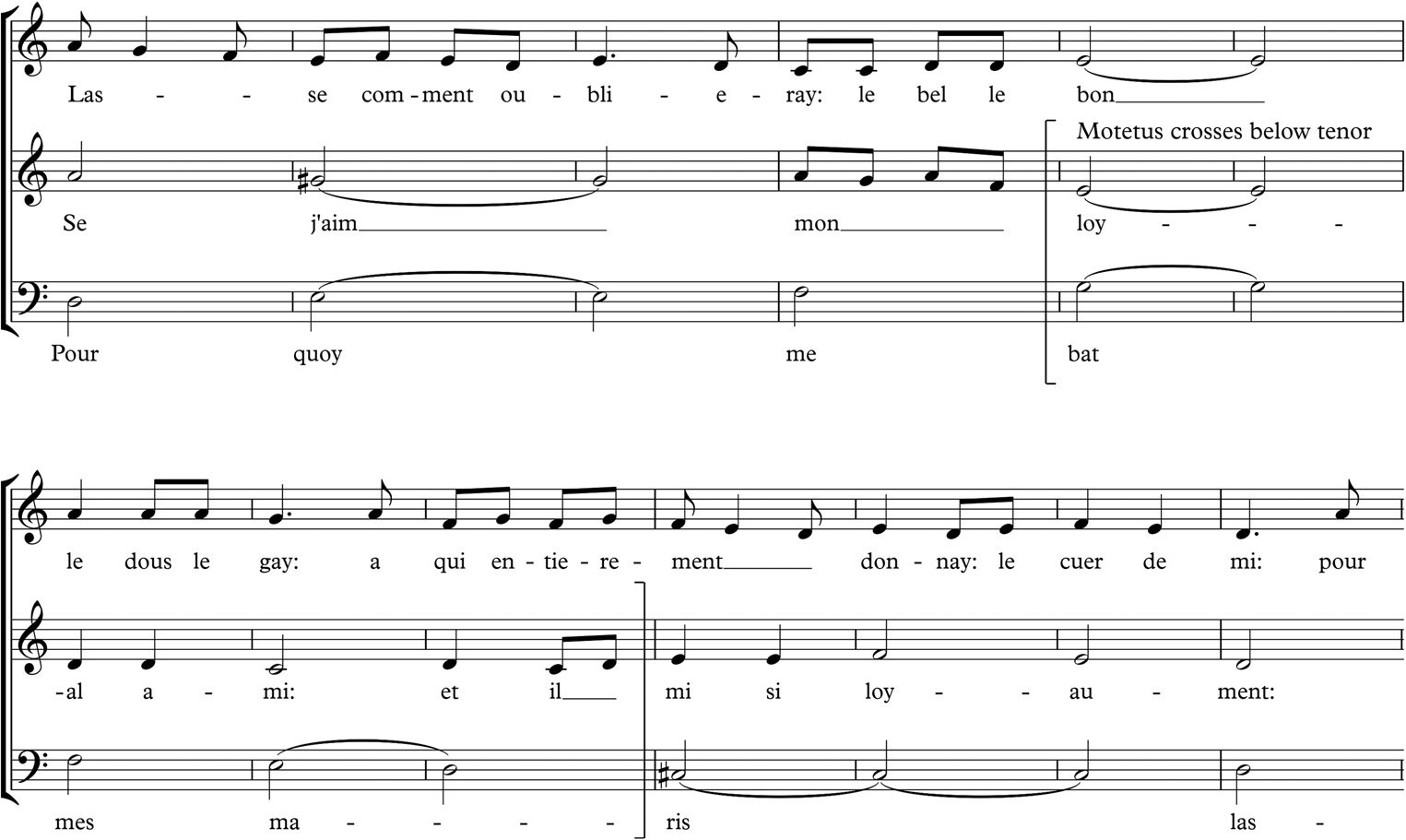
For instance, by crossing the motetus below the tenor in the middle section of its first phrase Machaut not only obscures the tenor's foundational role almost from the beginning, but also gives primacy to the beloved whose loyalty the motetus praises at this moment, while the husband in the tenor is hidden in the middle of the musical texture (see Ex. 5).
Guillaume de Machaut, Lasse! / Se j'aim / Pour quoy (M16), bb. 1–13.

Subsequent statements of this tenor phrase mostly keep its melody under the other voices, giving the husband the foundational role. The exception comes at the final return of the virelai refrain, beginning in bar 109, when the motetus again crosses briefly below as the motetus narrator speaks of the husband's instructions to forget her beloved; placing this segment in the same narrow range as the tenor links the husband's command to his physical abuse.
Robertson links this motet to a moment in Henry Suso's Horologium sapientiae (book 1, chapter 13), when Wisdom tells the Disciple of the difficulties suffered by biblical figures and later martyrs, and even a contemporary wife abused by her husband. That image allows her to conflate the masculine Disciple seeking union with Wisdom to the (feminine) Soul seeking union with Christ, where the jealous husband represents ‘the people and things of this world’, which neither the wife nor the pilgrim is (yet) able to escape.Footnote 37 She does not emphasise the triplum narrator's justification that the relationship with her lover is licit because it originated before the one with her husband, but that argument – in Robertson's terms, that the Soul's union with the Divine came before its embodiment in human form and is therefore superior to it – would support her reading. Indeed, it might further support her argument that this motet was created specifically for inclusion at this point in her larger narrative.Footnote 38 This may have implications for dating: while surely many of Machaut's motets were created before any attempt at manuscript ordering took place, it is possible that some were written specifically to fit (or even signal) ordering principles. (An obvious example is the first motet, whose triplum begins, ‘Quant en moy vint premierement’.)
In this motet, then, Machaut finds ways to express the fundamental idea of a turning between two opposing elements: between a first love and a jealous husband, between one stanza of text and the next, between an irregular tenor and apparently more regular upper voices, between the appearance of regularity in those voices and those factors that undercut it. The motet, like the woman, is poised between one thing and another – following Robertson's narrative, like a soul between the divine and the material, moving restlessly between the two. Unlike the perfect balance that is the subject of Trop / Biauté / Je ne sui (M20), here the elements may be seen in opposition to each other, reflecting the beating of the woman by her husband.
Dame je sui cilz qui weil endurer / Fins cuers doulz, on me deffent / T. Fins cuers doulz (M11)
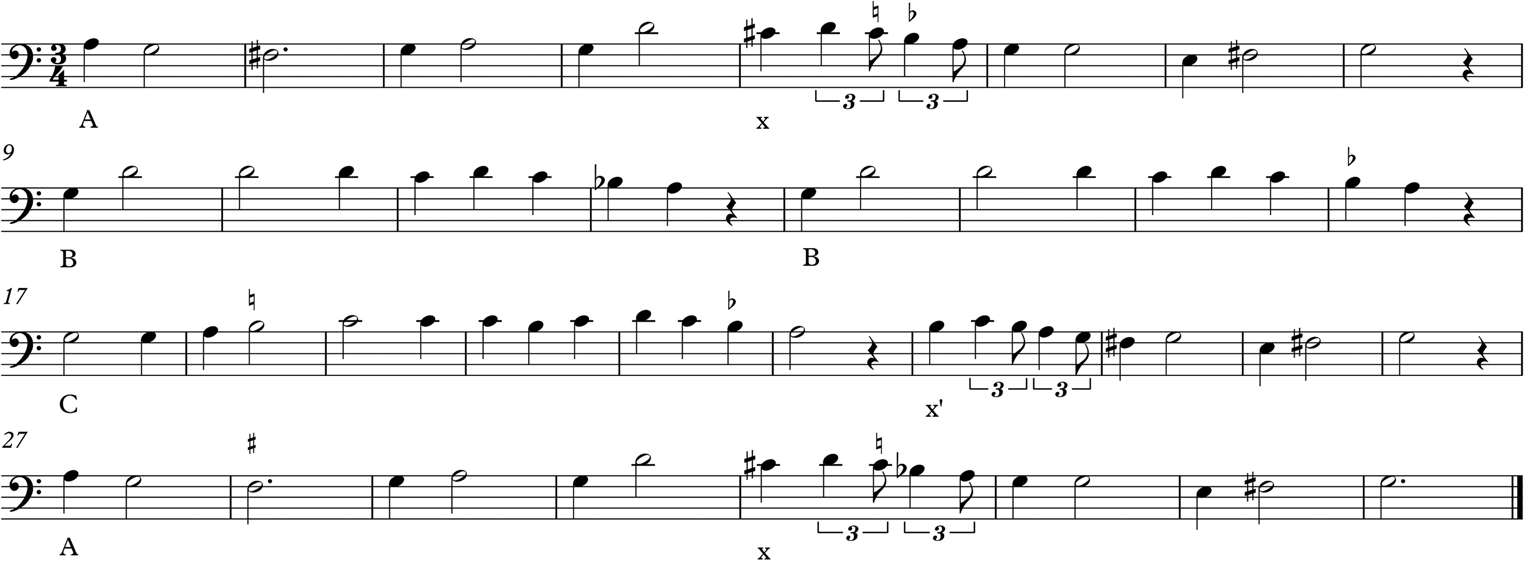
Dame je sui cilz qui weil endurer / Fins cuers doulz, on me deffent / T. Fins cuers doulz (M11) is built on a virelai-like tenor. Based on the correspondence between the tenor text ‘Fins cuers doulz’ and the opening of the motetus text, Friedrich Ludwig suggested that the text simply identifies the tenor as belonging with this motet and does not refer to any pre-existent source.Footnote 39 This text, however, appears in an anonymous Salut d'amours, each of whose stanzas ends with a refrain.Footnote 40 Although this is its only surviving appearance, the structure of its host poem gives credence to its classification as a refrain. If so, Machaut could be referring either to the refrain alone or to a song, now lost, that used it.
Whatever its point of origin, this melody makes an unusual choice for the basis of a polyphonic composition (see Ex. 6). It begins not on the final, G, but a note above, with prominent ficta F♯s and c♯s in the A section.Footnote 41 This tendency towards sharps in the A section is contrasted with flats in the B section, at least as the motet appears in the Ferrell-Vogüé manuscript, which is the source of the example given here. Other manuscripts are less consistent in their use of flats, perhaps because the level of mixture of sharps and flats in this melody seemed odd to some scribes.Footnote 42 The contrast between b♭ and F♯ is crystallised at the end of the C section, where the two appear within a few notes of each other. This conflict between the hard and soft realms of the gamut in the tenor will take on symbolic meaning in this motet.
Guillaume de Machaut, Dame / Fins cuers doulz / Fins cuers doulz (M11), tenor melody (reduced B = crotchet).

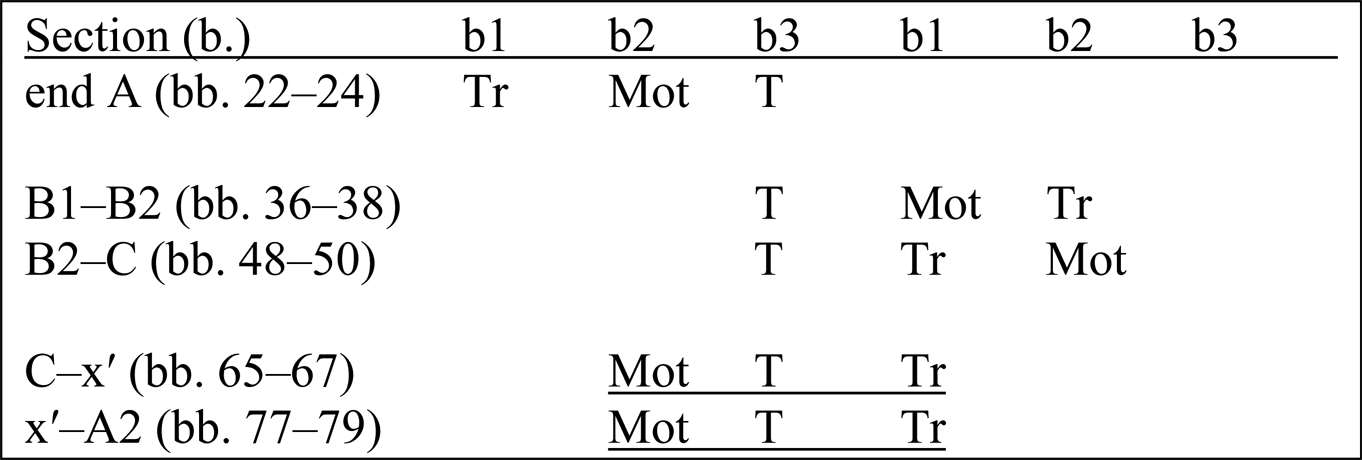
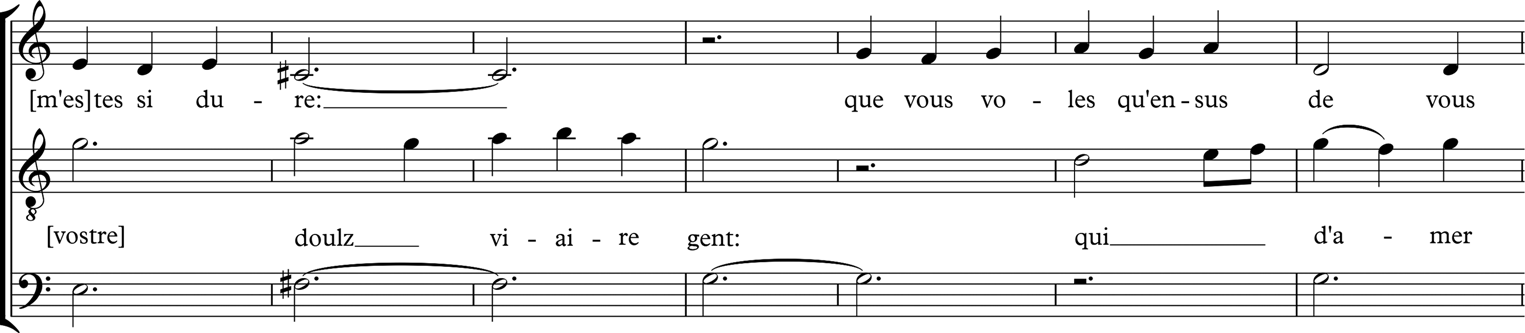
Formally, the tenor resembles a virelai, with the structure ABBCA and a section of musical rhyme (labelled x) linking the ends of the A and C sections.Footnote 43 As in the other two song-based motets, Machaut does not make the upper voices follow this structure, but borrows the motet's principle of staggered rests in a continuous texture. Those rests, however, do not occur at regular intervals, as is the case in most talea structures. Rather, while each upper voice has a rest within two breves of the tenor, whose rest always falls on the third breve of the long unit, each grouping of rests is different until the final one, which shares the pattern of the one that precedes it. (Figure 1a shows a tabular layout of rests by bar number; Fig. 1b shows the relationship of those patterns to long units. Example 7 shows how these play out at the end of the tenor's first A section.) The repetition of the final pattern of rests, coming immediately before the return of the A section, both adds weight to the return of the refrain and subtly signals to the listener that the end is coming.Footnote 44 The resulting phrase lengths for the upper voices are also irregular, so they neither follow the tenor consistently nor set up a separate talea structure, creating a motet that fits the structural expectations of neither the motet nor the polyphonic secular song but borrows from the principles of both.
Guillaume de Machaut, Dame / Fins cuers doulz / Fins cuers doulz (M11), pattern of rests at section ends, by measure number (after Jared C. Hartt, ‘Sonority, Syntax, and Line in the Three-Voice Motets of Guillaume de Machaut’, Ph.D. diss., Washington University, St Louis (2007), fig. 5-2, p. 186, corrected to reflect rest pattern in bb. 48–50, not 49–51).

Guillaume de Machaut, Dame / Fins cuers doulz / Fins cuers doulz (M11), pattern of rests at section ends, showing relationship to long units (b = breve 1–3 of long unit; underlining shows repetition of pattern).

The use of rests to mark phrase ends is not the only way talea units can be created: other regular repetitions of rhythm, and occasionally melody, can be used, and we have seen how hocket helps define talea units in Trop / Biauté / Je ne sui (M20). Here, too, a hocket passage appears three times, each being over a descending line in the tenor beginning on d.Footnote 45 It occurs at irregular intervals, however: beginning in bars 32, 61 and 91 (see Ex. 8a–c). These hocket sections also do not consistently align with the patterns of rests at the ends of upper-voice phrases. The first two times, the tenor descends in breves from d to b♭, moving to a in the following bar.Footnote 46 In the third and final hocket statement (Ex. 8c), the tenor moves in imperfect breves and semibreves from d through b♭ to G, the final. The change in tenor line for this final statement has harmonic implications as well as rhythmic ones. While the first two times the first note, and usually both notes, of the triplum are consonant with both tenor and motetus, and these voices hold their pitch for the entire breve, at the end the motetus and tenor move as well. By the end of bar 93, textual resolution is required as well. This is the only time in the motet where any word is broken by a rest.Footnote 47 When the final, G, is reached in bar 94, the chain ends. The tenor has an unbroken breve, the motetus does not change pitch, and both triplum pitches are stable, thus emphasising the arrival at the final and signalling the close of the piece.
Guillaume de Machaut, Dame / Fins cuers doulz / Fins cuers doulz (M11), bb. 19–25.

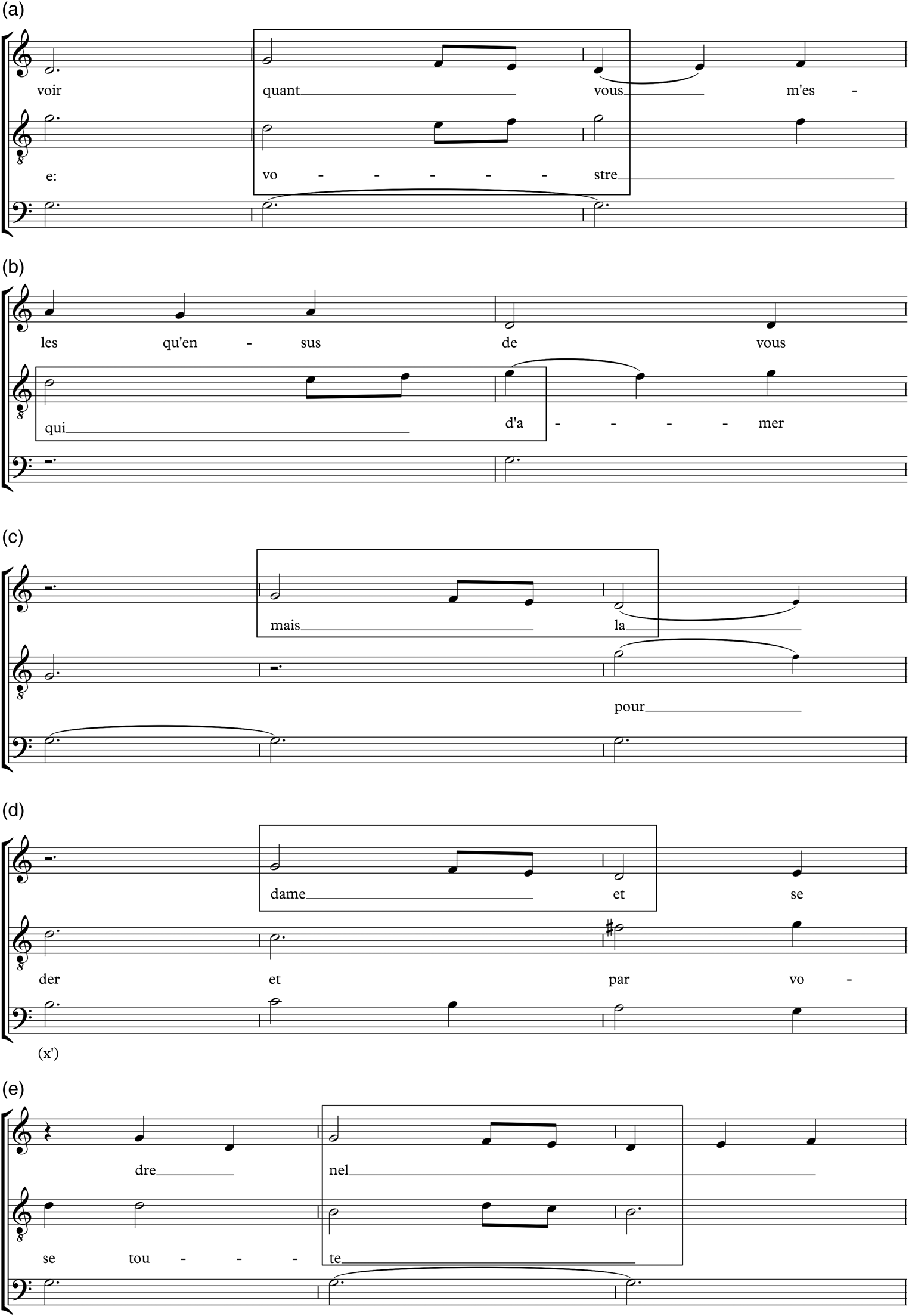
In addition to the patterning of upper-voice rests around tenor rests and the use of hocket, Machaut provides some small-scale irregular reuse of melodic material that can likewise serve to evoke the principles used in traditional motet composition while not following them in a thoroughgoing manner. For instance, Example 9 shows a small motive from bar 17 of the triplum in the first A section (Ex. 9a) that is echoed in bar 95, at the same moment in the second A section (Ex. 9e); a similar melodic gesture occurs at the beginning of the C section (b. 50, Ex. 9c) and its closing x′ phrase (b. 68, Ex. 9d), but it does not appear in the two B phrases.Footnote 48 Each time save the last the descending line also moves the triplum below the motetus. The motive is one whose significance becomes apparent only in retrospect, because its first appearance, in bar 17, is in the middle of a phrase and would excite no comment if it never appeared again. Its effect, however, is cumulative. Its return, twice, at the beginning of phrases in the C section (Exx. 9c and 9d) helps us hear that section as a return of sorts, just as the standard virelai form brings back the refrain music with new text before the refrain text returns. The final appearance of the motive, in bar 95 (Ex. 9e), sheds light on the first, for it returns at the same moment in the tenor melody as it had initially, thus recalling the framing nature of the refrain – a frame that is not emphasised in the triplum by other means.
Guillaume de Machaut, Dame / Fins cuers doulz / Fins cuers doulz (M11): (a) bb. 31–6; (b) bb. 61–6; (c) bb. 91–6.

The motetus reinforces this triplum motive: in the two A sections it uses the same rhythm (breve + two minims), and in bar 17 (Ex. 9a), motetus and triplum reverse each other's melodic motion, part of an extended section of crossing between the two voices.Footnote 49 The motetus repeats this motion to lead into the first B section a few bars later (Ex. 9b); here it again propels the motetus to the top of the musical texture, above the triplum, and it goes on to repeat the melody the triplum has just stated. Again, we would not notice this motive by itself, but in combination with the triplum motive it loosely marks the large sections of the motet, especially the framing A section. Though it serves a formal function, it does so subtly, without ever really becoming predictable in the manner either of a talea pattern or a fixed form. It is in fact something we recognise more than anticipate.
Guillaume de Machaut, Dame / Fins cuers doulz / Fins cuers doulz (M11): (a) bb. 16–18 (first A section); (b) bb. 24–5 (transition into B section); (c) bb. 49–51 (beginning of C section); (d) bb. 67–9 (x′ portion of C section); (e) bb. 94–6 (second A section).

The final statement of the motetus and triplum motives, the first time these two have simultaneously stated them since the opening, comes in bar 95 (ex. 9e). Here the voice exchange of the first A section is abandoned in favour of parallel motion, so the motetus remains below the triplum. The final hocket section, which we have seen changes the melodic and harmonic pattern used in the two previous hockets, immediately follows. In the last phrase of the motet, then, both rhythmic and melodic patterns of repetition are brought together, changed subtly, and lead to the final cadence.
Machaut therefore sets up three means, all borrowed from the talea principle, to organise his upper voices: rest patterns, hockets and small-scale reuse of melodic motives. These all, however, act largely independently of each other, at least until two are combined to lead to the final cadence, and none either sets up units of regular length (as taleae) or follows the tenor units in a consistent manner. Song and motet principles are not juxtaposed, as in Trop / Biauté / Je ne sui (M20) and Lasse! / Se j'aim / Pour quoy (M16), but almost merged, or liquidated into something that draws from both but gives in to neither.
The melding in a sense of two different structural principles is matched by the use of both hard and soft realms of the gamut in the tenor melody. This merging of harmonic areas is made even more prominent in Machaut's motet setting, taking advantage of a kind of hexachordal punning, where flats and sharps are combined with the words ‘doulz’ (sweet, or here soft) and ‘dur(e)’ (hard).Footnote 50 The close proximity of sharps and flats begins as early as bar 12, where Machaut immediately precedes the tenor's c♯ in bar 13 with a b♭ in the motetus (see Ex. 10).Footnote 51 The triplum at this point is singing ‘longuement l'endure’ (long endure), and the fragment ‘dure’ (hard) falls over the tenor's c♯. It may be worth noting in light of what will come that the phrase ‘par vous’ (‘by you’) is stated in the motetus at the same moment, suggesting that the Lady is the source of this dissonance.
Guillaume de Machaut, Dame / Fins cuers doulz / Fins cuers doulz (M11), bb. 10–16.

Such punning between hard/‘dur’ and soft/‘doulz’ is in fact an important feature in his texts. This is most prominently seen at the opening of the triplum text, where forms of ‘dure’ (‘hard’) and ‘endure’ (‘endure or suffer’) end the first four lines, moving from the lover's endurance to the Lady's hardness:
(Lady, I'm the one willing to endure what you will, as long as I'll prove able to last, but I don't think I can endure it for long without dying, with you being so hard on me.)Footnote 52
All four of these forms of ‘(en)dure’ are set to sonorities marked by sharps (bb. 4–5, 8, 13 and 19–21). The musical setting of the first falls in the middle of a phrase, following the poetic enjambment of the phrase ‘endurer / vostre voloir’ (‘suffer your will’), so the fragment ‘dure’ seems to be minimised, but the full text phrase appears over an unstable sonority consisting of a perfect long in the tenor and the only perfect long in the motetus, so one can clearly hear the triplum's words over the ‘hard’ sonority (see Ex. 11). The motetus's word at this point is ‘doulz’, borrowed from the tenor refrain's text and setting up a verbal contradiction between hard and soft that matches the harmonic instability. The answer to the lover's plea for relief may perhaps be seen in what happens next. While the motetus and tenor do resolve the unstable sonority properly in bar 7, the triplum avoids resolution until bar 10, after the second statement of ‘durer’ set to an unstable sharp sonority, at the words ‘mais ne cuit pas’, when he admits he cannot endure much longer.Footnote 53 The emphasis on unstable sonorities and their resolution, on endurance and hardness contrasted with softness, sets the stage for the rest of the motet.
Guillaume de Machaut, Dame / Fins cuers doulz / Fins cuers doulz (M11), bb. 1–10.

A similar conjunction of ‘dure’ with an unstable sonority occurs at bars 20–1, setting into relief this time a phrase of the motetus: ‘[vostre] doulz viaire gent’ (‘your sweet face’). Here the unstable and hard (sharp) harmony, reflecting the triplum text, throws the sweetness of the Lady as expressed by the motetus text into question and allows a further pun in the next line of that text: ‘qui d'amer m'a mis en voie’. The most common translation would say that the Lady's sweet face has caused the lover to fall in love, but ‘amer’ can also mean ‘bitter’, a pun used to good effect in another motet by Machaut (M1, Quant en moy vint premierement / Amour et biauté parfaite / T. Amara valde) and common elsewhere in medieval French literature.Footnote 54 So, where the motetus narrator tells us the Lady's sweet face ‘has set him on the path of love’, we can also read that she ‘has set him on the path of bitterness’. In the first section of the motet (bb. 1–24), then, setting the opening refrain of the tenor, each of the four appearances of the ‘(en)dure’ rhyme in triplum text of the A section is marked by an unstable (and ‘hard’) sonority. Two of these are further combined with the word ‘doulz’ in the motetus, and one other is linked with a flat (from the ‘soft’ hexachord, so a ‘doulz’ sound) in that same voice. In this Lady, as in this motet, sweetness (softness) and hardness are brought together and create both musical and metaphorical dissonance.
The harmonic conflict between the hard and soft sides of the gamut, expressing the amorous conflict between the Lady's sweetness and hardness, is avoided in the two B sections, where there are no sharps and the words ‘dur’ and ‘doulz’ do not appear. Moreover, the triplum text is mostly engaged in describing the beauty and worth of the Lady, rising to its highest note on the words ‘biauté vraie’ (true beauty). The motetus narrator does speak of death, but this is marked musically by range, as the motetus crosses below the tenor to some of its lowest notes, rather than through dissonance. The linking of the triplum discussion of the Lady's value with that of the dying motetus narrator here may suggest less a complaint of this death than an acceptance of it.
The harmonic tension of hard and soft used to such good effect in the A section, however, returns in the C section, and in the second A section the hard/soft combinations cluster around the long sonority in bars 82–4 that combines the words ‘vostre vouloir’ (‘your will’) in the motetus with ‘lonteins’ (‘distant’) in the triplum (see Ex. 12).Footnote 55 The distant harmonies brought together at this moment musically underline the distance between the narrator and his beloved, a distance that is his Lady's will. Moreover, the triplum has an impossible choice in bar 81: either the singer flattens the b on the last beat, creating a melodic augmented second (the solution Boogaart gives in his edition), or it creates a diminished octave with the motetus's b♭. The triplum's note is a passing tone, but it still creates a situation with no ideal solution – but this may be part of the point, as the narrator's agency is undercut by the will of his distant Lady.
Guillaume de Machaut, Dame / Fins cuers doulz / Fins cuers doulz (M11), bb. 79–87.

Machaut's motet therefore comments ironically on the tenor's text, ‘Fins cuers doulz’: this melody, at the ‘heart’ of the motet and describing his Lady's heart, has harmonic implications that are anything but sweet. The interactions between the hard and soft sides of the gamut found in the tenor melody and enhanced in the polyphonic setting, along with the formal interactions between the irregular song tenor and the irregular units of the upper voices, reflect how the Lady's outer appearance and her inner character coexist and contradict each other. The two upper-voice texts further set up expectations that in the end are undercut: pairs of rhyming lines in the triplum lead to a final five-line section, while the motetus begins with a quatrain, then turns to a set of three-line units. In every area, then, Machaut expresses notions of contradiction between appearance and reality that describe the Lady who is the motet's subject.
Anne Walters Robertson reads this motet as linking the concepts of death or suffering, in imitation of Christ's sacrifice, with the sweetness of eternal life as the pilgrim's goal.Footnote 56 Her use of affective theology here may resonate with the use of dissonance in this motet as a kind of ‘sweet suffering’ that yearns for resolution as the pilgrim yearns for God. This strikes me as a valid reading, but perhaps more in the sense of a rereading, a rethinking of a motet for use in a new context. The contradiction between soft appearance and hard reality expressed by the interactions between sharps and flats reflects the Lady more than the narrator, and it does not strongly support the idea of future resolution of suffering evinced by Robertson's (and Suso's) pilgrim. In that case, this motet would differ from Lasse! / Se j'aim / Pour quoy (M16), which may well have been created specifically for the spiritual narrative Robertson suggests.
* * *
All three of these motets use formal and stylistic principles borrowed from both the motet and the fixed-form song in order to express their fundamental subject, as articulated in their texts and supported by other aspects of their musical setting. Trop / Biauté / Je ne sui (M20) shows the balance of a perfect love, merging aspects of the personification allegory of Machaut's own Remede de Fortune with both dedicatory and spiritual possibilities. It brings together both rondeau and talea principles, allowing each to flourish together. Lasse! / Se j'aim / Pour quoy (M16) brings disparate elements into conflict as the female narrator looks in opposing directions, towards a lover and an abusive husband. Its two different upper-voice taleae compete with each other and with the song tenor, and aspects of its music and text embody the pivoting of its narrator between contradictory ideas. In Dame / Fins cuers doulz / T. Fins cuers doulz (M11), Machaut merges song and talea principles in a fundamentally new way, to express a Lady who in herself merges a sweet appearance with a hard reality. The three motets can be read as a narrative unit, moving from a two-faced Lady to one who looks in two directions to one who perfectly merges the courtly and the devotional, but such readings are often more rereadings imposed after the fact.
Though these motets are not based on chant as Egidius de Murino's elementary treatise dictates, they follow its basic principle: ‘First take the Tenor … and the words should concord with the matter of which you wish to make the motet’.Footnote 57 The general principle at work here is similar to that articulated by Anna Zayaruznaya as ‘form-idea relations’.Footnote 58 Here as well, hybrid musical structures serve to represent or express non-musical ideas, not in the sense of emotional expression as found in nineteenth-century music, but in a uniquely medieval manner. Where Zayaruznaya's motets (mostly associated with Philippe de Vitry) embody notions of hybridity or monstrosity that are often negative, here Machaut plays with ideas of love, both positive and negative.
Machaut's experiments in this area, however, seem not to have had much influence, because these motets did not circulate widely outside his own complete-works manuscripts: Lasse! / Se j'aim / Pour quoy (M16) and Trop / Biauté / Je ne sui (M20) are listed in the index of the Trémoïlle fragment (Paris, Bibliothèque Nationale, nouvelles acquisitions françaises 23190), but neither survives elsewhere, and Dame / Fins cuers doulz / Fins cuers doulz (M11) only appears in the Machaut manuscripts. Since no similar works by contemporary composers survive, one could guess that motets based on secular songs were considered unfashionable by the second half of the century.Footnote 59
The use of what is by Machaut's time an old-fashioned motet type does not indicate that these are early works, however. Indeed, as we have seen, the connection of Trop / Biauté / Je ne sui with Bonne of Luxembourg and the creation of MS C places its likely composition in the later 1340s, while Anne Walters Robertson has argued that Lasse! / Se j'aim / Pour quoy (M16) was written specifically for its location in the spiritual narrative of motets 1–17 she traces, which would mean that it would have to be composed not long before the compilation of those motets in MS C in the 1350s. These are therefore the fruits of a mature creator, an experimenter who plays with and against generic and stylistic conventions even while he helps codify them.