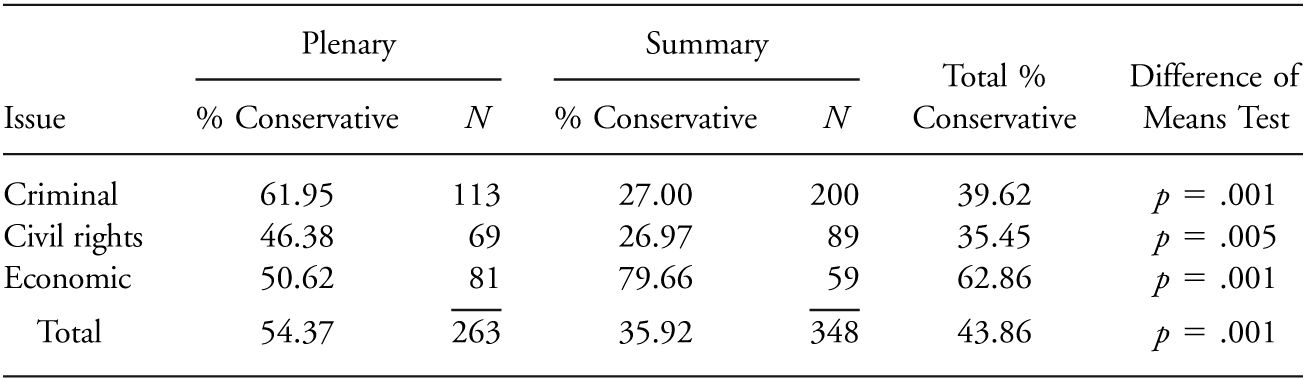
Richard Nixon and Ronald Reagan were widely perceived to be “law-and-order” presidents. Both presidents were strongly committed to changing the course of jurisprudence of the Warren Court, which resulted in major gains for the rights of criminal defendants (Flamm Reference Flamm2005). In 1972, Nixon appointed William Rehnquist to the Supreme Court, who, over his tenure as associate justice, cast 85% of his votes in plenary criminal cases in favor of the law-and-order (i.e., the “conservative”) position.Footnote 1 Reagan’s elevation of Rehnquist to chief justice in 1986 appeared to further advance the law-and-order agenda. Thus, it might surprise readers of this journal that the Court Rehnquist presided over from 1995 to 2005, consisting of seven Republican and two Democratic justices, granted certiorari to over 1,100 petitions from criminal defendants who lost their appeal in the court below, and it nullified that judgment against the alleged criminals in over 90% of its decisions. In the remainder of this article, we seek to gain a wider perspective on Supreme Court decision making that helps to explain these surprising decisional trends of the Rehnquist Court.
The finding of the high support for petitions from criminal defendants appears to go against conventional wisdom. This is because conventional understanding of the Court is largely derived from analyses that systematically exclude any consideration of the Supreme Court’s summary decisions. We contend that existing understanding of decision making is suspect, due to the exclusive reliance on the Court’s formally argued decisions. Excluded from the existing analyses derived from virtually all of the most prominent decision-making models (e.g., legal, attitudinal, and strategic models) are the Court’s summary decisions.Footnote 2 While some scholars discount the import of summarily decided cases for a variety of reasons, we argue below that such concerns are not persuasive.
Reconsidering some of the conventional wisdom is especially important in light of the growing frequency of summary decisions in contrast to a shrinking plenary docket. One critical problem with relying exclusively on orally argued cases, such as those in the Spaeth Database, is that one may get a systematically inaccurate perception of the impact of the Supreme Court on the policy output of the judicial system. For instance, the Rehnquist Court is generally perceived to be a conservative Court that mainly supports conservative policy positions—affirming conservative decisions by the courts below and disturbing (i.e., reversing or vacating) liberal decisions of the courts below. However, our examination of the Rehnquist Court’s full decision-making docket suggests that plenary decisions account for less than half of the Court’s total decision output, with summary decisions making up the majority of its decisions. We believe that only through analyzing the full decision-making docket of the Court can the validity of decision-making models be truly tested. For instance, under an attitudinal understanding, the total effect of the Rehnquist Court should clearly be conservative. Our tests of this assumption, described below, indicate that contrary to predictions derived from the attitudinal model, the actions of the Rehnquist Court frequently supported liberal outcomes in the lower courts.
Consideration of summary as well as plenary decisions of the Court may also raise questions about the extent to which the justices are concerned with making broad legal policy rather than correcting errors in the courts below. The Court most often disposes of a case summarily, rather than granting full plenary consideration, when it considers the basic law to be well settled. Thus, summary dispositions are used for the correction of legal errors in the courts below, to guarantee the uniformity of federal or constitutional law across circuits, or to spell out new implications of settled law that the Court does not believe are important enough to warrant fuller, more time-consuming treatment. As a reflection of this view that the Court relies on summary decisions when it believes that the applicable law is clear, a large majority of summary decisions explicitly direct that a lower court’s decision is vacated because the opinion of that court failed to include an analysis of the most relevant precedent. Typically, the summary decision goes on to direct the lower court to reconsider its earlier decision “in light of” a specific precedent that the Supreme Court considers is the best statement of the law binding on the case.
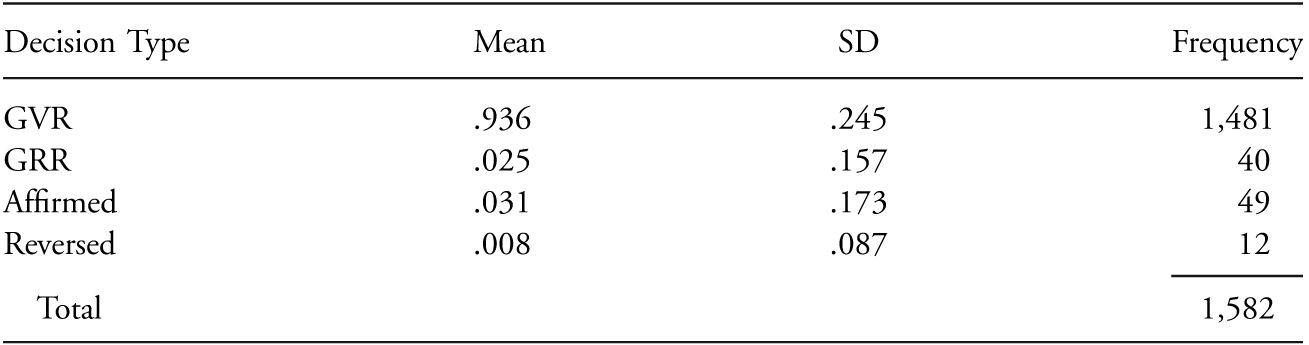
Summary decisions take several different forms. Some, like the most frequent types of plenary decisions, announce that the decision of the court below is either affirmed or reversed. These reversals and affirmances may include a per curiam opinion that is essentially indistinguishable from the per curiam opinions in plenary decisions. Conversely, the decision may be announced with a very brief order (often just one or two sentences in length). However, these affirmances and reversals constitute only a small portion of the Court’s summary decisions. As table 1 shows, affirmances and reversals account for less than 5% of all summary decisions during the 1995–2005 terms. By far, the most common type of summary decision is referred to as a GVR (grant, vacate, and remand)—a decision in which the Court grants the petition for certiorari, vacates the lower-court decision, and remands the case to the court below with directions to reconsider the case “in light of” a specific precedent announced by the Supreme Court.Footnote 3 As the data in the table indicate, close to 94% of all summary decisions take the form of a GVR.
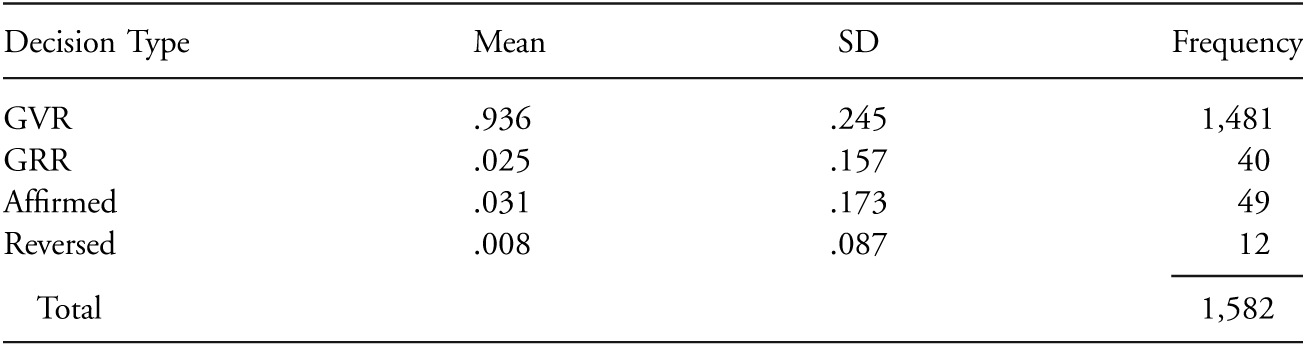
Note.—GVR = grant, vacate, and remand; GRR = grant, reverse, and remand.
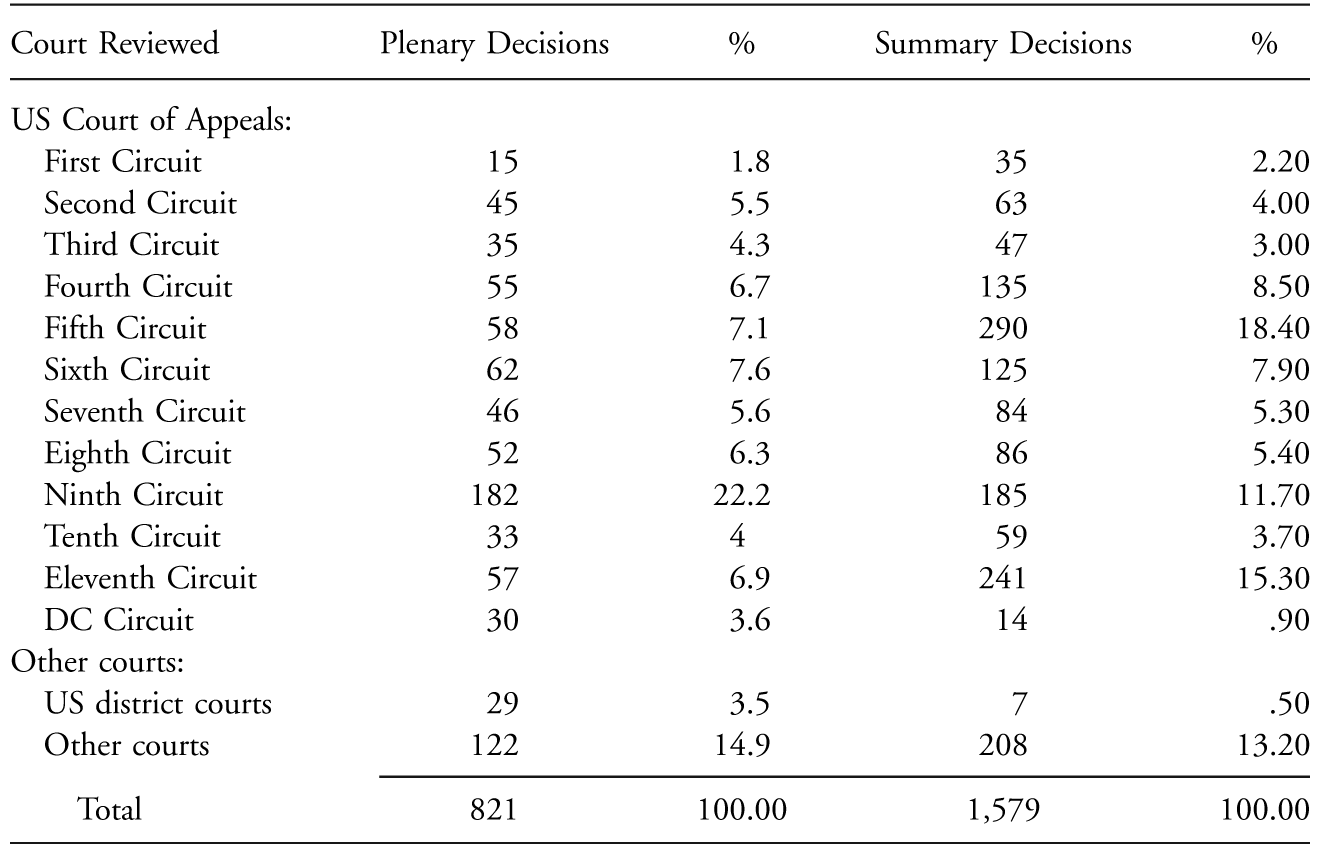
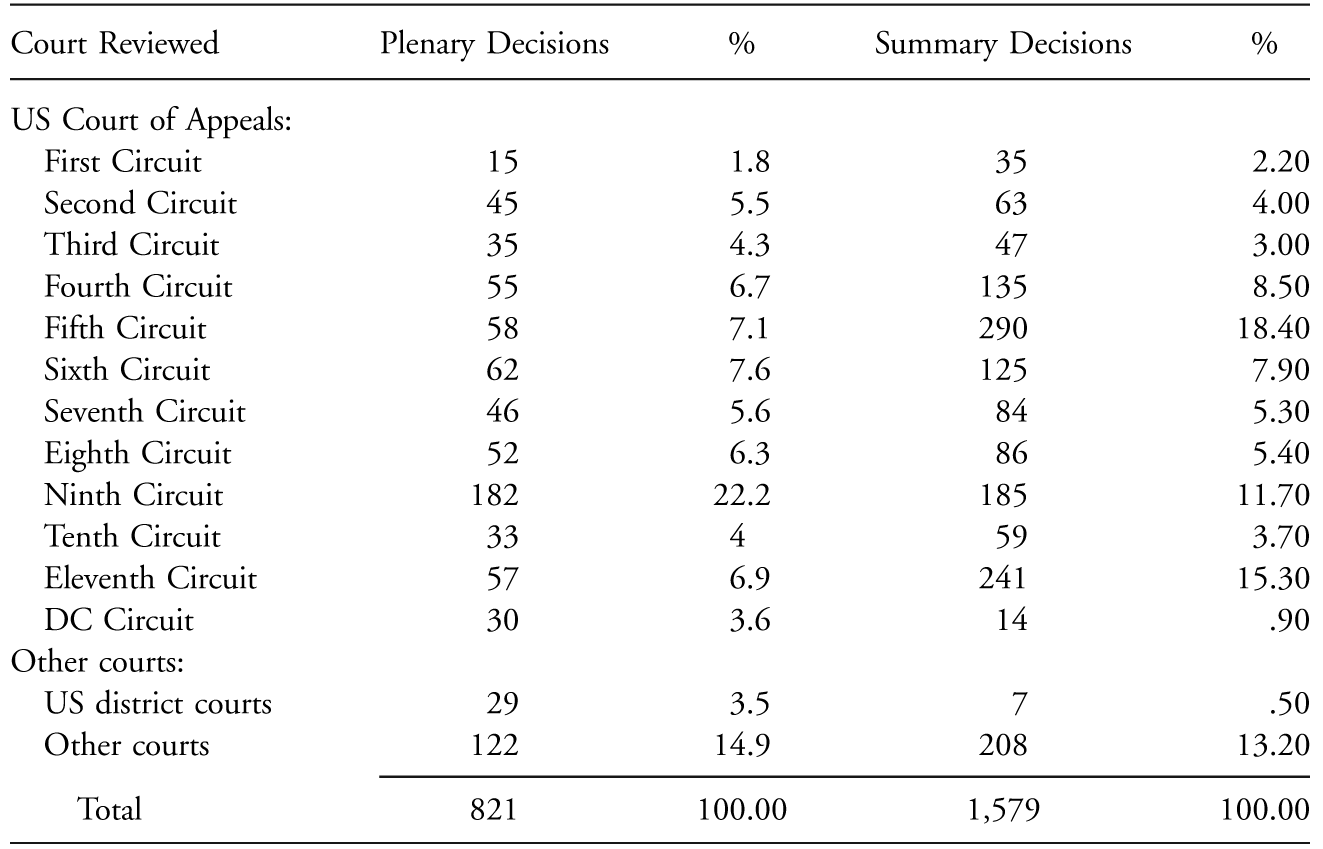
Disputes come to the Supreme Court from a great variety of sources, including the federal courts of appeals, other federal courts on occasion, and state high courts. Cases arriving at the Supreme Court from any of these sources may be decided by either summary or plenary decision. Table 2 details which lower courts’ decisions are resolved by summary and plenary decisions. The patterns are generally similar. Over 80% of the cases decided both summarily and by plenary review come from the US courts of appeals. Within the courts of appeals, the size of the circuit’s docket has a clear impact on the number of cases reviewed. The First Circuit, which decides the fewest cases, has the smallest number of cases reviewed through either plenary or summary treatment by the Court. The Ninth Circuit, which has the largest caseload, is frequently reviewed. The two circuits that stand out as having a different relative rate of review for plenary compared to summary decisions are the Fifth and Eleventh Circuits. In both instances, the high number of summary decisions appears to be driven by the high number of cases from the circuit receiving a GVR in light of the Booker decision (United States v. Booker, 543 U.S. 220 [2005]).
Most summary decisions do not direct the lower courts to adopt a different outcome with a corresponding change in the ideological direction of the decision. Instead, the decision below is vacated because the opinion contains an incorrect statement of current law; in particular, the Supreme Court most often notes that the opinion of the lower court did not discuss and apply the most relevant precedent, in some cases because that precedent was set after the lower-court decision. Unlike plenary decisions, summary decisions are not informed by more detailed briefs or oral arguments from the parties. Typically, the only information received by the justices before they issue a summary decision is contained in the certiorari petitions by each side, their clerk’s certiorari memo on the petition, and possibly the opinion of the court below. Given this lack of information, the most common form of summary decision, the GVR, is a brief order that declares the decision of the court below null and void and directs the lower court to the appropriate statement of law to consider in any further action in the case.
The absence of detailed information from briefs and oral argument may be a reason that GVRs do not typically decide in an explicit manner whether the ultimate resolution of the case (one that is based on a correct reading of the law) should favor the appellant or the respondent. In this regard, however, GVRs are not substantially different from the plenary decisions of the Court, which are remanded back to the lower courts for further action. In either case (summary or plenary remands), the Supreme Court limits itself to stating the appropriate legal rule for the courts to follow and then leaves it to the lower courts to apply the legal rule to the specific facts of their case. Thus, GVRs, like many plenary decisions of the Court, indicate that the Supreme Court is primarily concerned with shaping legal policy to guide the judicial system, rather than deciding specific factual disputes between the millions of litigants that use the US judicial system.
As Perry (Reference Perry1991) pointed out more than 2 decades ago, the Court frequently grants certiorari to advance “jurisprudential” rather than “outcome” goals. When the Supreme Court reviews the actions of the courts below in order to advance such legal goals, the ideological nature of the outcome below has minimal relevance for the Court’s decision. In fact, given the absence of full briefs in the cases summarily vacated, the Supreme Court may frequently be unable to predict whether the reconsideration of the case in light of the appropriate precedent following remand will result in any change in the outcome of the case from an ideological perspective. Thus, we should expect that the ideological preferences of the justices would be unrelated to their votes in cases granted certiorari for jurisprudential reasons.
As we believe that most of the cases disposed of with summary decisions are among such cases granted certiorari for jurisprudential reasons, we do not anticipate that the votes of the justices in these decisions can be adequately explained by their political attitudes. Accordingly, we offer the first systematic test of these theoretical expectations through an empirical analysis of the combined output of the Court in all cases granted certiorari in the 1995–2005 terms.
The Rehnquist Court
The Rehnquist Court is generally regarded as a conservative Court that primarily supports conservative policy positions. Prominent legal scholar Erwin Chemerinsky offers a direct assessment of the Rehnquist Court as one that “had a consistent majority of conservative Justices, and with overwhelming frequency ruled in a conservative direction” (Reference Chemerinsky2003, 675). Additionally, the most widely used measures of the ideology of the justices paint a clear picture of the Rehnquist Court as conservative. Using either the Segal and Cover (Reference Segal and Cover1989) scores or the Martin and Quinn (Reference Martin and Quinn2002) ideal point estimates as an indicator of the policy preferences, a majority of the justices have been conservatives throughout the entire span of the Rehnquist Court.
Summary Decisions in Supreme Court Decision-Making Analysis
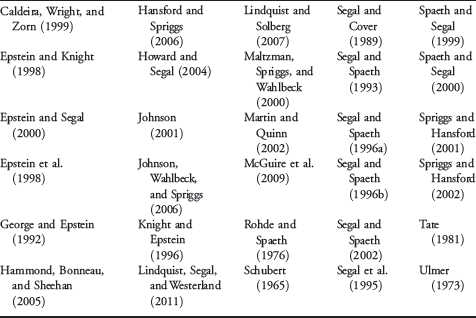
Summary decisions are routinely excluded from Supreme Court decision-making analyses (Schubert Reference Schubert1965; Rohde and Spaeth Reference Rohde and Spaeth1976; Tate Reference Tate1981; Segal and Cover Reference Segal and Cover1989; Segal and Spaeth Reference Segal and Spaeth1993, Reference Segal2002; see app. A for a listing of other studies). The general belief among many scholars is that summary decisions are inconsequential to decision-making analysis. With rare exception (e.g., Brenner and Stier Reference Brenner1996; Songer and Lindquist Reference Songer1996), much of the literature has altogether ignored any potential effect of including summary disposition as part of Supreme Court analysis. We believe that this exclusion of summary decisions is due to three reasons.
First, the nature of summary decisions is generally misunderstood. Some proponents of the attitudinal model equate the majority of summary decisions to certiorari denials (see Segal and Spaeth Reference Segal1996b, Reference Segal2002; Spaeth and Segal 1999). Segal and Spaeth frequently reference the work done by Epstein on summary disposition as the basis for this characterization (e.g., see Segal and Spaeth 1996b, 1077–79), but by their own account, Epstein’s analysis of summary decisions has been of a limited nature and only covers cases from the Burger Court. Moreover, Epstein’s work, on which Segal and Spaeth rely, has never been published; they reference it simply as “personal correspondence with the authors” (Segal and Spaeth Reference Segal1996b, 1081). But this position (that summary dispositions are the same as certiorari denials) is hard to maintain, in light of the fact that summary decisions typically include an explicit statement that the petition for certiorari is granted review. Brenner and Stier criticize Segal and Spaeth for their refusal to examine summary decisions. In their analysis of the influence of precedent on the Supreme Court, Brenner and Stier argue that the exclusion of summary decisions stacks the deck in favor of the attitudinal model by excluding those cases in which the law is most clear (Reference Brenner1996, 1042).
Considerations governing the certiorari process are specified under Rule 10 of the Court, which states, “review on writ of certiorari is not a matter of right, but of judicial discretion. A petition for a writ of certiorari will be granted only for compelling reasons” (US Supreme Court 2013, 5; emphasis added). That is, the Supreme Court itself maintains that summary decisions, like other cases granted certiorari, are granted review because the Court has decided that there are important reasons for it to take action. The implication of this finding is that in the absence of such “compelling reasons,” the Court would deny review rather than granting certiorari and then issuing a summary decision. The grant of review on certiorari separates both summary and plenary decisions from the thousands of certiorari petitions the Court receives and simply denies.
More substantively, a certiorari denial allows the lower-court decision to stand, whereas a summary decision frequently disturbs the lower court by either vacating or reversing the previous decision of the court below.Footnote 4 Thus, a denial of certiorari means that the Supreme Court does not create national precedent, the outcome for the parties remains unchanged, and the precedent established below as binding circuit law (or binding state law if the petition is from the decision of a top state court) remains in place. In contrast, most summary decisions mean that the outcome for the litigants is thrown out, and the circuit precedent established below no longer has the force of law.Footnote 5 The difference between certiorari denial and a GVR or another form of summary decision is typically quite consequential for the parties to the case. In some instances, the distinction is literally a matter of life or death. For example, following its decision in Furman v. Georgia (408 U.S. 238 [1972]), the Supreme Court vacated the sentences of more than 100 petitioners through GVRs (Songer and Lindquist Reference Songer1996). To suggest that these outcomes are essentially the same as a denial of certiorari is a fallacy. If certiorari had been denied, the capital sentences would remain in place, and each of the petitioners would have been executed. Because of the Court’s summary decisions, all of the petitioners were able to avoid execution. Moreover, these summary reversals put virtually all states that employed the death penalty on notice that their statutes were likely unconstitutional and would need revisions in accordance with the Court’s opinion in Furman. Certiorari denials would not have had a similar impact on state policy across the nation. Simply put, the Supreme Court deliberately affirming, vacating, or reversing a lower-court decision through summary disposition is fundamentally different from allowing the lower-court decision to stand without a grant of review.
The Supreme Court itself has said that summary decisions are issued “in light of a wide range of developments, including our own decisions, State Supreme Court decisions, new federal statutes, administrative reinterpretations of federal statutes, new state statutes, [and] changed factual circumstances” (Lawrence v. Charter, 516 U.S. 163, 167 [1996]). In Lawrence, the Court goes even further to justify the use of summary decisions as a means to “[conserve] the scarce resources of this Court that might otherwise be expended on plenary consideration” and to “[alleviate] the potential for unequal treatment that is inherent in our inability to grant plenary review of all pending cases raising similar issues” (167). As the Supreme Court notes, summary decisions are very much a part of the decision-making authority that the Court frequently employs for a variety of reasons.
Beyond changing the outcome for the litigants in a given case, summary decisions always either make an affirmative decision or unambiguously disturb a decision on the merits below. Additionally, as Perry (Reference Perry1991) notes, summary decisions have precedential value. In contrast, certiorari denials never have precedential value, nor are certiorari denials ever a decision on the merits. Certiorari denials do not indicate the support or nonsupport by the Supreme Court of either the factual outcome or the legal rule announced in the decision below, while summary decisions authoritatively either affirm or disturb both the outcome and the legal rule below. The Supreme Court has made it clear that the denial of certiorari should not be interpreted to mean that it supports or endorses either the outcome or the legal rule announced in the decision below. In Missouri v. Jenkins (515 U.S. 70, 85 [1995]), the Court is explicit that “the denial of a writ of certiorari imports no expression of opinion upon the merits of the case” (see also United States v. Carver, 260 U.S. 482 [1923]). The same does not hold true for summary decisions. For instance, in Hicks v. Miranda (422 U.S. 332, 344 [1975]), the Court offers that “summary disposition of an appeal, however, either by affirmance or by dismissal for want of a substantial federal question, is a disposition on the merits.” Perry notes that there is some difference of opinion as to how much precedential weight summary decisions have (1991, 32). Nevertheless, some summary decisions have substantial precedential significance. One prominent example is the Court’s decision in Espinosa v. Florida (505 U.S. 1079 [1992]). In this summary decision, the Rehnquist Court declares that vague descriptions of aggravating circumstances for criminal sentencing are unconstitutional. In a later plenary opinion in Lambrix v. Singletary (520 U.S. 518 [1997]), the Court reiterates that “Espinosa was not dictated by precedent, but [in fact] announced a new rule” (528). Here, in a plenary decision, the Court unambiguously declares that its summary decision constitutes a binding precedent.
Another way to differentiate between denials of certiorari and summary decisions is that while a certiorari denial has no effect on other decisions by either the same or other lower courts, summary decisions have a broader effect on lower courts (especially if a series of similar summary decisions is issued by the Court). For instance, the Supreme Court’s summary decision in Youngblood v. West Virginia (547 U.S. 867 [2006]) vacates and remands an earlier ruling by the Supreme Court of Appeals of West Virginia. While this summary decision only disturbs the ruling of the court directly below, other district, circuit, and state courts either cite or follow the Youngblood decision on more than 150 occasions. This is a clear indication that lower courts in our judicial system consider summary decisions to be important relevant precedent. The Court’s summary decision in Lawrence has similarly been cited by other lower courts. In fact, some lower courts interpret the Lawrence decision to give all appellate courts the authority to vacate (or reverse) and remand any decision that the lower court believes to be incorrectly decided, has a strong likelihood to be erroneous, or does not take into consideration a recent intervening decision that could affect its outcome. In SKF v. United States (254 F. 3d 1022 [2001]), the court of appeals for the Federal Circuit cites the Supreme Court’s Lawrence decision as the basis to reverse and remand an inferior court’s decision. The SKF decision “concerns the obligation of a court to remand a case to an administrative agency upon the agency’s change in policy or statutory interpretation” (1025). The Federal Circuit finds that the lower court “erred in declining to remand” the case to the appropriate agency (1025). Here is an instance in which the Supreme Court’s summary decision is used as the basis for disturbing an inferior court decision by an appellate court that was not affected by the Lawrence decision.
As further evidence of their legal value, the Court’s summary decision in Brosseau v. Haugen (543 U.S. 194 [2004]) is cited over a thousand times by lower federal and state courts, while a number of other summary decisions are cited well over 100 times each by the lower courts.Footnote 6 This leads us directly to our second point about misunderstandings on the frequency with which summary decisions are issued. While some summary decisions are accompanied by per curiam opinions, most summary decisions do not include a detailed opinion.Footnote 7 Segal and Spaeth (1996b, Reference Segal2002; see also Spaeth and Segal 1999) consider these summary decisions as even less important than those with opinions, due to the lack of a detailed accompanying opinion. Segal and Spaeth refer to these decisions simply as “hold orders.” As demonstrated by the points made earlier on the nature of summary decisions, this characterization appears to be inaccurate. As indicated by their title, “hold orders” do not disturb any decisions by the courts below; instead, they are temporary actions that keep a pending certiorari petition alive until the Court completes action on a different case on its plenary docket that, on its face, appears to raise similar issues. Once the opinion in that plenary case is issued, the cases whose resolutions were initially delayed by the hold orders are then resolved, most often by the denial of certiorari, summary reversal, or a GVR. But alternatively the Court may then proceed to place the case on its plenary docket. In contrast to a hold order, in issuing a summary decision the Court takes a meaningful action that frequently involves substantively disturbing the earlier decision of the lower court.
The frequency with which the Court disturbs lower courts summarily has increased, while the number of plenary decisions issued during the same period has steadily decreased. In 1986, for instance, the Court issued 153 plenary decisions and 107 summary decisions. By 2000, the Court’s plenary decisions decreased to 81, while the number of summary decisions rose slightly to 124.
Our third point concerns the systematic neglect within the scholarship in analyzing the significance of Supreme Court summary decisions. The primary basis of this exclusion is a near exclusive dependence on the US Supreme Court Judicial Database (the Spaeth Database) as the principal source for Supreme Court decisions (see Spaeth and Segal Reference Spaeth2000). Our contention is that the Spaeth Database, while highly useful, is incomplete in reporting the total decision-making output of the Court. The Spaeth Database excludes the majority of summary decisions issued by the Court. The only summary decisions included are those with per curiam opinions. The vast majority of summary decisions are not assigned an opinion (as “opinion” is defined by Spaeth); instead, they are usually short orders issued in light of a plenary ruling or an earlier summary decision, which affirms, reverses, or vacates and remands the decision of the lower court. These summary decisions are substantive decisions that authoritatively either affirm or disturb the ruling of the court below. GVRs, which make up most of the summary decisions, explicitly indicate that the opinion of the court below is unacceptable (and therefore cannot be allowed to remain in place as precedent for the circuit or state in which it was issued) because the reasoning of the lower court did not take account of binding precedent the Supreme Court determined to be essential for a proper decision. GVRs are not “suggestions” to lower courts. They are binding decisions that authoritatively throw out the prior decision of the lower court, declaring it to be null and void. After a GVR, as a matter of law, no party or court may rely on the prior precedent of the lower court. Through a GVR, the Supreme Court is instructing a lower court to take two actions. First, the lower court must issue a new decision. Second, the lower court must directly treat the precedent the Court references within the summary decision. As such, these decisions cannot be considered inconsequential or unimportant. These are deliberate rulings by the Court that are very much a part of its decision-making output. They are rulings that have real consequences for judges and litigants in the courts below, but they are excluded from nearly all decision-making analyses.
Only two prominent studies include summary decisions in their analysis. Brenner and Stier (Reference Brenner1996) and Songer and Lindquist (Reference Songer1996) both include summary decisions to replicate the study by Segal and Spaeth (Reference Segal1996a) to find precedent having a greater influence on decision-making behavior. The inclusion of summary decisions, particularly in the study by Songer and Lindquist (Reference Songer1996), presents a different but more complete understanding of the total decision-making output of the Court. Judicial scholars, at their own peril, continue to ignore summary decisions without first considering their efficacy and impact on Supreme Court behavior. We argue that summary decisions are not only important but essential to fully understand the totality of decision making in the Court.
Reevaluating the Rehnquist Court in Light of Its Summary Decisions
Since we argue above that the summary decisions of the Court are an important part of its decision making, we add a new perspective to current views of the Rehnquist Court by asking how one would evaluate that Court if one examined all cases granted certiorari (i.e., both plenary and summary decisions). As Songer and Lindquist note, one should not exclude the summary decisions of the Court when evaluating the output of the Court because such an exclusion eliminates those decisions in which the law is often clear (Reference Songer1996, 1057).
We examine the Rehnquist Court from two perspectives. First, and arguably most important, we use the decision of the Court as the unit of analysis to examine the overall pattern of decisions and their impact on the courts below. Additionally, we use the votes of the justices as the unit of analysis to determine whether the relationship between judicial attitudes and their votes is the same in summary decisions as it is in plenary decisions. Statistical analyses of plenary decisions concerned with understanding the policy impact of a given court often proceed by simply examining the directionality of the decisions of the court or the votes of the justices, categorized as either liberal or conservative. From an attitudinal perspective, it is expected that the Rehnquist Court, with a conservative majority, should decide its plenary decisions in a conservative manner. A corollary of this straightforward implication of the attitudinal model is that the Supreme Court should attempt to bring the policy output of the lower courts in line with its ideological preferences. Thus, we expect the Rehnquist Court to mainly affirm conservative decisions and to disturb liberal lower-court decisions by either reversing or vacating them. Our more inclusive analysis asks whether these same expectations will be supported when the analysis is expanded to include summary decisions as well as the Court’s plenary decisions.
Previous empirical analyses of just the plenary decisions of the Rehnquist Court demonstrate that the political preferences of the justices have a statistically significant and substantively major impact on their votes. Past analyses of decisions of the Supreme Court further suggest that civil liberties cases are among those in which the attitudinal model has the greatest explanatory power (Segal and Spaeth Reference Segal and Spaeth1993, Reference Segal2002; Kritzer, Pickerill, and Richards Reference Kritzer1998, 404). Thus, to determine whether the attitudes of justices have similar effects in summary and plenary decisions, we restrict the analysis of judicial votes to those in civil liberties cases.
Data and Method
To provide our expanded view of judicial decision making, we conduct a detailed examination of the Rehnquist Court, using the universe of cases decided by the Supreme Court in 11 consecutive terms. First, we compare the ideological direction of plenary decisions to summary decisions from 1995 to 2005. We obtain the data for formally decided cases from Spaeth’s expanded US Supreme Court Database.Footnote 8 The data for summary decisions are original data we collected from the U.S. Reports on the universe of the summary decisions from the 1995 to the 2005 terms of the Court.Footnote 9 In collecting the data on summary decisions, we code the issue area and directionality for each summarily decided case, following the coding conventions used in the Spaeth Database. Spaeth codes the ideological direction of a decision in terms of who wins in the most immediate sense in the Supreme Court, without reference to what the ultimate outcome for the litigants is in subsequent litigation. For example, if the Supreme Court vacates and remands the decision of a state supreme court that affirmed the conviction of an accused murderer on the grounds that the confession introduced at trial was in violation of Miranda, Spaeth codes the decision as liberal, regardless of whether the defendant was subsequently retried in a state court after the remand and convicted once again. We follow the same approach in our coding of summary decisions.
Remands are common in plenary decisions as well as in summary decisions. In fact, for the 11 terms we examine, over half of the Court’s plenary decisions involved a remand in the Court’s final decision. A recent study found that in remands by the Court in its plenary decisions, the winner in the Supreme Court lost more often than it won in the ultimate action by the lower court (Borochoff 2008). In research for a related project, we followed up on all remands in summary decisions used in the current study to determine the ultimate winner in subsequent litigation. We found that after remands of summary decisions, the winner in the Supreme Court was the ultimate winner in slightly over half the cases. That is, compared to the Borochoff results, Supreme Court winners in summary decisions fared better after the remand than did the winners in plenary decisions after remand. Since the conventional rules for coding the directionality of plenary decisions of the Supreme Court do not take account of whether the immediate winner in the Supreme Court ultimately prevails after remand, we believe it is appropriate to follow the same coding rules in our analysis; it is particularly important to follow the same coding conventions that Spaeth uses, because one of the purposes of this manuscript is to compare the pattern of results in summary decisions to the analogous patterns in plenary decisions. Such a comparison would be impossible if we used different coding rules for the same concepts in the two studies.
For summary decisions with per curiam opinions, we code directly from the opinion. For summary decisions without per curiam opinions, we first code the directionality of the lower-court decision. If the Supreme Court affirms the lower-court decision, we code directionality in accordance with the lower court. If the Court disturbs the lower-court decision by either vacating or reversing the lower-court decision, we code the Court directionality as in the opposite direction. For instance, a Supreme Court decision that summarily vacates or reverses the conviction of a criminal defendant is coded as liberal. We additionally compare the plenary and summary decision directionality by the major issue areas.
In order to determine whether an outcome is liberal (1) or conservative (0), we follow Spaeth’s coding conventions. For example, for civil liberties cases, an outcome or vote is coded as liberal if the decision is pro–person accused or convicted of crime, pro–civil liberties or civil rights claimant (except in affirmative action cases in which the pro–affirmative action position is coded as liberal), pro-female in abortion cases, and pro-neutrality in establishment clause cases. We code the inverse as conservative.
To determine what effect judicial attitudes have on their votes in our expanded data set, we conduct a logistic regression analysis of the votes of all justices in the 1995–2005 terms of the court in which the issue is either a criminal appeal or another civil liberties claim. Such civil liberties votes comprise 75.0% of all votes cast by the justices in the period examined (54.7% of plenary votes and 86.1% of votes in summary decisions). The dependent variable is whether the vote of the individual justice supports a liberal outcome.
The primary independent variable of interest is the ideology of the justice. As the measure of judicial ideology, we use the Segal and Cover scores derived from the content of newspaper editorials at the time the justice was nominated (see Segal and Cover [1989] for a detailed explanation of how the measure is derived). A score of 1.00 represents the most liberal position possible, and zero the most conservative position. The actual range for the justices included in the analysis is from Scalia (score 0) to Ginsberg (score 0.68).
Since previous analyses of Supreme Court decision making consistently demonstrate the influence of the solicitor general, we add two dummy variables to control for the influence of the United States as a party and the arguments of the solicitor general. US Liberal is coded one if the United States supports a liberal outcome in the case (zero otherwise), and US Conservative is coded one if the United States supports a conservative outcome in the case (zero otherwise). The excluded category consists of cases in which the United States did not participate.
Given the high stakes for the litigants in many criminal cases, even a court composed of judges primarily interested in making policy rather than correcting errors in the lower court might find it morally difficult to allow lower-court errors to stand when those errors have the potential to result in a significant loss of liberty (or even life) for an individual. Given such a scenario, decisions in criminal cases might disproportionately favor the criminal defendant, thus resulting in a decision coded as having a liberal outcome. To control for such a possibility, we add a variable, “criminal case,” coded one if the appeal raises a criminal rights issue (zero otherwise).
To test whether the impact of judicial attitudes on their votes is different in plenary decisions than it is in summary decisions, we add a dichotomous variable coded one if the case results in a plenary decision and coded zero if the case is decided through a summary decision. We then generate a multiplicative term (plenary case × justice ideology) to assess the interaction between the impact of judicial ideology in summary cases and its impact in plenary cases. For each model specification, we use standard errors clustered on the justice to control for nonindependent errors based on individual justice voting patterns over time.
Empirical Results
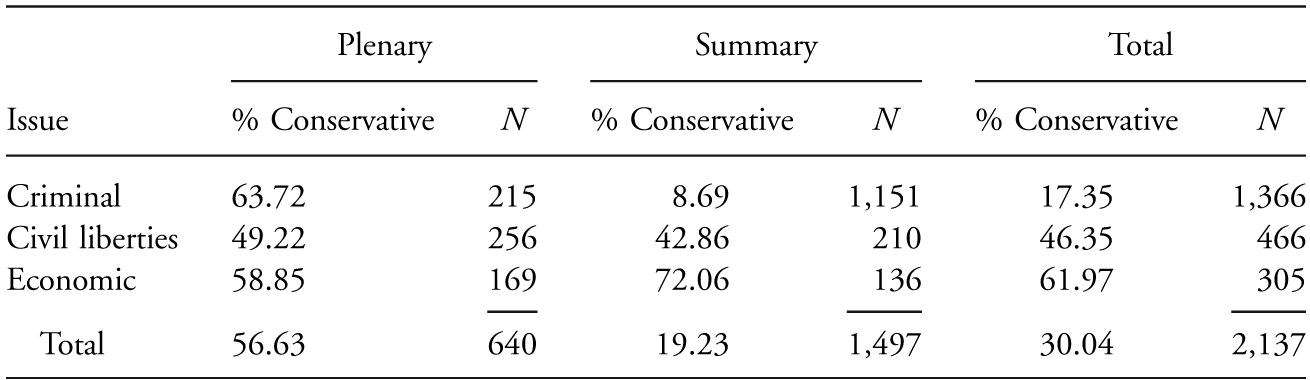
The results presented in table 3 show the conservative directionality of the Supreme Court’s plenary decisions during the 1995–2005 terms, confirming the results of previous empirical analyses. The Court’s decisions are segmented into the directionality of its decisions for both plenary and summary decisions in the three general issue areas that arguably are the most ideologically driven (criminal, civil liberties, and economic cases).Footnote 10 During this time, of the 640 cases the Court disposed through plenary review, just over half (56.6%) are decided in a conservative direction. During the same period, the Court disposes of more than twice as many cases through summary disposition. Of the nearly 1,500 cases decided through summary disposition, less than 20% are decided in a conservative direction. Moreover, the overall directionality of summary decisions is significantly different from the directionality in cases decided following plenary review. Looking at the case categories separately is also revealing. Less than 9% of criminal cases granted certiorari and summarily disposed have a conservative directionality. However, nearly three-quarters of summary decisions involving economic issues have a conservative outcome. Interestingly, the majority of civil liberties cases in both plenary and summary decisions have a liberal direction under an ideologically conservative Court.
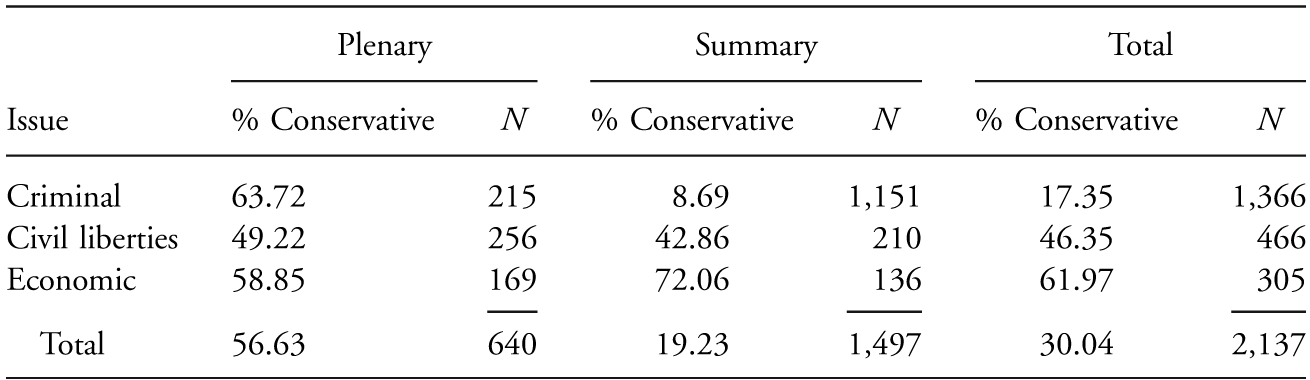
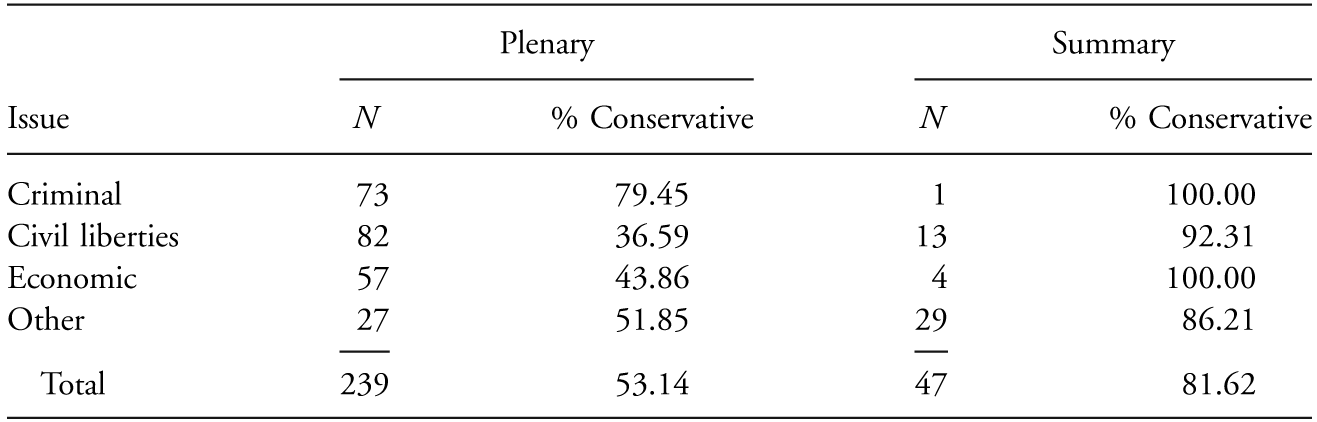
Source.—Plenary: Supreme Court Database; summary: U.S. Reports.
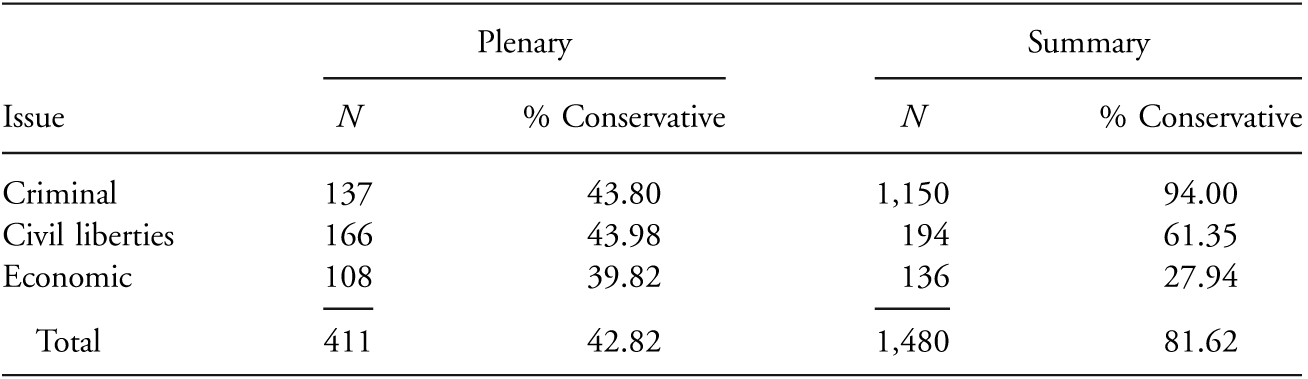
We refine our initial comparison of the policy output of the summary and plenary decisions of the Court by separately examining those Supreme Court decisions that affirmed the decision below and those that disturbed the outcome below.Footnote 11 In examining Supreme Court disturbances of lower-court decisions, we find that plenary decisions are most likely to disturb liberal lower-court decisions in all three issue areas (i.e., less than 43% of the decisions below had a conservative outcome in the court below). This is consistent with previous analyses restricted to the plenary decisions of the Court. In sharp contrast, summary decisions are most likely to disturb conservative lower-court decisions in both civil liberties and criminal rights cases (but not in cases involving economic disputes; see table 4). In criminal cases, well over half of the lower-court decisions disturbed by plenary action are liberal outcomes, whereas only one of 16 lower-court outcomes disturbed by summary action are liberal (i.e., 94% were conservative decisions in the court below). The contrast between summary and plenary decisions in the directionality of the lower-court outcome disturbed in civil rights cases is not as pronounced as in criminal cases, but it is substantial nevertheless (44% conservative in plenary cases vs. 61% conservative in summary decisions).
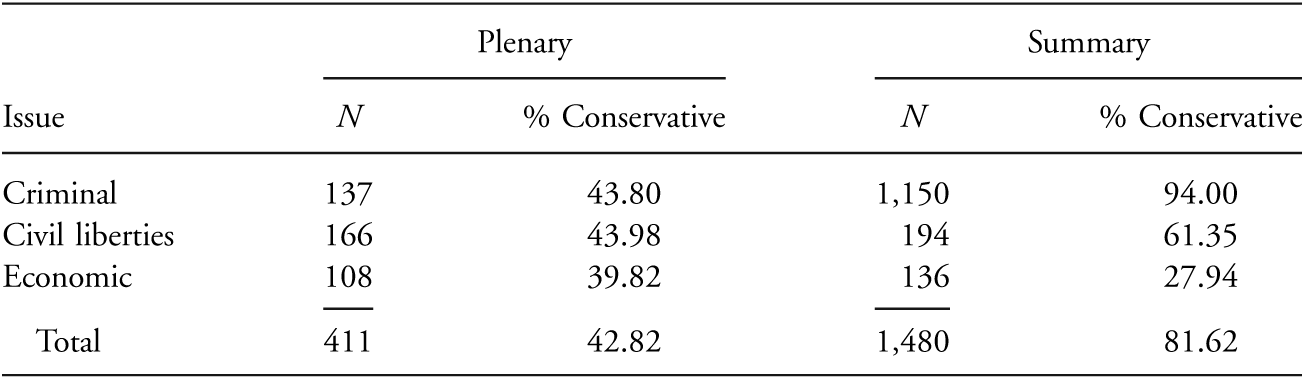
Source.—Plenary: Supreme Court Database; summary: U.S. Reports.
In contrast to the picture presented by cases that disturbed the decision below, summary decisions affirming the decision of the lower court are overwhelmingly conservative. In table 5, we see that over 90% of the summary decisions affirming a civil liberties decision below supported the conservative position. Only one criminal decision and four economic decisions were summarily affirmed, and in every instance the decision affirmed had a conservative outcome. Overall, including the cases in miscellaneous issue categories, slightly over 80% of the summary affirmances supported conservative outcomes. Also notable in the analysis presented in table 5 is that the Supreme Court only summarily affirmed 47 decisions of the lower courts in its 1995–2005 terms. Thus, overall, affirmances made up only 3% of all summary decisions.
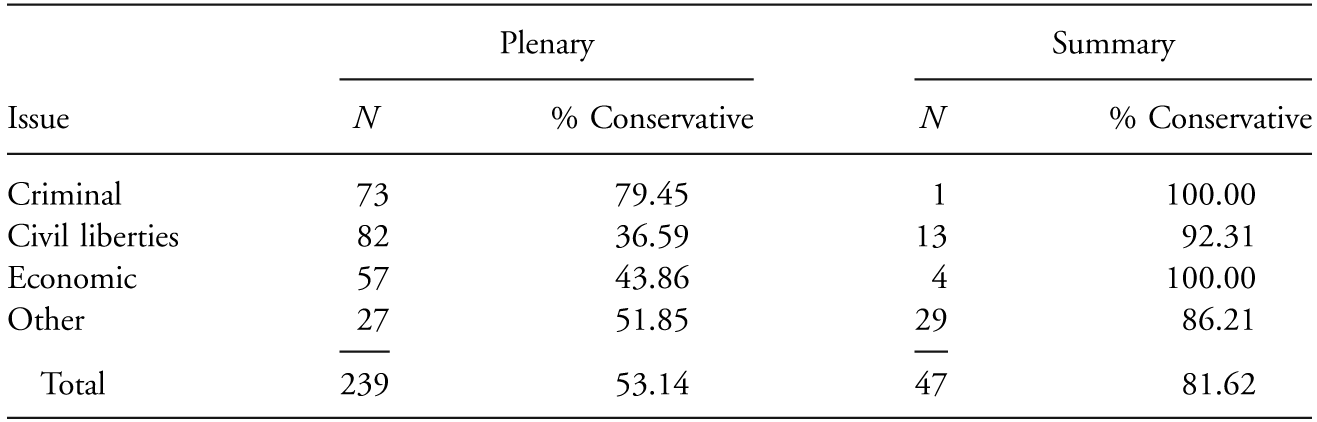
Source.—Plenary: Supreme Court Database; summary: U.S. Reports.
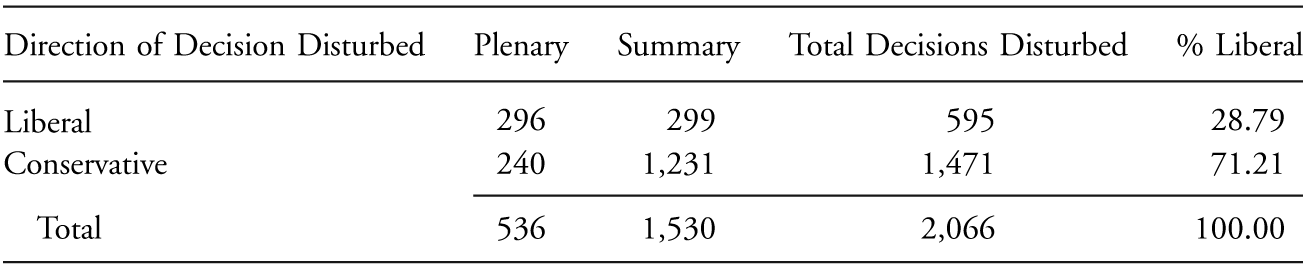
Given the higher frequency with which the Court issues summary decisions and the greater disparity between plenary and summary decisions in the direction of lower-court decisions it disturbs, the total effect of the Rehnquist Court is that it more often disturbs conservative lower-court decisions rather than liberal decisions. Table 6 shows the combined effect of the Rehnquist Court’s full decision-making output. The data suggest that the Rehnquist Court disturbs conservative lower-court decisions approximately 71% of the time. This finding is a significant departure from the conventional wisdom about the Rehnquist Court. Since the Rehnquist Court is widely viewed as conservative, it is expected to primarily disturb the liberal decisions of the courts below. Yet, the data on the Rehnquist Court show that this is not the case. This suggests that many of the decisions of the Rehnquist Court (especially the majority of its summary decisions) were driven by something other than the political ideology of the Court majority. We next directly examine the impact of the justices’ political attitudes on their voting choices in all civil liberties cases granted certiorari from the 1995 term through the 2005 term. The results are presented in table 7.
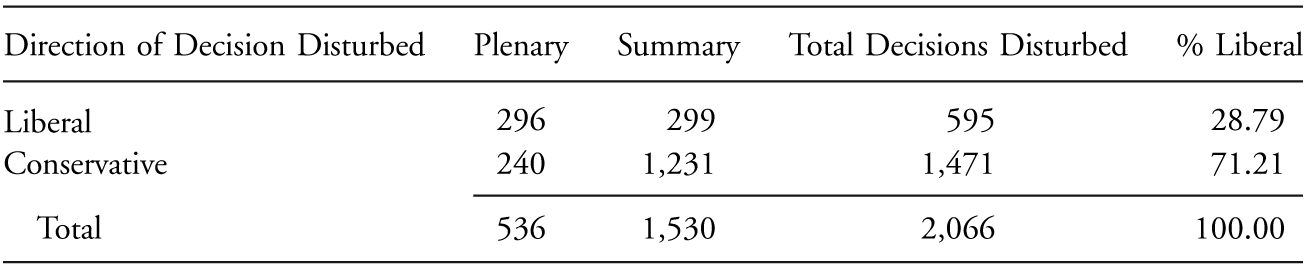
Source.—Plenary: Supreme Court Database; summary: U.S. Reports.
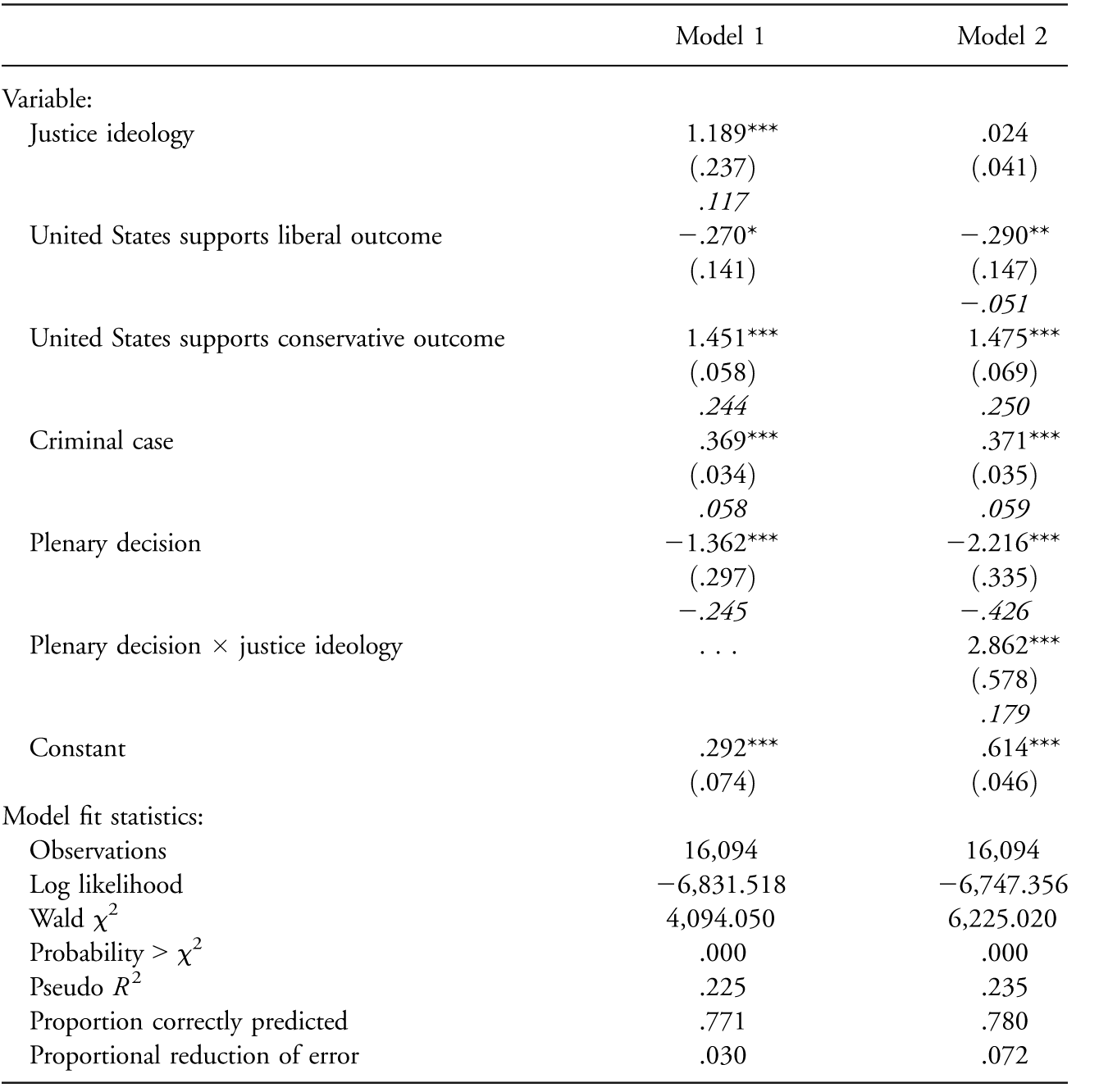
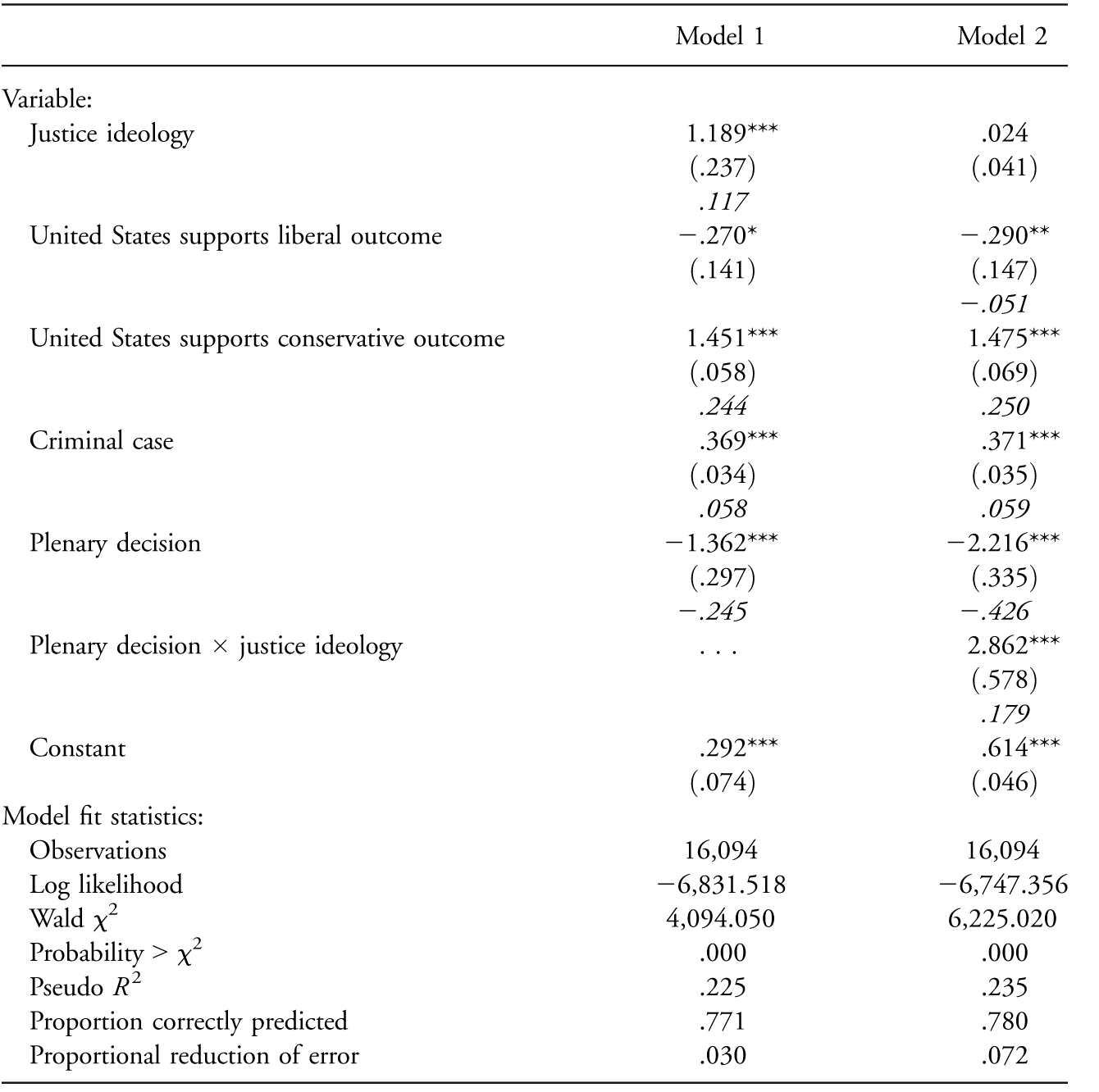
Note.—The multiplicative term plenary decision × justice ideology is excluded from model 1 and included in model 2. One-tailed test used for all variables whose direction is predicted; two-tailed test used for plenary decision. Standard errors clustered on the justice reported in parentheses. Change in predicted probability reported in italics. Changes in predicted probabilities are calculated by adjusting the variable of interest from its minimum to its maximum value while simultaneously holding all other variables constant at their appropriate mean or modal values.
* p < .01.
** p < .05.
*** p < .001.
Previous analyses (e.g., Segal and Spaeth 2002) of the plenary decisions of the Supreme Court have found that the political preferences of the justices strongly relate to the ideological direction of their votes. But in sharp contrast, the results in table 7 do not demonstrate such a strong effect of attitudes. The first model in table 7 demonstrates that the effect of the justices’ ideology on their votes in the sample of all cases granted certiorari (i.e., plenary and summary decisions combined) is statistically significant, but its substantive effect is modest. The predicted probability of a liberal vote for different values of justice ideology, with the values of all other variables held constant at their means, indicates that the likelihood of a liberal vote is only 12% higher for the most liberal justice than for the most conservative justice on the Court.
In the second model in table 7, we see that the impact of the ideology of the justices is conditioned by whether they are voting in a summary decision or a plenary decision. The base coefficient for the justice ideology variable is near zero and is not statistically significant. That is, in summary decisions (indicated by the value of the base coefficient for justice ideology that reflects its effect when plenary equals 0), justice ideology has virtually no relationship to the likelihood of a liberal vote. By contrast, the coefficient for the multiplicative term, which indicates the effect of justice ideology in plenary decisions, is positive and significant at the .0001 alpha level for almost the entire ideological range of the justices.Footnote 12
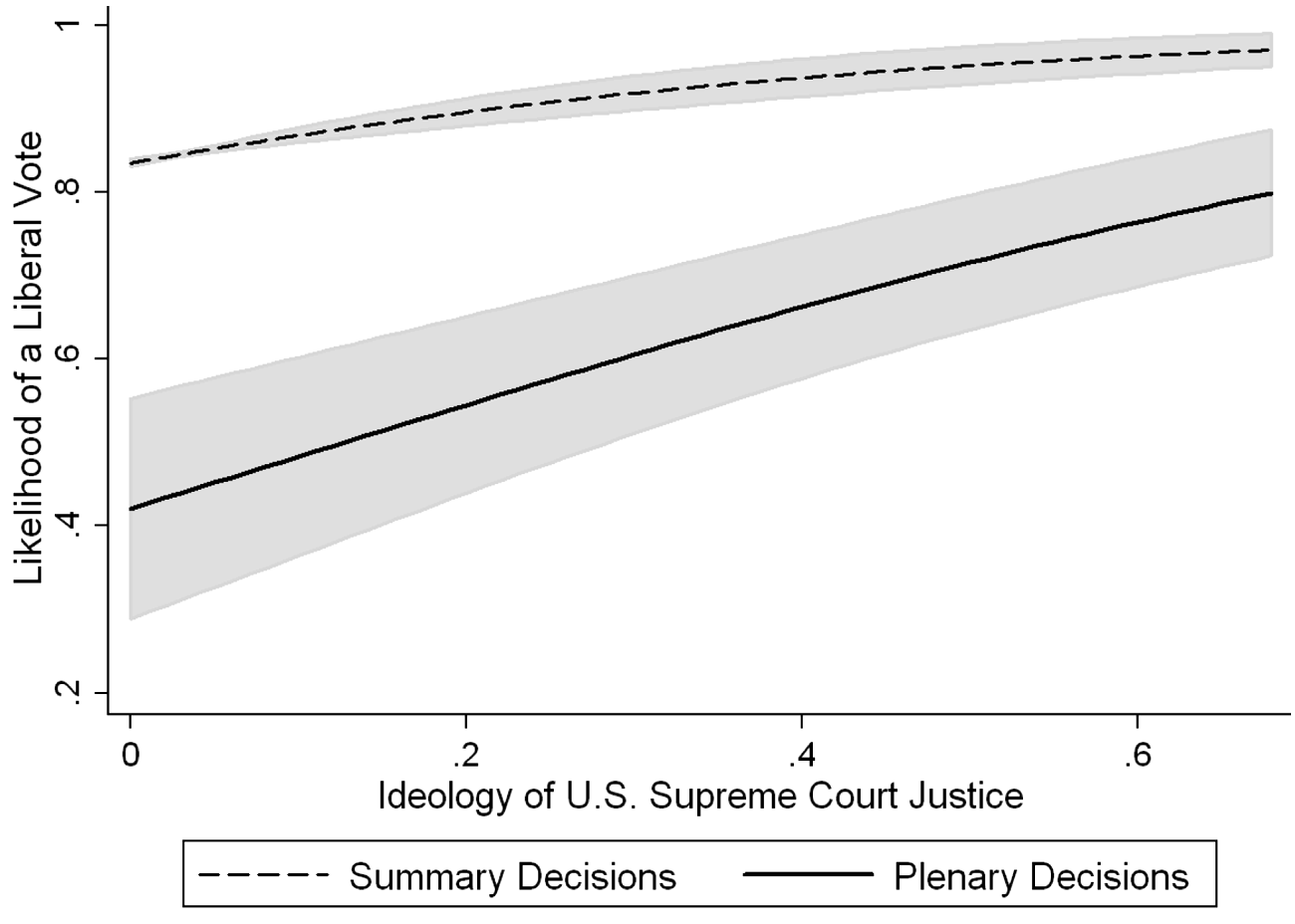
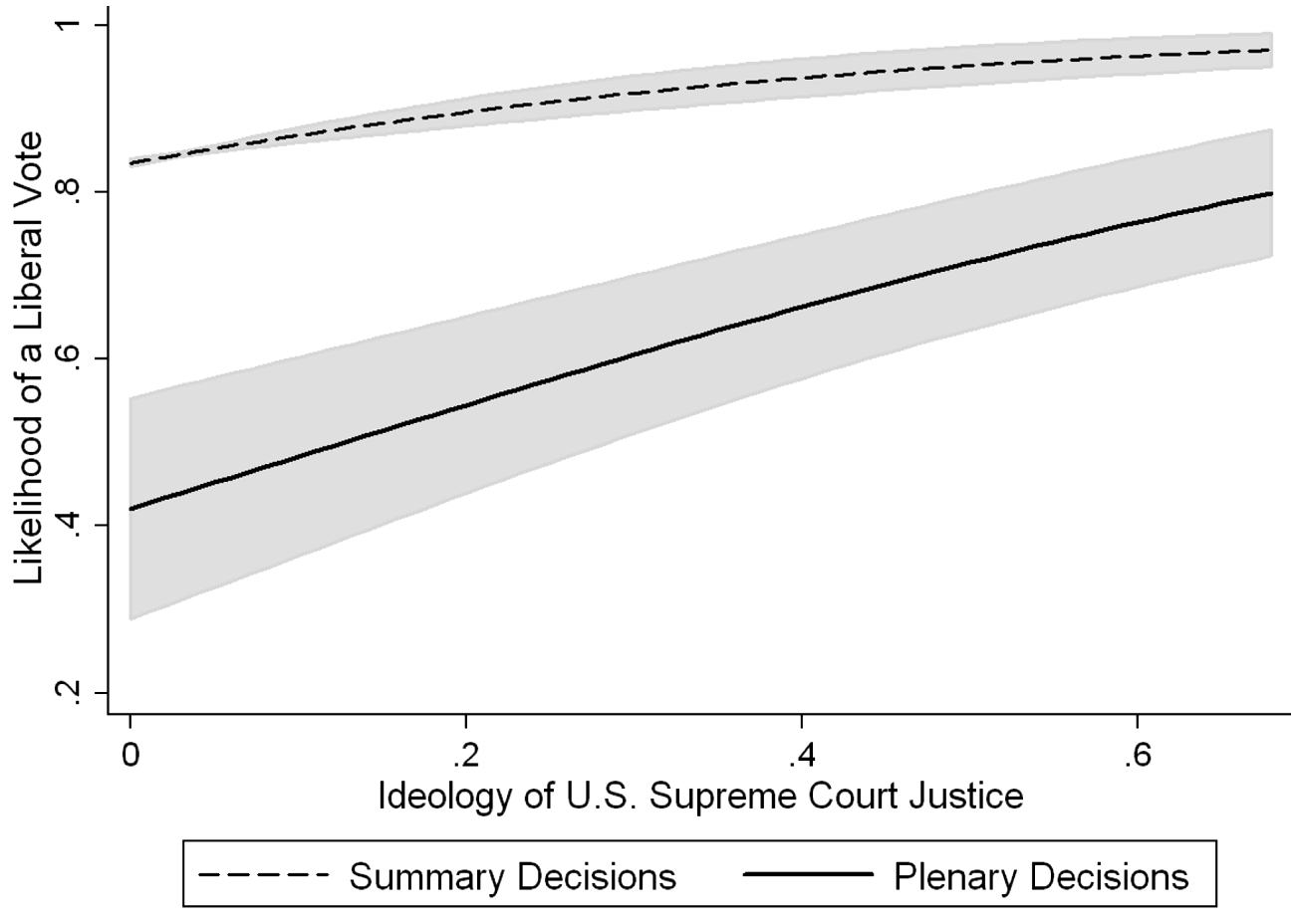
To better demonstrate the conditional nature of the relationship, we plot the predictive margins of the Court’s plenary and summary decisions. Figure 1 shows that there is a strong relationship between justice ideology and the likelihood of a liberal vote for plenary decisions. The probability of a liberal vote is near 40% for the most conservative justices and increases to above 80% for the most liberal justices. That is, the change in the likelihood of a liberal vote between the most conservative and the most liberal justices is almost four times as great in plenary decisions as it is in the combined sample of all cases granted certiorari. However, ideology has almost no effect on judicial votes in the Court’s summary decisions. The likelihood of a liberal vote in summary cases remains above 80% for all justices, regardless of their ideology.
Impact of ideology on US Supreme Court decision making 1995–2005. Likelihood of a liberal vote is based on the Segal and Cover (1989) ideology scores, with all other variables held constant at their appropriate mean or modal values. Shaded area represents 95% confidence intervals.
Discussion
During the 1995–2005 terms, formally argued decisions accounted for less than 40% of the Court’s total decision-making output. Thus, what we think we know about Supreme Court decision making is based on analyses of less than half of all cases granted certiorari by the Court. Our analysis of the Court during these terms, accounting for its summary decisions, suggests that some of our understanding of the role of the Supreme Court within the judicial system may be different once we examine the full population of cases granted certiorari. These results argue strongly for the need for more empirical analyses of the full decisional output of the Court.
We do not maintain that summary decisions are the equivalent of the plenary decisions of the Court, but they are clearly consequential. Summary affirmances and summary reversals of lower-court decisions are decisions on the merits that carry precedential value. GVRs, which make up a large majority of all summary decisions, may have less precedential weight than some plenary decisions, but it is clear that they have a major impact on the total policy output of the judicial system. Most GVRs appear to be part of a process of error correction in which the Supreme Court is exercising its authority to supervise the lower courts. This is an important role for a Court concerned about the policy impact of its decisions. “Error correction” is sometimes thought of as a process to ensure that mistakes are not made in the treatment that individual litigants receive from judicial proceedings, for example, to ensure that criminal defendants who did not commit the crimes they are accused of do not go to jail. But the way in which the Court uses GVRs, and the frequency of their use, suggests instead that the “error correction” that most concerns the Supreme Court is the elimination of decisions by the lower courts that misstate the law. Most GVRs signal to the courts below that they got the law wrong and direct the court to the appropriate precedent that more fully states the correct legal principles (i.e., precedent that defines the current policy preferences of the Supreme Court). Most GVRs do not express the preferences of the Supreme Court in regard to the substantive fate of the specific litigants in the case appealed to them. In fact, it is reasonable to guess that often the justices will not know which of those litigants will ultimately benefit from the Court’s summary decision. Scholars know that following remands in both plenary and summary decisions, the party who won in the most immediate sense from the Supreme Court’s ruling will often lose in subsequent litigation following the remand. The justices presumably know the same thing. Given such knowledge, it is reasonable to assume that the continued frequent use of GVRs indicates that the Court is more concerned that the lower courts accept the legitimacy and binding nature of the precedents announced by the Court than that the lower courts apply those principles in ways that benefit any specific litigant.
And on remand following a GVR, lower courts do overwhelmingly accept the legitimacy and binding nature of the precedents cited in the GVRs. We examined the subsequent lower-court decisions following remand and found that lower courts rarely ignore the precedent cited in the GVR (even when the same party that initially won in the lower appellate court eventually wins after subsequent litigation). We found that the lower court accepted the authority of the precedent cited in the GVR in over 95% of its decisions (either by explicitly following the Supreme Court and resolving the controversy before them in light of the precedent’s rule or by distinguishing the precedent—explaining why the facts in the case before them did not fit the precedent). That is, in almost every case, the discussion of the relevant law in the subsequent opinion of the lower court is different from the statement of the relevant law in the initial opinion. Even when the same party that initially won in the lower appellate court eventually wins after subsequent litigation (e.g., as happened in many of the cases in which the lower court distinguished the precedent), the ultimate opinion is not a “reinstatement” of the original opinion but a nontrivial modification of it.
In his examination of the use of GVRs by the Burger Court, Hellman indicates that when the Court GVRs a case “in light of” an existing precedent, it is saying that an initial examination indicates that “as a prima facie matter … the judgment below is in error” (1984, 393). That is, the Court is saying that the opinion announced by the lower court appears to have stated the law incorrectly because it did not take account of the precedent explicitly cited in the GVR. Similarly, Perry asserts that when the Supreme Court decides a case summarily, “it has technically made a judgment on the merits of the case, which means the decision has precedential value” (1991, 31). Perry goes on to argue that while some of those he interviewed suggested that such summary decisions did not carry as much precedential weight as did cases fully argued, from the perspective of the lower courts, “the summary decisions are precedential” (32). Moreover, in instances when the Supreme Court has reviewed the opinion of the lower court following a GVR and finds that the new opinion does not justify its subsequent action with an analysis of how the “in light of” precedent was taken into account, the Court has been adamant in striking down the lower-court action as noncompliant.
For the Supreme Court to control, or even to substantially influence, the policy output of the overall judicial system in the United States, it is essential that the Court act vigorously to disturb the policy pronouncements of the lower courts that are not consistent with the policies announced in the Supreme Court’s precedents. An important way in which the Court accomplishes that task is through its use of summary dispositions, especially GVRs. A summary decision to vacate and remand a decision below clearly disturbs the policy output of that lower court. A GVR indicates a preliminary judgment that the outcome of the action of the court below is probably in error, but more important to a Court concerned about controlling legal policy, it forces the lower court to change its policy by requiring a new decision and a new opinion justifying that decision (i.e., making policy) with explicit consideration of a specific policy pronouncement of the Supreme Court. Summary decisions are important to the overall efforts of the Supreme Court to influence the policy output of the courts below because they provide a “cheap” way to extend the Court’s influence. The Supreme Court has limited resources that make it difficult to review in detail a large number of cases. But the review of certiorari petitions can enable the Court to quickly identify many of the cases in which the lower court obviously failed to apply or refused to apply key precedents favored by the justices. Summary decisions can then be issued with a minimum expenditure of time and energy by the justices, to force the lower court to reevaluate its oversight or defiance. A Court concerned with its policy impact will be more concerned to eliminate instances in which the lower courts either ignore or directly repudiate its policy pronouncements than with decisions of lower courts that facially accept the Supreme Court’s policy but then engage in convoluted analyses of the specific facts of a given case that may result in a victory for an individual litigant who would not have been supported if the Supreme Court justices themselves had decided the specific conflict in the case. Summary decisions may not enable the Court to control instances in which the lower court used detailed factual analyses to reach results not favored by the justices, but they can be used to control those decisions that are of more concern to the justices. Given their importance, summary decisions are worthy of more extensive research in the future.
The findings reported in the “Empirical Results” section strongly suggest that additional attention to summary decisions is necessary to better understand the role of the political and legal preferences of the justices. It is well established that judicial attitudes have a major impact on some decisions of the justices. However, the findings of this article suggest that as in unanimous plenary decisions, the political preferences of the justices do not provide an adequate explanation or prediction of many of the summary decisions of the Court. We establish that summary decisions are important and that one cannot have a complete understanding of either Supreme Court decision making or more generally the Court’s role in the American legal system without considering the effect of summary decisions. These findings suggest that there are further limits to attitudinal theories of Supreme Court behavior. That is, attitudinal theories are useful in understanding some, but not all, aspects of judicial decision-making behavior. This suggests that a more fruitful direction for future research is not a continuation of a debate about whether it is attitudinal versus strategic versus legal factors that influence the behavior of the justices but instead an expansion of the inquiry into the situations or contexts in which different types of motivations become most relevant.
We believe that such inquiries have much to offer in improving our understanding of judicial decision-making behavior in not just the American courts but also courts in comparative environments. Appellate courts vary in the techniques they employ to influence the overall legal policy within a judicial system. A common problem for many appellate courts is finding the time and resources to oversee a large and increasing number of decisions in the courts below. As described above, the increasing use of summary decisions helps the US Supreme Court to correct legal errors. This technique enables the Court to extend its control in a manner that is time efficient. Other courts use alternative strategies to extend their control over large caseloads within severe time constraints. For instance, the courts of appeals in both Canada and England issue oral opinions immediately after argument, rather than producing more time-consuming written opinion in cases in which the law is clear. Similarly, the Supreme Court of Canada often uses smaller panels of judges in combination with oral opinions to handle the cases with clear law expeditiously, and the Supreme Court of the Philippines uses brief “Minute Opinions” for similar purposes.
Courts in different environments also use different mechanisms for signaling to the courts below the issues and precedents that are most important to the top court. The analysis in this article suggests that in the United States the Supreme Court often uses summary dispositions that supplement the more extended opinions found in its plenary decisions for such purposes. Notably, all nine justices in the US Supreme Court are involved with each decision the court issues. By contrast, the supreme courts of Canada and the United Kingdom engage the decisions of their respective lower courts in a very different manner. First, these courts disturb the actions of the lower courts at a much lower rate compared to the US Supreme Court. In addition, the Canadian and UK high courts employ a panel of justices, rather than the full membership, to resolve many cases and signal the relative significance of the decision both by the size of the panel employed and by the nature of the opinion issued (with the court uniting behind a single detailed written opinion in the most significant cases).
A corollary of our finding that judicial attitudes are not substantially related to the positions taken by the justices in many cases (including most summary decisions) is that the rate of conflict on the Court may be much lower than generally supposed. By analyzing all decisions in the 11 terms of the Rehnquist Court, we find that 78% of the cases granted certiorari from 1995 to 2005 were decided through a unanimous decision. The US Supreme Court, which in the past has been assumed to have less than a third of its cases decided unanimously, has long been considered to be “exceptional” among world courts. But when the rate of dissent is calculated for all decisions of the Court, the rate of unanimity is relatively similar to other high courts. For instance, analyses through the High Court Judicial Database (Reference Haynie, Sheehan and Songer2007) indicate that the rate of unanimity in the High Court of Australia is approximately 60%, 86% in the Philippines, 90% in South Africa, 75% in Canada, and 81% in the United Kingdom.
These findings are also consistent with and supportive of Perry’s (Reference Perry1991) conclusion that the Court often grants certiorari for what he calls “jurisprudential” reasons that have little to do with the concern of the justices about the outcome of the case. While Perry never offers a precise quantitative assessment of how frequently certiorari decisions are made on the basis of jurisprudential concerns, he clearly indicates that jurisprudential concerns are more common than policy or other “output concerns” (39). From this perspective of the certiorari process, our results are not surprising. If in most decisions to grant certiorari the justices are not primarily concerned about the outcome (i.e., which litigant prevails) of the case, it is not surprising that their final vote on disposition is less about affecting which litigant wins than about the legal or jurisprudential meaning of the case.
Many discussions of the policy impact of the Supreme Court are based on quantitative analyses, which tend to examine the decisions of the Court, categorized simply as liberal or conservative. They examine these decisions in isolation from the policy output of other political actors. An alternative way to assess the policy impact of the Court is to examine the extent to which it reinforces or disturbs the policy decisions of other political actors. One important part of such an approach is to determine the extent to which the Supreme Court disturbs the decisions of other courts, but to do that requires an examination of all decisions of the Court that disturb the policy output of the courts below. Not accounting for all decisions that substantively affect other actors (lower courts) presents a fundamentally different picture from reality. Our analysis of the total decision-making output of the Court shows that a generally conservative Court is in reality not behaving in accordance with the implications of the attitudinal expectations in many of its decisions. Our examination of the Court’s full decision-making docket suggests that the total effect of the Rehnquist Court on the courts below is more liberal than is commonly perceived.
We find that the Rehnquist Court, with a majority of justices widely perceived to hold conservative policy preferences for the period examined, exercised its attempt at control of the interpretations of law announced by the lower courts, by more frequently striking down conservative rather than liberal policy pronouncements of the lower courts. That is, the major impact of the Court’s attempt to rein in errant policy makers in the courts below was to prevent them from going too far in a conservative direction. Such a finding provides an important corrective to previous analyses restricted to the plenary decisions of the Court and demonstrates the importance of considering the summary decisions of the Court in any attempt to provide an overall perspective on the work of the Court.
In addition to providing a new perspective on the impact of judicial attitudes on judicial decision making, we make several other important contributions to the literature. Our findings have significant implications for contemporary understanding of certiorari votes and agenda-setting behavior. The findings suggest that an additional set of variables may affect certiorari to the Supreme Court, which are also the factors that help justices determine whether to dispose a case through plenary or summary treatment. We find that summary decisions now make up the majority of the Court’s decision-making docket. We reaffirm and supplement an earlier finding that the Supreme Court reverses by a wide margin the majority of cases it accepts for review. We find that like plenary rulings, summary decisions are not limited to a particular jurisdiction but instead have a wider effect on all of the courts below. Lower courts at all levels regularly cite or follow the Court’s summary decisions in related subsequent proceedings, even when a circuit or state court is not involved in the original summary decision. We demonstrate that, both procedurally and substantively, denials for certiorari and summary decisions are quite different. Denials of certiorari allow the lower-court decision to stand with no additional effect on the courts below. Summary decisions, by contrast, involve a positive grant of review by the justices and usually substantively disturb the earlier ruling of the lower court. The Court’s summary decisions sometimes lead a lower court to reach an entirely different outcome upon reconsideration. However, even when a lower court reaches a similar outcome to its earlier ruling, the summary decision usually forces a change in the legal rationale through which the lower court justifies its ruling to include consideration of the precedent cited within the Supreme Court’s summary decision.
Appendix A Studies Relying Exclusively on Plenary Decisions to Test or Support the Attitudinal Model
Appendix B
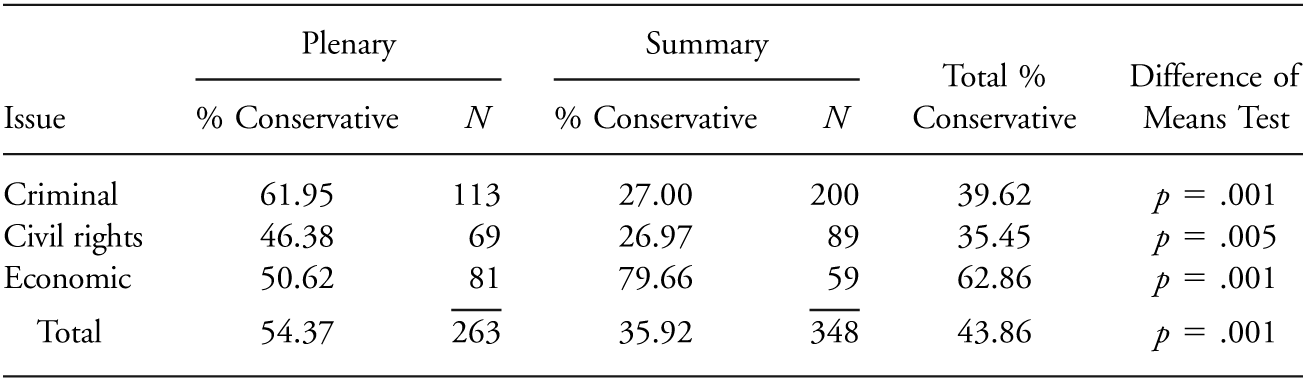
Source.—Plenary: Supreme Court Database; summary: U.S. Reports.