Introduction
Egg production in Brazil, characterized mainly by cage systems (Silva, Reference Silva2019), increased by almost 32% in the last five years. Consumption has also grown (ABPA, 2021), encouraged by the nutritional composition of the egg, as a source of high-quality animal protein, rich in vitamins and minerals, and by the low and attractive cost (Zaheer, Reference Zaheer2015) in addition to the dissemination of associated information for human health (Pal and Molnár, Reference Pal and Molnár2021).
The increase in demand for products of animal origin, including eggs, and the consequent intensification of production systems, has also increased society's concern about animal welfare (De la Fuente et al., Reference De la Fuente, Souto, Caselli and Schiel2017; Alonso et al., Reference Alonso, González-Montaña and Lomillos2020). In view of this new scenario, there is a growing trend in the implementation of cage-free systems (Amaral et al., Reference Amaral, Guimarães, Nascimento and Custodio2016). This movement is driven by the international community, consumers, large companies that use eggs, supported by the belief in the improvement of animal welfare provided by these systems, which provide more space and resources for laying hens (Silva et al., Reference Silva, de Abreu and Mazzuco2020).
Studies in the area focus their efforts on investigating consumer perceptions of well-being in egg production and on the causal understanding of this behaviour (Pettersson et al., Reference Pettersson, Weeks, Wilson and Nicol2016; Hong et al., Reference Hong, Kang, Park, Jeon, Kim, Kim and Kim2018; Rahmani et al., Reference Rahmani, Kallas and Gil2019; Cao et al., Reference Cao, Cranfield, Chen and Widowski2021). Generally, descriptive analysis is used, being an efficient and simple method to gather, organize and describe evaluation data, identifying patterns (Loeb et al., Reference Loeb, Dynarski, McFarland, Morris, Reardon and Reber2017). However, this type of analysis may underestimate important information for assessing the consumer profile within a sample group.
Unsupervised machine learning techniques allow to reduce the number of data and organizing them into groups, which can explore the potential of the data in a better way, providing more relevant results for a systemic view of the entire production process. Studies using a consumer typification approach in the face of different contexts associated with BEA, using machine learning techniques, are very limited in the egg production chain. The few existing studies using this type of approach are focused on other chains. Standing out, Pouta et al. (Reference Pouta, Heikkilä, Forsman-Hugg, Isoniemi and Mäkelä2010), in Finland, who evaluated consumer choice for chicken meat, Veljković et al. (Reference Veljković, Stojanović and Filipovic2015), in Serbia, evaluated different groups of consumers regarding the welfare of production animals and Lin-Schilstra et al. (Reference Lin-Schilstra, Backus, Snoek and Mörlein2022), in four countries of the European Union and four non-European countries, evaluated the attitude of consumers towards pork production.
This study assumes that there is more than one type of egg consumer profile in Brazil and that sociodemographic indicators, egg consumption, knowledge about the egg production chain and holistic perception of animal welfare in egg production differentiate these consumer profiles. Thus, the objective of the study was to typify, characterize and differentiate the profile of Brazilian consumers regarding animal welfare in laying poultry.
Materials and methods
The research was carried out over the Internet, and in accordance with Resolution No. 510 of 7 April 2016 (Brasil, 2016), applied to science in Brazil. This resolution does not require the approval of the People Ethics Committee – in the case of a public opinion survey with unidentified participants – as in this study.
The form was prepared on the Google Forms® platform and distributed throughout Brazil, on the internet, through social networks and email lists, featuring a convenience sample, between February and July 2021. A total of 1415 people answered the questionnaire (there were respondents corresponding to the five major regions of Brazil – South, North, Northeast, Midwest and Southeast)
The questionnaire questions according to indicators are presented below:
1. Sociodemographic (SOC), with six questions to characterize the respondents:
(a) Gender
(b) Age
(c) Education
(d) Family income
(e) Region of residence
(f) Interviewee's relationship with egg production
2. Eating habits (EHAB), with three questions:
(a) Do you consume eggs and/or products with eggs in their composition?
(b) How often do you buy eggs and/or products with eggs in their composition?
(c) How often do you consume eggs and/or products with eggs in their composition?
3. Knowledge about the egg production chain (KEP), with three questions:
(a) Have you ever visited/been in contact with egg producing farms?
(b) Do you know how laying hens are raised in the country?
(c) Would you like to be more informed about how chickens are raised?
4. Holistic perception of animal welfare in egg production (HPW), with seven questions:
(a) Have you ever heard about farm animal welfare?
(b) Do you believe that, currently, the level of welfare of laying hens housed on Brazilian farms is:
(c) In your opinion, who should be primarily responsible for ensuring that chickens are raised in an adequate welfare situation?
(d) Do you believe that animals are capable of feeling (e.g. pain, fear, frustration)?
(e) Have you ever heard of alternative egg production systems (free-range, colonial, organic, cage-free, free-range, cage-free)?
(f) Can you point out the differences between alternative egg production systems (free-range, colonial, organic, cage-free, free-range, cage-free)?
(g) Do you believe that the fact that consumers purchase products with a high degree of welfare can have a positive impact on animal welfare?
5. Perception about eggs with an animal welfare guarantee (PEAWG), with six questions
(a) Do you consume eggs produced in cage-free systems?
(b) Would you buy eggs produced with a higher degree of welfare, if these were the same price as conventional eggs (in cages)?
(c) Regarding the characteristics of eggs from hens raised in free systems when compared to conventional eggs (in cages), do you think they are: 1. More expensive 2. Healthier 3. Tastier
(d) Do you believe that, at the time of purchase, consumers can easily find information about the origin/type of system in which the animals were raised (on labels, market disclosure, etc.)?
(e) In your opinion, what is the best way to identify the conditions in which the chickens were raised?
(f) How much would you be willing to pay more for eggs raised in a system with a higher degree of welfare?
Statistical methods
The method was carried out in four stages, which involved the establishment of the variables object of the study, through the questionnaire; the reduction of variables by exploratory factor analysis; the definition of the number of typologies by successive hierarchical cluster analysis; the comparison between typologies; and finally, the analysis of the discriminatory power of the investigated variables and indicators. Data were analysed using the SPSS® software (Chicago, USA) (IBM Corp, 2011).
Choice of variables
The selection of variables was based on an extensive literature review (Queiroz et al., Reference Queiroz, Barbosa Filho, Albiero, Brasil and Melo2014; Miranda-De la Lama et al., Reference Miranda-De La Lama, Estévez-Moreno, Sepulveda, Estrada-Chavero, Rayas-Amor, Villarroel and María2017; Franco et al., Reference Franco, Sans, Schnaider, Soriano and Molento2018; Ochs et al., Reference Ochs, Wolf, Widmar and Bir2018; Teixeira et al., Reference Teixeira, Larraín and Hotzel2018).
Number of typologies
The Hierarchical cluster analysis (HCA) aimed to group consumers into typologies according to their perception of animal welfare according to the degree of similarity of responses. The model used for hierarchical clustering is described in Eq. (1).

This agglomerative algorithm calculates the shortest distance between elements i and j using the dij distance matrix (Hair et al., Reference Hair, Black, Babin and Anderson2009). The elbow rule based on Ward's method (Ward, Reference Ward1963) was used to decide the most appropriate number of clusters and the Euclidean distance as a measure of dissimilarity. To assess the optimal number of clusters, it was necessary to plot the number of clusters against the change in the fusion coefficient for each stage (each stage reflects a combination between two clusters) and find the two stages with the largest jump in the difference between their fusion coefficients distance (Gelasakis et al., Reference Gelasakis, Rose, Giannakou, Valergakis, Theodoridis, Fortomaris and Arsenos2017). This was obvious for stages 1412 and 1413. Then, the number of steps (n = 1412) was subtracted from the number of observations (n = 1415); the result indicated the ideal number of clusters (n = 3). The model's fit measure was 0.40, indicating a reliable cluster quality.
Comparisons between typologies
Differences between groups were estimated using the Chi-square test (χ 2) with Bonferroni correction. A significance level of 5% was adopted.
e. Discriminatory power of indicators/variables: the canonical discriminant analysis (CDA) was performed to discriminate the main variables that differentiate the typologies and which indicators have discriminatory power. The general CDA model is described in Eq. (2).

where Z n is the dependent variable (typologies), ∝ is the intercept, X i are the explanatory variables and β i are the discriminant coefficients for each explanatory variable. For this, the stepwise method was used, which is indicated when the researcher has many variables to be included in the function. Discriminant power was assessed by percentage of variance, Wilks' Lambda statistics, and standardized coefficients.
Results
General characteristics of the consumers
Most consumers of eggs and egg products were female (63.3%), with a high level of education (over 90% of responses for higher education or postgraduate studies), young people (almost 50% between 18 and 30 years old), with a well-distributed average income, with a small portion working in the poultry production area (5%), and residing mainly in the South and Southeast regions (more than 90% of responses). For the most part, they consume eggs and egg products (97.8%) and the purchase frequency (72.2%, at least once a week) and consumption (89.2%, at least three times a week) are high.
A considerable number of respondents have had contact with poultry farms (55.7%), and claim to know the egg production systems (66.1%), but would like to receive more information about them (almost 70%). Specifically on animal welfare in egg production, knowledge on the subject seems to increase, with almost 90% of respondents claiming to have knowledge about it. Only 16.6% believe animal welfare in egg production is poor or very poor, while more than half (51.1%) believe animal welfare is good or very good. Respondents mainly blame egg producers (36%) and professionals working in the production chain (27.6%) for ensuring this level of animal welfare for laying hens.
They believe in animal sentience (95.3% of responses) and claim to know about alternative production systems (86.4%). However, less than half (40.6%) manage to point out the differences between these systems. Respondents also believe that consuming products originating from systems which are more favourable to animal welfare has a positive impact on the welfare of laying hens (86.6% of responses).
Many reported not knowing the origin of the eggs they consume (35.4%), but would buy eggs from cage-free systems if they were the same price as eggs produced in conventional systems (94.8%). More than half of respondents believe that eggs from cage-free systems are healthier (60.9%), more expensive (77.6%) and harder to find for purchase (76.2%). On the other hand, 36.3% of respondents were unable to answer whether free-range eggs are tastier than caged eggs.
Most also stated that they could not easily find information about the origin and egg production system (73.0%) and listed the product labelling with information on the rearing system (34.1%) and the certification seal (33 .6%) as more effective ways of presenting information about egg production systems. Nearly 20% of respondents would not be willing to pay more for cage-free eggs, with just 8.1% saying they would be willing to pay 20% more.
Typology and characterization
Three consumer profiles were obtained, based on the analysis, named according to their main characteristics: interested, emerging and indifferent (Fig. 1). These three profiles represented 1307 (92.3%), 79 (5.6%) and 29 (2.1%) respondents of the total sample, respectively. The interested group, as the name suggests, showed the greatest inclinations towards animal welfare. The emerging group is the middle group, with more doubts about animal welfare, but with the potential to become interested. And, finally, the indifferent group is composed of occasional consumers, with no apparent interest in the cause.
Dendrogram of the hierarchical cluster analysis (a) and measure of adequacy of the number of clusters per cluster in two stages (b) according to the perception of animal welfare in laying poultry. For the three consumer profiles: (1) interested; (2) emergent; (3) indifferent.

Table 1 indicates the frequencies (%) for the categorical variables, as well as the statistical differences between the three consumer profiles found. The three profiles did not present, among themselves, statistical differences for ‘Gender’ (P = 0.159), ‘Education’ (P = 0.453), ‘Age’ (P = 0.207), ‘Family income’ (P = 0.524) and ‘Respondents’ region of residence’ (P = 0.592) for the SOC indicator; ‘Have you ever had contact with poultry farms?’ (P = 0.704) and ‘Do you know how chickens are raised?’ (P = 0.241) for the KEP indicator; ‘Are you familiar with the term BEA?’ (P = 0.476), ‘Are you aware of alternative egg production systems?’ (P = 0.794), ‘Can you differentiate the alternative systems?’ (P = 0.132), for the HPW indicator; and ‘Do you believe that eggs from free systems are more expensive?’ (P = 0.656) for the PEAWG indicator.
Group 1. Interested consumer (1307 respondents; 92.3%): consumers and professionals in the poultry area, with a high frequency of buying and consuming eggs, very interested in learning more about raising laying hens, uncertain as to the degree of good -animal welfare in laying poultry and more willing to pay more for eggs from cage-free systems, believing in the positive impact of this action on the production chain.
Frequency of responses (%) of respondents and comparisons for each categorical variable that showed statistical difference (to 5% significance level), according to clusters, by Pearson's χ 2 analysis

Cage-free systems are all those that have eliminated cages, hens live free, inside a shed, with features such as nests and perches, with access or to an outside area that can be explored.
The differences found between the three profiles allow us to describe the typologies:
Consisting of consumers and professionals in the chain, with a high frequency of buying and consuming eggs (P < 0.05), with respondents more interested in knowing more about egg production systems (P < 0.05), with more answers for all grades of animal welfare. They blamed egg producers, chain professionals and agroindustry as the main responsible for ensuring animal welfare. They generally believe that animals are capable of feeling (P < 0.05) and that consuming products from systems that are friendlier to animal welfare can positively affect animal welfare in production (P < 0.05). Higher frequency of respondents who consume eggs from free systems (P < 0.05) and who would buy them if they were the same price as eggs from conventional systems (P < 0.05). Group that most believes that eggs from free systems are healthier (P < 0.05) and difficult to find in the markets (P < 0.05). Like the other two groups, there are doubts whether these eggs are tastier or not (P < 0.05). They cannot easily find information about the origin and production system of the eggs and believe that certification with a seal and labelling the product with information about the rearing system are the best ways to identify the egg production system, just like the other two groups (P < 0.05). The group most willing to pay a premium for cage-free eggs.
Group 2. Emerging consumer (79 respondents; 5.6%): consumes eggs regularly, has more doubts about animal welfare and egg production systems, with an intermediate view on the degree of animal welfare in the laying poultry, relatively willing to pay more for eggs from cage-free systems and with the potential to become the interested consumer.
Mainly composed of egg consumers, with a regular frequency of purchase and consumption (P < 0.05), with respondents undecided or not very interested in knowing more about egg production systems (P < 0.05), compared to the interested group (P < 0.05). They rated animal welfare in laying poultry as reasonable. It is the group that had more doubts about the ability of animals to feel (P < 0.05) and whether consuming products from systems with a high degree of animal welfare can positively affect animal welfare in production. The knowledge about the origin of the eggs consumed by the respondents is similar to that of group 1. Group with more answers stating not knowing whether they would buy eggs from cage-free systems if they were the same price as eggs from conventional systems (P < 0.05). They believe that eggs from free systems are healthier and harder to find in the markets, but they cannot say if they are tastier. Respondents less able to find information about the origin and production system of eggs easily (P < 0.05); believe that product labelling with information about the rearing system and certification with a seal are the best ways to identify the egg production system. Group willing to pay some premium for cage-free eggs, lower than group 1 and higher than group 3 (P < 0.05).
Group 3. Indifferent consumer (29 respondents; 2.1%): is characterized by a small number of consumers, who may be allergic, vegan and vegetarian, or simply people who do not like to consume eggs, with no direct relationship with the poultry sector, with very low frequency of buying and consuming eggs, not very interested in learning more about raising chickens. It is the group that perceives animal welfare more positively and is the least willing to pay more for eggs from cage-free systems.
Mainly composed of respondents not associated with the production or direct consumption of eggs/egg products (P < 0.05), with more respondents not consuming eggs/egg products, with a lower purchase frequency (once a month or never), (P < 0.05) with the highest number of respondents not interested in knowing more about rearing systems (p < 0.05). They rated animal welfare more positively in laying poultry (P < 0.05). They believe that the animals are capable of feeling, as well as group 1 (P < 0.05) but that consuming eggs from free systems would not positively affect the animal welfare of the hens (P < 0.05). They do not consume eggs from free systems and would not buy them if they were the same price as eggs from conventional systems, in contrast to groups 1 and 2 (P < 0.05). They believe that eggs from free systems are more difficult to find in the markets, but not as much as groups 1 and 2 (P < 0.05). They cannot say whether they are tastier or healthier. They cannot find information about the origin and production system of eggs easily and believe that product labelling with information about the creation system and certification with a seal are the best ways to identify the egg production system, like the other two groups (P < 0.05). Group less willing to pay more for eggs from free systems (P < 0.05).
Comparison between respondents' profiles
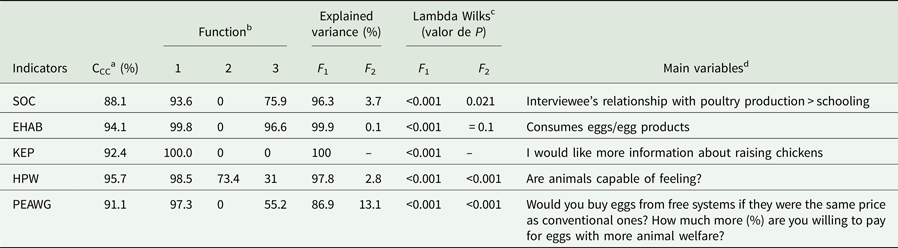
The summary of the CDA, the classification of respondents in their group of origin and the main discriminatory variables according to the indicators are shown in Table 2. All indicators studied individually showed discriminatory power (P < 0.05).
Canonical discriminant analysis (CDA) of sociodemographic indicators (SOC), eating habits (EHAB), Knowledge about the egg production chain (KEP), holistic perception of animal welfare in egg production (HPW) and Perception about eggs with an Animal Welfare Guarantee (PEAWG)

a Total percentage of correctly classified cases: CCC, correctly classified cases.
b Percentage of cases correctly classified according to consumer profile (1. Interested; 2. Emerging; 3. Indifferent).
c Statistical test: Canonical functions (F1 and F2) with P < 0.05 of Wilks' Lambda were considered significant.
d Main variables of the groups.
All indicators showed discriminatory power (P < 0.001) with explained variance above 85%. The indicators that were most important to classify the three profiles were, in descending order, HPW, EHAB, KEP, PEAWG and SOC. The variables that showed the greatest discriminatory power were ‘Interviewee's relationship with poultry production’ and ‘Education’, for the SOC indicator; ‘Do you consume eggs/egg products?’ for the EHAB indicator; ‘Would you like more information about raising chickens?’, for the KEP indicator; ‘Are animals able to feel?’, for the HPW indicator and ‘Would you buy eggs from free systems if they were the same price as conventional ones?’ and ‘How much more (%) are you willing to pay for more animal welfare eggs?’ for the PEAWG indicator.
The differentiation of group 2 from the others was only possible by the HPW indicator and, if the evaluation used only the KEP indicator, there would only be one group (Table 2). The importance of the indicator ‘Holistic perception of animal welfare in egg production’ is highlighted. The most important variables (discriminatory power) were ‘Do you consume eggs/egg products?’ in the first function (0.934%) and ‘Are animals capable of feeling?’ (97.4%), in the second role.
Figure 2 presents the classification dynamics of the three typologies in their groups of origin. It is noted, by the centroids, that the interested consumer group is between the indifferent group and the emerging group, and that the interested consumer is closer to the emerging one. And these furthest from the indifferent group. Still, 97.7% of the cases were classified correctly.
Two-dimensional graph of the canonical discriminant analysis showing the dynamics of sociodemographic indicators. Eating habits. Knowledge about the production chain. Holistic consumer perception of animal welfare in egg production and perception of eggs with BEA guarantee. Among the three established groups: (1) interested; (2) emergent; and (3) indifferent.

Discussion
Typology, characterization and validation
Consumer perception is complex, multifactorial, and involves social, cultural, ethical and economic aspects (Lagerkvist and Hess, Reference Lagerkvist and Hess2011), which makes it difficult to characterize. The systematic approach used facilitates this process, reducing its complexity. Cluster analysis allowed the formation of clusters with similar consumer characteristics, based on the greatest difference between the three profiles obtained and the smallest difference within each of them, minimizing its internal variation (Silveira et al., Reference Silveira, Façanha, McManus, Ferreira and da Silva2023).
The use of machine learning techniques allowed the identification of heterogeneity in the perception of Brazilian consumers about animal welfare in laying poultry, with three different typologies associated with the studied indicators. Other studies were successful in segmenting the profile of consumers into different groups using the same group segmentation method used in the present study. This is the case of Veljković et al. (Reference Veljković, Stojanović and Filipovic2015) who found four segments (indifferent, seekers, believers and antagonists) when assessing the attitude towards animal welfare and purchase intentions of Serbian consumers; and Lin-Schilstra et al. (Reference Lin-Schilstra, Backus, Snoek and Mörlein2022), who identified four groups (demanding, average, low in echo and indifferent), according to production preference and reasons for pork consumption in the European Union.
Characterization of the three consumer profiles
The evaluation resulted in three consumer profiles: interested, emerging and indifferent, according to the investigated indicators.
Sociodemographic
Most sociodemographic aspects did not differ between the three profiles obtained. According to Tonsor et al. (Reference Tonsor, Wolf and Olynk2009), socioeconomic factors have already been classified as less important in characterizing the consumer's perception of animal welfare.
The emerging group had the highest proportion of consumer respondents, followed by the interested group. The indifferent group had a much lower frequency than the others. It is noteworthy that the interested group was the only one to present respondents active in the production chain. Other studies have linked professionals in the field to a more positive perception of animal welfare (María, Reference María2006; Vanhonacker et al., Reference Vanhonacker, Verbeke, Poucke and Tuyttens2008), which corroborates the findings of this study, considering that the degree of animal welfare was positively evaluated (more than 80% believe it to be at least reasonable) in this group. The greater experience lived with the chain helps the vision about it and its evaluations in relation to the pertinent theme. The indifferent group had the highest frequency of answers for the ‘other’ option, indicating that many respondents have nothing to do with production, including consumption of eggs.
Eating habits
The frequency of purchase and consumption of eggs was also much higher for groups 1 and 2 in contrast to group 3. Groups 1 and 2 represent the largest share of respondents and characterized by the high frequency of purchase and consumption of eggs is in agreement with the growth and profile of consumption in Brazil, according to ABPA (2021).
Knowledge about the production chain
Previous contact with poultry farms was reported by about 50% of respondents in the three groups and just over half of them said they knew about the chicken farming system in the country. Previous contact and knowledge about the chain may indicate people who are more aware of consumption. In addition, knowledge about the chain may be related to marketing strategies in the agribusiness sector, proving to be effective in informing people about the peculiarities of the production chain.
However, only the interested group showed great interest in having more information about raising laying hens, as opposed to the emerging group, the less interested and more undecided about wanting more information or not. Several studies show consumers' interest in knowing about rearing systems (Miranda-De la Lama et al., Reference Miranda-De La Lama, Estévez-Moreno, Sepulveda, Estrada-Chavero, Rayas-Amor, Villarroel and María2017; Franco et al., Reference Franco, Sans, Schnaider, Soriano and Molento2018; Morales et al., Reference Morales, Ugaz and Cañon-Jones2021). The growth of interest reinforces the growth of discussions about animal welfare in society and the recent concern of consumers with the theme, motivated by the intensification of animal food production systems (Alonso et al., Reference Alonso, González-Montaña and Lomillos2020).
Holistic consumer perception of animal welfare in egg production
This was the most important indicator to differentiate the three profiles. Most respondents in all groups claim to know the term animal welfare and the different alternative egg production systems, but few would know how to differentiate between them. This fact reflects the dissonance between what the respondents believe they know and what they really know, which may suggest a superficial knowledge about production systems and animal welfare. The production of eggs in a conventional system is very limited in terms of space for the hens, and this can lead the consumer to assume that animal welfare consists of releasing the birds. Cage-free systems are highlighted by the non-use of cages, but animal welfare is a set of aspects that allow a more adequate life for the animal, in relation to the environment in which it is inserted. The system, however, is not problem-free. In this way, it is important to highlight the complexity of systems and animal welfare itself, reinforcing the need to educate consumers with more specific and in-depth information on these topics. Regarding animal sentience, groups 1 and 3 stated that they believe that animals are capable of feeling, in contrast to group 2, which, for the most part, had doubts about this belief. The three groups evaluated animal welfare relatively positively, with group 3 presenting the most positive evaluation for animal welfare in laying poultry, while group 2 presented the highest frequency for the answer ‘reasonable’. Responses to the most negative rating were low for all three groups as well. Moving away from production centres can distort the way consumers perceive animal welfare. In this regard, Lusk and Norwood (Reference Lusk and Norwood2011) reinforced how consumers of animal products have a more optimistic view of production systems, attributing a more adequate condition of animal welfare than reality. Still, respondents may go through a process of disconnection with the origin of the food, dissociating the fact that the food originates from live animals (Bastian et al., Reference Bastian, Loughnan, Haslam and Radke2012), making it easier to make a more positive assessment of animal welfare. Groups 1 and 2 indicated egg producers as the main responsible for ensuring animal welfare in laying poultry, in contrast to group 3, which had a higher frequency of responses considering that they would be ‘others’. The association of the animal welfare guarantee with the producers indicates the idea that those in direct contact with the birds are mainly responsible for such action. Other studies point to similar behaviour for Brazilians assessing animal welfare for the main production chains (WAP, 2016; Franco et al., Reference Franco, Sans, Schnaider, Soriano and Molento2018). As for group 3, we can make assumptions. With ‘others’, they can refer to NGOs, society in general or even the educational system. It is believed that the answer may be the confirmation of the lack of interest in the subject, in agreement with the general profile of this group. Group 1 believes that consuming products from systems that follow animal welfare standards has a positive effect on animal welfare, in contrast to groups 2 and 3. This group showed more interest and concern for animal welfare and this statement suggests a dissonance between what they believe and how they act. Even believing that consuming eggs from cage-free systems can positively affect animal welfare in egg production, few identified themselves as primarily responsible for ensuring animal welfare in the chain, or even as consumers of cage-free eggs.
Perception about eggs with animal welfare guarantee
Interested and emerging groups claimed to consume eggs from cage-free systems. Still, there is a considerable percentage of responses stating that they did not know the origin of the eggs consumed for groups 1 and 2. The behaviour of group 3 is explained, in part, by their low consumption of eggs, in general, with no need or reason to know the origin of eggs, with such occasional consumption. Doubts about the origin of the eggs consumed reinforce the problem related to the lack of information for society in this regard. Chilean consumers also reported doubts about the origin of the eggs consumed (Morales et al, Reference Morales, Ugaz and Cañon-Jones2021), which could be answered by information on the product packaging itself based on an efficient labelling system on the packages. If eggs from cage-free systems were the same price as eggs from the conventional system, group 1 would be the most willing to buy them followed by group 2, while group 3 showed great aversion to the idea of buying them. The emerging group had the highest frequency of responses to the ‘I don't know’ alternative, reinforcing their indecision and lack of confidence in the issue of animal welfare and, probably, its influence on purchasing power. This fact reinforces the lack of information about the origin of the product (eggs), the production system and animal welfare, associated with the reduced interest of the emerging group. In general, the three groups believe that eggs produced in cage-free systems are more expensive than those produced in a conventional cage system, which is a reality. The production of eggs from cage-free systems in Brazil is low (Silva, Reference Silva2019), and the cost of production increases the final value for the consumer (Chang et al., Reference Chang, Lusk and Norwood2010; Matthews and Sumner, Reference Matthews and Sumner2015). It is believed that the increase in demand may contribute to reducing the price difference between conventional eggs and cage-free systems. As for the egg characteristics associated with cage-free systems, group 1 showed greater agreement stating that these eggs are healthier and tastier (P < 0.05). Group 2 responses did not differ from any of the other groups. The three groups presented similar and considerable answers for the intermediate alternative, for both questions. A study carried out in the United Kingdom, Italy and Sweden found that consumers who believed in animal welfare saw an improvement in the taste and health of animal products, converging on better product quality and healthier animals (Mayfield et al., Reference Mayfield, Bennett, Tranter and Wooldridge2007). Other studies confirm the belief of consumers that eggs produced in more animal welfare friendly environments are of higher quality, healthier and tastier (Heng et al., Reference Heng, Peterson and Li2013; Pettersson et al., Reference Pettersson, Weeks, Wilson and Nicol2016). Furthermore, group 1's greater belief that eggs from cage-free systems are tastier and healthier may be a motivator to increase consumption, as observed by Hong et al. (Reference Hong, Kang, Park, Jeon, Kim, Kim and Kim2018), in which Korean consumers pointed to food safety as the main reason for purchasing eggs with animal welfare certification. Most consumers in the stakeholder and emerging groups agree that eggs from cage-free systems are harder to find in supermarkets. The indifferent group probably does not look for these products on the market, since they do not consume or buy them frequently, which would explain the confusion when faced with this question. Groups 1 and 2 not finding eggs could be a reflection of supply, due to the low egg production in these systems in the country. All groups indicated difficulty in finding information about the origin and type of egg production system and believe that the best way to identify eggs from these systems is labelling and certification, similar to the findings of other studies (Veljković et al., Reference Veljković, Stojanović and Filipovic2015; Franco et al., Reference Franco, Sans, Schnaider, Soriano and Molento2018). In fact, labelling can have significant results in the consumer's decision to purchase the product. For this, it is necessary to educate consumers about egg production and animal welfare, considering this knowledge gap presented by them throughout the study. Group 1 is the most willing to pay extra for eggs from cage-free systems, followed by group 2, and then group 3. It is noted that the greater the interest in animal welfare, the greater the willingness to pay more for eggs from cage-free systems. In South Korea, respondents showed a high willingness to pay more for eggs with animal welfare certification (92.0% of respondents) (Hong et al., Reference Hong, Kang, Park, Jeon, Kim, Kim and Kim2018). However, upon learning the price difference, interest reduced (to 62.7%). US respondents were also willing to pay a premium for cage-free eggs (Heng et al., Reference Heng, Peterson and Li2013). Thus, even if consumers are willing to pay more for eggs from cage-free systems, reality may change. Similar to stakeholder behaviour, Miranda-de la Lama et al. (Reference Miranda-De La Lama, Estévez-Moreno, Sepulveda, Estrada-Chavero, Rayas-Amor, Villarroel and María2017) identified Mexican respondents willing to pay more for wellness-friendly products as being more sensitive to the theme, more demanding about proper regulation and with commercial issues, including an effective labelling system. Therefore, this willingness to pay a premium for cage-free eggs needs to be associated with informative labelling and the animal welfare certification seal, which encourage consumers to purchase the product, in addition to investment in education on the subject for the society in general. The information provided on the egg packaging label should inform about the egg production systems, and more generally, address aspects and impact of these systems on sustainability and animal welfare. They should also be used as a tool to generate reflection on the importance of the consumer in decision-making when buying eggs. These results indicate the importance of investments in information and education on animal welfare for consumers and the potential for expanding the market for certified cage-free eggs in the Brazilian market.
Policy implications
The need for information on the perception of consumers from different countries is important for a global assessment of animal welfare, especially in the egg production chain, to mitigate global public policies aimed at the production system. In the specific case of Brazil, it is important to promote the profile of the consumer, as a decision maker and purchasing power in the supplier market. Public policies that aim to benefit the final consumer in favour of incentives for food quality and the performance of the rural producer are essential to be a driving element for behavioural and market changes.
The results present important insights into these animal welfare policies. Considering sustainable livestock. There is a clear need to develop policies that help subsidize the market risks inherent in new adoptions of production systems by producers can help encourage acceptance, increasing the likelihood of benefits from good egg production practices. These policies can help to reduce the stigma of wellness in the market and increase the likelihood of guaranteed origin-certified product distinctions. Therefore, these political approaches would need to be balanced with concerns for complete information and transparency with the consumer regarding their production concepts, methods employed in food production, and expectations as a final consumer.
However, these results show that the informative impacts were different among consumers with purchasing different experiences and visions of the production system. In this context, the marginal effects of additional information were much smaller for experienced consumers (those who had the habit of buying free-range, cage-free eggs) than for inexperienced consumers. Consumers were willing to pay a higher percentage price for cage-free or higher welfare systems. It is important to point out that the influence of information on consumer attitudes is a function of their consumption experience and judgment, however, when confusing messages appear conveying positive and negative aspects of certain production practices, consumers tend to give favourable considerations to the practice of production or credibility attribute that addresses an aspect of concerns (e.g. animal welfare or environmental issue) at the best level. Another fundamental aspect is the differentiated view among people if we consider the profile of European, North American and Latin American consumers, whose final product price factor is a major deciding factor for a population like Brazil.
Conclusion
The initial survey of egg consumers in Brazil and their perception of well-being in laying poultry allowed the typification into three groups: interested, emerging and indifferent, these being different in terms of socioeconomic indicators, egg consumption, knowledge about the egg production chain and holistic perception of animal welfare in egg production
The determination of groups allowed an initial understanding of the different behaviours observed for the sample set. The interested group is the most animal welfare driven, while the emerging group has potential for animal welfare. The emerging group showed more doubts about the production systems, the origin of the eggs and animal welfare in poultry farming. The indifferent group had no interest in the topic, and was less willing to learn more about it. With interested and emerging groups, educational strategies can be implemented to act in favour of animal welfare, bringing information and making them aware of their role within the chain. The sale of eggs with adequate packaging, with an animal welfare certification seal, can be an interesting tool to reach consumers in these groups.
Our results cannot be extrapolated to all Brazilian consumers, but similar patterns can be found in other related studies. The study is, therefore, an initial indicator of egg consumer behaviour according to the established segmentation, considering, mainly, the reality of the transition from caged production systems to cage-free systems in the Brazilian reality. The implications of this study lead to the improvement of the legislation that governs the egg production chain, and can be an incentive for the improvement and creation of new public policies acting in favour of animal welfare in the production chain.
Supplementary material
The supplementary material for this article can be found at https://doi.org/10.1017/S0021859623000552
Author's contributions
Alessandra Arno: conceptualization, methodology, data curation, writing – review & editing, and final review. Robson M. F. Silveira: conceptualization, methodology, final review, validation, visualization. José I. Oliveira da Silva: conceptualization, writing – review & editing, final review, validation, visualization.
Funding statement
This research received no external funding.
Competing interests
None.
Ethical standards
This study was carried out in accordance with Resolution No. 510 of April 7, 2016 (Brasil, 2016), applied to science in Brazil. This resolution does not require the approval of the People Ethics Committee - in the case of a public opinion survey with unidentified participants - as in this study.
Data availability
Data will be made available on request.