I. INTRODUCTION
Nanocrystalline materials with average grain sizes <100 nm show ultra-high yield and fracture strength, superior wear resistance, and enhanced hardness.Reference Nieman, Weertman and Siegel1–Reference Capolungo, Cherkaoui and Qu5 However, the high strength is at the expense of both low tensile ductility and fracture toughness, which limit their utility in many applications.Reference Dao, Lu, Asaro, De Hosson and Ma6–Reference Wolf, Yamakov, Phillpot, Mukherjee and Gleiter9 A large number of studiesReference Kumar, Suresh and Van Swygenhoven2,Reference Ovid’ko8,Reference Inoue, Fujii and Koseki10 have shown that the low ductility and toughness can not only be attributed to their unique deformation mechanisms but also to additional plastic accommodation processes, such as cavitation and microcracking. In these circumstances, it will be of large interest in understanding the fundamental micromechanisms for the formation of voids as carriers of ductile fracture processes in nanocrystalline materials.
In contrast to conventional coarse-grained polycrystals, deformation-induced nucleation of voids in nanocrystalline materials is strongly influenced by grain boundaries (GBs). The lattice dislocation slip serving as the dominant deformation mode in coarse-grained metals is suppressed in nanocrystalline materials.Reference Kumar, Suresh and Van Swygenhoven2,Reference Meyers, Mishra and Benson3 On the other hand, lattice dislocations can be absorbed into GBs and dissociate into the glissile extrinsic GB dislocations (GBDs) and disordered networks of trapped sessile GBDs.Reference Nazarov, Romanov and Valiev11,Reference Sheikh-Ali12 The motion of the extrinsic GBDs in the GB planes is associated with GB sliding. Using the model of Bollman,Reference Bollman13 GatesReference Gates14 showed how the motion of GBDs on high-angle tilt and twist boundaries can lead to GB sliding. The glissile GBDs stopped at a triple junction lead to a significant stress concentration, which caused the generation of nanovoids or/and nanocracks. Experimental dataReference Kumar, Suresh, Chisholm, Horton and Wang15–Reference Querin, Schneider and Horstemeyer17 also confirmed that the nucleation of nanovoids and nanocracks around triple junctions was related to GB sliding in deformed nanocrystalline materials. Kumar et al.Reference Kumar, Suresh, Chisholm, Horton and Wang15 have experimentally observed nanovoids nucleating at GBs and triple junctions in ex situ–deformed and in situ–deformed electrodeposited nanocrystalline Ni. They briefly discussed the generation mechanism of such nanovoids as a process of the emission of dislocations at GBs together with intragranular slip and nonaccommodated GB sliding. It is clear that the nucleation of nanovoids at triple junctions is related to the pile-up of GBDs that carry the GB sliding. However, the stress concentration of GBD pile-ups at triple junctions can be released by GB sliding accommodations, i.e., the emission of dislocations from the GBs and the diffusion of GB atoms. Recently, Ovid'ko and SheinermanReference Ovid'ko and Sheinerman18–Reference Ovid’ko and Sheinerman20 proposed an energy approach to describe the generation of nanocracks and elliptical nanovoids at triple junctions due to intergrain sliding in deformed nanocrystalline materials. However, the GB sliding accommodated by the emission of dislocations from GBs was not considered and only the effect of GB diffusion on suppression of the nucleation of triple junction nanocracks was discussed qualitatively.
The main aim of this article is to theoretically describe the effects of GB sliding accommodations on the nucleation of triple junction nanovoids in deformed nanocrystalline materials. The stress concentration at triple junctions caused by the pile-up of GBDs is the driving force for nanovoid nucleation. The stress concentration is released by the emission of dislocations from GBs as well as GB diffusion. An energy balance approach to account for nanovoid nucleation at triple junctions in nanocrystalline materials is proposed. The energy characteristics of the pile-up of GBDs, the emission of dislocations from GBs, and GB diffusion are calculated. The effects of the emission of dislocations from the GBs and GB diffusion on nucleation condition and equilibrium radius of triple junction nanovoids are also discussed.
II. GB SLIDING ACCOMMODATIONS IN PLASTIC DEFORMATION OF NANOCRYSTALLINE MATERIALS
In nanocrystalline materials, GB sliding,Reference Kumar, Suresh and Van Swygenhoven2,Reference Schäfer and Albe21 GB diffusional creep,Reference Kim, Estrin and Bush22–Reference Kolobov and Ratochka24 triple junction diffusional creep,Reference Fedorov, Gutkin and Ovid’ko25,Reference Yang and Yang26 grain rotation,Reference Murayama, Howe, Hidaka and Takaki27,Reference Ovid’ko28 and dislocation emission from GBsReference Van Swygenhoven, Derlet and Hasnaoui29,Reference Liao, Zhou, Lavernia, Srinivasan, Baskes, He and Zhu30 are treated as primary deformation mechanisms. GB sliding and grain rotation cause the stress concentration that drives the generation of nanovoids, whereas GB diffusion as well as dislocation emission from GBs suppress the nucleation of nanovoids. However, grain rotation dominates only when the grain size is <10 nm. In this article, we consider that GB sliding causes stress concentration that generates the nanovoid at triple junctions, although the stress concentration can be partially accommodated by the emission of dislocations from GBs and GB diffusion.
In this article, consider a situation that a nanocrystalline specimen is subjected to a remote uniaxial tensile stress σ, as illustrated in Fig. 1. Because of the applied uniaxial tensile stress σ, GBs are subjected to a shear stress τ causing the GB slide [Fig. 1(b)] and to a normal stress σn contributing to the diffusion of GBs [Fig. 1(c)]. From a microscopic viewpoint, GB sliding is considered as the movement of GBDs (with Burgers vector being parallel to GB planes). The GBDs slide along the GB plane under the shear stress τ and stop at triple junctions of GBs where the GB plane is curved. This process leads to the accumulation of sessile GBDs at triple junctions. A large number of sliding GB dislocations pile-up at triple junctions and cause the stress concentration. Subsequently, the accommodation processes occur, i.e., the generation of nanovoids and the emission of dislocations from GBs. It should be noted that the generation of nanovoids and the emission of dislocations from the GBs are the two competing processes.
Schematic of GB sliding with accommodations. (a) A nanocrystalline specimen subjected to uniaxial tensile load, which initiates GB sliding. (b) Pile-ups of GBDs at a triple junction. GBD splits into an immobile GBD and a partial Shockley dislocation sliding into grain interior. (c) GB diffusion occurs at an intermediate temperature leading to a partial relaxation of stress concentration created by the pile-up of GBDs.

At high temperatures, the contributions of GB diffusion and triple junction diffusion for the accommodation of GB sliding are also important. GB diffusion can be highly enhanced in nanocrystalline materials due to the annihilation of dislocations in GBs, causing the intensive generation of a point defect that carries GB diffusion.Reference Zelin and Mukherjee31,Reference Ovid’ko and Sheinerman32 In particular, the enhanced diffusion in nanocrystalline materials can significantly decrease the stress concentration caused by pile-ups of GB dislocations, thereby suppressing the nucleation and growth of voids and cracks. Ovid'ko and SheinermanReference Ovid'ko and Sheinerman18 elaborate the effects of enhanced GB diffusion on suppression of nucleation of triple junction nanocracks: (i) sessile dislocations at triple junctions climb toward and annihilate, therefore, stopping to be the stress source initiating the nucleation of nanocracks. (The rate of the dislocation climb is controlled by the diffusion and is thereby highly enhanced in nanocrystalline materials with high diffusion coefficients.); (ii) enhanced diffusion causes the interstitial atoms to move toward the local region where high tensile stress exist, thus relaxing the tensile stress; (iii) enhanced diffusion provides the effective action of Coble creep and triple junction diffusional creep, which effectively compete with GB sliding.
GB diffusion is treated to be suppressed at comparatively low temperatures (T < T GBD = 0.3T m, where T m is the melting temperature). However, when the temperature exceeds a certain temperature T GG (the temperature at which intensive grain growth occurs), the nanocrystalline structure will be destroyed. In the present study, we consider that at lower temperatures (T < T GBD), the GB diffusion is suppressed and the GB diffusion accommodated GB sliding only occurs at intermediate temperatures (T GBD < T < T GG).
III. ENERGETIC CHARACTERISTICS OF GBDs PILE-UPS AROUND TRIPLE JUNCTIONS
Consider a triple junction at which three interacting pile-up groups of GBDs meet, as illustrated in Fig. 2. To describe the equilibrium position of the ith GBD, the natural coordinates  ${\rm{\xi }}_i^p$ measured outwards from the triple junction along the GBs are introduced, where p = 1, 2, 3 and i = 1, 2,…, n p, and the symbol n p denotes the pile-up population at boundary p. We define p = 1, 2, 3 with the boundaries to the right, upper left, and lower left of the triple point. A global rectangular coordinate x–y with axes in the horizontal and vertical directions is also defined. Local coordinates attached to the ith dislocation on the pth boundary are denoted by
 $x_i^{\,p}$–
 $y_i^{\,p}$. In addition, the angle ϕ qp (p, q = 1, 2, 3) as shown in Fig. 2 denotes the angle of rotation from the local coordinate of the ith dislocation on the pth boundary to the local coordinate of the jth dislocation on the qth boundary.
Schematic of geometrical parameters used in the analysis of GBD pile-ups around a triple junction.
The complex micromechanics of GBDs pile-up require some assumptions in theoretical modeling. These assumptions are listed as follows: (i) the heterogeneity associated with the elastic anisotropy of the three contiguous grains is neglected, as in Nazarov et al.Reference Nazarov, Romanov and Valiev11 and Wu and NiuReference Wu and Niu33; (ii) the plane strain condition is considered; (iii) all of the GBDs are assumed to be edge in character, and those on a given GB have the same magnitudes of Burger vectors.
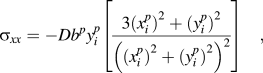
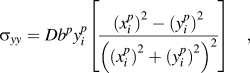
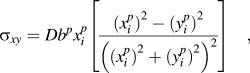
To determine the energy of the defect structure, one must know the equilibrium positions of all of the GBDs. The equilibrium positions are determined by requiring that the total stress acting on each GBDs be zero. The total stress arises from the remote tensile loading and the interacting force between GBDs. Consider a single edge dislocation located on boundary p (Fig. 2). The in-plane stress components in the local coordinate  $x_i^{\,p}$–
 $y_i^{\,p}$ of dislocation i can be expressed as:Reference Wu34
 $${{\rm{\sigma }}_{xx}} = - D{b^p}y_i^p\left[ {{{3{{\left( {x_i^p} \right)}^2} + {{\left( {y_i^p} \right)}^2}} \over {{{\left( {{{\left( {x_i^p} \right)}^2} + {{\left( {y_i^p} \right)}^2}} \right)}^2}}}} \right]\quad ,$$
 $${{\rm{\sigma }}_{yy}} = D{b^p}y_i^p\left[ {{{{{\left( {x_i^p} \right)}^2} - {{\left( {y_i^p} \right)}^2}} \over {{{\left( {{{\left( {x_i^p} \right)}^2} + {{\left( {y_i^p} \right)}^2}} \right)}^2}}}} \right]\quad ,$$
 $${{\rm{\sigma }}_{xy}} = D{b^p}x_i^p\left[ {{{{{\left( {x_i^p} \right)}^2} - {{\left( {y_i^p} \right)}^2}} \over {{{\left( {{{\left( {x_i^p} \right)}^2} + {{\left( {y_i^p} \right)}^2}} \right)}^2}}}} \right]\quad ,$$
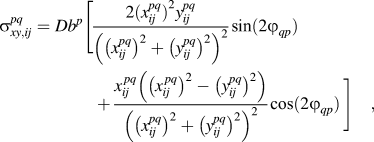
where D = G/[2π(1 − ν)] and b p is the Burgers vector magnitude of the GB dislocations on the boundary p. By coordinate transformation and Eqs. (1)–(3), the shear stress acting on the dislocation j of boundary q due to the dislocation i of boundary p can be written in the local coordinate of dislocation j as:
 $${\rm{\sigma }}_{xy,ij}^{pq} = D{b^p}[ {{{2{{( {x_{ij}^{pq}} )}^2}y_{ij}^{pq}} \over {{{\Big( {{{\big( {x_{ij}^{pq}} \big)}^2} + {{\big( {y_{ij}^{pq}} \big)}^2}} \Big)}^2}}}\sin ( {2{\varphi _{qp}}} ) + {{x_{ij}^{\,pq}\Big( {{{\big( {x_{ij}^{\,pq}} \big)}^2} - {{\big( {y_{ij}^{pq}} \big)}^2}} \Big)} \over {{{\Big( {{{\big( {x_{ij}^{pq}} \big)}^2} + {{\big( {y_{ij}^{pq}} \big)}^2}} \Big)}^2}}}\cos ( {2{\varphi _{qp}}} )} ]\quad ,$$
where  $\left( {x_{ij}^{pq},\;y_{ij}^{pq}} \right)$ denotes the position coordinates of dislocation j in the local coordinate of dislocation i. The shear force acting on dislocation j of the contributions of all dislocations i = 1, 2,…, n p, on all three boundaries is given by
 $${F_{ij}} = \sum\nolimits_p {\sum\nolimits_i {{\rm{\sigma }}_{xy,ij}^{pq}{b^q}} } \quad ,$$
where i ≠ j when p = q.
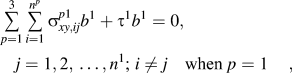
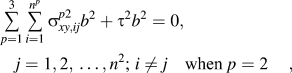
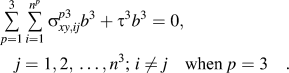
The contribution of the shear force acting on dislocation j due to remote loading is given by τqb q, where τq is the remote shear stress resolved on boundary q. Thus, the equilibrium positions of all dislocations can be obtained by solving the nonlinear equilibrium equations as follows:
 $$\mathop\sum\limits_{p = 1}^3 {\mathop\sum\limits_{i = 1}^{{n^p}} {{\rm{\sigma }}_{xy,ij}^{p1}{b^1} + {{\rm{\tau }}^1}{b^1} = 0,\quad j = {\rm{1,}}\,{\rm{2,}}\, \ldots {\rm{,}}\,{n^{\rm{1}}}{\rm{;}}\;i \ne j\quad {\rm{when }}\;p = {\rm{1}}} } \quad ,$$
 $$\mathop\sum\limits_{p = 1}^3 {\mathop\sum\limits_{i = 1}^{{n^p}} {{\rm{\sigma }}_{xy,ij}^{p2}{b^2} + {{\rm{\tau }}^2}{b^2} = 0,\quad j = {\rm{1,}}\,{\rm{2,}}\, \ldots {\rm{,}}\,{n^{\rm{2}}}{\rm{;}}\;i \ne j\quad {\rm{when }}\;p = {\rm{2}}} \quad ,}$$
 $$\mathop\sum\limits_{p = 1}^3 {\mathop\sum\limits_{i = 1}^{{n^p}} {{\rm{\sigma }}_{xy,ij}^{p3}{b^3} + {{\rm{\tau }}^3}{b^3} = 0,\quad j = {\rm{1,}}\,{\rm{2,}}\, \ldots {\rm{,}}\,{n^{\rm{3}}}{\rm{;}}\;i \ne j\quad {\rm{when }}\;p = {\rm{3}}\quad {\rm{.}}$$
Once the equilibrium positions of the dislocations are obtained, the energy W 1 of the GBD pile-up groups can be calculated. Based on the study by Wu,Reference Wu34 it can be written in the form:
$${W_1} = \mathop\sum\limits_{p = 1}^3 {{{{n^p}D{{( {{b^p}} )}^2}} \over 2}\ln \Bigg( {{R \over {{r_0}}}} \Bigg) + \mathop\sum\limits_{p = 1}^3 {\mathop\sum\limits_{i = 1}^{{n^p}} {\mathop\sum\limits_{j > i}^{{n^p}} {D{{( {{b^p}} )}^2}\ln ( {{{{{( { - 1} )}^{p + 1}}R} \over {x\prime_{ij}^{pq}}}} )} } + \mathop\sum\limits_{p = 1}^2 {\mathop\sum\limits_{q > p}^3 {\mathop\sum\limits_{i = 1}^{{n^p}} {\mathop\sum\limits_{j = 1}^{{n^q}} {D{{( {{b^p}} )}^2}[ {{{y\prime_{ij}^{pq}( {s{{( { - 1} )}^{q + 1}}R + cy\prime_{ij}^{pq}} )} \over {{R^2} + {{( {y\prime_{ij}^{pq}} )}^2}}} - {{y\prime_{ij}^{pq}( {sx\prime_{ij}^{pq} + cy\prime_{ij}^{pq}} )} \over {{{( {x\prime_{ij}^{pq}} )}^2} + {{( {y\prime_{ij}^{pq}} )}^2}}} + {c \over 2}\ln \Bigg( {{{{R^2} + {{( {y\prime_{ij}^{pq}} )}^2}} \over {{{( {x\prime_{ij}^{pq}} )}^2} + {{( {y\prime_{ij}^{pq}} )}^2}}}} \Bigg) ] \quad , \cr}$$where r 0 is the dislocation core radius, R is the screening length of dislocation stress field,  $\left( {x\prime_{ij}^{pq},\;y\prime_{ij}^{pq}} \right)$ are related to the relative positions
 $\left( {x_{ij}^{pq},\;y_{ij}^{pq}} \right)$ of Eq. (4) by:
 $$x\prime_{ij}^{pq} = cx_{ij}^{pq} + sy_{ij}^{pq},\quad y\prime_{ij}^{pq} = - sx_{ij}^{pq} + cy_{ij}^{pq}\quad ,$$
and s = sinϕ qp, c = cosϕ qp. Note that the first term of Eq. (9) represents the self-energy of the dislocations, the second denotes the interaction energy of the dislocations on the same GBs, and the third denotes the interaction energy between the dislocations on different GBs.
IV. EFFECTS OF GB SLIDING ACCOMMODATIONS ON NANOVOID GENERATION AT TRIPLE JUNCTIONS
A. GB sliding accommodated by diffusion processes
Let us consider the situation where the pile-up of GBDs at the triple junction is effectively accommodated through GB diffusion processes. In general, this situation comes into play at intermediate temperatures at which the GB diffusion is intensive, but the grain growth is suppressed. The enhanced diffusion causes the interstitial vacancies to move toward the local region where high tensile stress exist, and thus partly relieves the stress created by the pile-up of GB dislocations at triple junctions and reduces the strain energies. In this section, we develop a theoretical model based on the energy characteristics to analyze the effect of diffusion processes on nucleation of triple junction nanovoids.
Consider that the GB is subjected to a normal tensile stress σn, which is a variation with the GB length L. According to GB diffusion kinetics, the mass flux J gb is related to the chemical energy μ along the GB per atom as:
 $${J_{{\rm{gb}}}} = {{{\rm{\delta }}{D_{{\rm{gb}}}}} \over {\Omega kT}}\left( { - {{\partial {\rm{\mu }}} \over {\partial x}}} \right) = {{{\rm{\delta }}{D_{{\rm{gb}}}}} \over {kT}}{{\partial {{\rm{\sigma }}_n}} \over {\partial x}}\quad ,$$
where δ is the effective GB thickness, D gb is the GB self-diffusion coefficient, and Ω, T, k are the atom volume, the absolute temperature, and Boltzmann constant, respectively. The dissipation rate of GB diffusion is given by the following equation:
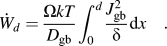 $${\dot W_d} = {{\Omega kT} \over {{D_{{\rm{gb}}}}}}\int_0^d {{{J_{{\rm{gb}}}^2} \over {\rm{\delta }}}{\rm{d}}x} \quad .$$
Substituting Eq. (11) into Eq. (12), the dissipation rate of GB diffusion  ${\dot W_d}$ can be evaluated as:
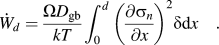 $${\dot W_d} = {{\Omega {D_{{\rm{gb}}}}} \over {kT}}{\int_0^d {\left( {{{\partial {{\rm{\sigma }}_n}} \over {\partial x}}} \right)} ^2}{\rm{\delta d}}x\quad .$$
RajReference Raj35 has shown that cavity nucleation by vacancy diffusion involves an incubation time t i:
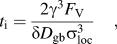 $${t_{\rm{i}}} = {{2{{\rm{\gamma }}^3}{F_{\rm{V}}}} \over {{\rm{\delta }}{D_{{\rm{gb}}}}{\rm{\sigma }}_{{\rm{loc}}}^3}}\quad ,$$
where F V denotes the void shape factor, γ is the surface energy, and σloc is the local stress at a triple junction. Therefore, during the incubation time, the energy dissipation by diffusion can be expressed as
 $${W_d} = {t_{\rm{i}}}{\dot W_d} = {{2{{\rm{\gamma }}^3}{F_{\rm{V}}}\Omega } \over {{\rm{\delta \sigma }}_{{\rm{loc}}}^3kT}}{\int_0^d {\left( {{{\partial {{\rm{\sigma }}_n}} \over {\partial x}}} \right)} ^2}{\rm{\delta d}}x\quad .$$
B. GB sliding accommodated by dislocation emission from GBs
The energetic characteristics of emissions of dislocation from a GB under the shear stress action have been studied by Bobylev et al.Reference Bobylev, Gutkin and Ovid’ko36 According to their study, there is an energetic barrier for dislocation emission and the critical shear stress required for dislocation emission is relatively high. The pile-ups of dislocations lead to stress concentration at triple junctions, and thus we consider that the dislocations are emitted from triple junctions in this article. For definiteness, we assume that the GBD located at a triple junction splits into an immobile GBD and a mobile Shockley dislocation that moves to the adjacent grain interior, as illustrated in Fig. 3. The sliding of the Shockley dislocation in the grain leaves the stacking fault behind it. The Burgers vector of the edge and screw components of the partial dislocations are be and bs, respectively. The immobile GBD located at the position of the initial dislocation is characterized by its Burgers vector with edge component bgb − be and screw component −bs.
A GBD splits into a leading partial Shockley dislocation and a difference dislocation. The partial Shockley dislocation is characterized by its Burgers vector with the edge component be and screw component bs.
In the following, we calculate the energy characteristics of the partial dislocation emission from a triple junction. The emission of dislocation can be considered as a transformation of the system from its initial state to the final state. The energy W 1 of the system in initial state has been calculated in Sec. III. The energy  $W_1^\prime$ of the defect system after the emission of dislocation from triple junction can be calculated similar to the study by Bobylev et al.Reference Bobylev, Gutkin and Ovid’ko36 For convenience, the formation of Shockley dislocation can be represented as that of two dislocation dipoles: a dipole of edge dislocations and a dipole of screw dislocations. Therefore, the characteristic energy difference ∆W can be expressed by:
 $$\Delta W = \;W_{{\rm{el}}}^{{\rm{dip}} - {\rm{e}}} + W_{{\rm{el}}}^{{\rm{dip}} - {\rm{s}}} + W_{{\mathop{\rm int}} }^{{\rm{gb}} - {\rm{e}}} - W_{\rm{c}}^{{\rm{gb}}} + W_{\rm{c}}^{\rm{e}} + 2W_{\rm{c}}^{\rm{s}} + W_{\rm{c}}^{{\rm{dif}}} + {{\rm{\gamma }}_{{\rm{sf}}}}{l_{\rm{p}}} - {A_{\rm{\tau }}}\quad ,$$
where  $W_{{\rm{el}}}^{{\rm{dip}} - {\rm{e}}}$ and
 $W_{{\rm{el}}}^{{\rm{dip}} - {\rm{s}}}$ are the self-elastic energies of the edge and screw dislocation dipoles, respectively;
 $W_{{\mathop{\rm int}} }^{{\rm{gb}} - {\rm{e}}}$ is the energy of elastic interaction of the edge dislocation dipole with the GB dislocations;
 $W_{\rm{c}}^{{\rm{gb}}}$ is the energy of the GB dislocation cores;
 $W_{\rm{c}}^{\rm{e}}$ and
 $W_{\rm{c}}^{\rm{s}}$ are the energies of the edge and screw components of the Shockley dislocation cores, respectively;
 $W_{\rm{c}}^{{\rm{dif}}}$ is the core energy of the immobile GB dislocation; γsf and l p are the energy and length of the stacking fault, respectively; A τ is the work spent to transfer the Shockley dislocation under an external stress τ. After some algebra operating with the above standard formulas, the following expression for ∆W is given in Bobylev et al.,Reference Bobylev, Gutkin and Ovid’ko36 which can be written as:
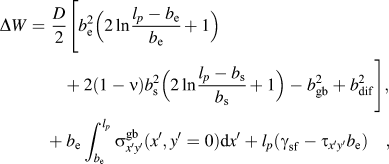 $$\Delta W = \;{D \over 2}[ {b_{\rm{e}}^2( {2\ln {{{l_p} - {b_{\rm{e}}}} \over {{b_{\rm{e}}}}} + 1} ) + 2(1 - {\rm{\nu }})b_{\rm{s}}^2( {2\ln {{{l_p} - {b_{\rm{s}}}} \over {{b_{\rm{s}}}}} + 1} ) - b_{{\rm{gb}}}^2 + b_{{\rm{dif}}}^{\rm{2}} ], + {b_{\rm{e}}}\int_{{b_{\rm{e}}}}^{{l_p}} {{\rm{\sigma }}_{x'y'}^{{\rm{gb}}}(x',y' = 0)} {\rm{d}}x' + {l_p}({{\rm{\gamma }}_{{\rm{sf}}}} - {{\rm{\tau }}_{x'y'}}{b_{\rm{e}}})\quad ,}$$
where  ${b_{{\rm{dif}}}} = \sqrt {\left( {{b_{{\rm{gb}}}} - {b_{\rm{e}}}\cos {{({\rm{\theta }}/2)}^2} + b_{\rm{e}}^2{{\sin }^2}{\rm{\theta }}/2} \right)}$ is the Burgers vector magnitude that characterizes the immobile GBD resulted from the splitting of the preexistent GBD (Fig. 3);
 ${\rm{\sigma }}_{x'y'}^{{\rm{gb}}}$ is the component of the stress tensors of the GB dislocation wall. Transformation of the stress tensor components written in the coordinate system Oxy into those written in the coordinate system Ox′y′ is described in the standard way as follows:
 $${{\rm{\sigma }}_{x'y'}}(x',y') = \;{{\rm{\sigma }}_{xy}}(x,y)cos{\rm{\theta }} - {{\sin {\rm{\theta }}} \over 2}\left[ {{{\rm{\sigma }}_{yy}}(x,y) - {{\rm{\sigma }}_{xx}}(x,y)} \right]\quad ,$$
where x = x′cosθ/2 − y′sinθ/2 + x d and y = x′sinθ/2 + y′cosθ/2 + y d.
C. Nucleation of nanovoids at triple junctions
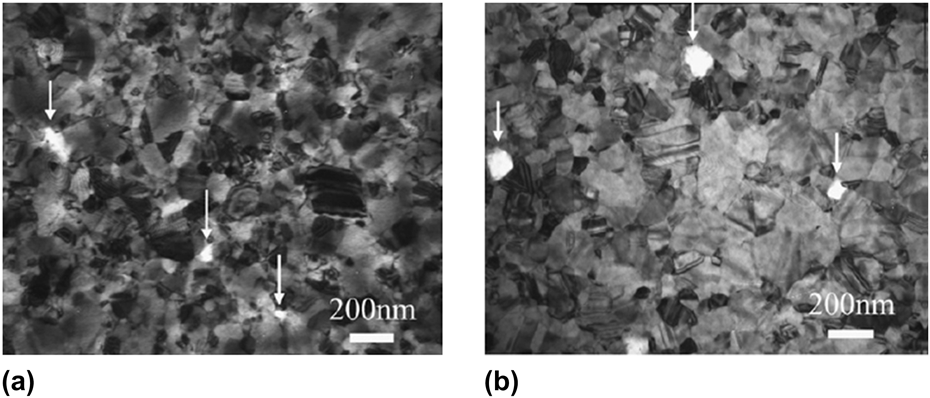
It has been generally observed that the nucleation of nanovoids is believed to occur predominantly at triple junctions in deformed nanocrystalline materials.Reference Inoue, Fujii and Koseki10,Reference Kumar, Suresh, Chisholm, Horton and Wang15,Reference Hugo, Kung, Weertman, Mitra, Knapp and Follstaedt37 Inoue et al.Reference Inoue, Fujii and Koseki10 have studied Cu films subjected to various subcritical uniform uniaxial tensile strains at an elevated temperature to observe void formations in nanocrystalline metals. TEM micrographs showed that voids were nucleated at the GB triple junctions, and clear evidence of the void growth was found in Fig. 4. Based on their studies, most of the voids are round shaped and penetrate through Cu films. Therefore, an isolated round-shaped void nucleated at the triple junction is considered in the void nucleation model presented.
TEM micrographs show (a) the evolution of void nucleation and (b) the growth in the Cu film during the uniaxial relaxation test. White arrows point to voids formed in the Cu film.Reference Inoue, Fujii and Koseki10
In the following, we will analyze the energy characteristics of a void nucleated at triple junction due to the pile-up of the GBDs. With an increasing number of GBDs at triple junction, the pile-up energy W 1 of GBDs with nonaccommodation becomes larger. On this occasion, a void is generated at the triple junction to release the energy. To quantitatively characterize the generation of triple junction nanovoids, we calculate the equilibrium radius r eq of a nanovoid. The equilibrium radius of the nanovoid is defined as that corresponding to the minimum energy of the system. Let us estimate the energy difference ∆W f related to the formation of a nanovoid. For an approximation, ∆W f can be represented as
 $$\Delta {W_{\rm{f}}} = {W_{\rm{1}}} - {A_{\rm{V}}}{\rm{\gamma }}\quad ,$$
where A V is the surface area of the void and γ the surface energy of the void. Therefore, the equilibrium radius of the nanovoid can be obtained by making the ∆W f = 0. When GB sliding is accommodated by the diffusion process, the change of energy  $\Delta W_{\rm{f}}^\prime$ of the system can be rewritten by Eq. (19) as
 $$\Delta {W'_{\rm{f}}} = {W_{\rm{2}}} - {A_{\rm{V}}}{\rm{\gamma }}\quad .$$
V. RESULTS AND DISCUSSION
A. Emission of dislocations from GBs
Equation (17) allows one to calculate the energy difference ∆W of the system before and after the partial dislocation emission. In doing so, we choose the nanocrystalline Ni as an exemplary case. The typical values of the parameters used in this article are as followsReference Chokshi and Mukherjee38–Reference Foiles and Hoyt40: G = 73 GPa, ν = 0.34, b = 0.249 nm, γsf = 0.127 J/m2, and the crystal lattice parameter a = 0.35 nm. The Burgers vector magnitude characterizing an elementary mobile GB dislocation is assumed to be b gb = b/2. The screw and edge components of the Burgers vector for a Shockley dislocation are  ${b_{\rm{s}}} = a/2\sqrt 6$ and b e = b/2, respectively.
Figure 5 represents the dependence of energy difference ∆W on stacking fault γsf for three values of shear stress τ = 0.6, 0.8, and 1 GPa. As follows from Fig. 5, an energetic barrier exists at the beginning of the curves, which hinders the GBD splitting. The energy difference ∆W is sensitive to the shear stress and an increase in τ enhances the splitting of a GBD, followed by the emission of a Shockley dislocation into the grain interior. Also, it seems that the stress for emitting partial dislocation, for example, τ = 1 GPa, is too high, however, MD simulations showed that this stress level is real for a nanocrystalline with grain size ranging from roughly 5 to 50 nm.
Variation of energy change ∆W of partial dislocation emission with the stacking fault length l p for three values of shear stress τ = 0.6, 0.8, and 1 GPa.
B. Energy characteristics of GBDs pile-up and GB diffusion
Based on Eq. (9), the pile-up energy W 1 of GBDs depends on the number of GBDs belonging to the pile-up groups and the equilibrium position of each GBD. By solving the nonlinear equilibrium Eqs. (6)–(8), we can obtain the numbers and equilibrium positions of GBDs in three GBs. Note that the resolved shear stress acted on each GB is different, thus the number of GBDs in each GB is different for the same GB length. Also, the number and equilibrium positions of GBDs are related to the geometric structure of a triple junction, i.e., the angles between GBs and the x-axis. Here, we calculate the conditions Φp = 20, −40, and −100° for p = 1, 2, and 3, respectively. The variation of the calculated number of GBDs in each GB on the GB length is shown in Fig. 6. It can be seen that the numbers of GBDs at the three GBs are different, although the length of each GB is the same. GB 2 has the largest number of GBDs, whereas GB 3 has the smallest. This is because the GB 2 plane is the nearest to the maximum shear plane. Also, the distribution of the number of GBDs presents a step structure with the length of the pile-up, especially when the resolved shear stress is relatively small. Figure 7 shows the equilibrium positions of the GBDs at three GBs for a given length of GB, L = 100 nm. The dislocation arrangement in the pile-up is not uniform due to the interaction between the GBDs.
Number of GBDs in each GB belonging to the pile-ups as a function of GB length for uniaxial tensile stress σ = 0.05G.
Equilibrium positions of GBDs in each GB for uniaxial tensile stress σ = 0.05G. The GB length is given for L = 100 nm.
The energy W 1 of the pile-up groups around the triple junction, as a function of pile-up length L, is shown in Fig. 8, for three values of uniaxial tensile stress: σ = 0.003G, 0.005G, and 0.01G. It is clear that energy W 1 of the pile-up groups increases with increasing pile-up length L and the remote tensile stress. Figure 9 demonstrates the dependence of the energy dissipation of GB diffusion on GB length L for three values of local tensile stress acting on GBs. The results show that the GB diffusion energy W d increases with the decreasing of GB length L and the increasing of parameter κ. It should be noted that the process of GB diffusion is also closely associated with temperature, which is beyond the scope of this article.
Variation of the energy of GBD pile-ups around a triple junction with the GB length for three values of uniaxial tensile stress.
Variation of the energy of GB diffusion with GB length in the cases of κ = 1×10¹⁵, 3 × 10¹⁵, and 5 × 10¹⁵.
C. Nucleation and equilibrium radius of nanovoid with GB sliding accommodations
Analyses on void nucleation indicate that stress concentration is necessary for nucleating cavities,Reference Raj35,Reference Chokshi41 and studies by Fleck et al.Reference Fleck, Taplin and Beevers39 show that a threshold stress is necessary for nucleation. This may be attributed to that there is a minimum value of the void radius, below which a steady state cannot be achieved for void nucleation. We assume the critical radius r c of the steady state for the void nucleation is 1 nm, thereby the threshold energy for the void nucleation is
 $${W_{{\rm{th}}}} = {\rm{2\pi }}{r_{\rm{c}}}{\rm{\gamma }}\quad .$$
Therefore, the criterion for the nanovoid generation is that the energies W 1 and W 2 of the GB sliding with nonaccommodation and accommodation are larger than the threshold energy W th.
The energy W 2 of the pile-up groups as a function of the GB length L with accommodation is plotted in Fig. 10, for three values of tensile stress. The energy of emission of partial dislocations is not on the same order with the energies of GBD pile-up groups and GB diffusion. Thus, the energy characteristic of the emission of partial dislocations is neglected. The horizontal dashed line in Fig. 10 represents the threshold energy W th. The generation of the nanovoid at a triple junction is energetically favorable in the range where the curve W 2(L) lies above the horizontal dashed line in Fig. 10. The critical GB length corresponds to the point where the curve W 2(L) and the horizontal dashed line intersect. It is shown that the critical length L c of the pile-up with accommodation decreases with increasing shear stress.
Variation of the energy of GBD pile-ups around a triple junction with GB diffusion accommodation with GB length for three values of uniaxial tensile stress. Horizontal dashed line represents the threshold energy for a nanovoid nucleation.
The dependences of the equilibrium radius r eq of triple junction nanovoid on the length L with nonaccommodation [Fig. 11(a)] and GB diffusion accommodation [Fig. 11(b)] are shown in Fig. 11 for different values of tensile stress. By comparing Fig. 11(a) with Fig. 11(b), it can be seen that the influence of GB diffusion process on nanovoid nucleation becomes large when the grain size decreases. This can be attributed to that the GB diffusion process is highly enhanced with decreasing grain size.
Dependences of equilibrium radius of a triple junction nanovoid on GB length with nonaccommodation (a) and GB diffusion accommodation (b) for three values of shear stress.
The results of the presented model show that the energy of the system combined pile-up of GB dislocations with GB diffusion decreases with decreasing GB length. Thus, the conclusion that nanovoids are prone to nucleate at triple junctions with larger length of GBs is obtained. However, this conclusion only demonstrates the potential void nucleation sites and does not mean that the reduction of grain size increases the ductility, since the reduction of grain size increases the total number of potential void nucleation sites. On the other hand, it should be noted that when the grain size of material decreases down to 30 nm (which is also called the finest grains),Reference Fedorov, Gutkin and Ovid’ko42 large pile-ups of GB dislocations hardly form due to geometric restriction.Reference Milligan, Hackney, Ke and Aifantis43,Reference Ke, Hackney, Milligan and Aifantis44 In these circumstances, GBs themselves carry plastic flow by other mechanisms such as Coble creep mode and rotational deformation mode. In situ transmission electron microscopy (TEM) observationsReference Milligan, Hackney, Ke and Aifantis43,Reference Ke, Hackney, Milligan and Aifantis44 of nanocrystalline Au films, with average grain sizes of around 8–10 nm, the absence of bulk dislocation activity and also nanovoid nucleation and growth at triple junctions were observed. Ovid'ko et al.Reference Ovid’ko, Sheinerman and Skiba45 studied the nanovoid nucleation in the stress fields of GB disclination dipoles formed at triple junctions. Therefore, the model developed in this article focusses on the nanocrystalline with intermediate grains (having the grain size in the range from tentatively 30–100 nm).
VI. CONCLUSIONS
An energy analysis of the nanovoid nucleation at triple junctions due to the sliding of GBs meeting at triple junctions is developed. In the model, GB sliding results from the glide of GBDs, and nanovoid nucleation occurs as a consequence of the pile-ups of the dislocations around triple junctions. The accommodation processes such as the emission of partial dislocations from GBs and GB diffusion cause a partial relaxation of stress concentration around triple junctions and thus suppress the nucleation of nanovoids. The number of GBDs belonging to the pile-up groups has been calculated, and the results show that the number in each GB is different. The GB which is the nearest to the maximum shear stress plane has the maximum number of GBDs. The energy of the emission of partial dislocations from GBs is closely related to the shear stress and the stacking fault length. Furthermore, an energy criterion based on the difference between the dislocation group energy and the void surface energy is used to predict the nucleation. The results show that triple junction nanovoid generates only when the energy of the pile-up of the GB dislocations exceeds the threshold energy. GB diffusion accommodation can effectively suppress the nucleation of triple junctions, especially when the grain size is relative small. Also, increasing the amplitude of the applied stress generally lowers the critical GB length for nanovoid nucleation.
ACKNOWLEDGMENTS
This work was supported by the National Natural Science Foundation of China Grant Nos. (11272143, 10872087, and 10502025), Key Project of the Chinese Ministry of Education (Grant No. 211061), the Fok Ying Tong Education Foundation (Grant No. 101005), the Program for New Century Excellent Talents in University (Grant No. NCET-12-0712), and Research Innovation Program for College Graduates of Jiangsu Province (Grant No. CXZZ12_0422).