Implications
Oxidation is the major non-microbial cause of quality deterioration in meat and is therefore one of the biggest economic problems in meat industry. It compromises nutritional quality, limits shelf life, increases toxicity and decreases market value of meat and meat products. Animal nutrition can influence these factors of meat quality. Providing further understanding in the reaction of an oversupply of inorganic Se and Mn on animal tissue can help to reduce negative effects of oxidation products on human health.
Introduction
A prooxidative environment due to reactive oxygen species (ROS) can impact the organism and the quality of the food of animal origin (Halliwell et al., Reference Halliwell, Aeschbach, Löliger and Aruoma1995). Meat quality is directly affected due to, for example, discoloration, off flavour, poor shelf life or drip loss. When polyunsaturated fatty acids (PUFAs) are oxidised by ROS, fatty acid radicals, and subsequently peroxy radicals, hydroperoxides and various aldehydes with potentially cyto- and genotoxic traits may be formed (Falowo et al., Reference Falowo, Fayemi and Muchenje2014).
Various enzymatic (superoxide dismutase (SOD), glutathione peroxidase (GPx), catalase (CAT)) and non-enzymatic (e.g. vitamin E, C, glutathione, uric acid) systems exist in the body to cover these prooxidative stressors and therefore reduce the susceptibility to oxidative stress (Halliwell et al., Reference Halliwell, Aeschbach, Löliger and Aruoma1995; Falowo et al., Reference Falowo, Fayemi and Muchenje2014). Likewise, trace elements like selenium may affect oxidative stability, however, with inconsistent results concerning the nature of its impact: Skřivan et al. (Reference Skřivan, Marounek, Englmaierová and Skřivanová2012) found beneficial impact of inorganic and organic dietary Se sources on oxidative stability of meat. In contrast, organic Se was reported to yield better drip loss and meat lightness than inorganic Se (Mahan et al., Reference Mahan, Cline and Richert1999). Also manganese proved beneficial, when fed in high concentrations of mainly organic source (Apple et al., Reference Apple, Roberts, Maxwell, Boger, Fakler, Friesen and Johnson2004 and Reference Apple, Roberts, Maxwell, Boger, Friesen, Rakes and Fakler2005).
Various synergistic or antagonistic effects of minerals and trace elements in absorption, transport and tissue storage are occurring (Suttle, Reference Suttle2010). Despite different absorption mechanisms, Se and Mn may yet interfere in nutrient metabolism, deposition or their physiological role, as Se and Mn are functionally related as cofactors of the antioxidative enzymes GPx and mitochondrial Mn-SOD, respectively. GPx contains selenocysteine at the active site and is responsible for the reduction of organic hydroperoxides (ROOH) to corresponding hydroxides (ROH) (Lawrence and Burk, Reference Lawrence and Burk1978). SOD catalyses the reaction of superoxide anion radical to H2O2 (Marklund and Marklund, Reference Marklund and Marklund1974). Therefore, Se and Mn may also influence the antioxidative capacity in the organism in protecting cells against damages caused by ROS and hydro- or lipid peroxides.
Depending on the concentration, impact of antioxidant molecules may shift from antioxidative to prooxidative (Halliwell et al., Reference Halliwell, Aeschbach, Löliger and Aruoma1995): The role of transition metals (e.g. in enzymes or metalloproteins) and oxidising lipids are discussed as factors influencing oxidation (Stadtman and Levine, Reference Stadtman and Levine2003). Supplementing feed with nutritional components such as trace elements is therefore a balancing act.
In the European Union, for most species and categories, maximum dietary concentrations of 0.5 mg Se and 150 mg Mn/kg feed have been defined (European Commission, 2003). Setting these maximum concentrations, parameters such as performance, health, environmental aspects as well as consumer safety are taken into account; however, meat quality is considered to a lesser extent.
To our knowledge, no study has dealt with the inclusion of high Se and Mn diets in livestock. We hypothesise that an oversupply of dietary Se or Mn improves the oxidative stability of organism and animal product, showing synergistic effects when combined in feed of fattening pigs. Comparing recommendation and EU upper-level supplementation of inorganic Se and Mn in a 2×2 factorial approach, the impact on performance and various meat quality parameters was investigated.
Material and methods
Animals and housing
The experiment was conducted at the Austrian Pig Testing Facility (OESPA, Lower Austria, Austria). Each pen offered a minimum of 1.2m2/animal on fully slatted concrete floor and was equipped with a nipple drinker and an automatic dry-feeding system allowing individual determination of feed intake. A total of 60 Austrian crossbred ((Large White×German Landrace)×Piétrain) gilts, with an average initial BW of 32.4±0.3 kg were allotted to 12 pens (i.e. five animals per pen, three replicates) on the basis of weight and litter, applying a randomised complete block design. Animals were marked with ear tag and transponder and monitored on a daily basis.
Diets and feeding
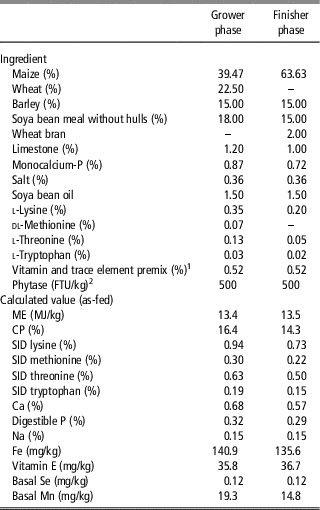
In a 2×2 factorial approach, inorganic Se and Mn were fed in two concentration levels (0.2 v. 0.5 mg/kg Se dry matter (DM); 20 v. 150 mg/kg Mn DM) for the whole fattening period. Considering the calculated native concentrations of Se and Mn (Table 1), Na-selenite and MnO were supplemented via vitamin and trace element premix to reach the proposed dietary concentrations. Animals received a grower diet (Table 1, 13.4 MJ metabolisable energy (ME)/kg, 16.4% CP, 0.94% standardised ileal digestible (SID) lysine as-fed) from start of the experiment up to an average penwise BW of 60 kg. Subsequently, animals were fed a finisher diet (Table 1, 13.5 MJ ME/kg, 14.3% CP, 0.73% SID lysine as-fed). Isocaloric and isonitrogenous diets were based on maize, barley and soya bean meal and were provided in ground form. The experimental diets are formulated to meet or exceed the nutrient recommendations (Society of Nutrition Physiology, 2006). Animals were fed and watered ad libitum.
Diet composition for grower and finisher phase

ME=metabolisable energy; SID=standardised ileal digestible.
1 Amount per kg as-fed: vitamin A 8000 I.E.; vitamin D3 1500 I.E.; vitamin E (as all-rac-α-tocopheryl acetate) 20.00 mg; iron (as iron-(II)-sulfate, monohydrate) 62.00 mg; copper (as copper-(II)-sulfate, pentahydrate) 11.00 mg; zinc (as zinc sulfate, monohydrate) 71.00 mg; iodine (as calcium iodate, anhydrous) 1.30 mg; cobalt (as alkaline cobalt-(II)-carbonate, monohydrate) 0.30 mg, diatomaceous earth as carrier; sodium selenite and manganese (II) oxide were added to the premixes to achieve the appropriate treatment levels.
2 Unit of phytase activity (FTU); 6-Phytase from Schizosaccharomyces pombe (Phyzyme XP; Danisco Animal Nutrition, Marlborough, Wilts, UK).
Slaughter, carcass characteristics and sampling
With an individual BW of about 115 kg, pigs were fasted for 12 h and slaughtered via stunning and bleeding at the adjacent slaughter facility. Blood samples were collected in heparinised tubes (Vacuette® Lithium Heparin; Greiner Bio-One, Kremsmuenster, Austria) during exsanguination. Following centrifugation (1500×g, 4 min, room temperature), plasma was obtained and stored at −70°C. Tissue samples of liver (left lobe) and mere abdominal muscle (rectus abdominis) were collected, vacuum packaged, transported on crushed ice to the laboratory (~1 h) and stored at −70°C until analyses.
Carcass characteristics were determined at OESPA by skilled personnel. Qualitative parameters were analysed in longissimus thoracis et lumborum (LTL) and semimembranosus (SM) muscle. Loin (between the 13th and 14th thoracic vertebrae) and SM pH at 45 min postmortem was determined using a portable temperature compensating pH meter (Portamess; Knick, Berlin, Germany). Conductivity (Konduktometer L 191; WTW GmbH, Weilheim, Germany) was measured in LTL (between the 12th and 13th thoracic vertebrae at 45 min postmortem and between the 15th and 16th vertebrae at 24 h postmortem, each at a depth of 6 cm) and in SM (depth of 3 cm at both points in time). Following separation of LTL between 13th and 14th vertebrae 24 h postmortem, meat lightness was immediately determined at the dorsal part of the dissected loin area using an optometer (OPTO-Star; R. Matthäus, Nobitz/OT Klausa, Germany; Units of ‘Göttinger Farbhelligkeitsmesser’ <45 U=pale, soft, exudative (PSE); >80 U=dark, firm dry (DFD)). Drip loss – as the weight loss during a 24 h storage at 4°C on a grid – was determined in 50 g of a cubically cut loin sample obtained 24 h postmortem.
Boneless tissue samples of LTL were obtained 24 h postmortem from chilled carcass.
Analyses
Antioxidant enzyme activity
Liver and abdominal muscle were homogenised in a potassium phosphate buffer (50 mmol/l K2HPO4, 50 mmol/l KH2PO4, 1 mmol/l ethylenediaminetetraacetic acid (EDTA), 1% Triton X-100) using an Ultra Turrax T25 homogeniser (IKA® Werke GmbH und Co. KG, Staufen, Germany). The buffer for GPx activity determination additionally contained 1 mmol/l of NaN3. Activities of GPx (Lawrence and Burk, Reference Lawrence and Burk1978), total SOD as well as Mn-dependent SOD and Cu/Zn-SOD (Marklund and Marklund, Reference Marklund and Marklund1974) and CAT (Beers and Sizer, Reference Beers and Sizer1952) were determined. Activities in plasma were determined without prior homogenisation.
Chemical analyses
Analyses of DM, CP, ether extracts (EE) and ash in feed and LTL as well as crude fibre, starch and sugar additionally in feed were performed (Naumann and Bassler, Reference Naumann and Bassler2012). Minerals and trace elements were determined using inductively coupled plasma mass spectrometry (ICP-MS) analysis after wet digestion with HNO3 and H2O2. Measurements were performed on a double-focussing sector field ICP-MS (Finnigan ELEMENT2; Thermo Electron Corporation, Bremen, Germany) equipped with a CETAC ASX-520 autosampler (CETAC Technologies, Omaha, NE, USA), a cyclonic spray chamber (20 ml, Jacketed Cinnabar Cyclonic, Glass Expansion, West Melbourne, Australia) and a conical nebuliser made from borosilicate glass (Glass Expansion). Argon (Ar 4.6, 99.996%) cool gas flow was 16 l/min, auxiliary (plasma) gas and sample (nebuliser) gas flows were optimised daily to obtain maximum signal intensity, the former typically between 0.75 and 0.90 l/min, the latter in the range of 0.90 and 1.00 l/min. Radio-frequency (RF) power was 1190 W. Thiobarbituric acid reactive substances (TBARS) were determined in liver, abdominal muscle and in LTL (before and after retail display, see below). Tissue homogenates (Ultra Turrax T25) with 1.15% ice cold KCl buffer including 0.3% butylated hydroxytoluene were produced and TBARS were determined according to Ohkawa et al. (Reference Ohkawa, Ohishi and Yagi1979) using 5 ml of butanol for transfer of reaction products to the organic phase. Values are expressed as mg malondialdehyde equivalents per kg of wet tissue. Total antioxidative capacity (TAC) was analysed using Cuprac method (Apak et al., Reference Apak, Güçlü, Demirata, Özyürek, Çelik, Bektaşoğlu, Berker and Özyurt2007) and is presented as ascorbic acid equivalents.
Sensory aspects and retail display of longissimus thoracis et lumborum chops
A sensory panel of six persons experienced in sensory evaluation of meat was used. Samples were thawed to 2°C for 24 h before testing. Untreated 1 cm thick LTL chops were cooked well-done for 5 min on each side in individual dishes at maximum power (Raclette Gourmet Grill Deluxe, Tefal S.A.S., Rumilly, France) and served immediately. Water and white bread were provided for neutralisation of receptors. Each panellist evaluated four pork samples per session (i.e. 15 sessions in total, performed on 2 days), one sample from each treatment in randomised order, for tenderness, juiciness and flavour intensity, using a six-point hedonic scale, in which 1=very tough/very dry/low flavour intensity and 6=very tender/very juicy/high flavour intensity. Sample of each session were additionally ranked in order of subjective overall preference (lower value=higher preference).
Starting 24 h postmortem, LTL chops were subject to a 7-day retail display simulation. Chops were plotted dry, weighed, vacuum packed and stored under continuous light (500 to 800 lx, Basics T5 fresh colour fluorescent tube, 14 W; Bäro, Leichlingen, Germany) in a cooler (4°C). Weight loss during storage (%) was determined gravimetrically on the patted dry loin chop. pH value was analysed in duplicate using a calibrated temperature compensating pH meter (testo 206 pH2; Testo AG, Lenzkirch, Germany) before (i.e. 24 h postmortem) and after retail display.
Statistical analysis
Data were evaluated with two-way ANOVA (PROC MIXED, SAS 9.4; SAS Institute, Cary, NC, USA) including the experimental factors (Se, Mn), their interaction (Se×Mn) and the replicates in the model. Animal or the tissue derived thereof served as experimental unit. Weekly data were used to evaluate performance (average daily gain (ADG), average daily feed intake (ADFI), feed conversion ratio (FCR)) applying repeated measures. For retail display (TBARS, pH) repeated measures of display days were accounted for. Panellist served as random effect in sensory evaluation. Pearson’s correlation coefficient was determined applying PROC CORR. Results are presented as least square means and pooled standard error of means.
Results
Feed, performance and carcass characteristics
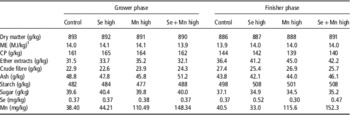
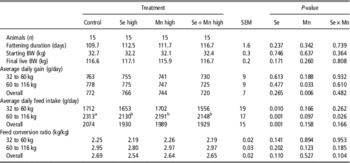
Results of feed analyses and performance are presented in Tables 2 and 3. In grower feed Se supplementation was not observable despite the verification of supplementation in the premix (inhomogeneity of feed). No severe morbidities or mortalities of pigs were recorded. High Se concentration in diets reduced ADFI in all growth periods investigated, without concomitantly improving FCR. High Mn supplementation resulted in reduced ADG in the finisher period and the overall performance. In finisher phase, ADFI was significantly lower in all supplemented groups compared with the control (Se×Mn P<0.05), however, additive effects of element combination were not found.
Analysed nutrient composition in experimental diets (as-fed)

1 Metabolisable energy (ME) calculated from data provided by Society of Nutrition Physiology (2008).
Performance results of fattening pigs fed an oversupply of Se and Mn compared with recommendations

a,bValues within a row with different superscripts differ significantly at P<0.05.
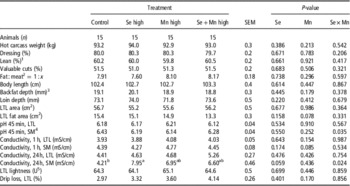
Quantitative carcass characteristics (Table 4) were only insignificantly influenced by Se or Mn supplementation. High Mn diets showed a trend in decreasing LTL fat area (P<0.10). Changes in qualitative carcass characteristics were predominantly observed in SM muscle, showing a significant interaction for pH (45 min postmortem), with reductions in single high supplementation. Conductivity in SM was increased by Mn 45 min postmortem (P<0.10), whereas single high doses of Se increased conductivity after 24 h in SM but not in LTL. Drip loss and lightness remained uninfluenced by dietary intervention.
Carcass characteristics of fattening pigs fed an oversupply of Se and Mn compared with recommendations

LTL=longissimus thoracis et lumborum; SM=semimembranosus muscle.
a,bValues within a row with different superscripts differ significantly at P<0.05.
1 Lean %=48.7719−0.48330×backfat depth (thinnest backfat section above M. gluteus medius) +0.23127×loin depth (BMLF, 2011).
2 (Weight of loin+filet+ham)/(weight of fat overlay of loin+ham).
3 Mean of three measurements: thickest section over the first thoracic vertebra+thinnest section over the last thoracic vertebra+thinnest section above M. gluteus medius.
4 P>0.10 for post-hoc test (Tukey).
5 Units of ‘Göttinger Farbhelligkeitsmesser’ <45 U=PSE; >80 U=DFD (OPTO-Star).
Oxidative properties
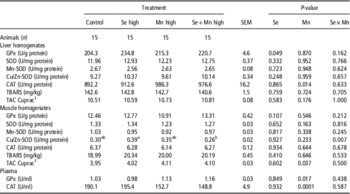
Activity of GPx in liver was increased due to high Se diets (Table 5). Furthermore, Mn increased liver CAT activity, whereas activity of SODs remained unchanged. Changes in enzyme activity were not reflected in changes in the concentration of TBARS or TAC. In abdominal muscle, Cu/Zn-SOD was increased in activity by the Se-high diet (Se×Mn P<0.05). Furthermore, dietary Mn supplementation increased muscle TAC. In plasma, Mn increased GPx activity, while reducing CAT.
Enzyme activity, thiobarbituric acid reactive substances (TBARS) and total antioxidative capacity (TAC) (Cuprac method) in liver and muscle (rectus abdominis) homogenates and plasma of fattening pigs fed an oversupply of Se and Mn compared with recommendations

GPx=glutathione peroxidase; SOD=superoxide dismutase; CAT=catalase.
a,bValues within a row with different superscripts differ significantly at P<0.05.
1 mg ascorbic acid equivalents/g wet tissue.
Nutrient composition and organoleptic properties of LTL
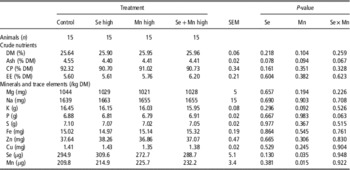
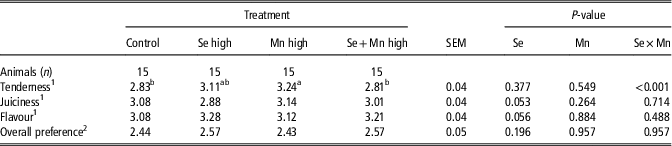
High dietary Se and Mn concentrations had no influence on DM, CP and EE in LTL samples (Table 6). Nevertheless, there was a lower ash concentration when high amounts of trace elements were applied; however, without additive effects when factors were combined (Se×Mn P<0.10). In detail, these changes can be traced back to decreased potassium concentrations due to Mn supplementation (P<0.10) and reduced phosphorus concentrations in single high Se/Mn diets (P<0.10). The Se increasing effect of Se supplementation was only visible when calculation was performed in µg/kg FM (P<0.10; data not shown) but not in DM. High dietary Mn could increase Mn in LTL; however, Mn markedly decreased Se concentration (P<0.05). Results of organoleptic analyses (Table 7) showed a higher intensity of flavour along with lower juiciness with Se supplementation (P<0.10) and higher tenderness in single high trace element diets (Se×Mn P<0.01).
Nutrient content in longissimus thoracis et lumborum of fattening pigs fed an oversupply of inorganic Se and Mn compared with recommendations

DM=dry matter; EE=ether extracts.
Results of organoleptic analyses of longissimus thoracis et lumborum obtained from fattening pigs fed an oversupply of Se and Mn compared with recommendations

a,bValues within a row with different superscripts differ significantly at P<0.05.
1 Six-point hedonic scale, in which 1=very tough/very dry/low flavour intensity and 6=very tender/very juicy/high flavour intensity.
2 Ranked in order of subjective preference (lower value=higher preference).
Retail display
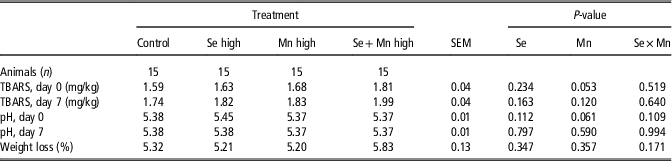
There was a trend of higher TBARS concentrations and reduced pH value in the non-stored (=24 h postmortem) LTL of the Mn group (Table 8). After retail display no statistically determinable difference between treatments was observable concerning TBARS, ultimate pH value or weight loss. Nevertheless, the overall effect of retail display on TBARS concentration (repeated measures) showed an increasing effect of Mn (P=0.015) as well as a trend of Se (P=0.091) to increase pork TBARS.
Thiobarbituric acid reactive substances (TBARS) content, pH value and weight loss (%) during 7-day retail display (day 0=24 h postmortem) of longissimus thoracis et lumborum obtained from fattening pigs fed an oversupply of Se and Mn compared with recommendations

Discussion
Performance and carcass characteristics
As dietary Se concentration is reported to have no impact on performance at recommendation level (Society of Nutrition Physiology, 2006) and only starts impairing at 5 mg/kg Se (Kim and Mahan, Reference Kim and Mahan2001) no changes were expected. Nevertheless, Se reduced ADFI without showing improved FCR. Likewise, also Mn is reported to be safe up to dietary concentrations of 1000 mg/kg (National Research Council, 2005). Despite that, we observed impaired ADG due to high Mn supplementation especially in the older animals. High inorganic Mn in feed in a hot and humid environment may lead to peroxidation (Suttle, Reference Suttle2010) or altered intestinal absorption (Smith et al., Reference Smith, Sherman, Miller, Robbins and Halley1995). Thus, the performance impairing effect observed may in part have been indirectly caused by reduced feed quality due to hot outdoor temperature.
No influence of Se supplementation on quantitative carcass characteristics was recorded. Manganese, however, decreased LTL fat area (P<0.10). Increasing dietary Mn concentrations also led to quadratically reduced backfat depth (Apple et al., Reference Apple, Roberts, Maxwell, Boger, Fakler, Friesen and Johnson2004), which may be traced back to lipoprotein lipase activity in fat tissue (Lu et al., Reference Lu, Ji, Luo, Liu and Yu2006).
We found decreased pH in SM muscle due to single high supplementation of Se or Mn. Similarly, also the conductivity in SM was increased, indicating a trend towards pale, soft and exudative meat.
Interestingly, feeding intervention did not show comparable effects in the different muscles analysed. More pronounced changes were observed in SM than in LTL muscle. Supplementing inorganic Se had a stronger effect on Se concentration in SM than LTL (Lisiak et al., Reference Lisiak, Janiszewski, Blicharski, Borzuta, Grześkowiak, Lisiak, Powałowski, Samardakiewicz, Batorska, Skrzymowska and Hammermeister2014). Higher TBARS concentration after storage (Bobček et al., Reference Bobček, Lahučký, Mrázová, Bobček, Novotná and Vašíček2004) and higher concentrations of PUFAs, as well as Fe, Zn, Cu (Purchas et al., Reference Purchas, Morel, Janz and Wilkinson2009) can be found in SM compared with LTL, so SM seems more susceptible to changes in dietary trace element concentrations.
Oxidative properties
In finishing pigs, serum GPx activity is reported to reach a plateau at a dietary level of 0.1 mg/kg Se as Na-selenite (Mahan et al., Reference Mahan, Cline and Richert1999), thus explaining our lack of improvement in plasma. GPx activity in liver and muscle can be increased when supplementing Se to a Se-deficient control (Zhan et al., Reference Zhan, Wang, Zhao, Li and Xu2007). Interestingly, we found higher GPx activity in liver raising inorganic Se from recommendation to maximum dietary EU level, indicating, that no plateau was yet reached in liver. Alternatively, higher GPx activity may have become necessary due to the prooxidative potential of selenite, as reviewed by Mézes and Balogh (Reference Mézes and Balogh2009) and discussed below. Different reaction patterns of Se supplementations in the tested matrices (liver, muscle, plasma) may be a result of different GPx concentration and activity levels (Daun and Åkesson, Reference Daun and Åkesson2004) and therefore different Se concentrations in the physiological form.
Single high supplementation of Se resulted in an increased Cu/Zn-SOD activity in abdominal muscle. Higher SOD activity due to Se was also observed by Ahmad et al. (Reference Ahmad, Tian, Wang, Khan, Wang, Zhang and Wang2012), who proposed an influence of several selenoproteins on thyroid function, provoking the production of ROS. Interestingly, combined Mn and Se supplementation alleviated this effect, resulting in an interaction of the factors (P<0.05).
Supplemental Mn did neither alter Mn-SOD nor Cu/Zn-SOD or the total activity, indicating sufficient Mn concentrations in control diets to reach a saturation state. Dietary Mn increased the activity of CAT in the liver but decreased it in plasma. Even though a procaryote CAT is reported to contain Mn in the catalytic active site, CAT in eukaryotes carries Fe in a haem group (Whittaker, Reference Whittaker2012), thus suggesting a relation of Mn with Fe in the current study. Mn and Fe are also interrelated in the eukaryote organism, using the same absorption mechanism and transport (Suttle, Reference Suttle2010). This may directly or indirectly also result in an interaction with CAT activity. Yet the question remains why the effect of high Mn on CAT activity was opposed in the two matrices. In general, the relation of total Fe : Mn decreases from plasma>muscle>liver (Suttle, Reference Suttle2010) and therefore may not be responsible for the observed effect. Zheng et al. (Reference Zheng, Zhao, Slavkovich, Aschner and Graziano1999) reported an upregulation of cellular Fe uptake in chronic Mn exposure. This resulted in reduced Fe concentrations in plasma while transferrin remained unchanged. Even though we have not analysed absolute Fe concentrations in liver and plasma, we hypothesise that lower available Fe in plasma and higher concentrations in liver may have affected these opposed changes in CAT activity.
CAT and GPx can both use H2O2 as a substrate. Therefore, the increase in GPx activity in plasma seen in Mn-supplemented pigs may be a compensational reaction to the decrease in plasma CAT activity (r=−0.273, P=0.0459).
Higher GPx activity in liver or Cu/Zn-SOD in muscle should go in line with a decrease in TBARS concentration, as marker of lipid peroxidation, resulting in improved oxidative stability (Lu et al., Reference Lu, Ji, Luo, Liu and Yu2006; Zhan et al., Reference Zhan, Wang, Zhao, Li and Xu2007). However, there is no correlation neither in our study (GPx v. TBARS: r=0.042, P=0.747; Cu/Zn-SOD v. TBARS: r=0.248, P=0.056) nor in the trial of Ahmad et al. (Reference Ahmad, Tian, Wang, Khan, Wang, Zhang and Wang2012). Determination of TBARS may therefore be no sensitively enough method to record these changes.
Aside from antioxidative enzymes, low molecular weight antioxidants of dietary or endogenous origin are also responsible for oxidative stability. In this respect, Se is reported to interact with dietary antioxidants such as vitamin E (Suttle, Reference Suttle2010), thus, a relation of Se with the antioxidative capacity could be expected (Ahmad et al., Reference Ahmad, Tian, Wang, Khan, Wang, Zhang and Wang2012), but was not observed. In contrast, Mn increased antioxidative capacity in abdominal muscle, this, however, was not reflected in lower TBARS concentrations.
Nutrient composition and organoleptic properties of LTL
Feeding high Se and Mn diets hardly affected nutrient concentrations of LTL, despite a trend in lowering ash concentrations (P<0.10). Lower ash concentration of breast meat was also found by Ahmad et al. (Reference Ahmad, Tian, Wang, Khan, Wang, Zhang and Wang2012) supplementing Na-selenite to broiler diets.
Se concentration in LTL was not as markedly elevated due to Na-selenite supplementation as can be seen when Se-deficient diets serve as control (Zhan et al., Reference Zhan, Wang, Zhao, Li and Xu2007). Livestock does not accumulate high dietary Mn concentrations (National Research Council, 2005) as absorption and elimination via bile/faeces are well regulated. Despite that, we could see increases in tissue Mn concentration by 7.8%.
Even though Mn is functionally related with Mg (Suttle, Reference Suttle2010), no influence of Mn supplementation on the Mg concentration in LTL was observed. Nevertheless, there was a correlation between Mn and Fe concentration in LTL (r=0.503; P<0.0001), supporting the relation discussed earlier. Interestingly, our results indicate that high dietary Mn has a reducing effect on Se tissue concentration. So despite different absorption and transport mechanisms there may be an effect on tissue element composition. Mn-SOD or non-proteinaceous Mn antioxidants may have taken over the antioxidative protection (Aguirre and Culotta, Reference Aguirre and Culotta2012), so we hypothesise that not only GPx but also other selenoproteins (e.g. selenoprotein W) may have been required to a lesser extent. Whether Mn indeed affects functional selenoproteins, Se homoeostasis (e.g. by increasing renal excretion) or tissue storage remains to be elucidated.
In general, higher oxidation is related with a lower tenderness sensation due to oxidation and crosslinking of proteins (Lund et al., Reference Lund, Lametsch, Hviid, Jensen and Skibsted2007). This suggests that the increase in tenderness in both single high applications of Se or Mn may be a result of lower predisposition to oxidation. However, there was no recordable correlation (r=−0.15; P=0.243) of tenderness with TBARS, and lipid oxidation in general was increased with high trace element supplementation.
Retail display
Dietary Se or Mn can improve stability of meat, for example, during retail display (Apple et al., Reference Apple, Roberts, Maxwell, Boger, Friesen, Rakes and Fakler2005; Zhan et al., Reference Zhan, Wang, Zhao, Li and Xu2007). This can be observed in reduced lipid peroxidation, weight loss or improved colour stability. Contradicting these results, we found increased TBARS concentration in retail display of LTL when MnO (P<0.05) and Na-selenite (P<0.10) were fed. Prooxidative effects of very high Mn sulphate concentrations in an in vitro model were reported (Tjhio and Karel, Reference Tjhio and Karel1969). Most experimental studies supplementing Mn in livestock diets used amino acid chelates or Mn sulphate as sources. The authors are not aware of data available on the effect of MnO on storage stability and lipid oxidation in meat. In contrast, reports are available on the potentially detrimental effects of inorganic Se sources such as selenite (Mahan et al., Reference Mahan, Cline and Richert1999). The oxidation of thiols like glutathione by selenite and other Se compounds can produce superoxide or H2O2 (Spallholz, Reference Spallholz1994). So even though we did not see negative changes of SOD or TBARS in liver and the non-stored abdominal muscle, prooxidative traits of inorganic Se might only be brought about in a prooxidative environment such as during retail display.
Conclusions
Feeding inorganic Se above recommendation levels could still increase liver GPx activity. While no further activity increase of Mn-SOD was observed, high Mn diets showed interactions with Fe-dependent antioxidative defence. Although only numerical increases in Se tissue concentration following Se supplementation were recorded, concomitant increase of Mn even had a Se-lowering effect. Despite some positive effects (TAC increasing effect of Mn, GPx increasing effect of Se), no synergistic effects of high Se and Mn diets could be observed. Interactions of factors showed attenuated impact of a combined supplementation compared with single high doses, yet the control supplemented with recommended concentrations offered the most favourable values. Feeding fattening pigs with concentrations as high as the EU maximum levels may lead to adverse effects on meat quality. Given the performance impairing effect, the question arises if dietary maximum levels for fattening pigs should be reconsidered.
Acknowledgements
The authors are thankful for the technical support provided by Bozena Rychlik, Alina Busch-Petersen, Katharina Wanka and Martin Kellner and gratefully acknowledge the assistance and hospitality of the employees at the Austrian Pig Testing Facility (OESPA) and the Landesberufsschule fuer Fleischer Hollabrunn.