Implications
The current study was performed to determine the effects of thermal manipulation on the developmental stability of the embryo, hatchability and chick quality. Negative effects of treatments of a long-term high-thermal environment in incubation were not determined on the embryo characteristics, but this treatment negatively affected both hatchability and chick quality.
Introduction
As a result of the long-term genetic improvement studies, the performance of broiler chickens has reached the current position (Baéza et al., Reference Baéza, Arnould, Jlali, Chartrin, Gigaud, Mercerand, Durand, Méteau, Le Bihan-Duval and Berri2012; Shaddel Telli et al., Reference Shaddel Telli, Alarslan, Altinsaat, Maheri Sis, Hatefi Nazhad and Ahmadzadeh2012). However, this development has led to an increase in sensitivity of the broilers to environmental factors, and has led to the weakening of their adaptability to adverse conditions (Uni and Yahav, Reference Uni and Yahav2010). The main environmental factors that cause loss of productivity and high mortality rates in poultry is heat stress, which is caused by high environmental temperature and humidity (Terim Kapakin et al., Reference Terim Kapakin, Imik, Gümüş, Kapakin and Sağlam2013). The feed consumption decreases in birds that are exposed to heat stress, and yield losses are experienced accordingly (Yalçin et al., Reference Yalçin, Settar, Özkan and Cahaner1997). In order to fight against heat stress, resistant genotypes should be developed through breeding, or the ability to resist existing thermal stress in poultry should be increased (Gowe and Fairfull, Reference Gowe and Fairfull2008). In order to adapt the broilers to heat stress, temperature and humidity over the optimum conditions are implemented in the pre-hatch period (Decuypere and Bruggeman, Reference Decuypere and Bruggeman2007). This application, which is also defined as an ‘epigenetic adaptation’, is based on lifelong permanent changes caused by various environmental manipulations on physiological control systems of the organism (Decuypere and Bruggeman, Reference Decuypere and Bruggeman2007). The main purpose of the studies in this direction was to gain resistance to stress caused by high temperatures and humidity to the hypothalamic–pituitary–thyroid and hypothalamic–pituitary–adrenal axis during embryonic development (Uni and Yahav, Reference Uni and Yahav2010).
It has been suggested that high temperature and humidity in various frequencies and intensities increases the liveability during the growing period of broilers, and decreases the decline in performance caused by strain in the early or late incubation periods (Yalçin et al., Reference Yalçin, Özkan, Çabuk, Buyse, Decuypere and Siegel2005 and Reference Yalçin, Bağdatlioglu, Bruggeman, Babacanoğlu, Uysal, Buyse, Decuypere and Siegel2008; Piestun et al., Reference Piestun, Shinder, Ruzal, Halevy, Brake and Yahav2008; Tzschentke and Halle, Reference Tzschentke and Halle2009). Most of the conducted studies are intended to demonstrate the effects of epigenetic adaptation during growing periods. The number of studies on the effects of the application is much less. However, the changes that occurred in the embryo during the incubation period, which is half of the growing time period (42 days), should be demonstrated in a detailed and comprehensive way.
The development of the left and right halves of the bilateral characteristics in animals is controlled by the same genes, and the two halves are expected to be the same size; in other words, they are expected to exhibit symmetry (Yang et al., Reference Yang, Dunnington and Siegel1997; Yalçin et al., Reference Yalçin, Özkan, Türkmut and Siegel2001). When the difference between the measurements of the left and right half of the bilateral body parts is equal to 0, the development is considered to be perfect. The most important factor leading to a difference between the right and the left parts is stress (Møller et al., Reference Møller, Sanotra and Vestergaard1995). Yalçin and Siegel (Reference Yalçin and Siegel2003) reported that heat and cold stress during incubation negatively affects the development of the embryo weight and balance. The researchers, in the measurements they made, suggested that the effects of heat stress on embryo development for some days of the embryonic development (10, 18 and 21 days) vary depending on time.
Obtaining high-quality chicks from breeder flocks is one of the most important factors affecting economic benefit. Tona et al. (Reference Tona, Bamelis, De Ketelaere, Bruggeman, Moraes, Buyse, Onagbesan and Decuypere2004) reported that chick quality affects the weight at slaughter age by a rate of 6.29% to 8.05%. Chick quality is under the influence of many genetic and environmental factors; however, Boerjan (Reference Boerjan2004) reported that the most important factor determining chick quality is the incubation conditions. Halle and Tzschentke (Reference Halle and Tzschentke2011) reported that the high temperature applied during the last 4 days of incubation causes low hatchability and low chick quality.
This study aimed to demonstrate the effects of long-term high-temperature application applied in the early and late periods to broiler chicken eggs in the incubation period. In order to investigate the time-dependent change of embryo development, embryo development and bilateral characteristics were measured daily between the 10th and 21st day of incubation. In addition, by determining the hatchability and chick quality, the paper also aimed to reveal the effects of high-temperature application.
Material and methods
The trial was conducted in accordance with the guidelines of the Experimental Animal Ethics Committee in the Department of Animal Science Research Laboratory of Namik Kemal University Faculty of Veterinary. Two incubators were used with the capacity of 1000 chicken eggs in which turning and ventilation were performed by temperature and humidity regulation automatically for the incubation of eggs. During the 18 days of inception, optimum incubation conditions were provided in one of the machines (37.8°C and 55% relative humidity), whereas in the other a high-thermal environment (39.6°C and 60% relative humidity) was created for 6 h/day (between 1000 and 1600 h). During the hatching period (19th to the 21st day), all eggs were kept in the same machine in which the optimum conditions (37.5°C and 70% relative humidity) were applied (Yalçin and Siegel, Reference Yalçin and Siegel2003).
In total, 600 hatching eggs of a standard fast-growing broiler genotype (Ross 308) were obtained and used in the experiment. The eggs were randomly divided into three groups and were numbered before being put into the machine. The optimal incubation conditions (37.8°C and 55% relative humidity) were provided for eggs in the control (C) group, whereas a high-temperature environment was applied to the other groups such as early embryonic period (EEP, 0 to 8th day) and late embryonic period (LEP, 10 to 18th day), respectively. The eggs in the EEP and LEP groups were taken with their trays to the No. 2 machine during the high-temperature application period.
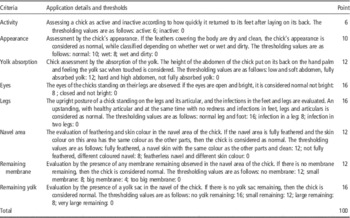
In all, 10 eggs from each group were broken every day from the 10th to the 21st day of incubation, and the embryos were removed and weighed at 0.001 g sensitivity. The right and left side lengths of face, wings, femur, tibia and metatarsus, which are bilateral characteristics, were measured with a digital calliper with 0.01 mm accuracy. In addition, the relative asymmetry values were obtained by proportioning the difference between the left and right side measurement values to the mean [(|Left−Right|/[(Left+Right)]/2)×100] (Yalçin and Siegel, Reference Yalçin and Siegel2003). On the 21st day of the incubation, the quality of the hatched chicks was evaluated by two operators, and their hatching weights were recorded. In determining the quality of the chicks, a protocol formed by Tona et al. (Reference Tona, Onagbesan, De Ketelaere, Decuypere and Bruggeman2003) was used, and the criteria of this protocol are presented in Table 1. In addition, the hatchability (%) was calculated by dividing the number of healthy chicks by the number of fertilised eggs.
The protocol used to determine the quality of Broiler chicks obtained from control, early embryonic period and late embryonic period groups

The assumptions of parametric tests were tested for all data other than the hatchability data showing binomial distribution. A normal distribution was achieved by rank transformation for the data of relative asymmetry and the quality characteristics of chicks not showing a normal distribution (Aulchenko et al., Reference Aulchenko, Ripke, Isaacs and Van Duijn2007; Narinç and Aksoy, Reference Narinç and Aksoy2014). In order to test the differences between groups in terms of the trait data measured daily during the 10th to 21st day of incubation, the ‘analysis of repeated-measures’ technique was used. In the analysis conducted using the MIXED procedure of the SAS program (SAS Institute, 2009), it was determined that the most compatible covariance structure was the ‘(G matrix) unstructured’ and this variance–covariance matrix was used in the analysis. In the analysis, the linear, quadratic and cubic contrasts of the time variable were included in the model (Khosravinia, Reference Khosravinia2015). The same statistical method was also used for comparing the relative asymmetry values of bilateral characteristics in the experimental groups. A generalised linear mixed-effects model with the logit function was used in the statistical analysis of the binomial data of hatchability observed in the experimental groups, and the differences between the groups were analysed by the Tukey–Kramer method, which is a multiple comparison test appropriate for this method. These analyses were performed by the GLIMMIX procedure of the SAS program (SAS Institute, 2009). The variance analysis method was used to demonstrate the difference between the groups in terms of chick quality, and Duncan’s multiple comparison test was applied. In addition, the GLM procedure of the SAS program was used in the analyses (SAS Institute, 2009).
Results
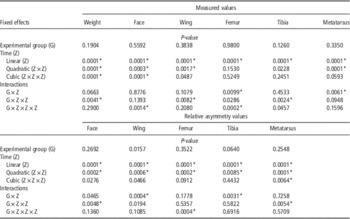
The time-dependent changes for the means of live weights and lengths of the face, wings, femur, tibia and metatarsus of the embryos according to the C, EEP and LEP experimental groups are shown in Figure 1. The statistical analysis performed for these traits is presented in Table 2. According to the results of the analysis performed by statistical analysis of repeated measurements, there was no significant difference between the groups in terms of any traits (P>0.01). According to the results, although the linear effect of the incubation development days was found significant for all traits (P<0.01), the cubic effect of time was determined to be significant in terms of the live weight and face length (P<0.01). The interaction effects of the experimental group×quadratic time for live weight, wing length and tibia length were found to be statistically significant (P<0.01). The interactions of the experimental group×cubic time for the face length and the experimental group×linear time for the metatarsus were found to be significant, whereas for the femur length, both the effects of the interaction for the experimental group×linear time and the experimental group×cubic time were significant (P<0.01).
Time–dependent changes for means of embryo weight and lengths of face, wing, femur, tibia and metatarsus according to the control, early embryonic period and late embryonic period groups.

The results of statistical analyses according to experimental groups, time and interactions for measured values and relative asymmetry values of traits in chick embryos

*P<0.01.
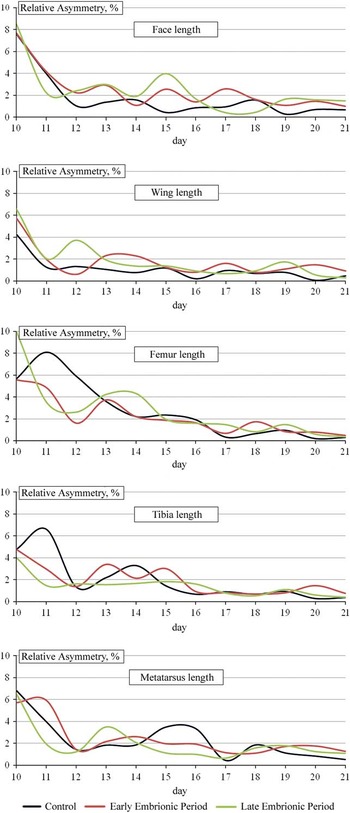
The time-dependant changes for the means of the relative asymmetry calculated for the bilateral traits are shown in Figure 2. The statistical analysis performed for these traits is presented in Table 2. There was no difference between treatment groups in terms of relative asymmetry values (P>0.01). In addition, the linear and quadratic effects of the time variable for all bilateral features were found to be statistically significant (P<0.01). A decreasing trend was observed between the 10th and 21st day in terms of the means of relative asymmetry for each trait according to the groups. In terms of the means of relative asymmetry, the effects of experimental group×linear time were found to be significant for the wing and tibia traits, whereas the interaction effects of experimental group×quadratic time were found to be significant for the face and metatarsus (P<0.01). It was determined that the interaction of experimental group×cubic time have statistically significant effect on the time-dependent change in the means of relative asymmetry of only the femur among the bilateral traits (P<0.01).
Time-dependent changes for means of relative asymmetry in bilateral traits (lengths of face, wing, femur, tibia and metatarsus) of chick embryos according to the control, early embryonic period and late embryonic period groups.

In this study, the hatchability in the C, EEP and LEP experimental groups was found to be 90.32%, 89.26% and 88.47%, respectively (Table 3). The difference between the groups in terms of hatchability was determined to be statistically significant (P<0.01). According to the multiple comparison test, it was found that the lowest hatchability was observed where the high-temperature environment was applied between the 10 and 18th day, whereas the highest mean hatchability was observed in the C group (P<0.01). The live weight mean of 1-day-old chicks in the experimental group are given in Table 3. There was no statistically significant difference between groups for live weight of chicks in the C, EEP and LEP groups (P>0.01). The findings concerning the evaluation of the C, EEP and LEP experimental groups in terms of chick quality are presented in Table 3. The best results in terms of chick quality criteria were observed in the C group, whereas the worst results were observed in the LEP group (P<0.01).
Results of hatchability, chick weight and chick quality according to control, early embryonic period (EEP) and late embryonic period (LEP) groups

a,b,cValues within a row with different superscript letters differ significantly at P<0.01.
1 0 to 10th day.
2 10 to 18th day.
*P<0.01.
Discussion
Yalçin and Siegel (Reference Yalçin and Siegel2003), who applied high temperature to two experimental groups for 6 h daily between the 0 to 8th and 10 to 18th day of incubation, reported that the embryo weights of the C group measured at the 10 and 18th day were higher than that of the experimental groups. The researchers determined that these differences disappear in the 21st day measurements. Badran et al. (Reference Badran, Desoky, Abou-Eita and Stino2012) reported that the weights of the embryos, to which were applied 40°C for 4 h daily between the 14 and 17th day of incubation, were lower than that on the 14th day. The researchers reported that these differences disappear in the following days and that on the 21st day, the mean of embryo weight of the group in which thermal manipulation was applied was higher than the C group. Elsayed et al. (Reference Elsayed, Elkomy, Al-Saadany and Hassan2009), who obtained similar results, suggested that the hatching weights of embryos treated with high temperatures were higher. In this study, the repeated-measures analysis technique was used for testing the differences in terms of embryo weights of the C, EEP and LEP groups between the 10th and 21st day of incubation, and the analyses were performed considering all time points. In the analysis, the interaction of the experimental group and quadratic time (group×time×time) was determined to have a significant effect, whereas there was no significant difference between the groups (P<0.01). As can be seen in Figure 1, some fluctuating differences occurred between experimental groups at some time points in terms of the means of the embryo weights. In this study, the embryo weights of the C, EEP and LEP groups measured on day 21 (41.26, 40.61 and 42.22 g, respectively) were found compatible with the embryo weights (41.69 and 42.82 g) determined on day 21 in the groups that were temperature treated by Yalçin and Siegel (Reference Yalçin and Siegel2003), whereas they were found to be higher than the mean (35.57 g) reported by Badran et al. (Reference Badran, Desoky, Abou-Eita and Stino2012).
There was no difference between C, EEP and LEP groups in terms of time-dependent changes of the face, wings, femur, tibia and metatarsus length means of the embryos (Table 2). However, as observed in the embryo weights, some of the effects of the experimental group×time interaction were also found to be significant for these traits. As can be seen from Figure 1, this indicates the presence of a significant difference for these traits related in terms of the experimental groups in some time points but afterwards indicates an inverse difference or the disappearance of this difference. A similar situation has been observed in various research results. Yalçin and Siegel (Reference Yalçin and Siegel2003) reported that there was no difference on the 10th day of incubation between the wing and femur lengths of the C group and the groups treated with high temperature. As a result of the measurements made on day 18, the researchers reported that the mean of the C group was higher in terms of the wing and femur lengths, but that there was no difference between groups for the measurements on day 21. In addition, it was reported by Badran et al. (Reference Badran, Desoky, Abou-Eita and Stino2012) that the tibia length of the embryos treated with high temperature was higher than the C group only in the measurements of day 14, and that there was no statistical difference between the groups in the measurements of the 14, 15, 17th and 21st day.
Yalçin and Siegel (Reference Yalçin and Siegel2003), who studied the effects of the high-thermal environment applied in the hatch to the embryo development balance, evaluated the means of relative asymmetry for face, wing, metatarsus, tibia and femur lengths. In the measurements of the 10th day of incubation, the researchers reported that there was a difference between the experimental groups in terms of asymmetry means for wing, tibia and metatarsus traits but that the asymmetry differences observed in the groups for the wing and metatarsus disappeared on the 18th day. On the 21st day of incubation, it was reported that there was again a difference found between the groups in terms of the metatarsus relative asymmetry means (Yalçin and Siegel, Reference Yalçin and Siegel2003). In this study, there was no difference between the C, EEP and LEP groups in terms of time-dependent changes in the means of relative asymmetry calculated for bilateral characteristics (Table 2). As seen in Figure 2, the relative asymmetry means for face, wing, femur, tibia and metatarsus in the experimental groups had fluctuating trends depending on time. In the statistical analysis, some of the effects of the experimental group and time interaction explain this variability (Table 2). The relative asymmetry means for face, wing, femur, tibia and metatarsus determined by Yalçin and Siegel (Reference Yalçin and Siegel2003) were similar to the means measured in this study, and, likewise with advancing age, it is stated that there was a decrease in the relative asymmetry values. The researchers suggested that this decrease occurred as a result of a compensating development.
In this study, the hatchability means in the long-term high-temperature, environment-treated groups in the early and late periods (89.26% and 88.47%, respectively) were found to be lower than the C group (90.32%) (P<0.01). It has been known that high-temperature applications in poultry embryos can cause low hatchability (Yahav et al., Reference Yahav, Collin, Shinder and Picard2004a). However, some researchers (Collin et al., Reference Collin, Picard and Yahav2005; Yahav and Tzschentke, Reference Yahav and Tzschentke2006; Halle and Tzschentke, Reference Halle and Tzschentke2011) suggested that this situation can vary depending on the degree of temperature, the application time and the period. Yahav et al. (Reference Yahav, Collin, Shinder and Picard2004a), who applied 39.5°C and 65% relative humidity on the 16 to 18th day of incubation, reported that the hatchability was 97.88% and this rate was 5.39% higher than the C group. The researchers suggested that a short-term high-temperature environment application has a positive effect on hatchability. As defined in this study, there are also numerous studies reporting that a long-term high-temperature environment has a negative effect on hatchability (Moraes et al., Reference Moraes, Malheiros, Bruggeman, Collin, Tona, Van As, Onagbesan, Buyse, Decuypere and Macari2004; Piestun et al., Reference Piestun, Shinder, Ruzal, Halevy, Brake and Yahav2008 and Reference Piestun, Halevy and Yahav2009).
In this study, there was no statistically significant difference between experimental groups in terms of the chick weight means of the C, EEP and LEP groups. This result was consistent with the results of both long-term high-temperature, environment-treated studies (Piestun et al., Reference Piestun, Shinder, Ruzal, Halevy, Brake and Yahav2008; Akşit et al., Reference Akşit, Yalçin, Yenisey and Özdemir2010; Yalçin et al., Reference Yalçin, Babacaonoğlu, Güler and Akşit2010) and short-term high-temperature, environment-treated studies (Moraes et al., Reference Moraes, Malheiros, Bruggeman, Collin, Tona, Van As, Onagbesan, Buyse, Decuypere and Macari2004; Yahav et al., Reference Yahav, Collin, Shinder and Picard2004a and Reference Yahav, Sasson Rath and Shinder2004b; Collin et al., Reference Collin, Berri, Tesseraud, Rodon, Skiba-Cassy, Crochet, Duclos, Rideau, Tona, Buyse, Bruggeman, Decuypere, Picard and Yahav2007). By contrast, there are few studies suggesting that the high temperature applied during incubation has an effect on the hatching weight in broilers. Hulet et al. (Reference Hulet, Gladys, Hill, Meijerhof and El-Shiekh2007) and Yalçin et al. (Reference Yalçin, Molayoğlu, Baka, Genin and Pines2007) suggested that the heat application increases the hatching weight, whereas Leksrisompong et al. (Reference Leksrisompong, Romero-Sanchez, Plumstead, Brannan and Brake2009) and Molenaar et al. (Reference Molenaar, Hulet, Meijerhof, Maatjens, Kemp and Van Den Brand2011) suggested that it decreases the hatching weight.
Halle and Tzschentke (Reference Halle and Tzschentke2011) suggested that low hatchability also causes low chick quality. The results of this study support the opinion of Halle and Tzschentke (Reference Halle and Tzschentke2011). In this study, the rates of the chicks in the C, EEP and LEP groups having 100 points in terms of quality were found to be 65.91%, 41.46% and 28.33%, respectively, and the statistical analysis results show parallelism with hatchability. According to the chick quality, the lowest means were obtained from the LEP group both in terms of the means of the ones not taken 100 points and in terms of the means of the quality score of all the chicks. There is only one study in the literature investigating the effect of high-temperature application on chick quality in the embryonic period (Halle and Tzschentke, Reference Halle and Tzschentke2011). In this study, a short term (4 days, 24 and 2 h) and low temperature (+1°C) were applied, and no difference was found between the groups in terms of the means of chick quality score. Therefore, it was concluded that a short-term high-temperature environment does not affect chick quality. Although low temperature decreases the development in embryos, high temperature accelerates their growth (Yalçin and Siegel, Reference Yalçin and Siegel2003). Iqbal et al. (Reference Iqbal, Decuypere, Abd El Azim and Kuhn1990), who applied 39°C for 6 h daily between the 11 and 20th day of incubation, suggested that normal hatching time decreased by ~10 h. The shortening of the incubation time of the high-temperature group caused the egg to lose more water than usual during its embryonic development. Too much water loss during the developmental period causes air gap expansion, embryo squeezing and weakness, the chicks to have different colour, and their feathers to be sticky and dry (Sözcü and İpek, Reference Sözcü and İpek2013). In this study, although >5% relative humidity was provided for the EEP and LEP embryos (Yalçin and Siegel, Reference Yalçin and Siegel2003) in order to reduce the effect of high temperatures on embryo dehydration, their hatching occurred earlier than the C group, and chick quality was adversely affected.
Consequently, it was determined that the long-term high-temperature environment applications in the early and late periods of incubation for the purpose of epigenetic adaptation had no adverse effects on embryo morphology, development balance and chick weight. In addition, it was determined that the hatchability of the embryos exposed to a long-term high-temperature environment decreased both in the early and late periods. Especially, the thermal manipulation performed between the 10 and 18th day of incubation was determined to considerably reduce chick quality. It is recommended to not perform high-temperature adaptation applications long term for eggs obtained from breeder flocks, and instead to perform short-term applications especially by determining the period ensuring an epigenetic adaptation.
Acknowledgements
The authors thank the Chairman of the Board of Pak Chicken (Mudurnu Chicken) Zuhal Dastan and İhsan Güney and his valued colleagues who gave full support in providing the study material. This study was funded with the number NKÜBAP.00.23.AR.14.01 by Namik Kemal University Scientific Research Projects Coordination Unit.