


Introduction
The archaeological study of grave goods has undergone significant methodological and theoretical transformations in recent decades. Interpretations rooted in metaphor, symbolism and cosmology have become the norm (e.g. Barrett Reference Barrett1994; Cooper et al. Reference Cooper, Garrow, Gibson, Giles and Wilkin2021; Gilchrist Reference Gilchrist2008; Reference Gilchrist2022; Giles Reference Giles2012; Härke Reference Härke2014; Parker Pearson Reference Parker Pearson1999; Williams Reference Williams2006; Reference Williams2007). Recent trends in (particularly prehistoric) archaeology have recognized grave goods as part of wider ‘assemblages’ and sought to free them from normative, singular or restrictive readings and encourage fluidity, difference and non-human agency as part of post-humanist and new materialist archaeologies (cf. Crellin Reference Crellin2017; Crellin & Harris Reference Crellin and Harris2021; Fowler Reference Fowler2013; Harris Reference Harris2019; Reference Harris2021). In this paper, I draw on aspects of grave goods studies past and present to propose an alternative, emotionally affective approach to what archaeological grave goods could do in terms of creating holistic, contextually specific meanings and in addressing the significant impacts of death, loss and grief. In doing so, I restate the importance of the concept of the human ‘self’ across deep history, albeit within a richly relational and intersubjective arrangement with other humans, plants, animals and things.
In working towards a more integrated and overarching approach to grave goods, it is important to recognize that two axioms have come to dominate funerary archaeology in recent decades. The first is the active, socially and politically embedded nature of funerary practices (e.g. Parker Pearson Reference Parker Pearson and Hodder1982; Reference Parker Pearson1999; Shanks & Tilley Reference Shanks, Tilley and Hodder1982). The idea of the burial as a site of ideological and personal expression and power-brokering was compatible with the dominant perception of processual archaeology (between the 1960s and 1980s) that grave goods were indicative of people’s individualism, rank, status and/or access to power (cf. Brück Reference Brück2004, 308–10; Reference Brück2019, 1–15; Fowler Reference Fowler2013, 68–107; Parker Pearson Reference Parker Pearson1999, 72–94). This ‘reflectionist’ or ‘symbols of power’ model (cf. Bradley Reference Bradley1984; Clarke et al. Reference Clarke, Cowie and Foxon1985) has been critiqued and replaced with a range of more anthropologically grounded and theoretically innovative approaches to relational identities and personhood (cf. Brück Reference Brück2004; Fowler Reference Fowler2013), including concepts of ‘kinship’ or ‘kinwork’ (Johnston Reference Johnston2020) and post-humanist and new materialist perspectives that look to recentre the focus of study away from privileging the ‘human’ within funerary practices and contexts (Crellin Reference Crellin2017; Fowler Reference Fowler2013, 98–107; Harris Reference Harris2021, 111–54).
The second axiom concerns a growing appreciation of the full(er) characteristics, qualities and variabilities of grave goods and the social implications of those factors (e.g. Barrett & Boyd Reference Barrett and Boyd2019; Brück Reference Brück2004; Fowler Reference Fowler2013; Gilchrist Reference Gilchrist2008; Reference Gilchrist2022; Giles Reference Giles2012; Härke Reference Härke2014; Williams Reference Williams2006; Reference Williams2007). The result has been a recognition that objects assumed to be ‘high-status’ items made of precious materials that are generally afforded greater prominence in museums, publications and exhibitions (so-called ‘iconic’ things which gain archaeological attention because of their rarity: cf. Garrow & Wilkin Reference Garrow and Wilkin2024) comprise only a minor component of the wider assemblage of grave goods. The AHRC-funded Grave Goods: Objects and Death in Later Prehistoric Britain project sought to quantify and account for the character of all grave goods during later prehistory (c. 4000 bce–43 ce) for case-study areas across Britain (Cooper et al. Reference Cooper, Garrow, Gibson, Giles and Wilkin2021). The project highlighted the importance of certain (relatively mundane and understated) types of material, particularly pottery, compared to those that tend to be foregrounded in publications, museum displays and exhibitions. Indeed, of the total number of objects in the Grave Goods project database (6044), a sizable 43.7% were ceramic vessels, although this varied considerably by period (Fig. 1) (Cooper et al. Reference Cooper, Garrow, Gibson, Giles and Wilkin2021, 45–74, 145–84).
The most common object categories deposited as grave goods through time, as compiled by the Grave Goods project for six study regions. (Cooper et al. Reference Cooper, Garrow, Gibson, Giles and Wilkin2021, fig. 3.04.)

Figure 1 Long description
A line graph showing the number of various object categories deposited as grave goods over time. The horizontal axis represents years, ranging from -4000 to 0. The vertical axis represents the number of objects, ranging from 0 to 300. The graph includes lines for different object categories: Animal bone, Coffin, Jewellery, Pin/point/brooch, Pot, Tools, and Weaponry. Each line shows the trend of the number of objects deposited over time. The Pot category shows significant peaks around -2500 and -500 years. The Coffin category shows a notable increase around -500 years. Other categories like Animal bone, Jewellery, Pin/point/brooch, Tools, and Weaponry show smaller fluctuations over time.
Among the interpretative perspectives taken by the Grave Goods project to (re)interpret objects from burials, particular focus was given to understated, humble, potentially ephemeral and personally significant things, and how these may illuminate what ‘mattered’ from the perspective of care, emotion and affection within prehistoric funerary practices (Büster Reference Büster2021; Cooper et al. Reference Cooper, Garrow, Gibson and Giles2019; Reference Cooper, Garrow, Gibson, Giles and Wilkin2021, 111–44; Giles Reference Giles2012; cf. Harris & Sørensen Reference Harris and Sørensen2010; Tarlow Reference Tarlow2000; Reference Tarlow2012). However, one important consequence of this more personalized, emotionally grounded and broadly ‘alternative’ approach to grave goods is the loss of an ‘overarching’ explanatory framework. As Harris & Sørensen (Reference Harris and Sørensen2010) have noted in their programmatic approach, there is scope and need for more fine-grained methodologies for the study of emotions.
This paper seeks to bridge and usefully combine these two axioms of recent funerary studies to argue for an underlying and wide-ranging explanation for the significance or meaning of grave goods based on their emotional and psychological (principally ‘transitional’) potency. A useful starting point can be found in the work of Donald Winnicott, a pioneering paediatrician and psychoanalyst of the mid-twentieth century, whose ideas can provide useful and fruitful points of comparison and reflection for archaeologists working towards a better understanding of the role of rites of passage and grave goods.
Transitional objects
One of Winnicott’s most celebrated concept is the theory of ‘transitional objects’ (also known as ‘not-me objects’) and the related field of ‘transitional phenomena’ (Winnicott [Reference Winnicott1953] Reference Winnicott1971). The theory accounts for a range of selected or created objects taken up by young children: teddy bears, dolls, hard toys, blankets, pieces of a parent’s clothing and other idiosyncratic, understated and unshareable things, gestures or mannerisms that became ‘vitally important to the infant for use at the time of going to sleep … [as] a defence against anxiety …’ and, more fundamentally, in managing and containing the fear of separation from primary caregivers (Winnicott [Reference Winnicott1953] Reference Winnicott1971, 4). Transitional objects are the child’s ‘first use of a symbol’ (the beginnings of symbolization) and, in Winnicott’s analysis, they exist within a space between both child and caregiver, between ‘subjectivity’ and ‘objectivity’, importantly belonging to both simultaneously. Winnicott believed that this inherently paradoxical quality lay at the heart of the concept (Winnicott [Reference Winnicott1953] Reference Winnicott1971, xi–xii). In his own words:
I call this thing a transitional object. By this means I can illustrate the one difficulty every child experiences is to relate subjective reality to shared reality which can be objectively perceived. From waking to sleeping the child jumps from a perceived world to a self-created world. In between there is a need for all kinds of transitional phenomena—neutral territory. (Winnicott Reference Winnicott1965, 143–4)
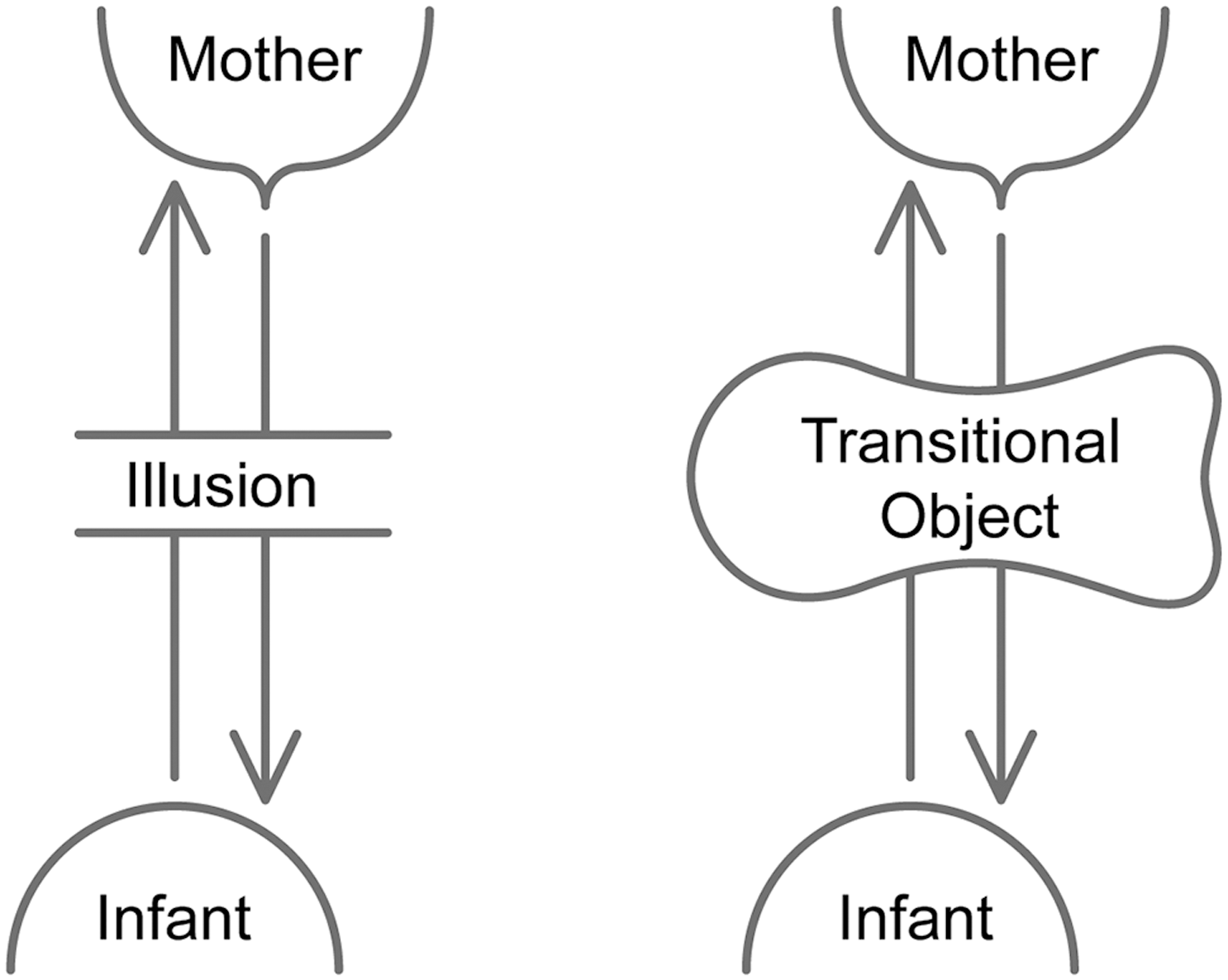
Winnicott believed transitional objects played a critical role in the process of differentiating the child from their mother (or primary caregiver(s)), with whom they were so entwined that, in the early months of an infant’s life they perceive, psychologically, as extensions of their developing and omnipotent self: ‘the infant takes from a breast that is part of the infant, and the mother gives milk to an infant that is part of herself’ (Fig. 2) (Winnicott [Reference Winnicott1953] Reference Winnicott1971, 12; cf. LaMothe Reference LaMothe1998, 160–63; Phillips [Reference Phillips1988] Reference Phillips2007, 113–21). Winnicott developed this concept to its logical, relational conclusion, arguing that there was no such thing as a baby; rather, there was always the baby and someone else, providing care and support, creating a relational sense of self by, ideally, creating a ‘facilitating environment’ in which the caregiver is neither overbearing nor absent but rather a scaffolding presence (Winnicott Reference Winnicott1960). There is, Winnicott argued, an important overlap between the qualities that the infant perceives in their caregiver and the qualities of the transitional ‘thing’. Thus, the transitional object, paradoxically, symbolizes both ‘me’ and ‘not-me’: ‘the union of two now separate things, baby and mother, at the point in time and space of the initiation of their separateness’ (Winnicott [Reference Winnicott1967] Reference Winnicott1971, 96–7).Footnote 1
Winnicott’s theory of transitional phenomena. In the primary stages of development the child holds the illusion that the mother, perceived through the feeding breast, was part of the infant (left side); the transitional object has the function of being a neutral area of experience in which the process of disillusionment and the development of a new understanding of the self can safely occur (right side). (Winnicott [Reference Winnicott1953] Reference Winnicott1971, figs 1–2, redrawn by Craig Williams.)

The movement between these developmental stages carries psychological jeopardy (the child being betwixt-and-between phases), which Winnicott argued necessitated the sensitive behaviour of parents and the presence of transitional objects to provide a scaffolding or bridge towards a new state of being (cf. LaMothe Reference LaMothe1998, 161). Certain aspects of the transitional object concept are therefore comparable to the footings of relational archaeology: as Brück (Reference Brück2004, 307) notes, ‘it was people’s relationships with others that made them who they were’. This paper argues that the process through which transitional objects are deployed is comparable to the structure and efficacy of ritualized practices and rites of passage.
In the course of childhood, transitional objects begin to lose and change their meaning, their potency having been ‘diffused’ and ‘spread out’ across the ‘whole cultural field’ and life span of a human (Winnicott [Reference Winnicott1953] Reference Winnicott1971, 7; [Reference Winnicott1967] Reference Winnicott1971, 95–103). Winnicott argued that they continued to have relevance to the fields of ‘art and religion’ (e.g. sacred symbols) within adult experience (Winnicott [Reference Winnicott1953] Reference Winnicott1971, 4; cf. LaMothe Reference LaMothe1998; Rizzuto Reference Rizzuto1979). He perceived the interplay between ‘inventiveness’ or ‘originality’ and ‘acceptance of tradition’ in all later creative practices as an extension of the relationship between separateness (aloneness) and union (socialization), the roots of which he perceived to lie in early childhood development (Winnicott [Reference Winnicott1967] Reference Winnicott1971, 99 & passim).
In recent decades, evidence for the universal applicability and relevance of transitional objects for understanding the adult realm has grown, and the concept has now gained widespread acceptance and application across a range of psychological and psychoanalytical studies and contexts (e.g. Lehman et al. Reference Lehman, Arnold and Reeves1995; Litt Reference Litt1981; LoboPrabhu et al. Reference LoboPrabhu, Molinari and Lomax2007; cf. Phillips [Reference Phillips1988] Reference Phillips2007, 113–21). It has also been applied to a range of culture studies, including aspects of literature and art (e.g. Cârstea Reference Cârstea2023; Kuhn Reference Kuhn2013; Rudnytsky Reference Rudnytsky1994). In the field of religious studies, Rizutto (Reference Rizzuto1979) has applied Winnicott’s theory to argue that a strong relationship exists between the religious symbols that a person holds dear (such as representations or images of God(s)), their relationship(s) with primary caregivers in childhood and their constructed sense of self. Of more immediate relevance to archaeology, transitional objects have been invoked in studies of the value and role of ‘memorial’ and ‘melancholy’ objects in bereavement, grieving and contemporary mourning practices (Gibson Reference Gibson2004; LeDuff et al. Reference LeDuff, Lawrence, Bradshaw and Blake2017; Wakenshaw Reference Wakenshaw2020).
In a study of parents following perinatal loss, LeDuff et al. (Reference LeDuff, Lawrence, Bradshaw and Blake2017) drew similar conclusions, arguing that the emotional, mental and spiritual anguish felt by parents leaving hospital with ‘empty arms’ could be partially addressed by better understanding the role of objects (photographs, hospital records, identification tags, footprints and handprints, even unused nappies) in successfully filling a ‘physical void’ and thus validating their parental roles while simultaneously providing a pathway through emotional grieving (LeDuff et al. Reference LeDuff, Lawrence, Bradshaw and Blake2017, 2–6). A more recent study of infant death in a neonatal care unit in Norway has explored how transitional objects adopted by parents can function as rites of passage or ‘ritualized acts’ (Værland et al. Reference Værland, Johansen and Lavik2025). The role of objects in these traumatic situations has been eloquently described by Margaret Gibson as one of ‘emotional transitions through objects’ (Reference Gibson2004, 285–6). Gibson’s study recognizes that the material culture left behind by the deceased exists within a similarly paradoxical relationship to the dead as an infant’s transitional object does to both their caregiver and their emergent sense of self. Both are ‘associated with’ the dead and ‘part of the substance of their very being’, which was impossible to be recalled simply as ‘immaterial abstraction’ or ‘pure spirit’ (Gibson Reference Gibson2004, 293, emphasis in original).
A key strength of Winnicott’s transitional object concept for archaeology is the balance it can strike between exterior and interior states by virtue of the emphasis it places on transitional phases, phenomena and objects. It is therefore able to acknowledge the fluid, highly relational character of identity formation and the importance of environmental factors in line with recent post-humanist and new materialist theories in prehistoric archaeology (cf. Crellin & Harris Reference Crellin and Harris2021; Harris Reference Harris2019), while simultaneously recognizing and retaining the importance of the personal ‘self-concept’, the significance of which appears important to judge from the bounded and coherent character of bodies in graves across a broad range of Eurasian cultures from at least the later fourth and early third millennium bce (Wentink Reference Wentink2020).
Emotion, selfhood and grave goods
Cooper et al. (Reference Cooper, Garrow, Gibson, Giles and Wilkin2021, 11–44) note that the current interest in the emotional qualities of prehistoric grave goods is not new. Both antiquarians and early archaeologists identified some of the personal, affective and emotional qualities of grave goods (Cooper et al. Reference Cooper, Garrow, Gibson, Giles and Wilkin2021, 21–3). The Grave Goods project also highlighted the potential importance of ‘small things that the dead would not be without’ as a means of ‘bring[ing] us close to the personality and life or relations of the deceased precisely because they are mundane or intimate’ (Cooper et al. Reference Cooper, Garrow, Gibson, Giles and Wilkin2021, 143; cf. Giles Reference Giles2012). This can be perceived as closing the circle, bringing the emotionally sensitive interpretations of nascent prehistoric studies back into play, albeit within a now more robust and richer interpretative framework.
Developing a similar strand of thought, Büster (Reference Büster2021) has argued that objects from a range of contexts (graves, hoards and ‘structured deposits’) have a similar underlying and unifying emotional calibre: they were all ‘problematic stuff’ left behind by the dead. This may be related to a perception of objects as indicative of ‘continuing bonds’, a rejection of the Freudian position that death was always accompanied by emotional and psychological approaches that sought or created ‘detachment’ on the way to obtaining ‘pre-bereavement status quo’ (Büster Reference Büster2021, 975–6; cf. Croucher et al. Reference Croucher, Büster and Dayes2020).
While there is much to recommend the notion of grave goods as belonging to a broader spectrum of ‘problematic stuff’ that evidence ‘continuing bonds’ between the living and the dead, grave goods were arguably not just about the detachment or the persistence of relationships, rather they were about the careful work of creating valuable transitions between the living and the dead. Grave goods cushioned, bridged and relieved psychological changes. Indeed, although death is often viewed with fear, loss can be a source of inspiration, expression, creativity and transformation. Emotionally and psychologically positive or sustaining attributes are expressed in the impressive qualities, characteristics and creativity of grave goods from, for example, later prehistoric Britain (cf. Cooper et al. Reference Cooper, Garrow, Gibson, Giles and Wilkin2021; Needham Reference Needham2005; Woodward & Hunter Reference Woodward and Hunter2015), a feature that has been hard for archaeologists to celebrate or fully explore using traditional interpretative frameworks, perhaps due to the persistently negative connotations of death and loss in contemporary thinking (cf. Phillips Reference Phillips2024, 134–7).
There have been a plethora of recent attempts to understand how grave goods may have reflected a range of deep-seated meanings: as expressions of webs or networks of connectivity that reflected personal and community based stories of socio-political achievement (e.g. Needham & Woodward Reference Needham and Woodward2008; Needham et al. Reference Needham, Lawson and Woodward2010); as material ‘metaphors’ for the construction of relational identities and personhood (e.g. Brück Reference Brück2004; Fowler Reference Fowler2004; Reference Fowler2013); and as communally conforming stereotypes or archetypes linked to key ideological and moral values (Wentink Reference Wentink2020). What these studies share in common is a loosening of simplistic, ‘reflectionist’ thinking and the embracing of relational constructions of personhood, identity and self. Joanna Brück’s (Reference Brück2004) study of the metaphorical qualities of grave goods was particularly influential in this respect. Brück states that ‘the Early Bronze Age self was constructed in terms of interpersonal connections rather than the intrinsic or essential attributes of a bounded individual’ (Brück Reference Brück2004, 311). Regarding the ‘self’, Brück notes that it ‘seems likely that in most societies, the self is considered to be neither completely open nor completely closed, neither a hostage to fortune (or more properly cultural context) nor a free agent unfettered by social bonds but may lie somewhere along this continuum’ (Brück Reference Brück2004, 313). This important contention was supported by a range of sociological and anthropological sources and case studies (cf. Fowler Reference Fowler2004). It marked an important point of departure for how later prehistoric grave goods were perceived: they were expressions of the ‘relational character of identity’ (Brück Reference Brück2004, 325).
In discussing prehistoric burials on the Isle of Man, Rachel Crellin (Reference Crellin2017) deploys an assemblage theory that maps the diverse and changing relationships and connections between humans, plants, animals and objects and that resists prioritizing people. All the components of the assemblage play a different but equally important role in understanding how the world ‘is’ and ‘histories of change’ (Crellin Reference Crellin2017, 113–15, 121–2). In interpreting British Neolithic burial practices through a post-humanist lens, Oliver Harris discusses how graves served to capture temporarily the ‘flows of desire, affect, memory and substance’ that shaped Neolithic worlds (Harris Reference Harris2021, 150). While Crellin and Harris are correct that traditional archaeological studies of grave goods and burial risk ‘black boxing’ the flow of relations that make up funerary assemblages, it is difficult to escape the impression that graves were vital arenas in which ideas about the personal self-concept were actively created and stated (cf. Brück Reference Brück2004; Thomas Reference Thomas, Garwood, Jennings, Skeates and Toms1991; Whitehouse & Lanman Reference Whitehouse and Lanman2014). Indeed, approaches that de-centre the human in accounts of funerary practices risk downplaying or ignoring what is emotionally and psychologically unique and vital about grave goods.
While recent studies have emphasized alternative, non-Western concepts of the self, I want to refocus attention on the impression of bounded (albeit potentially highly relational) identities presented in the archaeological record by bodies laid out and accompanied by grave goods, especially from the European Late Neolithic and Chalcolithic onwards, as recognized by Brück (Reference Brück2004). This was clearly not the case for all times and places, and the fragmentary, alternative or muted qualities of Mesolithic and Neolithic burial in Britain and beyond have been noted and interpreted in terms of worldview and social and economic practices and artefact temporalities and entanglements (e.g. Bradley Reference Bradley1998, 20–35; Cooper et al. Reference Cooper, Garrow, Gibson, Giles and Wilkin2021, 219–62; Cummings Reference Cummings2025, 32–4; Harris Reference Harris2021, 111–54). There were times when grave goods did different things and times when they were not visible at all—either because they were forbidden, taboo or because of issues of temporality and depositional practice that make them less likely to endure within the archaeological record. This situation is, in fact, reminiscent of the applicability (or not) of Winnicott’s transitional object concept, which does not apply to childhood development in all cultures through time (Applegate Reference Applegate1989). It is important to stress, however, that the concept has a wider relevance, occurring at alternative points in the lifecycle (as noted above) and existing as a broad and relatively flexible conceptual framework rather than as a universal principle bound to a particular point in behavioural development across all times and places. Just as grave goods can be seen as an optional element of a wider assemblage of funerary practices (e.g. Williams Reference Williams2007), the concept of transitional ‘objects’ could also be applied beyond the traditional definition of grave goods, to the treatment of the dead body and its substances.
To summarize, as the Grave Goods project’s historiography revealed (Cooper et al. Reference Cooper, Garrow, Gibson, Giles and Wilkin2021, 11–44), there has been no attempt to build on sociological and psychological understanding to outline an integrated or overarching way of talking about the relationship between grave goods and people’s ‘inner lives’. However, rather than being absent, these deep-seated perspectives have instead proliferated in emotionally embedded, relational and post-humanist archaeological approaches, albeit in a duality of extremes: expressed on the one hand through an atomized and potentially anecdotal way (e.g. ‘just-so’ stories about what exceptional or singular things ‘meant’ or symbolized to past people) and, on the other hand, through an appeal to ontological or ‘hyper’ relationality/connectivity in non-specific terms. In both cases, there is an innate wariness that emotive or affective concepts could be overly generic, suppressing differences through space and time or inappropriately applied as ‘psychic universals’ (Cooper et al. Reference Cooper, Garrow, Gibson, Giles and Wilkin2021, 35; cf. Metcalf & Huntington Reference Metcalf and Huntington1991). Archaeologists have, in fact, long been aware of, and keen to apply, the universal aspect of ‘rites of passage’, and it still provides a potentially vital means of developing a more integrated and psychologically informed approach to later prehistoric grave goods (cf. Værland et al. Reference Værland, Johansen and Lavik2025; Wakenshaw Reference Wakenshaw2020). Like rites of passage and the ritual process, the transitional object concept can be seen to offer archaeologists a useful, widespread and flexible framework for thinking about the psychological and emotional role of grave goods, without requiring dogmatic or essentialist perspectives on their social, cultural or cosmological meanings.
What grave goods do in funerary rites
Paul Garwood (Reference Garwood and Insoll2011a) has argued that the concept of ‘rites of passage’ possesses considerable untapped interpretative potential despite being a formative tenet of post-processual approaches to funerary practices. Rites of passage, he argues, can play a key role in understanding the particular purpose and function of funerary practices: noting that ‘[t]he ‘meaning’ of burials … lies not in how they reflect lived social types, but rather in how they realise sacred categories and concerns, and also in how these are manipulated to political ends’ (Garwood Reference Garwood, Hey, Garwood, Robinson, Barclay and Bradley2011b, 383). A strong societal and political emphasis is evident in many of the most well-known prehistoric burials, from the shaft-graves of Mycenae in Greece to the barrows of Normanton Down near Stonehenge in southern England (cf. Barrett & Boyd Reference Barrett and Boyd2019), but it does not account for or characterize the vast majority of prehistoric burials, which are relatively simple or austere (cf. Cooper et al. Reference Cooper, Garrow, Gibson, Giles and Wilkin2021). There may have been a range of other (complex) messages and meanings conveyed through other emotive performative or subtler elements of the funerary ritual (e.g. Garwood Reference Garwood and Insoll2011a,b; Williams Reference Williams2007). Indeed, at a fundamental level grave goods and material culture more generally exist in an awkward and still understudied relationship to ritual processes (Garwood Reference Garwood and Insoll2011a, 266).
The tripartite structure and stages of rites of passage (moving from rites of separation to a liminal or transitional phase and returning to ‘normal life’ through rites of reaggregation) are well-established tropes of prehistoric archaeology and in theory provide a scaffolding for approaching the role and meaning of objects and human remains involved in funerary practices. Chris Fowler has made valuable attempts to describe how grave goods ‘worked’ within these stages, observing how ‘[d]ressing the dead may have … been part of their liminal transformation, projecting forwards a desired identity for them through to the phase of the ritual when it was hoped they would be incorporated into the community of the dead or a new state of existence’ (Fowler Reference Fowler2013, 235). However, Fowler warns that the ritual process provides ‘only a very loose model for action’ (Reference Fowler2013, 103-4). He also notes that deposits cannot always be assigned to just one stage of the ritual process and ‘may materially “telescope” different phases’, and the media (including human remains and grave goods) present cannot be neatly divided between the various stages of the rite (Fowler Reference Fowler2013, 102–6). Thus, the body, for example, ‘passes through all three, and certain objects may be introduced to conjoin the different phases’ (Fowler Reference Fowler2013, 230). A final point made by Fowler seems relevant in the context of the psychological drama of funerary practices: that the structured nature of the ritual process introduces ‘inherent risk … anxieties and uncertainties’ that the rite will fail (Reference Fowler2013, 105), that much is essential to making the ritual appear legitimate.
Despite the sustained interest in ritual among prehistorians, research on the psychological dimension of rites has rarely been pursued. This is part of a wider interdisciplinary shortcoming, although efforts have been made to bridge the divide (e.g. Bull & Mitchell Reference Bull and Mitchell2015; Cupchik Reference Cupchik2002; Scheff Reference Scheff1979). Wojtkowiak (Reference Wojtkowiak2018) has undertaken an analysis of the power and meaning of ritual transformations (or transitions) from a psychological perspective, identifying ritual conditions under which important thought processes and states of mind were activated. Of particular relevance to the study of grave goods are the concepts of:
-
(1) Ritual transformation as ‘aesthetic distance’, by which means rituals provide an arena in which emotions can be stimulated ‘safely’ in a contained environment and thoughts and feelings cushioned, harmonized and reconciled (Wojtkowiak Reference Wojtkowiak2018, 467–8; cf. Scheff Reference Scheff1979).
-
(2) Ritual transformation as ‘social collaboration’, through which stronger social cohesion is generated among the living community undertaking funerary practices. Involvement in the rite, particularly the liminal stages of the process, during which time a state of ‘communitas’ creates a strong sense of egalitarianism and togetherness (Wojtkowiak Reference Wojtkowiak2018, 469–70; cf. Turner Reference Turner1969).
These ideas can be productively combined with Winnicott’s transitional object concept to develop a more coherent understanding of the efficiency and power of grave goods.
Grave goods as bridging objects
Winnicott noted that an essential feature of transitional objects is how people perceive them as neither creations of the child nor casually or randomly found objects. There is a ‘magical’ or ‘sacred’ quality to such objects because they seem to exist between the child’s imagination and objective reality (Winnicott [Reference Winnicott1967] Reference Winnicott1971, 96). It is worth reflecting on the importance of this sentiment for how archaeologists perceive material culture from graves.
Firstly, the magical quality that Winnicott perceives in children’s transitional objects enables them to ward off danger and generate protection and comfort (cf. Gibson Reference Gibson2004, 288). Archaeologists have interpreted a selective range of grave goods in terms of their potential magical, apotropaic or amuletic qualities (e.g. Claeys et al. Reference Claeys, Van de Vijver, Marinova, Cleymans, Degryse and Poblome2023; Gilchrist Reference Gilchrist2008; Woodward & Hunter Reference Woodward and Hunter2015), but viewed through the lens of transitional objects, this reading can take on greater depth. The paradoxical ontological status of grave goods in funerary contexts may have invested them all with a potent magical quality.
Secondly, there is a tendency among archaeologists to be uncertain whether grave goods can or should be understood as the belongings of the newly dead or objects bestowed upon them by the living. This can lead to feelings of ambiguity and a loss of confidence in ‘answering’ the question of what grave goods meant in the past. It is possible that the uncertainty which affects archaeological interpretation in this case is not actually a problem of our own conceptual making, but actually reflects a ‘true’ uncertainty in the past as well.Footnote 2 It is quite possible that this duality or multiplicity of meaning existed at the time of burial. Even if a strong desire for the inclusion of a certain pot or heirloom had been expressed, it would fall to the living to see that this wish was adhered to. In this respect, we can talk about grave goods as objects that belonged to both the dead and the living, and indeed that may also have played a role in the final days of a person’s life. This multiplicity of meanings underlying the selection of grave goods (and who they ‘belonged’ to) may seem to contradict the suggestion that they can be framed as transitional objects. However, a benefit of taking a deeper perspective on what grave goods do at a psychological and emotional level is the recognition that, just as children embracing a teddy or doll or grieving parents being offered potent reminders of a lost child will not be aware of the multiple ways it may be offering sensory, emotional and social comfort and connection, the concept can sit beneath—or be entangled with—a range of social and cultural meanings and sense of self (cf. Hodder Reference Hodder2012, 21–3; Værland et al. Reference Værland, Johansen and Lavik2025, 635–7).
In describing the character of the space in which transitional objects were situated, Winnicott outlines ‘an intermediate area of experiencing to which inner reality and external life both contribute’, and a ‘resting-place for the individual engaged in the perpetual task of keeping inner and outer reality separate yet interrelated’ (Winnicott [Reference Winnicott1953] Reference Winnicott1971, 230). In this intermediate or third space, Winnicott suggested that transitional objects created an ‘illusionary world’, in which there was a suspension of normal, external reality and the creation of new inner psychological realities (Kuhn Reference Kuhn2013, 2). It is relatively easy to transpose this language and conceptual bridging onto the special way grave goods worked. Like the objects described by Winnicott, grave goods possess qualities that exist between different stages of rites and (seemingly incompatible) worlds or states of being. As noted above, this has caused some consternation in recent attempts to read grave goods in terms of ritual processes (cf. Fowler Reference Fowler2013, 102–6). The ‘telescoping’ quality of grave goods across different stages of rites of passage identified by Fowler (Reference Fowler2013, 105, 230) may be critical. However, rather than serving as passive scaffolding to ‘conjoin the different phases’ of a funeral’s ritual process (Fowler Reference Fowler2013, 230), grave goods arguably served a more active and critical role, as the means and material embodiments of the psychological processes inherent within funerary rites.
Viewed in this way, grave goods can be related to the ritualized qualities of burial in a manner that is comparable to the transitional objects in the transformation of the self during childhood development. In both cases, there are obstacles and acts of separation that have to be overcome by pushing through a liminal state towards social and emotional reaggregation. The objects in question have to perform a bridging role of ‘telescoping’ between different states or phases of transformative processes and thus exist in a state of flux.
‘Transitional objects’ and grave goods
If grave goods are analogous to transitional objects, what do their material qualities tell us that may have hitherto been underexplored? One of the key attributes of Winnicott’s theory is the way it locates a symbolic materially realised origin for the inherent cultural tension between tradition and inventiveness or agency (Winnicott [Reference Winnicott1967] Reference Winnicott1971, 99; cf. Kuhn Reference Kuhn2013). Grave goods may have served a similar role. Much effort in archaeology has centred around the identification of similarity and difference in the morphology and decoration of grave goods, particularly pottery and metalwork. Reframing these typological details in terms of concepts of tradition and individuality opens up the potential for grave goods to have served as agents of both personal and socio-cultural change and transformation.
Like the ‘understated’ objects discussed above, the interpretive and insightful potential of pottery from graves has been underappreciated and understudied. As Daniel Miller noted 40 years ago, by flying below the cultural ‘radar’ (compared to more expressive or abstracted symbolic works of ‘art’), pottery obtains a rare interpretative virtue from its mundanity and material properties (i.e. the essential mutability of clay), becoming an important ‘framing’ device for cultural meaning and subconscious traits (Miller Reference Miller1985, 140, 203–5 & passim). Miller argues that this ‘framing’ effect was important in the creation of balance between the self and society, the mundanity of pottery lending it to ‘objectification’ involving the subconscious construction or enculturation of the self (Miller Reference Miller1985, 204). This position accords well with the preceding discussion of Winnicott’s transitional objects from the first ‘not-me’ object onwards.
Another distinctive feature of Winnicott’s definition of transitional objects is how they can be destroyed, mutilated and become the subject of aggression (Winnicott [Reference Winnicott1953] Reference Winnicott1971, 5). Doing so demonstrates the child’s psychological independence, control and agency as independent from the primary caregiver. In a similar vein, Brück (Reference Brück2004, 319–21) notes the recurrent deliberate destruction of some objects placed in (and around) burials during the Early Bronze Age in Britain and Ireland (Fig. 3). These acts of destruction have been taken to be ‘powerful symbolic statements of the social impact of death’ and a means of thinking through ‘questions of continuity of change’ and the recasting of relationships between the living and the dead (Brück Reference Brück2004, 320). Recalling the notion of ‘aesthetic distance’ discussed above, it is also possible that they served a cathartic role in managing and resolving strong emotions. These aspects can also be understood in terms of the psychological independence expressed through transitional objects. In the funerary domain, the meaning of such expressions centred on the transition to a community of the dead.
Two intentionally broken jet pendants deposited in a Beaker short-cist burial at Barns Farm, Dalgety Bay, Fife, Scotland. (After Watkins Reference Watkins1982, 105, figs 6 & 17.
© Societies of the Antiquaries of Scotland.)

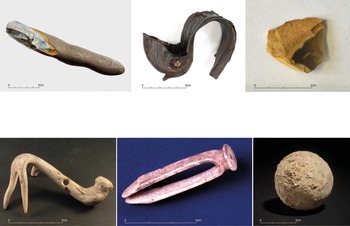
Perhaps the most conceptually straightforward category of later prehistoric grave goods to label as transitional objects is a group of ‘understated’ or ‘simple’ objects that rarely obtain the kind of attention or prominence in museum exhibitions given to ‘precious’ or ‘exotic’ objects and materials (Cooper et al. Reference Cooper, Garrow, Gibson, Giles and Wilkin2021, 113, table 5.01) (Fig. 4). In discussing the interpretive challenge of such objects, the Grave Goods project noted that ‘understated grave goods bring us closer to the personality and life or relations of the deceased precisely because they are mundane or intimate’ (Cooper et al. Reference Cooper, Garrow, Gibson, Giles and Wilkin2021, 143). This goes to the heart of the matter; grave goods can be at their most interpretatively potent when they appear to be revealing something of the ‘self’, bridging states of being in a manner analogous to the child’s teddy bear or blanket. Getting at this meaning may indeed rely on them being ‘framed creatively’, as the Grave Goods project proposed (Cooper et al. Reference Cooper, Garrow, Gibson, Giles and Wilkin2021, 144); however, I would argue that the concept of transitional objects provides a more systematic and psychologically grounded notion that can be deployed to better explain what such—surprisingly common—personal and intimate objects were actively ‘doing’ in later prehistoric graves.
A selection of understated objects from Neolithic and Early Bronze Age burials in Britain according to the criteria of the Grave Goods project (Cooper et al. Reference Cooper, Garrow, Gibson, Giles and Wilkin2021, 113, table 5.01). From top left: a flint blade core buried with an adult male, Winterbourne Stoke, c. 3500 bce (British Museum, Reg. 1873, 1219.12); cattle horn spoon or ladle found inside a Beaker from a burial at Broomend of Crichie, Aberdeenshire (National Museum of Scotland, Reg. X.EQ.37), c. 2200 bce (© National Museums Scotland); an unworked flint chip placed with an infant, Barnack, Cambridgeshire (British Museum Reg. 1975,0901.6); a pierced and heavily worn roe deer antler tine from Oakley Down Barrow 18, Dorset, c. 2200–1600 bce (Woodward & Hunter Reference Woodward and Hunter2015, 130, fig. 4.12.6; © Wiltshire Museum, Devizes); bone tweezers from Aldbourne Barrow X, Wiltshire, c. 2000–1600 bce (British Museum Reg.1879,1209.1878); chalk ball from multiple child burial, c. 3000 bce. (Images: all © The Trustees of the British Museum, unless otherwise stated).

Finally, Winnicott’s concept has something to offer archaeologists in explaining the temporalities of grave goods. As noted above, Winnicott understood that, over time, the significance of a child’s transitional object changed, but that it could be reactivated at difficult times when comfort was needed in the face of anxiety or discomfort. The concept of fluctuating temporal relevance has the potential to shed light on hitherto hard-to-account-for elements of grave good deposition. In particular, the extended lifespan of some curated or heirloom objects and human remains before deposition (Booth & Brück Reference Booth and Brück2020; Costello & Williams Reference Costello, Williams, Knight, Boughton and Wilkinson2019; Woodward & Hunter Reference Woodward and Hunter2015; Woodward Reference Woodward2002), and later additions of objects into graves and grave fills, or more generally at the burial site, some time after initial burial rites (e.g. Brück Reference Brück2019, 74–8; Cooper et al. Reference Cooper, Garrow and Gibson2020) could reflect the significance of transitional objects in grieving and mourning, as a means of mediating the absence left by a death. As studies of contemporary mourning have shown, some transitional objects begin life as essential, unpartable, from mourners until the emotional transition has run its course (cf. Gibson Reference Gibson2004, 288–90).Footnote 3
The concept may also help to explain complex, multi-temporal treatments of grave goods that characterize whole periods or regions (cf. Cooper et al. Reference Cooper, Garrow and Gibson2020; Reference Cooper, Garrow, Gibson, Giles and Wilkin2021, 219–61). During the Neolithic in Britain, grave goods were frequently fragmented, like the human bodies they accompanied. This has been related to the fragmented and fluid ontological priorities and perceptions of this period (Cooper et al. Reference Cooper, Garrow, Gibson, Giles and Wilkin2021, 240–41; Harris Reference Harris2021, 150–53; Jones Reference Jones2005). Having grave goods readily accessible for members of Neolithic communities to interact with regularly may have had benefits for the emotional, psychological and transitional processes that surrounded death and burial, which were fundamentally altered by the later adoption of the more discrete, coherent but sealed single burial traditions that followed from the Chalcolithic onwards across Europe.
Summary
While there is a spectrum of cultural phenomena that can be productively described using Winnicott’s notion of transitional objects, I have argued that grave goods fall into a special and important category. The two episodes bookend the life-cycle at times when claims of or to omnipotence are relevant; in one case the child emerges from subjectivity and perceived omnipotence towards socio-cultural and psychological separateness and objectivity, while, at the end of life, an analogous but inverted transition takes place as the dying and the surviving community struggle to accept their mortality and/or to cope with the loss of a member of their community. In the latter scenario, the possibility of moving towards omnipotence serves as a salve for the anxiety and finality of death.
Understanding grave goods as transitional objects that parallel formative experiences also helps to explain the aspects of funerary practice (in the past and present) that are redolent of the condition and experience of infancy: from the tender treatment of the body, the provision of sustenance and decisions made on behalf of the dead but with an apprehension, care and attention shown towards their potential future selves and their physical and metaphysical needs. Winnicott’s concept of transitional objects thus gives material and objective form to a relationship that previously existed between caregiver and child and allows the individual ‘self’ to emerge in the process. If, as argued, grave goods can be considered to be an inversion of that phenomenon, then it is possible to interpret their effect as moving in the opposite direction: subsuming (or returning) the objectively realized individual self within the subjective realms of an imagined community of the dead while simultaneously creating solidarity and communitas among the living who attended funerary rites (cf. Turner Reference Turner1969). This approach opens up new possibilities for how archaeologists can interpret the tendency for strong typological conformity among grave goods.
Funerary traditions as transitional phenomena
This section evaluates the potential of the transitional object concept for shedding new light on the social and psychological efficacy and spread of an archaeologically visible funerary tradition, the so-called Bell Beaker Phenomenon (BBP). The BBP forms part of a large-scale change in socio-cultural life (genetics, linguistics and kinship), cosmology and ontology between the late fourth and the later third millennium bce (Fig. 5). During that time, several widespread cultural phenomena that spanned large areas of Europe were signalled almost exclusively by distinctive funerary phenomena expressed archaeologically by pottery traditions: so-called Corded Ware and Bell Beakers (cf. Czebreszuk Reference Czebreszuk2014; Needham Reference Needham2005; Vander Linden Reference Vander Linden2024; Wentink Reference Wentink2020). Of course, it is not my intention to ‘solve’ the meaning or symbolism of the BBP; in fact, the absence of a singular underlying ideological ‘explanation’ for the phenomenon is precisely what I want to circle. The application of the transitional object approach to the BBP serves to highlight the benefit (and need) for a change of conceptual perspective if archaeology is to make progress in thinking about the ‘live’ meaning of grave goods.
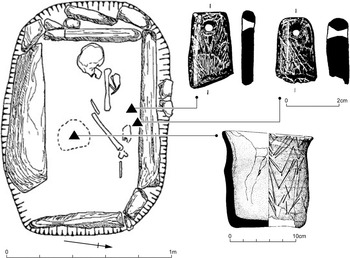
A double Beaker burial from Trumpington, Cambridge, containing the bodies of a young man and young woman, each with a Beaker pot decorated with notably different motifs (after Evans et al. Reference Evans, Lucy and Patten2018, 48, 58, figs 2.13, 2.20). (© Cambridge Archaeological Unit).

The spread of the Beaker burial tradition to Britain from the middle of the third millennium bce parallels the basic character of the BBP across much of northwest Europe (Vander Linden Reference Vander Linden2024). Over the course of the last 150 years, explanations of the cultural significance of the appearance and similarity of Beaker grave goods have varied significantly. In culture historical accounts of the mid-twentieth century, notions of ethnicity, affinity and drinking rituals were central concerns (Vander Linden Reference Vander Linden2024, 4–7), while early post-processual approaches of the 1980s and ’90s stressed the importance of power, ideology and identity (Barrett Reference Barrett1994; Thomas Reference Thomas, Garwood, Jennings, Skeates and Toms1991; Thorpe & Richards Reference Thorpe, Richards, Bradley and Gardiner1984). Recent developments in genetic, mobility and kinship studies have restated the importance of concepts of ethnicity and migration (e.g. Vander Linden Reference Vander Linden2024, 10–12 & passim).
Combining the importance of ideology and long-distance movement, Karsten Wentink (Reference Wentink2020) has recently argued that the standardized or ‘stereotypical’ qualities of BBP funerary practices are the antithesis of individualized status and hierarchy and instead reflect a desire to place individuals within a particular kind of archetypal or idealized identity (cf. Thomas Reference Thomas, Garwood, Jennings, Skeates and Toms1991), related to a sense of communal or shared identity. He argues that by ‘burying people in a standardised manner and with a standard set of grave goods, continual reference is made to the image of a particular ancestor, who was associated with these objects and way of burial’ (Wentink Reference Wentink2020, 14). Central to Wentink’s approach is the idea of the individual identity being subsumed within an ancestral Bell Beaker archetype connected with an ideology that celebrated travel, drinking and long-distance connectivity. To account for the ‘self’ within both Corded Ware and BBP funerary practices, Wentink draws on the work of the sociologist Erving Goffman and particularly his idea of ‘social fronts’, whereby people use material culture to conform to idealized or stereotypical behaviours in formal settings such as rites of passage for individuals to be located collectively within communities of the dead (Wentink Reference Wentink2020, 22–5). Less convincing is the attempt to relate these stereotypical identities to an external ideology as a means of explaining why the repetition of objects and funerary practices was socially and culturally valuable.
One way of building on Wentink’s valuable idea of individuals being transformed into ancestral archetype(s) is to investigate the various scales at which the BBP was materially manifest using the concept of transitional objects and phenomena. By considering these scales in turn it is possible to see how they served to create a balance between ubiquity and uniqueness; tradition and creativity; the community and the self; and to start to understand why and how that process was socially, culturally and psychologically valuable in its own right without recourse to a specific ideology, the existence of which—across the vast geographical and chronological span of the BBP and earlier single burial traditions—seems unlikely (Vander Linden Reference Vander Linden2024, 55–6).
(1) The production and selection of pots
At the more personal or intimate end of the spectrum, the choice of particular Beaker pots for the grave by the dying or their kin group is likely to have been important. Connections have previously been identified between aspects of identity (e.g. age, gender, regionality) and aspects of Beaker form and decoration (e.g. Curtis & Wilkin Reference Curtis, Wilkin, Parker Pearson, Sheridan, Jay, Chamberlain, Richards and Evans2019; Fowler & Wilkin Reference Fowler, Wilkin, Tipping, Crellin and Fowler2016; Shepherd Reference Shepherd, Allen, Gardiner and Sheridan2012). Following the brief, early phase of uniform ‘All Over’ (Cord or Comb impressed) motifs used to decorate funerary Beakers (Needham Reference Needham2005), no two vessels are exactly the same, even if key elements of the decorative repertoire or scheme were sometimes closely comparable (e.g. Curtis & Wilkin Reference Curtis, Wilkin, Parker Pearson, Sheridan, Jay, Chamberlain, Richards and Evans2019, 229–30).Footnote 4 When two vessels are buried together in the same grave (whether accompanying multiple burials or not), they often differ in form and decoration (schema and motif) in marked ways (Figs 5 & 6). This contrast has been interpreted as part of a sex and/or gender-based dichotomy within Beaker burial practices (Shepherd Reference Shepherd, Allen, Gardiner and Sheridan2012), but that binary reading, discussed below, does not fully exhaust the possible symbolic significance of the high degree of decorative similarity and difference among funerary vessels. Variation allowed for the individual identity of the deceased to be expressed, their uniqueness conveyed, but within a decorative repertoire that was shared and standardized.
Examples of paired Beakers from the same grave showing marked contrasts between two vessels placed in the same grave. (1) Broomend of Crichie, cist 1, Aberdeenshire; (2) Huggate and Warter Wold, East Yorkshire; (3) Garton Slack 163, East Yorkshire. (Images after Clarke Reference Clarke1970, figs 508, 531, 659–60, 666–7; © Cambridge University Press.)

In the context of the concept of ritual processes developed above, this stage begins the process of dissolving or disaggregating what was unique or bespoke about the newly dead and entering them into the communal whole. The selection of the pot by either the dying or the surviving community would have played an important briefing and ‘aesthetically distancing’ role. The addition of crushed calcined bone to the external surfaces and decoration of some Beakers found in graves (Curtis & Wilkin Reference Curtis, Wilkin, Parker Pearson, Sheridan, Jay, Chamberlain, Richards and Evans2019, 231) embodies the transformative potency of these vessels and their ‘not me’ roles in emotional transitions.
(2) Choice of additional grave goods and human remains
The stereotypical BBP funerary assemblage includes archery equipment, principally a stone wristguard and barbed and tanged arrowheads. A sizable subset of high-quality wrist-guards from Britain were fashioned from Langdale tuff, a material that was popular and common during the Neolithic when it was used to make stone axes (Roe & Woodward Reference Roe, Woodward and Shaffrey2017). The selection of Langdale tuff rock to make wristguards was a material transition: the creation of new (funerary) identities from a source valued by older Neolithic communities (cf. Woodward & Hunter Reference Woodward and Hunter2011). The decision to make these objects and include them in Beaker burials serves to reinforce the intentional combination of ‘ancestral’, ‘foreign’ or international attributes and local, place-specific geologies that had currency well beyond living memory. A different but related category of addition to a significant number of Beaker graves includes already old, curated objects and human remains (Booth & Brück Reference Booth and Brück2020). The inclusion of these additional objects and bodies served to bridge the self to a wider, ancestral community at a conceptual scale above the more nuanced, personal (kin, gender or personality) layer of selfhood encapsulated by Beaker pots.
(3) Sex and/or gender-based rules
Broadening the scale of analysis to the body allows for a key element of Corded Ware, BBP and Early Bronze Age funerary practices to be encompassed: across northwest Europe, BBP burials are well known for following strict sex and/or gender-based ‘rules’ regarding body arrangement (principally the side on which the body was arranged) and the direction of the crown of the head and face. Shepherd (Reference Shepherd, Allen, Gardiner and Sheridan2012) has shown the strong conformity of burials to a male/female pattern for two British Beaker ‘heartlands’, in East Yorkshire and Aberdeenshire (Fig. 7). In this way the dead were further distanced from their particular or personalizing identities, in a more extreme or disengaging way than was expressed or created by the conventions of producing or selecting the Beaker pot’s form and decoration and accompanying grave goods. They were being further distilled, dissolved and reduced on a trajectory that pointed towards the anonymity of idealization and standardization but, simultaneously, greater assimilation within the BBP system of values and concepts.
Sex-based binary rules in Beaker burials from northeast Scotland illustrated with two examples: a male burial from Mains of Scotstown, Aberdeen (Ralston Reference Ralston1996, 121–30) and a female burial with a neonate from Nether Criggie, Aberdeenshire (Kirk & McKenzie Reference Kirk and McKenzie1955). In this region, males were usually placed on their left sides, heads to the east, facing south, while females were given an opposite but complementary treatment: heads to the west, facing south. (© Craig Williams.)

(4) The regional funerary complex
At the largest scale of analysis, the BBP can be studied in terms of how the package of practices that made up ‘the burial’ as a whole (the architecture, orientation and layout of the body and grave goods) coalesced at a spatial scale; recurrently this was along regional lines that are well attested by later prehistoric and historic socio-cultural and political boundaries (cf. Curtis & Wilkin Reference Curtis, Wilkin, Parker Pearson, Sheridan, Jay, Chamberlain, Richards and Evans2019; Fowler Reference Fowler2013; Fowler & Wilkin Reference Fowler, Wilkin, Tipping, Crellin and Fowler2016). Critical to the meaningfulness of this scale is how similarities and differences to other regional groupings across Britain were perceived by Beaker communities rather than by archaeologists. There are significant similarities and differences between regions. As noted, communities in northeast Scotland and east Yorkshire shared a similar predilection for body orientation, but geological differences meant that the architecture of the grave (e.g. the presence or absence of stone-built cists or cairns) differed between regions. These were not the same communities living in the same material worlds; rather, they were communities holding a fragile but invaluable skein of shared cosmology. At this scale, the identity of the dead person (or self-concept) was far from view; the burial itself was being made meaningful at a communal scale by the repetition of a series of stereotyped practices that drew their value from their wider currency (cf. Wentink Reference Wentink2020). This scale is likely to have been meaningful to at least some within BBP communities, even if the international extent of practices was vaguely understood.
Summary: ‘a harmony of difference’
Having briefly reviewed the evidence for the BBP in Britain at different scales, I want to reflect on the relevance of the transitional object concept. One of the recurrent qualities of the BBP is the importance of similarity and difference at a range of scales: from the decoration and form of Beaker pots to the patterning of bodies and grave goods at a regional and inter-regional level. The significance of this aspect is reflected in the titles and conceptual concerns of several recent studies of the BBP, including Similar but Different: Bell Beakers in Europe (Czebreszuk Reference Czebreszuk2014) and The Bell Beaker Phenomenon in Europe: A harmony of difference (Vander Linden Reference Vander Linden2024). While similarities between archaeological objects and practices have long been understood to be a cornerstone of theoretical approaches to material culture (e.g. Clarke Reference Clarke1968; Hodder & Hutson Reference Hodder and Hutson2003, 173–91; Stout Reference Stout, Tarlow and Nilsson Stutz2013), prehistorians have rarely sought to address explicitly the question of why both similarity and difference form such a key feature of the BBP. It is important to stress that this dynamic is central to the role and achievement of transitional objects. That concept, Winnicott writes, ‘gives room for the process of becoming able to accept difference and similarity’ (Reference Winnicott1975, 233–4). This is important because, for Winnicott, acceptance is necessary for subjects to ‘make a more facilitating connection’, thus keeping inner and outer realities separate yet interrelated (Phillips Reference Phillips1993, 94–5).
The evidence of the BBP is particularly compelling in the way it charts gradual reduction and suppression of the personal self-concept: from an individual known intimately by close kin to the stereotyped construct. Rather than seeking to relate the characteristics of funerary practices to an underlying pan-BBP ideology, I wish simply to highlight the efficacy of this constellation of funerary rites as a means of systematically unstitching the newly dead from the warp and weft of everyday socialization and transitioning them into a new state of being or becoming. The practices and objects deployed in the rite also provided a highly refined infrastructure for the living, offering a bridge or scaffold to assist with emotional turmoil caused by death in a way that is akin to children’s use of transitional objects to address anxieties around sleep and parental separation.
The crouched posture of single burial has been the subject of interpretative interest from at least the outset of the discipline (see e.g. Thurnam Reference Thurnam1872, 320–21). Some have argued that the body was laid down as if asleep, while others have interpreted it as a reference to the unborn child, indicative of a belief in, or hope for, rebirth and regeneration (e.g. Grinsell Reference Grinsell1953, 32). The two interpretations are not incompatible: as Winnicott ([Reference Winnicott1953] Reference Winnicott1971) noted, sleep is a form of separation that can engender strong feelings of anxiety among young children (requiring transitional objects). The symbolic and metaphorical connections between sleep, (re)birth and death are well known (see Tarlow Reference Tarlow, Tarlow and Nilsson Stutz2013, 620–21). Moreover, the phenomenon is such a widespread feature of Eurasian single burial traditions that it may reflect a mindset or instinct that transcends a particular religion, period or ideology. Psychological factors may have played a part, particularly the kind of deeply held notions of parental care and nature associated with transitional phenomena. Furthermore, the high instance of ruminant animal dairy fats (milk or fermented milk) detected through the lipid analysis of British Beaker vessels (Šoberl Reference Šoberl2011) may also be expressive of a psychological dimension to the BBP, concerned with themes of childhood, separation, care and nurture (cf. Fowler Reference Fowler2013, 236).
What may have made the BBP so successful in its geographical and temporal span across northwest Europe is the cumulative (‘ramped’) nature of the transitional objects and phenomena that it drew together at nested scales. Object, body posture and local, national and international interlocked to create a compelling, effective and—most importantly—successful means of addressing the social, emotional and psychological difficulties of death.
Conclusions
I have argued that the concept of transitional objects was useful when accounting for the role and efficacy of grave goods. This approach draws on the already fertile subject of emotion in archaeology and on the vast literature on ritual and rites of passage. As Tarlow (Reference Tarlow2000) warned in a seminal account of emotion in archaeology, there is always a risk of essentialist arguments when dealing with emotion or psychological concepts across different cultural settings. However, as I have argued, the transitional object approach has the potential to offer a conceptual leap in terms of how we think about the relationship between subjectivity and objectivity as expressed in material terms. While other approaches, notably Ian Hodder’s (Reference Hodder2012) theory of entanglement, operate in these broad terms, I would argue they become relatively blunt tools when thinking about the emotional specificity of grave goods, funerary contexts and the enduring human experience of mortality. The concept of transitional objects allows grave goods to be seen as objects selected to cushion the experiences of grief and the changes of status as members of a community were unravelled from the fabric of objective, everyday experience—the experience of childhood anxiety and loss described so compellingly by Winnicott, but in reverse for the benefit of the dying, the dead and the living. Viewing grave goods in this way is distinct from seeing them as remaining in the world as unresolved, difficult or problematic things (although they may well be that too), as suggested by the valuable concept of ‘continuing bonds’ (cf. Croucher et al. Reference Croucher, Büster and Dayes2020). It also eschews the critique of traditional (broadly classical Freudian) approaches that associate mourning with simplistic reaggregation following a ‘unilinear’ rendering of the ‘complexity’ of grief (Büster Reference Büster2021, 975). Indeed, the benefit and novelty of a transitional object approach is that it allows for the many cultural possibilities of creativity and inventiveness that can stem from the human experience of loss in all its guises, from cradle to grave, without demanding a particularizing or essentialist purpose (Phillips Reference Phillips2024, 134–7). In this respect, it chimes with Tarlow’s (Reference Tarlow2000) case for seeing the emotional and, by extension, psychological dimensions of the archaeological record as indivisible from other social and cultural elements of practice and life experience.
Such arguments are always hard to sustain without collapsing into either opaqueness or essentialism, but one possible way forward is to consider the transitional object concept as being a means of bridging the material or objective and subjective and conceptual qualities of ritualized acts (cf. Værland et al. Reference Værland, Johansen and Lavik2025). In the creation and selection of grave goods, people and communities deployed objects that permitted growth and development in the face of loss. The creative balance and psychological benefits of what they obtained and achieved in the process cannot be understood either through the greatly reductive attitude of cultural history or the assemblage-mapping methods of post-humanism and new materialism. It is possible to interpret changes in funerary practices in terms of new ideologies, genetics, kinship and other broad-brush socio-political changes. All of these factors are undoubtedly important, but they do not explain why the material objects known as grave goods were needed, or their often repetitive, similar/different and relatively modest characteristics. To grasp fully what grave goods actually ‘did’ at a broad and deep(er) level, we can aspire towards a fuller understanding and exploration of how funerary rituals worked in the past (cf. Garwood Reference Garwood, Garwood, Jennings, Skeates and Toms1991; Reference Garwood and Insoll2011a; Giles Reference Giles2012: Whitehouse Reference Whitehouse2024; Williams Reference Williams2007), but, perhaps just as importantly, we can begin to recognize the potential of those objects in cushioning, bridging and transforming the fundamental experience and emotion of loss into something material, creative, cathartic, inspired and even ‘good’.
Acknowledgements
This paper stems from working as part of the Grave Goods: Objects and Death in Later Prehistoric Britain project team (UK Arts & Humanities Research Council (AH/N001664/1)). I am indebted to them for their tolerance and support during the project and after: Anwen Cooper, Duncan Garrow, Catriona Gibson and Melanie Giles. Duncan Garrow, Melanie Giles, Jody Joy and Stuart Needham read and offered insightful comments on earlier drafts of this article and Craig Williams prepared several illustrations. I am grateful for the remarkably perceptive comments and critiques of two anonymous reviewers and John Robb, which have helped me to make significant improvements to the paper. All errors of fact and judgement of course remain my own.



 Open access

