

Animal welfare impacts on climate change mitigation
The global livestock sector accounts for a substantial share of anthropogenic greenhouse gas (GHG) emissions and is one of the most important causes of climate change. Methane (CH4) and nitrous oxide (N2O) are GHGs produced through enteric fermentation and manure volatilization that have 25- and 298-fold global warming potential, respectively, in CO2 equivalents. Considering the relevance of the livestock sector for GHG emissions, it is now playing a major role in the mitigation effort. Recent literature highlights different strategies to reduce GHG emissions. The main direct strategies proposed are enteric CH4 mitigation practices for ruminants and manure mitigation practices for both ruminant and monogastric species. In light of further changes in livestock systems to tackle climate change, it is important to identify and describe potential side effects. Particular attention should be given to the risks of any unintended impact on the animals’ health and welfare.
A recent report (Moorhouse et al., Reference Moorhouse, Gittins, Phillips and Van de Weerd2009) has suggested that at least 30% of the practices that aim to minimize the environmental impact of livestock systems may be inconsistent with animal welfare. According to the study by Broom et al. (Reference Broom, Galindo and Murgueitio2013), animal welfare is considered to be a necessary element of sustainability in animal production, so any husbandry change that benefits environmental sustainability should also maximize animal welfare, or at least, avoid potential impairment. However, the potential implications of adopting animal-based strategies to reduce GHG emissions on the welfare of animals are currently ignored.
Increasing animal productivity may improve efficiency in the use of available resources as fewer animals, and hence less feed, are needed to produce the same amount of product, which will decrease the emission intensity (kg GHG/kg of product). Some of the most frequently quoted measures to increase productivity are enhancing feed efficiency and breeding for more efficient animals. Increased feed efficiency enhances animal production or growth and results in a decrease in animal waste (and also GHGs) per unit of output. Feed efficiency may be improved by feeding better quality or more digestible food. Cattle are responsible for the largest proportion of GHG emissions, but increasing fermentable carbohydrate in their diet is associated with increased risk of acidosis. If ruminal acidosis persists over time, it might be associated with other health problems such as laminitis, displaced abomasum or liver abscesses (de Boer et al., 2011), which are associated with pain and poor welfare.
Selective breeding for more efficient animals can also help mitigate livestock environmental impact by reducing the energy required for the same level of output (Bell et al., Reference Bell, Wall, Simm and Russell2011). Selection on production traits, however, runs the risk of unintended negative side effects that have consequences for animal health and welfare. For example, intensive breeding of dairy cattle leads to ketosis, mastitis and lameness (Ingvartsen et al., Reference Ingvartsen, Dewhurst and Friggens2003). In poultry and pigs, the most common undesirable side effects of decades of selective breeding are musculoskeletal diseases like osteoporosis (Rauw et al., Reference Rauw, Kanis, Noordhuizen-Stassen and Grommers1998) and osteochondrosis (Hocking, Reference Hocking2014), respectively. Similarly, breeding for higher feed efficiency is related to increased mobilization of energy reserves, which increases the probability of severe negative energy balance if feeding resources cannot cover the animal demands.
To investigate the exact consequences of the listed strategies to mitigate climate change on animal welfare, the mitigation potential of every strategy must be scientifically graded and contrasted to their welfare impacts. Therefore, the need is not only to identify the side effects but to calculate the dose-effect relationship between GHG mitigation and animal welfare in each strategy. Furthermore, the concept of ‘positive welfare’ demands to consider not just preventing ‘harms’ to animals but providing them with opportunities to have positive experiences. This offers an additional challenge when balancing climate change mitigation against animal welfare.
Mitigating climate change through animal welfare improvement
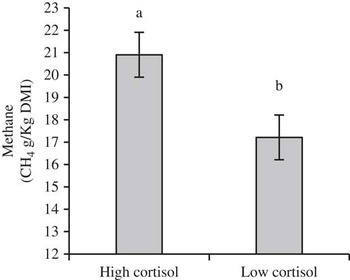
In some but not all cases, improvements in animal welfare can translate into more efficient conversion of feed nutrients into growth, milk and reproduction rate and a longer productive life, which might reduce the environmental footprint (Place and Mitloehner, Reference Place and Mitloehner2014). For example, Richardson and Herd (Reference Richardson and Herd2004) have estimated that stress responses can account for 37% of the variation in feed efficiency in beef cattle. Unpublished data from our group reveals that more stressed animals are less efficient and emit more CH4 than calm animals. Effectively, stress measured by increased serum cortisol during handling (30 min road transport) in 84 steers was directly related to higher (poorest) residual feed intake (0.24 v. −0.21; P<0.05) and increased CH4 emissions during the subsequent 4 days (Figure 1).
Methane emissions (CH4 g/kg DMI) from cattle with the (a) 10 highest v. (b) 10 lowest values of serum cortisol after transport (P<0.05). DMI=dry matter intake.

Other experiments conducted by the authors of this paper show that improvements in animal welfare can be translated into more efficient livestock systems. For example, in swine, Baxter et al. (Reference Baxter, Jarvis, Sherwood, Farish, Roehe, Lawrence and Edwards2011) showed that sows with low aggressive behaviour towards their litter weaned significantly more piglets than high aggressive sows. This statement enhances environmental sustainability by improving the efficiency of pig production with fewer mothers needed to produce the same amount of animals, thus reducing the GHG emission intensity. In addition, improving piglet survival obviously benefits piglet welfare.
Barnes et al. (Reference Barnes, Rutherford, Langford and Haskell2011) measured the technical efficiency from a set of dairy cattle farms by comparing the amount of physical output attainable from a given set of inputs. They contrasted the technical efficiency of each farm with the results of an animal welfare monitoring study performed in the same farms. It was found that farms with low prevalence of lameness (<10% of the cattle herd) were significantly more efficient than those with lameness rates >10% of the herd. They evidenced the need to expand the simulating models of production efficiency to include measures of welfare as they may be part of an integrative assessment of farm production efficiency.
Conclusions
Animal welfare can be impaired by some GHG mitigation strategies but at the same time improved welfare can help to promote both animal efficiency and GHG emissions mitigation. There is an urgent need to design simulation models at animal and farm level for a comprehensive life cycle sustainability assessment. This methodology will help in a better determination of the bidirectional and sometimes controversial relationship between GHG mitigation strategies and animal welfare, and identify those strategies that benefit both goals.
Acknowledgements
This work was partially funded by a Marie Curie Intra-European Fellowship within the Seventh European Community Framework Programme (PIEF-GA-2012-331505). The authors also wish to acknowledge financial support from the Scottish Government’s Rural and Environment Science and Analytical Services Division (RESAS).
Further information
The LiveM International Livestock Modelling and Research Colloquium was hosted by the Basque Centre for Climate Change (BC3) at the Maritime Museum in Bilbao, Spain between 14 and 16 October 2014. LiveM is the livestock and grassland modelling theme of the EU knowledge hub Modelling European Agriculture with Climate Change for Food Security (MACSUR). The MACSUR project is a pilot knowledge hub started by FACCE-JPI in 2012. It provides an opportunity to explore the role and potential of multi-disciplinary networking structures to address complex regional and global issues. More information on MACSUR and the LiveM theme can be found at www.macsur.eu, with PDFs of slides from conference presentations available through the conference website (http://www.livem2014bilbao.com/).