The incidence of Clostridium difficile infection (CDI) in the United States doubled between 2000 and 2010, and persons aged ≥65 years have been more affected than those who are younger.Reference Reveles, Lee, Boyd and Frei 1 The higher incidence in the elderly is concerning to the Veterans Health Administration (VA) because many veterans who use VA healthcare are in this age group and account for the majority of patients who reside in VA long-term care facilities, also known as community living centers (CLCs). CLCs typically provide skilled nursing services ranging from short-term rehabilitation to long-term care for dementia. 2
A nationwide CDI Prevention Initiative was implemented in July 2012 to lower CDI rates in VA acute-care facilities, and baseline rates prior to the Initiative were reported. The rate of hospital-onset cases decreased, but the rate of CDI presenting from the community increased as a result.Reference Evans, Simbartl, Kralovic, Jain and Roselle 3 In February 2014, the Initiative was expanded to include long-term care with dissemination of a guideline for the prevention of CDI based on published recommendationsReference Cohen, Gerding and Johnson 4 with additional expert input. As with acute care, the guideline emphasized environmental management, molecular diagnostics, antimicrobial stewardship, and infection prevention and control strategies for the prevention of CDI.
This is a report of nationwide baseline CDI data retrospectively collected from VA long-term care facilities for the 24-month period prior to the implementation of the CDI Prevention Initiative.
METHODS
Multidrug-resistant organism (MDRO) prevention coordinators at each of the 122 VA reporting sites retrospectively obtained a list of all positive CDI laboratory tests (LabID events) from February 2012 through January 2014 from their local clinical laboratories. The time a LabID event was collected defined the onset of a CDI case, and these data were obtained from the Veterans Health Information Systems and Technology Architecture (VistA) Computerized Patient Record System (CPRS), which is fully integrated among all acute and long-term care VA healthcare facilities. MDRO prevention coordinators entered these data, along with pertinent resident clinical information, into a pre-formatted spreadsheet developed by the MDRO Prevention Office that automatically categorized cases using standardized definitions. Aggregate data from each facility were then entered each month into a national database maintained by the VA Inpatient Evaluation Center in Cincinnati, Ohio.Reference Jain, Kralovic and Evans 5
Duplicate cases were defined as residents with LabID events collected ≤14 days from a previous positive CDI LabID event, while recurrent cases were defined as having repeated LabID events collected >14 days and ≤56 days from an initial test. The CDI admission prevalence rate was calculated as the number of nonduplicate (but including recurrent cases) LabID events collected ≤24 hours before to ≤48 hours after admission. Community-onset cases were defined as residents with LabID events collected during the same interval as the admission prevalence, but they did not include recurrent cases. Long-term care facility–onset cases were defined as residents with nonduplicate, nonrecurrent LabID events collected >48 hours after admission. Clinically confirmed long-term care facility–onset cases were defined as residents with nonduplicate, nonrecurrent LabID events collected >48 hours after admission who also had clinical evidence of CDI (ie, diarrhea or histopathologic or colonoscopic evidence of pseudomembranous colitis).Reference Cohen, Gerding and Johnson 4 The community-onset, long-term care facility–onset rates and the clinically confirmed long-term care facility-onset rates were calculated as both the number per 100 admissions and the number per 10,000 resident days.
All statistical analyses of CDI rate trends were performed using SAS version 9.3 (SAS Institute, Cary, NC). Poisson regression models, using a log-link function and either admissions or resident-days as the offset variable, were used to examine the change in infection occurrences over time while accounting for admission prevalence and diagnostic test type. Because the data were collected in aggregate, no patient-specific data were available to determine at-risk resident days for a CDI diagnosis. The effect of censoring resident days was simulated by recalculating the community-onset rate, the long-term care facility–onset rate, and the clinically confirmed long-term care facility–onset rate with a 20% reduction in resident days using the same Poisson models. A ratio of the scaled Pearson χ2 value to degrees of freedom was used to check for overdispersion. All P values were based on 2-tailed tests, and P≤.05 was considered significant.
The process of reviewing de-identified national data sets was reviewed by the Cincinnati VA Medical Center Institutional Review Board (IRB#05-6-29-2).
RESULTS
During the 24-month analysis period, there were 100,800 admissions and 6,976,121 resident-days in VA long-term care facilities nationwide.
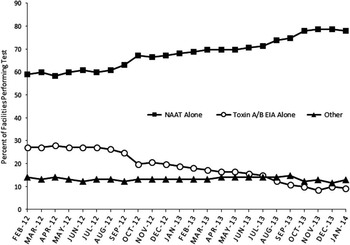
In February 2012, ~59% of clinical laboratories in the facilities included in this study used a nucleic acid amplification test (NAAT) alone. A total of 27% used a toxin A/B enzyme immunoassay (EIA) alone, and 14% used other tests for the diagnosis of CDI. During the analysis period, an increasing number of laboratories adopted NAAT, and by January 2014, 78% were using NAAT alone, 9% were using toxin A/B EIA alone, and 13% were using other tests (Figure 1).
Laboratory diagnostic tests used from February 2012 through January 2014. Percent of reporting sites by month where the clinical laboratory used nucleic acid amplification tests (NAAT), toxin A/B enzyme immunoassay (EIA), or other tests (glutamate dehydrogenase [GDH] plus NAAT, GDH plus toxin A/B EIA, cell culture cytotoxin assay, or anaerobic toxigenic culture) as the sole testing modality for the diagnosis of Clostridium difficile infection.

A total of 1,558 CDI cases were recorded during the 24-month analysis period. Of these, 176 cases (11.3%) were community-onset cases and 1,382 cases (88.7%) were long-term care facility–onset cases. Of the latter, 1,239 were clinically confirmed long-term care facility–onset cases (mean, 89.7%; range, 82.1%–94.2%). The pooled total admission prevalence rate (including recurrent cases) was 0.38 cases per 100 admissions. The pooled nonduplicate/nonrecurrent community-onset rate was 0.17 per 100 admissions (Figure 2). The pooled nonduplicate/nonrecurrent long-term care facility–onset rate and the clinically confirmed long-term care facility–onset rate were 1.98 and 1.78 per 10,000 resident days, respectively.
Clostridium difficile infection rates from February 2012 through January 2014. Dashed lines represent cases per 100 admissions, while solid lines represent cases per 10,000 resident days. Pooled total admission prevalence included all nonduplicate CDI cases (including recurrent cases) with CDI LabID event (ie, positive lab test) for which swabs were collected ≤24 hours before to ≤48 hours after admission to VA long-term care facilities. Community-onset cases included all nonduplicate, nonrecurrent CDI LabID events for which swabs were collected ≤24 hours before to ≤48 hours after admission to VA long-term care facilities. Clinically confirmed long-term care facility–onset cases included all nonduplicate, nonrecurrent CDI LabID events for which swabs were collected >48 hours after admission to VA long-term care facilities with diarrhea or histopathologic or colonoscopic evidence of pseudomembranous colitis. None of the trends were significant.

Based on the Poisson regression models, the nonduplicate/nonrecurrent community-onset rate per 100 admissions increased by 9%, but this increase was not significant (P=.71). The long-term care facility–onset rate and the clinically confirmed long-term care facility–onset rate per 10,000 resident days both decreased by 50%. Despite this similarity, the long-term care facility–onset rate decreased significantly (P=.05), while the clinically confirmed long-term care facility–onset rate did not (P=.17). An examination of the parameter estimates associated with the terms revealed that the significant decrease in long-term care facility–onset rates indicated by the time–effect results did not differ among the CDI test types; therefore, the decrease in CDI rates was evident regardless of testing modality. Significant CDI test–time interaction terms occurred only in the model for the community-onset rate per 100 admissions (P=.01). A reduction in the resident days by 20% to simulate censoring resident days for a CDI diagnosis did not change the significance of community-onset trend, long-term care facility–onset trend, or clinically confirmed long-term care facility–onset trend over time.
DISCUSSION
The analysis of data from VA CLCs in this report provides information regarding CDI in long-term care facilities in the absence of a formal nationwide program introduced to decrease rates. The pooled admission prevalence over the 24-month analysis period was 0.38 per 100 admissions. Others have reported admission prevalence rates of 3.3, 1.5, and 1.4 per 100 admissions in a long-term care subacute unit, on a rehabilitative floor, and in a nursing home unit, respectively, when all CDI-positive cases within 72 hours of admission were counted without including recurrent cases.Reference Laffan, Bellantoni, Greenough and Zenilman 6 Our rates only included those who tested positive for CDI within 48 hours of admission, but when recurrent cases were included this rate increased by 24%. Dubberke et alReference Dubberke, Reske and Olsen 7 suggested including recurrent cases when assessing admission prevalence because CDI-positive admissions may be a significant pool from which subsequent healthcare transmission occurs.
The pooled long-term care facility–onset rate was 1.98 per 10,000 resident days, which was comparable to rates of 1.7–2.9 and 0.9–1.1 cases per 10,000 resident days (reported by Campbell et alReference Campbell, Giljahn and Machesky 8 and the Pennsylvania Patient Safely Authority, 9 respectively), using definitions similar to ours. Even though long-term care facility–onset cases were defined as those diagnosed >48 hours after admission, we cannot categorically state that these infections originated in the CLCs because the origin of CDI cases is not always known.Reference Eyre, Cule and Wilson 10 Others have reported that up to 85% of long-term care CDI cases were diagnosed within 30 days of transfer from acute care and have postulated that these cases originated in acute care.Reference Kim, Toy and Muder 11 – Reference Guerrero, Nerandzic, Jury, Chang, Jump and Donskey 13 These results are consistent with the NHSN surveillance category of Acute Care Transfer–Long-Term Care Facility Onset, defined as long-term care facility–onset cases diagnosed ≥4 weeks after transfer. 14
Analyses of the VA long-term care facility–onset rate showed a significant 50% decline over the analysis period after controlling for the type of diagnostic test performed. At the same time, there was a 50% decline in the clinically confirmed long-term care facility-onset rate; however, the trend did not reach statistical significance. In the context of this analysis, there was a continual ~10% difference between the long-term care facility–onset rate and the clinically confirmed long-term care facility–onset rate throughout the analysis period. Because the clinically confirmed long-term care facility–onset rate is that of residents with diarrhea or histopathologic or colonoscopic evidence of pseudomembranous colitis, it may be a better indicator than the long-term care facility–onset rate regarding what is actually happening with illness due to C. difficile in the veteran population. The difference between these two rates is presumably the rate of positive LabID events in asymptomatic residents. The decline in the long-term care facility–onset rate but not the clinically confirmed long-term care facility–onset rate over the analysis period may be the result of clinicians and laboratories being more selective in the residents they test.
Notably, the hospital-onset CDI rate and the clinically confirmed hospital-onset CDI rate both declined significantly in acute care before the implementation of the CDI Prevention Initiative in that setting. This finding may have been due, in part, to the implementation of the VA MRSA Prevention Initiative in 2007. This initative placed an emphasis on active surveillance, contact precautions where indicated, hand hygiene, and an institutional cultural transformation in which infection control was everyone’s business.Reference Jain, Kralovic and Evans 5 , 15 The addition of an MDRO prevention coordinator at each facility may have also enhanced infection prevention and control efforts in facilities, resulting in a decline in CDI rates before the implementation of a formal prevention program.Reference Perencevich 16 , 17 The MRSA Prevention Initiative in CLCs, which began 2 years after its implementation in acute care, may have had less of an effect on CDI rates than in acute care because the length of stay in CLCs is longer and strict infection control is more difficult to achieve while balancing the need for a homelike environment.
The community-onset CDI rate was 0.17 per 100 admissions in VA long-term care facilities, but we were unable to find other reports of community-onset rates in long-term care for comparison. Like long-term care facility–onset cases, the true origin of community-onset CDI cases is often unknown. Because many residents admitted to long-term care are transferred from acute care, community-onset cases identified in long-term care may have become symptomatic in acute care but were not tested until after transfer, or these patients may have been incubating the disease, which did not manifest until transfer.
An important consideration with the Poisson regression models is the use of different CDI diagnostic tests. The prevalence of NAAT for the diagnosis of CDI has continued to increase since its approval by the Food and Drug Administration. The prevalence of CDI is illustrated by the increase from ~32% of VA laboratories using NAAT alone in October 2010Reference Evans, Simbartl, Kralovic, Jain and Roselle 3 to ~78% in January 2014. Compared to toxin A/B EIA, NAATs are more sensitive and have been associated with increased CDI rates.Reference Novak-Weekley, Marlowe and Miller 18 – Reference Moehring, Lofgren and Anderson 20
The long-term care facility–onset rate and the clinically confirmed long-term care facility–onset rate per 10,000 resident days in VA long-term care facilities were approximately 80% lower than the hospital-onset rate and the clinically confirmed hospital-onset rate per 10,000 patient days in VA acute-care facilities.Reference Evans, Simbartl, Kralovic, Jain and Roselle 3 The community-onset rate in long-term care was ~98% lower than that seen in VA acute-care hospitals.Reference Evans, Simbartl, Kralovic, Jain and Roselle 3 These differences are unlikely to be an artifact due to the use of different diagnostic laboratories because many CLCs are often located in close proximity to an acute care facility and share laboratory resources. Kim et alReference Kim, Toy and Muder 11 also showed that long-term care facility rates were lower than those of acute-care hospitals. A likely explanation is that the average resident length of stay in a long-term care facility is longer than that of a hospitalized patient. In this study and our other work, the average length of stay was 5.5 days per admission in VA acute-care facilities and 69.2 days per admission in VA long-term care facilities.Reference Evans, Simbartl, Kralovic, Jain and Roselle 3 Although rates may be lower in CLCs, the risk of acquiring CDI may be higher in acute care if the infection rate per 100 admissions is calculated. In this case, the long-term care facility–onset CDI rate would be 1.37 while the hospital-onset infection rate would be 0.51 per 100 admissions.Reference Evans, Simbartl, Kralovic, Jain and Roselle 3 Thus, the risk of acquiring CDI per admission in the CLCs may be ~2.7 times that in the acute care despite a per resident day rate of illness that is ~20% that of acute care hospitals.
There may be a number of limitations to our analysis. First, the results from this 2-year cohort of ~100,000 predominantly male residents served by the VA may not be generalizable to other long-term care populations in the United States, where ~68% are female.Reference Harris-Kojetin, Sengupta, Park-Lee and Valverde 21 Second, our study consisted of aggregate data and did not include patient-specific information, so we were unable to calculate rates using at-risk days. However, at-risk days were simulated by reducing resident days by 20%, and no significant changes in trends of community-onset rate, long-term care facility–onset rate, or clinically confirmed long-term care facility–onset rate were detected. Third, we did not have validated data on antimicrobial use in the CLCs during the analysis period. However, in acute care, the use of third-generation cephalosporins and clindamycin did not change, but fluoroquinolone use decreased. Due to retrospective data collection and manual data entry at each local VA facility, transcription errors were also possible. However, the use of a pre-formatted spreadsheet developed by the MDRO Prevention Office, which accurately categorizes each case based on patient admission history and the LabID event (ie, positive lab test) time stamp from the electronic medical record, should have facilitated the accuracy of case categorization. The data were assessed for outliers, which were subsequently clarified and validated. Furthermore, the large number of data points may have minimized the impact of occasional errors on the database.
CDI poses a significant economic burden for the US healthcare system, with increased lengths of stay and a national estimated cost up to $4.8 billion annually for acute-care facilities alone.Reference Lessa, Mu and Bamberg 22 Additionally, healthcare-acquired CDI rates often exceed those of methicillin-susceptible Staphylococcus aureus infections in acute-care facilities.Reference Evans, Simbartl, Kralovic, Jain and Roselle 3 , Reference Miller, Chen, Sexton and Anderson 23 The available evidence shows that aggressive CDI prevention initiatives are necessary and that comprehensive infection control programs can decrease CDI rates. 24 Multiple studies have shown a significant proportion of CDI occurs outside of acute care, including long-term care.Reference Lessa, Mu and Bamberg 22 , Reference Evans and Safdar 25 , Reference Chopra and Goldstein 26 Simulations have shown that long-term care healthcare-acquired infection rates may have a substantial effect on those in acute care.Reference Lee, Bartsch and Wong 27 A coordinated interfacility approach for the prevention of healthcare-associated infections, such as that of the VA, may lead to significant reductions in infection rates compared with independent facility-based approaches.Reference Slayton, Toth and Lee 28
ACKNOWLEDGMENTS
Financial support: No financial support was provided relevant to this article.
Potential conflicts of interest: All authors report no conflicts of interest relevant to this article.
We wish to thank the VHA Under Secretary for Health, the VHA Deputy Under Secretary for Health for Policy and Services, the VA MDRO Taskforce, MDRO prevention coordinators, infection prevention and control professionals, infectious diseases specialists, and clinical laboratory personnel at each facility for their support of the MDRO Prevention Initiatives as well as their hard work and dedication toward improving the healthcare of our veterans. We are also thankful to the CDI Data Workgroup and the MDRO Prevention Office staff, especially Linda Flarida, Judith Whitlock, and Brian McCauley for their educational activities and assistance with data validation and cleaning.