Introduction
To the untrained observer, dissociative (psychogenic non-epileptic) seizures (DS) can be mistaken for epileptic seizures (ES); however, DS differ from ES in a number of semiological characteristics (Avbersek & Sisodiya, Reference Avbersek and Sisodiya2010), they are not explained by epileptogenic electrophysiological activity, nor any other medical or psychiatric disorder. DS are assumed to be of psychological origin; however, there is considerable debate and inconsistency regarding the aetiology, classification and nomenclature of DS and conversion disorder (CD) more broadly (Stone et al. Reference Stone, LaFrance, Brown, Spiegel, Levenson and Sharpe2011; Brown & Reuber, Reference Brown and Reuber2016). Moreover, individuals with DS and other CDs are often assessed and managed within neurology services due to their initial presentation, outcomes are often poor and there is a need for better integration of psychological and psychiatric input to assessment and treatment for these groups (Nicholson & Kanaan, Reference Nicholson and Kanaan2009; Kanner, Reference Kanner, Schachter and LaFrance2010; LaFrance et al. Reference LaFrance, Reuber and Goldstein2013; Goldstein et al. Reference Goldstein, Mellers, Landau, Stone, Carson, Medford, Reuber, Richardson, McCrone, Murray and Chalder2015). Improved understanding and treatment of these disorders is likely to require more extensive collaboration between psychology, psychiatry and neurology, in both research and clinical contexts. Importantly, improvements in the quality of research into the psychological mechanisms underlying the symptoms would inform psychological models and interventions for these complex phenomena.
At present, DS are classified along with other CDs (i.e. functional neurological symptoms) as a somatoform symptom disorder in the Diagnostic and Statistical Manual of Mental Disorders, fifth edition (DSM-5; American Psychiatric Association, 2013). The term CD historically originated in the Freudian conception of ‘hysterical’ symptoms arising from the conversion of psychic energy into physical symptoms as a means of repressing psychological conflicts and distress into the unconscious. However, classification of CD within the current DSM-5 does not include reference to psychological aetiology or mechanisms, nor does it require evidence of psychological causation; therefore, it can be seen as rather non-specific, theoretically. Instead, DSM-5 criteria specify that the somatic symptoms should be persistent for a period of 6 months and associated with significant psychological distress or functional impairment (i.e. excessive thoughts, feelings or behaviours linked to the symptoms). Nevertheless, the use of the term ‘functional neurological symptom disorder’ in DSM-5 appears to imply a disturbance of neural activity linked to the reported symptoms (Ejareh dar & Kanaan, Reference Ejareh dar and Kanaan2016).
In contrast, DS are termed ‘dissociative convulsions’ in the International Classification of Diseases (ICD)-10 (World Health Organization, 1992) and included in the dissociative disorders group. This term can be broadened to ‘dissociative seizures’ as the events are not always convulsive in nature (e.g. atonic episodes). This classification requires the symptoms to occur within the context of trauma, insoluble problems and/or relationship dysfunction. As such, the ICD system provides a somewhat more explicit account of psychological causation and possible mechanisms underlying DS and other CDs. Indeed, several authors have proposed that DS are a manifestation of dissociated psychological processes, in at least a proportion of cases (e.g. Kuyk et al. Reference Kuyk, VanDyck and Spinhoven1996; Brown, Reference Brown, Trimble and Schmitz2002; Goldstein & Mellers, Reference Goldstein and Mellers2006; Roberts & Reuber, Reference Roberts and Reuber2014).
The term ‘dissociation’ is somewhat difficult to define; however, the ICD-10 dissociative disorders category refers to a ‘…partial or complete loss of the normal integration between memories of the past, awareness of identity and immediate sensations, and control of bodily movements’ (ICD-10; World Health Organization 1992, p. 151). Dissociation can also refer to a mental state in which there is an altered sense of awareness with or without altered responsiveness (e.g. depersonalization, derealization) (Holmes et al. Reference Holmes, Brown, Mansell, Fearon, Hunter, Frasquilho and Oakley2005), and a hypothetical psychological mechanism such as a defence against unwanted emotional experience/memories (Cardena, Reference Cardena, Lynn and Rhue1994).
Others have proposed two overall types of dissociation, namely ‘compartmentalization’ and ‘detachment’ (Holmes et al. Reference Holmes, Brown, Mansell, Fearon, Hunter, Frasquilho and Oakley2005). According to Holmes et al. (Reference Holmes, Brown, Mansell, Fearon, Hunter, Frasquilho and Oakley2005), detachment refers to an experiential psychological state involving a subjective sense of separation from specific aspects of usual experience (e.g. depersonalization, derealization). On the other hand, compartmentalization was proposed to refer primarily to phenomena in which usual voluntary control over psychological processes or motor function is lost, in the absence of underlying disease or pathology and where the loss of function is experienced as involuntary (e.g. dissociative amnesia, conversion/somatoform disorders). Moreover, Nijenhuis (Reference Nijenhuis2001) has outlined the concept of ‘somatoform dissociation’, defined as ‘…phenomena that are manifestations of a lack of integration of somatoform experiences, reactions, and functions’ (p. 9), which can be seen as a subtype of compartmentalization. The various uses of the term dissociation are not necessarily mutually exclusive as there is considerable overlap in these concepts. For example, both compartmentalization and detachment phenomena can be seen as a loss of or a reduction in the integration of usually integrated psychological processes.
There is considerable empirical evidence for a dissociative account of DS and CD more generally. Traumatic life experiences, including but not confined to childhood abuse and neglect, are known risk factors for elevated dissociative symptoms and the development of dissociative disorders (e.g. Chu & Dill, Reference Chu and Dill1990; Goodwin & Sachs, Reference Goodwin, Sachs, Michelson and Ray1996; Waller et al. Reference Waller, Hamilton, Elliott, Lewendon, Stopa, Waters, Kennedy, Lee, Pearson and Kennerley2001; Dalenberg et al. Reference Dalenberg, Brand, Gleaves, Dorahy, Loewenstein, Cardeña, Frewen, Carlson and Spiegel2012). Rates of traumatic life events are high in patients with DS (Rosenberg et al. Reference Rosenberg, Rosenberg, Williamson and Wolford2000; Sharpe & Faye, Reference Sharpe and Faye2006; Reuber et al. Reference Reuber, Howlett, Khan and Grunewald2007), CD (e.g. Roelofs et al. Reference Roelofs, Keijsers, Hoogduin, Näring and Moene2002; Nicholson et al. Reference Nicholson, Aybek, Craig, Harris, Wojcik, David and Kanaan2016) and somatoform disorders (Brown et al. Reference Brown, Schrag and Trimble2005). Interestingly, dissociative experiences have been found to be raised in DS patients with a history of trauma or abuse (Hingray et al. Reference Hingray, Maillard, Hubsch, Vignal, Bourgognon, Laprevote, Lerond, Vespignani and Schwan2011; Bodde et al. Reference Bodde, van der Kruijs, Ijff, Lazeron, Vonck, Boon and Aldenkamp2013; Hendrickson et al. Reference Hendrickson, Popescu, Ghearing and Bagic2015). Co-morbid post-traumatic stress disorder (PTSD) is also often present in patients with DS (Rosenberg et al. Reference Rosenberg, Rosenberg, Williamson and Wolford2000; Bowman, Reference Bowman, Schachter and LaFrance2010). It has been argued that in some cases, DS might represent a manifestation of the dissociative subtype of PTSD (Fiszman et al. Reference Fiszman, Alves-Leon, Nunes, D'Andrea and Figueira2004).
Importantly, studies have reported raised scores on measures of dissociative experiences such as the Dissociative Experiences Scale (DES) (Bernstein & Putnam, Reference Bernstein and Putnam1986) in patients with DS relative to those with ES (Reuber et al. Reference Reuber, House, Pukrop, Bauer and Elger2003; Goldstein & Mellers, Reference Goldstein and Mellers2006), mixed ES/DS (Prueter et al. Reference Prueter, Schultz-Venrath and Rimpau2002) and healthy controls (e.g. Goldstein et al. Reference Goldstein, Drew, Mellers, Mitchell-O'Malley and Oakley2000; O'Brien et al. Reference O'Brien, Fortune, Dicker, O'Hanlon, Cassidy, Delanty, Garavan and Murphy2015), although negative findings have also been reported in some studies comparing patients with DS with those with ES or mixed ES/DS (Alper et al. Reference Alper, Devinsky, Perrine, Luciano, Vazquez, Pacia and Rhee1997; Litwin & Cardeña, Reference Litwin and Cardeña2001). Nevertheless, peri-ictal symptoms of dissociation (i.e. detachment) are also regularly reported (Reuber et al. Reference Reuber, Jamnadas-Khoda, Broadhurst, Grunewald, Howell, Koepp, Sisodiya and Walker2011) and have been found to be elevated in patients with DS relative to those with ES (Hendrickson et al. Reference Hendrickson, Popescu, Ghearing and Bagic2015). Dissociative symptoms and disorders are also prevalent in patients with CD more generally (e.g. Sar et al. Reference Sar, Akyuz, Kundakci, Kiziltan and Dogan2004; Yayla et al. Reference Yayla, Bakım, Tankaya, Ozer, Karamustafalioglu, Ertekin and Tekin2015).
Higher scores on the 20-item Somatoform Dissociation Questionnaire (SDQ-20; Nijenhuis et al. Reference Nijenhuis, Spinhoven, Van Dyck, Van Der Hart and Vanderlinden1996) have also been reported in DS patients relative to those with ES (Lally et al. Reference Lally, Spence, McCusker, Craig and Morrow2010; Brown et al. Reference Brown, Bouska, Frow, Kirkby, Baker, Kemp, Burness and Reuber2013) and healthy control groups (van der Kruijs et al. Reference van der Kruijs, Bodde, Vaessen, Lazeron, Vonck, Boon, Hofman, Backes, Aldenkamp and Jansen2012; Xue et al. Reference Xue, Wang, Xiong, Tian, Wang and Xu2013). Lawton et al. (Reference Lawton, Baker and Brown2008) found elevated scores on the SDQ-20 in their DS sample relative to ES patients; however, the finding did not survive statistical correction for symptoms of anxiety and depression. This indicates the importance of controlling for such symptoms of general psychopathology, when examining dissociation in this group.
The overall aim of the study was to further explore the nature of the dissociative symptoms experienced by patients with DS, in comparison with a healthy control group, whilst controlling for symptoms of anxiety and depression. The study sought to examine a range of psychological dissociative experiences measured with a questionnaire not previously used in this group, namely the Multiscale Dissociation Inventory (MDI; Brière, Reference Brière2002). This measure provides subscale scores for different psychological manifestations of dissociation and was employed to provide a more detailed analysis of the types of dissociative experiences that are most common in patients with DS. In addition, a measure of somatoform dissociation/compartmentalization (the SDQ-20) was selected. On the basis of previous research findings, the DS group was predicted to report significantly higher levels of psychological and somatoform dissociation relative to the healthy control group.
The study also set out to examine the extent to which dissociative experiences in patients with DS were related to traumatic life experiences and post-traumatic stress symptoms, as measured with additional self-report questionnaires. Finally, the study explored whether there were relationships between specific self-reported seizure symptoms and dissociative and traumatic experiences. These were exploratory analyses, as limited previous findings precluded the generation of specific hypotheses relating to these relationships.
Method
Participants
Ethical approval was obtained from the Joint South London and Maudsley and Institute of Psychiatry NHS Research Ethics Committee (reference 08/H0807/82). Diagnosis of DS was classified on the basis of video-electroencephalography, or consensus opinion of two experts (i.e. neurologists, neuropsychiatrists). The control group consisted of self-reportedly healthy individuals, recruited from the local community of Greater London. Participants were between 18 and 65 years old, fluent English speakers, and had an estimated intelligence quotient of at least 70, based on clinical opinion/records in the first instance, and confirmed with scores obtained on the Wechsler Abbreviated Scale of Intelligence (WASI; Wechsler, Reference Wechsler1999). Exclusion criteria for both groups included: current major affective or anxiety disorder, substance dependence, psychosis, and significant medical or neurological conditions. The majority of patients with DS had been recently assessed and diagnosed with the disorder in a Neuropsychiatry Clinic (approximately 1–2 months prior to participating) and none had completed any form of psychological treatment for DS prior to participating in the study.
Measures
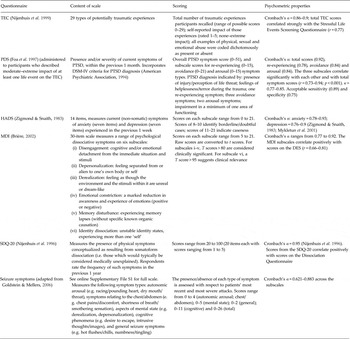
All measures included in the study were self-report questionnaires (see Table 1).
Self-report measures

TEC, Traumatic Experiences Checklist; PDS, Post-Traumatic Diagnostic Scale; PTSD, post-traumatic stress disorder; DSM-IV, Diagnostic and Statistical Manual of Mental Disorders, fourth edition; HADS, Hospital Anxiety and Depression Scale; MDI, Multiscale Dissociation Inventory; DES, Dissociative Experiences Scale; SDQ-20, 20-item Somatoform Dissociation Questionnaire.
Procedure
Participants provided written informed consent prior to taking part. Most participants completed the questionnaires at the Institute of Psychiatry, Psychology and Neuroscience, King's College London, with a minority completing them at home and returning them by post.
Data analyses
Between-groups differences were assessed with χ2, Mann–Whitney U, or t tests, as appropriate. The α level was set at p < 0.05 for questionnaires with ⩽2 subscales. For questionnaires with multiple (⩾3) subscales (i.e. the MDI), p < 0.01 was adopted for significant differences on each subscale to control for multiple testing. A power calculation indicated that an independent-samples t test would have 80% power to detect a large effect size (0.8), at p < 0.01, with about 39 per group (GPower 3.1) (Faul et al. Reference Faul, Erdfelder, Lang and Buchner2007, Reference Faul, Erdfelder, Buchner and Lang2009).
Correlational analyses utilized Spearman's ρ or point-biserial correlations, to assess inter-relationships between significant variables. The α level for the correlations was p < 0.01. Correlations between subscales of a single measure are not discussed as these are to be expected and yield little explanatory value to the analyses presented. Only correlations reaching significance in the DS group but not in the control group at p < 0.01 were considered noteworthy. According to GPower (Faul et al. Reference Faul, Erdfelder, Lang and Buchner2007, Reference Faul, Erdfelder, Buchner and Lang2009), a sample size of 27 can detect a correlation of r = 0.6 at p < 0.01 with 80% power.
Logistic regression analyses were conducted with group as the outcome variable (DS, control) to explore the extent to which key trauma and dissociation variables discriminated between the two groups, whilst controlling for relevant confounds [i.e. years of education (YoE), anxiety, depression]. Variables which had been significant in the between-groups analyses were first tested with univariate binary logistic regression analyses, controlling for YoE and/or anxiety/depression scores by entry in the first blocks. Variables that were significant in the univariate analyses (p < 0.01), and/or had most theoretical significance, were then entered as predictors in multivariate binary logistic regressions. Predictors were entered in blocks, on the basis of previous research/theory, with input of variables within blocks using the forced entry procedure.
A commonly accepted standard in logistic regression is the inclusion of a minimum of 10 events per variable (Peduzzi et al. Reference Peduzzi, Concato, Kemper, Holford and Feinstein1996; Hosmer & Lemeshow, Reference Hosmer and Lemeshow2000). Therefore, with 40 ‘events’ (i.e. DS cases), the inclusion of only four predictors could be justified in the multivariate logistic regression analyses to ensure adequate statistical power.
Where mediation analyses were undertaken (using the PROCESS custom dialog box for SPSS v22; Hayes, Reference Hayes2012), Sobel's test (Sobel, Reference Sobel1982) determined the significance of the effects.
Ethical standards
All procedures contributing to this work comply with the ethical standards of the relevant national and institutional committees on human experimentation and with the Helsinki Declaration of 1975, as revised in 2008.
Results
Demographic and clinical characteristics
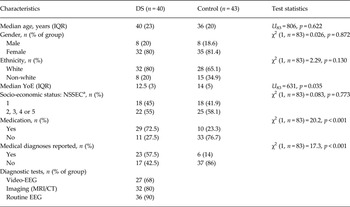
In all, 40 patients with DS and 43 control participants completed the study. No significant differences in age, gender, ethnicity or socio-economic status were observed between the groups (Table 2). Scores on the WASI did not differ between the two groups (t 81 = 1.5, p = 0.14), with mean scores in the average range for both groups [DS mean = 103.6 (s.d. = 14.5); control mean = 108.1 (s.d. = 13.1)]. However, the DS group reported significantly fewer YoE and a significantly larger proportion of DS patients were currently taking prescribed medication relative to controls. Anti-epileptic drugs and anti-depressants were the most common medications in the DS group, with 43% (n = 17) and 40% (n = 16) of the group reporting their use, respectively. Significantly more DS participants than controls reported a co-morbid medical diagnosis. The median current seizure frequency reported by the patient sample was 4.2 (interquartile range = 14) per month. The median total duration of the seizure disorder was 54 (interquartile range = 90) months.
Demographic characteristics of the total sample (by group)
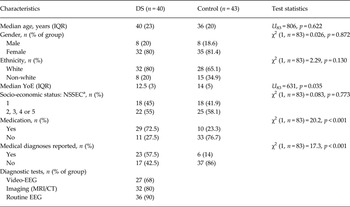
DS, Dissociative seizures; IQR, interquartile range; YoE, years of full-time education (or equivalent); NSSEC, National Statistics Socio-Economic Classification system; EEG, electroencephalography; MRI, magnetic resonance imaging; CT, computed tomography.
a 1 = Higher managerial, administrative and professional occupations; 2 = intermediate occupations; 3 = small employers and own account workers; 4 = lower supervisory and technical occupations; 5 = semi-routine and routine occupations.
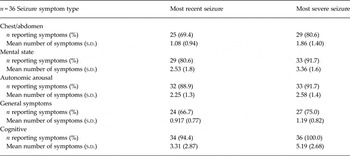
When DS patients were asked about their most recent seizures, the most frequently reported symptoms were cognitive and autonomic arousal phenomena (Table 3). With regards to their most severe seizure, the most frequent symptoms were those relating to mental state, autonomic arousal and cognitive symptoms.
Seizure symptoms: number and proportion of dissociative seizure patients reporting at least one of each symptom type, and the mean number of each symptom type reported across all patients

s.d., Standard deviation.
Between-group comparisons (Table 4)
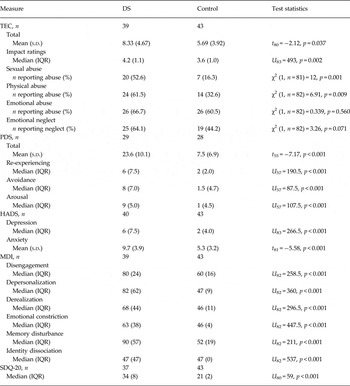
The DS group reported significantly more total traumatic experiences and higher mean impact scores, relative to the control group. In addition, significantly more participants reported having experienced sexual and physical abuse in the DS group, in comparison with controls. However, there were no significant between-group differences for rates of emotional neglect and abuse.
Between-groups comparisons on questionnaire measures

DS, Dissociative seizures; TEC, Traumatic Experiences Checklist; s.d., standard deviation; IQR, interquartile range; PDS, Post-Traumatic Diagnostic Scale; HADS, Hospital Anxiety and Depression Scale; MDI, Multiscale Dissociation Inventory; SDQ-20, 20-item Somatoform Dissociation Questionnaire.
On the Post-Traumatic Diagnostic Scale (PDS), there was a significant elevation of total, re-experiencing, avoidance and arousal PTSD symptoms in the DS group, relative to controls. None of the control participants met the criteria for a diagnosis of PTSD, in contrast to 66.7% of the DS patients who completed the PDS. As would be expected, there were also highly significant elevations in Hospital Anxiety and Depression Scale (HADS) anxiety and depression scores in the DS group relative to control participants; however, mean scores in the DS group were not in the clinical range for either subscale.
The DS group obtained significantly higher scores than control participants on all MDI subscales. The average scores were in the clinically significant range for the disengagement, depersonalization and memory disturbance subscales in the DS group, but all scores were in the normal range in the control group. There was also a significant elevation in scores on the SDQ-20 in the DS group relative to the control group.
Correlational analyses
Online Supplementary File S2 presents the statistical values for all significant correlations (p < 0.01) described below.
Relationships between trauma variables and dissociation
Traumatic Experiences Checklist (TEC) total scores were positively correlated with MDI depersonalization and emotional constriction scores, whereas the presence of sexual abuse was positively associated with MDI identity dissociation. PDS avoidance scores were associated positively with MDI disengagement and memory disturbance scores.
Relationships between trauma variables and seizure symptoms
In the subgroup of participants who completed the PDS (i.e. traumatized participants), PDS total scores were positively correlated with ictal cognitive symptoms (most recent seizure). Finally, PDS re-experiencing symptoms were positively associated with total ictal symptoms (most recent seizure).
Relationships between dissociation and ictal symptoms
The MDI depersonalization subscale scores were positively associated with ictal mental state symptoms (most recent and most severe seizures) and the total number of ictal symptoms (most recent seizure). Moreover, MDI derealization scores were also positively correlated with ictal mental state symptoms (most recent and most severe seizures). Finally, the MDI identity dissociation subscale scores were positively correlated with ictal cognitive symptoms (most severe seizures). SDQ-20 scores were not significantly associated with any seizure variable at p < 0.01.
Regression analyses
Trauma variables and group membership
In individual univariate logistic regression analyses, TEC mean impact scores and presence/absence of sexual abuse and physical abuse significantly differentiated DS patients from controls, after controlling for YoE (all at p < 0.01; see online Supplementary File S3).
A hierarchical multivariate logistic regression model with YoE (block 1) and relevant TEC variables (block 2; impact scores, sexual abuse, physical abuse) was highly significant (χ2 4 = 21.3, p < 0.001) (see online Supplementary File S3) and correctly classified 70% of cases. The only variable to retain significance in the second step was presence of reported sexual abuse (Wald (1) = 5.04, p = 0.025). The presence of sexual abuse was associated with a three-fold increase [odds ratio (OR) 3.59, 95% confidence interval (CI) 1.18–10.96] in the likelihood of being diagnosed with DS.
Dissociation and group membership
SDQ-20 total scores and scores on all of the MDI subscales were significant predictors of DS group membership, in individual univariate logistic regressions (with YoE as covariate, all p values < 0.01; see online Supplementary File S4). To control for general emotional distress, these analyses were rerun with HADS anxiety and depression scores entered in a second block and dissociation variables entered in a third block. In these latter analyses, the effects of MDI emotional constriction (p = 0.018) and identity dissociation (p = 0.138) were no longer significant at p < 0.01. However, the other subscales remained significant controlling for HADS scores (p < 0.01). Depression but not anxiety scores were significant in some of these analyses (p < 0.01).
As MDI depersonalization and derealization scores correlated with ictal DS symptoms (see above) and previous studies have reported elevated ictal symptoms of this nature (Goldstein & Mellers, Reference Goldstein and Mellers2006; Hendrickson et al. Reference Hendrickson, Popescu, Ghearing and Bagic2015), these subscales were entered into the multivariate analysis, due to their potential significance to DS occurrence. In this analysis, MDI depersonalization and derealization subscale scores were entered simultaneously with SDQ-20 total scores in block 2 of the hierarchical logistic regression (block 1 = YoE), with group status as the outcome variable. The final model was highly significant (χ2 4 = 76.7, p < 0.001), indicating that these combined types of dissociation were strongly predictive of DS diagnosis (see online Supplementary File S4), successfully categorizing 92.5% of cases. However, only SDQ-20 scores remained significant (Wald (1) = 15.8, p < 0.001) with all variables included in the model, with an OR of 1.53 (95% CI 1.24–1.89). Furthermore, when HADS depression scores were entered in a second block in a rerun of the analysis (MDI and SDQ-20 scores entered in block 3), the same pattern of results was observed, with only the SDQ-20 scores reaching significance in the final step (p < 0.001).
Sexual abuse, depression, somatoform dissociation and group membership
The first set of analyses reported above indicated that, of the variables relating to trauma, a history of sexual abuse was the most important predictor of DS group membership. The second set of analyses showed that several types of psychological dissociation were predictive of the diagnosis, but that somatoform dissociation was an independent predictor. Symptoms of depression were also found to be predictive of DS diagnosis in some of these analyses.
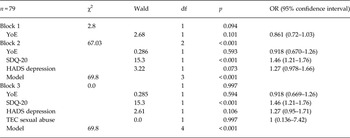
A final set of exploratory analyses was, therefore, conducted to examine whether the predictive relationship of self-reported sexual abuse to DS diagnosis might be mediated by depression and/or somatoform dissociation scores. First, a multivariate hierarchical logistic regression was conducted, in which the following procedure was implemented: block 1 = YoE; block 2 = SDQ-20 total, HADS depression; block 3 = TEC sexual abuse (presence/absence). Within the final model, the only variable that remained significant was the SDQ-20 total score (Table 5). The overall model was highly significant and allowed accurate classification of 91.1% of cases.
Hierarchical logistic regression statistics: sexual abuse, somatoform dissociation (SDQ-20), depression (HADS depression) and DS group membership

SDQ-20, 20-Item Somatoform Dissociation Questionnaire; HADS, Hospital Anxiety and Depression Scale; DS, dissociative seizures; df, degrees of freedom; OR, odds ratio; YoE, years of full-time education (or equivalent); TEC, Traumatic Experiences Checklist.
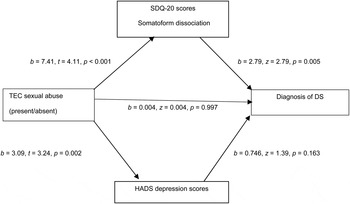
Mediation analyses were conducted with TEC sexual abuse (present/absent) as the predictor variable, group (DS, control) as the outcome variable, and SDQ-20 and HADS depression scores as the mediating variables (with YoE as covariate). In this analysis, the presence/absence of TEC sexual abuse significantly predicted SDQ-20 scores and HADS depression scores (Fig. 1). With these mediating variables in the model, the direct effect of TEC sexual abuse on group was not significant. Furthermore, the mediating effect of HADS depression was not significant. On the other hand, the mediating effect of SDQ-20 was significant.
Mediation analysis. Traumatic Experiences Checklist (TEC) sexual abuse, 20-item Somatoform Dissociation Questionnaire (SDQ-20), Hospital Anxiety and Depression Scale (HADS) depression and diagnosis of dissociative (psychogenic non-epileptic) seizures (DS).

Discussion
The study sought to further examine psychological and somatoform dissociative experiences reported by patients diagnosed with DS, whilst controlling or matching for relevant confounding variables. Additional aims of the study were to measure the traumatic life experiences, post-traumatic symptoms and seizure symptoms reported by the sample, and to explore any relationships of these factors to the currently reported dissociative symptoms.
Dissociation
The study supported the proposal that a variety of types of psychological dissociation are more common in patients with DS, compared with healthy individuals. These symptoms included processes measured by the depersonalization, derealization, disengagement, identity dissociation, memory disturbance and emotional constriction subscales of the MDI. Symptoms of disengagement, depersonalization and memory disturbance were clinically elevated in the DS group, highlighting the severity and possibly distressing nature of these experiences in patients with this disorder. Several types of dissociative experience (disengagement, depersonalization, derealization, memory disturbance scores) discriminated patients with DS from healthy controls after controlling for the effects of education and general emotional distress (HADS anxiety and depression scores).
The findings support and extend previous research into dissociative phenomena in patients with DS compared with healthy controls on measures such as the Dissociation Questionnaire (DIS-Q) (e.g. Ozcetin et al. Reference Ozcetin, Belli, Ertem, Bahcebasi, Ataoglu and Canan2009; van der Kruijs et al. Reference van der Kruijs, Bodde, Vaessen, Lazeron, Vonck, Boon, Hofman, Backes, Aldenkamp and Jansen2012) and DES (e.g. Goldstein et al. Reference Goldstein, Drew, Mellers, Mitchell-O'Malley and Oakley2000; O'Brien et al. Reference O'Brien, Fortune, Dicker, O'Hanlon, Cassidy, Delanty, Garavan and Murphy2015). Previous negative findings in some studies which compared patients with ES and DS could be due to organically-mediated symptoms superficially resembling dissociation occurring during some ES (Medford, Reference Medford2014). In contrast to measures such as the DIS-Q and the DES, the use of the MDI in the current study has provided a more detailed analysis of the specific types of psychological dissociation experienced in this group. It seems, for example, that symptoms of disengagement, depersonalization and memory disturbance were particularly relevant in this sample. Disengagement and depersonalization are suggestive of a marked sense of detachment from the environment and self/body, whereas memory disturbance indicates non-organic amnesia for aspects of daily life. Interestingly, these symptom types are all ‘negative’ dissociative symptoms, that is, apparent losses of functions that can be seen as inhibitory experiencing states (van Dijke et al. Reference van Dijke, van der Hart, Ford, van Son, van der Heijden and Bühring2010). Such dissociative symptoms (e.g. depersonalization) have been termed ‘secondary dissociation’ and appear to be associated with over-regulation (excessive inhibition) of affect, such as in dissociative PTSD (Brand & Lanius, Reference Brand and Lanius2014).
Scores on the SDQ-20 were also elevated in the DS group in this study, whilst controlling for the effects of education and depression/anxiety. SDQ-20 scores were also found to be one of the most important predictors of a diagnosis of DS. Together, the findings suggest that individuals with DS frequently experience abnormal somatic phenomena, which can be characterized as ‘compartmentalization’. It is possible that a screening questionnaire for somatoform dissociation, such as the SDQ-20 or the five-item alternative (SDQ-5) (Nijenhuis et al. Reference Nijenhuis, Spinhoven, van Dyck, van der Hart and Vanderlinden1997) might be a useful complementary tool for monitoring progress during and after psychological interventions for DS.
Trauma
This study has provided additional evidence that DS are associated with high rates of traumatic life events; greater perceived impact of the events was also reported in the DS group relative to controls. Interestingly, the total number of traumatic events reported by DS patients (TEC total scores) correlated positively with two MDI subscale scores, emotional constriction and depersonalization. These findings concur with previous literature on the relationship between dissociative symptoms and traumatic experiences (Gershuny & Thayer, Reference Gershuny and Thayer1999; Lanius et al. Reference Lanius, Vermetten, Loewenstein, Brand, Schmahl, Bremner and Spiegel2010).
Higher rates of previous sexual and physical abuse were observed in the DS sample, relative to controls. As noted elsewhere (Fiszman et al. Reference Fiszman, Alves-Leon, Nunes, D'Andrea and Figueira2004; Sharpe & Faye, Reference Sharpe and Faye2006; Nicholson et al. Reference Nicholson, Aybek, Craig, Harris, Wojcik, David and Kanaan2016), such experiences seem to be important risk factors in this disorder and other CDs, for a significant proportion of patients. When explored further in the regression analyses, self-reported history of sexual abuse was uniquely predictive of DS diagnosis. The finding that sexual abuse increased the likelihood of DS diagnosis approximately three-fold in this study is similar to conclusions drawn elsewhere (Sharpe & Faye, Reference Sharpe and Faye2006). Reports of sexual abuse also correlated positively with MDI identity dissociation scores, suggesting that those patients with a history of sexual abuse were more likely to also experience this severe and disruptive type of dissociative symptom, relative to those not reporting sexual abuse. Again, this supports previous findings of a relationship between dissociative identity disorder and sexual abuse (e.g. Anderson et al. Reference Anderson, Yasenik and Ross1993).
A novel finding in the current study was that somatoform dissociation was found to mediate the relationship between a history of sexual abuse and a diagnosis of DS. A previous study found that the relationship of psychological abuse to DS diagnosis was mediated by family dysfunction (experiences of control) and somatization (Salmon et al. Reference Salmon, Al-Marzooqi, Baker and Reilly2003). Together, the findings suggest that different types of historical abuse may lead to DS through increasing a tendency toward somatic manifestations of emotional distress. Again, these findings highlight the possible importance of addressing somatoform dissociation in treatments for DS, perhaps using approaches focusing on somatic awareness.
In the subgroup of participants who completed the PDS, the DS group scored higher than the control group for total PTSD symptoms, and all three symptom subtypes (re-experiencing, arousal, avoidance). Furthermore, of the DS patients who completed the PDS, 67% met formal criteria for a diagnosis of PTSD. These results support previous findings indicating high rates of PTSD in patients with DS (e.g. Rosenberg et al. Reference Rosenberg, Rosenberg, Williamson and Wolford2000) and suggest that pathological responses to traumatic life events may play an important role in the development or maintenance of DS, in at least a subgroup of patients. Furthermore, post-traumatic stress symptoms (PDS total and re-experiencing scores) were positively correlated with seizure symptoms (cognitive and total, respectively).
The current findings in relation to trauma and post-traumatic symptoms indicate the possible value of addressing these issues within psychological interventions in DS, at least for this subgroup of patients. The possibility of extending treatments for DS patients with significant trauma histories by incorporating techniques focused on trauma-related processes (e.g. prolonged exposure, eye-movement desensitization and reprocessing) might also be considered, although a more rigorously established evidence base would be needed for this patient group. At present a clinical trial (Goldstein et al. Reference Goldstein, Mellers, Landau, Stone, Carson, Medford, Reuber, Richardson, McCrone, Murray and Chalder2015) proposes paying early attention to addressing seizure symptoms with cognitive–behavioural approaches with a view to enabling patients to establish some control over their seizures before undertaking any trauma-related work. As the evidence base for robustly demonstrated effective treatments for DS is still at an early stage (Martlew et al. Reference Martlew, Pulman and Marson2014), it is not currently possible to indicate conclusively how trauma-related interventions might best be integrated with existing approaches. This is a possible area for future treatment studies to explore.
Seizure symptoms
The most commonly reported seizure symptoms by the DS group were cognitive, mental state and autonomic arousal symptoms. The mean number of autonomic arousal symptoms reported by the DS group in the present study was broadly similar to the mean of the DS group (2.64) from Goldstein & Mellers’ (Reference Goldstein and Mellers2006) study. Symptoms of physiological arousal resembling the somatic manifestations of anxiety, therefore, seem to be a common experience during DS, as also suggested by Hendrickson et al. (Reference Hendrickson, Popescu, Dixit, Ghearing and Bagic2014). These results are consistent with the proposition that elevated levels of emotional arousal may serve as an important factor in triggering DS (Goldstein & Mellers, Reference Goldstein and Mellers2006; Baslet, Reference Baslet2011).
The mental state symptom type was also commonly reported in the current sample of patients. This supports other evidence that symptoms of the ‘detachment’ type of dissociation are commonly experienced by patients during or around the time of their seizures (Hendrickson et al. Reference Hendrickson, Popescu, Dixit, Ghearing and Bagic2014, Reference Hendrickson, Popescu, Ghearing and Bagic2015). Furthermore, scores on the MDI derealization and depersonalization subscales were significantly correlated with ictal mental state symptoms, strengthening this proposition. Patients who experience more mental state symptoms during their attacks might also experience higher levels of depersonalization and derealization more generally (i.e. in daily life).
Other common ictal symptoms reported in the current sample were those belonging to the ‘cognitive’ category. This category includes items that reflect cognitive manifestations of anxiety (e.g. wanting to escape a situation, embarrassment). It is possible that these anxiety-related cognitions are the result of the severe loss of control and voluntary physical functioning that patients experience during a DS and also confirm that many of the experienced symptoms are similar to those experienced in panic attacks, but without explicit feelings of panic (Goldstein & Mellers, Reference Goldstein and Mellers2006). Such cognitions occurring during seizures might exacerbate or prolong the severity of the attacks by heightening subjective emotional distress and/or physiological arousal. These types of thoughts are, therefore, important targets for therapeutic interventions, such as cognitive–behavioural therapy for this disorder (Goldstein et al. Reference Goldstein, Mellers, Landau, Stone, Carson, Medford, Reuber, Richardson, McCrone, Murray and Chalder2015).
Strengths and limitations
The study examined a range of potentially important psychological variables in a sample of patients with DS, in comparison with a generally well-matched control group. The study included a moderate-to-large sample size that was adequately powered to detect the expected differences. A key strength of the study was the novel inclusion of a multidimensional measure of psychological dissociation, allowing an examination of different types of dissociative symptoms. Moreover, measuring both somatoform and psychological dissociation in the same sample provided insight into the relative importance of these types of experience. The inclusion of a measure of general emotional distress (HADS) importantly allowed statistical control of this possible confound.
Some limitations of the study should be discussed, however. The use of self-report measures could be seen as a limitation when assessing some variables, due to possible biases arising from self-presentation concerns and/or retrospective reporting. In addition, the seizure symptom questionnaire used in this study was developed with the aim of examining subjective/psychological seizure symptoms only, rather than the full range of motor and behavioural manifestations often observed during DS. Given the importance of somatoform dissociation revealed by the current study, further research may seek to explore possible relationships between measures of dissociation with ictal motor and/or behavioural symptoms in this population.
Furthermore, it is important to note that the measures of psychological and somatoform dissociation used include items that could pertain to the experience of the seizures experienced by respondents, making it difficult to distinguish between whether the higher scores on the measures are due to the seizures or more general elevations in dissociation in daily life. Nevertheless, whether the scores reflect ictal and/or inter-ictal experiences, given that other organic causation (i.e. neurological disorder) for the experiences measured has been excluded, those symptoms can be assumed to be manifestations of dissociative psychological processes and as such provide important insights into the possible underlying mechanism of DS. It is important for future research in this area to closely examine the timing and context in which dissociative symptoms occur, particularly in relation to the occurrence of individual DS.
DS patients with co-morbid anxiety and/or depression were excluded in this study to provide rigorous control of the influence of these possibly confounding diagnoses; however, this may also represent a limitation of the study, due to the potential for this to yield an unrepresentative sample. Patients with DS are known to present frequently with such diagnoses (Diprose et al. Reference Diprose, Sundram and Menkes2016). It may be beneficial for additional studies to include two groups of DS patients, i.e. those with and without co-morbid anxiety/mood disorders. This would allow a more detailed analysis of the possible relationships between such psychopathologies and the variables examined here.
The lack of a clinical control group in this study could also be viewed as a possible limitation. However, a control group of patients with epilepsy would not be appropriate for this particular study, due to the possible experience of organically mediated ictal symptoms that are similar to dissociative symptoms (e.g. reduced awareness and agency, sensory abnormalities), which would make interpretation of group comparisons difficult. Alternatively, future studies might include control participants with mild–moderate anxiety or depression, post-traumatic symptoms with and without dissociative symptoms, panic disorder and/or a group of individuals with mixed psychiatric diagnoses.
Summary
The study provided further evidence that patients with DS report high rates of trauma, particularly sexual abuse, and many experience considerable post-traumatic psychological consequences. A range of dissociative symptoms were elevated in patients with DS, relative to healthy control participants, some of which were not attributable to general emotional distress. Some of these phenomena (i.e. everyday depersonalization, derealization) were positively associated with seizure symptoms and so suggest that patients' seizures may well include prominent dissociative manifestations, or that patients who experience most dissociation during seizures also experience more frequent dissociation in daily life.
Of the dissociative symptoms measured, somatoform dissociation appeared to be an important feature characterizing patients with DS. This study also suggested that these ‘compartmentalization’ phenomena might mediate the relationship between sexual abuse and DS diagnosis. Potential clinical applications involve the possibility of using a formal measure of somatoform dissociation and/or traumatic experience at some stage during assessment of patients with possible DS, when indicated by psychosocial risk factors. In addition, findings highlighted the potential importance of explicitly addressing dissociative symptoms and trauma-related psychopathology within psychological interventions for the disorder.
Supplementary material
The supplementary material for this article can be found at https://doi.org/10.1017/S0033291716003093
Acknowledgements
This work was supported by the Institute of Psychiatry, Psychology and Neuroscience (King's College London), and the Central Research Fund (University of London). This paper also represents independent research part-funded (L.H.G.) by the National Institute for Health Research (NIHR) Dementia Biomedical Research Unit at the South London and Maudsley NHS Foundation Trust and King's College London. L.H.G. and J.D.C.M. are in receipt of further funding from the NIHR. The views expressed are those of the authors and not necessarily those of the National Health Service, the NIHR or the Department of Health. We wish to thank all participants who completed the study
Declaration of Interest
None.