Introduction
Success of weed biological control agents is often determined by climatic factors which are critical to their establishment and effectiveness (e.g. Byrne et al., Reference Byrne, Coetzee, McConnachie, Parasram, Hill, Cullen, Briese, Kriticos, Lonsdale, Morin and Scott2004). Of the various climatic factors, temperature plays a critical role in the survival and development of insects (e.g. Trudgill et al., Reference Trudgill, Honek, Li and Van Straalen2005) and influences their geographic range and abundance (e.g. Baars & Heystek, Reference Baars and Heystek2003; Crozier, Reference Crozier2004; Diaz et al., Reference Diaz, Overhold, Samayoa, Sosa, Cordeau and Medal2008). A narrow temperature tolerance can diminish a biological control agent's ability to control a weed when it spans wide climatic variations in the introduced range (e.g. Dhileepan et al., Reference Dhileepan, Trevino and Raghu2005). Hence, information on the temperature tolerance of biological control agents is valuable to identify climatically suitable areas for field release (e.g. Simelane, Reference Simelane2007; Diaz et al., Reference Diaz, Overhold, Samayoa, Sosa, Cordeau and Medal2008), estimate population growth potential (e.g. McClay & Hughes, Reference McClay and Hughes2007) and to understand why some agents have failed to establish in their introduced range (e.g. Coetzee et al., Reference Coetzee, Byrne and Hill2007).
Cat's claw creeper, Macfadyena unguis-cati (L.) Gentry (Bignoniaceae), has a wide geographic native range, from Mexico through Central America to tropical South America including Trinidad and Tobago (Everett, Reference Everett1980; Howard, Reference Howard1989). Cat's claw creeper also has a wide introduced geographic range across several countries, including Australia, South Africa, India, Mauritius, China, Hawaii and Florida in the USA and New Caledonia (Holm et al., Reference Holm, Pancho, Herberger and Plucknett1991; Henderson, Reference Henderson1997; Meyer, Reference Meyer and Sherley2000). Cat's claw creeper is a major environmental weed in its introduced ranges and is a target for classical biological control in Australia (Dhileepan et al., Reference Dhileepan, Treviño and Snow2007a,Reference Dhileepan, Snow, Rafter, Treviño, McCarthy and Wilmot Senaratneb) and South Africa (Sparks, Reference Sparks1999; Williams et al., Reference Williams, Neser and Madire2008). In both countries, cat's claw creeper occurs across varying climatic conditions (Rafter et al., Reference Rafter, Wilson, Wilmot Senaratne and Dhileepan2008); and, for biological control to be effective, the agent must survive and develop in a range of temperature conditions.
The leaf-sucking tingid, Carvalhotingis visenda (Drake & Hambleton) (Hemiptera: Tingidae), from Argentina and Brazil has been introduced as a biological control agent for cat's claw creeper in Australia (Treviño et al., Reference Treviño, Snow, Seneratne, Conrad, Dhileepan, Preston, Watts and Crossman2006; Dhileepan et al., Reference Dhileepan, Treviño and Snow2007a) and South Africa (Williams et al., Reference Williams, Neser and Madire2008). Models using the ‘Match Climate’ function of CLIMEX for native (Brazil) and introduced (Australia) ranges suggests that C. visenda has the potential to cover most of the geographic range of cat's claw creeper in Australia (Rafter et al., Reference Rafter, Wilson, Wilmot Senaratne and Dhileepan2008). However, a more rigorous climatic model using information on temperature tolerance of C. visenda would be valuable to identify suitable areas for field release. In this study, we evaluated the ability of C. visenda to survive and develop across a range of temperatures to understand its climatic tolerance and predict the potential number of generations the tingid could complete in a year in release sites in Australia.
Materials and methods
The study insect
The specialist cat's claw creeper leaf-sucking tingid, C. visenda, is native to Argentina, Brazil and Peru (Drake & Ruhoff, Reference Drake and Ruhoff1965; Montemayor & Coscarón, Reference Montemayor and Coscarón2005). A colony of C. visenda was established in South Africa from material collected on M. unguis-cati by Dr S. Neser from near Curitiba in Brazil and from Posadas in Argentina in April 2002. The tingid was identified by Dr Thomas J. Henry, from the Systematic Entomology Laboratory, USDA, Beltsville, Maryland, USA. The tingid, imported to Australia in 2004 as a potential biological control agent for cat's claw creeper (Treviño et al., Reference Treviño, Snow, Seneratne, Conrad, Dhileepan, Preston, Watts and Crossman2006), was approved for field release in 2006 after detailed host specificity tests (Dhileepan et al., Reference Dhileepan, Treviño and Snow2007a).
Females lay their eggs closely together in groups along the main vein on the undersides of cat's claw creeper leaves. The nymphs, which emerge after about 15 days, feed as a group, usually on the underside of leaves, by sucking out the cell contents of leaves and causing chlorosis. There are five nymphal instars and the total nymphal duration is about 15 days. Females start ovipositing eggs after eight days and produce up to 187 eggs in their lifetime (Williams et al., Reference Williams, Neser and Madire2008). Adults are relatively long-lived; some adults have been found alive after two months (Dhileepan et al., Reference Dhileepan, Treviño and Snow2007a; Williams et al., Reference Williams, Neser and Madire2008).
Experimental design
Newly emerged C. visenda adults collected from a laboratory colony maintained in a glasshouse were used in the study. Potted cat's claw creeper plants of similar size were grown from field collected seedlings and used to sustain the tingids during the study. All tests were carried out in controlled temperature cabinets (Linder & May Pty Ltd, Brisbane). The effect of temperature on adult survival, longevity, fecundity, incubation period, nymphal survival and nymphal development of C. visenda was studied at constant temperatures ranging from 0°C to 45°C. An identical photoperiod (12 h light:12 h dark) was maintained in all cabinets. Humidity control was not possible, and therefore a tray of water was placed at the bottom of all cabinets to maintain the relative humidity at saturation level.
In each cabinet were placed five potted cat's claw creeper plants, each with ten newly emerged adults (five males and five females), enclosed in a transparent plastic tube (34 cm high and 12 cm diameter) with a gauze cap. Adult survival was monitored at least once every two days, with more frequent observations (every four hours) for higher (40°C and 45°C) and lower (0°C and 5°C) temperatures. Oviposition, if any, was recorded at weekly intervals, and the number of eggs oviposited on each plant counted from the second week onwards until all adults died. The first batch of eggs in each potted plant was retained in the same temperature cabinet and monitored for hatching and nymphal development. In temperatures where either oviposition or egg hatching did not occur (⩽15°C and ≥35°C), cat's claw creeper with newly emerged nymphs (<12 h old) from the 25°C cabinet were transferred to these respective temperatures and their survival and development monitored daily with more frequent observations (every four hours) for higher (≥40°C) and lower (⩽5°C) temperatures.
Data analysis
The duration of adult survival (longevity) and the number of eggs/female were calculated for each potted plant within a temperature cabinet and these means were used in subsequent analyses. One-way ANOVA was used with temperature as the fixed factor and adult longevity (days), number of eggs/female, proportion of eggs hatched and proportion of nymphs developed into adults, as the response variables. Data were log-transformed prior to the analysis to homogenize variance and normalize the residuals. Survival over time was explored by regressing proportion (mean of five replications) surviving over time at each temperature. All results in the text are presented as means±standard error.
For egg and nymph, based on the developmental time at each temperature, linear regression (y=a+bt) was fitted to the developmental rates (y) versus temperatures (t), where a and b were estimates of the y intercept and slope, respectively. Degree-day (DD) requirement for egg and nymph was estimated by the reciprocal of the slope (b) of the fitted linear regression (DD=1/b) (i.e. Diaz et al., Reference Diaz, Overhold, Samayoa, Sosa, Cordeau and Medal2008). The mean (>20 years) DD accumulated for each month over the lower developmental threshold (t b) was calculated from monthly mean of maximum (t max) and minimum (t min) temperatures ([t max+t min/2]−t b) obtained from the online climate database (www.bom.gov.au/climate/averages). The mean annual DD accumulated over the lower developmental threshold was calculated for 16 sites in Queensland and eight sites in New South Wales (NSW) with or near cat's claw creeper infestation. The potential number of generations the tingid could complete in a year at each site was predicted by dividing the cumulative DD accumulated over the lower developmental threshold in a location by the DD requirement of the tingid to complete development (e.g. Larentzaki et al., Reference Larentzaki, Powell and Copland2007). A map of the potential number of generations the tingid could complete each year at sites with or near cat's claw creeper infestation was generated using the ArcGIS 9 program.
Results
Adult survival and longevity
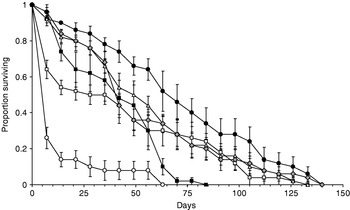
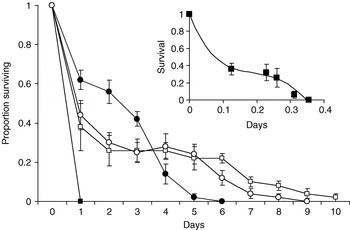
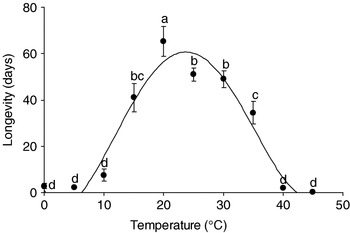
Adult survival declined over time and the decline was more rapid at low (0°C and 5°C) and high (40°C and 45°C) temperatures (figs 1 and 2). Temperature significantly influenced adult longevity (One-way ANOVA, F9,40=47.7, P<0.001), which increased with the increase in temperature from 10°C to 20°C, but declined after that (fig. 3). Adults survived up to four months in temperatures between 15°C and 30°C (fig. 1), and the maximum longevity was obtained at 20°C (fig. 3). At 40°C and 45°C, 50% of adults survived for three days and two hours, respectively, and at 0°C and 5°C, 50% of adults survived less than a day (fig. 2). As a result, adult longevity remained very low at high (40°C=2.0±0.05 days; 45°C=0.2±0.01 days) and low (0°C=2.8±1.07 days; 5°C=2.2±0.28 days) temperatures (fig. 3).
Effect of constant temperatures on the survival of C. visenda adults over time (–○–, 10°C; –□–, 15°C; –•–, 20°C; –▵–, 25°C;  , 30°C; –▪–, 35°C).

Effect of constant high and low temperatures on the survival of C. visenda adults over time (–•–, 40°C; –▪–, 45°C; –□–, 0°C; –○–, 5°C).

Effect of constant temperatures on the longevity (mean±SEM) of C. visenda adults (y=0.0004x 4−0.0342x 3+0.905x 2−4.531x+1; R 2=0.944). Fisher LSD, means with same alphabets are not significantly different (alpha=0.05).

Oviposition and incubation period
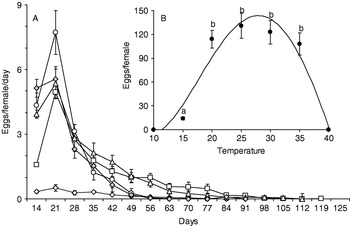
Oviposition was evident only between 15°C and 35°C; and, at all these temperatures, the average number of eggs per female per day declined over time (fig. 4a). At 20°C and 25°C, females continued to lay eggs for up to 12 weeks (fig. 4a). Temperature had a significant impact on the number of eggs per female (One-way ANOVA, F 4,20=14.57, P<0.001). The number of eggs per female did not differ significantly at temperatures between 20°C and 35°C but was significantly higher than at 15°C (fig. 4b).
Effect of constant temperature on (A) the number of eggs per female per day (mean±SEM) and (B) the number of eggs per female (mean±SEM) (y=−0.588x 2+30.81x−273.83; R 2=0.856) in C. visenda. Fisher LSD, means with same alphabets are not significantly different (alpha=0.05) (–◊–, 15°C; –□–, 20°C; –▵–, 25°C; –○–, 30°C; , 35°C).

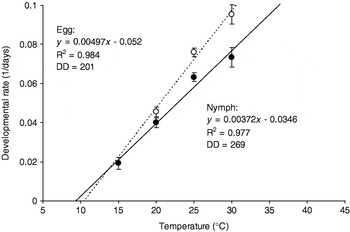
Egg hatching occurred only between 20°C and 30°C, and there was no difference in the proportion of eggs hatched within that temperature range. None of the eggs laid at ⩽15°C and ≥35°C hatched. However, exposure of less than day-old eggs of up to six hours at 35°C and 40°C had no negative impact on egg hatching. The rate of egg development increased with increasing temperature and maximum egg development occurred at 30°C (fig. 5). The DD required for egg development was 201 (fig. 5).
Effect of constant temperature on the developmental rate (day−1) (mean±SEM) of C. visenda eggs and nymphs (•, nymph; ○, egg).

Nymphal survival and development
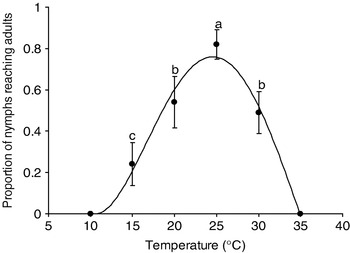
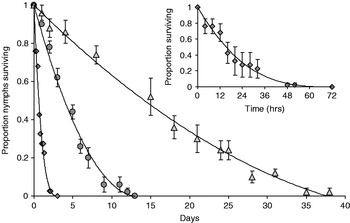
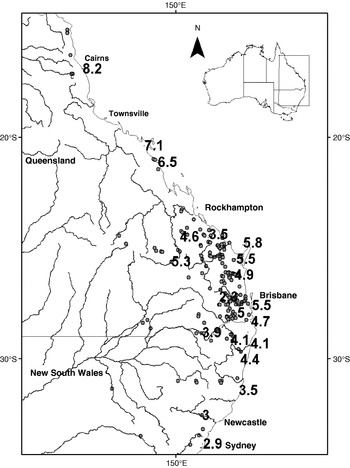
Nymphs developed into adults only between 15°C and 30°C (fig. 6), but the proportion of nymphs that developed into adults differed significantly between temperatures (one-way ANOVA, F 4,20=16.41, <0.001). The highest proportion of nymphs became adults at 25°C (fig. 6). At 35°C and 40°C, 50% of nymphs survived for five days and 12 hours, respectively (fig. 7), but none of these developed into adults. As a result, the duration of nymphal survival remained low at temperatures above 30°C (35°C=3.6±0.58 days; 40°C=15.5±4.4 hours). At 10°C nymphs survived for 16.7±0.39 days, but none of them developed into adults. The rate of nymphal development increased with the increasing temperature from 15°C to 30°C (fig. 5) and the DD required for nymphal development was 269 (fig. 5). The potential number of generations (egg to adult) the tingid can complete in a year ranged from three to eight, with more generations in Queensland than in the NSW (fig. 8).
Effect of constant temperature on the proportion of C. visenda nymphs (mean±SEM) becoming adults (y=0.002x 3+0.061x 2−0.762x+3.19; R 2=0.982). Fisher LSD, means with same alphabets are not significantly different (alpha=0.05).

Effect of constant high (40°C and 45°C) and low (10°C) temperatures on the survival (mean±SEM) of C. visenda nymphs over time ( , 35°C;
 , 40°C;
 , 10°C).

Potential number of generations that C. visenda can complete in a year in cat's claw creeper infested areas in Queensland and NSW, Australia (, cat's claw creeper; —, rivers).

Discussion
The study, though mainly concentrating on the effect of temperature, represents the combined effect of temperature and high humidity. The results suggest that eggs and nymphs have a narrower range of temperature tolerance than do adults. Eggs and immature stages are known to be more susceptible than adults in other insects also (e.g. Lale & Vidal, Reference Lale and Vidal2000). Temperatures between 20°C and 30°C are the most favourable for adult survival, oviposition and nymphal development, while egg hatching occurred only between 20°C and 30°C. Though fecundity was low at 15°C, it was not affected by temperatures between 20 and 35°C, as reported in other tingids (Cividanes et al., Reference Cividanes, Julio and Galli2004). Though the rates of decline in adult and nymphal survival were higher at low (0°C and 5°C) and high (40°C and 45°C) temperatures, both adults and nymphs survived for a few days at high and low temperatures (figs 2 and 7). Hence, it is unlikely that either higher or lower temperatures will drastically affect the tingid population, as most areas where cat's claw creeper is targeted for biological control are riparian areas, and are known to experience only limited durations (maximum of a few hours a day) of low (⩽5°C) or high (≥40°C) temperatures.
Although adults showed tolerance for wide temperature ranges (0–45°C), oviposition, egg hatching and nymphal development are all affected by both high (>30°C) and low (<20°C) temperatures. Nymphs were shown to be more susceptible to low and high temperatures than adults. Prolonged nymphal survival at lower temperatures is attributed to the species' ability to form dense aggregations, a behaviour reported in other insects also (i.e. Braman & Pendley, Reference Braman and Pendley1993; Bryant et al., Reference Bryant, Thomas and Bale2000; Danks, Reference Danks2002). At high temperatures, the nymphs exhibited thermal avoidance behaviour, by moving into the soil to avoid exposure to warm conditions, a behaviour also known in other insects (i.e. Gang & Chunsen, Reference Gang and Chunsen2007). Adults survived significantly longer than nymphs at lower temperatures, but neither adults nor nymphs exhibited any overwintering or diapause behaviour. As a result, both nymphs and adults remain active throughout the year, including the winter months in the field.
The relative humidity, though not studied here, could also affect the survival and development of the tingid. In Australia, cat's claw creeper occurs mainly in riparian areas (fig. 8; Rafter et al., Reference Rafter, Wilson, Wilmot Senaratne and Dhileepan2008), where the microclimate provides protection from frost, and the increased soil moisture would enable species to exist in areas where the macroclimate is unfavourable (Kriticos et al., Reference Kriticos, Sutherst, Brown, Adkins and Maywald2003). Although the inland areas, based on macroclimates, may appear unfavourable for the tingid due to prolonged dry and cold conditions, the riparian microclimates may remain favourable for the tingid. A previous climate-matching model also suggested that the majority of the areas with cat's claw creeper infestation in Australia are suitable for the tingid (Rafter et al., Reference Rafter, Wilson, Wilmot Senaratne and Dhileepan2008). The DD requirements of C. visenda suggest that the potential number of generations (egg to adult) the tingid can complete in a year in the cat's claw creeper infested areas in Australia ranged from three to eight (fig. 8). Similar multiple generations in a year by other tingids in the tropics have been reported (e.g. Romero et al., Reference Romero, Ravelo and Rodriguez2000; Cividanes et al., Reference Cividanes, Julio and Galli2004). Though it appears that C. visenda could complete equal numbers of generations in the inland regions as in the coastal areas (fig. 8), dry stress in inland regions may restrict the suitability of these areas for the tingid. The predictions from this study and from the earlier climate-matching model (Rafter et al., Reference Rafter, Wilson, Wilmot Senaratne and Dhileepan2008) are currently being field tested by releasing the tingid and monitoring its establishment in both inland and coastal areas of Queensland and NSW.
Acknowledgements
We thank Stefan Nesar and Hester Williams (PPRI, South Africa) for supplying tingid, Jayd McCarthy and Mathew Shortus for technical support and Wilmot Senaratne and Fernando Chandima for the ArcGIS map. Comments from Bill Palmer and Dane Panetta helped improve this manuscript.