Mareschal et al. (Reference Mareschal, Johnson, Sirois, Spratling, Thomas and Westermann2007a) is a breakthrough in that it unifies many diverse approaches, each of which gives a partial explanation for brain functionality, into a more complete and modern interpretation. Building blocks of Boolean algebra known as logic gates and models of distributed control systems can serve as elucidation for levels of regulatory states that are responsible for optimal, pathological, and developmental processes as they manifest themselves in regulatory and nonregulatory functions to impact structural development.
The immediate implications are: (1) The complexity of feedback mechanisms between all the systems involved is more than earlier assumed, and (2) The optimal functioning of development is dependent on regulatory and nonregulatory states of the brain working within the body and the environment.
Regulation was defined earlier as the ability of the organism to return to baseline after mounting specific responses to an environmental stimulus. Neurobehavioral coregulation is defined as the capacity of the organism to subordinate all neurobehavioral capacities to enhance learning that allows it to be adaptive to the environmental requirements. It is also defined as the capacity of the organism to return to balance, following the adaptation of the enhanced neurobehavioral subsystem to the environmental stimulus. These processes support the successive maturation of all neurobehavioral subsystems, while working together and in competition with each other, towards a coordinated balance by increasing or decreasing responses to each other's state.
The importance of neurobehavioral function of regulation has been identified in several neurobehavioral MRI and EEG studies (e.g., the works of Als et al. Reference Als, Duffy, McAnulty, Rivkin, Vajapeyam, Mulkern, Warfield, Huppi, Butler, Conneman, Fischer and Eichenwald2004; Duffy et al. 1994; and Hofer Reference Hofer1994). The studies from our lab (Ferber & Makhoul Reference Ferber and Makhoul2004; Reference Ferber and Makhoul2008) show the interplay between the motor and the state/sleep/awake subsystems in full-term and in preterm infants (i.e., that the motor system activation is the source of inhibition of the attention system and vise versa).
As with a distributed control system, each subsystem output is used for regulating other subsystems. Thus the subsystems can be viewed as controllers or regulators that control one another. Each regulator can be viewed as comprising numerous logic gates.
A regulator within a distributed control system maintains an output in an optimal range. According to my view, the balanced control between the subsystems exists to avoid situations of extreme arousal or decline, as noted, for example, in situations of omnipotence versus helplessness or depression versus hypomania. A hyperalert condition of a subsystem that overrides the control of the other subsystems may lead to the decline of this subsystem, as observed, for example, in bipolar affective disorders.
Boolean algebra building blocks known as logic gates may be used to construct a model for explaining neural connectivity as well as neurobehavioral subsystems. A change in a state of a subsystem can be described as the product of an excitatory input and a NOT (inhibitory) input applied to an AND (excitatory) gate. If the excitatory input is active and the inhibitory input is not active, then the gate (subsystem) output will be active. Alternatively, if the inhibitory input is active, then the gate (subsystem) output will be not active regardless of the state of the excitatory input. However, we suggest that AND gates and NOT gates describe a function of deregulation in neurobehavioral subsystems. The same is true for an OR gate, in which the output is active if one or more of its inputs is active.
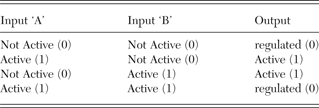
In contrast, an XOR gate which comprises 2 inputs, A and B, will have an active output if either A or B but not both are active. This could be an example for a regulated function of the neurobehavioral subsystems. See the truth table (Table 1) below:
Truth Table for XOR gate
The brain can be thought of as comprising a huge number of different types of the above mentioned basic logic gate types. Since there is a synaptic delay (the equivalent of propagation time delay in logic gates) in the operation between input activation and output change of state for every logic gate in a process, a relatively long execution time for every brain function might be expected. However, as in Boolean algebra, the rules for minimization of logic gates required to implement a logic function apply. By minimizing the number and complexity of the logic structure as above, the propagation delay time is decreased. The brain may be able to simplify complex logic functions and structures as above. This suggests the relatively minimal synaptic delay time for the complex cortical and subcortical interrelations (e.g., the impact of the limbic system and hypothalamus on the frontal control).
To explain discontinuity and nonlinear trends in development, Neuroconstructivism suggests a transition of observed behavior from one equilibrium state to another (see figure in Mareschal et al. Reference Mareschal, Sirois, Westermann and Johnson2007b, p.101, and the equation on p. 102).
Such developmental transitions are emphasized using a behavioral variable X as a function of parameter W. X grows up to a peak and then goes through a transition stage, characterized by instability and discontinuity, to another stable state which in turn grows to another peak and so on. This approach explains the macro picture of development through stages, each of which is a stable state, up to a transition point. It could also explain the interplay between the individual neural cell and its neural environment. Whenever an individual neuron is able to fire and is not regulated by other neurons, we have an unstable transition from one stable state to another. To answer one of the book's questions, I propose that the functional instability and nonregulated states may bring about structural changes which in turn are shown in developmental changes.
The brain works between peaks of arousal and decrement. Its efficient work is manifested in environmental conditions that support its interplay between peaks of neurobehavioral subsystems, up to a level of pleasure and harmony.
ACKNOWLEDGMENT
My deep thanks go to Professor Sunny Anand for his comments on the prefinal version of this commentary and to Daniel Yaron, BSc Eng. for his contribution to the final version.