In February 2004, 21 Chinese immigrants drowned in Morecambe Bay, off Britain's west coast. Working on the sand banks for sub-minimum wages collecting cockles, they fatally failed to get back to the coast before the tide came in. In May 2003, 17 illegal immigrants died of dehydration and asphyxiation as they were being smuggled into the United States from Mexico. These tragedies expose the human side of cheap labor or the “employment underclass” in the British and American economy. In using cheap labor, however, U.S. and U.K. employers are far from unique among advanced democracies. All industrialized democracies depend on cheap labor (of different kinds) for a wide range of economic activities.
In addition to low-cost immigrant workers, most advanced economies also rely on a sector of the domestic labor force with flexible and temporary contracts. The ideology and practice of deregulated labor markets has boosted the significance of cheap labor.Footnote 1 Supported for instance by the Organization for Economic Cooperation and Development (OECD), these policies foster the development of unprotected outsider positions (filled with part-time and fixed-term workers) and deepen the division between protected, unionized workers and those denied these rights.
Governments have promoted cheap labor in a variety of ways. Punitive workfare policies, formulated as conditional systems imposed on recipients of income and unemployment support, are designed both to restrict access to social benefits and to push those receiving them into the labor market, often through filling the least well-paid and least protected jobs.Footnote 2 Although exhortations about improving skill levels through training are common in most industrialized democracies, they are often just a cover for deregulation and greater labor market flexibility. That is, developing training programs is defended as a means to maintain the pool of cheap labor rather than substantially to reduce its size. By directing those on benefits into mandatory work programs, these schemes complement the perpetuation of a structural cheap labor pool.
Scholars have neglected the political significance of these labor market trends. This is surprising given the historical importance of labor in capitalist democracies. Whether victorious or suppressed, organized labor is a significant part of the twentieth-century narrative. Labor drove the expansion of the welfare state during the postwar consensus.Footnote 3 In some countries this consensus was formalized in corporatist institutions uniting labor and employers. In others, the institutions were weaker and less legitimate, as in the reluctant acceptance in the U.S. of the right to unionize.
In most industrial democracies, the power of organized labor has been under severe threat since the 1970s, tested variously by the ideological shift to neo-liberal market polices, oil crises and economic recessions, the reduction of employee protection rights in order to increase labor market flexibility, and the decline of class-based allegiances in the face of invigorated cultural sources of identity including race, ethnicity and religion. In this new setting, how can labor's traditional concern with a core of protected workers be transformed into a concern with an economy's weakest workers? In other words, can the Left's focus on equality—symbolized in the phrase “bread and roses” voiced by women workers striking for equal pay in early twentieth century America—be extended to cheap labor?
In this article we provide a framework with which to conceptualize the political economy of cheap labor in advanced democracies.Footnote 4 The empirical evidence we present below is preliminary but nonetheless sufficient to illustrate the importance of the topic. If nothing else, we would like this paper to convince readers that cheap labor needs to be the focus of comparative politics. Our data shows that cheap labor is a significant part of the political economy of industrialized nations and we hope our analysis will challenge other scholars to produce better evidence as well as alternative models to explain these developments.
Theorizing Cheap Labor
The first step in our argument concerns the definition of cheap labor. We propose that to understand the politics of cheap labor since the end of the “golden age of social democracy” the weakest members of the labor market need to be divided into two structural groups: those in standard and those in nonstandard employment. Standard employment includes what the OECD calls “regular jobs” (i.e., jobs with non-temporary non-part time contracts). Nonstandard employment includes jobs with temporary and part-time contracts. As we shall explain in more detail, because a majority of immigrant workers hold jobs that are either illegal or nor fully protected, we also include them with the nonstandard employment group.
Our analytical point of departure in defining cheap labor is to divide workers into insiders and outsiders, the former defined as those workers occupying highly protected jobs and the latter as a group of workers who are either unemployed or precariously employed. We adopt Rueda's category of “outsiders” to define a pool of cheap labor whose members share three characteristics: low levels of pay; low levels of employment protection, if any; and low levels of benefits, if any.Footnote 5
Our focus on low pay, low benefits, and low protection has clear implications in terms of the divisions between those in standard and nonstandard employment. It is incontrovertible that low pay, low benefits, and low protection can be a characteristic of standard employment. It is equally clear, however, that low pay, low benefits, and low protection are the norm for almost all nonstandard employment in industrialized democracies. Workers in this disadvantaged secondary sector change jobs frequently but across a pool of low paid, unskilled positions; the working conditions they face are commonly grim with few rights or protection; the positions themselves are unstable often with no real notice about being laid off; there is little on-the-job training; and earnings are flat, neither rising with experience nor length of employment. Often those working in these sectors come from ethnic minorities or new immigrants and many are women and young people. Skill levels and opportunities for training are crucial to the reproduction of dual labor markets, so to be locked into a secondary sector that excludes access to training is commonly fatal.Footnote 6
Developing accurate and adequate measures of the pool of workers falling within the cheap labor sector is complex. It is possible to some extent to measure not only the number of workers in cheap labor but also their “cheapness” directly for standard employment. For this, we can measure the percentage of the labor market in low pay as well as the extent of their low pay, low protection, and low benefits. But presently available data make the direct measurement of nonstandard employment much more difficult. Although it is not impossible for high-skilled and well-remunerated workers to opt for unorthodox and highly flexible employment contracts, there is an abundance of data showing that nonstandard employment in the OECD is characterized by low pay and minimal levels of benefits and protection. We propose using temporary employment, part-time employment and number of immigrants to measure the prevalence of cheap labor in nonstandard employment.
The first challenge in our empirical analysis, then, is to show that there is a relationship among the different characteristics constituting standard and nonstandard cheap labor: that is, that there is a structural category of “cheap labor” in advanced democracies. Our argument necessitates that a relationship exists among low pay, low protection, and low benefits so that these factors can convincingly be considered part of what we have called cheap labor in standard employment. More importantly, we need to show that the cheapness of labor in standard employment is in fact correlated with its use. Our framework implies that cheaper labor should be associated with heavier reliance on it in standard employment. Logically, we must also show that temporary employment, part-time employment, and immigration are related to form what we have called cheap labor in nonstandard employment.
Our second goal is to reconceptualize our vision of the comparative political economy of industrialized democracies, given existing patterns in the use of cheap labor. It is striking that within the rich flowering of comparative political economy in the last two decades cheap labor is either a missing or underspecified factor. The dominant tendency in explaining cross-national variations has been to concentrate either on labor market “insiders” or on capital and employers conceptualized as firms.Footnote 7 Most studies generally overlook the role of low-paid, unprotected workers as a distinct category.Footnote 8 Scholars associated with the influential “varieties of capitalism” approach formulate a distinction between coordinated market economies and uncoordinated market economies and maintain that the former, coordinated economies, depend on a work force with high industry-specific or firm-specific skills.Footnote 9 According to Kathleen Thelen, for instance, in coordinated market economies both labor and employers have chosen a trajectory of “high-quality, high-skill, high value-added production strategies” that appears to eliminate problems associated with the use of cheap labor.Footnote 10 We disagree. Given that all countries make use of cheap labor, we argue that advanced economies are in fact more similar than they seem.
While the presence of a pool of cheap labor and marginal workers is often seen as a structural feature of capitalist societies and a historically identifiable phenomenon,Footnote 11 the development of coordinated market economies should have signaled its eclipse. The persistence of cheap labor clashes with the expectation that some advanced capitalist states have moved to an era in which regulated systems of worker protection would extend to all citizens.Footnote 12 Cheap labor has not dissipated in those countries where the welfare state is at its most generous as we show below. This prompts us to question the traditional understanding of the relationship between politics and protection in both liberal and social market economies.
The third and final part of our argument concerns the existence of a tradeoff between standard and nonstandard cheap labor. The logic for this relationship is simple. Assuming that there is a widespread need for cheap labor, facilitating the supply of cheap labor in the standard sector should allow economies to rely less on the nonstandard sector. Conversely, economies that protect the standard sector need to turn to the nonstandard sector for their cheap labor. The analysis below finds that liberal market economies obtain their share of cheap labor from those in standard employment. Europe's social market economies, on the other hand, are much more generous in their protection of standard employment and have turned to nonstandard employment (including immigration) for their supply of cheap labor.
Contrary to the dichotomy between “social Europe” and “liberal America”Footnote 13 we contend that European economies need cheap labor as much as the U.S. They simply obtain it in a different way, by promoting nonstandard employment and (often illegal) immigration.
Cheap Labor in Standard Employment
Number of Workers in Standard Cheap Labor
Perhaps the simplest way to look at the significance of cheap labor in standard employment is to measure what the OECD calls the incidence of low pay in industrialized democracies. In table 1, we measure low pay as the percentage of full-time wage-earners earning less than two thirds of the economy-wide median wage (of full-time earners).Footnote 14 Wages in this instance refer to the hourly earnings of full-time workers. The higher the proportion of workers in this category for a country, the greater the incidence of low pay.
Incidence of low pay in standard employment

Notes: Source for all countries: OECD wage database, 2005. Except Austria, Belgium, Italy, Portugal and Spain, OECD wage database, 1999.
For each country, the table provides the mean value for low pay for the years in which data is available between 1970 and 2004. This measure of the incidence of low pay refers to gross income from employment for individuals: other sources of income (such as government transfers, self-employment, income from capital, etc.) are disregarded and the distributive effects of taxation and income pooling within households are excluded. The data are restricted to full-time employees.
The data have been organized in order of decreasing reliance on cheap labor in standard employment. The countries closest to the top of the table are those in which cheap standard labor is most common. Table 1 reveals important cross-national variation in the incidence of low pay in standard employment. For all the countries in the table, the average incidence of low pay in standard employment is 14.73. In other words, almost 15 percent of full time wage earners earn less than two-thirds of the median. Cheap standard labor is abundant in some liberal market economies (the U.S., Canada and the U.K. being at the top of the table with more than 20 percent of full-time wage earners in cheap standard employment). But another liberal economy, Australia, is much lower in the table with only 14 percent (between two continental coordinated economies, Germany and the Netherlands with very similar figures). A Mediterranean economy, Italy, is on the other hand as reliant on standard cheap labor as the U.K. (with more than 20 percent of wage earners in cheap employment).
Low Pay in Standard Employment
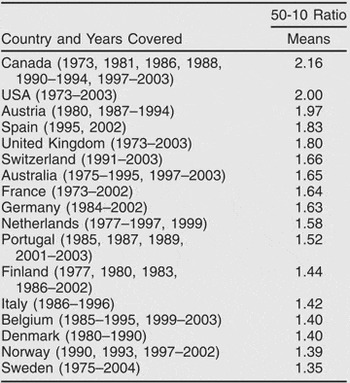
To assess the cheapness of labor in standard employment we look at the wages of those close to the bottom in comparison to those at the middle of the wage distribution. In table 2, we measure low pay as the ratio of the hourly earnings of a full-time worker in the 50th percentile of the wage distribution (someone whose earnings are at the median for all workers) relative to a worker in the tenth percentile. The higher this ratio is, the cheaper the standard employment. Greater values of the 50–10 ratio mean that the earnings of a worker in the tenth percentile of the wage distribution are smaller as a proportion of the earnings of a worker getting the median wage.Footnote 15
Low pay in standard employment

Notes: Source for all countries: OECD wage database, 2005. Except Austria, Belgium (1985–1995), Italy, Portugal (1985–1989) and Spain (1995), OECD wage database, 1999.
For each country, the table provides the mean value for low pay for the years between 1973 and 2003. The data have been organized in order of decreasing cheapness of standard employment. The countries closest to the top of the table are those in which standard labor is cheapest. As was the case in table 1, table 2 brings to light important cross-national differences in the levels of low pay in standard employment. In these seventeen countries, the average 50–10 ratio for the 1973–2003 period was 1.64. In other words, a person in the fiftieth percentile of the wage distribution (the wage median) earned, on average, 1.64 times as much as a person in the tenth percentile. Standard labor is very cheap in some liberal market economies (Canada and the U.S. being at the top of the table). But this is also the case in some coordinated market economies (like Austria or Switzerland) and Mediterranean ones (like Spain or even France).
Low Protection in Standard Employment
Achieving some rights of protection at work is a fundamental demand of organized labor. Employment protection legislation establishes rules about unfair dismissal, the conditions under which layoffs for economic reasons are permissible, severance payments, minimum periods of notice required to be followed by employers, consultation with union representatives and administrative authorization for dismissals.
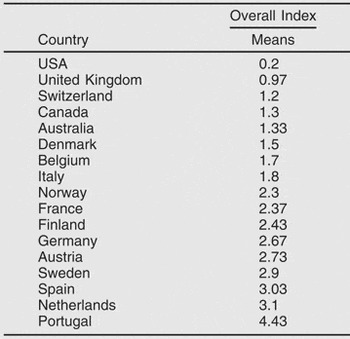
The OECD's overall strictness of protection against dismissal index emphasizes what the OECD calls “regular contracts” and therefore focuses on what we have defined as standard employment.Footnote 16 The index is constructed by averaging the scores obtained by each country in three categories: “procedural inconveniences which the employer faces when trying to dismiss employees; notice and severance pay provisions; and prevailing standards of and penalties for unfair dismissal.”Footnote 17 Conceptually, the strictness of protection against dismissal is an ideal dependent variable with which to test our hypothesis. This measure, however, suffers from the important practical limitation of being available only as a summary value for the late 1980s, the late 1990s, and 2003. Table 3 presents the index as an average for each of the countries in our sample.
Employment protection for standard employment

Notes: Source for overall index: OECD 2004a.
Once again, we have placed those countries in which standard labor is cheapest regarding job protection closest to the top of the table. And table 3 again reveals important cross-national variation in the levels of protection enjoyed by those with standard employment. It is perhaps in relation to job protection that a distinction between Liberal and Coordinated Market economies is most valid. In the Liberal Market Economies, employment protection is at its lowest (with the U.S., the U.K., Canada, and Australia close to the top of the table). In general, employment protection in these countries is much lower than in the rest of the countries in the table (Switzerland being the exception). However, the level of diversity within the European cases is notable. Countries like Belgium or Denmark have job protection levels that are closer to those of Australia or Canada than to those of Sweden, Spain, the Netherlands, and Portugal (closer to the bottom of the table). More importantly, there is a degree of agreement between the positions of the countries in tables 2 and 3. The tables suggest that a relationship may exist between low pay and low protection in standard labor.
Low Benefits in Standard Employment
Improving the assistance available to workers during periods of unemployment has been a key demand of labor since the late nineteenth century and it has affected labor market structures significantly.Footnote 18 Together with pensions, unemployment benefits constituted the earliest attempts to shape state policy in workers' interests. We use unemployment replacement rates to measure benefits in standard employment.
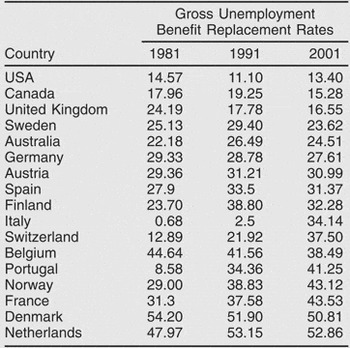
Our variable measures the average level of earnings replacement provided by public unemployment insurance. The OECD summary measure is defined as the average of the gross unemployment benefit replacement rates for two earnings levels, three family situations, and three durations of unemployment.Footnote 19 The OECD's approach rests on calculating the total benefits received by a variety of “typical” worker and household cases over a year of unemployment. The cases include three different durations of an unemployment spell for a person with a long record of previous employment, three family and income situations, and two different levels of previous earnings in work. Taking all these factors into consideration, Martin concludes that “the replacement rates refer to a 40-year-old worker who is considered a good approximation to the average situation of an unemployed person.”Footnote 20 For the purpose of this paper, these rates reflect the level of unemployment benefits that a person in standard employment receives. Given the emphasis on the long record of employment of this “typical” worker, it is unlikely that these rates could be applied to workers in the nonstandard sector of the economy.
In table 4, three points in time were chosen to capture some of the changes during this period but, as with the previous tables, we have placed those countries in which standard labor is cheapest in 2001 (in terms of replacement rates) closest to the top of the table. The table once again shows a high degree of national variation. It is true that the countries on top of the table (the U.S., Canada, and the U.K.) are Liberal Market Economies.Footnote 21 They do display very low levels of replacement rates. But the country that is next in the list is, surprisingly, Sweden, which provides public unemployment insurance replacing only about 24 percent of earnings. This emphasizes the great diversity within Europe, with countries like Sweden, Germany and Austria providing levels of replacement that are more similar to those in Liberal Market Economies than to the ones we can observe in the more generous European countries (Denmark and the Netherlands). At the same time, however, it is evident that there are patterns of cheap labor in standard employment that are common to the three tables presented above. We will argue below that a relationship does in fact exist between the variables presented in tables 2, 3, and 4.
Replacement rates for standard employment

Notes: Source for replacement rates: OECD 2004c.
Cheap Labor in Nonstandard Employment
In terms of data measurement, constructing indicators of cheap labor in nonstandard employment presents the biggest challenge. This category is of considerable importance since it covers large sections of the cheap labor pool in industrial democracies.
Temporary and Part-Time Employment
Fixed-term employment in advanced democracies is often judged to be second-class employment. There are several reasons for this presumption. First, temporary employment normally pays less than permanent employment. No less a stalwart for labor market flexibility than the OECD has to concede that the average wage gap between temporary and permanent workers is non-trivial, reaching over 45 percent in some countries.Footnote 22 In calculations to control for age, skills, and other individual factors there is still a significant wage differential between those in permanent and those in temporary employment. Second, temporary employment provides fewer benefits and protection than permanent employment. This is often the case even in countries where statutory benefits apply to all jobs. The reason for this denial of rights is that eligibility conditions for benefits and protection often require a minimum period of contribution which excludes temporary workers from the benefit system.
Another important aspect of temporary employment, but one that is difficult to capture with the data available, is its relationship to the hidden economy. Temporary employment and the hidden economy are interrelated. Employers in the hidden economy engage in two key activities: they ignore regulations concerning labor market arrangements and they undercut wage hierarchies either by paying very low wages on a hourly or daily basis (often recruiting workers each day in familiar city center gathering points in a manner reminiscent of the nineteenth century) or by using flexible cash wages which avoid such taxes as VAT or income taxation. The former feature is common practice in temporary employment of the seasonal variety—such as that associated with agricultural production—but is also found in the bottom end of the food industry.Footnote 23
Since the mid-1970s part-time employment has grown. To increase flexibility and productivity employers in many sectors have favored new production arrangements based on “working time” variations.Footnote 24 The need for flexibility to achieve international competitiveness, however, did not result in the lowering of employment protection in most OECD countries. Rather, the flexibilization of labor market legislation accomplished in the 1980s affected in most cases the entry into (not the exit from) the labor market.Footnote 25
One of the consequences of this process was a dramatic increase of part-time work to the point that, Maier argues, “whole sectors of national economies have reorganized their employment/working-time patterns around various forms of part-time work.”Footnote 26 The great majority of part-time work and temporary contracts, however, pay poorly, are concentrated in low-skilled activities, and possess precarious benefits, social security regulations, and employment rights.Footnote 27 Most analysts also agree that the majority of workers holding part-time contracts in the OECD do so involuntarily. It is often contended that some part-time workers, in particular women, acquire these contracts voluntarily but the fact that many working women do not want to work full-time does not imply that they prefer part-time jobs with precarious levels of protection and benefits.
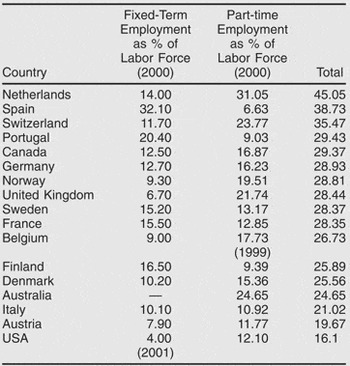
Table 5 presents data for fixed-term and part-time employment. They are presented together because there is a relationship between these two kinds of employment. Countries that promote high levels of labor market flexibility through fixed-term employment are less likely to need high levels of part-time employment. We use the OECD's definition of temporary and of part-time employment.Footnote 28
Fixed-term and part-time employment

Notes: Source for fixed-term employment: OECD Labour Market Statistics Database. Source for part-time employment: OECD 2004b, Table E.
The first thing to point out about table 5 is the extraordinarily high levels of fixed-term and part-time employment in most OECD countries. The levels in the Netherlands (45 percent), Spain (39 percent), Switzerland (35 percent), Portugal (29 percent), Canada (29 percent), and Germany (29 percent) illustrate that in these countries nonstandard employment has become a portion of the labor market that we ignore to our analytical peril.Footnote 29
The countries are ranked according to their reliance on cheap labor in nonstandard employment. Those near the top of the table make the most extensive use of fixed-term and part-time employment, while those countries ranked near the bottom do not. The data shows no clear differentiation between Liberal and Coordinated Market Economies. The U.S. is plainly the country that needs nonstandard cheap labor the least, but it is accompanied at the bottom of the table by Austria and Italy (two European economies). The same can be said about the top of the table, where the Netherlands, Spain, Switzerland, and Portugal are accompanied by Canada.
Comparing table 5 with the previous tables reveals the trade-off between standard and nonstandard cheap labor. We shall provide a more systematic analysis of this but, for the moment, it can be observed that countries at the bottom of table 5, like the U.S., had been close to the top of tables 1, 2, 3, and 4. The opposite can be said about countries at the top of table 5, such as the Netherlands, which had been close to the bottom of tables 1, 2, 3, and 4.
Immigration—Legal and Illegal
Some key characteristics of migration into the industrialized democracies are fundamentally relevant to understanding cheap labor. The number of workers in the cheap labor pool who are immigrants, whether legal or illegal, is high. Although the figures are not completely reliable and the incidence of illegal migration is likely to make these numbers even more dramatic, in Germany and France, for example, more than 70 percent of foreign employees but less than 45 percent of nationals are employed as manual workers in manufacturing or agriculture.Footnote 30
Many European countries have relied on immigrant workers in their service sectors since the 1950s. In fact in these decades immigration was promoted by countries such as the U.K., Germany, and France.Footnote 31 This pattern ended abruptly with the first oil shock in 1973, when the number of immigrants admitted was drastically reduced. The increasing economic relevance and political visibility of immigration has coincided with deepening European integration. This coincidence has prompted contradictory policies: greater internal mobility coupled with tougher policing toward aspirant non-EU immigrants. These tendencies have grown with EU enlargement. At the same time, there has been a geographic spread of immigration in Europe. Such traditionally emigrant-exporting countries as Spain and Italy began receiving immigrants just as formerly immigrant-importing nations such as Germany were closing their borders to them. The authorities in these new immigrant-importing nations have tended to think they were principally countries of first entry but, by the late 1980s and early 1990s, they had become places of settlement for a large number of illegal immigrants. In most of these states the issue of immigration has achieved extreme political salience.
Ideally, we would want to include illegal immigration into this analysis. Unfortunately, the lack of data availability makes this inclusion impossible. The difficulties in trying to measure illegal immigration are, in fact, almost overwhelming. Specialists emphasize how complex it is to determine how many times those apprehended at borders have been apprehended previously, the problem of inadequate data on those registered, and the weaknesses of surveys aimed at establishing the number of illegal immigrants. Nonetheless, despite the absence of reliable annual data on illegal immigration, we can report some general trends. One of the most important characteristics of immigration into the industrialized democracies is that there is a substitution effect between the legal and illegal kinds. The trade-off between illegal and legal immigration is particularly clear when comparing the U.S. and Europe. Estimates suggest that “illegal flows as a proportion of the population can be about a fourth larger in Europe than in the U.S. At the same time, legal flows are in broadly the same proportions (+25 percent) in the U.S. than in Europe.”Footnote 32 Illegal immigration into the EU is estimated by Europol to be about 500,000 individuals a year.Footnote 33 Illegal immigration into the U.S. is estimated to be about 300,000 individuals a year,Footnote 34 though some estimates calculate the figure to be 500,000 a year. When the U.S. tightens legal immigration this usually stimulates the flow of illegal immigrants. In Europe the migration of the 1960s and early 1970s was driven by a demand for manual workers, which receded after the oil crises. Since then, there has been a significant increase in illegal migration. Furthermore, with the collapse of the Berlin Wall in 1989 the number of illegal immigrants able to find their way to countries such as Germany, Britain, and France—already large immigrant-receiving countries—grew.Footnote 35 Lederer suggests that illegal immigration has increased between 150 percent and 300 percent in the 1990s.Footnote 36 In the Southern European Countries, illegal immigration is rampant in the informal sector of the economy.Footnote 37
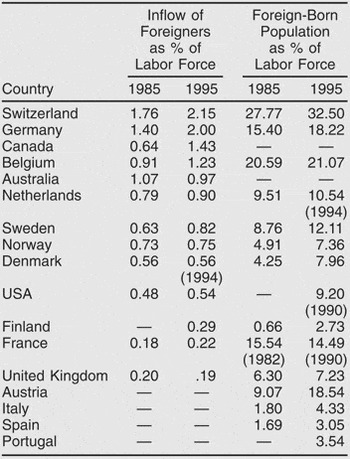
Even when we exclude illegal immigration (perhaps the most important sector for our argument) from the analysis, there are several complications attached to the existing immigration measures. First, immigration is usually measured as foreign born population or as foreign nationals. There is a lack of uniformity in national surveys and neither measure is available as a unified and consistent statistic.Footnote 38 Second, the EU excludes naturalized immigrants in its measure of foreign population. Countries in which naturalization is easier may have lower levels of official immigration. In this article, we try to get a fuller (although admittedly partial) picture of legal immigration in industrialized democracies by looking at two measures: the stocks of foreign-born population and the inflow of foreigners into a country. Table 6 presents the data for the countries in our sample.
Legal immigration

Notes: Foreigners are defined as all persons who have a foreign country as country of usual residence and who are the citizens of another country (Source: OECD Immigration Database).
Two important caveats must precede our discussion of the figures in table 6. First, as we have mentioned above, the table provides a skewed outline of immigration in the countries sampled. Data on illegal immigration would be a necessary complement to the numbers we present in the table. Second, we present the numbers of foreigners (both their inflow and stock) as a percentage of the labor force. This is done for illustrative purposes. Our data captures the total number of foreigners and does not distinguish those who are working from those who are not.
The first thing to note about the table is that the unavailability of the data on the inflow of foreigners is particularly acute in the Mediterranean cases. Only France provides data for this variable. The second feature of note is, once again, the general difficulty in making varieties of capitalism distinctions. The U.K. and the U.S. exhibit a medium to low reliance on legal immigrants, while countries like Canada or Australia (where only inflow data is available) are close to the top. The same could be said about coordinated market economies, since they display a high degree of variance (from the high levels of Switzerland, Germany. and Belgium to the low levels of Denmark, Finland, Italy. and Spain).Footnote 39
Analyzing Cheap Labor in Standard and Nonstandard Employment
Cheap Labor in Standard Employment
There are two related dimensions to our argument about cheap labor in standard employment. First, we contend that there is a relationship among the different characteristics we have defined as “cheap labor in standard employment.” We therefore expect that a relationship exists among low pay, protection. and benefits in standard employment. Second, we argue that the cheapness of standard employment is correlated with its use. Accordingly, we expect that low levels of pay, employment protection. and replacement rates are associated with an increase in the reliance on cheap labor in the countries in our sample. The logic is straightforward. Low levels of pay, employment protection, and benefits make cheap labor in standard employment cheaper. Those countries that facilitate the use of cheap labor in standard employment should therefore exhibit a high incidence of low pay (as measured in table 1).
We explore the relationships among the different components of cheap labor in standard employment in three figures. The claims summarized in the previous paragraph have a clear implication for the data presented in these figures. We expect the figures to reflect that an increase in the cheapness of standard employment is correlated with a higher reliance on this kind of labor. This should be the case for our three measures of the cheapness of standard employment: levels of low pay, employment protection, and replacement rates.
Figure 1 illustrates the association between the incidence of low pay and the levels of low pay (measured as 50–10 ratios).Footnote 40 As expected, the cheapness of standard employment is correlated with greater use of cheap labor. Cheaper standard labor is reflected in the figure as a higher 50–10 ratio (signifying that those at the bottom of the wage distribution earn less in relation to the median). The figure demonstrates that a high 50–10 ratio is associated with high incidence of low pay, with a line summarizing this relationship.Footnote 41 The figure labels each of our data points, so it is easy to identify the cases. It is clear, for example, that in Sweden in the late 1990s and 2003 and in Belgium in the late 1980s, the difference between the wages of those at the bottom of the distribution and the median is small. As a consequence, the incidence of low pay is quite modest. In the U.S. in the late 1980s, late 1990s, and in 2003 on the other hand, standard cheap labor is very cheap (as shown by the high 50–10 ratio) and its use is very high (as shown by the high incidence of low pay).
Low pay and incidence of low pay

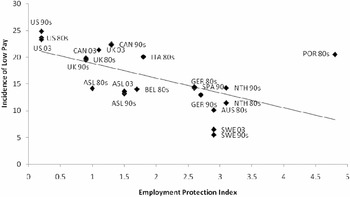
Figure 2 captures the relationship between the use of cheap labor (represented again by the incidence of low pay) and the levels of employment protection. Again consistently with our claims, when standard employment is cheaper, the incidence of low pay in standard employment grows. In the figure, low levels of employment protection coincide with high incidence of low pay while high levels of employment protection coincide with low incidence of low pay. In this case, the regression line is naturally a negative one. We can again identify some notable cases. In the U.S. (the observations for the late 1980s, late 1990s, and 2003 are grouped closely together) employment protection is very low while the incidence of low pay in standard employment is very high. Sweden in the 1990s and 2003 is a good illustration of the opposite relationship, high levels of employment protection and low incidence of low pay.
Employment protection and incidence of low pay

A pattern similar to that in figure 2 emerges from figure 3. In this graph, high levels of benefits in standard employment (measured here as replacement rates) are associated with less reliance on cheap labor. The lower the generosity of the benefits associated with standard employment, on the other hand, the higher the incidence of low pay. The regression line in the figure makes clear that cheaper standard employment is associated with higher incidence of low pay. Italy in the 1980s represents an extreme example of low replacement rates and a related very high incidence of low pay, but the observations for U.S., Canada, and the U.K. are also a good example. On the other hand, the Netherlands in the 1980s and 1990s exhibit very high replacement rates and low incidence of low pay (Belgium in the 1980s is also a good illustration of this relationship).
Replacement rate and incidence of low pay

Cheap Labor in Nonstandard Employment
We also hypothesized that there is a relationship among the variables we have defined as “cheap labor in nonstandard employment.” We therefore expect that an association exists between fixed-term and part-time employment, on the one hand, and immigration. As in the case of standard employment, we explore the connection between the different components of cheap labor in nonstandard employment by constructing some figures.
Figure 4 illustrates the association between the inflow of foreigners (measured as a percentage of the labor force) and the levels of fixed-term and part-time work (also measured as a percentage of the labor force).Footnote 42 As expected, there is a relationship between these two measures of cheap labor in nonstandard employment. As indicated by the regression line, countries that rely on larger numbers of fixed-term and part-time workers also depend on a significant inflow of foreigners. Unlike the previous figures, the number of observations makes it impractical for us to label each data point. We can mention, however, that the cluster of five observations in the upper right quadrant belong to Switzerland (1991 to 1995) while the five observations in the lower left quadrant belong to Belgium (1983 and 1984) and France (1983 to 1985).
Fixed-term and part-time employment and inflow of foreigners

Figure 5 turns to the association between the stock of foreign-born population (again measured as a percentage of the labor force) and the same measure of fixed-term and part-time work used in figure 4.Footnote 43 In this case, the expected relationship between these two measures of cheap labor in nonstandard employment is not clearly discernable. We hypothesized that a greater stock of foreign-born population would be associated with a more significant reliance on fixed-term and part-time workers. Figure 5 does not provide any evidence for this but this is perhaps not so surprising. We have explained above the numerous limitations of our measures for immigration so this part of the analysis remains, of necessity, preliminary. Nonetheless it is not without interest that, in spite of the problems with the data, the analysis of the inflow of foreigners still supports our claims.
Fixed-term and part-time employment and stock of foreign-born population

The Trade-Off between Standard and Nonstandard Cheap Labor
The final claim that we have made is that there is a trade-off between standard and nonstandard forms of cheap labor, a proposition examined systematically in this section. We have shown above that the number of people in standard cheap labor is associated with their cheapness (measured as levels of low pay, protection, and benefits). As in the preceding sections, we will take the incidence of low pay in regular jobs as our measure of the magnitude of standard cheap labor. We can compare this variable with our measures of cheap labor in nonstandard employment (fixed-term and part-time employment, on the one hand, and immigration on the other). Our argument's implications are quite straightforward. We have claimed that the need for cheap labor is widespread and not limited to liberal market economies. We therefore expect that those economies that facilitate the availability of cheap labor in the standard sector will not need to rely on cheap labor in the nonstandard sector. In contrast, we expect economies that limit the use of cheap labor in the standard sector to have no choice but to turn to the nonstandard sector for their cheap labor.
The availability of the data (both in terms of country and year coverage) limits the number of observations we can marshal to explore our claims. Nevertheless, we can produce three figures that get at the heart of the relationship between the use of standard and nonstandard cheap labor in industrialized democracies. They capture the relationship between the incidence of low pay in standard employment and our three measures of cheap labor in nonstandard employment: fixed-term and part-time employment, inflow of foreigners, and stock of foreign-born population.
Figure 6 shows the relationship between the incidence of low pay in standard employment and the levels of fixed-term and part-time work.Footnote 44 As expected, there is a negative association between these measures of cheap labor in standard and nonstandard employment. As indicated by the regression line, countries that rely on abundant cheap labor in standard employment (signified by a high incidence of low pay) do not need as significant a supply of fixed-term and part-time workers. Where fixed-term and part-time employment is prevalent, on the other hand, the incidence of low pay in standard employment is low. Once again, the number of observations makes it impractical for us to label each data point. We can illustrate the variation in the figure, however, by pointing out that the observations with the highest levels of fixed-term and part-time employment (and the corresponding low incidence of low pay in standard employment) belong to the Netherlands (1994 to 1999) and to Spain (1995). On the other hand, the observations with the lowest levels of fixed-term and part-time employment (and the corresponding high incidence of low pay in standard employment) belong to Italy (1986 and 1987) and Belgium (1983 and 1984).
Fixed-term and part-time employment and incidence of low pay

The association between the incidence of low pay in standard employment and immigration is depicted in figures 7 and 8.Footnote 45 Whether we use a measure of immigration capturing the inflow of foreigners or the stock of foreign-born population makes little difference to our analysis. The figures confirm once more the expected negative association between the measures of cheap labor in standard and nonstandard employment. As was the case in figure 6, the use of cheap labor in standard employment (i.e., a high incidence of low pay) coincides with both low inflows of foreigners and low stocks of foreign-born population. Conversely, countries that do not use cheap labor in standard employment in a significant way rely on larger inflows of foreigners and larger stocks of foreign-born population. We can illustrate the variation in the figures by noting that the observations with the highest inflows of foreigners and stocks of foreign-born population (and the corresponding low incidence of low pay in standard employment) belong to Germany (1989 to 1993, in the case of inflows) and to Belgium (1981 to 1987, in the case of stocks). On the other hand, the observations with the lowest inflows of foreigners and stocks of foreign-born population (and the corresponding high incidence of low pay in standard employment) belong to the U.K. (1984 to 1995 in the case of inflows) and to Italy (1986 and 1987), Portugal (1990 to 1993), and Spain (1995) in the case of stocks.
Inflow of foreigners and incidence of low pay

Stock of foreign born population and incidence of low pay

Aggregating Standard and Nonstandard Cheap Labor
At this point we want to identify and correct one potential criticism of the analysis. A critical reader might concur about the importance of cheap labor but still wonder about the substantive relevance of our findings. In other words, it would be possible to argue that even if European countries have developed a significant (mostly nonstandard) cheap labor sector, it may still be the case that this sector is much more limited as a part of the labor market than the combination of standard and nonstandard cheap labor in the liberal market economies.
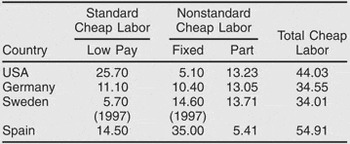
To explore this issue we can return to some of the variables used in the preceding empirical discussion. We have selected a diverse and illustrative sample of countries for which we have data. The data in table 7 is from the more recent year for which there is availability for all these variables (1995, unless otherwise specified).

Although we do not include immigration figures in the table (the previous sections have made clear the limitations of available measures), table 7 demonstrates that when the standard and nonstandard kinds are combined the total number of people in cheap labor is relatively similar in all our countries. More than 44 percent of the labor force in the U.S. can be categorized as cheap labor, a very high number indeed. But the number is even higher in a European country. In Spain, almost 55 percent of the labor force is cheap labor. Even more importantly, the social market economies of Western Europe are not that different. In Germany, almost 35 percent of the labor force is cheap labor and even in Sweden this number is 34 percent. It is indeed the case that everybody needs cheap labor and that the European social market economies have as much of a need as the liberal market economies.
Conclusion
The preceding pages are intended to support our proposition that cheap labor is an important, if presently neglected, aspect of the political economy of industrialized democracies. The presence of cheap labor exposes a significant similarity in OECD economies (all economies need cheap labor) but our empirical patterns also show important variations in how cheap labor is used in different economies. We have also shown that there is a trade-off between standard and nonstandard cheap labor and how this trade-off helps identify different clusters of countries. It is this last point that we want to focus on in our concluding section around the general question: how important politically is the presence of two types of cheap labor, standard and nonstandard?
The Political Alienation Problem
We have pointed out above that there is a major distinction within advanced industrial democracies about the extent of standard versus nonstandard employment. Thus, the amount of cheap labor that comes from nonstandard employment in the coordinated economies of Europe is much larger than that in the liberal political economies. Why does this matter? One significant conjecture is that the structure of the labor market might be expected to turn those in the most marginally nonstandard categories away from democracy by eroding its legitimacy as a mechanism associated with economic protection, declining income inequality, and political inclusion.Footnote 46 This propensity will be greater in a system which historically has delivered, through its high welfare state insider-based protection system, real benefits to workers. We might call this the political alienation problem posed by the expansion of nonstandard cheap labor.
Some political parties gain from the trends represented by a growth of nonstandard cheap labor. Those in nonstandard cheap labor have political incentives to oppose a system that provides few benefits; and those in standard positions may fear the arrival of new workers through immigration. Historically the appeal of anti-system parties to the marginal has become significant at important moments in a polity's development.Footnote 47 Factors such as high unemployment, hesitant economic growth, growing income inequalities, and globalization influence the political preferences of disadvantaged groups. This view of the potential political consequences of nonstandard cheap labor is consistent with what other authors have observed.Footnote 48 Anxiety about the destabilizing effects of nonstandard cheap labor can easily be integrated into these two visions of anti-system support in Western Europe.
The New Identities Problem
The political alienation problem does not imply that cheap labor is a naturally or automatically empowered sector easily mobilized to effect their preferred public policy and welfare outcomes. Far from it: collective action has become more difficult for those in cheap labor, both standard and nonstandard workers, because of the greater salience given to sources of identity other than the workplace, what sociologist Michael Hechter terms “cultural identity.”Footnote 49 The persistent marginality and political weakness of cheap labor within capitalist democracies is often associated with greater attachment to their ethnicity or race or gender than to their status as workers,Footnote 50 constituting the new identities problem. This is especially true in respect to nonstandard cheap labor, and it distances them from those workers in standard employment more routinely connected to existing parties and integration mechanisms.
Thus the growth in immigration to advanced capitalist societies has made immigrant status an important marker of self-identity for those with common experiences.Footnote 51 Cheap labor workers themselves often develop little identity rooted in occupation since they move rapidly between jobs and form their ties in terms of immigrant community networks, articulating political consciousness and action about immigrant rights rather than class-based issues.Footnote 52 The status of immigrants is also increasingly politicized. They are now often treated as the suspects of ideological extremism or as objects of hostility among anti-immigrant populist politicians, or as both.
The Collective Mobilization Problem
The endurance of cheap labor in advanced capitalist societies underlines the challenges that the most marginal parts of the labor market face when organizing collectively and the ambivalent stance of Left parties toward a part of the electorate that should be among their core constituencies.Footnote 53 This is the collective mobilization problem redefined by cheap labor. Standard cheap labor forms a substantial part of the polity but who mobilizes the members of this group? Conventional analysis gives this role to social democratic and labor parties who define themselves historically as representatives of the least well off in society. However, many social democratic parties choose to advance the interests of one sector of the labor force, insiders in standard employment, and deliberately to neglect the concerns of the outsiders.Footnote 54 It is precisely this nonstandard pool of cheap labor which has been growing most rapidly in the post-Cold War market-based capitalist democracies.
The mobilization problem correlates with how political economies are changing.Footnote 55 The effects of political parties focusing their appeal on standard workers to the detriment of nonstandard workers has only intensified since the late 1970s.Footnote 56 To adapt and succeed electorally in the new post-golden age capitalism, parties of the Left have opted to sacrifice the interests and needs of nonstandard cheap labor. An example of this is evolution of the U.K.'s Labour Party since the mid-1990s under its New Labour leadership.Footnote 57
There are, however, grounds for a more sanguine view of the effects of nonstandard cheap labor. The political party system is not the only outlet for cheap labor or the only means through which it can exercise its political muscle. Historically, some grass-roots organizations have been of primary importance to making inroads into and modifying existing political arrangements and priorities. In this context the growth of movements that transcend the community/work divide in novel ways is significant. Fine maintains that community unions—that is, organizations representing low paid and cheap labor workers organized along ethnic and geographical communities rather than occupational workplace—have emerged as effective pressure groups on local politicians about a range of issues including work conditions, housing, and health.Footnote 58 This sort of organization (which is not limited to the U.S.) holds obvious potential for integrating nonstandard cheap labor into the political system and for providing a forum through which forms of identity such as ethnicity and race can be rendered an organizational and political asset rather than a liability.
In sum, exploring the problems with cheap labor should help scholars of comparative political economy think about the political effects of major labor market features of these societies hitherto overshadowed by analysts' recent absorption with privileged workers, firms, and state policy. The present neglect is unsustainable for two reasons made clear here: first, cheap labor, in its standard and nonstandard forms, is a persistent and significant structural feature of these countries; and second, we know little about the political consequences of the increasing importance of nonstandard cheap labor. Our understanding of Left parties and organized labor still reflects the now-disappearing realities that prevailed in the “golden age” of social democratic welfare states. The disadvantaging of cheap nonstandard labor and the new inequality this entails may be less significant in liberal countries but will politically test the foundations of the European coordinated market economy.Footnote 59