In many parts of the world, Tiananmen Square is the name by which a brutal massacre is remembered. For those who first learned this name along with media images of a sea of protesting students and citizens whose hopes seemed to soar high above their colorful banners, the Square stands for People Power and its tragic repression by an autocratic state. Those with some knowledge of Chinese history also know that the Square's association with the tradition of dissent goes back to the momentous May Fourth movement of 1919, long before it took on its present shape and immensity. Any geo-biography of the Square invariably starts with this foundational moment of Chinese modernity, and typically concludes with the bloodshed that upended the seven-week protest movement of 1989, also known as Beijing Spring.
Denounced as “counter-revolutionary turmoil” in official media, the events of 1989 have largely been erased from public memory in China. In official iconography, Tiananmen SquareFootnote 1 is rather the paradigmatic site for the rites of power and the acclamations of sovereignty. It was the ceremonial birthplace of the People's Republic and the center stage of May Day and National Day parades. It was also the arena in which Mao reviewed and recruited millions of Red Guards to his permanent revolution. And most recently, a spectacular military parade and a lavish song-and-dance extravaganza were staged here to mark the 60th anniversary of the founding of the People's Republic. It is clear that the two traditions are intimately bound up with each other, and that the Square has become the epicenter of dissent not only because it has always been the symbolic seat of political power, but also public political space par excellence. However, while we are familiar with how art in China has been politicized, we are less clear on how Chinese politics has been aestheticized. Addressing this lacuna, I show how a militant aesthetic suffuses the official iconography of the ur-political space of Tiananmen Square. Using the 1985 film The Big Parade (Da yuebing 《大阅兵》) (Chen Kaige Reference Chen Kaige1985) as my case study. I examine the aesthetic of the military sublime in representations of the People's Liberation Army (PLA). I argue that PLA martyrology and pageantry are what sustains the charisma of power and constitutes the nation as a militarized body politic. In conclusion, I suggest that that the sacralized political space of Tiananmen Square largely framed the political street theater of 1989 with tragic implications.
The Charisma of Power
Seeking to restore Max Weber's concept of “charisma” from its current watered-down usage to its original complexity, Clifford Geertz (Reference Geertz and Wilentz1985) stresses the link made by Edward Shils between charismatic individuals and their proximity to “the active centers of the social order.” He interprets such centers as the “concentrated loci of serious acts…It is involvement, even oppositional involvement, with such arenas and with the momentous events that occur in them, that confers charisma. It is a sign, not of popular appeal or inventive craziness, but of being near the heart of things“ (Geertz Reference Geertz and Wilentz1985, 14). One such “glowing center,” perhaps the most obvious and universal, is the state, whose ideologies and institutions impinge on the lives of the people on a scale unmatched by any other social entity. For this reason, Geertz devotes his influential essay to a thick description of what he calls “the inherent sacredness of sovereign power” (14). Sacrality, he insists, is a product of the rites and images that exert the universal will of kings, presidents, generals, führers, or party secretaries much as they do for gods. The symbolic trappings of rule are thus productive of power instead of being mere window-dressing or camouflage, and no regime has been able to dispense with them. “Thrones may be out of fashion, and pageantry too; but political authority still requires a cultural frame in which to define itself and advance its claims, and so does opposition to it. A world wholly demystified is a world wholly depoliticized” (Geertz Reference Geertz and Wilentz1985, 30). While power may grow out of the barrel of a gun, as Mao famously pronounced, it can only glow by igniting the desires and fantasies of the ruled and by basking in the mystique of popular sovereignty. It must not only intimidate, but also enchant. The CCP understood this well and put its mastery of storytelling and facility in managing “ceremonies, insignia, formalities, and appurtenances” (Geertz Reference Geertz and Wilentz1985, 15) to the service of a socialist mythology.
The symbolism of Maoist politics began with the designation of Beijing as the capital of the People's Republic. More than any other factor, it was Beijing's status as the historical center of unified “Chinese” states that clinched its selection. Jeffrey Meyer contends that “Beijing was an idea before it was a city” and that this idea was not only a political statement but, more importantly, a cosmological one: “it spoke, not in words, but in the language of architecture, mass, and space…that this Beijing was the earthly termination of the axis of the universe, the center of the world, the pivot of the four quarters” (Reference Meyer1991, 1). Traditionally, the spatial layout of Beijing forcefully expressed the idea of centrality, concentricity, and axiality, enveloping the emperor inside the palace, the imperial city, the inner and outer city, and the empire in correlation with the celestial realm, “calling upon the heavens to witness its mandate” (Meyer Reference Meyer1991, 2). As historians and historical geographers have noted, the highly schematic organization of space in Beijing mirrored the mystical impenetrability of imperial kingship. The emperor was never visible, at least in theory, to his subjects, just as gods are beyond mortal sight. Ruling on behalf of Heaven, the emperor emerged from the Forbidden City periodically to burnish his aura at the Temple of Heaven. But “the pattern of imperial seclusion” was strictly maintained on such occasions as well as when he went on tours and hunts (Esherick and Wasserstrom Reference Esherick and Wasserstrom1990, 849). At the enthronement ceremony, the emperor took symbolic possession of his empire by occupying the throne and put in order “the realm under Heaven” (tianxia) by performing the Grand Sacrifices (Zito Reference Zito1997). Sacrality was the effect of rites, which could confer sanctity and gravitas on even a boy emperor. Witness in the film The Last Emperor (Bertolucci Reference Bertolucci1987) how little it matters that the 3-year-old Puyi should wander insouciantly at his coronation, weaving his way through a forest of grim court officials only to be captivated by the gift of a pet cricket.
The ways in which Mao Zedong and his regime remade Beijing geographically and architecturally are both legendary and, to the conservation-minded, lamentable. As others have shown, the transformations were as much driven by ideological visions as by the imperative to modernize an ancient city (Barmé Reference Barmé2008; Braester Reference Braester2010a; Broudehoux Reference Broudehoux2004; Dutton, Lo, and Wu Reference Dutton, Hsiu-ju Stacy Lo and Dong Dong Wu2008; Li, Dray-Novey, and Kong Reference Li, Dray-Novey and Kong2008; Wu Reference Wu2005). In this spirit, Mao was true to the Chinese tradition of city-making as spatialization of the reigning cosmology (Wright Reference Wright and Skinner1977). A new spatial order was necessary because the cosmology by which the new regime legitimized its rule rode on the wings of an unprecedented social revolution. Never before had the wretched of the earth been exalted as the subject of history and master of the land. The new polity was predicated on the sovereignty of “the people” on whose behalf the CCP enforced the dictatorship of the proletariat against the former ruling classes and their putative allies the Nationalist Party and foreign imperialists. There is little doubt that the Party was (and is) the de facto power holder, but it could not consecrate itself without also consecrating the people—the source of its power and legitimacy. Herein lay the ideological impetus of the creation of Tiananmen Square.
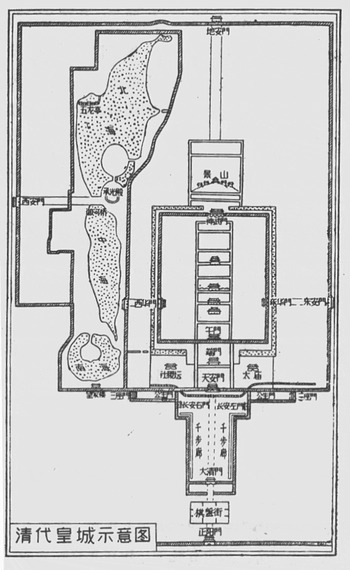
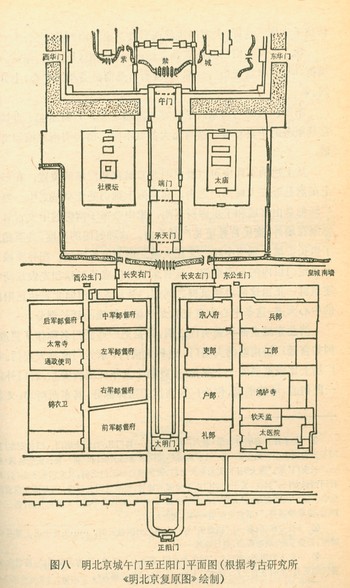
Whereas the Forbidden City was turned into a museum, its adjacent lake complex known as Zhongnanhai became the CCP leadership compound (Barmé Reference Barmé2008). But the regime still needed a space in which the sacralization of power could be enacted in a process of mutual acclamation between the Party and the people. In imperial times, Tiananmen Gate connected the imperial city to an intermediate zone of government ministries and a T-shaped enclosure for special occasions such as military reviews (figures 1&2). It was the location for issuing imperial proclamations which were received by kneeling officials in an elaborate ceremony. Crucially, the Gate was not approachable by the common folk, for the emperor had no cosmological justification for coming face to face with the latter. In razing the numerous structures in this intermediate zone and creating a flat square, the new regime did away with the mediating role of the officialdom while “permanently altering the symbolic balance between the Forbidden City and Tiananmen Square” essentially relegating the former to “backyard” status (Hershkovitz Reference Hershkovitz1993, 407). The Square would emerge as the sacred heart of public political life in the PRC and become an icon disembedded from the daily life of the city (Braester Reference Braester2010a, Reference Braester2010b). It was here that the charisma of power—with the cult of Mao as its most concentrated expression—was nurtured through a dialectic of visibility.
The Forbidden City and the T-shaped enclosure outside Tiananmen, Qing Dynasty (Cao Juren, ed. Jinri Beijing. Hong Kong: n.p. 1971, 19.)

Government ministries surrounding the T-shaped enclosure, Qing Dynasty. (Hou Renzhi, Lishi dilixue de lilun yu shijian. Shanghai: Shanghai renmin chubanshe, 1979, 239.)

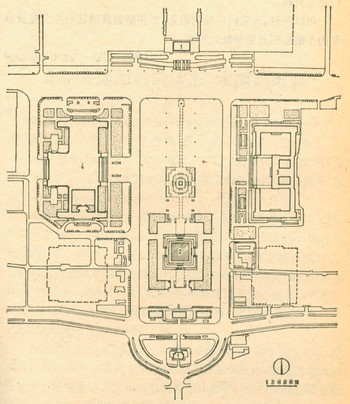
Modeled on Moscow's Red Square, Tiananmen Square was built to consecrate in spatial terms the regime's socialist cosmology (figure 3). The immensely flat space is the stage on which the people come together to proclaim their new, collective, and egalitarian subjectivity. They are here not so much to see or reach across one another horizontally as to see and to be seen by the Party and its paramount leader Mao. As the personification of the Chinese revolution, Mao must be ultra-visible at all times and in constant, unobstructed symbolic communication with his moral-political source—the people. The only way to enable this perennial hypothetical contact between the one and the many is by elevating the former on the altar-like gate tower and by hanging his giant portrait on its front side facing the Square. This explains why, according to Wu Hung, three different portraits of Mao were tried and dismissed until the 1952 version became accepted as the norm: “Compositionally, in this new version Mao's posture is perfectly frontal, and he stares straight into the viewer's eyes” (Wu Reference Wu2005, 77). This also explains why the planners of National Day parades strained so hard to facilitate the convergence of gazes between Mao and the masses so that a “shared vision” could emerge from this convergence to “endow the ceremony with a coherent meaning as a supreme representation of the people” (Wu Reference Wu2005, 95).
Contemporary Tiananmen Square. 1. Tiananmen Gate; 2. Mao Zedong Mausoleum; 3. Monument to the People's Heroes; 4. Great Hall of the People; 5. Museum of the Chinese Revolution; 6. Qianmen (Hou Renzhi, Lishi dilixue de lilun yu shijian. Shanghai: Shanghai renmin chubanshe, 1979, 249.)

However, the exchange of gazes is decidedly asymmetrical. While few individuals can actually see Mao—other than a tiny speck under the ornate eaves of the Gate, Mao's gaze in theory takes in everyone in the Square and uplifts them “to a new level of spirituality” (Wu Reference Wu2005, 99). Wu shows how pictorial representations of National Day parades habitually assume Mao's downcast perspective in making visible the living patterns composed by massed bodies (Reference Wu2005, 96–101).
Aesthetically, these pictures are the still equivalent of Leni Riefenstahl's documentary representation of the mobilized masses at the Nazi Party's Nuremberg rally in her 1935 film Triumph of the Will. Susan Sontag notes how Riefenstahl alternates between wide shots of “clean-cut people in uniforms group[ing] and regroup[ing], as if they were seeking the perfect choreography to express their fealty,” and close-ups that “isolate a single passion, a single perfect submission,” creating a cinematic dialect of “ceaseless motion and a congealed, static, ‘virile’ posing” (Reference Sontag1981, 87, 91). Susan Buck-Morss observes that the surface patterns of the mass rally “provide a pleasing design of the whole, letting the [screen] viewer forget the purpose of the display, the militarization of society for the teleology of making war” (Reference Buck-Morss1993, 142).
The National Day rally is not ostensibly for the purpose of war mobilization, yet it consecrates a militant body politic that is ever unified and ready to defend itself in a life-and-death struggle against its enemies—this is how politics is defined by Carl Schmitt and explicitly understood by Mao (see Dutton Reference Dutton2005; Schmitt Reference Schmitt1996). In the words of Ban Wang, “politics became a form of sublime art” (Reference Wang1997, 193). In arranging themselves into pleasing patterns visible to Mao but not to themselves, the masses spatially constitute themselves as “People-as-One,” an ideological fiction that can only be confirmed by the “egocrat” (Solzhenitsyn's term). In Claude Lefort's gloss, the egocrat is both a metaphorical figure of the body and its metonymic head, “both the whole and the detached part that makes the whole, that institutes it” (Reference Lefort1986, 299). By becoming identical with, indeed iconic of, the space of power that is necessarily left “empty” in a democracy, the egocrat turns mass democracy into its evil twin: totalitarianism.
As a public ceremony, the parade was invented in the self-governing towns of antebellum America where “aimlessness” was its chief characteristic. “The marchers,” writes Mary Ryan “did not set off single-mindedly for an established civic center, there to place an offering to a patron saint, profess fealty to a leader, or enact a civic pageant” (Reference Ryan and Hunt1989, 134). This lack of a plot or telos reflected the fluid and contentious nature of American society and was an ingenious exercise of popular sovereignty. Usually jointly organized by constituted authorities and a variety of social constituencies, the parade was like “a civic omnibus” (Ryan Reference Ryan and Hunt1989, 137) open to any group wishing to display itself to the citizenry. Unlike a coordinated pageant in which each is assigned a specified role, the American parade was not “the design of an auteur” but rather had multiple authors, to wit, “the thousands of marchers who carried their own chosen symbols into one composite ceremony” (Ryan Reference Ryan and Hunt1989, 133).
The National Day parade, by contrast, is anything but a disorderly and boisterous affair (figure 4). Rather, it mimics the religious ritual of sociality theorized by Emile Durkheim. As Craig Calhoun explains: “During the forty years of Communist rule, [Tiananmen Square] has been the place to which ‘the people’ have come in large crowds to witness displays of leadership and to grant leaders authority by acclamation. … True believers went there for inspiration, for a glimpse of Mao, for the most Durkheimian of collective representations of social membership” (Reference Calhoun1994, 188). Moreover, being a secular ritual means that the deity on which collective identity is projected assumes the human form, in “the untroubled image of Mao as the fountainhead of all morality, standing high above all laws and institutions” (Schwartz Reference Schwartz and Lewis1970, 168). If the emperor's authority falls largely within the personal but conventionalized “traditional authority” category, then Mao's authority is decidedly of the “charismatic” kind, almost wholly dependent on the recognition of the followers and their expectations of a radical transformation or “miracle” (Weber Reference Weber, Gerth and Mills1946, 245–252; see also Dirlik Reference Dirlik and Stutje2011). The alienation of power—the voluntary but misrecognized surrendering of agency to a higher being—may be more dangerous in the case of charismatic leadership than, say, clerical manipulation of divine authority or bureaucratic obfuscation of legal procedure. If the legitimacy of the emperor, the church, or the bureaucracy can be challenged by appealing to the mandate of Heaven, God, or law, it is much harder to question Mao the egocrat who not only embodies the Marxist Truth, but also represents the people to the people by standing above them as the sum total that is greater than its parts. In other words, Mao is closer to Heaven than any Son of Heaven could ever hope to be. With “a celestial eye,” he alone enjoys the “pleasure of ‘seeing the whole,’ of looking down on, totalizing the most immoderate of human texts” (de Certeau, 1984, 92).
The 2009 National Day Parade (http://www.boston.com/bigpicture/2009/10/china_celebrates_60_years.html)

The only complicating factor in the symbiosis between the egocrat and the People-as-One was the Party and its apparatuses for running a vast country. Mao chafed at the Party's gradual retrenchment into a routinized bureaucracy and privileged social stratum, governing the people as the powerful have always governed the powerless. In launching the Cultural Revolution, he called upon the people to attack the Party from without, hoping to restore the centrality of revolution as the driving force of history, and to refurbish the revolutionary charisma that had, in his view, been rubbed dull by the pragmatic policies and red tape of Party bureaucracy. In openly splitting with the Party, Mao stripped it of what little institutional charisma it had had and left it demystified, desanctified, and vulnerable. Thenceforth, the charisma of the Chinese revolution would be solely vested in Mao himself. A godhead figure, he mobilized the Red Guards to “reproletarianize” the Party like a prophet calling on the salt of the earth to rechristen a corrupt world in a millenarian uprising. Writing during the height of the Cultural Revolution from a half world's distance, Benjamin Schwartz predicted that once the Party was “revealed” to be a profane bureaucratic organization “devoid of any inbuilt proletarian grace or powers of self-redemption,” its institutional charisma could not be easily restored (Reference Schwartz and Lewis1970, 156). As I intend to show in the second half of this article devoted to a close reading of The Big Parade, the restoration of the Party's charisma began ritually in 1984 when the 35th birthday of the People's Republic was observed in an elaborate ceremony after a 14-year hiatus.Footnote 2 Familiar symbolic resources—particularly the military sublime—were deployed, but the ‘cultural frame” had shifted from class struggle to nationalism.
The Military Sublime
Theorizing fascism as a political religion, Emilio Gentile believes that WWI conditioned “the generation of 1914” for the interwar fascist drive to found “a secular religious faith in politics.” He writes:
The war itself, which was lived as a ‘great regenerating experience,’ contributed to the ‘sacralization of politics.’ With the myths, rituals and symbols which were born in the trenches, it provided a greater amount of material for the construction of a national religion. The symbolism of death and resurrection, the commitment to the nation, the mysticism of blood and sacrifice, the cult of heroes and martyrs, the ‘communion’ of camaraderie—all contributed to the spreading of the myth amongst soldiers that politics was a total experience which had to renew all forms of existence. Politics could not return to the banal forms of everyday life, but had to perpetuate the heroic impetuosity of the war and the mystical sense of a national community. (1990, 233)
While I by no means wish to equate the Chinese revolution with fascism, it is the similar mystification of wartime experience as purifying, unifying, and regenerating that I hope to capture with the notion of “the military sublime.” I submit that the military sublime serves simultaneously to militarize and mystify the people, and as such is a most powerful trope in the socialist project to remake the citizenry. The myths, rituals, and symbols that were born in the years of guerrilla resistance against the Japanese and civil war with the Nationalists came to constitute the PLA mythology in the founding narrative of the birth of the nation. Exalted stories of derring-do and heroic sacrifice pervaded the socialist mass media. Military personnel were the most “lovable” (zui ke'ai de) citizens and granted special entitlements and deferential treatments. Soldiery became not only the noblest profession to which every youngster aspired, but also one of the very few viable paths of upward mobility for many rural youth.Footnote 3
The army was as much a propaganda organ as a defense force. Its Central Political Headquarters (zong zhengzhi bu) oversaw over a dozen news, educational, recreational, and publishing institutions, including The PLA Daily, PLA Literature and Art, PLA Arts Academy, August First Film Studios, PLA Song and Dance Troupe, PLA Spoken Drama Troupe, PLA Publishing House, etc. In addition, each of the seven Military Regions (junqu) had its own array of educational and artistic organs. In the 1960s, utilizing its formidable command of ideological state apparatuses, the army under the leadership of Generalissimo Lin Biao, who would rise to be Mao's officially designated heir-apparent, spearheaded the cult of Mao with the compilation and publication of the “Little Red Book”—allegedly the “best-selling” book ever in world publishing history. The army was also a magnet for the literarily and artistically inclined; over the years, accomplished writers, singers, musicians, and actors steadily emerged from its well-funded and energetic cultural enterprises. Reversing the traditional Chinese disdain for soldiery, the PLA loomed ever so large in the national consciousness.Footnote 4
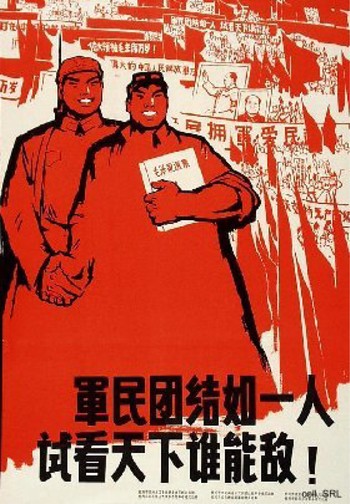
In National Day parades, the three divisions of the army—infantry, navy, and air force—always marched in the front, before the civilian sections (Wu Reference Wu2005, 99). If the proletariat was “the people in its essence” (Lefort Reference Lefort1986, 287), then the PLA was the essence of the essence. Thus, the socialist triune of gongnongbing (workers, peasants, and soldiers) named not three discrete social classes in a stratified society, each with its own interest and identity, but rather the political ideal of the People-as-One. The categorical mismatch is telling: Soldiery is a service and an instrument of state violence, not a socio-economic reality determined by the relations of production; yet it was the soldier who was held up as the socialist paragon and it was the military that was the crucible of revolutionary citizenship. In the 1960s, Mao called upon the entire nation to “learn from the PLA” and to “learn from Lei Feng”—the model soldier and exemplar of exemplars. The goal of such campaigns was to remake society in the image of the military, orderly, disciplined, and instantly mobilizable (figure 5). The army uniform would be adopted by the populace as everyday attire; during the Cultural Revolution, it would become the de facto uniform of the Red Guards. Evocative of “community, order, identity, competence, legitimate authority, [and] the legitimate exercise of violence” (Sontag Reference Sontag1981, 99), the olive green suit became a political statement, a testament of ideological orthodoxy, and a badge of revolutionary credential (see Finnane Reference Finnane2008, 231–240). Everyone was to be Mao's foot soldier—hence the ubiquity of fighting names like Weidong (“guarding Chairman Mao”) or Xiaobing (“Chairman Mao's little soldier”) bestowed on children born in the deliriously belligerent days of the Cultural Revolution.
Propaganda poster: “The unity of the army and the people is invincible.” (http://chineseposters.net/themes/pla-cultural-revolution.php)

The army's ideological leadership in society effectively erased the tensions and taboos between “those have killed and seen killing in battle and those who have not” that concern Catherine Lutz in her study of military-civilian relations in the United States (Reference Lutz2001, 230). Tales and images of mutual love and assistance abounded to diminish the distinction between civilian and military life (figure 6): A regiment unfailingly took care of an issue-less elderly by doing his laundry, sweeping his floors, and fetching firewood for his stove; a group of village women regularly visited the barracks to mend the soldiers' clothes and pushed local delicacies on them like indulgent mothers. Individual soldiers and civilians were hailed as national models (mofan) for their outstanding “Support the Army, Cherish the People” (yongjun aimin) deeds. The people's militias, as studied by Elizabeth Perry (Reference Perry2006), further broadened the project to ground citizenship in (para) military service.
Propaganda poster: “The army love the people, the people support the army; the troops and civilians are close as one family.” (http://chineseposters.net/themes/pla.php)

A central component of the PLA mythology is its martyrology. Most prominent are battleground heroes commemorated in various hagiographical accounts that highlight their sufferings in the Old Society (pre-1949 China) and their path to salvation illuminated by the Party's beacon light. The moment of death is always formulaically stylized and saturated with ideological signification: Invariably Mao's instruction or the Party's bounty would flash across the hero's mind as he (sometimes she) lies dying and, whenever possible, the last breath is expended on revolutionary slogans. There is absolutely no room to question the motivation for the sacrifice or the meaning of death. Death, the loneliest and most meaning-defying human experience, is rendered into a mimetic and transparent gesture by way, in the words of Susan Sontag, of “the fetishism of courage [and] the dissolution of alienation in ecstatic feelings of community” (Reference Sontag1981, 96). Similarly, Gentile points out that the fascist cult of martyrs addressed the problem of death through “the exaltation of a sense of community” (1990, 244). The aestheticization and de-individualization of death is indeed the essence of the military sublime: Dying a violent death on the battleground is no longer a private, finite experience, it is the rite of passage to martyrdom, revolutionary immortality, and national/communal ecstasy. In contemplating the death of a hero—his body riddled with bullets, or blown to smithereens, or charred in a conflagration—we experience the sublime birth of the nation.
Martyrological narratives also feature less spectacular but no less harrowing forms of sacrifice, such as the hardships endured by Red Army soldiers on the Long March or torture inflicted on captured underground agents in the Nationalists' prisons. They give their lives with the fiercest conviction in the cause, the most intense love of country and comrades, the most searing hatred of the enemy, and the grandest gesture of defiance. Like frontline heroes, they close their eyes in radiant beatitude, transcending the hideous reality of death and suffering. The martyr's death overwhelms us with its boundless vista of significance and renders us all immortal. As such the military sublime posits martyrdom as the ultimate source of beauty, truth, and goodness. Consider the refrain of the theme song of the 1964 war epic Heroic Sons and Daughters (Yingxiong ernü) (Wu Zhaodi Reference Zhaodi1964):
The film tells the story of a Chinese “volunteer” soldier who dies in the Korean War. The song lauds his heroism in martial hyperboles:
If the martyrological dimension of the military sublime foregrounds the fallen body, or the body imprisoned, shackled, bound, whipped, and maimed by the enemy, then the pageant dimension glorifies the erect body, or the body in uniform and at attention. If the martyr's body is necessarily singular, or one as many, the plural bodies of pageantry are many as one. The poetics of death gives way to the poetics of life, though both undergird a mythology of immortality. Here, the military sublime is experienced in the display of the power of discipline, achieved through a militant aesthetic of regularity and uniformity, an aesthetic preoccupied with “situations of control, submissive behavior, extravagant effort, and the endurance of pain” (Sontag Reference Sontag1981, 91). It is unabashedly seductive: the glistening helmet, the crisp uniform, the shining medals, the ornamental insignia, and the glinting bayonet. It should surprise no one that in the mid-1980s the PLA brought back the formal system of ranks and insignia which had been abolished in the 1960s in the spirit of radical egalitarianism. A newer set of uniforms with stiffer fabric and greater attention to style has also replaced the older shapeless fatigue-style garb.Footnote 5
When soldiers march in formation, their arms, legs, and heads fully synchronized, they merge into a super-body or human machine that has overcome the randomness, irregularity, and vulnerability of the singular, finite body of the individual. It exudes invincibility. Concerning the importance of military traffic in Renaissance city planning, Lewis Mumford writes: “the avenue is essentially a parade ground…the uniformed soldiers march down the avenue, erect, formalized, repetitive: a classic building in motion” (Reference Mumford1961, 97). Again, “the esthetic effect of the regular ranks and the straight line of soldiers is increased by the regularity of the avenue: the unswerving line of march greatly contributes to the display of power, and a regiment moving thus gives the impression that it would break through a solid wall without losing a beat” (96). For Michael Dutton, the parade ground is not only the site for the spectacular display of collective action, but is also a realm of national enchantment, “for behind each display of bodily precision [lies] the sacred duty of each soldier to give and to take life” (Dutton Reference Dutton2010). When a society is modeled on the army, the geometric aesthetic of the military march would completely displace the American brand of town parade. And the disciplinary model of political theology would completely displace the dissentious model of democratic politics. The people are to make no mistake about it: the only legitimate way to amass in public space is the military-geometric way. It is this aesthetic-political imperative that comes under scrutiny in the film The Big Parade.Footnote 6
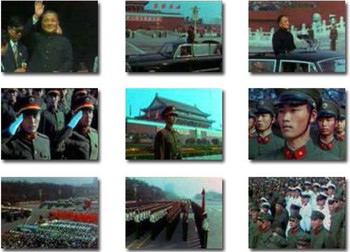
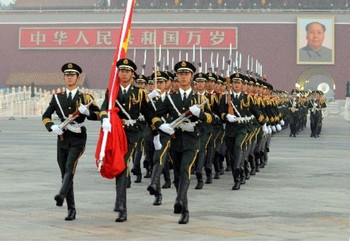
Immediately on the heel of their successful collaboration in making the “5th generation” classic Yellow Earth (Huang tudi 1984), Chen Kaige (director) and Zhang Yimou (cinematographer) turned their attention, somewhat uncharacteristically, to a contemporary event: the celebration of the 35th anniversary of the national founding.Footnote 7 It was the largest officially organized mass congregation in Tiananmen Square since Mao reviewed the Red Guards there in 1966. It was widely regarded as an event orchestrated to shore up the tattered image of the Party in the wake of the Cultural Revolution and to bolster the new leadership of Deng Xiaoping (figure 7). Now that Mao had been buried (albeit still on display in a glass sarcophagus), the Party needed to recoup and re-focus the charisma of the Chinese revolution. It did so by transforming itself into a nationalist party in charge of the developmental programs of the Four Modernizations, christened as the “new Long March.” From now on competition would replace struggle and the tried and true socialist mobilizing apparatuses would be put to the service of the capitalist spirit of “each tub on its own bottom” (Duara Reference Duara, Yao and Wu2010). In the meantime, the Party strove to rein in the centripetal forces of capitalism by foregrounding the myths and rituals of nationalism. To this end, the National Flag Raising ceremony in Tiananmen Square was revamped in 1991 and became a must-see item on the itinerary of thousands of Chinese tourists, who each day brave the predawn chill of Beijing for the sake of witnessing “the daily reenactment of the birth of the Chinese nation” and reaffirming their sense of national belonging (Dutton, Lo, and Wu Reference Dutton, Hsiu-ju Stacy Lo and Dong Dong Wu2008, 2) (figure 8).Footnote 8
Photographic collage of the 1984 National Day parade (blog.sina.com.cn/s/blog_543162d70100einc.html)

An honor guard of the People's Armed Police escorting the flag to Tiananmen Square on 1 October 2008 (http://news.sohu.com/20081001/n259825791.shtml)

The PLA, as the paradigmatic socialist subject, was called upon once again to model national cohesion and purposefulness, or to embody “the regime of authenticity” even as the rest of the nation succumbed to the lure of individualism and consumerism. Prasenjit Duara defines the regime of authenticity as representations of timelessness and inviolability amidst the ceaseless change and erosion of the linear time of modernity. Figures productive of “deep affect” and embodying such values as “dutifulness, discipline, self-abnegation, sacrifice, and militancy” are prime candidates for such a representational order (Duara Reference Duara2003, 29–31). His examples are the woman, the child, the rustic, the aboriginal, and the royalty. To this list we might add the soldier. The best articulation of what it means for a soldier to inhabit the regime of authenticity comes from a member of the People's Armed Police (a paramilitary unit closely affiliated with the PLA) honor guard in charge of the daily flag raising ceremony in Tiananmen Square in an interview: “We don't smoke, drink, go shopping, enter karaoke bars or dance clubs, gamble, or harass women. We may live in the dusty world, but not a speck of dirt falls on us” (Sang Ye Reference Ye, Barmé and Lang2006, 320). As such, the soldier is the figure of the sublime par excellence: in him “the all-too-human is sublimated into the superhuman or even inhuman realm” (Wang Reference Wang1997, 2). His symbolic role explains why the rise of “PLA, Inc.” in the reform era was so troubling: it was difficult to hold onto the image of purity and selflessness when military personnel were knee deep in a wide range of industries and trades that had little to do with defense (see Sang Ye Reference Ye, Barmé and Lang2006, 223–234). Not surprisingly, in the late 1990s, the army was forced to divest most of its commercial enterprises (Bickford Reference Bickford and Li2006, 166–170).
Nonetheless, nothing is more effective than the military parade in renewing the army's image as the embodiment of national authenticity. It is in the perfect columns of soldiers training for the National Day parade in an empty airfield that the battered and dissentious nation can see itself as a unified entity: orderly, imposing, and invincible. The military and the Party that leads it can then emerge as the charismatic center that will lift the people out of the banal and formless everyday and its endless petty choices. Now nationalist politics, not class struggle, will “perpetuate the heroic impetuosity of the war” (Gentile 1990, 233). It also aspires be a total experience, promising emotional intensity, moral redemption, and spiritual transcendence.
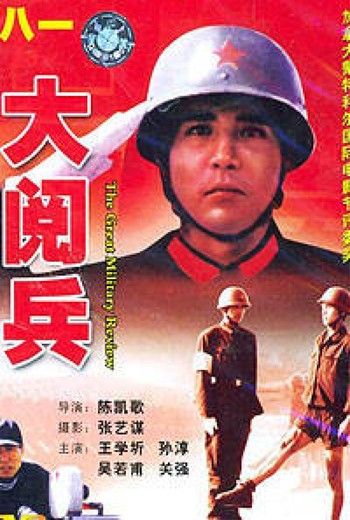
The film, however, does not approach its subject in the manner of socialist war epics such as the afore-mentioned Heroic Sons and Daughters. In place of the standard omniscient narration, The Big Parade (figure 9) is told in multiple voice-overs, particularly the pensive voice of the battalion commander Li Weicheng.Footnote 9 The camera dwells extensively on individual soldiers, with many close-ups of sweaty bodies and gleaming faces. But above all, it is fascinated by how human bodies, amassed and coordinated, can achieve the impossible: how jostling bodies bursting with youthful vitality and irreducible individuality are hammered into a single machine, how jutting arms and awkward legs are forged into pliable parts, and how brooding and dreaming minds are just so many heads that turn this way and that way with mathematical precision. It institutionalizes the individualistic martial arts tradition, substituting regimentation for magic and esoterica. Here, no secret formula or divine manual is necessary, nor is there any use for a grandmaster or Daoist mystic. A company of determined men and iron discipline are all that is required.
The Big Parade poster

The sublimation of individuality is dramatized in several instances. In one scene, the 16-year-old Liu Guoqiang is found to be running a high fever and unable to maintain a steady posture on the training ground. When asked why he did not apply for sick leave, the baby-faced soldier replies:
I dunno why. Standing there among my mates, I just couldn't get the words out. It's not that I'd be embarrassed, or that I'd be afraid of sly comments. It's just…with us standing so close, I could almost hear everyone's heartbeat, and everyone could probably hear mine too. We could all hear one another's heartbeat.
These artless words speak rather vividly of the gravitational pull of the collectivity, or the super-body, which makes individual needs trivial, negligible, and even contemptible. Jiang Junbiao has slight bow legs and is teased about his dim prospects of making it through the rigorous vetting process. He therefore binds his legs tightly with bandages every night, never mind that the ensuing pain prevents him from getting much sleep and causes him to falter during drilling. Commander Li Weicheng is an epileptic, but he keeps quiet about it and begs the soldier who happens upon his prone body in the shower room to keep the secret for him. The only one who questions the entire enterprise is Lü Chun, who is shown making multiple trips to the mailroom to inquire about the admissions letter he is hoping to receive from a military academy. Soon after the rejection letter arrives, his pent-up frustration explodes into a torrent of words:
“I quit! In this day and age, who doesn't want to have a little individuality? Take a look at those four hundred soldiers. At one another's elbow day in and day out and bustling from dawn to dusk. Doing what? Walking like robots! … Instructor Sun, do you know what's on the minds of folks out there in the real world and what they are busy doing these days? Do you think we could just have a little parade and their blood would boil? Do they understand our soldiers' difficulties? Times have changed!”
In the disenchanted “real” world in which everyone is busy enriching him or herself, Lü Chun suggests, the Party's program to re-enchant it with pomp and ceremony borders on the pathetic. His outburst leaves the instructor speechless. Thereupon the beady-eyed Hao Xiaoyuan walks into the room. Hao has just been granted leave for his mother's funeral—a previous scene has shown the company seeing him off under a stormy sky on the same day. The astonished instructor asks the bedraggled Hao what has brought him back so soon. With a slight stutter, Hao replies that his folk back home are eager to see him in the parade on television, and that if he returned home and missed the great occasion, he would be deemed unfilial—more so than being absent at his mother's funeral.
Lü Chun's protest is thus summarily negated by Hao Xiaoyuan's dogged determination to realize his filial duty via service to the state. This is a potent moment in the film, as it illustrates the ideal state of human relations in a society modeled on the military. In the strictly hierarchical structure of the military, each soldier relates to another soldier merely in the capacity of his organizationally assigned identity, i.e., as an armed serviceman. All horizontal relations are necessarily mediated through the organization and its agents, the officers. In theory therefore, the only legitimate relationship is that between a subordinate and a superior in rank; the only viable horizontal connection is that of camaraderie, which is supposed to be universal, transparent, and transferrable. Any other ties, formed on the basis of kinship, native place, or sexuality, are frowned upon, discouraged, or outright forbidden.Footnote 10 It is also the totalitarian fantasy to organize society at large in this fashion, so that all horizontal, particularistic bonds—in families, neighborhoods, villages, schools, friendship circles—are dissolved and reoriented vertically to the state, so that each individual derives his or her identity solely from above, and so that society is utterly visible to power and amenable to its social engineering programs and mobilizing drives. Hao Xiaoyuan imagines that his family, like him, is so thoroughly oriented to the state that they derive utmost satisfaction not from his devotion to the memory of his dead mother or his honoring traditional kinship values and rituals, but from his partaking of the sacred rite of the state. Filiality is thus emptied of its kinship protocols and is instead inhabited by political loyalty. In other words, being filial to one's parent is meaningless or less meaningful if it is not mediated by a third term that transcends all dyadic relations—the nation-state.
The empty airfield on the outskirts of Beijing where the training is carried out is likewise emptied of any locally meaningful references. It is not so much a concrete place as an abstract, timeless space in which the soldiers are in no danger of striking root or pursuing personal projects. In one scene, the still feverish Liu Guoqiang wanders off to a nearby farm and lends a hand to a family busily harvesting wheat. But he exchanges no words with them and merely allows the teenage daughter to steal a few furtive glances at him when they are taking a break in the haystacks—a hackneyed setting for the rustic lovers' tryst. In another scene, Jiang Junbiao is taking a bath in a wooden tub. Instructor Sun Fang, the only other person in the darkened room, offers to scrub his back for him. The film has so far hinted at a special relationship between these two men, but only in the subsequent scene do we hear the full story about how Jiang once saved Sun's life by pulling him out of a pile of corpses and carrying him to safety in an unspecified war (presumably the Sino-Vietnam Border War). Shown in profile, Jiang appears lost in revelry while Sun lathers up his back. A contemporary viewer might be forgiven for anticipating a homoerotic development. Instead, Jiang tilts his head back and asks: “Little Sun, what does Beijing look like?” Clearly, even a close bond such as theirs is also mediated by the state, here couched in the familiar trope of a provincial youth's yearning for the capital city. Sun pauses and ponders for a moment but offers no answer. Perhaps it is because as an ideal, Beijing is beyond any mundane description of streets, buildings, or tourist sites.
In the end, Lü Chun returns to the training ground fully reconstructed. But the bow-legged Jiang Junbiao is let go by Instructor Sun in a show of disinterest; Li Weicheng also withdraws for the sake of not jeopardizing a performance that brooks no margins of error. Before the whittled-down regiment departs for Beijing, they gather together to put their signatures on a red flag. Those who are not bound for Beijing are given the consolation prize of signing their names first. The message is unmistakable: even if not everyone can march in front of Tiananmen, no one is left out of the national community. In his final pep talk, which a New York Times reviewer finds “painfully earnest,”Footnote 11 Li Weicheng tells the soldiers that they have altogether walked 9,993 kilometers, the equivalent of going from the northernmost tip of the country to the southernmost tip three times in goosestep, and in doing so they have used up six tons of shoe nails. “But how far will we march in front of Tiananmen? 96 steps. And it'll take us less than a minute.” Still sans irony, he likens their effort to the Long March and promises the soldiers that they will all be moved to tears in the Square. The film ends with a montage sequence taken from newsreel footage of the 1984 National Day parade. The slow motion rendition of the marching soldiers in perfect square formation seems to be the fitting denouement of a film about the tempering of those bodies for precisely such a moment, though it is said that this ending was demanded by the censors. Edward A. Gargan tells us that the censors had found the original cut “incomprehensible”: “In the end, there is no parade, just a few silhouetted individuals cast against a murky sunset. Both the army and the censors were appalled; they ordered that the film end with a majestic, nationalistic parade.”Footnote 12 In an interview, Chen Kaige admits that the military parade itself is not a cinematic novelty, but he stresses its significance as an expression of “the national spirit,” for it is all about how individual bodies amalgamate into a powerful communal body (qunti).Footnote 13 Both Zhou Xuelin (Reference Zhou2007, 73) and Yomi Braester (Reference Braester2010a, 171), point out that immediately before the tacked-on ending is a backlit shot of a soldier standing beneath a fluttering national flag, with his face completely in the shadow, signifying the erasure of individuality and the hollowness of the military aesthetic. It is logical that the ending should leave out questions of individual emotion or fulfillment, such as whether the soldiers are indeed moved to tears as they march their 96 steps pass the reviewing stands, or whether their folks back home are duly prideful when they perchance make out their native sons' visages from a sea of neatly aligned heads, arms, and legs on the television screen. Such questions are beside the point, as everyone, performer and spectator alike, is expected to lose him or herself in the military sublime.
The only genuinely ambiguous moment in the film is an extended scene of a training exercise in which the soldiers have to stand at attention under a blistering sun for three long hours. Zhang Yimou captures the scene, in the words of the same New York Times reviewer, “with excruciating immediacy.”Footnote 14 The scene is shot without any music or dialogue on the soundtrack. At some distance from the soldiers' formation is a white tent sheltering a team of medics. One by one the soldiers are overcome by the heat and thump to the ground. The ever-alert medics then rush to the inert body and carry it back to the tent for medical treatment. The intense heat makes each frame quiver slightly, giving the impression that the characters are bobbing in a sea of white light. The frequent close-ups of the soldiers' squinted eyes and parched lips are juxtaposed with shots of the medics poised—with almost comical exaggeration—to charge toward the soldiers. As the scene drags on, a sense of existential absurdity seems to creep in, forcing one to ask why human beings play such contrived games with or against one another. It might well be read as an oblique commentary on the military sublime that must inflict such pain for the sake of one minute's worth of spectacle. Chen Kaige tells an interviewer that he intended the film to explore the relationship between the individual and the collective: “I wanted to pose the question: can the individual survive amid the rushing floodlike power of the collective, or will he be swept away and destroyed? My conclusion was that he will be destroyed” (Berry Reference Berry2005, 91).
Chen Kaige's skepticism toward the collective comes through most forcefully in this particular sequence. It seems to ask: Is the pursuit of “the national spirit” worth the toll it takes of the soldiers in body and spirit? Are there any human enterprises that can justify the mechanization of human beings? The state of soldiery, to be sure, is a state of exception that presupposes the renunciation of the sovereign control of one's body and free exercise of judgment. When a soldier kills in combat, after all, it is not an act of murder liable to criminal prosecution, but rather an act of bravery deserving of eulogy and gratitude. Yet the exaltation of soldiery as a normative ideal for the population at large means that society itself has been consigned to the state of exception wherein everyone forswears the right not to kill or to be killed. Much of the fortuitous violence during the Cultural Revolution stems precisely from the militarization of society. However, the critique implied in this scene is blunted when the entire medical crew rush to the remaining soldiers the minute their three-hour ordeal is over. Symphonic music swells from the soundtrack and all the pain seems redeemed by the improbable feat just accomplished. Meaning, momentarily deferred, is now restored and reinforced.
Mumford believes that the military parade serves to both awe and intimidate onlookers: “it helps keep them in order without coming to an actual trial of strength, which always carries the bare possibility that the army might be worsted” (Reference Mumford1961, 96). But this was Renaissance Europe when the princes and their mercenary armies presided over power structures that reserved no political role for the people. The Tiananmen parades can certainly awe and intimidate the domestic population as well as foreign observers. But their purposes go beyond that. Other than the Party leaders and invited VIPs on the reviewing stands, there are usually no unorganized onlookers in the Square ready to be awed and intimidated. During the 50th National Day celebration in 1999, Beijing residents were told to stay home and enjoy the week-long festivities on television (Broudehoux Reference Broudehoux2004, 162). In an interview about the 60th anniversary celebration 10 years later, Geremie Barmé has this to say: “Apart from those up on the rostrum of Tiananmen Gate, the parade and the festivities are primarily produced for a TV audience (as well as spinoff Internet and DVD viewers). As they have for sixty long years, the residents of the capital provide the fodder, the backdrop, the crowds, and the logistical wherewithal for the lavish display, but they are not its target audience. For the most part, locals are required to stay off the streets, keep indoors, and make like the rest of the country: behave and watch the show on the tube.”Footnote 15 The implied spectators are elsewhere—in the villages and towns and cities across the country—connected by mass media and standing in a metonymic relationship to the marchers. They are “the people” and the foundation of the political order. But they are too numerous, too amorphous, and too fractious. Thus they must be absent and “represented” by the PLA as well as civilian formations created in the former's idealized image. The people are to see themselves in the marching soldiers and to recognize themselves as the absent signified. With the memory of 1989 safely repressed, the people are invited to savor the terror that such a show of force will strike into the hearts of the nation's would-be enemies, and to support arms spending that amounts to a kind of tithe paid to the nation—“our modern church,” as Michael Mann puts it (Reference Mann1988, 185). The 2009 parade is noted for its unprecedented display of advanced weaponry, signaling a shift from what Mann calls “militarized socialism” to “spectator-sport militarism” more commonly operative in Western nations (figure 10). This can be seen as the culmination of a trend since the 1990s of increasing emphasis on military technology and of downplaying the Maoist idea of the “people's war,” in reverse proportion, it seems, to the PLA's fading ideological halo.
The 2009 National Day parade (http://www.boston.com/bigpicture/2009/10/china_celebrates_60_years.html)

Coda
When college students amassed in and eventually occupied the Square unbidden by the government in 1989, the PLA troops that were called in to discharge what was essentially a police function found themselves in a tight bind. They were asked to wage an actual battle where they had only performed symbolic acts before. The protesters took full advantage of the paradox, looking to undermine troop morale with such standard communist slogans as “The people's army love the people” and “The people love the people's army.” Once the government sanctioned the use of force, the symbolic aura of the PLA is temporarily tucked away in an actual trial of strength. Yet the government did not waste time in stemming the desacralization of the army in the aftermath of June 4. The propaganda offensive centered on PLA soldiers killed by “counter-revolutionary rioters” sought to recover the charisma of power from the protesters by means of a renewed martyrological discourse and ritual.
Commentators have long noted how the student-led movement adapted the organizational structures and mobilizing tactics of the ruling regime to subversive ends (Barmé Reference Barmé1996, 17; Calhoun Reference Calhoun1994, 155–187). Particularly noteworthy is the isomorphism of symbolic practices between the state and the opposition. Elaine Chan, for example, argues that the students used the familiar techniques of drama and ritual drawn from the revolutionary repertoire to generate an aura of sacredness to their actions. In the process, they became charismatic leaders who were able to “infuse a sense of ‘we-ness’ into various sectors” so that the participants ceased to be individuals and were melded into a political community with the students at its core (Chan Reference Chan1999, 8), much like what the early Party leaders were able to achieve in the guerilla war years. Joseph Esherick and Jeffrey Wasserstrom stress the “braided” relationship between official rituals designed to consolidate the social order and subversive political theater that improvises within and beyond the former's parameters. For several weeks, the students were at the center of a theatrical community of their own making, acting out democracy with consummate skills and with astonishing effect. However, in their “symbol-laden performances” (Esherick and Wasserstrom Reference Esherick and Wasserstrom1990, 839), the leaders began to exhibit mimetic traits that made them, in the eyes of both their followers and outsider observers, the ragtag twin of their formidable opponents in Zhongnanhai. As the space for carnivalesque street theater shrank thanks to the stonewalling government, heroic, even martyrological, talk became a familiar refrain in the Square and reached a crescendo during the hunger strike. Indeed, the hunger strike was undertaken to achieve a symbolic rather than tactical purpose: to demonstrate that the students were prepared to sacrifice their youthful lives for the people and the nation (Esherick and Wasserstrom Reference Esherick and Wasserstrom1990, 856–857). In resorting to the theatrical mode of politics on the national stage of the Square, they were not merely bargaining for rights or resources, but contesting the Party's very monopoly of the charisma of power in its own terms and on its own sacred ground. It was as if the Square had heaved the students to the crest of patriotic heroism only to hurtle them down the path to martyrdom.
In other words, a movement that was enabled by a vast open square was paradoxically also hemmed in by it. Craig Calhoun points out that martyrdom became plausible because the students had taken leave of their everyday identity and wholly merged with the movement (Reference Calhoun1994). Conversely, withdrawing from the Square became inconceivable for it would have meant a complete loss of identity, and it would have made bad theater: those who broker compromise or retreat “do not live on as positive role models, much less as heroic legends” (Calhoun 1994, 267). In the end, it was the students' brilliant appropriation of aestheticized and ritualized politics that proved to be their undoing. The politics as they understood and practiced it could not be returned to the banal everyday, but “had to perpetuate the heroic impetuosity of the war and the mystical sense of a national community” (Gentile 1990, 233). In the bloodbath of June 4 that seemed to have been eagerly anticipated by some of the student leaders, one sees the specter of the military sublime still haunt the Square.
In repossessing the Square and consecrating it to the memory of the fallen PLA soldiers, the Party reclaimed the stage to complete its nationalist metamorphosis. Repackaging itself as the guardian of Chinese culture and defender of Chinese sovereignty, it renewed the charisma of power so successfully that merely ten years later students from the same university campuses that had agitated against it in the 1980s would rally behind it to protest an allegedly malicious blow to the body politic from foreign powers.Footnote 16 For all the economic and social upheavals of the reform decades, Chinese politics has remained resolutely mystified (and hence mystifying to the disenchanted and depoliticized “free world”), in the Geertzian sense that both the political center and “the opposition,” elusive as it necessarily is, reply on a nationalist mythology to define themselves and advance their claims. The Party and the students have made common cause in nationalism, a politics made all the more charismatic by a shared aesthetic of the sublime.
Acknowledgments
I would like to thank Arif Dirlik, Prasenjit Duara, Jean Ma, Tom Mullaney, Ban Wang, Eugene Wang, Jeffrey Wasserstrom, Yingjin Zhang, and the two anonymous JAS readers for their critical comments.