INTRODUCTION
Cynoscion nebulosus (Cuvier, 1830) is a commercial species named as spotted seatrout or spotted weakfish, in the Atlantic waters of Central and North America. Croakers or drums, family Sciaenidae contains more than 80 genera. The genus Cynoscion currently is represented by 25 species. These species are mainly demersal, coastal and marine but some of them inhabit deep waters. The family commonly use estuarine environments as a nursery ground in the juvenile phase and as a feeding ground in the adult phase. During the spawning season large aggregations are formed near the coastline and estuaries, and these are then exploited by artisanal fisheries (Chao, Reference Chao and Carpenter2002). The distribution range of C. nebulosus spreads from the Gulf of Mexico (15°N 83°W) to the United States coast in Massachusetts (42°N 70°W).
MATERIAL EXAMINED
An individual of Cynoscion nebulosus was caught in December 2011 during a commercial fishing trip on a sandy bottom near the Guadalquivir River estuary (36°42′N 6°26′W; Figure 1) at a depth of 10 m. The fishing gear used was a gill-net (8 cm mesh). Meristic and morphometric measurements were taken according to FAO procedures (Agger et al., Reference Agger, Bagge, Hansen, Hoffman, Holden, Kesteven, Knudsen, Raitt, Saville and Williams1974).
Map of the Gulf of Cadiz showing the proximity between the Guadalquivir River estuary and the geographical position where the specimen of Cynoscion nebulosus was caught.

RESULTS
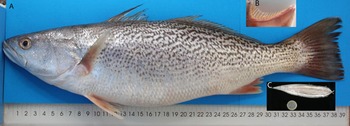
The specimen was collected and identified as Cynoscion nebulosus (Figure 2A). The identified characters in the collected species are elongate and fusiform body, large and oblique mouth, projecting lower jaw, conical teeth, two large canine in upper jaw, chin without barbels or pores, colour silvery and dark grey on back, with numerous black spots over dorsal surface and dorsal and caudal fins, large and ctenoid scales. Pelvic (ventral) fin is slightly shorter than pectoral one. This last fact is a non-matching character with those given by Chao (Reference Chao and Carpenter2002). Caudal fin shape is truncate with a large fleshy part that does not clearly allow locating margins of caudal peduncle. Stomach was empty and it was a resting female. Visceral cavity had a large amount of fat. There are ten gill rakers on lower limb of the gill arc (Figure 2B). Gas bladder is oval-elongated and has in the front side a pair of peaked appendages oriented to centre (Figure 2C) similar to the scheme presented by Chao (Reference Chao and Carpenter2002). First dorsal fin has 11 spines and second dorsal three spines and 22 soft rays. Anal fin has one weak spine and ten soft rays and pelvic two spines and four soft rays. Pectoral fin has one spine and 15 soft rays.
(A) Specimen of Cynoscion nebulosus; (B) gillrakers; (C) gas bladder.

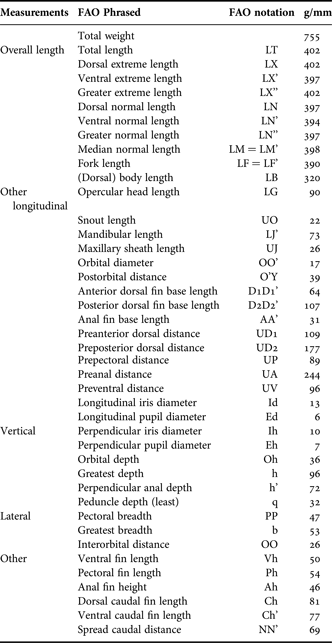
Distinctive characteristics and measurements according to the FAO Manual (units in mm; Agger et al., Reference Agger, Bagge, Hansen, Hoffman, Holden, Kesteven, Knudsen, Raitt, Saville and Williams1974) were mainly coincident with those given by Chao (Reference Chao and Carpenter2002). The data are summarized in Table 1.
Morphometric data of the Cynoscion nebulosus specimen caught in the Spanish waters of the Gulf of Cadiz.

DISCUSSION
Cynoscion nebulosus is generally a non-migratory species that inhabits marine and brackish waters, frequently in estuaries with submerged aquatic vegetation or shallow sand areas (Chester & Thayer, Reference Chester and Thayer1990). Tagging studies had suggested a close association with local environment (Iversen & Tabb, Reference Iversen and Tabb1962) and the highest distance observed from tagging location was 75 km (Tremain et al., Reference Tremain, Harnden and Adams2004).
The specimen of Cynoscion nebulosus did not show stress signs (low fat condition, colour changes or damaged digestive system) despite the great distance to the original distribution. In addition, it seemed to be quite adapted. Temperature and salinity conditions in the vicinity of the Guadalquivir River mouth (Sobrino et al., Reference Sobrino, García, Garcia-Isarch, Silva, Baro and Mas2005) are similar to tolerable ranges for habitability of this species. Highest abundance has been observed in salinities from 5 to 35 psu (Gunter, Reference Gunter1945; Tabb, Reference Tabb1966) and suitable temperature ranges from 5 to 27°C (Tabb, Reference Tabb1958).
During the last decades an important number of rare or unusual species has been detected on the east coast of the North Atlantic Ocean. Most are tropical or subtropical species (Juarez et al., Reference Juárez, Silva and Gil2008; Acosta et al., Reference Acosta, Muñoz and Juarez2009) that are spreading their distribution limits northwards (Quero, Reference Quero1998; Stebbing et al., Reference Stebbing, Turk, Wheeler and Clarke2002). Several authors linked these events with the ocean warming (Quero, Reference Quero1998; Stebbing et al., Reference Stebbing, Turk, Wheeler and Clarke2002; Poulard & Blanchard, Reference Poulard and Blanchard2005) and these shifts could have enabled the survival, adaptation and migration to this area of this allochthonous species.
The explanation for this migration could be the arrival, in their early stages (egg, larvae, juvenile) aboard tanks of ships that come from other latitudes (Juarez et al., Reference Juárez, Silva and Gil2008; Acosta et al., Reference Acosta, Muñoz and Juarez2009). Another interpretation about this report should be the connectivity by a natural transport way, the Gulf Stream. This current, through one of their branches, originates the Azores current that reaches the Gibraltar Strait (Johnson & Stevens, Reference Johnson and Stevens2000) and could explain how this species arrived at the Gulf of Cadiz.
ACKNOWLEDGEMENTS
Our thanks to the owner of the fishing boat ‘Virginia Primera’, for the collection of the specimen and hence making possible this new record for the ichthyofauna in the Gulf of Cadiz. This research received no specific grant from any funding agency, commercial or not-for-profit sectors.