Introduction: Moya Michael and Her Coloured Swans
We hear a recording of Moya Michael singing the song “Special Lady” by Ray, Goodman, and Brown, as if she is listening to it on a 1980s Walkman. The stage is pitch black. Another voice starts singing with her. This is Tracey Rose, a childhood friend of Michael's. They comment on each other's singing and giggle as if they are teenage girls in the 1980s again. The real song chimes in, and video images are projected on white and gray frayed ribbons of fabric that hang from the ceiling all the way to the black glossy floorboards. After a while, we are able to detect images of a waterfall, quivering as if they were recorded by an amateur on a Handycam. The white lines of fabric suddenly resemble this waterfall, dropping from the ceiling and crunching up when they hit the lake. The lyrics, “you must be a special lady and a very exciting girl,” fade away when Michael finally bursts through the backdrop; she is dressed in black, wears heels, and has her hair tied up neatly. She grabs the mic and addresses the audience as if she is hosting a television talk show. “Well hello! Good evening ladies and gentlemen.”Footnote 1 In the parts that follow, we are offered a collage of personal stories (we get to meet Michael's Auntie Mo) and historical references (Josephine Baker is conjured up in poetry, and Saartjie Baartman appears in a shadow play) brought to us interspersed with a wide-ranging movement vocabulary (from disciplined to abstract to free). We witness Brussels-based choreographer Moya Michael's milestone solo, Coloured Swan I: Khoiswan (2018), the first of a series and a turning point in her career after a long period of questioning what type of work she wanted to be making.
After years of working as a performer in the service of others, Michael started to make her own work only about a decade ago. When selling and presenting her work in the European contemporary dance field as well as in her homeland of South Africa, she soon noticed that her work was not being seen and/or was being seen in ways that fetishized her body and cultural identity. This experience called for a questioning of her artistry within her work environment, as she recounts:
I'm trying to figure out how to position myself in this world. In one way, I feel pressured to do it in a certain manner, and in another way I also question what I'm doing here. Am I here just because I'm African or am I here because I'm now also European? I'm questioning a lot of these things because it's important to question these things. But I don't know if my dance should be an outlet for these questions. (Michael Reference Michael2016)
Eventually, interrogating the labor conditions within the European contemporary dance field in relation to the artistic trajectory she took within it, made way for the creation of Khoiswan in 2018. This article discusses the significance of this key work in her oeuvre, and its genesis, by combining dance performance analysis with longitudinal fieldwork in the contemporary dance field of Brussels. The aim is to probe to what extent this work environment forms a breeding ground for the fetishization of Afrodiasporic artists in particular and, most importantly, to reveal Michael's prowess in the face of it. Both the issue of fetishization and Michael's responses toward this matter are bared in the particular performance as well as in the fieldwork findings in her artistic context.
Moya Michael is from Johannesburg, South Africa, and is classified as Coloured (a social construct under the apartheid government). Her dance training began with ballet in Eldorado Park, on the south side of Johannesburg, where she grew up. Later, she became part of the Johannesburg Youth Ballet that included people of different races, which was exceptional during the end of the apartheid regime in the early 1990s. She then went on to graduate with a degree in contemporary and African dance at Tshwane University in Pretoria. In 1997, Michael received a scholarship to move to Brussels, Belgium, where she furthered her dance education at the Performing Arts Research and Training Studios (P.A.R.T.S.). After graduating in 2000, she spent five years in London, where she became a founding member of the Akram Khan Company. In 2005, she moved back to Belgium, where she worked as a dancer with Anne Teresa De Keersmaeker (Rosas) and later with Sidi Larbi Cherkaoui and Damien Jalet for Eastman. Michael continues to work as a performer and freelancer with the likes of Mårten Spångberg and Faustin Linyekula, among others. Today, she is very active as a choreographer of her own work as well as commissions worldwide.
Arriving in Europe in the late 1990s, Michael's goal was to be one of the best African dancers in Europe. However, while working as a performer in what she calls “the white canon,” she gradually started to notice the subtle exoticization of her body (Michael Reference Michael2021). Although it was never very explicit, it would sometimes be intimated that her movements be more suggestive, more sensual. As she recalls, her body was “pushed into a frame to fit the white gaze” (Michael and Kanobana Reference Michael and Kanobana2021). When Michael started making her own work, she was more attracted to neutral and abstract movement, not excluding the “conceptual thing” that was going on in continental Europe at the time (Michael Reference Michael2021). In 2013, she created the choreography Darling together with Igor Shyshko, which she marks as a turning point in her career. This performance was an important step toward a collaborative and interdisciplinary methodology, in which all elements such as sound, light, and scenography are considered as equal and integral components within the process and of the performance. In collaboration with Shyshko, Michael wanted to make pure movement that was explicitly non-virtuoso (in the conventional sense of the term): “I was used to working with disciplined movement” (2019). Instead, she wanted to show skill in a different way than what was expected of her as a performer mastering all the Western techniques in her former collaborations with European-based choreographers (from classical ballet to release technique). Throughout the piece, both performers use only repetitive footwork with slight variations—seemingly simple or even amateur, but remaining complex in its choreographic totality. In their minimalist footwork of pedestrian quality, in which a split-second loss of concentration can mean a missed beat, the dancers demonstrate a very authentic vulnerability. The precise steps are accompanied by a somewhat haunting soundscape that exposes their respective pasts and associatively assembles them together. Audio fragments of traumas from the apartheid regime (Michael) and the Chernobyl nuclear disaster (Shyshko) encounter with their repetitive movements that travel through to other parts of their bodies and intensify as the sound composition builds up. In this work, Michael exposes herself by opting for a minimalist approach that eclipses her multiple consummate dancing skills while remixing her personal history in the soundscape, juxtaposing it with her collaborator's past. However, while many choreographers in Europe at that time were drawing on such postmodernist approaches to dance, whiteness seemed to expect something else from Michael: when selling Darling in both Europe and Africa, she often received the comment that this “type of work did not fit her profile” (Michael Reference Michael2021). Conceptually, this work was significant, as it was the first time that she—as a Belgian citizen in the meantime—was able to consider in-depth the layers of her cultural identity and her positioning. The next year, Faustin Linyekula created a solo for her, titled The Dialogue Series IV: Moya (2014–2016), in which these conceptual threads were also present. Exploring notions of visibility within and outside Europe, they asked themselves whether being of color is inherently political within various forms of artistic expression. Thereafter, Michael wanted to “decolonize everything [she] had learned before” (Michael Reference Michael2021).
In 2018, all these questionsFootnote 2 led to the creation of the concept for the Coloured Swans Series, exploring themes such as identity, in-betweenness, ancestry, and heritage. The first two solos of the overarching series premiered in 2018 and the third piece in 2020. Created in collaboration with acclaimed South African visual and performance artist Tracey Rose, CS 1: Khoiswan deals with Michael's own ancestry and the layers of her identity. CS 2: Eldorado explores the complexity of heritage in a solo made with and performed by American dancer and choreographer David Hernandez. Subsequently, CS 3: Harriet's reMix explores the future in relation to past and present. In this third part, Michael works with three young Belgian-born multidisciplinary artists with mixed backgrounds from the African diaspora, Loucka Fiagan, Oscar Cassamajor, and Milo Slayers. As is the case for all three parts, dance and performance are entangled with text, singing, sound collage, and video work.
The feeling of in-betweenness, which runs through the series as a core concept, is at the root of what Tia-Monique Uzor refers to as the “African diasporic identity,” which, drawing on Stuart Hall (Reference Hall and Rutherford1990), entails a plurality of identities existing in one African diasporic body (Uzor Reference Uzor and Akinleye2018, 38). Such cultural identity is not an already accomplished fact; as Hall puts it, “It is not once-and-for-all” (1990, 226). However, it is constantly in production and undergoing transformation. Importantly, one's identity may also vary according to the circumstances. In Hall's words, it is “a positioning”—a term that appears repeatedly in the many questions an artist must fill out in a project subsidy application. Thus, Michael wonders, when do artists embrace elements linked to their individuality and identity? When do they consciously decide to omit them to avoid a type of ethnic labelling? Although Darling was widely criticized by African and European gatekeepers alike, in that performing non-virtuoso and abstract dance movement alongside a white male dancer did not align with their expectations, she eventually chose to deliberately center her identity in Khoiswan in response to the systemic reduction of her work to her identity and body. Ultimately, and as we will come to understand, with this solo she puts her identity at the forefront of her artistry yet clearly on her own terms.
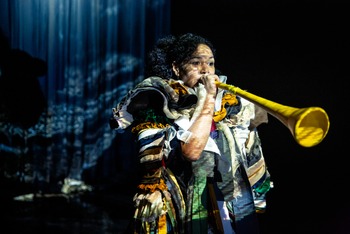
Moya Michael in costume blowing the vuvuzela. Coloured Swan I: Khoiswan (2018) © Danny Willems Photography

My relationship with Moya Michael dates back to 2013, when we went on tour together for the project Re:Zeitung by Anne Teresa De Keersmaeker and Alain Franco. Michael was the rehearsal director for the piece, and I worked closely with her in my role as the production and tour manager. Our collaboration aligned precisely with the momentum of creating and presenting Darling and the reception of that debut. Between 2014 and 2018, I conducted longitudinal fieldwork in the frame of my research on the labor conditions of contemporary dance artists in Brussels and Berlin. During that fieldwork, I was able to follow closely which struggles Michael had to overcome further as a South African maker in the European contemporary dance field trying to create and sell her work. Although the study was not set up to explore Brussels-based dance artists from the African diaspora in particular, her case revealed a struggle worth probing in that respect. I continued to work closely with Michael as an interlocutor in the development of her work after 2018. In several coaching sessions, we conversed on a regular basis about her trajectory, work experiences, and career tactics, as well as struggles with regard to her artistry.Footnote 3 In 2019, both these in-depth conversations and studio observations fed into the project subsidy application she had asked me to prepare with her for the creation of her latest work Harriet's ReMix. This particular assignment required careful listening on the one hand and tactical wording toward receiving the funding on the other hand, which in turn also fed into the conception of this article.
Methodologically, this article thus follows an ethnographic approach to studying dance and its socioeconomic, political, and cultural ramifications. In Susanne Franco and Marina Nordera's Dance Discourses: Keywords in Dance Research, dance scholar Andrée Grau examined the way identity can be seen as one of the key ideas underpinning the study of dance. She contends that “it is crucial to carry out more empirical research and listen to what dancers have to say about their experiences so as to better understand, through rigorous documentation and analysis, how they find their place in the world and how their experiences of gender, race, identity, or other, are, or are not, invoked in their artistic practices” (Reference Grau, Franco and Nordera2007, 203). If dance scholars refrain from doing so, she posits, “Dance Studies end up creating another sort of intellectual imperialism, divorced from dancers’ lives and their daily experiences” (203).
In the United States, dance artists and scholars of color in particular have long explored the ethnographic path to study dance. In the early twentieth century, dance artist Katherine Dunham was a pioneer in combining a training in anthropology with a dance practice. Her ethnographic study in the Caribbean fed into the development of her own dance technique, which “mirrored the creolization she witnessed in the Caribbean” (Dee Das Reference Dee Das2017, 5).Footnote 4 The groundwork laid by Dunham was continued in academia by a number of dance artists and scholars pursuing multimodal scholarship combining ethnography and choreographic analysis. In doing so, these scholars—among them mostly women of color—innovated dance studies with their multimethod approaches to studying AfricanistFootnote 5 aesthetic qualities in dance (e.g., George-Graves Reference George-Graves2010; González Reference González2010; Jones Reference Jones2016). Such empirical methods are especially worth practicing in exploring the theme of identity underpinning dance, returning to Grau.
My own ongoing empirical research focuses on the relation between labor and contemporary dance and examines the impact of the labor conditions, particularly in the project-based work environment, on dance performances presented in Europe (see esp. Van Assche Reference Van Assche2020). For this article, I am first returning to the qualitative data from Brussels to contextualize the work environment under discussion, which played an important role in the genesis of Michael's Coloured Swans Series and is under inquiry in Khoiswan. In doing so, this article exposes the core point in question regarding fetishization and zooms in on how this affects Afrodiasporic artists in particular. This article continues to discuss Michael's solo Khoiswan, which interrogates this specific issue and demonstrates Michael's particular prowess in the face of it. Departing from the acquired ethnographic knowledge,Footnote 6 I expose the many layers of the piece that reveal a complex entanglement with identity and body politics in the European contemporary dance field. Although I do not intend to take Michael's case as representative for all Afrodiasporic artists based on the European mainland, I do believe zooming in on her unique trajectory reveals struggles worth discussing and conflicts that can to some extent be generalized. For example, many of the testimonies in Uzor's chapter, “Negotiating African Diasporic Identity in Dance” (2018), resonate with Michael's struggles unpacked in this article, but Michael's artistic context brings in an underexplored work environment, thereby providing a valuable contribution to the existing discourse. Her trajectory, including her abilities and struggles to define her artistic work on her own terms, is undoubtedly recognizable for many choreographers of color, especially women, and is one that definitely merits attention.
Contemporary Dance and Identity Work in Europe
Michael's solo constitutes a critical inquiry into her artistic context with respect to issues concerning the body and identity, which I shall discuss under the notion of fetishization. In order to understand this interrogation ingrained in Khoiswan, I will first address the historically embedded institutional whiteness of concert dance in Belgium, whereby the contributions of Afrodiasporic artists to the formation of Belgian contemporary dance to date remain eclipsed and highly understudied. It is against the backdrop of this context that we can move on to unpack Michael's work and come to understand her particular prowess.
In the United States and the UK, a body of critical dance theory has unfolded, particularly engaging with the dance work of artists of African descent in relation to identity politics (Gottschild Reference Gottschild2003; DeFrantz and González Reference DeFrantz and González2014; Adair and Burt Reference Adair and Burt2016; Akinleye Reference Akinleye2018),Footnote 7 but their work is still seldom addressed within dance scholarship in continental Europe. In Belgium, not only have the contributions of Afrodiasporic artists been invisibilized within dance scholarship, but they have been excluded from the institutionalization of concert dance altogether throughout the twentieth century. Admittedly, the country is small but not insignificant: today, Belgium hosts worldwide appraised dance companies and continues to attract talented dance students from abroad to join its esteemed dance school P.A.R.T.S.
Belgium's capital, Brussels, is at the heart of the European Union and has long been considered a central hub of the dance scene, in which contemporary dance has come to stand for the expansion of the definition of dancing (Barba Reference Barba2016; Burt Reference Burt2016; Laermans Reference Laermans2015). Although this definition may sound rather wide-ranging, this scene is far from inclusive. In fact, Afrodiasporic artists have been and are to this day underrepresented as protagonists on the Belgian stages. Furthermore, the cultural and ethnic diversity present in BrusselsFootnote 8 is not reflected in the homogeneous institutional staff in the dance sector, neither in dance programming, nor in the public funding outcomes tethered to the city.Footnote 9 While in the United States, not only did Afrodiasporic dance artists such as Katherine Dunham, Pearl Primus, Talley Beatty, and Alvin Ailey, among others, develop their own techniques as early as the 1930s, 1940s, and 1950s, they institutionalized them by founding companies and schools across the country. Although their contributions to American concert dance history may have been largely invisibilized, the structures they built up “make claims to historical importance, durability, and relevance” (Dee Das Reference Dee Das2017, 7). In Belgium, as far as documented by dance historians and critics, there has not been a single dance pioneer of color before the turn of the century within concert dance (see esp. Vos Reference Vos2012 for 1890–1940; T'Jonck Reference T'Jonck2013 for 1980–2013).Footnote 10 Above that, the country lacks cross-cultural professional dance training programs and, to date, there is no specialized dance critic of color.
Having established this institutional context, we can advance to a better understanding of the notion of contemporary dance and how this art form appears inextricably linked with questions of identity and fetishization when studied from a labor perspective. What has come to be known as contemporary dance in Belgium is not characterized by a particular movement style, but by the expansion of the definition of dancing: all bodily activity can be classified as dance and can become an element of choreography (Barba Reference Barba2016; Burt Reference Burt2016; Laermans Reference Laermans2015).Footnote 11 Contemporary dance considers alternative approaches to virtuosity, which relate to the performer's unique presence on stage, the capacity to attract attention, and/or the ability to embody the artistic intention of the choreographer in a specific way, but at the same time to radiate something very individual as a dancer. Herein lies a core point at issue concerning how questions of identity underpin the study of dance.
In this context, a career in contemporary dance involves, among other things, the accumulation of what Pierre Bourdieu termed social and symbolic capital (1986). Contemporary dance artists utilize and develop their social capital for exploiting work opportunities, as it is “the aggregate of the actual or potential resources which are linked to possession of a durable network of more or less institutionalized relationships of mutual acquaintance and recognition” (Bourdieu Reference Bourdieu and Richardson1986, 247). This capital always functions as symbolic capital, apprehended symbolically in a relationship of misrecognition and recognition (255). Together with the professional capital (credentials), the accumulation of social capital (network of contacts) and symbolic capital (proof of recognition) is thus crucial for selling a choreographic work. Developing these forms of capital go hand in hand with identity work.
Under discussion here is both the identity work that artists undertake to sell their work to gatekeepers and the activity of being branded by institutions (with their gatekeepers) that sell that work to their audiences. This should not be confused with identity politics, which refers to a range of practices in a community to address the various systems of oppression they encounter in relation to the wider sociocultural context, which in many cases can be a response to identity work. Whereas this article considers specific aspects of identity work under the notion of fetishization, it also attends to identity politics through revealing Michael's prowess in the face of fetishization. In the remainder of this section, I set out some of the fetishizing mechanisms to frame the context that brought forth Khoiswan in order to proceed to the performance analysis that manifests Michael's prowess.
My longitudinal studyFootnote 12 concluded that contemporary dance artists in Europe maneuver in a largely symbolic economy, which incites gatekeepers to make their selections based on the identity of a maker rather than on the qualities of the artwork itself (Van Assche Reference Van Assche2020, 141). Artists do not always have control over how they are perceived, presented, and promoted: sometimes gatekeepers create certain expectations, determined by artists’ inherited as well as accumulated cultural, social, and symbolic capital, about the sort of work that they should (not) make. In turn, artists sometimes find themselves conflicted about whether to abide by these expectations, even though this profiling might not always match with how they see themselves (i.e. risk management), or ignore the expectations, even though this might come to hamper their work opportunities (i.e. risk taking).
Although the study has revealed that this logic is a fetishization that all queried artists face, in what follows, I enhance on how the fetishist gaze affects contemporary dance artists to a different degree. Despite their agenda of decolonization, the cultural institutions in Europe are still largely run by white, middle-class, European-born, and predominantly male gatekeepers. In this work environment, the fetishization addressed may tie in and intersect with exoticization on the one hand and tokenism on the other. In the latest overview of the arts landscape in Flanders that is composed every five years, a chapter is dedicated to the state of affairs regarding ethnic-cultural diversity within the field (Janssens, Leenknegt, and Hesters Reference Janssens, Leenknegt and Hesters2019, 127–133). The text foregrounds that, while some voices in the debate see a hopeful sign in the increased efforts of the cultural sector in favor of diversity, others see too often an accessory in the form of a focus program or a temporary program line by a curator of color. In that sense, the efforts are limited to “an additional task to the real work” (132; my translation from Dutch). These are usually initiatives limited in time rather than a structural investment in trajectories and people who can change the institution itself. A quote from an anonymous member of the focus group, on which the report is based, states: “Access to the posts that determine artistic criteria and the definition of canon or quality remain closed or tightly guarded by gatekeepers” (132; my translation from Dutch). The text and its included testimonies expose the described fetishization in referring to a tendency to festivalize the minority, whereby white-run institutions make feeble and temporary attempts to be more inclusive.
In the past few years, smaller stage arts festivals in Belgium are indeed dedicated to programming a more cross-cultural lineup of artistic work, often under the marker of decolonizing performing arts. It seems as though contemporary dance artists from the African diaspora are almost exclusively programmed in such a festival context, as if their performances would not attract sufficient spectators if they were included in the regular venue program. For example, Same Same But Different was an international festival about decolonization and identity in 2019, curated largely by white-run programmers and hosted by a number of white-run institutions in Ghent in temporary collaboration with non-white voices such as Black Speaks Back. Connexion BXL was a festival in 2018 controlled by the nonprofit, white-run organization Connexion in Brussels that aims to foster and develop exchanges and cultural collaborations between regions of the South and the North and between South and South. Both these events were not dance specific and have not been repeated in Ghent nor Brussels. Nonetheless, we ought to take into account that not every festival with that focus can be reduced to this intention. In Brussels, Congolisation, aka the Festival Afro-Diaspora-Arts Made in Belgium, for example, developed in 2015 out of the desire to have a platform programmed by Afrodiasporic artists for Afrodiasporic artists. This festival, initiated by Pitcho Womba Konga, is entirely programmed by Afrodiasporic artists, initially to highlight the contribution of Congolese artists to the Belgian cultural landscape. Congolisation has been repeated several times in different venues (some of which were still largely white-run), whereby the latest rendition provided a look into the arts “‘from within’ diversity towards the world surrounding it, rather than a look ‘at’ this diversity,” as quoted on the website (Womba Konga Reference Womba Konga2021).
The list provided as supplementary material supports and complexifies this observation by offering an overview of all dance productions programmed at Kaaitheater between January 2018 and December 2019. Kaaitheater is the go-to venue for contemporary dance in Brussels. It specifically aims to support local artists by offering five years of residency on its grounds, and it collaborates regularly with partners to organize targeted festivals. The list entails sixty performances labelled under “dance.” These data expose that although several festivals offer a platform for putting the work of specific underrepresented artists in the spotlight in close collaboration with stakeholders, such context simultaneously reproduces segregation: in analyzing the overview, it becomes all the more apparent that the key issue is that artists of color are not featured in the program without these festival contexts. What's more even, the overview exposes that, over the course of two years, only four entries in the list are allocated to Belgian-based artists of color.Footnote 13 Moreover, and most strikingly, when singling out the Belgian-born artists of color, I must conclude that the venue did not program any at all.Footnote 14 Hence, when coupling Belgium's dance history to current venue programming, it appears that Afrodiasporic artists are to this day underrepresentedFootnote 15 on stage, unless almost solely under a fetishist label and/or as an act of tokenism.
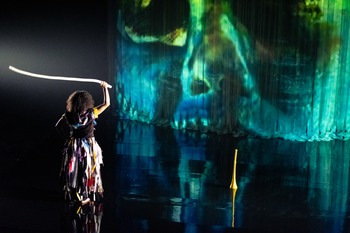
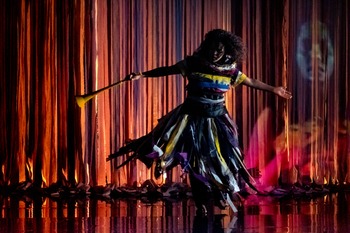
Moya Michael on stage swinging a whirly tube. Visuals of Tracey Rose are projected on the backdrop. Coloured Swan I: Khoiswan (2018) © Danny Willems Photography

A Look into Khoiswan
When returning to Khoiswan now, it should thus be comprehended within the context of the observed whiteness in the regular program of dance venues. Michael's artistry is embedded in a work environment that seems to acknowledge the work of artists from the African diaspora almost exclusively in the margin of a program, in a one-shot lineup devoted to non-whiteness. Such labelling reproduces the fetishist gaze on the artist because it advertises the artist's (exoticized) identity. In decision-making processes, not only in venue programming but also in subsidy decisions for example, fetishization additionally happens when choreographic work of Afrodiasporic artists comes with specific aesthetic and substantive expectations in terms of particular movement vocabularies with Africanist aesthetics and narratives related to one's cultural identity.
In response, the narrative for the Coloured Swans Series starts from Michael's position as a woman of color in the context of a rapidly changing demography in major cities such as Brussels, which is often disproportionate to its representation on stage. From that starting point, the series critiques binary thinking and translates the notion of in-betweenness toward a hybrid cross disciplinarity on stage. Michael comments in an early interview on the twenty years she has been living and working in Brussels:
I'm very grateful for where I worked and whom I worked with [as a performer], but there's a thing after a while that you just become the dancer—and it's fine, you know. But, I question what is valid in terms of my own work [as a maker], because I have this experience with [my debut] Darling where I performed it in Africa and people tell me it's too Eurocentric or producers say it's too personal or they love it but “it's not for the audience.” So I'm questioning what kind of work I want to make in this sense. (Michael Reference Michael2016)
Notably, she was not regarded as a “real African” by African and European gatekeepers alike, which to her remains an important part of her identity. The frustration of not being associated with the African continent led to the investigation into her African origins. It turned out that her ancestors are of the Khoi and San people, the original and indigenous inhabitants of the southern part of Africa who were labelled by the derogatory term “Hottentots” by the settlers. To this day, these people are fighting for recognition of their existence as a people. This research gave rise to Khoiswan, in which Michael encounters her personal and historical ancestors, with and through whom she critically questions her artistic context.
As we have seen, the performance sets out with Michael bursting through the backdrop, welcoming us as if she is the talk show host for the evening. After introducing her first guest from Eldo's,Footnote 16 called Auntie Mo, Michael goes on to perform a schizophrenic monologue with her invisible aunt. Thrilled about seeing Michael again, Auntie Mo makes a not-so-subtle comment about her hair—“What's up with your hair?! How can you be out here on the TV looking like this?”—after which Michael unties her curly hair upon approval of Auntie Mo. Michael asks her guest whether she still remembers Lacrimosa, and Auntie Mo responds that “it must be like 200 years since [she] last thought of that girl.” The audience learns that she is proud of her “for making it here in Europe. Respect! Respect for that girl hey.” We start to wonder whether Lacrimosa is Michael herself or a figure that embraces all women who, like her, moved from South Africa to make it in Europe? Then suddenly Auntie Mo gets the chills and asks whether Michael has left the door open. In response, Michael announces that they are not alone but joined by a new guest. The new guest is another spirit in the room, a dark toned voice-over that sharply contrasts the joyfulness of Auntie Mo. A voice comments that she has something to say about Lacrimosa, namely that “she did come back, 200 years later.”
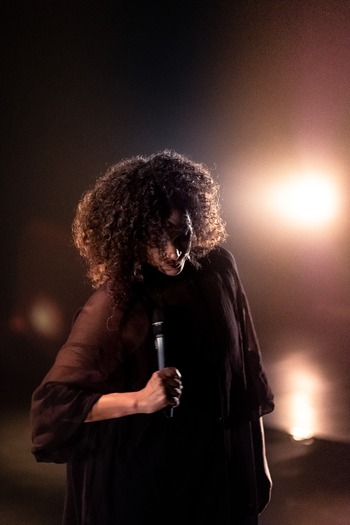
While the voice-over gradually fades out, we still hear the words “silence, invisibility, risk, danger.” The voice resounds faintly: “all the requirements necessary for existing in foreign lands and also the essence of she, her, their, trauma.” Michael walks to the side of the stage and slowly takes off her heels. Barefooted, she proceeds to perform a “sound” choreography in which she taps, beats, swipes, and caresses the microphone all over her body. We hear alien-like clicking noises fade in through the soundscape as Michael effortlessly places her microphone on the floor and transitions into a faster and freer movement vocabulary, combining fluid gestures with jerks. The sudden jolts and clicking sounds render the dance somewhat robotic, but equally graceful. She performs in circles, juxtaposing motion with stillness.
Moya Michael performs a sound choreography with a microphone. Coloured Swan I: Khoiswan (2018) © Danny Willems Photography

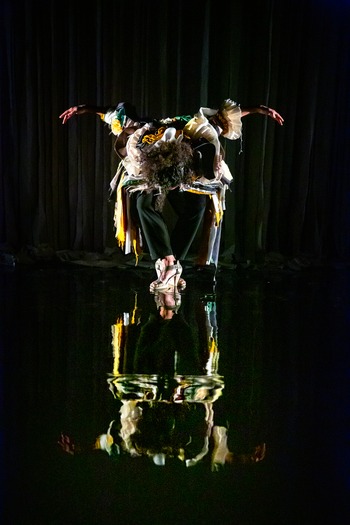
Thereafter, she walks back over to her shoes and puts them on. She neatly ties her hair up again, turns her back to us, and walks into a blackout. When she reappears, she is standing in first (ballet) position in front of the backdrop, barely lit and wearing a magnificent coat fashioned out of different colored and patterned pieces of fabric. Still in dim light, Michael starts dancing with very slow arm movements. Her arms move toward her back; she bends forward and down gradually. Her decelerated but elegant movements are reminiscent of Mikhail Fokine's The Dying Swan. In combination with the colorful feathers she is wearing, suggested by the layered coat, we realize that Michael is a “Coloured Swan.” Michael's evocation is captivating because of its slowness. Coincidentally (or not?) her colorful coat is reflected in the black dance floor, as if she is dancing on a lake. Michael's recorded voice resounds: “Hybridization, look it up.” In a mysterious monologue, Michael recounts a fragmentized tale: “She was the exotic. A commercialized burden. Too much” and “People are fluid. Highly Fanon” and “I wanna do this hair solo.” “Please do something exotic,” she continues, with a certain rhythm to it. “I will do that exotic deconstruct set to my advantage.” And finally: “She created a persona for her own interest. Not the annoyance of not being seen as who I am. Not having eroticism, exoticism, outside gazes.” She closes with: “Watch. Baker. Paris. Josephine.”
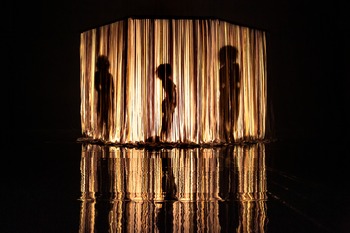
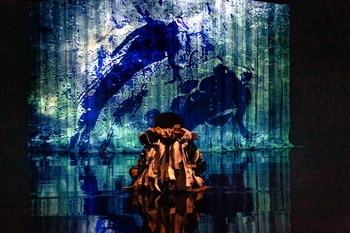
The lighting changes. Shadows of the decelerated swanlike movements appear on the white lines of fabric falling from the ceiling.Footnote 17 Michael then picks up a vuvuzela. (Remember this extended horn we all got to know a bit too well during the Soccer World Championship in South Africa in 2010?) She does not blow on it, though; she just sits with it, center stage, with her back toward the audience. She watches the video on the backdrop, before she leaves it there and goes behind the curtains. Meanwhile, projections of cave drawings in fluorescent blues and greens spill over the lines of fabric. Again, a clicking noise arises —a different one than before, more reminiscent of tongue clicking, characteristic of the click language of the Khoi and the San people of South Africa and similar to the rhythm of a metronome. Pinkish lights that flash to the rhythmic clicks render the act a peep show quality. The clicks are looped and the rhythm becomes more complex. We see Michael's silhouette appear behind the sheer curtains, with her bottom prominently contoured—an image we have seen before in history class (or not?) and an eyewink to Saartjie Baartman, whose body was eroticized and exoticized as the “Hottentot Venus” by its exhibition in early nineteenth-century Western Europe (even after her death). The wavy lines of fabric split Michael's contours in three parts: three differently shaped women shifting into changing positions. Michael's multiple shadows move slowly and sensually behind the rouge-colored curtain as a male voice repeats, “Your skin is your nation, your foundation.” Behind the veil, Michael puts on a layered skirt, in the same style as her coat. The pieces of fabric seem to produce a swan's tale in the evocative silhouette, yet simultaneously they evoke the image of a sumptuous tutu. A video now overlaps the silhouette dance. We see Tracey Rose wearing almost demonic face makeup. Somewhat eerie string music is accompanied by gnawing sounds. Still behind the backdrop, fully adorned now in what seems to be her costume, Michael is spinning and spinning as the lights continue flashing faintly. We still see Michael's dim image through the video.
Almost at the end now, Michael starts swinging a whirly tube, creating something between a harmonious howl and a screaming whistle. On screen, we see a close-up of Rose, who is now gradually, but intensely, wiping her blue facial makeup off her face. Michael emerges now from behind the backdrop, still swinging her tube as she moves slowly onto the stage, whistling and clicking under her breath. She then starts producing rhythms with her bare feet, dancing in circles, still holding on to the tube. More chaos enters the soundscape, including her own cheering, chanting, and maybe even wailing. Michael's movement vocabulary becomes more intense, now including sensual hip shifts and shoulder and chest thrusts. Michael's cheers, stomps, and whirly sounds are mixed with slam poetry, as she almost comes into a trance. She finally picks up the vuvuzela and walks through the curtain. Her silhouette is divided into three as she blows the vuvuzela. The soundscape fades away. After a last waning blow in the vuvuzela, the performance has reached its end.
Three silhouettes of Moya Michael in shadow play behind the backdrop. Coloured Swan I: Khoiswan (2018) © Danny Willems Photography

Afrofuturism, Layers, and Linearity
Although Michael does not intentionally invoke Afrofuturism in Khoiswan, she does evoke questions with her aesthetic and thematic choices that can be connected to the broader discourse that Afrofuturism brings forward.Footnote 18 This implies that, despite her personal exploration with regard to ancestry and identity and despite the specific geopolitical context of being a South African artist in Belgium, the Afrofuturist lens uncovers subtle critiques on issues such as corporeal exoticism and the fetishization of an Afrodiasporic artist's identity, which render the performance a global relevance. I propose that by using devices that could possibly be identified as Afrofuturist, Michael breaks with Western ways of binary thinking around identity and race. I certainly do not want to restrict her work by reading it through Afrofuturism, but a brief introduction of what Afrofuturism entails in relation to Michael's research questions helped me put together at least some pieces of the puzzle by exposing the multiple layers in the performance that reflect Michael's multilayered identity.
For the Coloured Swans Series, Michael started exploring the works by Octavia Butler, Kodwo Eshun, and John Akomfrah, who have also expanded the ideas around Afrofuturism, incorporating new themes such as urbanism, technological development, and gender fluidity. The basic ideas behind Afrofuturism have been developing avant la lettre since the early twentieth century and first appeared in the development of several music genres, such as jazz, reggae, and funk (including in music videos and album cover art).Footnote 19 The term “Afrofuturism” presumably emerged as a response to the observation that diasporic ethnic groups of African descent had been underrepresented as protagonists in science fiction and fantasy entertainment forms such as literature and film, as if there would be no Black skin in the future or in alternative worlds. However, sci-fi story lines deal with alien abductions and concurrent feelings of estrangement that were in fact ever so familiar for the African diaspora, especially in postslavery United States (see esp. the special issue on Afrofuturism edited by Nelson [Reference Nelson2002] or the Greg Tate interview in Dery [1994, 212]). Although Mark Dery coined the term in 1994, Octavia Butler is often considered the mother of Afrofuturism as the first widely known Black female science fiction author in the 1970s and 1980s, a time when few Afrodiasporic Americans published science fiction (Dery Reference Dery1994, 180). In Europe, African diasporic artists may experience alienation from their native cultures owing to colonialism as well as transatlantic slavery. The histories of the colonization of the Congo by King Leopold II and the long incipience of apartheid rooted in the colonial arrival of the Dutch East India Company in South Africa are of particular relevance in Michael's artistic context.
Moya Michael in her costume with a vuvuzela. Coloured Swan I: Khoiswan (2018) © Danny Willems Photography

At the very basis of Michael's choreographic language lies the deconstruction and reconstruction of images brought to life by translating them into her own body (or that of performers). In her solo, and I will return to this later on, this is especially visible in the slow sequence reminiscent of The Dying Swan, in which she has in fact deployed this de- and reconstruction technique to blend images of different ballerinas and Khoi cave drawings. However, despite the fact that her competence and experience originated mainly from dance, Michael has always found this discipline in itself too restrictive. Some ideas and stories cannot be expressed through movement alone and require a different way of expression. She sees her work as compositions with different ingredients, which relate to one another in an equal way and influence one another. One of those recurring elements in her vocabulary is text, moving away from a linear narrative but following a poetic approach based on association. Similar to her movement vocabulary, she utilizes this approach to deconstruct and rearrange text on the basis of chance and intuition. The fragmentized tale, in which Michael evokes Josephine Baker through her poetry, is a noteworthy example here. The same can be seen in her use of sound and visuals, even in the concept for her costume, fashioned out of layers of cutup fabrics. In fact, this way of working could perhaps be understood as a reference to the notion of remixability, which is a free way of creating something using different media and resources.Footnote 20
Digital culture theorist Lev Manovich explains the concept by comparing information with a train; each receiver of that information can be seen as a train station. When the information arrives, it gets remixed with other information that has arrived at the platform. Thereafter, a new package of information travels to other destinations where the process is repeated (Manovich Reference Manovich2007). In a way, Michael's techniques of de- and reconstruction already reflect the layered-ness of her identity and the critiques on binary thinking that inform her research. In Khoiswan, the de- and reconstruction of the iconography of her Khoi lineage and her classical ballet training produce a very contemporary aesthetic in the decelerated movement sequence, and testify that her excellence is not determined by one over the other. The use of mixed media, such as the multidisciplinary tools of text, visuals, sound, and movement material, contributes to this layered-ness. Historical knowledge and personal stories are interlaced in conjuring the ancestral spirits of Auntie Mo, Josephine Baker, and Saartjie Baartman. These are without a linear narrative highly suggestive in their references, raising issues around body politics, marketization of art, the commodification of the self, and the postcolonial discourse.
Afrofuturism essentially provides an outlook or projection of the future entangled with past and present. In other words, it questions the linear concepts of time and progress that define a Westernized way of life. For example, Michael shares the Khoi belief that you are never alone because your ancestors are always accompanying you (Michael Reference Michael2019), and she translates this belief to the stage in conversation with her presumably deceased Auntie Mo and with the other spirit in the room. The interplay between physical presence and mediated presences (through video projection and voice-over) also contributes to the dismantling of the conception of time. By de- and reconstructing the linearity of the narrative in bringing her ancestors on stage with her, Michael uses an Afrofuturist device to question the notion of progress, imagining how the world she is part of could be different.
Moya Michael's evocation of a swan with her colorfully layered costume and her reflection in the black dance floor. Coloured Swan I: Khoiswan (2018) © Danny Willems Photography

Meaningful Multilayered Movement
While dancing the slow choreographic sequences, she repeatedly refers to dancer and Afro-American rights activist Josephine Baker, who became world famous with her exotic and even erotic danse sauvage in her banana costume. In these passages, Michael juxtaposes imposed discipline versus supposed savage, and in doing so, she not only questions the power relations that the iconography of ballet provokes,Footnote 21 but also the fetishized gaze on the female body of color. In the early twentieth century, US-born Baker escaped from poverty to vaudeville, passed Broadway and ended up in the Parisian Folies Bergère. In her performances, she questions the perception of women of color by theatricalizing her identity and deploying it—tactically—as an instrument for entertainment. As Samir Dayal argues, Baker's work can be understood as both an early testimonial of “market orientation—her ability to merchandize herself” and also an act of “subtly subversive agency that she was occasionally able to access even through her self-commodification” (Reference Dayal and Raphael-Hernandez2012, 36). Hence, Michael's words: “She was the exotic—a commercialized burden” who “created a persona for her own interest.” The layers of fabric on Michael's costume may also be an eyewink to Baker's notorious banana skirt. In a sense, this reference also deals with the struggle Michael herself is going through as an emerging maker, a struggle she did not experience as intensely when she was a performer or co-creator in someone else's work. Now that she is responsible for selling her own work, questions on identity move to the forefront. In one of our early conversations, she asks:
I'm wondering what kind of work I should, would, or could make? The minute I invite somebody else into my work (like Igor), then the piece becomes “white” or Eurocentric, but, if I put my whole self (as in my identity) into the work alone—that's what everybody wants, right? Because I'm African.… So, I'm literally trying to figure out how I could sell my work. (Michael Reference Michael2016)
Indeed, as a dance maker, she is much more confronted than before, as a dance performer, with the unspoken obligation to play out her roots—her exoticism—in order to receive support and sell her work. As a choreographer, important gatekeepers (such as funding institutions, venue programmers, festival curators, and even audiences) expect her to present an Africanist aesthetic and narrative.
Yet another critique on the exoticization/eroticization of the female body of color is the evoked image of Saartjie Baartman, one of the last Khoi women who became known worldwide as the “Hottentot Venus,” exhibited for her extraordinary body parts, even after her death. Baartman is conjured through a shadow play behind the sheer curtain, where Michael poses to the rhythm of an audio loop reminiscent of the Khoi clicking language. Through these references, Michael explores the perception of the physicality of her “colouredness,” in which she contraposes visibility and invisibility. She questions the relationship between stereotype and individuality by asking herself what her position as a moving body is and whether she is accountable for what is considered exoticism in her artistic work. And in expansion, to what extent does the fact that she is a woman play a role in exoticism? These questions related to the politics of labelling and identity work have greatly informed Khoiswan, but the piece is exceptionally layered and raises a multitude of delicate questions.
Not until 2002 did South Africa claim the body of Baartman in order to bury her on her grounds. To this day, female artists of color in Europe still feel as though institutions treat them as “an exotic layer on their colonial cake” (Kaersenhout in Lockward Reference Lockward, Robinson and Buszek2019, 433). The references to Baartman—a very present ancestor on stage—demonstrate how historical knowledge and personal stories are constantly interlaced. Baartman is Lacrimosa, who only returned two hundred years later, but this figure also stands for Michael herself and all women who migrated and, according to Auntie Mo, “made it in the West.” In South Africa, people are proud that Michael has “made it” in Europe. However, Michael questions to what extent she has: “Have I really made it because I have been able to colonize my own body into the teachings of the West?” (Michael Reference Michael2019). While dancing her decelerated and deconstructed sequence, (which could be) reminiscent of Fokine's The Dying Swan, she does in fact unintentionally refer to this specific choreography. She has deployed her cutup technique by observing and remixing images of different ballerinas dancing Swan Lake, with images of the Khoi people found in cave drawings that resemble them. For example, when we see Michael in first (ballet) position with her arms up like wings, she pairs this image with a Khoi cave drawing, shifting into holding her hands in the back. In an attempt to undermine the disciplined skill that has “colonized her body” (to use her words quoted above), she unlearns it by growing into the skill of her ancestors, which we witness toward the end of the piece. She does so with an eyewink to the famous words by Audre Lorde: “It is learning how to take our differences and make them strengths. For the master's tools will never dismantle the master's house. They may allow us temporarily to beat him at his own game, but they will never enable us to bring about genuine change” (Lorde Reference Lorde1984, 111).
Michael's alleged success in the West (voiced by Auntie Mo) can be ascribed to mastering the skills set by Western standards. Rather than further employing those tools, Michael attempts to decolonize her body through the movement material that constitutes the piece by embracing her multilayered identity as an indigenous woman from South Africa based in Brussels, the heart of the European dance scene. In addition, it should be noted that through her choice of title, both of the series and of its first part discussed here, Michael engages with a specific politics of naming in referring to these ballets of the Eurocentric canon. The images of the “swan” evoked in the titles (as well as within the dance vocabulary and through the costume and lakelike dance floor) allude to the discourses of aesthetics, techniques, and ideal bodies within this historicism and historization. Michael, who also has had significant training in classic ballet, is aware of these associations, and with this work, she visibly speaks back to the Eurocentric canon (compare to Ashcroft, Griffiths, and Tiffin [Reference Ashcroft, Griffiths and Tiffin2003] on the act of writing back in postcolonial literature).Footnote 22 Thus, the dance vocabulary, imagery, and naming tactics in her work reveal Michael's awareness of this discourse and her interrogation of it, adding yet another layer to the work.
The female bodies conjured in the movement material of Khoiswan are everything but balletic: constantly submissive to an outside gaze, Eurocentric historical whiteness has considered them exotic, savage, and fertile. Michael interrogates the colonial, capitalist, and patriarchal character of the Western hegemony over knowledge by transitioning into a “freer” movement vocabulary derived from that of her Khoi lineage and, simultaneously, condemning the eroticized gaze on her female ancestors through conjuring the spirits of Baartman and Baker. Through de- and reconstructing the conventions of Western classical ballet by remixing the iconographic Westernized images with the Khoi cave drawings in her movement vocabulary, Michael succeeds at shifting binary thinking and stereotypes with references to women of color, identity politics, the production of knowledge, and the Western hegemony over it.
Ancestor Worship, Untold Stories, and a Spiritual Home
Michael's questions on the production of knowledge transpire through the recurring references to ancestor worship and spiritualism in sound, visuals, and text as well. One of the authors who was responsible for the first conceptualization of the notion Afrofuturism, Tricia Rose, explains the general interest in ancestral Africa with regard to the search for one's roots or spiritual home: “If you're going to imagine yourself in the future, you have to imagine where you've come from; ancestor worship in black culture is a way of countering a historical erasure” (Dery Reference Dery1994, 215).
The oscillating play between historical references, ancestor worship, the exploration of one's heritage, and personal stories in Khoiswan may suggest this Afrofuturist elastic temporality that combats historical erasure. In the imagery Michael evokes, the spectator is constantly confronted with Michael's roots: the facial makeup in Tracey Rose's video work; the Khoi cave drawings; the allusions to Baker and Baartman; her movement vocabulary, particularly in the final sequence of the work; the vuvuzela, the whirly tube used by storytellers as a call to gather kids around; and, not unimportantly, the returning motif of hair. In that respect, the fleeting comment of Auntie Mo with regard to how Michael wears her hair in public is certainly not an innocent one. Earlier in the performance, Michael also proclaims she intended to do a hair solo. Why is hair so significant here? In South Africa under apartheid, a pencil test was held to determine the racial classification for those whose categorization was questionable. As Sarah Robertson puts it in her review of the piece: “For those of you unfamiliar with this grotesque piece of apartheid history: a pencil was ‘combed’ through the hair and if it fell out easily … lucky you! You could be classified white. If the pencil stayed in your hair, you were classified black” (Reference Robertson2018). Today, the motif of hair remains important in the context of colonization because the Westernized fashion industry has for a long time imposed the beauty ideal of sleek hair. When Michael undoes her hair in the piece and wears it naturally, Auntie Mo is content. However, is she really content? Because Michael's hair is curly and not sleek.
Therefore, by entangling historical knowledge and personal stories, Michael succeeds in transmitting subtle criticisms on the postcolonial (dis)course and the body politics of exoticism and eroticism. Whatever the medium, Afrofuturism involves reclaiming some type of agency over one's story. In doing so, Michael climaxes in a trance toward the end of the performance. Conjuring the ancestral spirits in the room through a collage of sound, visuals, movement, and text, she digs deeper into a knowledge that her work environment considers epistemologically marginal, a knowledge that continues to be excluded from Western institutions such as the European dance market, field, and scholarship.
Moya Michael sits in her costume facing the backdrop on which Khoi cave drawings are projected. Coloured Swan I: Khoiswan (2018) © Danny Willems Photography

Conclusion
Overall, Khoiswan tackles numerous issues that receive too little attention in the European dance field. As a female artist of color, Michael directly addresses the fetishistic gaze of her work environment that emphasizes her exoticized body, a body imagined as exotic vis-à-vis institutional whiteness. Whereas fetishization is something that all contemporary dance artists in Europe seem to face as a multifaceted capitalist, neoliberal, and Western problem with soft and hard articulations, whereby gatekeepers base their decisions on the subjectivity of the artist rather than on the movement and aesthetic qualities of the artwork, this article highlights a particularly hard form of fetishization resulting from intersectionality: Moya Michael is a contemporary dance artist, a woman, a person of color. Although Afrodiasporic dance artists are often only programmed in venues under a label that segregates them from the regular program, they “must face the corresponding labeling of their work as ‘foreign’ or ‘non-European,’ categories that are ingrained in the foundational racism of the Enlightenment and its invention of modern aesthetics” (Lockward Reference Lockward, Robinson and Buszek2019, 420). Michael's meaningful movement vocabulary embraces perhaps the most powerful layer within her performance, the layer that captures her questions with regard to the claim that she has “made it in the West.” Should her South African family be proud of her if her success in Europe is measured by those gatekeepers who only fleetingly accredit her dance trajectory in South Africa yet without ever naming the schools and acclaimed artists from the African continent she has been connected to in promotion materials? What does this accomplishment mean if in the European dance market her credentials as a choreographer are all too often reduced to the symbolic capital of having attended the prestigious school P.A.R.T.S. in Brussels and of having worked with highly acclaimed European choreographers always connected to movement techniques from the West?
This structural problem cannot be solved as long as the European dance field is governed by an ideological framework of whiteness, particularly facilitated by white and predominantly male gatekeepers, because they continue to ascribe value according to Western standards and to decolonize their institutions only superficially (if at all). By listening to what Michael had to say before, during, and after the first part of Coloured Swans, I learned how her foregrounded issues are invoked in her artistic work. I must conclude that an Afrodiasporic female artist in the European dance field still faces multiple forms of fetishization. As a consequence, she may find herself conflicted about whether to abide by these expectations, even though this profiling might not always match with how she sees herself, or ignore these expectations even though this might come to hamper her future. Certainly, there is still a lot of work to be done. Nonetheless, Michael possesses some powerful tools to interrogate them rigorously and pressingly. She has come to resolve some of these conflicts by making her cultural identity central in her work while ensuring that this, at all times, occurs on her own terms. In doing so, she is reclaiming the agency of her story, and it is only hers to tell. In speaking back to institutional whiteness through her artistry, she demonstrates her ingenious prowess in the face of fetishization. As a consequence, perhaps, she eventually was denied subsidy for the third part of the series I had helped her apply for on the grounds of insufficient audience development and tour dates within Europe (as opposed to the visibility her work could attest to outside of Europe). However, this misrecognition did not hold her back from continuing the work. With her series, Michael continues to raise questions around identity as a commodity and the leading knowledge hegemonies. In decolonizing her body through the movement material in Khoiswan, she explores only some of those questions. A series is therefore a powerful format (or medium) to return to at this very end because, in line with the underlying concept of remixability, in a series, every performance is a train stopping each time in a new station, where baggage can be dropped off and new baggage picked up and remixed upon departure. Continuing her exploration on these issues in the Coloured Swans Series, each performance is also an occasion for a new beginning.
Supplementary material
To view supplementary material for this article, please visit https://doi.org/10.1017/S0149767722000134