Introduction
Alcohol use disorder (AUD) is a multifactorial psychiatric disorder with a heritability of approximately 50% (Verhulst, Neale, & Kendler, Reference Verhulst, Neale and Kendler2015), but the nature of genetically influenced traits conferring the elevated risk to develop the disorder is not known. Patients with AUD have higher self-rated impulsive behavior (Bjork, Hommer, Grant, & Danube, Reference Bjork, Hommer, Grant and Danube2004; Ketzenberger & Forrest, Reference Ketzenberger and Forrest2000), and they exhibit a wide range of cognitive deficits across all domains (Stavro, Pelletier, & Potvin, Reference Stavro, Pelletier and Potvin2013) including impairments in executive functions (Le Berre, Fama, & Sullivan, Reference Le Berre, Fama and Sullivan2017) e.g., response inhibition (Goudriaan, Oosterlaan, de Beurs, & van den Brink, Reference Goudriaan, Oosterlaan, de Beurs and van den Brink2006; Lawrence, Luty, Bogdan, Sahakian, & Clark, Reference Lawrence, Luty, Bogdan, Sahakian and Clark2009a), attention (Cordovil De Sousa Uva et al., Reference Cordovil De Sousa Uva, Luminet, Cortesi, Constant, Derely and De Timary2010) and cognitive flexibility (Goudriaan et al., Reference Goudriaan, Oosterlaan, de Beurs and van den Brink2006; Noël et al., Reference Noël, Van der Linden, Brevers, Campanella, Hanak, Kornreich and Verbanck2012). Less is however known to what degree these observed cognitive deficits are caused by alcohol intake or whether they are genetically influenced inherited traits present before the development of the disorder.
Characterizing clinical endophenotypes, i.e. intermediate phenotypes between the genotype and phenotype, can improve understanding of complex psychiatric disorders (Gottesman & Gould, Reference Gottesman and Gould2003). An endophenotype should be found at a higher rate in family history (FH) positive individuals, who themselves are not afflicted by the disorder in question. By investigating patients and healthy individuals with both positive and negative FH for substance use disorders (SUD), it is possible to investigate cognitive endophenotypes specific for SUD, and thereby disentangling which cognitive symptoms are genetically influenced and thus more likely to be present before the development of the disorder (Robbins, Gillan, Smith, de Wit, & Ersche, Reference Robbins, Gillan, Smith, de Wit and Ersche2012).
Several studies have previously investigated the effect of AUD FH on cognitive function. In an early study, Schaeffer and colleagues found that AUD FH was associated with an impaired abstracting capacity, problem-solving and perceptual-motor function in both patients and healthy individuals (Schaeffer, Parsons, & Yohman, Reference Schaeffer, Parsons and Yohman1984). Clinical studies in children of AUD parents have found elevated impulsivity, reduced attention, and poor planning capacity (Acheson et al., Reference Acheson, Lake, Bray, Liang, Mathias, Ryan and Dougherty2016; Corral, Holguín, & Cadaveira, Reference Corral, Holguín and Cadaveira1999). Furthermore, it has been shown that healthy individuals with a positive FH of AUD have elevated rates of self-rated impulsivity (Gierski et al., Reference Gierski, Hubsch, Stefaniak, Benzerouk, Cuervo-Lombard, Bera-Potelle and Limosin2013) and overall impairment in executive functions (Gierski et al., Reference Gierski, Hubsch, Stefaniak, Benzerouk, Cuervo-Lombard, Bera-Potelle and Limosin2013), including response inhibition (Acheson, Richard, Mathias, & Dougherty, Reference Acheson, Richard, Mathias and Dougherty2011; Kareken et al., Reference Kareken, Dzemidzic, Wetherill, Eiler, Oberlin, Harezlak and O'Connor2013). To our knowledge, however, few previous studies have compared the relation between AUD FH in healthy individuals to the cognitive outcomes in treatment-seeking AUD patients.
The aim of the current study was to investigate potential cognitive endophenotypes in AUD. First, a traditional case-control study was done by comparing AUD and healthy volunteers without taking into account FH status. Second, the AUD patients were compared with the same healthy individuals subdivided into those with positive AUD FH (FH+) and those with negative AUD FH (FH−).
Materials and methods
Participant recruitment
The study was conducted at the Stockholm Centre for Dependency Disorders outpatient research clinic in Stockholm, Sweden. All participants were recruited by advertising in local media or online. The AUD patients were recruited to participate in two separate randomized controlled trials (Khemiri et al., Reference Khemiri, Steensland, Guterstam, Beck, Carlsson, Franck and Jayaram-Lindström2015b; Khemiri, Brynte, Stunkel, Klingberg, & Jayaram-Lindström, Reference Khemiri, Brynte, Stunkel, Klingberg and Jayaram-Lindström2019a), while the HC were recruited as anage and sex-matched control group to the patients. The study received approval by the local ethics committee in Stockholm and was conducted in accordance with Good Clinical Practice and the declaration of Helsinki.
Inclusion and exclusion criteria
The main inclusion criteria for the AUD patients were current DSM-IV diagnosis of alcohol dependence, minimum 4 and maximum 14 days of alcohol abstinence and age 18–60 years. Importantly, the DSM-IV diagnosis of alcohol abuse was not sufficient to be included in the study. Since all the DSM-IV alcohol dependence criteria are present in the DSM-5 AUD diagnosis as well, the term used throughout the paper is AUD, in line with the more recent DSM-5 terminology. Main exclusion criteria were DSM-IV diagnosis of any other substance abuse or dependence (except nicotine), severe major psychiatric disorder (e.g. psychotic disorders, bipolar disorder), previous withdrawal-induced delirium tremens or seizures, current alcohol withdrawal, traces of narcotic substances (cannabis, cocaine, opioids, amphetamine and cocaine) in urine or positive breathalyzer test on the day of testing, regular use of psychoactive medication within the last 3 months (defined as a regular intake of medication used to treat any psychiatric or neurological disorder, e.g. antipsychotic, antiepileptic or opioid pain medications, with the exception of selective serotonin reuptake inhibitors for anxiety and depression diagnoses, currently in remission), severe somatic illness, history of stroke, intracranial hemorrhage or severe head trauma and current use of any narcotic drugs. For HC, the same overall inclusion and exclusion criteria were applied, with the exception that the HC could not have any current or past alcohol-related diagnosis. Further exclusion criteria for the HC were self-reported FH of severe major psychiatric disorders (e.g. psychotic disorders, bipolar disorder), and any use of psychoactive medications or narcotic substances during the last 12 months. These more extensive exclusion criteria were only applied to the HC group since it was recruited as a comparison group where the primary goal was to study FH status. The patients however as mentioned above, were recruited earlier as part of separate clinical treatment trials, in which such exclusion criteria were not applied as the aim of these studies were to evaluate treatment effect (Khemiri et al., Reference Khemiri, Steensland, Guterstam, Beck, Carlsson, Franck and Jayaram-Lindström2015b; Khemiri et al., Reference Khemiri, Brynte, Stunkel, Klingberg and Jayaram-Lindström2019a).
Study procedure
After an initial telephone screening, participants came to the research clinic, received oral and written information by an M.D. and provided written informed consent to participate. All participants underwent psychiatric evaluation using the Structured Clinical Interview for DSM-IV (American Psychiatric Association, 2000) for AUD patients and the Swedish DSM-5 version of the Mini-International Neuropsychiatric Interview (Sheehan et al., Reference Sheehan, Lecrubier, Sheehan, Amorim, Janavs, Weiller and Dunbar1998) for HC. The reason different diagnostic interviews were performed was that when the AUD patients were recruited (2012–2015) the DSM-5 had not yet been translated into Swedish. A study nurse administered a urine dip test for drug toxicology of narcotic substances and a breathalyzer test.
Clinical instruments
Sociodemographic information was collected by a self-report questionnaire. Drinking history for the last 90 days (AUD) and 30 days (HC) was collected by the TimeLine Follow Back (TLFB) interview (Sobell & Sobell, Reference Sobell, Sobell, Litten and Allen1992). Alcohol craving and depressive symptoms were assessed by the Obsessive Compulsive Drinking Scale [OCDS; (Anton, Moak, and Latham, Reference Anton, Moak and Latham1995)] and the Montgomery-Åsberg Depression Self Rating Scale [MADRS-S; (Svanborg & Asberg, Reference Svanborg and Asberg2001], respectively. Presence of AUD FH was assessed only in the HC group using a Swedish translation of the Family Tree Questionnaire [FTQ; (Mann, Sobell, Sobell, & Pavan, Reference Mann, Sobell, Sobell and Pavan1985)], a validated self-rating scale where the subject is asked to categorize each relative in a family tree, including grandparents, parents and siblings, as (1) never drank; (2) social drinker; (3) possible problem drinker (a person who you believe or were told might have had an alcohol problem); (4) definite problem drinker (only for persons who either are known to have received treatment for an alcohol problem or who have experienced several alcohol-related consequences) or (5) don't know/don't remember. The subject was asked specifically to only include biological relatives, and not family members who were adopted, half-siblings or step-relatives. In the main analysis, subjects were classified as FH+ if they had responded option 3 or 4 to any biological relative, and otherwise, they were classified as FH−. In a sensitivity analysis, the definition of FH+ was restricted to only include subjects who responded option 4 to any biological relative.
Neuropsychological assessment
All neuropsychological tests were administered by trained research staff in a silent test room at the research clinic. Participants were told that they could drink coffee and use nicotine before, but not after the start of the test session.
Non-computerized tasks
The Barratt Impulsiveness Scale (BIS) (Patton, Stanford, & Barratt, Reference Patton, Stanford and Barratt1995), translated in Swedish, was used to assess self-rated overall impulsive behavior. The questionnaire was completed using paper and pencil, and consists of 30 statements describing impulsive behaviors/thoughts in different situations. The subject rates each item on a 4-point scale ranging from 1 (rarely/never) to 4 (almost always/always) and the sum of all scores are added to a total score. The BIS can also be further subdivided into three subscales of motor, attentional and non-planning impulsivity.
Verbal working memory was assessed by the Digit span task from the Weschler Adult Intelligence Scale-IV (Swedish version, 2010, Pearson assessment). In this task, the research assistant reads digit sequences with increasing length and the subject is asked to repeat back each digit sequence. The outcomes are total score and backward score, and a higher score is indicative of better working memory.
Computerized tasks
All computerized cognitive tests from the Cambridge Neuropsychological Test Automated Battery (CANTAB®) were performed on a touch screen tablet PC (MOTION model J3500-i7B) and a press pad provided by Cambridge Cognition Ltd. Stop Signal Task (SST) is a widely used task of response inhibition, i.e. the ability to inhibit a prepotent response (Logan, Cowan, & Davis, Reference Logan, Cowan and Davis1984). In each trial, the subject is presented with an arrow pointing left or right and is asked to press as quickly as possible in the direction of the arrow. On a minority of trials, however, an audible stop signal is heard and then the subject should try to withhold the response, and by varying the timing of the stop signal the main outcome stop-signal reaction time (SSRT) is calculated (lower is better). Other outcomes are proportions of successful stops and standard deviation of response time on go trials (response time variability). Cambridge Gambling Task (CGT) was used to assess risky decision making in a gambling task (Rogers et al., Reference Rogers, Owen, Middleton, Williams, Pickard, Sahakian and Robbins1999), with the main outcomes, risk-taking, overall proportion bet and deliberation time. Stockings of Cambridge (SOC) is a task of future planning and problem-solving (Owen, Downes, Sahakian, Polkey, & Robbins, Reference Owen, Downes, Sahakian, Polkey and Robbins1990), with main outcomes being the number of problems solved in minimum moves (higher is better) and mean moves performed (lower is better) for the most difficult 5-move-problems. Information Sampling Task (IST) is a task of ‘reflection impulsivity’, i.e. the propensity to collect and evaluate information before making a decision. This task is blocked into a fixed win and decreasing win condition, in which the latter involves a conflict between uncertainty and possible reward (Clark, Robbins, Ersche, & Sahakian, Reference Clark, Robbins, Ersche and Sahakian2006). The main outcomes (lower scores indicative of more reflection impulsivity) for each condition were a number of boxes opened per trial, mean probability of correct decision (P correct) given the sampled information and total correct trials. Rapid Visual Processing task (RVP) is a task of sustained attention (Coull, Middleton, Robbins, & Sahakian, Reference Coull, Middleton, Robbins and Sahakian1995), in which the subject is asked to identify specific sequences of digits which are presented one by one during a prolonged time period. The main outcomes are A’, B’’ and probability of a hit (higher is better) as well as false alarms and mean latency (lower is better). Attention Switching Task (AST) assesses both attention and mental flexibility, with the main outcomes percent correct trials and reaction latency. Spatial Working Memory (SWM) task is a task of visuospatial working memory (Owen et al., Reference Owen, Downes, Sahakian, Polkey and Robbins1990), with outcomes total errors and strategy (higher scores suggest poor performance). The Emotion Recognition Task (ERT) assesses capability to recognize emotions expressed in facial expressions, with main outcomes percentage correct responses and mean response latency. For a full description of the different CANTAB® tasks and outcomes see www.camcog.com and the original references.
Statistical analysis
Sociodemographic variables, clinical outcomes and neuropsychological test outcomes were compared between AUD patients and HC using Student's t test, Mann-Whitney U test and χ2 goodness of fit for continuous, ordinal and categorical outcomes, respectively. In the FH analyses, one-way analysis of variance (ANOVA) analyzes with a group (AUD/FH+/FH−) as an independent variable and the neuropsychological test outcome as the dependent variable were performed. If a statistically significant main effect of group was found, Fischer's protected least significance difference and Bonferroni corrected post-hoc tests were performed in the main and sensitivity analysis, respectively. Assumption of normality and homogeneity of variances was assessed by visual inspection of QQ-plots and Levene's test of equality of variances, respectively. Severe outliers were identified by visual inspection of boxplots, and removed in sensitivity analysis and only reported if different results from the main analysis. For the IST task, a mixed ANOVA with the group as between-subject factor and condition (fixed v. decreased reward) as the within-subject factor was performed for each outcome. No missing data were imputed.
Effect sizes were reported as Cohen's d, i.e. mean difference between groups divided by the pooled standard deviation (Cohen, Reference Cohen1988). Given the exploratory nature of the study, the alpha level was 0.05, two-tailed, uncorrected in the main analysis. In a sensitivity analysis, Bonferroni adjustment for multiple comparisons was performed with an alpha level of 0.005 (based on the 10 administered neuropsychological tests) for the t tests and ANOVA main effects. The statistical analyses were performed using IBM SPSS statistics (version 26.0, SPSS inc., Chicago, Illinois).
Results
Study participants
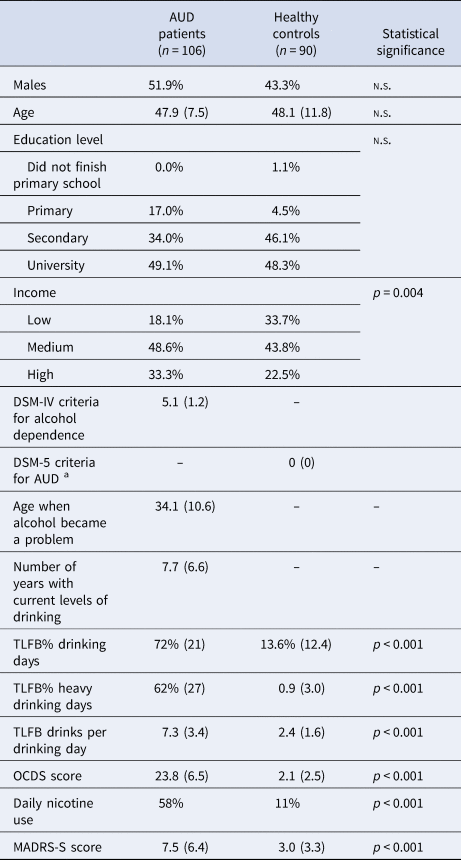
The total study sample consisted of 106 AUD patients and 90 HC, who fulfilled the inclusion and exclusion criteria and completed the test day. There were no statistically significant differences between AUD patients and HC regarding sex, age or education, while the HC to a higher degree had lower income compared to the AUD patients. As expected, the patients had significantly higher levels of drinking days, heavy drinking days, drinks per drinking day, alcohol craving, daily nicotine use and depressive symptoms. Table 1 presents a detailed description of the sociodemographic and clinical background variables.
Sociodemographic and clinical background variables in patients with alcohol use disorder (AUD) and healthy controls

AUD, alcohol use disorder; TLFB, Timeline Follow-back interview; OCDS, Obsessive Compulsive Drinking Scale; MADRS-S, Montgomery-Åsberg Depression Self Rating Scale; n.s., No statistically significant difference p > 0.05.
Values are presented as percentages or mean (standard deviation).
a The AUD patients and healthy controls were interviewed using the Structured Clinical Interview for DSM-IV and the Swedish DSM-5 version of the Mini-International Neuropsychiatric Interview, respectively.
AUD patients v. HC
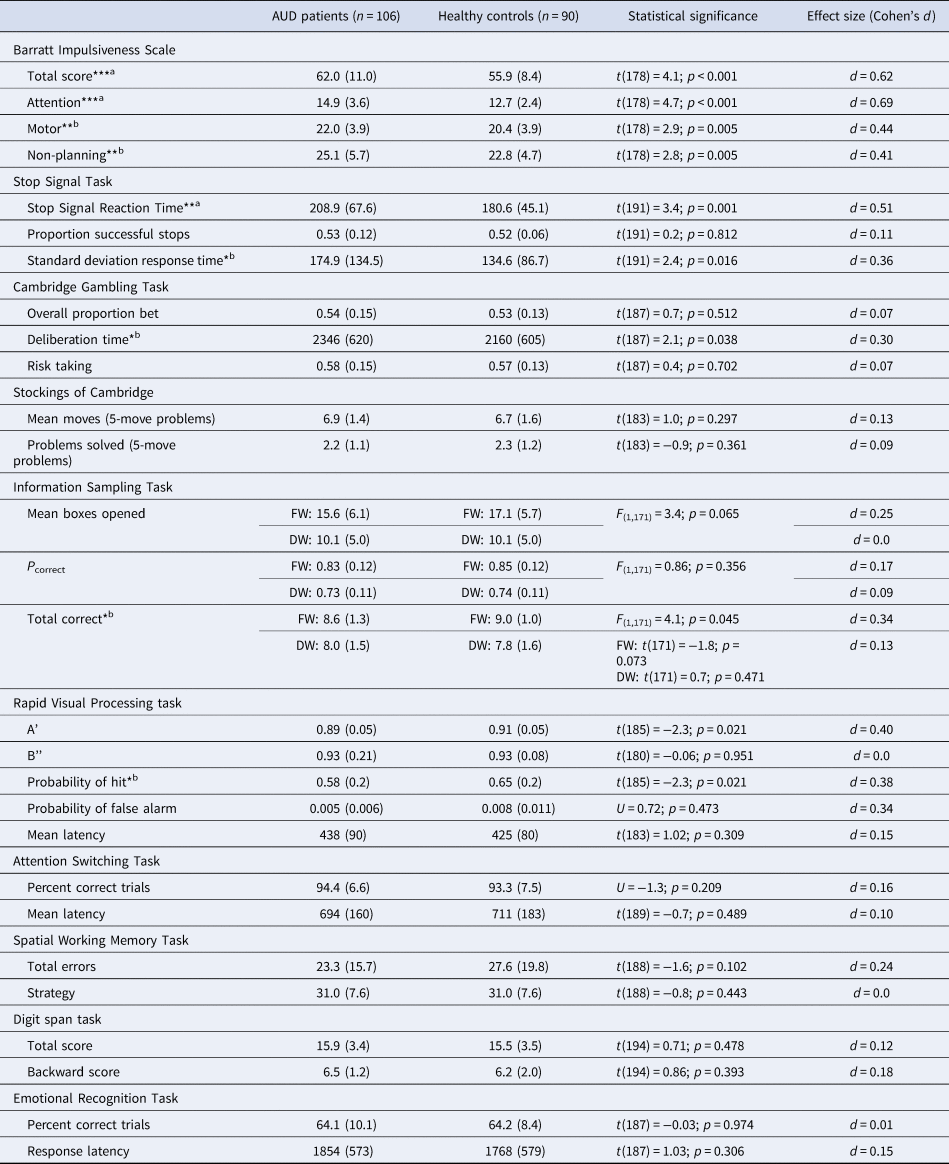
Compared to HC, the AUD patients scored significantly higher on the BIS total score [t (178) = 4.1; p < 0.001], including the attention [t (178) = 4.7; p < 0.001], motor [t(178) = 2.9; p = 0.005] and non-planning [t(178) = 2.8; p = 0.005] subscales. In the SST, AUD patients exhibited a significantly higher SSRT compared to HC [t(191) = 3.4; p = 0.001] indicative a poorer response inhibition ability in patients. Furthermore, AUD patients had a greater response time standard deviation, suggesting greater response time variability, compared to HC [t(191) = 2.4; p = 0.016] but no significant difference in proportion successful stops [t(191) = 0.2; p = 0.812]. In the CGT, AUD patients had slightly longer deliberation time [t(187) = 2.1; p = 0.038] but no significant differences between groups were found for risk-taking [t(187) = 0.4; p = 0.702] or overall proportion bet [t(187) = 0.7; p = 0.512]. On the RVP, AUD had a statistically significant lower probability of hit [t(185) = −2.3; p = 0.021] and a trend toward poorer A’ [t(183) = −1.8; p = 0.078], while no effect was found for B’’ [t(180) = −0.06; p = 0.951], probability of false alarm (U = 0.72; p = 0.473) or mean latency [t(183) = 1.02; p = 0.309].
On the IST task total correct responses, there was a statistically significant interaction between group and condition (F (1,171) = 4.1; p = 0.045), driven by a trend toward significantly more correct responses [t(171) = −1.8; p = 0.073] in the fixed win condition only. Even though not reaching statistical significance (F (1,171) = 3.4; p = 0.065), a trend was also observed suggesting that AUD patients opened fewer boxes (mean 15.6) compared to HC (mean 17.1) in the fixed win condition. No significant interaction was found for P correct (F (1,171) = 0.86; p = 0.356). In the SWM task, the HC performed more errors than the AUD group [t(192) = −2.3; p = 0.020] but no significant difference was found for strategy [t(192) = −1.1; p = 0.269]. However, 4 outliers in the HC group were detected who all responded more errors than any of the AUD patients (>70 errors) which significantly influenced the analysis. After removal of these outliers, there was no statistically significant difference between AUD and HC [t(188) = −1.6; p = 0.102] and therefore these subjects were removed from the current and subsequent SWM analyses. There were no statistically significant differences between AUD patients and HC for the SOC, Digit span, AST or ERT outcomes (all p > 0.1). Complete results for the comparison between AUD and HC are presented in Table 2.
Neuropsychological test outcomes in alcohol use disorder (AUD) patients and healthy controls

FW, fixed win condition; DW, decreasing win condition.
Values are presented as mean (standard deviation).
a Statistically significant after Bonferroni adjustment of multiple comparisons.
b Not statistically significant after Bonferroni adjustment of multiple comparisons.
* p < 0.05; ** p < 0.01; *** p < 0.001.
AUD patients v. HC subdivided by FH
In total four HC were excluded from the FH analysis. Two subjects did not complete the FTQ, while two subjects were adopted at a young age and responded option 5 (‘Don't know/don't remember’) for all biological relatives. Among the remaining 86 subjects, 39 subjects (45%) were categorized as FH−, while 47 subjects (55%) were categorized as FH+, i.e. classified any biological relative as possible or definite problem drinker on the FTQ. Within the FH+ group, there were subjects with one (n = 27), two (n = 14), three (n = 5) and four (n = 1) AUD relatives. There were no statistically significant differences between FH+ and FH− participants on any sociodemographic or clinical variable (online Supplementary Table S1), with the exception of a trend toward higher percentage heavy drinking (U = 1013; p = 0.067) and significantly higher prevalence of daily nicotine use (χ2 = 9,6; p = 0.02) in the FH+ group.
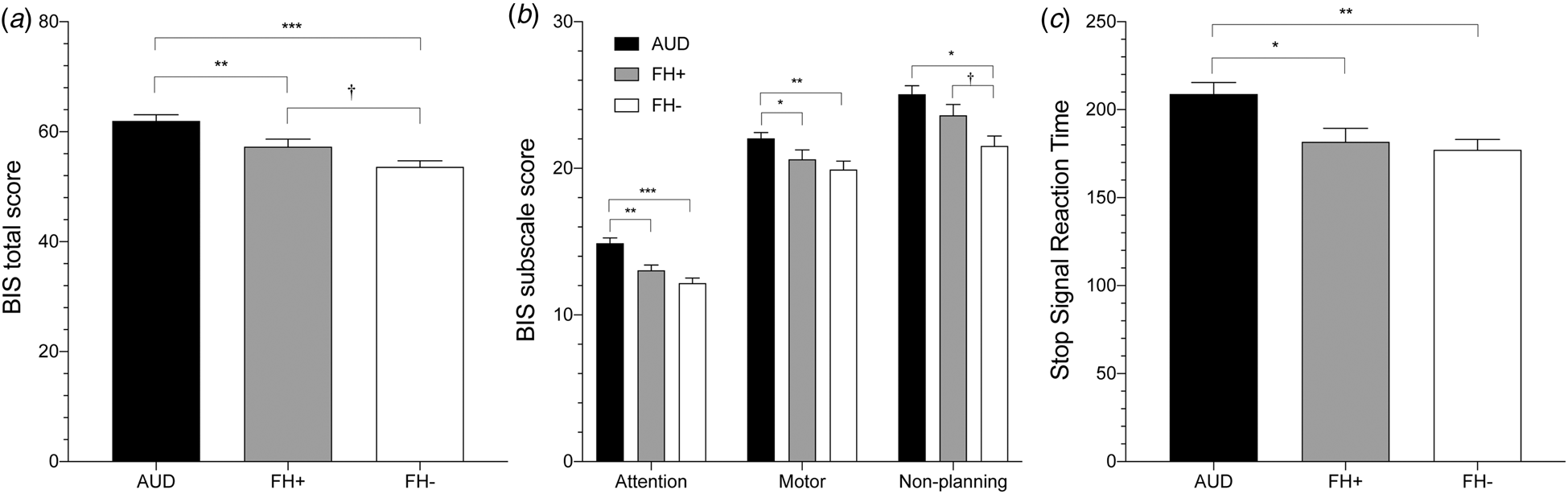
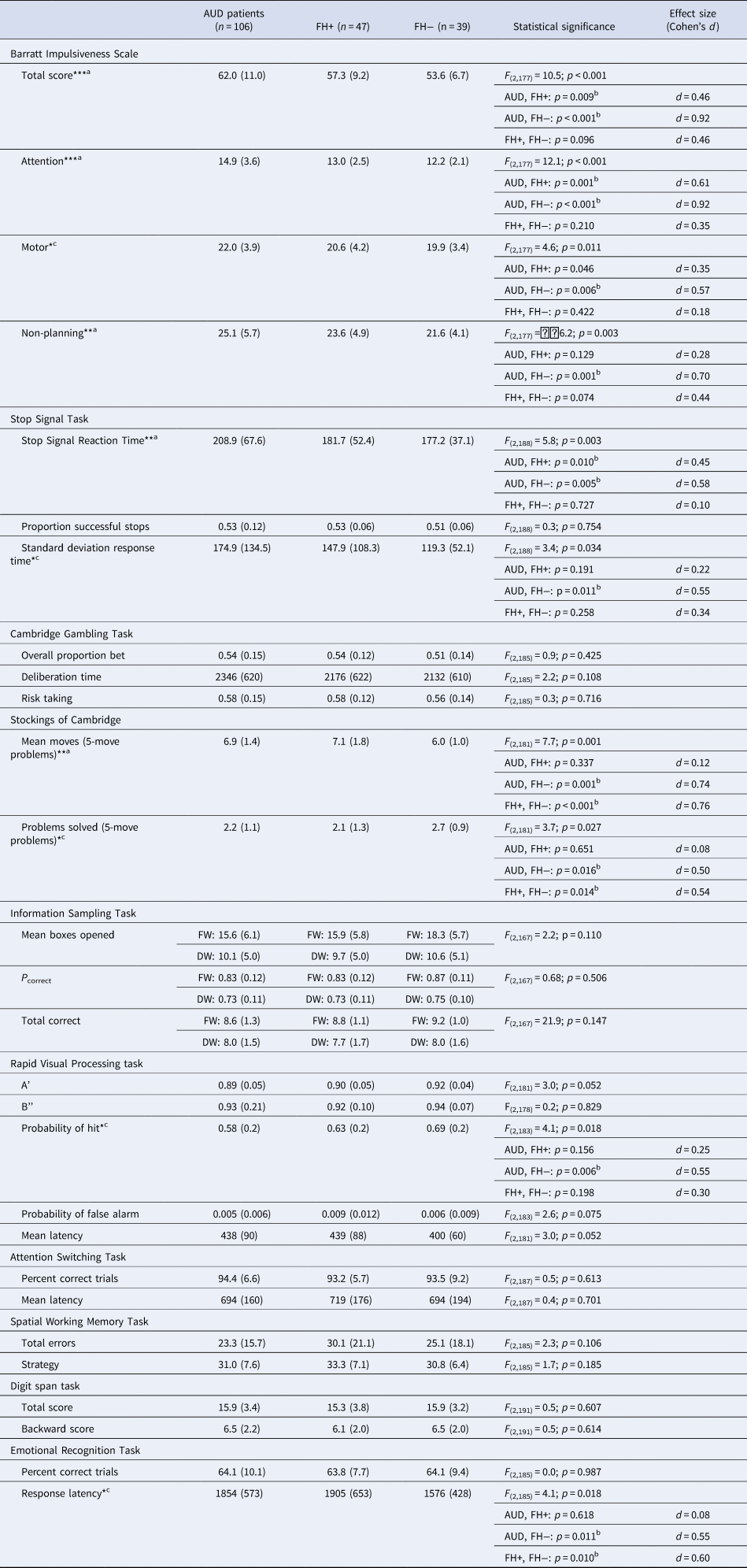
There was a statistically significant main effect of group on BIS total score (F (2,177) = 10.5; p < 0.001; Fig. 1a), with increasing scores from FH− (53.6 ± 6.7), FH + (57.3 ± 9.2) to AUD patients (62.0 ± 11.0). Post hoc tests showed that AUD patients had significantly greater self-rated impulsivity than both FH groups (p < 0.01), while a trend toward significance was observed suggesting higher scores in FH+ than in FH− (p = 0.096). The main effect of group was significant for all three BIS subscales, but for both attention and motor impulsivity subscales the AUD group scored significantly higher than both FH+ and FH−. For the subscale of non-planning however, AUD patients rated higher than FH− (p = 0.001), no difference between AUD and FH+ (p = 0.129), while a trend was observed toward higher scores in FH+ compared to FH− (p = 0.074; Fig. 1b).
Barratt Impulsiveness Scale (BIS) total score (a), BIS subscales (b) and Stop Signal Reaction Time (c) in patients with alcohol use disorder (AUD), healthy volunteers with AUD family history (FH+) and without family history (FH−). Error bars indicate standard error of the mean.

For the SST SSRT, there was a significant main effect of group (F (2,188) = 5.8; p = 0.003), but post hoc comparisons showed that AUD patients had significantly higher SSRT (mean 209 ms) than both FH+ (182 ms; p = 0.010) and FH− (177 ms; p = 0.005) with no difference between FH+ and FH− (p = 0.727; Fig. 1c). For standard deviation of response time, there was a significant main effect of group (F (2,188) = 3.4; p = 0.034), with the FH+ group being not significantly different from neither AUD (p = 0.191) nor FH− (p = 0.258). Finally, there was no significant main effect of group on the proportion of successful stops (F (2,188) = 0.3; p = 0.754). On the RVP, there was a significant main effect of group on the probability of a hit (F (2,183) = 4.1; p = 0.018), with the FH+ group not being significantly different from neither AUD (p = 0.156) nor FH− (p = 0.198). A’’ exhibited a similar pattern, even though the main effect of the group did not reach statistical significance (F (2,181) = 3.0; p = 0.052). No statistically significant main effect of group was found for RVP B’’ (F (2,178) = 0.2; p = 0.829), probability of false alarm (F (2,183) = 2.6; p = 0.075) or mean latency (F (2,181) = 3.0; p = 0.052). There were no significant main effects of group or interactions for the CGT, IST, AST, Digit span or SWM task outcomes, as reported in Table 2.
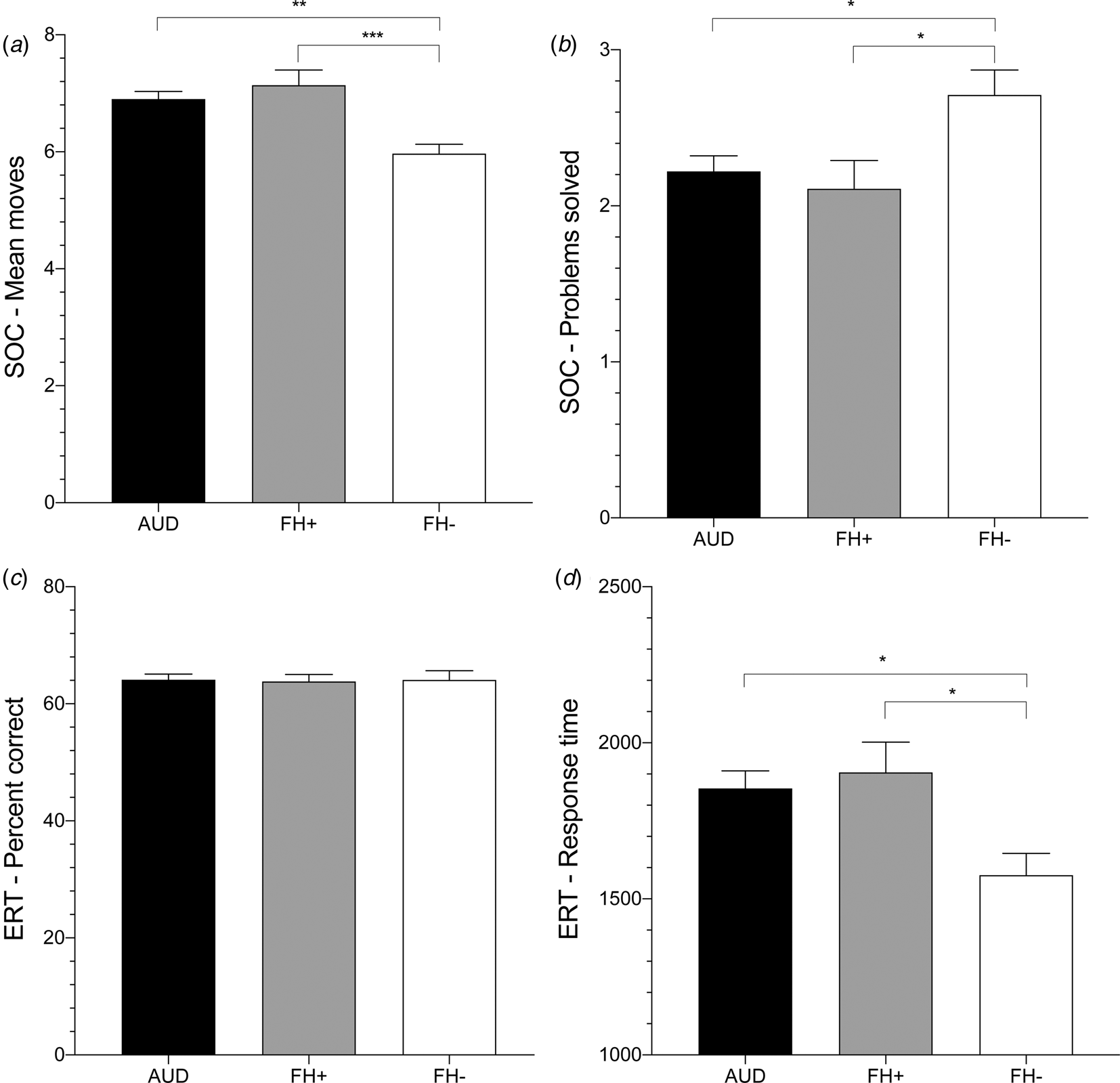
In the SOC task, there were statistically significant main effects of group on both mean moves (F (2,181) = 7.7; p = 0.001; Fig. 2a) and number of problems solved (F (2,181) = 3.7; p = 0.027; Fig. 2b), suggesting that FH+ performed similar as AUD (p > 0.1 for both outcomes), while needing to do more moves (p < 0.001) and solved fewer problems (p = 0.014) compared to the FH− subjects. In the ERT, a similar pattern was observed for mean response latency (F (2,185) = 4.1; p = 0.018; Fig. 2d) with longer response time in both AUD (p = 0.011) and FH+ (p = 0.010) compared to FH−, while no difference was found between AUD and FH+ (p = 0.618). There was no statistically significant main effect of group for ERT percent correct responses (F (2,185) = 0.0; p = 0.987; Fig. 2c).
Stocking of Cambridge (SOC) 5-move-problems mean moves (a), number of problems solved (b) and the Emotional Recognition task percent correct (c) and mean response time (d) in patients with alcohol use disorder (AUD), healthy volunteers with AUD family history (FH+) and without family history (FH−). Error bars indicate standard error of the mean.

Sensitivity analyses
The main FH analysis was repeated with a more restricted FH+ definition, i.e. at least one blood relative rated as 4 (definite problem drinker) on the FTQ, rendering 28 and 58 HC subjects categorized as FH+ and FH−, respectively. This analysis found similar results for the BIS, SSRT and SOC task, while the main effect of group on emotional recognition latency was no longer statistically significant. Online Supplementary Table S2 reports the complete sensitivity analysis.
In the Bonferroni adjusted HC v. AUD analysis, the BIS total score and subscale of attention, together with the SST SSRT remained statistically significant (Table 2, annotated a). In the Bonferroni adjusted FH analysis, the BIS total score, attention and non-planning subscales, SSRT and SOC mean moves still had a statistically significant main effect of the group with the adjusted alpha levels of 0.005 (Table 3, annotated a). Furthermore, the Bonferroni adjusted post hoc tests of these ANOVAs rendered identical conclusions as in the main analysis (Table 3, annotated c).
Neuropsychological test outcomes in alcohol use disorder (AUD) patients and healthy controls with positive and negative family history (FH) of AUD

FW, fixed win condition; DW, decreasing win condition.
Values are presented as mean (standard deviation).
a Statistically significant after Bonferroni adjustment of multiple comparisons for the main effect.
b Statistically significant after Bonferroni corrected post-hoc tests.
c Not statistically significant after Bonferroni adjustment of multiple comparisons for the main effect.
* p < 0.05; ** p < 0.01; *** p < 0.001 for the overall ANOVA.
In the AUD group, eight subjects (7.5%) had current serotonin reuptake inhibitor treatment, specifically sertraline (n = 3) and citalopram/escitalopram (n = 5). To investigate whether psychopharmacological treatment affected the results, the main HC v. AUD analysis and FH analyses were repeated after excluding the eight AUD patients on medication. This analysis yielded the same conclusions as in the original analysis (data not reported).
Discussion
When employing a traditional case-control study design, the present study showed that AUD patients exhibited elevated self-rated impulsivity, impaired response inhibition, attention and information gathering in decision making compared to HC. Importantly, in the FH analysis when taking into account FH status in the HC group, a different pattern of difference in cognitive outcomes emerged. In FH+ individuals, a trend was observed suggesting that this group may exhibit higher self-rated impulsivity than FH−, but lower than the AUD patients. Furthermore, FH+ individuals performed similar to AUD patients but significantly worse than the FH− group, on tasks of future planning and emotional recognition latency. Taken together, the results demonstrate that while certain cognitive deficits (i.e. impaired response inhibition, attention and information gathering) observed in AUD patients may be exclusively associated with the disorder – other cognitive constructs related to overall impulsive behaviour, future planning and emotion, could, on the other hand, represent potential genetically influenced endophenotypes in AUD.
Previous research has firmly established elevated impulsivity in AUD (Dick et al., Reference Dick, Smith, Olausson, Mitchell, Leeman, O'Malley and Sher2010), while the question regarding etiology remains unanswered. The current study found that self-rated impulsivity assessed by the BIS was significantly greater in AUD patients, while a trend toward higher levels of impulsivity was observed also in the FH+ group, for both the total score and the non-planning subscale. Importantly, this association was further supported in the sensitivity analysis with a restricted definition of FH+ which included only family members who were classified as definite problem drinkers. Even though the FH analysis did not reach statistical significance, the pattern of results are in line with previous studies showing that children (Acheson et al., Reference Acheson, Lake, Bray, Liang, Mathias, Ryan and Dougherty2016) and adults (Gierski et al., Reference Gierski, Hubsch, Stefaniak, Benzerouk, Cuervo-Lombard, Bera-Potelle and Limosin2013) with FH of AUD have elevated levels of self-rated impulsivity. In addition, these results corroborate a recent bivariate twin study indicating shared genetic factors between alcohol dependence and impulsivity (Khemiri, Kuja-Halkola, Larsson, & Jayaram-Lindström, Reference Khemiri, Kuja-Halkola, Larsson and Jayaram-Lindström2015a). Ersche and colleagues studied stimulant abusers, their nonaffected siblings and HC without any SUD FH, and found a similar pattern of results for the BIS, but the absolute values were much greater for the stimulant dependent patients (Ersche, Turton, Pradhan, Bullmore, & Robbins, Reference Ersche, Turton, Pradhan, Bullmore and Robbins2010). Even though our data cannot address the mechanism of action, previous studies have shown that elevated self-rated impulsivity is associated with reduced striatal dopamine receptor levels (Buckholtz et al., Reference Buckholtz, Treadway, Cowan, Woodward, Li, Ansari and Zald2010; Lee et al., Reference Lee, London, Poldrack, Farahi, Nacca, Monterosso and Mandelkern2009) and reduced gray matter in the orbitofrontal cortex (Korponay et al., Reference Korponay, Dentico, Kral, Ly, Kruis, Goldman and Davidson2017; Matsuo et al., Reference Matsuo, Nicoletti, Nemoto, Hatch, Peluso, Nery and Soares2009), both of which have been implicated in the neurobiology of AUD (Moorman, Reference Moorman2018; Volkow et al., Reference Volkow, Wang, Telang, Fowler, Logan, Jayne and Wong2007). Future studies employing larger sample sizes, longitudinal designs and neuroimaging techniques are needed to further delineate the underlying neurobiology of this putative endophenotype.
Response inhibition is often conceptualized as both a crucial executive function and a core feature of impulsivity (Bickel, Jarmolowicz, Mueller, Gatchalian, & McClure, Reference Bickel, Jarmolowicz, Mueller, Gatchalian and McClure2012). Our results replicate several previous studies showing poorer response inhibition in AUD patients (Bjork et al., Reference Bjork, Hommer, Grant and Danube2004; Goudriaan et al., Reference Goudriaan, Oosterlaan, de Beurs and van den Brink2006; Lawrence et al., Reference Lawrence, Luty, Bogdan, Sahakian and Clark2009a), but importantly we did not find any association between AUD FH and response inhibition. There was no difference between FH+ and FH− in neither the main analysis nor the sensitivity analysis with a more severe FH definition. These results were not consistent with previous studies that have found impaired response inhibition in FH+ individuals (Acheson et al., Reference Acheson, Richard, Mathias and Dougherty2011; Kareken et al., Reference Kareken, Dzemidzic, Wetherill, Eiler, Oberlin, Harezlak and O'Connor2013). Rather, our results are compatible with the conclusion that response inhibition deficits in AUD are possibly related to alcohol consumption or other external factors. Importantly, our results are also in contrast to the findings of Ersche and colleagues who found elevated SSRT also in unaffected siblings of stimulant abusers (Ersche et al., Reference Ersche, Jones, Williams, Turton, Robbins and Bullmore2012). A possible explanation could be that individuals with different cognitive profiles are more likely to initiate and engage in different forms of substance use. While acute alcohol intake impairs response inhibition (Schweizer et al., Reference Schweizer, Vogel-Sprott, Danckert, Roy, Skakum and Broderick2006), central stimulants such as amphetamine and methylphenidate can improve this cognitive domain (de Wit, Enggasser, & Richards, Reference de Wit, Enggasser and Richards2002; DeVito et al., Reference DeVito, Blackwell, Clark, Kent, Dezsery, Turner and Sahakian2009), reflecting inherent differences in the neurobiological mechanism of action of these substances of abuse, which may have a differential effect on individuals with these distinct cognitive profiles. Our results could thus reflect an important difference between the underlying genetic architecture between AUD and central stimulant use disorder: While self-rated overall impulsive behavior seems to be a possible endophenotype in both disorders, response inhibition may not follow the same pattern in AUD.
The AUD patients also performed significantly worse than the HC group on indices of prolonged attention (RVP) and ‘reflection impulsivity’, i.e. information gathering/evaluation in decision making (IST). These findings are in line with previous studies showing that AUD patients have impairments in tasks of attention (Cordovil De Sousa Uva et al., Reference Cordovil De Sousa Uva, Luminet, Cortesi, Constant, Derely and De Timary2010; Salgado et al., Reference Salgado, Malloy-Diniz, Campos, Abrantes, Fuentes, Bechara and Correa2009). Furthermore, we replicate findings from previous studies reporting higher reflection impulsivity on the IST task in AUD patients (Lawrence, Luty, Bogdan, Sahakian, & Clark, Reference Lawrence, Luty, Bogdan, Sahakian and Clark2009b) and both opioid and amphetamine dependence (Clark et al., Reference Clark, Robbins, Ersche and Sahakian2006). In the current study however, there was no statistically significant difference between FH+ and FH− on these outcomes. One possible interpretation is that these cognitive domains are impaired in AUD patients as a consequence of long-term excessive alcohol drinking, and not related to a genetically influenced endophenotype. Another possibility is that there actually is a true difference, but our study failed to detect it due to lack of statistical power. Inspection of the raw outcome data for both RVP and IST outcomes actually do suggest similar performance in AUD and FH+ groups compared to FH−, even though the threshold for statistical significance was not reached. Finally, it is important to note that certain cognitive endophenotypes could, in fact, be difficult to detect using a cross-sectional study design. If a specific cognitive trait constitutes a strong risk increase to develop AUD (or other severe psychiatric disorders), individuals with this trait will to a higher degree end up with the disorder and would, therefore, be included in our AUD patient group (or excluded due to psychiatric co-morbidity) and not in the HC group. Future replication studies employing longitudinal design are needed to further characterize specific cognitive AUD endophenotypes.
On the ERT task, emotional recognition response latency was associated with AUD FH while no such effect was found for the percentage of correct trials. Interestingly, emotional recognition has been shown to be impaired in AUD (Bora & Zorlu, Reference Bora and Zorlu2017), and indices of emotional recognition can also predict clinical treatment in clinical treatment settings (Rupp, Derntl, Osthaus, Kemmler, & Fleischhacker, Reference Rupp, Derntl, Osthaus, Kemmler and Fleischhacker2017). The association with FH+ did however not remain significant in our sensitivity analysis employing a more severe definition of FH+, suggesting that this finding should be interpreted as preliminary until replicated. Furthermore, FH of AUD was also associated with significantly worse performance on the SOC task of future planning. This is in line with previous studies showing impaired future planning and problem-solving in AUD (Beatty, Katzung, Nixon, & Moreland, Reference Beatty, Katzung, Nixon and Moreland1993; Goudriaan et al., Reference Goudriaan, Oosterlaan, de Beurs and van den Brink2006; Noël et al., Reference Noël, Van der Linden, Schmidt, Sferrazza, Hanak, Le Bon and Verbanck2001) as well as in patients dependent on opioids (Ersche, Clark, London, Robbins, & Sahakian, Reference Ersche, Clark, London, Robbins and Sahakian2006), ketamine (Morgan, Muetzelfeldt, & Curran, Reference Morgan, Muetzelfeldt and Curran2009) and amphetamine (Ersche et al., Reference Ersche, Clark, London, Robbins and Sahakian2006). The results also corroborate earlier work by Schaeffer and colleagues who found that FH of AUD was associated with impairments in problem solving/abstraction in both patients and healthy volunteers (Schaeffer et al., Reference Schaeffer, Parsons and Yohman1984). The results were similar also in the sensitivity analysis with a more severe definition of FH+, which further strengthens our conclusion. Our findings generate the hypothesis that cognitive domains related to future planning, and possibly emotional recognition, may constitute in part genetically influenced endophenotypes elevating the risk of AUD. In addition, the current study highlights the importance of breaking down heterogenous cognitive constructs, such as ‘impulsivity’, into separate subconstructs as they may have different genetic influences: While self-rated overall impulsive behavior and future planning ability were associated with positive AUD FH, other aspects of impulsivity such as response inhibition (SST), information gathering (IST) and risky decision making (CGT) were not.
Targeting cognitive domains could be a viable strategy when developing novel treatments, as well as for prevention programs for youths with FH of AUD. We recently found that parental SUD (including AUD) is associated with lower general cognitive ability in offspring, and this association was in part explained by shared genetic factors, suggesting that genetically influenced cognitive traits could index a genetic risk of SUD (Khemiri et al., Reference Khemiri, Larsson, Kuja-Halkola, D'Onofrio, Lichtenstein, Jayaram-Lindström and Latvala2019b). Previous studies have indeed found that baseline levels of impulsivity (Müller, Weijers, Böning, & Wiesbeck, Reference Müller, Weijers, Böning and Wiesbeck2008), response inhibition (Rupp et al., Reference Rupp, Beck, Heinz, Kemmler, Manz, Tempel and Fleischhacker2016) and risky decision making (Bowden-Jones, McPhillips, Rogers, Hutton, & Joyce, Reference Bowden-Jones, McPhillips, Rogers, Hutton and Joyce2005) can predict AUD treatment outcome in clinical settings. Importantly, cognitive outcomes such as response inhibition and self-rated impulsivity have been shown to predict individual treatment response to pharmacological treatments in AUD (Anton, Schacht, Voronin, & Randall, Reference Anton, Schacht, Voronin and Randall2017; Joos et al., Reference Joos, Goudriaan, Schmaal, Fransen, van den Brink, Sabbe and Dom2013; Khemiri et al., Reference Khemiri, Steensland, Guterstam, Beck, Carlsson, Franck and Jayaram-Lindström2015b; Schmaal et al., Reference Schmaal, Joos, Koeleman, Veltman, van den Brink and Goudriaan2013). If genetic in origin, these cognitive deficits would also be less likely to recover with time and thus in need of treatment even after a long time period of abstinence. Cognitive endophenotypes may thus have potential as possible clinical predictors or treatment outcomes, and future studies of novel interventions could benefit by including cognitive assessment in the study design.
The current study had several important limitations in need of discussion. First, the study had a limited sample size especially in the FH analyses, rendering the risk of type II errors as discussed above. Second, given the nature of this exploratory hypothesis-generating study (Kraemer, Reference Kraemer2019), and in accordance with previous studies allowing for cross-study-comparisons (Kehagia et al., Reference Kehagia, Housden, Regenthal, Barker, Müller, Rowe and Robbins2014; Lawrence et al., Reference Lawrence, Luty, Bogdan, Sahakian and Clark2009b; Lees et al., Reference Lees, Michalopoulou, Lewis, Preston, Bamford, Collier and Drake2017), we performed many statistical tests without adjustment for multiple comparisons. The overall interpretation of the results must thus be cautious and interpreted in light of the risk of type 1 errors. It is, however, important to note that the direction of all our findings was in the expected direction i.e. worse performance on cognitive tests in the FH+ and AUD compared to FH−. Furthermore, in a sensitivity analysis with Bonferroni adjustment for multiple comparisons, the overall results still remained significant, further supporting the findings of the main analysis. Third, there was likely selection bias of AUD patients volunteering to take part of the treatment studies with strict inclusion and exclusion criteria, and our findings are therefore not possible to generalize to more severe forms of AUD, who may exhibit a different pattern of more severe cognitive deficits. Fourth, even though our neuropsychological test battery included tests of a wide range of cognitive functions, some cognitive domains of relevance in addiction (e.g. episodic memory, verbal and learning capability) were not assessed due to limited time and resources. Future studies of cognitive endophenotypes in AUD would benefit from including such cognitive constructs as well.
Finally, a general limitation is that the AUD patients were recruited to take part in two separate RCTs while the HC group was recruited specifically for the current study of FH, yielding slightly different procedures and inclusion/exclusion criteria across participants. The AUD patients, for instance, could have current serotonin reuptake inhibitor treatment while no psychopharmacological treatment was allowed in the HC. We did however in a sensitivity analysis excluding the AUD patients with current psychopharmacological treatment and the results did not change, suggesting that this discrepancy did not bias the results greatly. Further, no validated assessment of FH status for AUD or other psychiatric disorders was performed, while in the HC group participants were excluded based on FH of other severe psychiatric disorders. It is thus not possible to exclude the possibility that within the AUD patient population, specific cognitive deficits could be associated with FH of AUD or to other major psychiatric disorders.
When evaluating AUD patients in clinical practice, the focus is traditionally on alcohol consumption, craving, psychiatric co-morbidity and the social environment. Basic cognitive functioning, however, tends to be overlooked, even though it is possible that these cognitive deficits indeed may explain some of the difficulties for which AUD patients seek out help. The main finding of the study was that elevated self-rated impulsivity, future planning and emotional recognition latency was associated with FH+, indicating that these cognitive domains could constitute a potential cognitive endophenotype in AUD. In contrast, other cognitive deficits observed in AUD, e.g. response inhibition, may be caused by external factors such as excessive alcohol intake. The present study highlights the importance of assessing cognition in AUD, as well as controlling for FH status in case-control and clinical treatment studies. Future studies using a longitudinal design and including methods such as neuroimaging and genotyping are needed to advance the understanding of cognitive endophenotypes in AUD.
Supplementary material
The supplementary material for this article can be found at https://doi.org/10.1017/S003329172000238X
Acknowledgements
For excellent assistance in data collection, we thank research nurses Margareta Gard-Hedander, Else-Britt Hillner, Rebecka Broman and Daniella Souma, psychologist Angela Stünkel, undergraduate students Maria Östman and Zakarias Thorin and project coordinator Camilla Hellspong. The study was financially supported by grants provided by the Stockholm County Council (20170512), Stiftelsen Söderström Königska Sjukhemmet (SLS-750801 and SLS-780001) and Systembolagets Alkoholforskningsråd (F02015-0099 and F02016-0078) to NJL. LK was supported by the Stockholm County Council (combined clinical residency and Ph.D. training program project grant 20170264), Bror Gadelius memorial fund and Psykiatrifonden research grant.
Conflict of interest
None.
Ethical standards
The authors assert that all procedures contributing to this work comply with the ethical standards of the relevant national and institutional committees on human experimentation and with the Helsinki Declaration of 1975, as revised in 2008.