Introduction
In the UK, thyroid cancer is the commonest endocrine malignancy; however, it only accounts for 1 per cent of all new malignant tumours diagnosed annually. Worldwide incidence rates vary by geographic area, age and sex, with an increasing incidence in females.Reference Leese, Flynn, Jung, Macdonald, Murphy and Morris1, Reference Mitchell, Livingston, Chang, Holts, Snyder and Lingvay2 Haselkorn et al. and Spitz et al. found that the incidence of thyroid cancer in the USA varied among ethnic groups, with reports of a higher incidence in Filipinas and South Asian women.Reference Haselkorn, Bernstein, Preston-Martin, Cozen and Mack3, Reference Spitz, Sider, Katz and Olacks4 Rossing et al. found a complex pattern of US thyroid cancer incidence, with rates varying between immigrant and native US populations.Reference Rossing, Schwartz and Weiss5
We had previously noted an apparent increase in the number of young Asian women presenting with thyroid cancer.Reference Rossing, Schwartz and Weiss5 The current study was conceived to investigate the age of presentation with thyroid cancer of female patients from various ethnic groups in our local population.
The study aimed to determine if ethnicity was a relevant variable in patients’ age of presentation with thyroid cancer.
To our knowledge, there has been no previous publication specifically assessing thyroid cancer and ethnicity in the UK.
Methods
We conducted a retrospective analysis of computerised pathology data for all patients undergoing an operative and/or core biopsy procedure for a thyroid nodule between 1 January 1998 and 31 December 2009 at three district general hospitals serving a very mixed ethnic population. Within this group, we identified a total of 263 patients diagnosed with thyroid cancer.
The three hospitals’ databases were used to identify patients’ ethnic origin. The ethnicity of individual patients was based on self-reporting.
Ethnic group was categorised (according to the UK Office of National Statistics system) as Asian (including Asian and Asian British Pakistani, Bangladeshi and Indian), Caucasian (including white-British and Irish), black (including black and black British Caribbean and African) or ‘other’ (including all other ethnic groups).6
Other information recorded from the databases included patients’ age, sex and type of thyroid cancer.
Statistical analysis
Statistical calculations were made using the Statistical Package for the Social Sciences version 16.0 for Mac software program. The independent sample t-test was used for statistical analysis.
Results
We identified 263 cases of thyroid cancer from our databases. The ethnic origin of 17 patients (6 per cent) was not identified; these patients were therefore excluded from the study, leaving 246 patients.
All ethnic groups showed a female predominance in thyroid cancer patients.
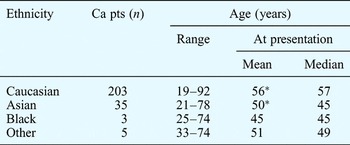
Table I shows the mean age of presentation with thyroid cancer, for all ethnic groups. There was no statistically significant difference in this respect between Asian and Caucasian patients.
Thyroid cancer presentation age by ethnicity

*p = 0.08 and 95 per cent confidence interval = −0.70 to 12.3, comparing mean thyroid cancer presentation age. Ca pts = thyroid cancer patients
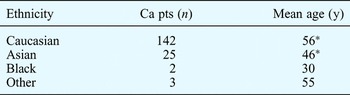
Table II shows the mean age of presentation with thyroid cancer in women. Asian women with thyroid cancer presented at a younger mean age than Caucasian women with thyroid cancer; this difference was statistically significant (p = 0.01).
Thyroid cancer presentation age in women, by ethnicity

*p=0.01 and 95 per cent confidence interval = 2.4–18.2, comparing mean thyroid cancer presentation age. Ca pts = thyroid cancer patients; y = years
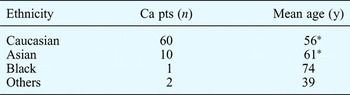
Table III shows the mean age of presentation with thyroid cancer in men. There was no statistically significant difference in this respect between Asian and Caucasian patients.
Thyroid cancer presentation age in men, by ethnicity

*p = 0.33 and 95 per cent confidence interval = −16.5 to 5.7, comparing mean thyroid cancer presentation age. Ca pts = thyroid cancer patients; y = years
Our data indicated that well differentiated papillary thyroid cancer predominated in all ethnic groups.
Discussion
Thyroid cancer occurs predominantly in female patients.Reference Leese, Flynn, Jung, Macdonald, Murphy and Morris1, Reference Mitchell, Livingston, Chang, Holts, Snyder and Lingvay2 Our study findings supported this observation, in all ethnic groups. However, our study found that the ethnicity of female patients influenced the age at which they presented with thyroid cancer. Most importantly, Asian women presented with thyroid cancer at a significantly younger mean age (46 years) than Caucasian women (56 years) (p = 0.01). In contrast, there was no significant difference between the mean age of thyroid cancer presentation of Asian men (61 years) versus Caucasian men (56 years) (p = 0.33).
Other studies, mainly from the US, have also found ethnicity to be a relevant variable in thyroid cancer.Reference Haselkorn, Bernstein, Preston-Martin, Cozen and Mack3, Reference Spitz, Sider, Katz and Olacks4, Reference Schwartz, Kulwicki, Weiss, Fakhouri, Sakr and Kau7, Reference Haselkorn, Stewart and Horn-Ross8 These studies found that certain ethnic groups had a much higher incidence of thyroid cancer, for example Southeast Asian and Arab and Chaldean females.Reference Schwartz, Kulwicki, Weiss, Fakhouri, Sakr and Kau7, Reference Haselkorn, Stewart and Horn-Ross8 However, it is important to note that the ethnic mix in the UK differs from that in the US.
In the UK, there have been no previous studies assessing specifically the relationship between thyroid cancer and ethnicity. However, some general studies have assessed the incidence of all cancers in various ethnic groups. One such study looked at general cancer incidence in the English South Asian population (i.e. England residents of Indian, Pakistani or Bangladeshi origin). The incidence of various cancers, including thyroid cancer, was found to be significantly higher in this population compared with the non-South-Asian population.Reference Winter, Cheng, Cummins, Maric, Silcocks and Varghese9
Unfortunately, our study was not able to demonstrate the incidence rates of thyroid cancer in the different ethnic groups studied, due to differences in referral patterns and consequent problems in defining the catchment areas of the three hospitals.
It could be speculated that a combination of factors may have accelerate the malignant process, resulting in female Asian patients presenting with thyroid cancer at a much earlier age than female Caucasian patients. One such factor may be iodine deficiency.Reference Knobles and Medeiros-Neto10 Thyroid cancer has also been linked to genetic factors.Reference Franceschi11 An estimated seven to nine per cent of patients with well differentiated thyroid cancers have been shown to have a positive family history.Reference Grieco, Santoro, Berlingieri, Melillo, Donghi and Bongarzone12, Reference Jhiang, Sargartz, Tong, Parker-Thornburg and Capen13 However, none of these studies specified patients’ ethnicity.
Our study included three black patients with thyroid cancer. A similar proportion was reported by the Surveillance, Epidemiology and End Results study, which found that the black population had a significantly lower rate of thyroid cancer than the white population.Reference Spitz, Sider, Katz and Olacks4 However, in our study the number of patients from black and other ethnic groups was too small to draw any conclusions.
Seventeen patients were excluded from the study as data on either due to patient refusal or ethnic data was not available. Had this information been available, it may have affected our results. However, if these 17 patients had been Caucasian, the mean age of presentation of thyroid cancer in both sexes would not have changed. Alternatively, if they had all been Asian, again, the mean age of presentation in both sexes would not have changed; thus, our results would have been unchanged. It is important to note, however, that ethnicity in this study was based on patient self-reporting rather than patient surname, unlike previous studies.Reference Winter, Cheng, Cummins, Maric, Silcocks and Varghese9, Reference Nasseri14 This added strength to our findings. If these 17 patients’ surnames had been used to identify their ethnic origin, then they would have been classified as Caucasian, leaving our results unaffected.
The age of presentation of thyroid cancer (i.e. <10 years or >40 years) is a well known prognostic factor. As Asian women present with thyroid cancer at a much younger age than women from other ethnic groups, this raises the question of whether there should be an ethnicity-specific age criteria, rather than just age alone, with which to assess thyroid cancer risk.
The comparison of thyroid cancer incidence in different ethnic groups requires caution. To our knowledge, there are no published, English language data available from Pakistan, India or Bangladesh to support our UK findings. Our study did not divide our Asian patients into those who had immigrated from their country of origin and those who had been born in the UK. There may be a difference in health services uptake between these two groups, and this may have influenced our results. In more recent times, the UK health department's introduction of a ‘choose and book’ patient referral self-management system may have resulted in some patients in our three hospitals’ catchment areas being treated elsewhere.
The main limitations of this study were the relatively small number of patients, particularly in the Asian group, and the confinement of the study to a specific geographical area.
These problems could be addressed by obtaining national data on ethnicity and thyroid cancer via the UK head and neck cancer registry. Analysis of UK-wide data for certain cancers is currently possible using a pooled dataset from all the UK cancer registries. Unfortunately, at the time of writing (August 2010) ethnicity-linked thyroid cancer data were unavailable from this source. Furthermore, a review of available resources (e.g. the Cancer e-Atlas) failed to locate any alternative, comparable data. Fortunately, the West Midlands Cancer Intelligence Unit, part of the United Kingdom Association of Cancer Registries, was able to provide further information and clarification on issues surrounding ethnicity data. In our experience, the best source of ethnicity data for cancer patients is Hospital Episode Statistics records. The West Midlands Cancer Intelligence Unit uses individual patients’ National Health Service numbers to locate their Hospital Episode Statistics records. Each patient's ethnicity is then determined from the Hospital Episode Statistics record. In many cases, conflicting ethnicities are recorded.
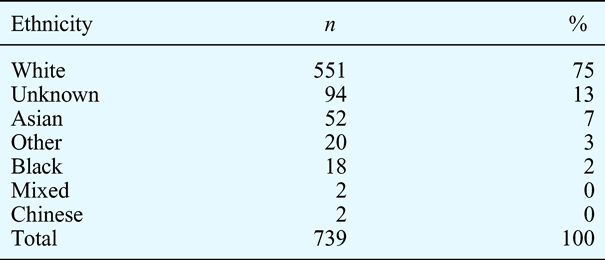
The West Midlands Cancer Intelligence Unit provided us with data on the ethnicity of thyroid cancer patients within their region, recorded between 2005 and 2008, as shown in Table IV. This table shows that thyroid cancer patients of unknown ethnicity make up 13 per cent of the total; this is a higher proportion than that of all other non-white ethnic groups combined. It is thus difficult to draw any meaningful conclusions.
West midlands thyroid cancer patients* diagnosed 2005–2008, by ethnicity
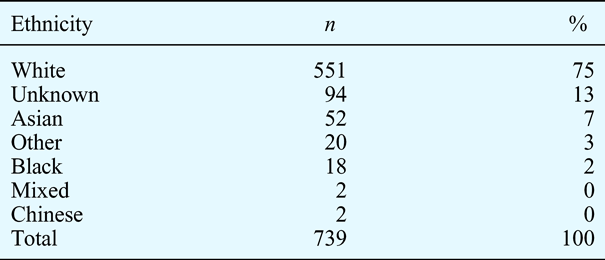
* Resident in the West Midlands region.
• Thyroid cancer commonly occurs in women
• In the US, thyroid cancer is commoner in certain ethnic groups
• There has been no equivalent research in the UK
• In this study, Asian women presented with thyroid cancer significantly younger than Caucasian women
Another source of ethnicity information is the Office of National Statistics, which produces ethnicity data at a Primary Care Trust population level. However, these statistics are still experimental, they are of limited use as they are not categorised by sex or age, and no data are available prior to 2001.
We acknowledge that a larger, national study of thyroid cancer and ethnicity is needed in order to draw a much more rigorous conclusion. However, such research would require better recording of ethnicity data.
Conclusion
This study of a mixed ethnic population in the West Midlands region found that Asian women with thyroid cancer present at a significantly younger age than Caucasian women. We acknowledge that a larger study is needed to assess whether this trend is found in other areas of the UK. If so, this may have clinical implications when assessing patients with thyroid nodules.
Our finding of an ethnic difference in thyroid cancer presentation age is interesting and raises questions of aetiology and prognostic significance, both of which are outside the scope of this study.
Acknowledgement
We thank Dr Tim Evans from The West Midlands Cancer Intelligence Unit for providing information on thyroid cancer and on the problems regarding currently available ethnicity data.