Introduction
After the Second World War a new agro-food system defined by a series of common features took shape worldwide, particularly in the developed nations. This system was based on intense farm capitalisation, the massive use of industrial inputs, genetically improved seeds, the intensification of livestock farming relying on processed feeds, and the progressive domination of new marketing patterns (Tubiana, Reference Tubiana1989). Among these features, numerous scholars have pointed to the expansion of intensive livestock farming and the associated feed sector as the keystone of the system (Berlan, Reference Berlan, Friedland and Busch1991; Goodman and Redclift Reference Goodman and Redclift1991, Le Heron and Roche, Reference Le Heron and Roche1995: 23). Beginning with the first American grain surpluses in the early 1950s, the intensive United States model spread quickly to Western Europe and other less developed parts of the world, gathering pace as a result of supply agreements between private enterprises and the United States administration (Schusky, Reference Schusky1989; Etxezarreta, Reference Etxezarreta2006: 38–9).
It would be an error, however, to suppose that these new technologies represented a radical break with those existing before the Second World War. In fact, the majority, including tractors and harvesters, hybrid seeds, chemical fertilisers and industrial animal husbandry were already in use before the War, but after 1945 they developed fast and spread rapidly throughout the industrialised nations. In almost all of the countries that had access to these technologies the rate of output growth shot up (Brassley, Reference Brassley2000: 77). The consolidation of this new agro-food system involved the majority of the developed countries in a rapid transition from traditional to modern methods of agriculture. These transformations were accelerated by a range of factors. On the one hand, the industrialisation and internationalisation of agricultural and livestock output provided the sector with powerful new technologies, either developed locally or imported, which allowed farmers to overcome many of the restrictions imposed by environmental factors. On the other, demand side changes associated with rising incomes and the emergence of a much more urban, industrial and services oriented world generated new needs, to which agriculture had to respond. This profoundly changed the nature of the sector from the standpoint of both inputs and outputs.
Spain was one of the countries where American style intensive agriculture took hold most quickly (Etxezarreta, Reference Etxezarreta2006: 39). The economic and military agreements reached by Spain and the United States in 1953 resulted in the arrival not only of American maize and soy surpluses but also of the major feed multinationals, giving rise to a farm policy that was modelled along United States lines from the 1950s onwards and clearly contributing to the process of modernisation (Clar, Reference Clar2008a: 155 and Reference Clar2009: 105). In this context, certain regions underwent a very rapid, even acute intensification of agriculture. This was the case in Aragon, where the transformation of farming between the 1950s and the 1980s provides an excellent case study exemplifying the changes that occurred all over Spain in this period. The first year of the study period, 1955, was a watershed, the moment at which the adversities that had dogged Spanish farming since the Civil War were finally overcome. In 1951 the regime relaxed its rigidly interventionist farm policy, and the policy of economic autarky that had bedevilled the 1940s and early 1950s was finally abandoned in 1959. As a consequence, agriculture embarked on the path of post war growth some years later than other European countries like the United Kingdom (Brassley, Reference Brassley2000: Clar and Pinilla, Reference Clar, Pinilla, Lains and Pinilla2009: 322–325). In 1950, for example, agricultural labour productivity in Aragon was only sixty-three per cent and crop production was seventy-four per cent of its level in 1932 (Pinilla and Clar, 2011: 50).
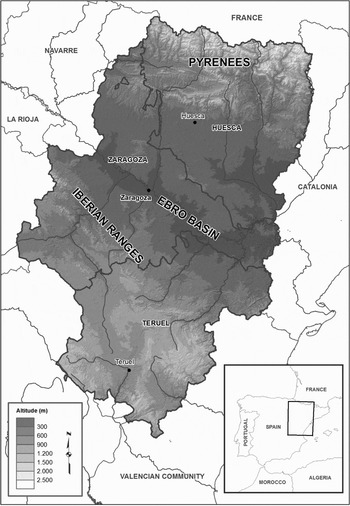
Aragon, which has an area of 47,720 square kilometres, is located in north eastern Spain. The region is formed by the three provinces of Huesca to the north, Teruel to the south and Zaragoza in the centre. The region is crossed by two mountain chains, the Pyrenees in the north of Huesca province, which mark the border with France, and the Sistema Ibérico range, which occupies much of Teruel and extends south eastwards into Zaragoza. The two ranges are divided by the Ebro Valley, which runs the length of Aragon from north east to south east, taking up almost all the province of Zaragoza, the southern half of Huesca and the north east corner of Teruel (map 1). The swift restructuring of Aragonese agriculture from the 1950s is interesting because it exemplifies events in Spanish farming as a whole in two key ways.
First, the region's modernisation reflects the opportunities offered by new technologies and changes in the demand for foodstuffs to shift output in an agriculture that was traditionally conditioned by environmental factors. Two serious obstacles hindered the growth of Aragonese farm output in the last two centuries. In the first place, the Ebro Valley, which makes up almost half of the territory of Aragon, is extremely dry with average annual rainfall of only around 300 to 350 millimetres. Second, 31.2 per cent of land in Aragon is mountainous with an altitude of over 1,000 metres (3,280 feet) above sea level and steep slopes. Just 41.3 per cent of the region's land lies below 600 metres (1,968 feet), and this is in the parched Ebro Valley. The combination of steep slopes, high altitude and aridity places tough environmental constraints on the development of agriculture. The only crops that can be grown in the Ebro Valley without irrigation are winter cereals, vines and olives, and natural pasture is very poor, which limits the opportunities for livestock farming, especially in summer. The steep slopes and high altitudes of the mountain areas, meanwhile, are largely unsuitable for agriculture of any kind, but the potential for livestock is limited by winter snows, despite the abundant, rich pasture available (Pinilla and Clar, 2011: 41–42).
Second, modernisation increased the polarisation of agricultural systems. Some regions adapted better to the far reaching changes affecting farming after 1955, while others suffered crisis and the abandonment of the land, intense migration and depopulation (Collantes and Pinilla, Reference Collantes and Pinilla2011: 27–44). Meanwhile, the disparate responses in Spain to what contemporaries called the ‘crisis of traditional farming’ were very much shaped by earlier paths. Thus, the highly positive results were clearly favoured by the existence of a whole series of earlier processes and transformations that intensified the impact of exogenous variables.
Various scholars have remarked on the link between the new agricultural technologies and the existing infrastructure. To begin with, the development of modern irrigation systems has been identified as a necessary condition for the efficient use of the agricultural technologies that emerged in the second half of the twentieth century (Hayami and Ruttan, Reference Hayami and Ruttan1985: 283 and 286). In the case of the Green Revolution, the new high yield varieties worked best where irrigation infrastructure was already available and chemical fertilisers were widely used (Schusky, Reference Schusky1989: 128–9; Federico, Reference Federico2005: 103). Thus, the general economic context and the specific agricultural conditions for the implementation of these powerful technologies had a decisive impact on the eventual outcomes both in developing countries and developed nations like the United States (Evenson and Gollin, Reference Evenson and Gollin2003: 758–760; Mundlak, Reference Mundlak2005: 1007). The United States, in fact, achieved international leadership as a result of the accumulation of successive agricultural technologies after a long process of development and innovation that was closely linked to prevailing conditions in that country (Olmstead and Rhode, Reference Olmstead and Rhode2008).
In view of these theoretical arguments, our initial hypothesis is that the rapid modernisation and transformation of Aragonese farming after 1955 can be largely explained in terms of a series of earlier, cumulative changes. Beginning at the turn of the twentieth century, these changes prepared the ground, ensuring that the factors inherent in new supply side technologies and variations in demand were sufficient to bring about a profound transformation, driving an intense modernisation of the agricultural sector. In short, we suggest that the process of technological change which allowed the rapid modernisation of Aragonese farming is a clear example of path dependency. Closely linked with this initial hypothesis is the stark contrast in the pace of agricultural change within Aragon itself. In those areas where earlier changes had not gone far, especially the highland province of Teruel, the results were poor throughout the whole process of agricultural modernisation.
One of the most frequently noted effects of Green Revolution technologies is precisely the polarisation between, and indeed within, regions (Hayami and Ruttan, Reference Hayami and Ruttan1985: 359–60). Events in countries which themselves embody differing degrees of development reveal how high yield seed varieties have especially benefited the more advanced rural communities, accentuating internal inequalities (Hazell and Ramasamy, Reference Hazell and Ramasamy1991). Analysis of the Aragonese case also reveals the extent to which the starting positions of different areas determined increasing intra-regional polarisation between ‘successful’ agriculture and more ‘backward’ farming, as also occurred in Mexico, Turkey, Pakistan and India in the second half of the twentieth century.
Examination of the transformation of agriculture in Aragon offers not only a good approximation to the peculiarities of agricultural change in Spain as a whole, but also some very useful lessons for farming in other countries, particularly today's developing nations. Essentially, it reveals how the sudden arrival of modern technologies can be a necessary, but is not a sufficient, condition for a successful process of agricultural transformation to take off. In short, gradual dynamics preceding a technological change facilitate a more profound technological break afterwards. This may be due to a certain narrowing of the existing technology gap, the learning and experimentation processes undergone by the agents concerned, and to existing links between the domestic and external markets, all or any of which could induce change processes. Based on historical experience in Europe and the United States, it would appear, in general, that the main drivers of agricultural change have normally emerged outside the farm sector itself. Thus, it was economic modernisation and closer links with external markets that generated the transforming spark leading to the development and deployment of available technologies (Gardner, Reference Gardner2002: 346–9; Lains and Pinilla, Reference Lains, Pinilla, Lains and Pinilla2009: 2–6; Pinilla, Reference Pinilla and Pinilla2009: 18–23). This paper is basically concerned with the extent to which such exogenous factors interacted with earlier changes in the Aragonese case, and the lessons that can be learned from the historical process in the region.
An overview of Aragonese agricultural output, 1955–85
Given the importance we ascribe to changes in farming before the Civil War (1936–39), which prepared the ground for the eventual process of modernisation, we shall begin by considering the uneven evolution of agriculture in the different parts of Aragon. Development in the lands of the central Ebro Valley (Zaragoza and the south of Huesca province) in the first third of the twentieth century was in stark contrast to the stagnation of the highland areas of northern and southern Aragon (Teruel and the north of the province of Huesca).Footnote 1 This is reflected in differences in output growth and productivity gains. This uneven performance illustrates the enormous difficulties faced by farmers in the highlands of Huesca and Teruel in their efforts to share in the process of agricultural modernisation. Transhumant sheep farming, subsistence agriculture, the production of woollens and pluri-activity formed the pillars of the economy in these areas until the end of the nineteenth century, when the system ran into severe difficulties that dismembered economic structures and led to intense participation in early migratory flows in Spain (Collantes and Pinilla, Reference Collantes and Pinilla2004: 154–8).
The lands of the Ebro Valley in Huesca and Zaragoza, in contrast, were better placed to benefit from the new opportunities for agricultural production offered by incipient industrialisation and, especially, by rising demand from the expanding cities. Significant growth was achieved on the back of the wheat flour complex in the first place, and sugar beet in the second. Aragon thus tended to specialise in supplying farm and food products to neighbouring regions, particularly wheat and lamb to Catalonia, olive oil to Italy, wine to La Rioja and France, and sugar to much of Spain. The development of sugar beet production was especially important, driving industrialisation in the province of Zaragoza where production was concentrated. The expansion of this crop was promoted by the Granja Escuela Experimental de Zaragoza (Zaragoza Experimental Farm) in response to falling wheat prices during the depression at the end of the nineteenth century. Wheat, which occupied a large part of the irrigated land in the Ebro Valley, was thus displaced by sugar beet, a crop that needed the new chemical fertilisers that were beginning to be produced in the city of Zaragoza. Traditional irrigation methods were also transformed to accommodate beet, which needs permanent irrigation. Meanwhile, beet drove the creation of sugar mills and output rose to more than fifty per cent of the Spanish total, in turn encouraging the development of machinery manufacturing and a modern financial sector in the city of Zaragoza (Pinilla, Reference Pinilla1995: 373–86). The modernisation process accentuated the dual pattern of agricultural development that already existed in Aragon, an outcome that can be explained basically in terms of the capacity of different kinds of farmers to adopt innovations and switch to higher value added crops.
The Civil War and the farm policy implemented by the dictatorship during the 1940s brought an abrupt end to growth in the most dynamic areas and piled on problems in struggling districts. The Franco regime was isolated and currency reserves were too scarce to allow essential imports of key agricultural inputs that were in short supply domestically. This caused a sharp fall in the use of chemical and mineral fertilisers and slowed acquisitions of new farm machinery and spare parts to a trickle, as existing equipment gradually became obsolete and fell into disrepair. Meanwhile, new irrigation schemes planned in the 1930s were shelved, seriously affecting the third driver of the earlier expansion of agriculture. In addition the farm policy was slow to correct the imbalance between supply and demand in a context of poor interventionist practice (Clar and Pinilla, Reference Clar, Pinilla, Lains and Pinilla2009: 319–22). In these circumstances, Aragonese agriculture returned to a largely organic model while crop yields fell far below their pre-war levels. Output continued to fall in all three of the region's provinces until well into the 1950s, accompanied in all cases by a sharp decline in crop yields, and in Huesca and Teruel by a reduction in the land cultivated (Pinilla and Clar, 2011: 52–5). As mentioned in the introduction, however, the end of Spain's isolation and the about turn in farm policy eventually allowed farmers to recommence the process of modernisation in the early 1950s.
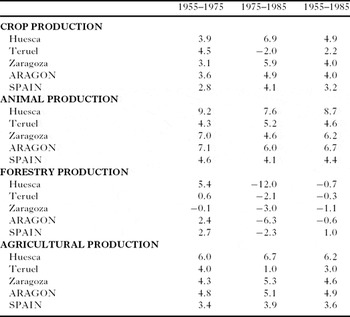
The development of the farm sector in Aragon after 1955 reveals a clear reorientation towards products that had earlier hardly figured in the structure of output, particularly in the case of livestock and animal produce, although appreciable differences in the dynamics may be observed in the region's three provinces. Aragonese farm output grew strongly in the brief period of thirty years between 1955 and 1985, at the same time undergoing an intense process of modernisation like the rest of Spanish agriculture. The main agricultural macro-variables bear this out. Between 1955 and 1985, average annual growth in the gross value added of Aragonese farming was 2.7 per cent, a significantly higher figure than the Spanish average of two per cent. In chronological terms, growth was fastest in Aragon before 1975 (three per cent), by which time the transformation from traditional to highly industrialised agriculture had been almost completed. Growth then slowed considerably between 1975 and 1985 (two per cent), coinciding with the general crisis of the new, fossil-fuel dependent agricultural model (Sumpsi, Reference Sumpsi1982).
However, this result conceals very different performance across the Aragonese provinces. While gross value added expanded fast in Zaragoza (average annual growth of 2.6 per cent) and Huesca (3.9 per cent), the two provinces with the best conditions for agriculture in the Ebro Valley, mountainous Teruel's growth was much slower (0.7 per cent) and was even negative between 1975 and 1985, a consequence of the increasing difficulties facing highland farmers.Footnote 2 Labour productivity also rose sharply (a total 609 per cent in Aragon between 1955 and 1985) well above the Spanish average (420 per cent) for two closely linked reasons. Firstly, labour saving techniques and machinery were deployed on a massive scale and, secondly, rural migration decoupled the Spanish economy from farming, a phenomenon that had a major impact on Aragon. The strong growth in labour productivity in Zaragoza and Huesca (632 per cent and 681 per cent respectivelyFootnote 3) was largely due to the impact of technological change, but in Teruel (365 per cent) the progress made was basically linked to the enormous decline in the rural population after 1955 and it faltered around 1975, by which time the exodus from the land had come to an end (Ayuda et al., Reference Ayuda, Sáez and Pinilla2000: 144–52). These two transformation models, one active and associated with mechanisation, and the other passive and associated with migration, exemplify developments in Spain as a whole in this period (Clar, Reference Clar2008b). In general terms, the north and east of the country followed the active model, while farming in the south and west underwent a more passive transformation.
Breaking farm production down into agriculture, livestock and forestry, the three basic sub-sectors, Aragon also provides an especially intense case of Spanish farm restructuring. In fact, the growth gap between Aragonese and total Spanish farm output was due both to the region's dynamic agriculture and to its commanding lead in animal husbandry. Livestock was unquestionably the most dynamic farm sector in Aragon between 1955 and 1985, and the trend was similar in all three provinces (see Table 1). The result of this process was an intense change in the components of Aragonese farm output. While livestock accounted for only twenty-eight per cent of final farm output in 1955, its share had risen to forty-seven per cent for Aragon by 1985.
Average annual final output growth in agriculture

Source: Own work based on Banco de Bilbao (1955–1985).
The dynamics of Aragonese livestock farming reflects events in Spain as a whole after 1960, and not just in quantitative terms. Perhaps the most distinctive feature of the Spanish case is that a country where animal husbandry had traditionally accounted for only a small part of agricultural output, given the scarcity of good pasture, should draw level with, and even overtake, other countries with a much stronger tradition. Indeed, intensive rearing of chickens and above all pigs has reached such a pitch that Spanish output per head of population is now among the highest in the world.Footnote 4 Both in Spain as a whole and especially in Aragon this tremendous growth in the livestock sector was due to a rapid change in the predominant model. The scant comparative advantages of traditional animal husbandry, which was always hampered by the extreme aridity of much of the region's land, combined with the crisis of transhumant sheep farming to keep Aragonese stock farming weak until the 1960s. Thereafter, however, the arrival of intensive animal husbandry in Aragon, beginning with poultry and pig farms using sheds and feeding lots, swiftly displaced traditional sheep farming, an activity that was bound to the region's agro-climatic conditions. The evolution of stock farming structures in Aragon thus show a clear shift towards intensive, industrial methods and systems, particularly in the case of pig farming, which were decoupled from the condition of the land.
Meanwhile, the rapid growth of animal husbandry also changed the structure of Aragonese farm output. The traditional specialisation in wheat had been further strengthened from the mid nineteenth century by the development of a strong flour milling industry (Pinilla, Reference Pinilla1995: 283–342; German, 2002: 70–6), and cereals grown for human consumption had become the chief crop. This dominance began to change in the 1960s, however, as ever more land and crops were given over to feedstuffs for intensive livestock farms. The key crops were barley and maize, with production in Aragon of the former soaring by twenty per cent and of the latter by sixty per cent. No other crop expanded anything like as fast. In just two decades livestock farming thus spearheaded change not just in the farm sector as a whole, but in the internal crop structure, which was placed at the service of animals. Once again, Aragon exemplifies the dynamics of Spain as a whole after 1960, when the reorientation of production to intensive livestock farming sharply changed the composition of the main crops grown.Footnote 5 This dynamic also connects the Aragonese case to one of the most visible effects of agricultural globalisation in the second half of the twentieth century, that is the integration of major agricultural sub-sectors, such cereals, within the livestock complex (Etxezarreta, Reference Etxezarreta2006: 75).
Explaining agricultural change
This brief description of the main changes affecting Aragonese farm output between 1955 and 1985, raises three questions. First, what are the factors that explain the extraordinarily intense restructuring of agriculture in Aragon in just three decades? Second, how did the impact of transformation differ in the three provinces of Aragon? And third, why did this happen?
To focus first on the factors driving change, we may note the impact of demand side shifts. Beginning in the 1960s, the Spanish diet joined the general process of convergence between Europe and the high calorie, animal protein based United States model. These changes were a consequence of urbanisation and rising per capita incomes and were amply reflected in household expenditure. Within a general dynamic of shrinking spending on food as a part of the household budget, animal products and fresh fruit and vegetables gained ground, while consumption of cereals declined. Bread, pasta and other cereal products accounted for 18.5 per cent of food spending in 1958, but by 1968 this had fallen to just 13.5 per cent, according to the Encuestas de Presupuestos Familiares, the family budget surveys. The appreciable growth in demand for meat and other animal products translated into rising output in the 1960s, 1970s and 1980s, and Aragon was a notable example, having switched from being a predominantly agricultural to a largely livestock oriented region in a relatively short time. Cross-border agribusiness had a significant influence on this process, as the basically United States feedstuff-livestock complex established itself in Spain largely by developing industrial methods based on modern technologies in a domestic context that lacked both feed manufacturing and intensive livestock industries, and advanced genetics and animal feed technologies. The institutional framework, meanwhile, was highly favourable to the massive penetration of these industries, given the Franco regime's avowed aim of supplying cheap meat to the mass of the Spanish people (Clar, Reference Clar2008a: 155–7).
Aragon was a key player in this process, given the region's proximity to Catalonia and Valencia, both major centres of Spanish industry and big buyers of foodstuffs. This effect is clearly observable in the high percentage of animals raised in Aragon but slaughtered in the industrial regions on the coast. This was seventy-five per cent of total Aragonese meat production for all four of the main food species in 1985. However, the commercial networks linking Aragon with its neighbours were not created from nothing. Aragon had specialised in raising lamb for slaughter from the end of the nineteenth century, and these animals were exported by rail especially to Catalonia. Huesca and Zaragoza were the provinces that concentrated most on this trade (Pinilla, Reference Pinilla1995: 397–8). From this standpoint, the commercial links established before the First World War were a key link with the 1950s, providing continuity for Aragon's leading livestock entrepreneurs (Clar, Reference Clar2010).
Aside from the shift in the pattern of demand, it is clear that the new technologies arriving in the Aragonese countryside after 1955 were decisive. Thus, the key factor in the rapid output growth achieved by Aragonese agriculture was productivity, a common pattern in the modernisation of traditional agricultural models (Grigg, Reference Grigg1992: 11–12). Productivity growth was itself the combined result of three factors: irrigation works, the use of new industrial inputs and the application of Green Revolution biotechnologies. Most of these factors had already taken root in Aragon before the Civil War (1936–39), laying the foundations for later expansion. Meanwhile, the Aragonese provinces of Zaragoza and Huesca were always among the leaders in Spain, but Teruel lagged behind the process of agricultural modernisation. This resulted in differences in the speed of change and polarisation of agricultural spaces in Aragon.
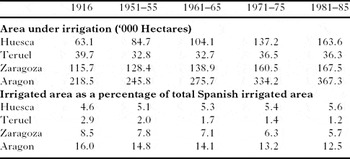
With regard to the first of these factors, Aragon had been seeking ways to overcome the limitations that extreme aridity placed on plant growth from the beginning of the twentieth century, and by the early 1930s the region accounted for a large part of Spain's irrigated land. Not in vain. Sixteen per cent of irrigation in Spain was in Aragon in 1916. Development continued after 1939, and in the 1950s the construction of irrigation works in the form of reservoirs and canals went ahead at a dizzying pace. Although the rate slowed somewhat after 1965, the final outcome was an expansion of some 170,000 hectares in Aragonese irrigation between 1955 and 1985 (Pinilla, Reference Pinilla2006). As a result, the area of irrigated land in Aragon was much higher in percentage terms than the Spanish average. This process began before the Civil War, and gained strength in the post-war decades during the great expansion of Spanish irrigation (see Table 2). However, it again concealed wide differences in performance. The percentage of irrigated land in Zaragoza, in particular, and also in Huesca was significantly higher than the national average, but irrigation was considerably below the average in the province of Teruel, where the development of infrastructure before the Civil War was affected by the smaller flow of the river systems on the right bank of the Ebro and by the rugged nature of the terrain (Figure 1).

Map of Aragon

This is important because the expansion of most of the key crops in Aragon, like maize and forage plants, occurred in irrigated areas in the period examined, and these developments were mostly related directly to the new role of animal husbandry. Meanwhile, irrigation also helped the expansion of market gardens and orchards, for which a ready market already existed given rising demand for more income-elastic produce. This was due not only to the increase in the area affected, but also to the quality of the water supply. Much infrastructure construction was designed to ensure regularity and manage water flows in areas that were already irrigated, since many of the new intensive crops simply could not be grown on the dry fields of Aragon if water was only available from time to time. Thus, the availability or otherwise of permanent irrigation had a decisive impact on changes in land use. In general, output from irrigated fields increased faster than from rainfed land, although the impact was again much more significant in Huesca and Zaragoza than in Teruel, where the productivity of irrigated land even slipped between 1975 and 1985. It is important to understand the fall in crop production in Teruel between 1975 and 1985 compared to the growth achieved in Huesca and Zaragoza (see Table 1). The two per cent annual shrinkage in Teruel was the combined result of a moderate decline in rainfed crops (at an annual rate of −0.8 per cent) and a much sharper drop in irrigated crops (annual rate of −3.8 per cent). In the province of Teruel, this outcome was closely related with the intense process of rural depopulation in the province after 1950. By 1998, in fact, the population had fallen by 45.7 per cent compared to 1900, and only two of its twelve districts saw any growth, albeit slight, in the twentieth century, while six lost more than sixty per cent of their people (Ayuda et al., Reference Ayuda, Sáez and Pinilla2000: 149). This demographic contraction also affected output in those areas where mechanisation was most difficult, even resulting in the abandonment of more marginal irrigated land. In Huesca and Zaragoza, however, the production of irrigated crops rose by 1.7 per cent and 3.1 per cent per year, respectively. Irrigation had expanded more slowly in Teruel before 1955 (see Table 2), and the effects were carried forward in the crisis of the fossil fuel dependent agricultural model.
Another key factor in the process of agricultural transformation in Aragon was the increasing use of industrial inputs, especially inorganic fertilisers and machinery, which required the use of fossil fuels and spread widely in this period. As a consequence, agriculture increasingly decoupled from the natural environment and became ever more closely linked to the industrial sector as both a major customer and a supplier, as is clear, for example, from the growing importance of intermediate inputs provided by industry. In 1978, the intermediate inputs supplied by agriculture itself, or by livestock farming, accounted for only a quarter of the total for Aragon, while industrial inputs predominated, tending to increase their share still further in the ensuing years. As might be expected, the main purchases of agricultural inputs consisted of fuel sourced from the oil industry, non-basic chemicals and capital equipment such as machinery. By adding capital expenditure in the form of purchases of farm machinery, we may obtain a picture of one of the key elements in the profound integration of agriculture and industry.
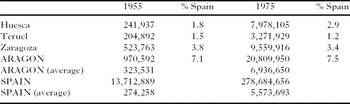
As in the case of irrigation, expenditure by farmers outside the agricultural sector itself was a key factor for the transformation of Aragonese agriculture, and by 1955 the region's farms were among the most highly capitalised in Spain. However, the regional figures were once again influenced by the province of Zaragoza, while farm capitalisation in Huesca and Teruel was actually below the Spanish average. Twenty years on, when Spain had completed the modernisation of its agriculture, Aragon remained above the national average in terms of capitalisation, and both Zaragoza and Huesca were among the top ten provinces in terms of farm costs and depreciation. However, farm capitalisation in Teruel was still well below the Spanish average (see Table 3).
Costs and depreciation of the Aragonese farm sector in current pesetas, 1955 and 1975

Source: Own work based on Banco de Bilbao (1955–1985).
Note: Costs include fertilisers, animal feed, seeds, mechanisation and power, sanitation (plants and animals), machinery maintenance and other expenses. Depreciation includes charges in respect of machinery and tractors. Averages are provincial averages (comprising three provinces in the case of Aragon and fifty in the case of Spain).
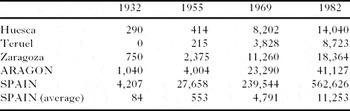
Mechanisation was an area where capitalisation was most impressive and the process was already considerably advanced before 1950. In the first three decades of the twentieth century, when the motorisation of agriculture began to expand in Spain, Aragon was already one of the regions with the highest number of tractors. While Huesca and Zaragoza were at the forefront, however, Teruel had not one single tractor in 1932 (see Table 4). Huesca and Zaragoza also enjoyed a considerable advantage over the rest of Spain in harvesters and threshing machines, but the situation of Teruel was much weaker. The conditions for the early mechanisation of these two provinces were created by the rapid expansion of cereals and migration from the land, a process that drove up wages especially at harvest time. Despite the existence of migration from the countryside to the cities in Teruel, the much smaller growth in cereal crops and the difficulties inherent in the mechanisation of highland farms slowed the whole process (Pinilla, Reference Pinilla1992: 407–8). Meanwhile, the larger size of farms in the Ebro Valley favoured mechanisation in Huesca and Zaragoza. The scant figures available for the period reveal a considerably greater concentration of rural landholdings in the lowlands than in the highlands as far back as the 1930s.Footnote 6

The number of tractors grew more than sixteen times and harvesters twelve times in Aragon between the mid-1950s and 1982. This process was especially intense during the crisis of traditional agriculture. In fact, Aragon accounted for ten per cent of all tractors in Spain, and sixteen per cent of harvesters by 1973. In terms of the area of farmland, these figures are approximately in line with the region's share in the Spanish total (nine per cent in 1972), but the level of mechanisation appears significantly higher when viewed in terms of the output of Aragonese agriculture (6.2 per cent of the total for Spain in 1973). There are various reasons for the lead taken by Aragon in farm mechanisation. To begin with, investment in machinery was needed to maintain the profitability of agriculture in a region where farms were almost twice as large on average (34.5 hectares in 1972) than in Spain as a whole (17.9 hectares). Closely linked to this factor, the use of machinery in Aragon was further stimulated by the sharp decline in the region's rural population between 1950 and 1980.Footnote 7 The spectacular fall in the region's farm labour force in both absolute and relative terms resulted in an acute shortage of hands, and indirectly to a sharp rise in farm wages. Both of these factors would have provided an incentive for the rapid deployment of tractors and harvesters.
The same dynamic is apparent in the spread of chemical fertilisers. Consumption grew without pause from the 1950s onwards to twice the pre-war level by 1970. The enormous increase in the nutrients applied per hectare coincided with a relative decline in the importance of organic fertilisers. Meanwhile, chemical fertilisers combined with new crop varieties, particularly hybrid seeds, and the intensive use of pesticides and insecticides to drive a very considerable rise in the yield from the land. The massive use of these new technologies and inputs occurred mainly in irrigated areas such as the more advanced agriculture of Zaragoza and the south of Huesca province, where they had a significant impact. In particular, the combination of irrigation and chemical fertilisers multiplied the effects of the third explanatory factor for the transformation of Aragonese agriculture, which was the appearance of new biotechnologies. The strong link between the use of high yield varieties and energy consumption required farming methods that relied on both chemical fertilisers and irrigation (Schusky, Reference Schusky1989: 126). Aragon, and in particular the provinces of Zaragoza and Huesca, was already well prepared to benefit from the Green Revolution.
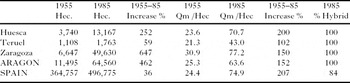
Maize presents a paradigmatic case of this process, as hybrid varieties spread rapidly throughout the region. The introduction of hybrid maize on irrigated land was already complete in the province of Zaragoza by 1965, although it took a little longer for the new varieties to take over in Huesca and Teruel. Thirty years on, all of the maize grown in Aragon was hybrid, and yields per hectare were at least twice the levels that could be achieved in 1955 (see Table 5). In this period, the area sown with maize in Aragon grew strongly from three per cent of the national total in 1955 to thirteen per cent by 1985. However, the introduction of high yield seeds after 1955 was not new to Aragonese farmers. In fact, intense efforts had already been made to obtain high yield cereal varieties from the beginning of the twentieth century, especially in Zaragoza (Pinilla, Reference Pinilla1995: 215–17). After the Civil War, wheat varieties like ‘Aragon 03’ were developed. This was the most widely sown on rainfed fields in the 1960s and 1970s and is still valued by ecological growers. Mexican varieties, such as ‘Siete Cerros’ and especially ‘Anza’, were introduced on irrigated land, becoming dominant by the late 1970s. In the case of maize, research into hybrids resulted in the development of the variety ‘AE-703’ by an Aragonese agronomist. This was the most widely sown variety throughout Aragon in the last quarter of the twentieth century. Meanwhile, another agronomist working at the Aula Dei Experimental Station near Zaragoza developed the drought-resistant ‘Albacete’ variety of barley in 1965. This has remained the most widely used variety on arid, unirrigated land, while imported varieties like ‘Hatif de Grignon’ and ‘Alpha’ have proliferated on semi-arid land (Roldán, Reference Roldán2003: 140 and 147–8).
Evolution of the area sown with maize in Aragon and yields, 1955–1985

Source: Own work based on Ministerio de Agricultura (1955–1986).
The close connection between the new genetic crop technologies, which have been intensely developed in Aragon, and the technologies applied to farm animals in the 1950s go some way to explaining the rapid transformation of Aragonese agriculture. The development of hybrid maize varieties was connected with the hybridisation of animal species, especially chickens, as early as the 1930s (Schusky, Reference Schusky1989: 110–11). Meanwhile, the introduction of intensive agriculture to Spain in the 1950s encouraged ever closer links between hybrid animal husbandry, beginning with broiler chickens and followed somewhat later by pigs, and the production of cereals and forage crops, often using genetically improved varieties. Thus, the rapid expansion of the new model of landless animal husbandry in Aragon combined with the development in the region of cereal varieties suitable for use as animal feed. Crops like rainfed barley and irrigated maize, as well as alfalfa, spread rapidly, facilitating agro-industrial integration in both sectors. This intense integration of crops and animal husbandry in Aragon over such a short period would have been impossible without the early development of irrigation and modern farming methods, involving both industrial techniques and biological experimentation.
Naturally, other factors were also involved in the reorientation of agricultural and livestock output. In the first place, Aragon is geographically close to Catalonia, Spain's leading industrial region and a large consumer of animal products, with which it has close, traditional commercial links. Secondly, the climate was well suited to the expansion of certain types of production, such as air-dried ham and sausages in Teruel, and beef in the Pyrenean highlands and foothills of Huesca. However, the combination of technological and production improvements was unquestionably the key to Aragon's successful agricultural transformation, and this factor also explains the internal differences in the rate of change between the region's three provinces.
Concluding Remarks
This paper has examined the far reaching transformation of agriculture in Aragon after 1955, a region traditionally much constrained by natural and climatic conditions, with rugged highland terrain in the north and south and extreme aridity. At this time, the structure of Aragonese agricultural output was still basically that of the traditional model, in which wheat accounted for over a quarter of total crop production and the main animal products were wool and mutton from traditional extensive sheep farming, representing some thirty-seven per cent of the total. Nevertheless, this structure would change out of all recognition in just thirty years, driven by the relentless expansion of intensive animal husbandry, accounting for two thirds of animal production by 1985, and of associated crops. Feed cereals and forage would come to represent half of total crop production. These developments would have been impossible without the right initial conditions. These, in turn, could only come about as the result of a whole series of long-run factors, which make Aragonese farming an interesting example of path dependency.
The modernisation of Aragonese farming unquestionably arose from the impact of a series of exogenous factors, chief among which were changes in the pattern of demand for foodstuffs and the powerful new agricultural and animal husbandry technologies that became available in the second half of the twentieth century. Meanwhile, Aragon's highly favourable location allowed the region to benefit from the demand generated by nearby major cities and industrial centres. At the same time, the penetration of international agribusiness in Spain provided easy access to imported technologies of enormous potential. As we argued in the introduction, however, restructuring went ahead particularly quickly in Aragon because the majority of these factors had already influenced the region before 1955. Links with the Catalan markets, the development of irrigation, the fast growth of the beet-sugar complex, the use of industrial inputs and early tests with high yield biological varieties had already been developed before 1936 at a time when Aragon was already one of Spain's most modern agricultural regions. Over the course of this paper we have shown that this leadership allowed Aragon to modernise faster when the process gathered pace in the latter half of the 1950s.
We have also shown, however, that the dynamics of agricultural transformation differed considerably between the provinces of Aragon. Where Zaragoza and Huesca modernised fast, the pace of change was slower in Teruel and restructuring was more difficult. This agricultural polarisation supports our hypothesis in that Zaragoza and Huesca enjoyed the benefits of earlier market development and industrialisation, while Teruel had lagged behind in the race to enter the major Spanish markets, and its farms were scarcely capitalised before 1960. Natural obstacles combined with poor road and rail links to the major cities to hinder the modernisation of farming in Teruel. Scarce rainfall, winter frosts, the high altitude of much of the province and steep, poor quality land made it difficult to recover investments in technology, and the province lacked any comparative advantages for growing high elasticity crops. Meanwhile, poor communications with the cities left Teruel on the periphery of urban development in Spain, discouraging trade and enterprise (Sáez, 2007:153).
Comparison with Huesca, a province that is also affected by serious environmental constraints, is revealing. Huesca was not only closer to the industrial hub of Spain and centre of agricultural modernisation represented by Catalonia, but railways had already linked up the most dynamic part of the province by 1870, while Teruel lacked even a mile of track (Pinilla, Reference Pinilla1989: 200). This translated into much closer connections with the major markets for inputs and outputs, which drove the development of irrigation and mechanisation in the south of Huesca in the early decades of the twentieth century, but not in Teruel. Meanwhile, the Pyrenean highlands of Huesca had undergone substantial emigration beginning in the second half of the nineteenth century, precisely because the area was close to Catalonia, one of Spain's main centres of industry (Collantes, Reference Collantes2004: 139). In Teruel, meanwhile, the process began only after 1950. The annual rate of demographic growth between 1950 and 2000 was −1.1 compared to 0.2 for Huesca. Finally, per capita income in Huesca was substantially higher, representing ninety-seven per cent of the average for Spain compared to just sixty-five per cent in Teruel (Domínguez, Reference Domínguez and Domínguez Martín2003: 58).
Aragon thus serves as a case study for the way in which exogenous factors worked to speed the transformation from traditional to modern agriculture after 1950, at the same time offering economically viable outcomes wherever an existing technological and marketing infrastructure existed to launch the process. The province of Teruel, in contrast, reveals the arrival of modernisation through a much slower process that often required the abandonment of land that was formerly tilled. To put this another way, the Aragonese case reveals two types of transformation within the general process of agricultural restructuring based on the dynamic created by a series of exogenous factors. The first type, seen in Zaragoza and Huesca, is active, and changes are the direct outcome of far-reaching technical and productive modernisation, while the second type (Teruel) is passive. In this case, change and modernisation were slow, and were driven rather by migration and the abandonment of farms as people were attracted away by the magnet of Spanish industrialisation and urbanisation after 1955.
The internal polarisation of agricultural growth in Aragon exemplifies events in Spain as a whole after 1955. The impacts of farm modernisation on output and demography were significantly more positive in the two provinces where agriculture had already been substantially transformed, through mechanisation, fertiliser use, irrigation and so on, before the crisis of the traditional model that set in after 1955. Meanwhile, the lessons of the Aragonese case may throw light on other processes displaying fast yet polarised growth in developing nations.
Acknowledgments
This paper was made possible by financing received from Fundación de Economía Aragonesa (FUNDEAR), the Spanish Ministry of Science and Innovation Project ECO2009-07796 and the Department of Science, Technology and Universities of the Government of Aragon, excellence research group for ‘Agri-food Economic History’ (nineteenth and twentieth centuries). We would like to thank the participants at the seminars organised by the Fundación de Economía Aragonesa, the universities of Lund and Zaragoza and the editors and referees of this journal for their helpful comments.