Introduction
Researchers have increasingly been interested in investigating human work in extreme environments characterized by dangerous situations, high workloads, social isolation, narrow spaces, limited communication with the outside world and limited possibilities for evacuation (Suedfeld & Steel Reference Suedfeld and Steel2000, Zimmer et al. Reference Zimmer, Cabral, Borges, Côco and Hameister2013, Smith et al. Reference Smith, Sandal, Leon and Kjærgaard2017). A typical example of such work, along with work in submarines and on space stations, is that which is performed during long-term Antarctic expeditions (Rothblum Reference Rothblum1990, Tortello et al. Reference Tortello, Barbarito, Cuiuli, Golombek, Vigo and Plano2018).
The extreme working and living conditions in Antarctic stations are caused by the region's low temperatures and atmospheric pressure, the effects of polar days and nights, geomagnetic disturbances, increased solar radiation and stormy winds (Wood et al. Reference Wood, Lugg, Hysong and Harm1999, Belkin et al. Reference Belkin, Dyurgerov, Finaev and Soroko2016, Nicolas et al. Reference Nicolas, Suedfeld, Weiss and Gaudino2016). Additional negative factors in the life and work of Antarctic expedition personnel include the monotonous environment and landscape, the absence of usual living conditions, hypodynamics and prolonged participation in small, closed groups (Palinkas & Suedfeld Reference Palinkas and Suedfeld2008, Roberts Reference Roberts2011, Sandal et al. Reference Sandal, Van de Vijver and Smith2018). Mullin (Reference Mullin2006) emphasized the problems related to individual adjustment to the group, the relative sameness of the milieu and the absence of habitual sources of emotional satisfaction as the most important psychological stressors influencing Antarctic expeditioners.
The negative psychological consequences of the above stressors on expeditioners include deteriorated well-being, mood, concentration, performance and sleep (Leon et al. Reference Leon, Sandal and Larsen2011, Collet et al. Reference Collet, Mairesse, Cortoos, Tellez, Neyt and Peigneux2015, Chen et al. Reference Chen, Wu, Li, Zhang and Xu2016) as well as increased tension, irritability, anger and confusion (Wencheng et al. Reference Wencheng, Wen and Yongzhong1995, Bhargava et al. Reference Bhargava, Mukerji and Sachdeva2000, Chen et al. Reference Chen, Wu, Li, Zhang and Xu2016) and mood disorders, along with the development of symptoms of depression (Palinkas & Suedfeld Reference Palinkas and Suedfeld2008, Khandelwal et al. Reference Khandelwal, Bhatia and Mishra2017). In addition, as noted by Palinkas & Suedfeld (Reference Palinkas and Suedfeld2008), people on such expeditions may even experience long-term psychological changes.
It is established in psychology that human personality traits can, in principle, be changed. This has recently been confirmed in studies by Bleidorn et al. (Reference Bleidorn, Hopwood and Lucas2018) and Denissen et al. (Reference Denissen, Luhmann, Chung and Bleidorn2019), who examined associations between various life events and personality trait changes; Schwaba & Bleidorn (Reference Schwaba and Bleidorn2018), who studied personality trait changes across the course of life; Alessandri et al. (Reference Alessandri, Perinelli, Robins, Vecchione and Filosa2020), who investigated how the Big Five personality traits of cadets changed over the course of a 3 year police officer training programme; and Woods et al. (Reference Woods, Edmonds, Hampson and Lievens2020), who studied the developmental influences of occupational environments on personality traits.
Although, as Leon et al. (Reference Leon, Sandal and Larsen2011) noted, the personality traits of individuals participating in expedition teams and working in polar environments have received considerable attention, little research has been conducted on changes in expeditioners' personality measures. Studies with a similar scope to the present study include only Weiss et al. (Reference Weiss, Suedfeld, Steel and Tanaka2000), who examined respondents' hardiness and attitudes towards life events, and Paterson (Reference Paterson1978), who analysed 15 Antarctic expeditioners between 1971 and 1972. This is a serious gap in the existing research, as these data could be used to improve psychological selection, training and work for Antarctic expedition personnel. In particular, Norris et al. (Reference Norris, Paton and Ayton2010) and Zhang et al. (Reference Zhang, Yan, Sun and Saklofske2021) substantiated the need to consider individual, interpersonal and organizational factors throughout the Antarctic employment experience.
The existing research on changes in expeditioners' defence mechanisms (Nicolas et al. Reference Nicolas, Suedfeld, Weiss and Gaudino2016, Tortello et al. Reference Tortello, Folgueira, Nicolas, Cuiuli, Cairoli and Crippa2021) and coping strategies (Sandal et al. Reference Sandal, Van de Vijver and Smith2018) throughout an expedition only partially corresponds to the focus of this study. Similarly, the studies carried out by Doll & Gunderson (Reference Doll and Gunderson1970), Aldasheva (Reference Aldasheva1984), Suedfeld et al. (Reference Suedfeld, Bernaldez and Stossel1989), Palinkas et al. (Reference Palinkas, Gunderson, Holland, Miller and Johnson2000), Grant et al. (Reference Grant, Eriksen, Marquis, Orre, Palinkas and Suedfeld2007), Mehta & Chugh (Reference Mehta and Chugh2011) and Jaksic et al. (Reference Jaksic, Steel, Stewart and Moore2019) were devoted mainly to the adaptive significance of various personality traits. Sarris (Reference Sarris2006) demonstrated a link between personality and job outcomes, including role conflict, job satisfaction and return to the Antarctic.
The aim of the present exploratory study was to determine possible changes in expeditioners' personality measures over the course of 1 year Antarctic expeditions. However, there is not enough evidence to predict exactly how these personality measures might change (i.e. which specific measures undergo positive vs negative changes and which do not change). Many researchers (e.g. Gunderson Reference Gunderson1974, Palinkas & Suedfeld Reference Palinkas and Suedfeld2008, Leon et al. Reference Leon, Sandal and Larsen2011, Mehta & Chugh Reference Mehta and Chugh2011, Zimmer et al. Reference Zimmer, Cabral, Borges, Côco and Hameister2013, Blight & Norris Reference Blight and Norris2018, Suedfeld Reference Suedfeld2018, Kokun & Bakhmutova Reference Kokun and Bakhmutova2020) have discussed some of the negative effects on the psychological states or interpersonal relationships of expedition personnel during long periods at Antarctic bases, as well as possible positive, salutogenic effects such as successful adaptation, personal growth, spiritual and existential changes, high levels of enthusiasm, a need for achievement and optimistic future orientations.
Methods
Participants and procedure
This study examined 56 expeditioners working at the Ukrainian Antarctic Akademik Vernadsky station (52 men, 4 women; ages 20–63 years, M = 38.12, SD = 10.01) who participated in five annual expeditions between 2016 and 2021. Most of the expeditioners (34 of the 56) had previous experience with annual expeditions (ranging from one to eight expeditions).
For each expedition, personality assessments were conducted before participants' departure from Ukraine to the Antarctic station (in every March of 2016–2020) and immediately after participants' return to Ukraine (in every March of 2017–2021) after 1 year of working and living in isolation from the rest of the world. Each expedition group consisted of 12 people, although 4 of the 60 expeditioners did not complete the psychological examinations for various reasons.
The Ukrainian Antarctic Akademik Vernadsky station (65°15'S, 64°16'W) is located on Galindez Island, which belongs to the Argentine Islands, off the west coast of Graham Land, West Antarctica. The Argentine Islands group is small and ice-capped and is separated from the Antarctic Peninsula by the 7 km-wide Penola Strait. Akademik Vernadsky station (the former Faraday Station that was transferred from the UK to Ukraine in 1996) is one of the oldest stations in the Antarctic Peninsula area operated by the Upper Atmosphere and Ice and Climate Divisions. Measurements of surface meteorology, ozone, ultraviolet radiation, geomagnetism, ionosphere, tides and seismic waves are carried out here. A total of 12–13 people carry out this work over the year and communicate only with each other during the 7–8 months during which the station is cut off from contact with the rest of the world due to the weather conditions.
The station complex consists of several buildings standing on rock foundations. The working and living accommodations are quite comfortable for work and relaxation. The ground floor of the two-storey main building provides sleeping accommodation for 24 people, a clothing storage area, a boiler room, a reverse osmosis plant, a reception area and a lobby. There is a lounge, library, dining room and kitchen upstairs. The rest of the building mostly consists of laboratories and work rooms, together with the surgery and washrooms. Electricity is provided by diesel generators. Temperature is controlled via oil-fired central heating. One old building is now used as a frozen food storage facility and a carpenter's workshop. A general storage facility holds the base's emergency supplies.
The climate in the region is quite mild by Antarctic standards. The average temperature is close to 0°C in summer and rarely falls to < -20 °C in winter. The area experiences strong winds, especially in winter (where gusts can reach 40 m/s). On average, it snows 255 days a year and rains for 85 days a year.
Measures
The Ukrainian adaptations of four instruments were used to measure participants' personality traits.
The Thomas-Kilmann Conflict Mode Instrument (TKI; Thomas & Kilmann Reference Thomas and Kilmann2002) consists of 30 pairs of statements. For each pair, a respondent must choose either item A or item B (e.g. one item describes collaborating while the other describes avoiding). Each pair of statements was specifically designed in a multi-stage research process to be equivalent in terms of social desirability. The TKI uses two axes: assertiveness and cooperativeness. It also identifies five conflict styles: competing (assertive, uncooperative), avoiding (unassertive, uncooperative), accommodating (unassertive, cooperative), collaborating (assertive, cooperative) and compromising (intermediate assertiveness, cooperativeness) (https://people.themyersbriggs.com/TKI40.html).
The Eysenck Personality Questionnaire (EPQ-R; Eysenck & Eysenck Reference Eysenck and Eysenck1991) consists of 100 dichotomous (yes/no) items. The EPQ-R is used to measure three factors: extraversion, neuroticism and psychoticism. It also measures dissimulation tendencies or lying (https://en.wikipedia.org/wiki/Eysenck_Personality_Questionnaire).
The Leonhard-Schmieschek Questionnaire (Schmieschek Reference Schmieschek1970) is a personality inventory used to identify 10 types of personality accentuations, which are divided into two groups: character accentuations (demonstrative, affectively exalted, pedantic, stuck and excitable) and temperament accentuations (hyperthymic, dysthymic, anxious-fearful, cyclothymic and emotive). The inventory consists of 88 dichotomous (yes/no) items. A total score of 8–12 points is considered within the normal range, a score of 13–19 points indicates accentuations and a score of 20–24 points indicates a high degree of character accentuation (https://srcaltufevo.ru/en/oprosnik-shmisheka-akcentuacii-haraktera-rasshifrovka-test-oprosnik.html).
The Leary Interpersonal Checklist (ICL; Leary Reference Leary2004) is used to obtain descriptions of an individual with respect to the interpersonal domain of personality. The standard form of the ICL consists of 128 words or phrases (e.g. well thought of, forceful, often gloomy, cooperative). Respondents are instructed to mark those items that they consider to be generally characteristic of themselves. The 128 items are grouped into the following 8 behavioural categories (or octants): 1) managerial-autocratic, 2) competitive-narcissistic, 3) aggressive-sadistic, 4) rebellious-distrustful, 5) self-effacing-masochistic, 6) docile-dependent, 7) cooperative–over-conventional and 8) responsible-hypernormal (https://www.scribd.com/document/60680189/Interpersonal-Checklist-Test-Correlated-with-Mind-Mirror).
All questionnaires were completed individually with paper and pencil. All four methods used to measure participants' personality traits have been used by the National Antarctic Scientific Centre of Ukraine, which is part of the Ministry of Education and Science of Ukraine, for over 10 years as mandatory components of the psychological selection of expeditioners who are to work at the Ukrainian Antarctic Akademik Vernadsky station. These methods have shown a fairly high information capacity in studies with expeditioners (Kokun & Bakhmutova Reference Kokun and Bakhmutova2021).
Statistical analysis
Statistical Package for the Social Sciences version 22.0.0.0 was used for the statistical analysis. Descriptive statistics (mean, standard deviation, skewness and kurtosis) and paired-sample t-tests were used. Paired samples were used because the data distributions for all indicators were close to normal (modulo sum of skewness and kurtosis < 1).
Results
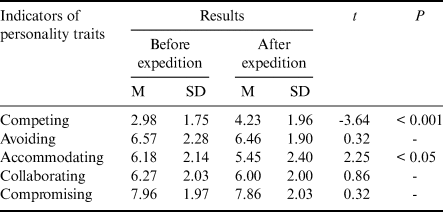
Table I compares the indicators of the expeditioners' personality measures as determined by the TKI. These results indicate that the competing style of conflict appeared significantly more often (P < 0.01) and the accommodating style appeared less often (P < 0.05) after a 1 year Antarctic expedition. The other three styles remained virtually unchanged.
Comparison of Thomas-Kilmann Conflict Mode Instrument indicators before and after participants' 1 year Antarctic expeditions.

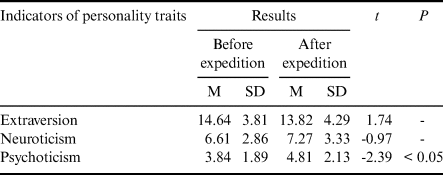
During the 1 year stay in Antarctic conditions, expeditioners' psychoticism increased (P < 0.05) according to the EPQ-R. The changes in extraversion and neuroticism were insignificant (Table II).
Comparison of Eysenck Personality Questionnaire indicators before and after participants' 1 year Antarctic expeditions.

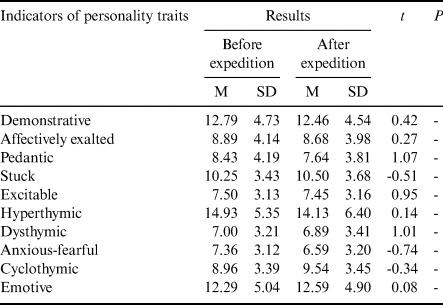
During this period, no significant changes occurred in any of the 10 personality accentuations measured by the Leonhard-Schmieschek Questionnaire (Table III).
Comparison of Leonhard-Schmieschek Questionnaire indicators before and after participants' 1 year Antarctic expeditions.

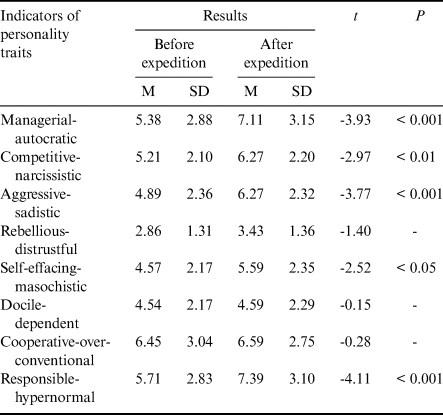
The largest changes in the expeditioners' personality measures during their 1 year Antarctic expeditions were recorded for the ICL indicators (Table IV). The obtained data showed significant increases in five of the eight behavioural categories: managerial-autocratic (P < 0.001), aggressive-sadistic (P < 0.001), responsible-hypernormal (P < 0.001), competitive-narcissistic (P < 0.01) and self-effacing-masochistic (P < 0.05).
Comparison of Leary Interpersonal Checklist indicators before and after participants' 1 year Antarctic expeditions.

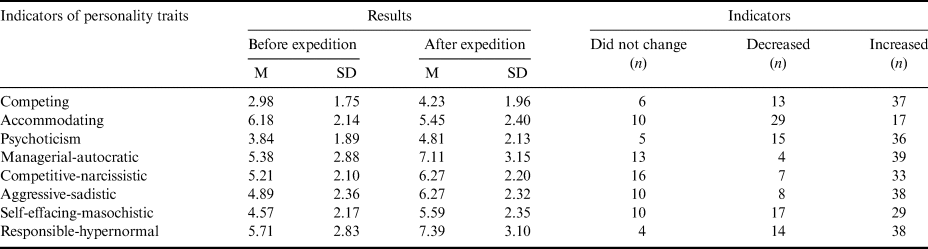
Additional summary information on the frequency of changes in the expeditioners' personality measures during 1 year Antarctic expeditions, as measured by the indicators that significantly changed, is presented in Table V. If a certain indicator changed significantly in the results, it denoted a change that was typical for 29–39 of the 56 expeditioners.
Frequency of changes in expeditioners' personality measures during 1 year Antarctic expeditions (n = 56), measured by the indicators that significantly changed.

Discussion
The results show significant changes in 8 of the 26 personality measure indicators for the expeditioners during their 1 year Antarctic expeditions. These indicators belong to three of the four methods used, as all 10 indicators of personality accentuations remained unchanged. In particular, the levels of seven of the indicators increased: psychoticism (P < 0.05) and competing (P < 0.01), managerial-autocratic (P < 0.001), aggressive-sadistic (P < 0.001), responsible-hypernormal (P < 0.001), competitive-narcissistic (P < 0.01) and self-effacing-masochistic (P < 0.05) styles. One indicator decreased: accommodating style (P < 0.05). If a certain indicator showed a significant change, it was typical for 29–39 of the 56 expeditioners.
All of the above changes, in the researchers‘ opinion, can be assessed as unfavourable. The ICL behavioural categories (Leary Reference Leary2004) that increased among expeditioners in this study (i.e. managerial-autocratic, aggressive-sadistic, responsible-hypernormal, competitive-narcissistic and self-effacing-masochistic) were negative. The increased levels of the competing style and psychoticism were also unfavourable, as was the decreased accommodating style, according to the meaningful interpretation of these indicators (Thomas & Kilmann Reference Thomas and Kilmann2002). These data indicate that expeditioners consistently exhibited a generally increased proclivity for conflict, higher levels of aggression, reduced openness in communication and worsened social adaptation. Grant et al. (Reference Grant, Eriksen, Marquis, Orre, Palinkas and Suedfeld2007) determined that ’high defensive hostility' causes the deterioration of Antarctic personnel's ability to adapt.
This study thus confirms the fundamental possibility of significant changes in expeditioners‘ personality measures during 1 year Antarctic expeditions. Unfavourable changes were recorded in almost a third of the examined indicators and no favourable changes were recorded. At first glance, this contradicts the opinion presented in the ’Introduction‘ section of this paper and by various authors regarding the possible positive salutogenic effects of a long-term stay at Antarctic bases. However, firstly, the stated signs of such salutogenic effects (e.g. successful adaptation, personal growth, spiritual and existential changes, high levels of enthusiasm, need for achievement and optimistic future orientation) are not equivalent to the personality measures studied herein. Secondly, these salutogenic effects may initially appear quite a long time after return from the Antarctic base, while, in this study, the reassessment of personality traits was conducted immediately after the expeditions. Thirdly, and most importantly, no author to date has discussed the possibility of salutogenic effects in all or even most of the expeditioners. For example, Kokun & Bakhmutova (Reference Kokun and Bakhmutova2020, p. 11, emphasis added) noted that only ’some expeditioners maintained a good level of psychological adaptation throughout all term of the expedition, becoming emotional and professional leaders of the station personnel'. Of course, the sample in this study included some expeditioners whose personality measures showed positive dynamics.
However, the analysis of participants' individual results goes beyond the research tasks presented in this article. It was most important to record a general statistically significant trend and its direction with regard to changes in expeditioners' personality measures during Antarctic expeditions. In particular, the data are fully consistent with studies that found strong deteriorations of cognition during the final phase of a 1 year Antarctic residence (Khandelwal et al. Reference Khandelwal, Bhatia and Mishra2017), a particularly noticeable deterioration of expeditioners' coping strategies in the third quarter of a 10 month expedition (Sandal et al. Reference Sandal, Van de Vijver and Smith2018) and worsening mature defence mechanisms and coping strategies over the course of a 1 year expedition (Tortello et al. Reference Tortello, Folgueira, Nicolas, Cuiuli, Cairoli and Crippa2021).
Conclusion
This exploratory study confirms that expeditioners' personality measures can change during long Antarctic expeditions. A significant change was observed in almost a third of the examined indicators of expeditioners' personality traits. These changes were generally unfavourable. It should be noted that during work in extreme environments or long-term isolation significant negative changes experienced by group members (even in only one or two indicators of personality traits or psychological states) can be critical and lead to adverse consequences. Therefore, all such changes must be taken into account. Practical psychological work with expeditioners should take into account possible personality trait changes, even very small ones, and specific sets of traits in order to prevent decreased effectiveness in terms of work performance as well as negative mental and physical health consequences. This study presents more questions than answers, allowing the researchers to outline several promising areas for further research on the examined issue.
Firstly, there is a clear need for a more comprehensive examination of expeditioners' personality traits using other methods and incorporating additional information. Secondly, a larger series of assessments are needed not only immediately before and after expeditions but also during them. Additionally, assessments are needed at 6 months, 1 year and 2 years after expeditions; this is most important as it may help both to document the features of the salutogenic effects or positive personality changes that appear a certain period after an expedition ends and to typify the main individual coping strategies that lead to expeditioners' personality changes.
In addition, this study's sample lacked female representation. It is possible that there are some differences in the changes in personality measures undergone by female vs male expeditioners during long expeditions in terms of both which measures change and the extent of these changes. The extent of changes in personality measures for expeditioners participating in an expedition for the first time vs those who have participated in several expeditions is also a matter for investigation. The degree of reactivity of personality traits that may differ among expeditioners of different ages, from different countries or working at different Antarctic bases could also be examined.
The researchers believe that conducting (at least some of) this suggested research would significantly improve Antarctic expedition personnel's psychological selection, training and work.
Acknowledgements
We thank the expeditioners working at the Ukrainian Antarctic station who participated in the psychological examinations. We also thank Dr Daniela Liggett and all anonymous reviewers for constructive comments on the manuscript. In addition, we would like to thank Evgen Dykyi, the Director of the National Antarctic Scientific Centre, for supporting this investigation.
Conflicts of interest
The authors declare none.
Ethical standards
The authors assert that all procedures contributing to this work comply with the ethical standards of the relevant national and institutional committees on human experimentation and with the Helsinki Declaration of 1975, revised in 2008. The studies were conducted with the approval of the National Antarctic Scientific Centre of Ukraine and the participants' individual consent. Participants were informed that there were no right or wrong answers to the questions and they were encouraged to respond candidly. Complete confidentiality was assured.
Author contributions
OK conceived the presented idea and interpreted the results. LB designed and carried out the study. Both authors discussed the results and contributed to the final manuscript.