INTRODUCTION
Stancetaking is a quintessentially social act involving interlocutors, their interactions, and their topic within a sociocultural field, and unfolding in micro-time through the constitutive components of evaluation, positioning, and alignment of stance takers (Du Bois Reference Du Bois and Engelbretson2007; Englebretson Reference Englebretson and Engelbretson2007; Jaffe Reference Jaffe2009). These basic elements of social stance are ubiquitous in naturally occurring, interpersonal, conversational exchange, which we might gloss as stance in the wild. By contrast, social scientists engage in the designedly systematic and serial elicitation of stance in carefully crafted interviews, focus groups, surveys, and questionnaires. These purposeful manipulations, or stance in the greenhouse, involve specific adaptations and transformations of stance, and these calibrations differ according as social scientists ‘grow’ stance in qualitative versus quantitative environments. The challenge for mixed method or multimethod researchers (Hesse-Biber & Johnson Reference Hesse-Biber and Johnson2015; Creswell & Plano Clark Reference Creswell and Clark2017; Bazeley Reference Bazeley2018) is first to attend to the different conditions of, and techniques for, eliciting and analyzing stance, and second to integrate the results into comprehensive accounts of the complex, multidimensional character of social reality.
As it turns out, the most common mixed project involves the combination of qualitative interviews and quantitative surveys (Bryman Reference Bryman2006), and our goal in this article is to draw on recent discourse-analytic research on linguistic stance to lay a theoretical foundation for linking interview and survey data. Indeed, all data from interviews and surveys necessarily result from interactional, co-constructed, social stance. At the core of the mixed methods effort lies the claim that a detailed stance analysis of the qualitative interview critically informs the analysis of the quantitative survey, and vice versa, a stance analysis of the survey will inform the analysis of interviews. This linguistic-discursive framework is uniquely suited for a specific family of social science methodologies—those involving research on sociocultural phenomena (Schrauf Reference Schrauf2016).
OUTLINE AND DATA SOURCE
We begin with a brief sketch of the key components of conversational stancetaking: evaluation, positioning, and alignment within a sociocultural field. Then, in the three major sections of the article we address the transformations of these key elements in the qualitative interview, the quantitative survey, and mixed methods integrations. In each section we exemplify our points by reanalyzing data from a completed, comparative project, the Alzheimer's Belief Study, that examined ethnic beliefs about aging, memory loss, and Alzheimer's disease among three ethnic groups in Chicago, US. Specifically, in this article, we work with the Spanish and English data from the Mexican American participants.
This mixed methods study employed a sequential qual → quan → qual design (Schrauf Reference Schrauf2016, Reference Schrauf2018), with results reported across a number of publications. In the first strand (qualitative), we conducted ethnographic interviews with ten participants from each of the three groups, followed by content analysis of the transcribed data to generate items for a larger survey (Schrauf & Iris Reference Schrauf, Iris, Kronenfeld, Bennardo, de Munck and Fischer2011a). In the second strand (quantitative), we piloted Likert-styled items developed from the interviews with the same participants, and then we administered the final survey with new samples of participants from the ethnic groups (thirty-six participants from each). We analyzed these data via consensus analysis (Schrauf & Iris Reference Schrauf and Iris2011b). We then followed up with a third strand (qualitative) in which we conducted discourse analyses of the original ethnographic interviews to further interpret the quantitative findings from the survey (Schrauf & Iris Reference Schrauf, Iris, Schrauf and Müller2014, Schrauf, Iris, Navarro, & Smotrova Reference Schrauf, Iris, Navarro and Smotrova2014; Schrauf Reference Schrauf2016).Footnote 1
LINGUISTIC STANCE: THE BASICS
Linguistic stance in an interactional context is the act whereby one speaker evaluates, assesses, or takes an attitude toward some stance object—often a proposition (Du Bois Reference Du Bois and Engelbretson2007; Englebretson Reference Englebretson and Engelbretson2007; Jaffe Reference Jaffe2009)—and reflexively positions herself vis-à-vis the object. When another speaker evaluates the same object, she also reflexively positions herself and, by that very act, either aligns (or disaligns) with the first speaker. Evaluation, positioning, and alignment are thus three critical components of social stancetaking (Du Bois Reference Du Bois and Engelbretson2007). The social act of cooperation or dissent itself (DuBois's alignment) may be further nuanced in terms of structural alignment and social affiliation (Stivers Reference Stivers2008). Structural alignment describes the ways in which speakers signal that they are attending to, and cooperating with, the other's interactional project (e.g. nods of recognition, not interrupting, not competing for the floor). But this structural alignment does not necessarily signal actual agreement with the speaker's stancetaking (Kiesling Reference Kiesling2011). Social affiliation, by contrast, describes the ways in which speakers express agreement with, or endorsement of another speaker's stance evaluation (Pomerantz Reference Pomerantz, Atkinson and Heritage1984; Stivers Reference Stivers2008; Stivers, Mondada, & Steensig Reference Stivers, Mondada and Steensig2011). In practice, however, structural alignment and social affiliation are intertwined in complex ways and are frequently concomitant in interaction.
All stancetaking both presupposes and reformulates a shared sociocultural field: a textured web of mutually recognized, sometimes shared, and sometimes contested social values strategically invoked by interlocutors in acts of evaluation, self- and other-positioning, and alignment. Speakers and hearers orient to this sociocultural field as they account for and explain the logic of their stances in terms of wider orders of normativity.
In the next sections, we attend to how interpersonal, conversational stance is elaborated, adapted, and transformed in the structured, schematized, and often scripted interchanges of the qualitative interview and quantitative survey. In each case, we begin by addressing the ways in which evaluation, positioning, and alignment are adapted to the schematized interactions of research interviewer and study participant. We then move onto broader notions of positioning and alignment, followed by analytic explorations using data from the Alzheimer's Beliefs Study.
STANCETAKING IN THE QUALITATIVE INTERVIEW
Co-constructed interactive stance in the interview
In social science, the interpersonal interview has long been the preferred context in which researchers seek to trigger participants’ stance evaluations of social phenomena. Such interviews, whether face-to-face or via telephone, are thoroughly interactional events, and research has illuminated the role of the interviewer in co-constructing interview data (Holstein & Gubrium Reference Holstein, Gubrium and Silverman1997; Rapley & Antaki Reference Rapley and Antaki1998; Rapley Reference Rapley2001; Roulston, Baker, & Liljestrom Reference Roulston, Baker and Liljestrom2001; Roulston Reference Roulston2006; Mann Reference Mann2011, Reference Mann2016; Talmy & Richards Reference Talmy and Richards2011; Lampropoulou & Myers Reference Lampropoulou and Myers2013; Roulston Reference Roulston2014). To what extent then do the fundamental components of social stance (evaluation, positioning, and alignment) map onto the question-answer schema of the interview?
Evaluation in the interview
Evaluation in the interview is seemingly straightforward. Interviewers propose stance objects in their questions, and participants take stances vis-à-vis those objects in their responses. For instance, a common initial question in our interviews about Alzheimer's disease was: “What do you think Alzheimer's is?” The question lays out ‘Alzheimer's’ as a potential stance object, and participants usually begin by taking a stance on that object “I think it's complicated” or “It's frightening” or “I don't understand it” and so on. Of course, by their wording, prosody, and sequential positioning, the interviewer's questions come with assumptions and constraints, and these can reflect subtle stancetaking by the interviewer. Consequently, in their responses, participants often exercise their agency by reframing questions, resisting or rejecting their underlying assumptions, and even redirecting the flow of conversation (Raymond Reference Raymond2003, Reference Raymond, Freed and Ehrlich2010; Stivers & Hayashi Reference Stivers and Hayashi2010; Wortham, Mortimer, Lee, Allard, & White Reference Wortham, Mortimer, Lee, Allard and White2011; Lampropoulou & Myers Reference Lampropoulou and Myers2013).
Positioning and alignment in the interview
Positioning and alignment in the interview are more complex. Although, on the one hand, study participants regularly evaluate stance-objects (propositions), and thereby reflexively position themselves vis-à-vis those phenomena, on the other hand, it is designedly less frequent that interviewers make stance evaluations in turn. Or rather, interviewers frequently express structural alignment (e.g. encouraging the flow of talk via back-channeling, continuers, discourse markers, repetitions, facial expressions, and gestures), but their expression of social affiliation (agreement) or dis-affiliation (disagreement) about common stance objects is markedly less common.
Broader positioning in the interview
Beyond positioning and alignment at the micro-level of turn-by-turn stancetaking, there is a more pervasive positioning of study subjects as study subjects (Briggs Reference Briggs2007). Thus, participants know from reading and responding to recruitment materials and consent forms, and from their interactions with study personnel, that they have been recruited precisely because of their specific social identities, experiences, or expertise. In the conceptual terms of positioning theory (Harré & van Langenhove Reference Harré and van Langenhove1999), interviewers assign participants ‘fluid parts or roles (as) speakers in the discursive construction of personal stories that make (their) actions intelligible and relatively determinate as social acts’ (van Langenhove & Harré Reference van Langenhove, Harré, Harré and van Langenhove1999:16). In effect, participants know that they are expected to develop ‘storylines’ in accord with their identities. By implication, the interview places moral demands on participants to account for their actions, identities, and worlds, though again in the course of the interaction, participants will variably accept, resist, or transform this institutional positioning (van Langenhove & Harré Reference van Langenhove, Harré, Harré and van Langenhove1999; Rapley Reference Rapley2001).
To accomplish these enactments of stance, identity, and social world, participants draw on moral and cultural values from the larger sociocultural fields within which the interview is contextualized. Three key resources for linking stancetaking at the micro-level of talk to these larger sociocultural contexts are indexicality, accounting practices, and appeals to normativity.
Indexicality
By selecting from among a range of prosodic, lexical, morphosyntactic, and discourse devices at the micro-level of turn-by-turn interaction, speakers index macro-level orders of social discourse and organization (Silverstein Reference Silverstein2003). These latter include identifiable ways-of-speaking, social roles and gradations of authoritative speakers, cultural identities, knowledge frames, systems of value, behavioral scripts, and institutional organization (Labov Reference Labov1972; Ochs Reference Ochs, Gumperz and Levinson1996; Silverstein Reference Silverstein2003, Reference Silverstein2004; Agha Reference Agha2007).
Accounting practices/cultural logics
Speakers routinely provide implicit and explicit accounts for their actions and speech (Edwards & Potter Reference Edwards and Potter1992; Antaki Reference Antaki1994; Potter Reference Potter1996; Garfinkel Reference Garfinkel2001) and thereby articulate the cultural logic of their own and other's actions (Enfield Reference Enfield2000; Enfield & Sidnell Reference Enfield and Sidnell2017). That is, actors draw on publicly available cultural assumptions (beliefs, schemata, scripts, scenarios) to interpret the motivations, intentions, and actions of their interlocutors and to contextualize and justify their own actions.
Appeals to normativity
In accounting for their behavior, speakers appeal to what is normative. They invoke, apply, defend, negotiate, alter, and/or dismiss notions of what is acceptable or expectable (for a discussion of the source of such social compulsion, see Bloor Reference Bloor1997). However, what-is-normative is itself a graded appraisal, for which Agha (Reference Agha2007:125–26) provides three descriptors: (a) a norm of behavior: simple appeals to frequency (e.g. ‘everybody does it’), (b) a normalized model of behavior: reflexive statements of typicality (e.g. ‘we do it this way’), and (c) normative standards: prescriptions and sanctions (e.g. ‘if you don't do it, you'll suffer the consequences’). Thus, normativity is not a binary (e.g. acceptable vs. unacceptable; right vs. wrong), but rather the nuanced evocation of social accountability, situationally constructed and managed by speakers according to their intentions, purposes, and needs in the micro-flow of conversational time.
Interview participants strategically draw on these three discursive resources to contextualize and shape their stancetaking, and of course these are the resources that guide the analysis of interview material. What might a fine-grained stance analysis of an interview look like? To answer this question, we analyze several excerpts from interviews with two participants in the Alzheimer's Beliefs Study described at the beginning of this article.
DEMONSTRATION DATA: INTERVIEWS ON MEDICINAL HERBS AND WITCHCRAFt
Data source
Among the participants in the qualitative strand of the study, there were ten Mexican Americans, who were recruited via a reputational case selection methodology and maximum variation sampling (Teddlie & Yu Reference Teddlie and Yu2007), targeting persons locally known to be knowledgeable about aging. The participants (five male, five female) ranged in age from forty-two to eighty-two and were either involved in social service/health care professions or identified as leaders in the community. The interviewer was a white female, Spanish-English bilingual, and employed by the medical center that sponsored the study. The interview excerpts below come from the responses of two participants to questions about ‘ways to help someone with Alzheimer's disease’. The excerpts focus on two nonbiomedical options: herbal medicine and witchcraft.
In these excerpts we examine the following: (a) the situated emergence of social stance, (b) indexical references from the micro-context of the interview to the participants’ macro-social contexts, (c) participants’ accounting practices drawing on larger cultural logics or systems of value, and (d) participants’ invocation of normative social order(s) in their talk.Footnote 2
En las herberías – At the herbalist's [Participant 202]
This first set of excerpts come from a fifty-four-year-old man with twelve years of education, who emigrated to the US at age thirty-five. In excerpt (1), he is responding to the interviewer's question whether there are ‘remedies that aren't given in hospitals’.

In answer to the interlocutor's opening question about alternative remedies, the participant takes the negative stance: ‘it's that they don't work’ (line 267), and the interviewer's repetition of that phrase (line 268) functions as structural alignment (Stivers Reference Stivers2008). The participant repeats his negative evaluation a few lines later by quoting the stock phrase ‘(use) at your own risk’ (line 272). We know from other portions of the interview that this phrase functions for him as an indexical reference to a class of nonprescription remedies that lack official medical approval, and which carry the label ‘use at your own risk’. The cultural logic is as follows: medically unapproved = medically inefficacious.
In these lines, the participant also addresses the normativity of herbal medicines. In line 269, he uses an impersonal verb construction to demonstrate their ubiquity: “si se busca, se encuentra” ‘if you look, you'll [impersonal] find them’. He then employs a listing strategy (Jefferson Reference Jefferson and Psathas1990) to emphasize that there are herbal remedies for any disease: ‘there's for the brain’ (presumably including Alzheimer's disease), followed by a generalized completer, ‘there's for whatever you want’ (lines 271–72). In short, use of herbal medicines meets a typicality or normalized model of behavior threshold (Agha Reference Agha2007:124–26)—an observable pattern of culturally acceptable practice.
If herbal remedies are not efficacious, why would anyone take them? As it turns out, the participant himself has bought herbal remedies, and he offers an account for this action by exploring a second cultural logic, which is roughly: ‘a good salesman knows how to exploit your needs’. In excerpt (2) we see his extended use of reported speech as he voices the herbalist (and himself).

The participant launches his small story with ‘he sold it to me’ (line 310) and signals his own reported speech in line 312 via shift to a breathy voice (Couper-Kuhlen Reference Couper-Kuhlen1998; Klewitz & Couper-Kuhlen Reference Klewitz and Couper-Kuhlen1999). The salesman appeals to the vulnerabilities of aging (lines 313–16)—touching on the participant's perceived needs, and the participant acquiesces: ‘I say okay’ (line 317).
Throughout these two excerpts, the interviewer has expressed only structural alignment via the continuer ‘yeah’ (lines 270, 273, 311), although it is worth noting that, as an employee of a tertiary medical center, she represents a biomedical view of health and illness, and her own views parallel the participant's views. It is possible then that he hears her continuers as affiliation (i.e. agreement) with his articulations.
In sum, through a series of stances, the participant has established that the use of herbal medicines is a ‘normal’ (i.e. culturally acceptable) practice, albeit with varied uptake. Specifically, via a brief personal narrative, he articulates one prevalent cultural logic. He appeals to ‘use at your own risk’ labeling as the signal that herbal medicines are inefficacious. He also articulates a cultural account for why people go to herbalists, even when they believe the remedies are of questionable value.
La brujería – witchcraft [Participant 205]
This second set of excerpts come from a Mexican American woman, born in the United States, who has completed twelve years of education. She chose English as the language of the interview. In excerpt (3), the topic is ‘prayer as a cure for Alzheimer's’ (lines 682–83).

The participant's utterance initial epistemic stance, “I would think” (Kärkkäinen Reference Kärkkäinen2003) in line 687, followed by the reported hypothetical, epistemic stance, “only if they think”, introduces the limit cases for which prayer might be effective: “that person is dying or it's a curse” (lines 687, 689). Dropping to a sensitive softer voice (line 691), the interviewer focuses on the phrase ‘a curse’ by offering a hearsay evidential (“have you heard that before?”) as a resource that allows the participant to distance herself from knowing about curses. The participant takes up that offer by repeating the interviewer's wording, “well I've heard of”, and she introduces the Spanish word brujeríía ‘witchcraft’. From this point on in the dialogue, the participant repeatedly employs a range of epistemic modals, hedges, and vague language (Biber & Finegan Reference Biber and Finegan1989; Thompson & Hunston Reference Thompson, Hunston, Hunston and Thompson2000) to distance herself from brujería. These include the following phrases: “brujería and stuff like that”; “this brujería business”; “I stay away from stuff like that”; “the devil I guess”; “black magic whatever you call it”; “spirits or whatever”. Via these carefully nuanced evaluations and self-positioning, she simultaneously exhibits her cooperative orientation toward the requirements of the interview (i.e. sharing information as the local expert) and her cultural distancing from the practices that she describes (i.e. making clear that she is not involved in brujería). Later in the interview, the participant explains that one way to undo the curse is to visit a curandero/a (a ‘healer’—man or woman) who performs barridas (lit. ‘sweeps’) of the evil spirit(s) from the body of the afflicted person.
Much of the social power of brujería resides in its being secret and ultimately taboo, a power that is exercised discursively (see Favret-Saada Reference Favret-Saada1981), and excerpt (4) offers an example of this secrecy.

The passage above includes thirteen second-person pronouns, and distinguishing their function is key to their interpretation. First, the participant sets up a social category, “like with a lot of people” (line 740), whose stance in general is to recognize, but maintain silence about brujería. Her use of the noun business in “this brujería business” (line 741) suggests a dismissive, if not disapproving stance, and she uses the zero-quotative, generalized reported speech: “ooo it's taboo” (line 742) whose subject seems to be “a lot of people”. There follow seven instances of generalized you, which serve as the pronominal subject terms of a series of reported stances (for generalized you as a categorization device, see Myers & Lampropoulou Reference Myers and Lampropoulou2012). These are: “you don't talk about such things” (line 743), “you know that it exists” (line 745), “you know things like that exist” (line 749), “you try [not to talk about it]” (line 751), “you didn't talk about it” (line 752), “you don't see it” (line 753), and “you don't want to deal with it” (line 754). These phrases characterize brujería as a proscribed practice (Agha's 2009:125 normative standards). There are also five instances of you know as a discourse marker (lines 743, 747, 748, 751, and twice in 755), which the participant uses to establish (and reconfirm) the common ground (Schiffrin Reference Schiffrin1987) between herself and the social science interviewer, presumably as objective observers and commentators on the beliefs and practices of “a lot of people”. Finally, her brief reference to the “ranchos in Mexico” (lines 747–48) indexes the rural social life of the large sheepherding and cattle ranches of the pre-immigration past, characterizing brujería as typical of a more primitive setting. This leaves open the question to what extent brujería is a current practice (a question of frequency), and the interviewer returns to the question later in the interview.
In sum, brujería is a familiar cultural practice whose cultural logic is well known. From the interviews, however, it is hard to gauge how widespread that practice is. On the one hand, at a normative level, brujería is clearly proscribed and considered taboo, but on the other hand, from “the ranchos of Mexico” into urban Chicago, it remains a culturally available option for understanding and altering the course of certain physical and psychological misfortunes. However, its connection to Alzheimer's disease remains unexplored in the interview.
The interpretation of interview stance
Casting stance as eminently social trains the analytic gaze on how participants’ stances are in fact co-constructed through interaction with the interviewer. For instance, in the brujería excerpts, we see the interviewer drawing out the participant's views on witchcraft and facilitating her distancing herself from the topic, essentially working with her to enact the cultural script of taboo. Further, attention to participants’ use of accounting practices enables us to see the interplay of cultural logics, as in the herbal medicine excerpts where the participant rejects such remedies but then recounts his rationale in purchasing them. Appeals to cultural logics and appeals to social norms lead beyond the interview situation to the larger social world of the participant: norms of behavior, normalized models of behavior, and normative standards. We lack, however, a sense for how widespread these stances might be or how they are distributed.
STANCETAKING IN THE QUANTITATIVE SURVEY
Co-constructed interactive stance in the survey
Like the qualitative interview, the quantitative structured survey, with its preformatted items and response options, is a standard social science genre for triggering participant stance. Research on the face-to-face and telephonic administrations of the survey demonstrates its social-interactional character and the co-constructive dynamics of interviewer and respondent (Suchman & Jordan Reference Suchman and Jordan1990; Houtkoop-Steenstra Reference Houtkoop-Steenstra2000). Less obvious is the notion that a self-administered, read-and-respond survey (i.e. paper and pencil, internet, or computer assisted) is an instance of social interaction. Galasiński & Kozłowska (Reference Galasiński and Kozłłowska2010, Reference Galasiński and Kozłłowska2013) addressed this issue empirically by having respondents engage in think-aloud procedures (cognitive interviewing) immediately after completing paper-and-pencil scales or surveys. Their results suggest that participants treated survey response as a communicative event.
[T]he person completing the instrument is the sender of the message, ‘the speaker’; the choice, the mark on the questionnaire selecting an option is the message, what the person ‘says’; finally, the person who asked for completion of the questionnaire is the addressee of the message. (Galasiński & Kozłowska Reference Galasiński and Kozłłowska2013:3512)
If indeed read-and-respond surveys are interactional events, how do we understand the stance components of evaluation, positioning, and alignment within such events?
Evaluation in the survey
The evaluation component of stancetaking in the survey is rigorously structured. Participant response is constrained by Likert-formats (e.g. strongly agree, agree, unsure, disagree, strongly disagree) or dichotomous formats (yes/no; true/false; agree/disagree). By marking an answer, the participant effectively takes a stance (e.g. ‘I agree (disagree) that [ITEM]’). These standard options encode cognitive stance, but preferential stance (e.g. I like (dislike) [ITEM], affective stance (e.g. ‘I am afraid of [ITEM]’), or deontic stance (e.g. ‘I should [ITEM]’) can also be encoded.
Nevertheless, from a social perspective, the participants’ evaluation of items in the survey differs markedly from stancetaking in an interview because the survey is an extremely low-stakes environment. Especially in paper-and-pencil, computer-assisted, or internet formats, participants respond in relative privacy to written statements, devoid of any real-life context, and they know that their responses will have no immediate consequence(s). For any item, we cannot know to what extent they would take the same stance in any actual social context. Effectively, they select among alternatives in a space of pure alternatives.
Positioning and alignment in the survey
Again, in contrast to an everyday conversation (or even the standard interview), positioning and alignment undergo considerable transformation in a survey. Primarily, there is the issue of self- and other- positioning. In oral conversation, when a participant evaluates a stance-object, she ipso facto reflexively positions herself vis-à-vis that object, and indeed this same self-positioning occurs in the survey. However, in a read-and-respond survey, there is no next-turn by another interlocutor, no second speaker evaluation, no parallel self-positioning, and ultimately no real-time alignment. Rather, having made an evaluation on one item, the participant simply moves to the next item, makes another evaluation, and again reflexively positions himself or herself on that item.
In the process, however, by taking stances on successive items, the survey respondent effectively builds a response profile: a pattern of self-positionings. Furthermore, because participants show sensitivity to Gricean maxims in interpreting and responding to items (Hilton Reference Hilton1995; Lee Reference Lee2006), it is arguably the case that participants are aware (at some level) of building this profile, but admittedly, each participant's profile exists virtually in the sociocultural space of the survey. What kind of alignment is possible under these circumstances?
The answer to this question lies in the participant's acceptance of his or her role as a survey participant. Participants know that the survey administrator will combine all the responses of all participants to generate a report or summary, and therefore they know that their participation is public in its effects by agreement or disagreement (social affiliation) with every other survey-taker. Or, from another angle, participant stance on survey items is a kind of vote that has social effects. In this sense, participants do exercise (and are aware of exercising) stance alignment with all the other people who take the survey. As Briggs (Reference Briggs2007:555) notes, ‘Indeed, surveys and polls both find preexisting publics and bring them into being by magically enabling them to speak, capturing their multiplicity, and producing a single “public opinion” ‘. Hence, although survey alignment seems largely virtual, it is nevertheless quite real, and (critically) survey participants know it. Social facts are real in their consequences.
Broader positioning in the survey
As in the qualitative interview, participants in survey research are positioned in various ways both prior to and during their participation in the data collection, and again we use positioning theory (Harré & van Langenhove Reference Harré and van Langenhove1999) to elaborate this. First, of course, survey respondents are positioned as members of a determinate social category, identity, or constituency via the processes of advertisement, recruitment, and consent. Second, the wording, content, and sequencing of items in the survey itself also serve to subtly position the participant. In another think-aloud study, Galasiński (Reference Galasiński2008) reports that participants taking the Beck Depression Inventory sometimes accepted items with little comment but sometimes challenged the instrument by reformulating, recontextualizing, reinterpreting, or rejecting items. From participant comments, Galasiński draws the lesson that the instrument ‘must be seen as imposing the clinician's frame of reference upon the experience of the patient’ (Reference Galasiński2008:525). Similarly, social surveys also implement ‘frames of reference’ via the lexis, syntax, and sequencing of items, and these work to position participants in particular ways.
In sum, the rigid format of survey items and response formats clearly canalizes stance evaluation. Surveys also massively transform participants’ reflexive positioning and eliminate any overt alignment with the survey author (arguably the ‘interlocutor’ in the interaction). Nonetheless by close inspection of the participants’ serial self-positioning and attention to the broader positioning of participants as a ‘public’, we discover the more complex alignment of participants with other participants in the construction of group stances.
Given these considerations, what might a stance analysis of the survey look like? In the following paragraphs we present an analysis of several items from the Alzheimer's Beliefs Study.
DEMONSTRATION DATA: A SURVEY ON ALTERNATIVE MEDICINE AND ALZHEIMER'S DISEASE
Though drawn from the same population as the sample of interview subjects, the thirty-six Mexican Americans who participated in the Alzheimer's Belief Study survey were a new sample of individuals who responded to advertisements placed in community centers, grocery stores, church bulletins, public libraries, and laundromats in Mexican American neighborhoods. Printed recruitment materials were in Spanish and announced paid participation in a study about envejicimiento ‘growing old’, pérdida de memoria ‘loss of memory’, and demencia ‘dementia’. These recruitment materials and the consent forms (also in Spanish) positioned potential participants as Mexican Americans, who self-selected into the study. Participants were forty years of age and older, representing a range of education and income. The survey administrator was the same white, female, Spanish-English bilingual, applied anthropologist who conducted the qualitative interviews.
The goal in this section is to examine: (a) the linguistics of survey items: their phrasal character and their syntactic form, (b) the positioning effect of the item set, (c) the statistical transformation of aggregated stances into a subset of inferential, externally valid stances, and (d) interpretation of survey stance. For the purposes of this article, we focus especially on how results from small sample surveys map onto the larger populations, which they purportedly represent.
Linguistic analysis of the ‘Ways to help’ survey
A subsection of the paper-and-pencil survey contained twelve items concerning ‘Ways to help’ people who have Alzheimer's disease. The items were arranged in a table with the following instructions: ‘Please mark whether or not you think the following items are possible treatments for Alzheimer's disease’. Participants took a stance on each item by checking a blank for YES or NO printed before each item. The items were: see a specialist; medications; participate in experimental drug trials; place the person in a nursing home; distract the person from confusing thoughts; modify the person's diet (e.g. more vegetables, less meat); socialize with the person; prayer; make a promise to God or the Virgin; herbs, roots, and/or tonics; gingko biloba; and see a healer and/or do a sweep of the body.
Notably, the items are a mix of simple noun phrases that announce some object (e.g. medications; herbs, roots, and/or tonics) or verbal phrases that announce some practice (e.g. see specialist; see a healer; distract the person). The telegraphic nature of the phrasing and lack of context create a sense of independence and equivalency from item to item, a desirable effect from the viewpoint of survey design. Further, the only evaluative criterion articulated in the instructions is the vague ‘possible treatment’, leaving the participant to interpret what that means. Finally, no item includes a reference to any person: neither the persons or patients who might have the disease, nor the agents who might select among these treatments (e.g. family member, caregiver).
In addition, each interrogative can have only a yes/no response. However, whereas yes/no interrogatives in oral-interactional conversation often have the epistemic effect of triggering additional elaboration or qualification on the part of respondents (Raymond Reference Raymond, Freed and Ehrlich2010), the preprinted, read-and-respond format of the survey precludes any such attempt. Here, participants cannot nuance their responses or contextualize them according to any differences in patient age, stage of disease, or the availability, accessibility, or cost of the treatment. In sum, the lack of any detail in the phrasing of items, their presentation in a bullet point format, the vague evaluative criteria, the absence of agents or ‘patients’, and the restriction to unqualified affirmation or rejection construct a space of alternatives unbound by any contextualization.
At closer inspection, however, the items do in fact contextualize one another. Taken together they work to position participants as Mexican Americans who will recognize both a professional, medically constructed space (e.g. medications, specialists, and nursing homes) and an historically conditioned, cultural space (e.g. herbal remedies, healers, and promises to the Virgin Mary). Again, participants may not affirm particular items, but their inclusion in the list implies that they are culturally recognizable options for the participants. (By comparison, for instance, the items presented to African American and Russian participants in the Alzheimer's Beliefs Study did not include ‘make a promise to God or the Virgin’ or ‘see a healer and/or do a sweep of the body’, because these would not have been culturally recognizable to these participants).
Quantitative analysis of the ‘Ways to help’ items
As noted above, participants are aware (at some level) that their stances on survey items are aggregated with the responses of other participants, and that the summation of those results is the motive of the survey. Whether participants found the items appropriate and/or congenial or inappropriate and problematic is washed away in this summation. Nevertheless, analysts expect variation among participants, and there are sophisticated statistical procedures for assessing the extent to which demographic, social, and cultural factors might account for such variation.
Some of these methods begin with the stance profiles of individual participants (generated by their reflexive, self-positioning on successive items) and then test for whether and how similar profiles mark out demographic, social, or cultural groups. Appropriate multivariate exploratory analyses for this approach include correspondence analysis, metric scaling, and consensus analysis. Indeed, these were methods that we used in studies of ethnicity and Alzheimer's disease (Schrauf & Iris Reference Schrauf, Iris, Kronenfeld, Bennardo, de Munck and Fischer2011a,b; Schrauf & Iris Reference Schrauf and Iris2012; Schrauf Reference Schrauf2016). Other statistical approaches begin by aggregating participants’ stances on individual items (a traditional item analysis) and then characterizing groups based on summed responses. In the following paragraphs, we conduct only the simplest form of this latter type of analysis (frequency counts, conversion to percentages, and nonparametric analyses) for the purpose of drawing parallels between stance in the survey and stance in the qualitative interview. Further, to facilitate a direct comparison of the survey and interview data presented above, we focus only on items concerning alternative and spiritual remedies (i.e. the last five items in the list) versus the medical and psychosocial remedies.
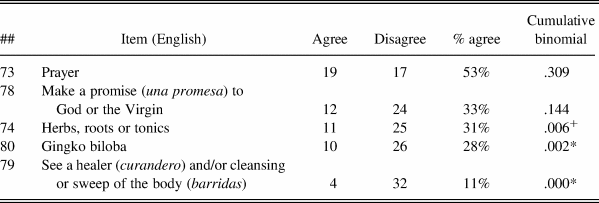
We begin by summing individual ‘yes’ vs. ‘no’ responses, developing a frequency table, and characterizing the group results for each item as percentages (see Table 1). In this transformation, the group itself becomes the stancetaking subject, and the stance objects are the survey items.
Selected item summary for ‘Ways to help’.

In this basic analysis, we might report quantified majority stances at the sample level, as for example, ‘Fifty-three percent of Mexican Americans in our sample agreed that prayer is a way to help people with Alzheimer's disease’ or ‘Of Mexican Americans in our sample, 89% disagreed that seeing a curandero would be an effective way of helping people with Alzheimer's disease’.
In a next step, we might test claims about the larger population based on inferential statistics. However, because this stratified, purposive sample of thirty-six participants does not allow more powerful parametric statistics, we calculate nonparametric cumulative binomials to assess the significance of items. With no priors, we assumed a fifty-fifty response probability for all items, and we calculated a Bonferroni correction for alpha based on the twelve items of the ‘Ways to help’ section. In Table 1, results marked with asterisks * meet Bonferroni corrected tests of significance (p < .004), and the one item marked with superscript + reflects a trend toward significance. Given these restrictions, we can make no inferential claims, for example, about ‘prayer’ or ‘making promises to God’. However, we could say, ‘Based on our small sample, we found that Mexican Americans did not agree that using herbs, roots, or tonics/taking gingko biloba/going to a curandero would be ways to help a person with Alzheimer's’.
In addition to these simple frequency analyses, it is also possible to assess how the Mexican American participants thought of the relationships between items. For example, using nonparametric Spearman correlations, we tested for the relations between our two selected items and the rest of the set. Setting alpha at .05, we found that herbs, roots, and tonics correlated moderately with ‘prayer’ (.39), ‘make a promise to God or the Virgin’ (.43), ‘see a healer (curandero)’ (.34), ‘gingko biloba’ (.53), and ‘modify diet’ (.34). These several correlations suggest a potentially coherent subset of alternative/complementary ‘ways to help’ versus medical ‘ways to help’. By contrast, ‘see a healer (curandero)’ correlated only with ‘herbs, roots, and tonics’ (.34) and no other item, raising questions for further investigation (e.g. is there a connection between botánicas, where herbs, roots, and tonics are sold, and information about healers?).
The interpretation of survey stance
Attention to the linguistics and interactive formats of survey items reveals the subtle positioning of participants as specifically Mexican American participants, who by their active engagement and interaction in the survey co-construct a ‘public’ along with other Mexican American survey takers. Further, a careful analysis of the self-positioning, item-after-item, of participants shows that each one develops a stance pattern or profile among other participants in the virtual space of the survey. By aggregating participants’ stances, the analyst completes the co-construction of the ‘public’, and the statistical analysis (though quite simple) allows us to assess the distribution of a belief, practice, or value across a sample, and to assign some degree of confidence to our statements about it. However, surveys are admittedly low-stakes social environments, and survey stance represents an ‘all things being equal’ criterion applied to the participant's evaluation of each item (stance object). Of course, in the actual social world, all things are rarely equal.
STANCETAKING IN MIXED METHODS
Linguistic stance as an integrative, mixed methods paradigm
The mark of modern mixed methods is the principled, systematic, theoretically driven integration of qualitative and quantitative methods of data collection and analysis (Johnson & Onwuegbuzie Reference Johnson and Onwuegbuzie2004; Shannon-Baker Reference Shannon-Baker2015; Bazeley Reference Bazeley2018). Integration involves both the researchers’ analytic practices in working with two or more data sets and their theoretical, overarching frames or paradigms for combining different traditions of enquiry (for a brief review, see Schoonenboom Reference Schoonenboom2017; see also Morgan Reference Morgan2007; Harrits Reference Harrits2011; Schrauf Reference Schrauf2016). In the following paragraphs, we address linguistic stance as an overarching data paradigm and as a set of practices for analyzing data.
Stance as an overarching mixed methods paradigm
At a theoretical level, a stance framework for combining qualitative and quantitative data offers a grounded account about where data come from and what form data take. Briefly, data originate in carefully crafted, schematized speech events (e.g. interviews and surveys) in which researchers systematically elicit participant stance. This co-constructed data is inherently linguistic and discursive in form. However, as we have seen, interviews and surveys shape participant stance in markedly different ways, and this raises the question of integration.
In the interview, participants offer stance evaluations on topics (the stance objects) proposed in the interviewer's questions. Skilled interviewers invite further elaboration with follow-up questions, comments, and repeated acts of structural alignment and sometimes social affiliation, and this environment of back-and-forth interaction gives participants the discursive and narrative freedom to ground their stancetaking in real-life contexts—their self-described social worlds. Thus, we see participants working to account for their stance evaluations in terms of available cultural logics and by appeal to social and cultural norms.
In the survey, by contrast, participants engage with a succession of preformatted items (stance objects) and response options (evaluations), but there is no second speaker evaluation, positioning, or alignment. Thus, via their stance evaluations, participants are limited to positioning themselves and implicitly aligning with other participants in a virtual space of survey takers. Arguably however, because participants know how surveys work, they in fact intend such alignment. Thus, by their participation, they effectively constitute a group (or ‘public’), within and across which their collective stances are quantitatively distributed and ultimately represented as second-order ‘group stances’ by the researcher.
In essence, stance is at the generative core of both methods of data collection, though differentially manipulated to produce different effects. At the analysis stage, the mixed methods researcher works at a level of second-order stance [the researcher's stance(s) on participant stance(s)] and seeks to interweave the results from either method. Both the participants’ first-order stancetaking (data generation) and the researcher's second-order stancetaking (analysis) belong to a consistent continuum of stance transformation. How is this done in practice?
Analytic practices for integrating interview and survey stance
In terms of analytic practices, the literature on mixed methods advises researchers to attend to triangulation, complementarity, expansion, exploration, and even contradiction between the results from the two methods (Bryman Reference Bryman2006; for an in-depth treatment, see Bazeley Reference Bazeley2018). Having traced the generation of socially relevant data to participant stancetaking, we might ask: How does the detailed discursive analysis of the interview inform the interpretation of survey results? And vice-versa, how does a detailed analysis of the survey inform interview results? Of many possibilities, we explore two here.
First, as noted above, it is a signal strength of the interview that participants contextualize their stance evaluations and rationalize them by drawing on cultural logics and sociocultural norms, whereas by contrast, in the survey it is the aggregation of individuals’ highly formalized stance evaluations that allows for the modeling of persons and objects in a virtual sociocultural field, beyond the welter of idiosyncrasy and circumstance. At the level of mixed methods integration, interview data informs the summary statistics and statistical models by showing how the micro-social connects to the macro-societal (indexicality), by documenting ‘real-life clips’ of cultural reasoning in situ (cultural logics), and by revealing implicit and tacit sociocultural norms. Nevertheless, the analytic influences run both ways: interview data applies but also tests survey models, and survey models situate interview material in a larger sociocultural context.
Second, there is the issue of generalization, usually viewed as problematic for small, purposive, qualitative samples versus larger, probability-based, quantitative samples. By design, however, mixed methods sampling includes aspects of both (Teddlie & Yu Reference Teddlie and Yu2007), and the question becomes how to optimize their relation. Within a linguistic-discursive framework, we recast generalization in terms of normativity in order to combine stancetakers’ implicit and explicit invocation of social norms in their interview talk and the relative social force of aggregated stance (e.g. survey stance as a ‘vote’). Earlier in this article, we adopted nomenclature from Agha (Reference Agha2007) to distinguish between three levels of normativity: a norm of behavior, reflecting simple frequency; a normalized model of behavior, reflecting an assertion of group typicality; and a normative standard, reflecting explicitly prescribed or proscribed behaviors, the latter sometimes sanctioned.
In the qualitative interview, participants make both implicit and explicit appeals to social norms, and these invoke normalized models of behavior and normative standards. In contrast, the aggregated, second-order, group-level stances from a survey reflect descriptive frequencies—norms of behavior. By combining expressions of normativity across both the interview and the survey, the mixed methods approach facilitates a more comprehensive characterization of the social force (and variable applicability) of sociocultural norms.
DEMONSTRATION DATA: MIXED METHODS INTEGRATIONS
What might a mixed methods integration of qualitative and quantitative stance look like? We turn now to the integration of the interview excerpts and the survey items that we drew from the Alzheimer's Beliefs Study. In our applied analyses of both data types, we focused on medicinal herbs and brujería ‘witchcraft’ as ‘ways to help someone’ with Alzheimer's disease. In the paragraphs below, we consider how the results from either data set inform the interpretation of the other data set.
Herbs, roots, or tonics
We know from the quantitative analysis that 69% of survey participants rejected the use of herbal medicines as a ‘Way to help’ someone with Alzheimer's disease (trending toward significance with a Bonferroni corrected p-value of .006 and alpha set at .004). In addition, from the qualitative data, we know that use of herbal remedies is a culturally ‘typical’ practice (a normalized model of behavior), and we have at hand two cultural logics. First, we know that some people reject herbal medicines as scientifically inefficacious, but, second, we know that even people who hold that belief will go to herbalists and buy the medicines. In effect, we see the tension between a normalized model of behavior (culturally acceptable remedies) and a contrary cultural logic (appeal to science) with variable results (after all, there are still 31% of those surveyed who agreed that herbal remedies would help someone with Alzheimer's disease). Indeed, we can easily imagine that some survey respondents, exercising individual stance (privately, anonymously), would authentically select a ‘no’ response to the survey item and yet go to an herbalist seeking a remedy. Given this mixed methods combination of stancetaking data, we can paint a far more nuanced picture of the tense role of herbal medicines as ‘Ways to help’ people with Alzheimer's disease.
Brujería/See a curandero
We know from the qualitative data that an illness can be caused by a curse laid by a witch (brujería) and that the usual way to remove a curse is to see a healer (curandero). However, from the quantitative data we know that 89% of survey respondents disagree with ‘see(ing) a healer (curandero)’ as a way to help someone with Alzheimer's disease (p < .000). We also know from the qualitative data that engagement with witchcraft is highly proscribed (i.e. taboo), reflecting a normative standard against seeing curanderos. Interestingly, the proscription even prohibits talking about brujería, which would seem to imply that people who get involved in brujería would not talk about it at all or only with carefully selected others in highly circumscribed situations. If the anonymity of a survey allows such individuals to admit to being involved, we must assume that this taboo practice is limited to very few individuals (one in ten according to our small sample survey). Again, the mixed methods integration of data types, and attention to the circumstances of stance production, both point to a quite limited use of brujería or curanderos for persons with Alzheimer's disease, yet we know that both are well known cultural options.
The interpretation of integrated stance
If we think of survey participation as creating ‘publics’, the second-order public stance of the Mexican American samples shows a majority rejection of witchcraft and herbal remedies as ‘ways to help’ someone with Alzheimer's. Yet the exploration of participant stance in the interviews shows robust cultural scripts that challenge an easy interpretation of that majority rejection. Witchcraft is taboo (perhaps more accurately, socially repressed), but retains its subterranean salience. Herbal remedies are unscientific but widely available, and we saw at least one cultural logic explaining their persistence. The mixed methods integration of interview and survey stance allows us to capture more adequately the cultural realities and to draw out the generalizations that might be made beyond these somewhat artificial samples to the larger social worlds of participants in the study.
CONCLUSION
Research on stancetaking has emphasized the social contexts in which individuals take stances and the ways in which their self- and other-positioning creates momentary alignments and social affiliation with their interlocutors. We have sought to work out the implications of this social stance in the formalized contexts of social science data collection, and we have sought in the originary act of stancetaking a framework for integrating qualitative interview data and quantitative survey data in mixed methods research.
By way of discussion and conclusion, we ask two questions. What does the analysis of stance in mixed methods bring to the study of linguistic stance in general? How does linguistic stance as an integrative framework advance mixed methods social science?
Contributions to the study of stance
In the opening paragraphs of this article, we distinguished everyday conversational stancetaking as ‘stance in the wild’ and the manipulation of stance by social scientists as ‘stance in the greenhouse’. The greenhouse metaphor has the advantage of suggesting (a) designed environments, in this case, the schematized qualitative interview and the quantitative survey, and (b) trained technicians, in this case, the interviewer, survey author, and the mixed methods analyst. In separate sections of this article, we have analyzed alterations of evaluation, positioning, and alignment in the interview versus the survey. For instance, in the interview there is designedly little in the way of third-turn evaluation (and consequent self-positioning) vis-à-vis the participant's second-turn evaluation (in response to the interviewer's first-turn question). Rather, in the third turn, the interviewer often vocalizes structural alignment, which often has the effect of encouraging the participant's elaboration of descriptions, accounts, and appeals to norms. Importantly, these are the analytic desiderata.
In the survey there is never any such third turn stance. Nevertheless, although the lack of third-turn evaluations on the part of the (absentee?) interlocutor would seem to render moot any application of stance as an analytic frame, our analysis of the participant's reflexive positioning vis-à-vis individual items and vis-à-vis the ‘public’ of which she becomes a member illustrates the observable social effects of virtual alignment that results from survey participation.
In both cases (interview and survey) we see how purposeful alterations of fundamental stance elements result in differential outcomes and different kinds of data. One contribution of this kind of study is to suggest that kinds of stance manipulations in other discourse environments (e.g. court trials, congressional hearings, hospital rounds) will reveal different patterns of outcomes, all amenable to discursive analysis. Metaphorically, different technicians working in different environments will ‘grow’ different types of stance. This is yet another extension of discourse analysis to institutional contexts.
Advances in mixed methods
As noted in the text, there is a growing literature on stance in the qualitative interview but little stance research on the read-and-respond quantitative survey (with Galasiński's work as an exception). The specifically linguistic contribution here is to approach very highly schematized data elicitations in quantitative instruments as fundamentally linguistic-discursive events, just like qualitative interviews. One effect of doing this is to encompass quantitative data collection under the umbrella of the discursive turn in social science, now however with a well-established methodology and clearly defined toolkit, (e.g. discourse analysis, conversation analysis, sociolinguistics, and linguistic ethnography) for describing, analyzing, and theorizing the interactive moments of qualitative and quantitative data generation. This runs directly counter to the more usual encompassment of qualitative approaches under the umbrella of a refined quantitative positivism that reads statements by the interview participant as if produced independent of the interviewer or the interaction, in much the same was as quantitative data is assumed to be context free. By extending the discursive turn to quantitative data collection, we endow the mixed methods researcher with a coherent theory of data generation common to both qualitative and quantitative paradigms.
At least two caveats are in order. First, there are many other methods of qualitative data collection beyond the interview and similarly many more quantitative instruments beyond the survey. Each of these involves different adaptations and transformations of stance, and our effort is only one example of stance as an overarching framework for mixed methods research. Second, in this article we compared interview excerpts and survey items on the same topics (witchcraft and herbal medicines) with two different samples taken from the same population (Mexican Americans). This allowed us to make direct comparisons of participants’ stancetaking under two conditions. However, many mixed methods projects in social science employ different qualitative versus quantitative strands to collect and combine data on different (but related) research questions, and hence one data set will not mirror the other. Nevertheless, if the data are essentially versions of linguistic stance, we would expect the stance framework to offer an optimal integration of the data.
Appendix: Transcription conventions
Adapted from Hutchby & Woofit Reference Hutchby and Woofit1998; Jefferson Reference Jefferson and Lerner2004.