1 Introduction and background
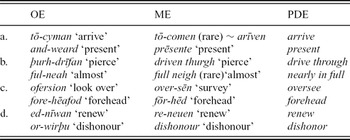
During the period spanning the Old English (OE) of King Alfred (late eighth century) and the Middle English (ME) of Geoffrey Chaucer (late fourteenth century) the majority of Germanic prefixes fell out of use. It was, nevertheless, neither the end of all native prefixes, nor the demise of prefixation as a word-formation strategy throughout the language. A number of highly productive prefixes were ultimately lost and either replaced by simplex borrowings (a), or by other available resources, such as periphrasis (b). However, several Germanic prefixes remained productive into Present-day English (PDE) (c), while others were replaced by new prefixes of Romance descent (d) (see table 1).
Prefixes, lost and preserved

Accounts of the loss of native prefixes have been proposed for all core domains of linguistics: semantics (Samuels Reference Samuels1972; Brinton Reference Brinton1988; Kastovsky Reference Kastovsky and Hogg1992), syntax (Hiltunen Reference Hiltunen1983; van Kemenade & Los Reference Kemenade, Los, Geert and van Marle2003; Elenbaas Reference Elenbaas2007) and phonology (Lutz Reference Lutz1997), as well as for Grammaticalisation Theory (Hopper & Traugott Reference Hopper and Traugott2003; van Kemenade & Los Reference Kemenade, Los, Geert and van Marle2003). Thus far, however, all such accounts have been restricted to the loss of verbal prefixes, failing to explain the simultaneous decay of nominal and adjectival prefixes.
It is this study's intention to provide a principled explanation of prefix loss and preservation across word categories. To do this, we will first review the literature on the history of English prefixation (section 1), and then assess the true extent of prefix loss between OE and ME, using corpus data (section 2). This done, we will propose syllable weight, foot structure and the ability to constitute independent prosodic words as crucial factors determining prefix preservation and loss (section 3). We will finally argue for the growth, in Early ME (EME), of a constraint which banned heavy monosyllabic prefixes. Constituting canonical feet and prosodic words, such prefixes would have borne stress, which clashed with adjacent root-initial stress, thus explaining their loss or lexicalisation, and the preservation of light monosyllables and disyllables (section 4).
1.1 The origins of Old English prefixes
Accounts by Kuryłowicz (Reference Kuryłowicz1964) and Hopper (Reference Hopper1975) track the origin of verbal prefixes back to Indo-European (IE) preverbs, and of nominal prefixes to IE adjectival elements and prepositional variants of IE adverbials. In both the nominal and verbal forms, the transition from full lexical word to affix has been described as a canonical case of grammaticalisation. The following cline is given for verbal elements (Booij & van Kemenade Reference Kemenade, Los, Geert and van Marle2003: 4):
(1) independent preverb > left member of verbal compound > prefix (> zero)
A fundamental subprocess in the evolution of preverbal elements in IE languages is their ‘functional bifurcation’ (Kuryłowicz Reference Kuryłowicz1964: 171), that is, the evolution and coexistence of two morphosyntactically distinct reflexes of the same adverbial, one in the form of an aspectual/intensifying affix (2a) and the other as a separable, adverbial particle (2b–c).Footnote 2
(2) Prefix/particle alternation (data from Elenbaas Reference Elenbaas2007: 119, 135, 142)
(a) ac þa Iudei of-slogon sume of þam witegum,
but the Jews off-slay some of the wise men
‘but the Jews killed some of the wise men’
(coaelhom, ÆHom 3:115.479)
(b) & his heafod of asloh
and his head off smote
‘and cleaved his head off’
(cobede, Bede 1:7.40.7.331)
(c) & cearf of heora handa & heora nosa.
and cut off their hands and their noses
‘and cut off their hands and noses’
(cochronE, ChronE [Plummer]:1014.24.1903)
Note that the OE adverbial particles can appear in either the immediate preverbal position (2b) or following the verb (2c). These forms preserve Germanic word-initial stress, while the bound morpheme (2a) lacks stress, which falls on the root-initial syllable. This difference has led researchers (in particular Lass Reference Lass1994: 92–3) to approximate separable prefixed verbs to compounds, while inseparable forms are widely considered affixal.
In the case of nominal prefixes, stress is quite consistent, which Hogg (Reference Hogg1992: 45–6) suggests is a reflex of their being bound to the root at an earlier stage than verbal prefixes (see also Campbell Reference Campbell1959: §73). This means that OE inherited a series of prefixes that alternated stress based on the word-class of the root (cf. ǽfþanca ‘offencen’ ~ ofþýncan ‘displeasev’).
1.2 Previous accounts of prefix loss
1.2.1 Contact-based arguments for prefix loss
A traditional notion in the literature claims there is a causal link between the Norman Conquest and the waning of OE prefixes. ‘Widespread use of prefixation in OE’ (Kastovsky Reference Kastovsky and Hogg1992: 378) would have been upset by a massive influx of new vocabulary providing lexical alternatives to the native word-formation system (Baugh Reference Baugh1935; Marchand Reference Marchand1969; Samuels Reference Samuels1972). Although Baugh does mention that before their replacement, prefixes had already mysteriously lost much of their ‘vitality’ (Reference Baugh1935: 224), he goes on to state that: ‘the wealth of easily acquired new words had weakened English habits of word-formation’ (Reference Baugh1935: 225), which is echoed by Marchand's assertion that ‘the language took to wholesale borrowing, a method which meant an enormous cut-down on the traditional patterns of word-formation’ (Reference Marchand1969: 131).
Although much of the semantics of lost prefixed-words was, no doubt, taken over by simplex or complex non-native vocabulary, the ‘loss of vitality’ of OE prefixes cannot be explained by the subsequent repair strategy of borrowing. Furthermore, the ‘wholesale borrowing’ approach gives no reason for the loss of some prefixes and the preservation of others.
1.2.2 Semantic accounts of prefix loss
The main argument explaining prefix loss in the literature is a semantic one. It underlies the notion of ‘loss of vitality’ and is explicitly dealt with in accounts of the rise of the phrasal verb (Samuels Reference Samuels1972; De la Cruz Reference De la Cruz1975; Hiltunen Reference Hiltunen1983; Elenbaas Reference Elenbaas2007) and the development of aspectual systems in English (Brinton Reference Brinton1988; Ogura Reference Ogura1995). The position is summarised by Kastovsky (Reference Kastovsky and Hogg1992: 337):
the system of OE prefixes, in particular those occurring with verbs, was already at the end of the tenth century in a state of advanced decay, because many prefix-verb combinations were no longer transparent. . . in subsequent copies of one and the same text prefixes are often omitted, added or exchanged for other prefixes without any apparent semantic effect.
For Hiltunen (Reference Hiltunen1983: 96), the separate particle would have surfaced as a ‘more explicit means’ of expressing the spatial meaning of the bound prefix, which by late OE overlapped with perfective and intensive meanings. However, this account evidently does not apply to nominal or separable verbal prefixes. Furthermore, some inseparable prefixes manage to survive loss even when weakened (i.e. when they alternate with other prefixes in parallel manuscripts). Such is the case of ME a- and be-, which represent the merger of several OE prefixes (see entries in OED), as well as ge-, which alternates in OE (Ogura Reference Ogura1995: 73) but survives throughout ME. Hence, it must be concluded that ‘semantic strength’ alone cannot be taken to determine the diachronic trajectory of prefixes in English.
1.2.3 Syntactic approaches to prefix loss
The syntactic arguments for prefix loss refer to two basic generalisations: that throughout its recorded history, English has undergone an ‘analytic drift’, thus preferring periphrastic constructions to word-formation strategies (van der Gaaf Reference Gaaf1930; De la Cruz Reference De la Cruz1975: 67; Lutz Reference Lutz1997: 263 fn. 6), and that the shift from OV to VO word order in OE and ME set forth a general tendency to post-specification (Hiltunen Reference Hiltunen1983; Elenbaas Reference Elenbaas2007). Hiltunen specifically claims that the decay of inseparable prefixes:
is not to be seen as an isolated process of waning and wearing out, but as part of the changing systems which involve the phrasal and prepositional adverbs, and ultimately the entire syntax of the language – in particular the establishment of the SVO syntax. (1983: 101)
Both Hiltunen and Elenbaas’ (Reference Elenbaas2007) data on the position of particles in OE and ME point towards a reduction in frequency of preverbal specifiers, whether morphological or syntactic (i.e. prefixes or particles). However, a major argument against the rise of post-specification is the persistence of inseparable prefixes throughout the period of growth of the phrasal verb (un-, be-, mis-, ge-, a-), as well as the later productive adoption of Latinate prefixes in the fourteenth and fifteenth centuries. As in the case of semantic decay, here too the arguments are tailored for verbal prefixes. In the case of nouns, rather than working like adverbs, the prefixes are much more like adjectives (bīfylce ‘neighbouring folk (lit. by-folk)’; inhere ‘home army (lit. in-army)’) thus remaining consistent with ME and PDE word order.
1.2.4 A phonological account of prefix loss
Although most accounts of prefix loss refer to phonological factors,Footnote 3 the only explicit account of this type is given by Lutz (Reference Lutz1997). She maintains that prefix strength derives both from the inherent characteristics of its consonants (3) and from their position within stressed/unstressed syllables (4), where weaker syllables are more vulnerable to ‘phonotactically conditioned change’ (5).
- (3)
(a) Inherent consonantal stress

(b) Inherent strength within fricatives
(4) Positional strength (‘≥’ = stronger than)
(a) onset ≥ coda (b) stressed ≥ unstressed
(5) Changes triggered by phonotactic weakness:
(a) loss of weak consonant, simplifying the original form of the syllable;
(b) replacement of the consonant by a similar but stronger consonant, thus stabilising the syllable;
(c) loss and replacement of the entire morphological unit.


Since, in Lutz's theory, the positional strength of the consonants is increased by stress, nominal and separable verbal prefixes would be much less vulnerable to reduction or replacement, and hence their loss remains unexplained. The adoption of Latinate prefixes with inherently weak consonants in unstressed syllables such as mal- and re- is another stumbling block for Lutz's general theory. If the same constraints that allegedly destabilised the OE prefixes were still active at the time when Latinate forms were adopted, then a number of these would have been replaced or reduced and possibly lost. The subsequent history of the prefixes proves this not to be the case.
1.2.5 Grammaticalisation and prefix loss
Hopper & Traugott propose that ‘at the extreme end of the history of a particular form as a grammatical marker we may find loss, either of form alone or occasionally of both form and function’ (Reference Hopper and Traugott2003: 172). This is precisely what is implied by the final stage of the cline in (1). Nevertheless, the processes by which this final state is arrived at are not predetermined, and, as we shall see for the history of prefixes, the path leading to such loss is not uniform for all the items in a category. It is claimed here, along with Joseph (Reference Joseph, Fischer, Norde and Perridon2004: 61), that grammaticalisation is an ‘epiphenomenon’ of change, that is, the intersection of a series of language change processes, one that is quite common, but not one that can be viewed as a causal force on its own. It is concluded, therefore, that an analysis of native prefix-loss in English cannot be simply the ‘result’ of grammaticalisation, but that a principled account of the divergent diachronic paths of OE prefixes is called for.
2 Corpus data
In this section, we report on a controlled comparison between two stages of English, based on evidence for the productivity of prefixes at each stage. As a result, the data prompt a series of inferences about the diachronic development of native prefixes. Although Hiltunen (Reference Hiltunen1983) and Ogura (Reference Ogura1995) have provided accounts of the alternation of verbal prefixes in OE manuscripts, and Hiltunen (Reference Hiltunen1983) and Elenbaas (Reference Elenbaas2007) have explored the frequencies of pre- and postverbal separable prefixes, there has been – to our knowledge – no comparative corpus-based look into prefixation at the relevant stages. The emphasis here is on understanding the development of prefixes across word categories and without regard to separability.
2.1 Prefixation and productivity
The productivity of a morphological process is defined as ‘its potential for repetitive non-creative morphological coinage’ (Bauer Reference Bauer2001: 98). In other words, a morphological process is productive if it can be used with words with which it was previously not used, and preserve a specific meaning across them.
The origins of many simplex PDE words can, evidently, be traced back to prefix–root combinations in OE, showing at least some relic continuity, as in the case of forbid < OE for-beodan ‘hinder, restrain’. Today, however, for- (meaning ‘in opposition’) is no longer used in combination with new roots (cf. *for-march). The necessary conclusion is, hence, that the prefix is no longer productive, and that forbid has become ‘lexicalised’: there is no longer a synchronically productive rule for the word's decomposition into meaningful units or for the prefix's use in constructing new complex words (see Bauer Reference Bauer2001: 43–51).
This study does not focus on a measure of degree for productivity, but on the causes behind the absolute loss of productivity of prefixes. A fair gauge to determine this is the frequency of attestations of the prefix, not only with different roots, but also with novel ones (Bauer Reference Bauer2001: 47–9; Booij Reference Booij2005: 69–70). We will therefore evaluate two specific synchronic stages in the language, A and B, determining the productive prefixes for stage A, and later ascertaining whether they are still productive in B.
2.2 Empirical questions, data and methods
Our data belong to two distinct stages in the history of the language: the early West-Saxon language of the late ninth century, and the London variety of late ME spoken towards the end of the fourteenth century. This five-century span affords a look at a stage of OE when native prefixes were still robustly used, and a stage of ME after the major changes in verbal prefix structure had occurred. The study views all morphemes that appear before a major word category, forming a close semantic unit with it, as prefixes.Footnote 4
(6) Empirical questions:
(a) Which OE prefixes are still productively used in the late ME period, and which ones are lost?
(b) Is separability a factor influencing survival of OE prefixes?
(c) Is the category of prefixed words a factor influencing survival of OE prefixes?
For the purposes of controlling the corpus’ topic and register, the study has been limited to OE and ME translations of a single, relatively large Latin text: Boethius’ De Consolatione Philosophiæ. The OE version, attributed to King Alfred, is likely to date from the very last years of the ninth century (894–9 is suggested by Godden & Irvine Reference Godden and Irvine2009: 145). For ME, we examine Chaucer's translation (known as the Boece), which has been dated to the early 1380s (Benson Reference Benson and Cannon2008: xxv).Footnote 5
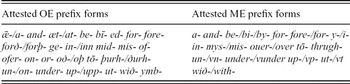
The texts were searched using the Dictionary of Old English Web Corpus and the Corpus of Middle English Prose and Verse. Specific strings of letters used in the attested spellings of the studied prefixes were targeted (see table 2).
Prefixes studied in the corpus

2.3 Results
An overall total of 5,149 tokens were found for the 26 target prefixes. The OE prefixes make up 79 per cent of this total (4,072 tokens), while the ME prefixes make up only 21 per cent (1,077 tokens). A total of 711 different combinations of specific prefixes and roots (types) were found in the OE Boethius, while the ME version had only 260. In the case of both token and type, then, we find a drastic reduction of prefix use, especially, when we consider that the word-count of the Chaucerian version is approximately twice that of the Alfredian.
By far the most common prefix in both the OE and ME texts is ge- (ME y-/i-), making up 38 per cent of the total tokens. In order not to skew the data, this prefix is dealt with separately, after the type and token data are presented for the rest of the prefixes.
2.3.1 Token-based results
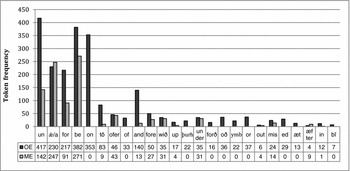
Figure 1 gives token-based results. Tokens, in this case, are individual attestations of the prefixes, regardless of the root they are attached to (see Bauer Reference Bauer2001: 47). Although these data provide the actual number of prefixes being used in the text, they can give an inaccurate view of a prefix's actual productivity, since they may only reflect the prefix use in combination with a small number of roots.
Token-based results
Dark bars represent the total number of OE prefix tokens, by prefix, while lighter ones represent ME prefixes. For consistency, prefixes are ordered according to the type frequencies for OE, in figure 2.

2.3.2 Type-based results
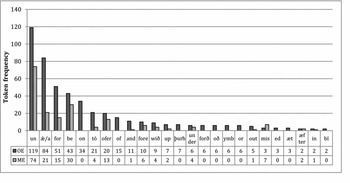
Figure 2 gives type-based results. Type results refer to the number of different roots that are attached to a particular prefix. In this sense, they are a reflection of the diversity of the roots the prefix attaches to and hence a more reliable indicator of productivity (Bauer Reference Bauer2001: 153–9).
Type-based results
Dark bars represent the number of different OE roots each prefix attaches to, while lighter ones represent the same number for ME prefixes. Prefixes are in descending order according to the type frequencies in OE.

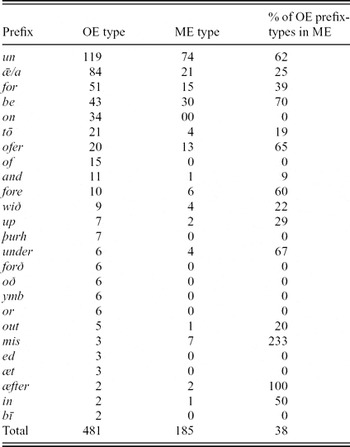
We are now able to compare the overall numbers of OE and ME prefix–root combinations and provide a percentage of OE prefix types still present in ME (see table 3).Footnote 6
Percentage of OE types in ME

2.3.3 Results for inflectional ge-
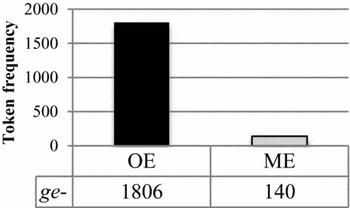
By the ME period, ge- functions mostly as a marker of the participle (cf. Stanley Reference Stanley1983), as can be seen in the corpus data, where the only exception is ynough ‘enough’ (see figure 3).
Token-based results for ge-
Bars represent the total number of attestations for ge- in each text.

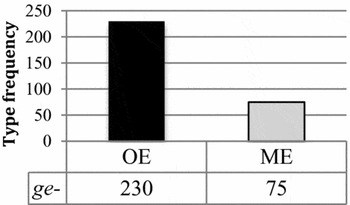
As is evident from figures 3 and 4, the number of tokens of the prefix is radically reduced in the ME corpus as compared to the OE corpus (8 per cent). The reduction of types, however, is not as radical (33 per cent). Furthermore, in the case of both type and token, the ME numbers are just as high as those of the most frequent ME prefixes in the previous section.
Type-based results for ge-
Bars represent the number of different roots ge- attaches to in each text.

2.4 Discussion
2.4.1 Preserved prefixes:
un-, a-, for-, be-, under-, ofer-, mis-, fore
On purely numerical grounds, we can conclude that these prefixes are well preserved into the ME period, since they are all either attested with fifteen or more types in Chaucer's translation, or with 50 per cent or more of the OE types in the ME text, along with at least five types preserved. It must be mentioned, however, that the etymology of ME a-prefixed words shows them to originate not only in OE a-, but also in of- and on-. Although the meaning of the prefixes preserved in ME may have been rather unclear, the number of attestations in the Boece seems to indicate that they were still productively attached to a large number of roots.
In the case of orthographic for-, its semantics and etymology in ME alternate between OE for- ‘against’ and fore- ‘in front of, before’. Five out of the twenty types can be traced back to the disyllabic prefix,Footnote 7 while the rest can be traced back to OE uniformly unstressed monosyllabic for-. Importantly, all the types involving monosyllabic for- that are preserved in ME are attested in OE as well. Adding no new roots, it is hard to say whether the prefix is truly productive; however, the number of prefixed words is still high enough in ME to make a case for its preservation.
Even though fore- only surfaces once in the Boece with the final vowel, we assume that the full disyllabic form must have survived through EME, after which the final vowel was lost. We note also that ME forknowen ‘foreknowledge’ is not attested as a compound in any of the OE sources consulted, though clearly decomposable into etymological fore-, and the root knowen (< OE cnāwan), which argues for productivity of ME for- with the meaning of OE fore-.
ge-
Although ge- is reduced both phonologically and in its frequency and distribution in ME, it is still the most common prefix in our data. It also attaches to non-native roots (cf. ypruved ‘prove, ppl.’; ygoverned ‘govern, ppl.’), and should hence be considered productive.
2.4.2 Lost prefixes
oð-, or-, ed-, þurh-, ymb-, æt-, bī-, on-, forð- and of-
It is assumed here that all forms with zero attestations in ME have been lost. This is the case for oð-, or-, ed-, þurh-, ymb-, æt-, and bī-. The prefixes on- and of-, which survived in forms reduced to a-, are also considered lost as independent forms.
tō-, and-, out-, up-, in-/inn-, wið-
We consider ME forms with tō- no longer truly productive, but relic forms. Evidence for this is given by the fact that two of the erstwhile prefixed forms are still present in PDE: the adverbial tōgeder ‘together’ and tōward ‘towards’. In this case, the high frequency of these adverbials in general usage may have led to loss of morphological structure at an early stage (cf. Aronoff Reference Aronoff1983: 168).
and- appears with only one root in the ME corpus: verbal answēren and nominal answēre. The same relic has survived into PDE as undecomposable answer. We find a single, both nominal and adjectival attestation of ME out-: outcaste ‘outcast, abject’, where the prefix is likely to be just a relic. The verbal forms of OE out appear in ME only in the postverbal position.
There are only two attested types of the prefix up- in the ME text, making up less than 30 per cent of the overall types. The forms are upryght ‘upright’ and uphepynge ‘abundance’. The former is most likely a lexicalised item, as it still is today, and the latter may well have been lexicalised and later lost. The single case of the prefix in- in ME seems to be a relic form (inset ‘implanted’), since it is unlikely that it would have survived productively side by side the Latinate en/in-.
Of the four with-prefixed words preserved into ME, three – withholden, withdrawen and withstanden (with 9, 9 and 11 tokens, respectively) – are also preserved into PDE as undecomposable relics, withhold, withdraw and withstand. Their relatively high token frequency is likely to correspond to a greater degree of lexicalisation (Aronoff Reference Aronoff1983: 168).
2.5 Corpus-data conclusions
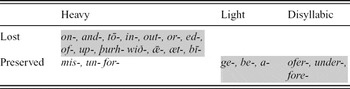
Our quantitative and qualitative analysis allows for the classification of prefixes given in table 4.
Lost and preserved OE prefixes in ME

These data constitute an answer to the first of the three empirical questions. To address the next two questions, we shall ask whether separability or word-category membership are related to prefix loss and preservation.
Inseparability of prefixes cannot guide loss or preservation, since canonically inseparable prefixes such as ed-, and-, ǣ-, or-, ge-, un-, mis- and be- were in some cases lost, and in others preserved. Furthermore, typically separable verbal prefixes such as under-, ofer-, wið-, forð-, up- and ūt- also went in both directions. In other words, since separable and inseparable prefixes do not pattern with any particular diachronic trajectory, we consider such morphosyntactic factors not to influence prefix survival.
The same is true for canonically nominal and verbal prefixes. Both purely nominal/adverbial prefixes (or-, bī-, ǣ-, uð-, æf-) and predominantly verbal/adverbial prefixes (on-, of-, at-, oð-) are lost. Moreover, in the case of prefixes that can attach to both nominal and verbal roots in OE, there is no tendency for verbal forms to be preserved over nominal ones, or vice-versa.
3 A prosodic approach
If we momentarily exclude for-, mis- and un-, a look at the prefixes that were lost and preserved during the ME period – according to our corpus study – shows a correlation between survival and syllable weight (see table 5).
Lost and preserved native prefixes by weight and number of syllables

It is this study's contention that, in the absence of other factors providing a uniform explanation for prefix loss and preservation across categories, phonological factors – in this case, weight distinctions – must play a role. Since heavy syllables are not lost across the board in EME, it is further contended that the loss of heavy monosyllabic prefixes is specific to their position immediately preceding the root. This interaction between syllable weight and a morphophonological position (the left edge of a word) can be characterised as prosodic. Controversially, the corpus evidence shows that it is not the ‘weaker’, light, unstressable prefixes that were lost in the transition to ME, but the ‘stronger’, heavy, stressable monosyllabic prefixes. This can only be explained if we consider disyllables and light monosyllables to remain compatible with EME roots, while their weight made heavy prefixes progressively incompatible.
It will be argued that language-internal factors such as the growing preference for branching feet in ME, and contact factors such as the borrowing of countertonically stressed words, led the language to avoid stress clash between adjacent syllables within the prosodic word. As a result, heavy monosyllabic prefixes – which tended to bear primary stress in nouns and secondary stress in verbs – were dispreferred due to clash with root-initial stress.
3.1 OE and ME word-prosodic structure
3.1.1 Minimal weight
Syllable weight distinctions occupy an important place in the prosodic makeup of Germanic languages (Prokosch Reference Prokosch1939; Campbell Reference Campbell1959: 39; van der Hulst Reference Hulst2003). In OE and ME this is evidenced through minimal wordhood constraints. All major word categories appear to allow monosyllables, but only on the condition that they have a long vowel and/or a coda consonant.
(7)

The same syllabic conditions, however, do not apply to disyllables, where two light syllables may constitute a lexical word.
(8)

Clearly, the distribution of syllables in OE and ME minimal words is amenable to a moraic analysis: the minimal word is made up of two morae (see Minkova Reference Minkova2008: 32).
3.1.2 Stress in Old and Middle English
Old English
Primary stress in OE is relatively straightforward, it follows the general ‘left strong’ Germanic tendency by falling on the first syllable of the root (Halle & Keyser Reference Halle and Keyser1971: 90; Hogg Reference Hogg1992: 47; Minkova Reference Minkova, van Kemenade and Los2006: 95). In the case of compounds, main stress is assigned to the leftmost morpheme (córnhūs ‘granary’; góldhroden ‘adorned with gold’), very much as in PDE (píckpocket; flówerpot). In the case of prefixed words, nominal and adjectival prefixes consistently take primary stress (with the exception of be-, ge- and for-), inseparable verbal and adverbial prefixes are unstressed (with the exception of ed- and and-) and separable verbal prefixes tend to take primary stress (but see Minkova Reference Minkova2008).
Based on the evidence from alliteration, and from the position of the rises in metre (Sievers Reference Sievers1893; Minkova Reference Minkova2003), there is general agreement that secondary stress in OE falls on the second element of compounds (e.g. gámolfèax, ‘grey-haired’), or on bound suffixes that can be traced back to independent morphemes (éorl-scìpe ‘manliness’; cýne-dṑm ‘dominion’). Crucially, this holds regardless of the number of syllables of the roots involved (blṓdrḕad ‘blood-red’; kýnegṑd ‘noble’). In the case of prefixed nouns and adjectives (as well as separable verbal prefixes), root-stress is claimed not to be lost, but simply to remain at a lower level of prominence compared to the prefix (ánd-sàca ‘apostate’; ín-c  ð ‘strange’, see Hogg Reference Hogg1992: 48, Minkova Reference Minkova2008: 46 fn. 41).
Finally, there is evidence for secondary stress in inflected words of three or more syllables (see Sievers Reference Sievers1893). The environment for secondary stress is defined by Campbell as ‘any long final syllable [H], after another long syllable or its equivalent [LX]. . . when it becomes internal due to the addition of an inflection’ (1959: 34–5). Hence we find the following alternations (from Lahiri & Fikkert Reference Lahiri and Fikkert1999: 246–7).
(9)

Again, weight surfaces as a fundamental factor in OE stress assignment.
Middle English stress
Halle & Keyser (Reference Halle and Keyser1971: 101) argue that ME had a hybrid stress assignment system, where native words were stressed from left to right without regard to quantity, as in OE, and Romance loans were assigned stress from right to left on the first heavy syllable. However, although there are a number of cases where primary stress falls on a syllable that is not initial, most words lacked heavy syllables at the right edge, hence the vast majority of ME loans would have been stressed identically whether stress was assigned starting at the left or the right edge (Dresher & Lahiri Reference Dresher, Lahiri, Fortescue, Jensen, Mogensen and Schøsler2003: 76–7). Moreover, alleged end-stressed words tend to show alternation to fit the metre, particularly in the Chaucerian canon, producing a series of doublets (from Dresher & Lahiri Reference Dresher, Lahiri, Fortescue, Jensen, Mogensen and Schøsler2003: 78).
(10)

Furthermore, the vast majority of the words attested with final stress in ME surface with initial stress in PDE. That is, although some alternation was allowed in verse, ME preserves the Germanic ‘left-strong’ system.
In the case of disyllabic words, Fikkert (Reference Fikkert, Fikkert and Jacobs2003) concludes that the stress patterns of disyllabic loan-verbs in ME tends to mirror OE prefixed verbs, i.e. the first syllables were left unstressed.
(11)

Ultimately, since OE had only monosyllabic verbal roots,Footnote 8 ‘the natural interpretation of foreign disyllabic verbs was. . . to consider them prefixed’ (Fikkert Reference Fikkert, Fikkert and Jacobs2003: 325). In other words, stress could still be assigned left to right, but it could skip the first syllable of disyllabic verbs.
3.1.3 Evidence for Old and Middle English foot structure
Since OE monomorphemic words were assigned main stress at the left edge and lacked any further secondary stress, we may say that they were made up of a single, left-strong foot, i.e. a trochee. For OE, as for most early Germanic languages, feet are prototypical lexical words (Russom Reference Russom1998; Minkova Reference Minkova2008). This is further supported by the evidence from compounds, where each independently attested morpheme bears stress on the first syllable, with the leftmost foot bearing primary stress.
(12)

Further evidence for the internal structure of the foot is given by inflected words which are able to bear secondary stress. Following Campbell (Reference Campbell1959: 34–5), these words must be at least trisyllabic, with secondary stress being assigned to non-final syllables following a heavy syllable (σ) or its ‘equivalent’, that is, a light syllable (σ) followed by another syllable, heavy or light. Feet may hence be assumed to include the stressed syllable ([x]) and following syllables up to the next stress.
(13)

Dresher & Lahiri (Reference Dresher and Lahiri1991) propose the OE foot to be a resolved moraic troichee. The foot has a minimally bimoraic head, a constraint satisfied by either a single heavy syllable ([H]), or a light syllable plus another syllable ([LL] or [LH]). Beside this head (in brackets), the foot may optionally have an additional light syllable, making it a branching foot (([H]L) or ([LX]L)).
(14) The Germanic Foot (Dresher & Lahiri Reference Dresher and Lahiri1991)
Foot type: resolved expanded moraic trochee ([μ μ(μ)] μ)
Direction of parsing: left to right
Main stress: left
(15)

Note that only (15d) in the examples has more than a single foot, and hence has secondary stress. For the cases where the second foot is non-branching (in Campbell's terms ‘the second heavy syllable or its equivalent’ is not ‘internal’, 1959: 34–5), secondary stress is lacking. This is what Dresher & Lahiri (Reference Dresher and Lahiri1991: 260) term Final Destressing (FD): the defooting of a final non-branching foot (⊗).
(16)

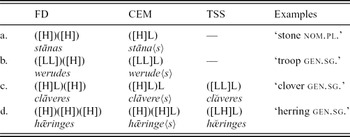
The explanatory power of the Germanic Foot is of particular use as regards the changes in weight that took place during late OE and EME. Three types of weight change would have preserved, and even optimised, the OE foot structure: Consonant Extrametricality (CEM); Trisyllabic Shortening (TSS) and Open Syllable Lengthening (OSL).
Lahiri & Fikkert (Reference Lahiri and Fikkert1999: 246) claim lack of stress on final syllables would have been reanalysed in the synchronic grammar as CEM, that is, final consonants not following the weight-by-position parameter (Hayes Reference Hayes1989). As a result, the defooted final, non-branching foot is incorporated into the first foot (which becomes maximal) (table 6, a-b). There are also cases however, where the final syllable cannot be footed at all, since the previous foot is already maximal (c). Lahiri & Fikkert (Reference Lahiri and Fikkert1999: 247) suggest that TSS would be a solution to those cases that are not yet optimal. Shortening the vowels of the first syllables in trisyllabic words would have led to many more instances of the LX pattern to fill the head position of the Germanic Foot.
Consonant extrametricality to trisyllabic shortening (data from Lahiri & Dresher Reference Lahiri and Fikkert1999: 708 and Lahiri & Fikkert Reference Lahiri and Fikkert1999: 247)

Finally, just as CEM and TSS exert pressure on the EME vocabulary to conform to a single foot, Lahiri & Dresher (Reference Lahiri and Fikkert1999: 709) explain OSL as a pressure to create branching, maximal feet. Hence, short vowels in open syllables of words made up of a single non-branching foot ([LL]), are lengthened if this will push the second syllable into the weak branch of the foot ([H]L), as in the case of OE tale ‘tale’ which surfaces in ME as tāle. Note that in the cases where TSS occurs (e.g. claveres ‘clover gen.sg.’), OSL is blocked, allowing the prosodic optimisation to occur. Ultimately, the net result of CEM, TSS and OSL is the reduction of the vast majority of native content words to a single branching foot.
This foot-based account, however, makes no claims as to the prosodic structure of prefixed words in OE and ME. If we consider the case of heavy and disyllabic nominal prefixes, we find that they pattern exactly as compounds would, since they are canonical prosodic words, with main stress falling on the first element (see Minkova Reference Minkova2008: 32–3).
(17)

Note that under- in (17c) must necessarily be analysed as an independent prosodic word, otherwise its second syllable would have to be footed with the first syllable of the root, or alternatively, be stressed. Neither of these options is motivated by the metrical structure of the language (see Minkova Reference Minkova2008: 28–9). Considering under- as a full PrWd makes it subject to FD in OE, hence keeping the morphological boundary and the reconstructed stress pattern.
Although the compounding analysis may adequately explain the structure of nominal prefixes that constitute a full foot, this strategy is not adequate for light prefixes, or for heavy verbal prefixes which lack main stress. From the perspective of the foot structure we have followed here, as well as the account given by Minkova (Reference Minkova, van Kemenade and Los2006, Reference Minkova2008), light prefixes fail to meet the minimal foot and wordhood criterion and hence remain unfooted, lacking independent prosodic wordhood.
(18)

In the case of verbal prefixes which constitute full feet, their relation to the Germanic foot structure is less straightforward, since main stress falls on the second PrWd in the sequence. Nevertheless, and crucially to our argument, insofar as they constitute a foot and a prosodic word, verbal prefixes must bear a certain degree of stress. Hence, there must be a morphological rule that assigns main stress to nominal/adjectival prefixes, and to the root of prefixed verbs and adverbs (see Minkova Reference Minkova2008: 32–6).
(19)

Finally, since it is argued here that ME continued to have the same foot structure as OE, prefixes that could be footed independently would have also remained so in ME. However, by the ME period the prosodic conditions of the language had changed slightly, especially as concerns the interaction of primary and secondary stress at the prefix–root boundary. The optimisation of the Germanic Foot led to adjacent stress on prefix and root, a clash acceptable in OE, but no longer tolerated in the ME period. The historical evidence points to the resolution of this conflict not by upsetting the segmental or foot structure of the language, but by eliminating one of the conflicting morphosyntactic elements: the heavy monosyllabic prefixes.
4 Stress clash and language change: accounting for the data
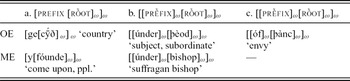
The category of OE prefixed words where the prefix is not a full prosodic word has been shown to survive robustly into ME (table 7, column a). However, the category of OE prefixed words where the prefix constitutes a full prosodic word is split in terms of survival. Disyllables (b) are retained, while monosyllables are lost (c).
Prefixed words in OE and ME (stressed elements marked with ‘x’)

We have argued that all prosodic words were stressed in OE and ME, and hence, the heavy monosyllabic prefixes would have incurred stress clash across the prosodic word and prefix–root boundary, eventually leading to their demise. What must be explained, then, is the development of the constraint against stress clash at this boundary.
The first notable development to this effect, is that, as a result of the changes in syllable weight that occurred in EME, feet were maximised, thus drastically reducing the frequency of word-internal stress clashes and increasing the frequency of branching feet. These changes must have created the percept of stress skipping at least one syllable before repeating in compounds and at the phrase level.
To these changes, we may add the adoption from Romance of the Countertonic Principle (Danielsson Reference Danielsson1948: 27), which is said to reflect ‘a balancing pattern relating to the wider stress-pattern, whereby there is a regular alternation between stress and non-stress within a polysyllabic lexeme’ (Horobin & Smith Reference Horobin and Smith2002: 53). Hence, an Old French (OF) word such as còuntenánce would have been borrowed into English at least as early as the thirteenth century with a reversal of the original stress to fit the Germanic stress pattern: cóuntenànce (Horobin & Smith Reference Horobin and Smith2002: 53). This particular variety of loans would have fitted in with the pattern of most OE compounds, strong-suffixed words and the disyllabic prefixed words, providing an apparent alternation between stressed and unstressed syllables in longer ME words.
(20)

This percept of a regular stress-non-stress alternation is formalised by Minkova (Reference Minkova, van Kemenade and Los2006: 115) as *Lapse, a constraint banning the succession of unstressed syllables, comparable to what we now find at the EME prefix–root boundary: a constraint against the succession of stressed syllables. In the case at hand, the constraint is formulated at the level of the prosodic word, which is the key prosodic constituent for stress assignment. It states that there is a strong dispreference for strong, stressed syllables (heads of feet) to be adjacent across PrWd boundaries.
(21)

4.1 Heavy monosyllabic prefixes
The development of the constraint banning stress clash at the prefix–root boundary actively affected the makeup of the heavy native prefixes, which were faced with either loss or preservation in a relic form (lexicalisation), a choice that was most likely determined by frequency of the prefix–root combination. In the case of prefix loss, clash was avoided simply by the absence of the entire prefix. In the case of lexicalised preservation, the prefix–root combination lost its morphological structure along with the independent prosodic wordhood of prefix and root.
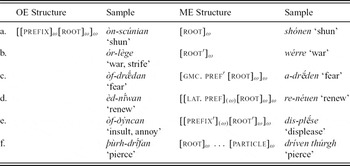
Heavy prefixes in ME were often lost and replaced by either the simplex form of the word (table 8a) or by a different simplex word (b). Another option was the replacement of the prefix with a reduced, light prefix (c). Often the semantic gap left by the loss of the OE prefixed word could be filled by an incoming Romance prefix (d), in which case stress followed the noun–verb alternation ábstract–abstráct. The OE prefixed word could also be replaced by a new prefixed word (e), whose morphemes could be taken from either native or Latinate stock. Finally, the option of a periphrastic construction was also often available, as in (f).
Patterns of OE heavy prefix loss in ME

Since, as we have seen, the development of the language displays weight-changing processes (such as CEM, TSS and OSL), one may ask why English would adopt such a radical solution to the problem of *Clash. The reduction of long vowels or the extrametricality of a segment might have been enough to assure the compatibility of prefix and root. Nevertheless, the crucial generalisation here is that the constraint is active at the level of the concatenation of prosodic words, where segmental changes are no longer possible.
The repair strategies available, therefore, are not generated at the level of the word-phonology, but at the level of the morphosyntax. As a result, the speaker must choose to either eliminate the prefix, replace it with another form, or place it elsewhere in the phrase, as in the case of phrasal verbs.
Another path followed by prefixes was that of lexicalisation due to their loss of morphological content (table 9), a possibility only available to relatively frequent prefixed words.Footnote 9 In this case, it is proposed that the main stress pattern of the OE word is maintained, but, due to the loss of independent prosodic wordhood of the prefix and root (i.e. the dissolution of the prefix–root boundary), secondary stress is lost, hence avoiding stress-clash. Nouns came to be stressed on the first syllable while verbs came to be stressed on the second syllable of the ME relic.
Patterns of OE heavy prefix lexicalisation in ME

4.2 Light monosyllabic and disyllabic prefixes
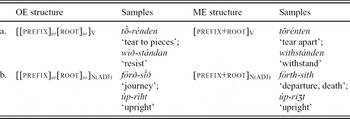
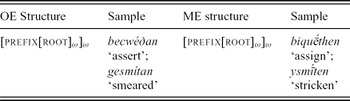
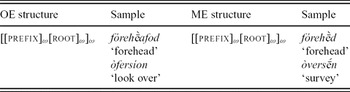
The EME constraint on stress clash at the prefix–root boundary applies vacuously in the case of both light and disyllabic prefixes (tables 10 and 11). In the case of the former, they are unstressed since they cannot form an independent, bimoraic PrWd. For the latter, no clash occurs since a second syllable intervenes between the stressed syllable of the prefix and the root.
Structure of light prefixes in OE and ME words

Structure of disyllabic prefixes in OE and ME words

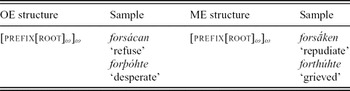
Interestingly, the OE prefix for-, although a closed syllable, lacks stress throughout the history of the language (cf. Minkova Reference Minkova2008: 22). Its preservation into the ME period constitutes further grounds in arguing that for- is prosodically light. Such a state of affairs can be explained by the relatively high sonority of the rhotic, which would have allowed it to syllabify within the prefix's head mora. The independent process of reduction in ME unstressed vowels, no doubt further facilitated this monomoraic interpretation.Footnote 10
(22)

Such a pattern would most likely have been interpreted by speakers’ grammars as closer to that of unfooted, light prefixes (be-, ge- and a-), than to footed, heavy ones. Whether or not this is the case, it is here claimed that for the purposes of stress assignment as well as preservation in the face of stress-clash, for- is indistinguishable from light prefixes (table 12).
Structure of for- prefixed words in OE and ME

4.3 A different path of development: un- and mis-
un- and mis- appear not to follow the straightforward generalisation of heavy monosyllabic prefix loss. As a matter of fact, in the corpus data, un- and mis- were found to be robustly productive at the time of the composition of Chaucer's Boece. The five-century gap in the evidence presented in the corpus data, however, makes important processes opaque.
The OE evidence for un- indicates that the nominal form of the prefix was not consistently stressed, but alternates frequently. In this respect, Kendall (Reference Kendall1981: 41) states that ‘Though the fact that un- was not originally a verbal prefix suggests that it should be accented, it is clear from the evidence of Beowulf (and elsewhere) that an unstressed form existed side by side with the stressed prefix’. In a close examination of the seventy attested uses of the prefix in Beowulf, Kendall concludes that the poet had the choice of either stressing the prefix or leaving it unstressed (examples from Kendall Reference Kendall1981: 41).
(23)

In ME, the patterns of alliteration of un- show that, ‘promotion of this prefix is optional’ (Minkova Reference Minkova2003: 55), that is, the ME prefix was unstressed unless the poet or copyist saw it fitting to change that stress to fit the verse. Such a practice appears to be at odds with the consistency of stress in the oral tradition of OE (Minkova Reference Minkova2003: 59).
While stress on un- shows an alternation in OE, by ME the prefix was mostly unstressed, varying somewhat artificially in written metre. Furthermore, Minkova's (Reference Minkova1997) analysis of un- in EME verse seems to show absolute lack of stress. In particular in the metre of the Proverbs of Alfred, an early alliterative ME text, un- surfaces consistently in unstressed position, as in (24) (Reference Minkova1997: 448).
(24) for betere is bern unborn þanne unibeten. (PA, M 243–45)
for better is child unborn than unbeaten
‘for better is a child unborn than unbeaten.’
From the perspective of this study's argument, destressing is a sign of clash avoidance, which crucially occurs during exactly the same period where heavy, stressed prefixes were lost across the language.Footnote 11 To this, we may add the observation made by the OED with regard to the non-verbal forms of the prefix: ‘altogether, the number of un- words recorded in OE is about 1250, of which barely an eighth part survived beyond the OE period’. Although new un- prefixed words have entered the language since the OE period, there seems to have been a specific point in the history of the language when, regardless of its semantic strength, the prefix became dispreferred.
In the case of mis- it is generally agreed that the prefix ‘became contaminated with French més- and gained extra life from it’ (Bauer Reference Bauer2003: 34).Footnote 12 Evidence for this is cases such as ME misbelieve, modelled after the Anglo-Norman mescreire ‘misbelieve’ (cf. OED entry). The ultimate result would have been the licensing of the mis-/mes- prefix attaching to both native and borrowed roots. This is compatible with the growth in the frequency of the prefix in the corpus data.
According to OED, there are approximately forty roots attached to the prefix mis- in OE. Of these, only about half survive into ME. We may deduce, hence, that the process of decay due to stress clash was well underway before the merger with OF mes-. As in the case of un-, the avoidance of stress-clash must be the result of the demotion of the prefix's stress (i.e. the loss of its independent prosodic wordhood),Footnote 13 which would have also been the first stage in a process of lexicalisation whose progression was prevented by OF mes-.
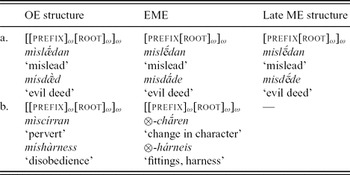
The examples in table 13 (a) show loss of independent prosodic wordhood for verbal and nominal mis-, with concomitant stress-clash avoidance. Ultimately this led to preservation into LME with strengthening from incoming mes-. Note that, PDE assigns secondary stress to mis- prefixed words, regardless of word category,Footnote 14 a sign that the OE noun–verb stress alternation has been lost in this case, just as in that of light prefixes. The examples in (b) show the loss of the prefixed form due to stress clash with the root.
Paths of survival (a) and decay (b) for mis- prefixed words

4.4 Constraints on the prosodic word: verb–noun stress alternations in ME disyllables
Aside from loss, stress clash also led to the dissolution of the prefix–root boundary in the case of lexicalised prefixes. These forms lost secondary stress, but preserved the main stress alternation of OE prefixed nouns and verbs. Crucially, OE prefixed verbs that lexicalised in ME did not follow the Germanic trend of stressing the first syllable. Furthermore, the words were no longer considered synchronically prefixed, so the verb/noun alternation was not simply a question of affix stress, but one of word category, specifically among disyllables.
Although Fikkert's (Reference Fikkert, Fikkert and Jacobs2003) claim that disyllabic Romance borrowings in ME followed the pattern of OE prefixed words is not here disputed, a stage is missing from her analysis. Some Romance verbs may well have been borrowed very early, with stress on the second syllable taken directly from prefixed words. For the vast majority of the borrowed disyllabic verbs, however, the original distinction was no longer available, since the prefixes were lost. In these cases, it is claimed here that the verbal stress pattern of loans was taken by analogy with relic forms, where the erstwhile prefix was fully defooted. The original morphological structure of the relic prefixed words was by then gone, hence the stress alternation between nouns and verbs is reanalysed in the synchronic ME grammars as an alternation clarifying word-category membership.
(25)
(26)


Note that for verbs the first foot of the word (the OE heavy prefix) is defooted, while in the case of nouns, footing corresponds to the native Germanic system, allowing for a single foot in disyllables.
5 Conclusions
When viewed from a distance, the loss of OE prefixes in ME can be characterised as the end-state of a process of grammaticalisation. Independent IE adverbials seem to have gradually merged with Germanic words, lost semantic and syntactic independence in OE, and finally either disappeared or became indistinguishable from other simplex words in ME. Nevertheless, if the goal of our account is to understand the final stage of prefix loss, a grammaticalisation analysis gives no principled means for distinguishing lost and preserved prefixes; thus attempting a sweeping historical account, at the expense of true explicative power. This article explored the motivations for prefix loss and preservation from a purely prosodic perspective, thus allowing the structural differences between lost and preserved prefixes to emerge.
It was argued here that prototypical OE roots were made up of a single, weight-sensitive, optionally branching, left-headed foot (i.e. the Germanic Foot). OE root-stress often clashed with other morphemes in word-formation processes, a situation that was not proscribed in the earliest stages of the language. The transition to ME, however, brought with it a tendency to optimise the foot by way of a series of weight alternations that created maximal, branching feet. This tendency, along with the growth of the Countertonic Principle in Romance loans, led to the synchronic percept of a regular stress-non-stress alternation in the language. In this new situation, words with heavy monosyllabic prefixes displayed an undesirable succession of stressed syllables at the prefix–root boundary, which ultimately brought about prefix loss and lexicalisation. Therefore, the greater entrenchmnent of the Germanic Foot in EME would have played an important part in triggering the rise of the clash-avoidance constraint, which in turn led to the loss of heavy monosyllabic prefixes.
Although there is no doubt that structures in language have a tendency to change meaning, decay and pass away, human perception also has a tendency to identify and perpetuate patterns that are seen as fundamental. Contrary to semantic arguments for prefix loss (Hiltunen Reference Hiltunen1983; Kastovsky Reference Kastovsky and Hogg1992), as well as views of their grammaticalisation (Booij & van Kemanade Reference Booij, van Kemenade, Booij and van Marle2003) or phonotactic destabilisation (Lutz Reference Lutz1997), OE prefixes were lost in order to preserve a perceived structural requirement of the language. In this sense, loss was the result of an active process rather than a passive one.
This study falls in with the growing body of literature viewing the preservation and optimisation of prosodic structure as driving forces in the evolution of language (see Dresher & Lahiri Reference Dresher and Lahiri1991; Kiparsky Reference Kiparsky, Jasanoff, Melchert and Oliver1998; Lahiri, Riad Jacobs Reference Lahiri, Riad, Jacobs and van der Hulst1999; Fikkert, Dresher & Lahiri Reference Fikkert, Dresher, Lahiri, van Kemenade and Los2006). Such an approach is premised on theories of prosodic morphology (McCarthy & Prince Reference McCarthy and Prince1986, Reference McCarthy and Prince1990), where the synchronic shape and possible combination of morphemes is constrained by language-specific prosodic templates. Viewed diachronically, a language's preference for specific prosodic structures pushes it to change over time, creating greater conformity with these structures, a characteristic termed pertinacity (Dresher & Lahiri Reference Dresher, Lahiri, Fortescue, Jensen, Mogensen and Schøsler2003).
As regards the diachronic development of OE prefixes, the importance of the division between heavy prefixes – which were lost – and disyllabic and light prefixes –which were preserved – is, no doubt, much greater than that of the division between the word categories they attach to, or between their degree of semantic or syntactic independence. Although the influence of semantic and syntactic factors in the history of English prefixation is not here denied altogether,Footnote 15 there is no doubt that a prosodic account fits in much more naturally with the important quantity and weight adjustments that ran through the English language around the time of the Norman invasion.