Introduction
Chronically decreased oxyhaemoglobin saturation (hypoxaemia) is common in patients with single-ventricle heart disease post-Fontan palliation and leads to compensatory polycythaemia. Reference Liptzin, Di Maria and Younoszai1 Sleep-disordered breathing, a frequent comorbidity in Fontan patients, Reference Wolfe, Liptzin and Brigham2 may lead to additional intermittent episodes of relative hypoxaemia. Sleep-disordered breathing is associated with adverse neurodevelopmental impact in otherwise healthy children, including increased attention deficit/hyperactivity disorder symptoms and reduced visual-motor integration. Reference Beebe3 Increased attention deficit/hyperactivity disorder symptoms, and poorer visual-motor integration skills are also more common in children post-Fontan palliation compared to the general population. Reference Liptzin, Di Maria and Younoszai1,Reference Wolfe, Liptzin and Brigham2 Whether sleep-disordered breathing is a driver of neurodevelopmental outcomes in children with single-ventricle heart disease is not clear. Neurodevelopmental concerns have been associated with subjective sleep disturbance in those with Fontan circulation Reference Knobbe, Partha and Seckeler4 and preliminary evidence associates parent-reported symptoms of sleep-disordered breathing with poorer visual-motor integration. Reference Wolfe, Liptzin and Brigham2 However, the relationship between specific, and potentially modifiable, pathophysiologic parameters from polysomnography and neurodevelopmental testing has not been studied.
Methods
Following approval by the Colorado Multiple Institutional Review Board 14-1072, a retrospective chart review was performed. Inclusion criteria were children with Fontan circulation who underwent polysomnography with ≥2 hours of recorded sleep time. Medical, sociodemographic, and neurodevelopmental data were abstracted. Neurodevelopmental testing was included if completed within 2 years of polysomnography, acknowledging real-world limitations in scheduling and waiting lists for both polysomnography and neurodevelopmental testing in our clinics. The timing of which occurred first/second is variable, and for this reason, all data were excluded if tonsillectomy/adenoidectomy or cardiothoracic intervention was performed in the interim.
Cardiorespiratory parameters obtained from polysomnography included severity of obstructive sleep apnoea as categorised by obstructive apnoea-hypopnoea index as none (obstructive apnoea-hypopnoea index <1/hour), mild obstructive sleep apnoea (obstructive apnoea-hypopnoea index 1–4.99/hour), moderate obstructive sleep apnoea (obstructive apnoea-hypopnoea index 5–9.99/hour), or severe obstructive sleep apnoea (obstructive apnoea-hypopnoea index ≥10/hour); central apnoea index; baseline or absolute hypoxaemia as oxyhaemoglobin saturation (SpO2) mean and nadir; intermittent or relative hypoxaemia, represented as oxygen desaturation index (desaturations/hour of sleep); percent of total sleep time with SpO2 < 90% or 88% (%total sleep time < 90%, %total sleep time < 88%); end-tidal carbon dioxide time>50mmHg; heart rate; and arousal index. The presence and patency of Fontan fenestration at the time of polysomnography were recorded, and a subanalysis was performed to determine whether the presence of a patent fenestration was associated with SpO2 indices or severity of obstructive sleep apnoea.
Neurodevelopmental variables included the Full-Scale Intelligence Quotient standard score from either the Wechsler Intelligence Scale for Children, Fifth Edition or the Wechsler Adult Intelligence Scale, Fourth Edition, the Vanderbilt attention-deficit hyperactivity disorder rating scale (parent report; number of symptoms endorsed), and the Beery-Buktenica Visual-Motor Integration Test-6th Edition standard score. IQ and visual-motor integration scores were standardised by age.
Group comparisons were completed using chi-square tests for categorical variables and two-sample t-tests for continuous variables. Nonparametric analyses were used to evaluate associations between polysomnography and neurodevelopmental variables given the modest sample size. All tests used a two-tailed alpha < 0.05 threshold for significance.
Results
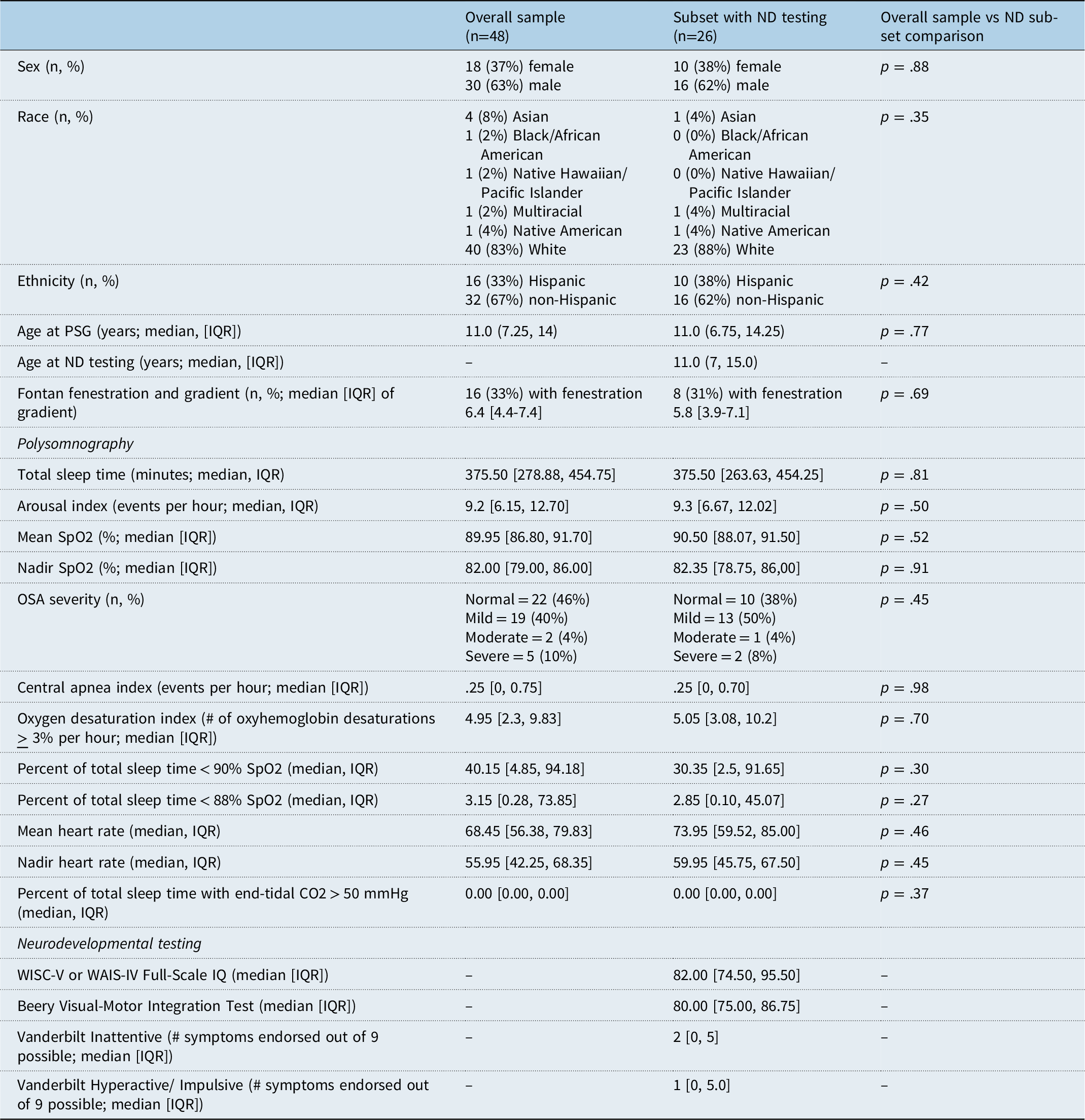
Forty-eight children between ages 4 and 17 years of age with Fontan circulation met inclusion criteria with polysomnography; 26 also had a qualifying neurodevelopmental evaluation with a median time between polysomnography and neurodevelopmental studies of 5.5 months (IQR = 1.0, 19.25; Table 1). The subset with both polysomnography and neurodevelopmental testing (26 of 48) did not differ from the overall cohort in terms of any demographics or polysomnography characteristics (Table 1), demonstrating the subset was comparable to the full sample. One participant had a chromosomal microdeletion, and three had a history of perioperative stroke, and as these comorbidities are not uncommon in the Fontan population, we included these participants to maximise sample representativeness and generalisability.
Demographic, medical, polysomnographic, and neurodevelopmental data

Table 1 Long description
The table compares demographic, medical, polysomnographic, and neurodevelopmental data for an overall sample of 48 children and a subset of 26 children with Fontan circulation. The table has 20 rows and 3 columns. Column headers are Overall sample (n=48), Subset with ND testing (n=26), and Overall sample vs ND subset comparison. Row labels include Sex, Race, Ethnicity, Age at PSG, Age at ND testing, Fontan fenestration and gradient, Total sleep time, Arousal index, Mean SpO2, Nadir SpO2, OSA severity, Central apnea index, Oxygen desaturation index, Percent of total sleep time < 90% SpO2, Percent of total sleep time < 88% SpO2, Mean heart rate, Nadir heart rate, Percent of total sleep time with end-tidal CO2 > 50 mmHg, WISC-V or WAIS-IV Full-Scale IQ, Beery Visual-Motor Integration Test, Vanderbilt Inattentive, and Vanderbilt Hyperactive/Impulsive. Each row provides specific data points and comparisons between the overall sample and the subset with neurodevelopmental testing.
Note: ND = neurodevelopmental; PSG = polysomnography; OSA = obstructive sleep apnea, categorized by obstructive apnea-hypopnea index range: normal = 0-0.99/hr; mild OSA = 1-4.99/hr, moderate OSA = 5-9.99/hr, and severe OSA = 10+/hr; SpO2 = peripheral oxygen saturation; CO2 = carbon dioxide; WISC-V = Wechsler Intelligence Scale for Children, 5th edition; WAIS-IV = Wechsler Adult Intelligence Scale, 4th edition; SS = standard score; mean = 100, SD = 15. Vanderbilt = Vanderbilt Rating Scale, parent report.
Ample total sleep time was recorded. In both the overall sample and the subset with neurodevelopmental testing, >50% of participants met obstructive sleep apnoea criteria (Table 1). Mild obstructive sleep apnoea was the most common subtype. Acute desaturations within the context of absolute hypoxaemia were common in the cohort. Significant central apnoea or hypoventilation was not observed. Heart rate mean and nadir were normal to low-normal.
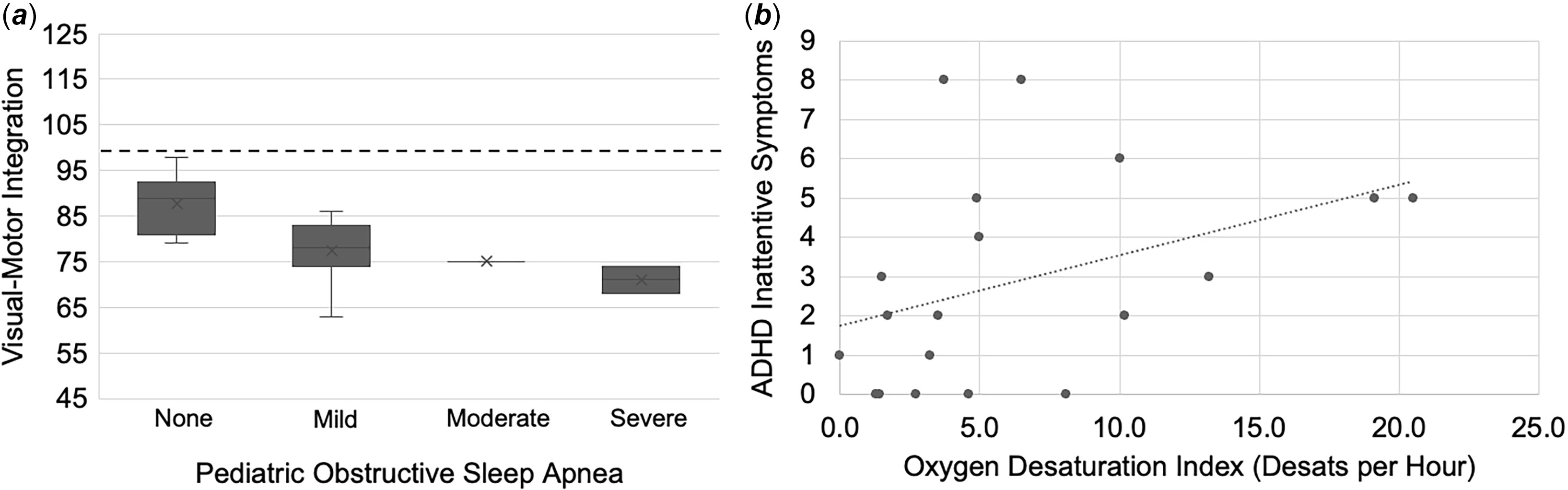
Neurodevelopmental testing showed IQ and visual-motor integration skills overall measuring in the clinical low-average range (Table 1). Median inattentive and hyperactive/impulsive attention deficit/hyperactivity disorder symptoms measured in the subclinical range. Increased severity of obstructive sleep apnoea was associated with poorer visual-motor integration skills (Figure 1; Spearman’s rho = −0.739; p = <0.001). This association was maintained even when the obstructive apnoea-hypopnoea index was analysed as a continuous variable (Spearman’s rho = −0.573; p = 0.005). Increased inattentive attention deficit/hyperactivity disorder symptomatology was associated with intermittent hypoxaemia and higher frequency of relative oxyhaemoglobin desaturations during sleep (Figure 1; Spearman’s rho = 0.529; p = 0.020) but not with baseline hypoxaemia SpO2 mean or SpO2 nadir. Presence or patency of fenestration did not alter these associations, and each remained statistically significant when participants with a history of stroke or chromosomal abnormality were excluded. There were no associations between polysomnography measures and Intelligence Quotient, nor hyperactive/impulsive attention deficit/hyperactivity disorder symptoms.
(a) Visual-motor integration standard scores (normal mean = 100, depicted with the dashed line, SD = 15) by severity of obstruction sleep apnoea(categorised by obstructive apnoea-hypopnoea index score, in events per hour). (b) ADHD-inattentive symptoms on the parent-report Vandebilt Rating Scale by oxygen desaturation index, measured in number of ≥3% oxyhaemoglobin desaturations per hour of sleep; scatterplot trend indicated by the dotted line.

Discussion
This is the first report of an association between direct measurements of obstructive sleep apnoea and neurodevelopmental in children with Fontan physiology. In this preliminary study with a small sample size, we found increased obstructive sleep apnoea severity was associated with poorer visual-motor integration skills and a higher frequency of sleep-related oxyhaemoglobin desaturations with more parent-reported inattentive attention deficit/hyperactivity disorder symptoms. These findings add to a growing literature on sleep anomalies in this population, aligning with previous studies showing significant prevalence of sleep-disordered breathing, Reference Liptzin, Di Maria and Younoszai1 as well as the robust literature characterising the complex and multifactorial aetiology of neurodevelopmental impairment in children born with single ventricle physiology. Reference Sood, Newburger and Anixt9
Our findings suggest that intermittent relative hypoxaemia (here, as oxygen desaturation index) rather than chronic baseline hypoxaemia (oxyhaemoglobin saturation mean or nadir) was associated with attention deficit/hyperactivity disorder symptoms. In patients with Fontan circulation, oxyhaemoglobin saturation by pulse oximetry is not a surrogate for oxyhaemoglobin content or carrying capacity due to variable haemoglobin concentration as seen with compensatory polycythaemia. Reference Wolfe, Brinton, Di Maria, Meier and Liptzin5 Furthermore, static or averaged measurements of oxygenation may not adequately characterise the variability of circulation or perfusion, regardless of Fontan physiology. One potential hypothesis to explain this finding could be that the individual’s physiology normalises to some degree to their typical, baseline oxygenation, even hypoxaemia, and thus the frequency of clinically significant desaturation events may confer an additive impact of cardiorespiratory instability.
These findings are exciting due to the potential avenues for therapeutic intervention: in otherwise healthy populations, adenotonsillectomy has been shown to improve neurocognition and behaviour in children with sleep-disordered breathing, Reference Chen, Xu, Yin and Ye6 and the use of CPAP has been shown to improve parent-report attention deficit/hyperactivity disorder symptoms in children with Reference Marcus, Radcliffe and Konstantinopoulou7 obstructive sleep apnoea and cognitive flexibility in adults with obstructive sleep apnoea. Reference Durtette, Dargent and Gierski8 The differences in visual-motor integration skills were clinically significant, such that the mean score for children with obstructive apnoea-hypopnoea index < 1/hour measured in the clinical average range, with the interquartile range extending from the low-average to the average range; however, children with obstructive apnoea-hypopnoea index ≥ 1/hour showed visual-motor integration skills measuring 1–2 standard deviations below the mean, which would be anticipated to cause functional impact and should prompt clinical referrals to occupational therapy and academic intervention (e.g., handwriting intervention), in addition to appropriate obstructive sleep apnoea interventions.
It is important to note that, due to the modest sample size with neurodevelopmental testing, we were not able to control for additional medical, individual, or sociodemographic factors known to impact neurodevelopment. The potential pathophysiology of neurodevelopmental impairment in youth with Fontan circulation is certainly complex and multifactorial, encompassing genetic causes, noxious medical exposures, reduced cerebral oxygen delivery, and neurologic comorbidities, among others. Reference Sood, Newburger and Anixt9 As this broad constellation of risk factors may be somewhat daunting, identifying any potentially modifiable contributing risks is an exciting step towards avenues for mitigation. Clinically, findings support early and frequent screening for both sleep-disordered breathing and neurodevelopmental symptoms in youth with Fontan physiology with a low threshold to intervene and therefore potentially improve functioning, though with particular consideration to the potential complexities of treating sleep-disordered breathing in the Fontan population. Reference Watson, Bushnell, Jones and Stout10 Further research is needed to clarify whether earlier recognition/intervention more specifically for intermittent hypoxaemia or hypoxic burden may mitigate attention deficit/hyperactivity disorder symptoms. Future studies should conduct neurodevelopmental assessment pre/post medications or sleep-disordered breathing intervention to evaluate whether benefit to visual-motor integration and attention deficit/hyperactivity disorder symptoms could be conferred in this specific population.
Financial support
This research received no specific grant from any funding agency, commercial or not-for-profit sectors.
Competing interests
None.
Ethical standard
This research was approved by the Colorado Multiple Institutional Review Board 14-1072.