Although previous research shows compellingly that female officeholders engage in advocacy for women, measured in a range of ways, at greater rates than their male colleagues, studies have also shown that the content of this advocacy is highly varied (Celis Reference Celis2006; Chattopadhyay and Duflo Reference Chattopadhyay and Duflo2004; Reingold Reference Reingold2000). Further, identifying the factors that shape which legislators engage in which kind of advocacy is more complex than merely distinguishing between women and men or between feminist and traditionalist orientations. Many diverse voices engage in the substantive representation of women, which is broadly defined as all of the ways in which representatives “act for” women (Mansbridge Reference Mansbridge1999; Phillips Reference Phillips1995; Pitkin Reference Pitkin1967).
Correspondingly, there is a wide variety of notions of what would be “good” or “best” for women. Some of these notions sit squarely within the (also diverse) sphere of feminism, with the general aim of unmaking gendered hierarchies; some are highly traditionalist, focusing on women's roles within the home as wives and mothers and actively discouraging women from the public sphere; and yet other notions include the goal of gender equality but reject state intervention to achieve it.Footnote 1 Antifeminist claims are not always articulated by men; feminist claims are not always articulated by women. In short, how, when, and why to make claims about women's rights and interests is contested among both constituents and policymakers.
The wide range of sources of this diversity has gone largely under-studied in the field of women and comparative legislative politics, which has tended to focus on establishing that sex (female) and ideology and partisanship (left-leaning) correspond with specifically feminist positions.Footnote 2 Similarly, it is only relatively recently that scholars in the field of women and politics have shifted from a focus on feminist politics to investigating the dynamics of more conservative (nonfeminist, or even antifeminist) claims about women's rights and interests. In particular, though we have robust accounts of the role of party affiliation and ideology in the extent of individual legislators’ feminist activities, and growing accounts of substantive effects of electoral institutions, many more factors are likely candidates. This study presents evidence supporting the claim that one of the factors critical to shaping women's substantive representation is political actors’ generational membership. As there is turnover in what values constituencies hold, there is likely to be turnover in both legislative membership and ultimately policy; an important vehicle of this turnover is generational.Footnote 3
Thus, this article asks the following questions: to what extent do generational differences among legislators produce variation in their representational activities on behalf of women, and what kinds of shifts in gender policy are they likely to produce over time? In order to address these questions, this article builds upon the literature on both political generations and women's substantive representation. It tests the influence of generational membership on women's substantive representation with a content analysis of 416 speeches delivered in plenary sessions of the German Bundestag, 1998–2009 (14th–16th legislative periods). These comprise the 43 debates addressing the 24 pieces of legislation identified in the Stand der Gesetzgebung des Bundes (GESTA, Germany's catalog of federal legislation) in this period as pertinent to women as a group. (See Appendix A.) The content of each speech was coded for whether it included claims to women's political, economic, or family-related rights, respectively, in its reasoning.
An original dataset of the 1,064 members of the Bundestag (342 women and 722 men) in this period is used to test first whether generational membership influences which legislators speak in these debates; and second whether it shapes the content of speakers’ arguments. Models include a range of alternative explanations for varying attention to women's rights, including sex and the influence of gender quotas on the salience of women's rights and issues. Inclusion of gender quota hypotheses contributes to expanding literature on electoral institutions and women's substantive representation.
In taking this strategy, the study defines legislators’ engagement in women's substantive representation in two ways: (1) participation in debates on women-related legislation and (2) incorporation of claims to women's rights into arguments about policy. This definition is a subset of the possible representational activities on behalf of women as a group. Individual legislators also join legislative committees in which legislation is crafted; they sponsor and cosponsor legislation; they forge relationships with constituents; and so forth. In addition to activities undertaken by individual legislators, a growing body of research points to advocacy for women outside legislative settings (Celis et al. Reference Celis, Childs, Kantola and Krook2008; Weldon Reference Weldon2002). In focusing on claims presented in plenary sessions, this study cannot address all questions of interest, such as whether generational differences also help us understand variation in legislators’ effectiveness. Further, it cannot address the extent to which generational differences might have manifested differently in earlier eras of the German welfare state when, for example, different family policy frames prevailed.
In terms of the data this project employs, analysis of parliamentary debates has precedent in the study of both German politics and women's substantive representation (WSR). Bernauer and Bräuninger (Reference Bernauer and Bräuninger2009) and Davidson-Schmich (Reference Davidson-Schmich2006a), for example, examine German parliamentary debates at the national and state level, respectively. Celis (Reference Celis2006) addresses “interventions” on behalf of women in Belgian budgetary debates.
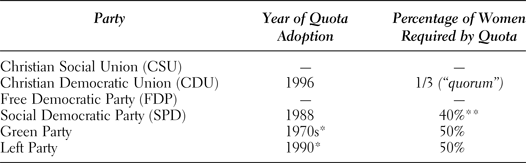
The lessons from the case of contemporary German legislative politics are numerous. Debates over gender equality that persist in Germany are inflected by the argument that much has already been accomplished in the sense that women's aggregate rates of educational attainment and their presence in political office are globally relatively high. However, complacency has dangerous implications for less advantaged women who do not share increased access to social and political influence. These are women for whom Germany's persistently high gender-wage gap, for example, is especially a hindrance to social mobility. Thus, the German case serves as a useful illustration of the direction of debate for countries where advances are mixed. Second, the single case study facilitates advantages in research design. It theoretically grounds concepts such as generations that are difficult to measure and test statistically due to their collinearity with key competing explanations (Glenn Reference Glenn2005; Kertzer Reference Kertzer1983; Mason et al. Reference Mason, Mason, Winsborough and Poole1973). Finally, both the generational and gender quota hypotheses presented here are expected to apply elsewhere in the industrialized world. The generations defined by German legal and cultural milestones correlate with the timing of the first, second, and third waves of feminism globally (Ferree Reference Ferree2012; Paxton, Hughes, and Green Reference Paxton, Hughes and Green2006; Squires Reference Squires1999). All but two national parties in the German party system have voluntarily adopted gender quotas over the last 30 years, separating quota adoption from any specific event that might also shape political attitudes and behavior. (See Table 1 for an overview of German quota adoption.)
Parties’ Adoption of Electoral Gender Quotas in Germany

Notes: See Davidson-Schmich Reference Davidson-Schmich2006b.
*The Greens’ first election to the Bundestag was in 1983, and the Left party entered the Bundestag as the Party of Democratic Socialism upon Germany's reunification in 1990; **The SPD gradually increased this percentage from 25% (when the quota was adopted) to 40% (1994 onward). Note that this is a minimum percentage of either gender, not only of women.
The article proceeds as follows. First, it draws upon existing literature to theorize sources of variation in legislators’ engagement in women's substantive representation, focusing on the potential for generational differences to produce variation in Germany. The paper next outlines its empirical strategy for testing whether generational membership matters in Bundestag speech-making in the period of study. Third, it presents and discusses the results of statistical models.
THEORY AND EXPECTATIONS
This section first theorizes women's rights and interests for the purposes of the project; second it reviews the existing literature on women's substantive representation (WSR) to produce a series of alternative hypotheses; and it concludes with a discussion of why generational membership is expected to matter.
Women's Rights and Interests
As noted, what is “best” for women is not agreed upon even among women.Footnote 4 Better political representation for women can in one sense then be understood as more diverse representation, as argued by Celis (Reference Celis2006) and Celis and Childs (Reference Celis and Childs2012). Writing about substantive and symbolic effects of women's descriptive representation, Mansbridge (Reference Mansbridge1999) argues for the inadequacy of merely “token” presence of women in elected office because a small number of female officeholders cannot capture the breadth of female constituents’ needs and preferences, nor the breadth of what women believe themselves to have moral claims to (i.e., the range of rights that women make claims to).Footnote 5
In order to examine variation in legislators’ advocacy for women's rights and interests, this study disaggregates rights into categories mirroring T.H. Marshall's conceptualization in the classic essay “Citizenship and Social Class” (Reference Marshall, Marshall and Bottomore1950). Marshall breaks citizenship into three categories: civil rights, political rights, and social rights. He argues that the development of these rights is necessarily sequential, and although feminist scholars have largely debunked this (because for women these rights are historically often achieved “out of sequence”), it remains the case that advances in rights arise incrementally and within specific contexts.Footnote 6 Building from Marshall, this study observes plenary speakers’ claims to three distinct areas of women's rights in explaining their positions on legislation: political rights (women having actionable rights as citizens; among other rights, this includes suffrage and, a more contemporary concern, women's access to opportunities to run for office), economic rights (women having actionable rights as employees, in the labor force, etc.; this includes the right to financial independence), and family-related rights (this corresponds to what is often called the private sphere and includes women's roles as mothers and family members). Rights categories are not measured as mutually exclusive in the study, which means that a single argument might be coded as referring to more than one category at once. Thus, this approach does not force a measurement of which right a speaker refers to more than another in any given argument.
Disaggregating women's rights is important for numerous reasons. First, it permits distinguishing among different conceptions of women's rights. Second, studies using narrowly feminist definitions of women's rights “see” only left-oriented parties’ advocacy for women, while right-oriented parties may also advocate for women, but differently. Finally, previous research on parties shows variation across parties in these areas (Skeije Reference Skeije1991; Xydias Reference Xydias2013).
Explanations for Variation in WSR
Much of the existing literature on individuals’ engagement in WSR identifies sex and party affiliation as the main explanations for variation. In the aggregate, women will be more active on women's issues than men, and left-leaning parties and their members will be more active on women's issues than right-oriented parties and their members (Chattopadhyay and Duflo Reference Chattopadhyay and Duflo2004; Childs and Withey Reference Childs and Withey2004; Swers Reference Swers2002; Thomas Reference Thomas1994). This expectation applies to representational activities ranging from bill sponsorship and voting patterns to female legislators’ articulation of women's interests by appealing to their own personal experiences (Celis Reference Celis2006; Piscopo Reference Piscopo2011). Proposed mechanisms vary but generally draw a link between women's direct experiences with gendered inequalities and a heightened sense of urgency surrounding advocacy for women's rights.
H1: Female legislators are more likely to participate in debates on women's issues than their male counterparts.
H2: As speakers, female legislators are more likely to incorporate claims to women's rights (in all three areas) into their arguments than their male counterparts.
As noted above, there is also reason to expect that political parties will vary in the issues they are active on. Writing about Germany, Wiliarty (Reference Wiliarty2010) shows that the rise of the Women's Union in the Christian Democratic Union (CDU) has increased the center-right party's attention to women's issue areas, with a focus on family. This rise of the CDU's Women's Union in the 1980s and 1990s corresponds with broader changes in Germany's economic development and social infrastructure. Responding to these same changes, the liberal Free Democratic Party (FDP) explicitly notes the need for both women and men in the labor force in its arguments regarding workplace flexibility and family policy.Footnote 7
This variation in issue attention across the ideological spectrum obtains in other national contexts as well. In the Argentine context, for example, Piscopo (Reference Piscopo2011) shows that women across parties participated in women's sexual health debates, but distinct conservative frames emerged with a focus on women's roles as mothers even when conservative women supported contraception. Thus, while overall attention to women's issues may well concentrate on the left, focusing on this placement misses other important sources of variation in the issues that get attention (Celis and Childs Reference Celis and Childs2012; Childs and Webb Reference Childs and Webb2012; Schreiber Reference Schreiber2008).
H3: All other things being equal, left-leaning legislators are more likely to participate in debates on women's issues than speakers from right-leaning parties (i.e., left-leaning legislators engage in WSR more overall).
H4: All other things being equal, right-leaning speakers are more likely to incorporate claims to women's family-related rights into their arguments than speakers from left-leaning parties (i.e., right-leaning legislators pay disproportionately more attention to the family).
H5: All other things being equal, left-leaning speakers are more likely to incorporate claims to women's political and economic rights into their arguments than speakers from right-leaning parties.
Emerging research on women and politics points to the potential for electoral institutions, in particular gender quotas, to produce substantive changes in policymaking for women (Franceschet, Krook, and Piscopo Reference Franceschet, Krook and Piscopo2012; Kittilson Reference Kittilson2005; Krook Reference Krook2009). This research is divided in the mechanisms that it proposes for substantive quota effects. Some studies focus on gender quotas’ potential to elect more women as central to improving WSR. Gender quotas that are effectively implemented are shown to increase women's presence in office, and this might promote WSR due to female legislators’ greater attention to women's issues than male counterparts (Davidson-Schmich Reference Davidson-Schmich2006b; Murray Reference Murray2010; Schwindt-Bayer Reference Schwindt-Bayer2009). Other studies argue that quota adoption signals the higher prioritization of women's rights by political parties. Though there is less research on this, quotas may also relate to the attitudes and behaviors of male candidates and male officeholders (Besley et al. Reference Besley, Folke, Persson and Rickne2013).
Since this article focuses on vehicles of policy change in the form of cohorts, this section presents the expectation that legislators’ membership in a quota cohort (i.e., their early socialization into candidate selection procedures) shapes their awareness of gendered inequalities and consequently their engagement in WSR. Legislators who first enter the Bundestag as members of a party with a gender quota are theorized to be more aware of gendered inequalities. Regardless of whether parties with quotas talk explicitly about gendered inequalities, though they may also do this, their candidate selection processes implicitly address gender and power.
The expectation that candidate selection processes that include quotas socialize legislators into awareness of gendered inequalities does not assume that legislators like the quota. Research on attitudes towards quotas shows variation even within parties that have implemented them (Dubrow Reference Dubrow2011). In parties in which quotas are hotly contested, such as in Germany's Christian Democratic Union, this contestation serves to draw attention to questions of fairness and equality (Davidson-Schmich Reference Davidson-Schmich2006b; Wiliarty Reference Wiliarty2010).
This quota cohort expectation therefore differentiates among legislators in two ways. Within any given party that has a quota in the period of study (1998–2009), it distinguishes between legislators who first entered the legislature prior to quota implementation and legislators (in the same party) who first entered after implementation. It also distinguishes between legislators who first entered the legislature after their parties implemented a quota and legislators whose parties have never implemented a quota. These expectations would play out differently in systems where quotas have been constitutionally mandated or legislated for all parties, because in those systems parties’ prequota and postquota periods are not staggered chronologically.
H6: Legislators first elected into the Bundestag as members of a party with a gender quota are more likely to participate in women's issue debates than legislators first elected as members of a party without a quota.
Because the goals motivating the implementation of gender quotas focus on women's presence and equality in public life, it is theorized that quotas’ substantive effects will principally enhance attention to the areas of women's political and economic rights. The right to hold office fits squarely in the category of political rights, and arguments in favor of gender quotas emphasize quotas as key to justice in the public sphere, including the labor market. Proponents of gender quotas, such as the United Nations Entity for Gender Equality and the Empowerment of Women, typically justify the need for quotas in terms of women's right to participate in public decision making.Footnote 8 Although women's family-related rights certainly intersect with women's rights in public life, quotas are explicitly motivated by goals of inclusion.
H7: Speakers first elected into the Bundestag as members of a party with a gender quota are more likely to integrate claims to women's political and economic rights into their arguments than legislators first elected as members of a party without a quota.
Six political parties have regularly held seats in the Bundestag since German reunification in 1990. They are introduced here from left to right. The Left Party (democratic socialist) has undergone several transformations since German reunification, but it has always included a 50% quota for candidate lists in its party rules (1990).Footnote 9 The Greens (post-materialist) have implemented a 50% quota since the party's origins in the 1970s. In 1988 the Social Democratic Party (catch-all, center-left) implemented a 25% quota, which has since increased to 40%. The Free Democratic Party (liberal, oriented toward free-market principles) has not implemented a quota. The Christian Democratic Party (catch-all, center-right) implemented a 1/3 “quorum” in 1996. Finally, the Christian Social Union (more socially conservative than its sister party, the CDU; the CSU functions only within the German state of Bavaria) has not implemented a quota. Although these quotas vary in their requirements, they all implement positive discrimination to increase women's presence in the Bundestag. (See Table 1.)
In addition to addressing an institutional explanation of variation in WSR, Hypotheses 6 and 7 are also important because they offer a key alternative cohort category to which legislators may belong that is not a perfect function of age: both generational membership and quota “cohort” may be included in the same statistical model without collinearity problems. Further, to some extent it is difficult to talk about generations of legislators without talking about gender quotas. Quota adoption has defined the entrance of many women, in particular, into German national politics over the last 30 years. Parties’ adoption of quotas intersects with changing attitudes toward women in public roles as well as the evolution of the German labor market, in which women increasingly participate. In the case of the CDU, the adoption of a quorum in the mid-1990s very clearly marks a turn in the party's evolution (Wiliarty Reference Wiliarty2010). In sum, both generations and gender quotas are about change over time.
Generational Membership
In this study, generations refer to cohorts of legislators of the same age group whose attitudes were shaped at similar points in the trajectory of women's rights in Germany. Glenn defines a cohort as consisting of people “who experienced a particular event during a specified period of time” (2005, 2). Sociologists agree that events and influences that are particularly relevant to defining cohorts are usually experienced between the ages of 15 and 30, and these events are said to shape political attitudes and behavior.
In his seminal essay on generations, Karl Mannheim ([Reference Mannheim1952] 1997) emphasizes that generational change is a highly contingent process; not all members of a given generation will have identical perspectives even on shared events. However, groups have the potential to identify their shared generational membership and thereby share attitudes and goals (such as second-wave feminism). Research on the case of Germany, for example, argues that political generations alternate between traditionalism and radicalism in a historically contingent process (Lücke Reference Lücke2013.)Footnote 10 Recent work in political psychology shows evidence of younger white Americans having been socialized during Barack Obama's presidential campaign and election into more liberal racial attitudes (Nteta and Greenlee 2013). A study of feminist attitudes in Australia argues that younger women are more reluctant to identify with feminism because they perceive less urgency in questions of gender equity (Stevenson, Everingham, and Robinson Reference Stevenson, Everingham and Robinson2011).
In contrast to generations, life-cycle differences would emerge as any given cohort of legislators aged, such that older legislators would consistently exhibit similar attitudes in the aggregate. Period-related differences are when people change in response to the changing social-cultural-political context and would distinguish the attitudes of legislators in a given period (e.g., members of the 12th legislative period [Bundestag, 1990–1994]) would be different in the aggregate from the members of the 16th legislative period (2005–2009) (Glenn Reference Glenn2005; Kertzer Reference Kertzer1983; Mason et al. Reference Mason, Mason, Winsborough and Poole1973).
Scholarship on German generations and their consequences for political attitudes and behavior has tended to focus on the Holocaust and acceptance or rejection of national guilt (Cohen-Pfister and Vees-Gulani Reference Cohen-Pfister and Vees-Gulani2010). Central to this historical account is the generation known as the 1968ers (born in the years from 1936 to 1956), described by scholars and in popular culture as the German protest generation. In the aggregate identifiable as activist and antiestablishment (orientations that accompany second-wave feminism), 1968ers comprise the first postwar generation, and their protests targeted policies regarding privacy, rights to assemble, and the Vietnam War (Klimke and Scharloth Reference Klimke and Scharloth2007). Writing about women in particular, Gerhard (Reference Gerhard1999) describes female 1968ers as a cohort whose feminist identity was forged in the student movement when questions of sexuality became politicized (1999, 185; see also Ferree Reference Ferree2012). While 1968ers are expected to be “more” feminist than later generations, their feminism is also distinctive because in the aggregate they manifest a sense of urgency about structural and systemic sources of oppression that later generations do not share. Like every era, 1968er feminism is not monolithic. However, it is better characterized by the feminist magazine EMMA (1977), whose very name is a play on the word emancipation, than by contemporary writing, such as Jana Hensel and Elisabeth Raether's Reference Hensel and Raether2008 memoir Neue deutsche Mädchen (New German Girls), which argues that the second wave's focus on patriarchy and its critique of heterosexuality are now irrelevant.
The 1968er generation was raised in the context of post-war natalist policies, designed to restore the German population and economy (Moeller Reference Moeller1993). These policies preserved substantial restrictions on the rights of married women that dated back to the German Civil Code, originally enacted in 1900, despite the fact that they contradicted the equality-of-the-sexes clause in the Federal German Republic's new constitution. For example, according to the Code women required their husbands’ permission to work outside the home. These restrictions were dismantled only incrementally in the post-war period, and the timing of their dismantling further substantiates a theorization of generational groups based upon the 1968ers. The 1900 Civil Code was dismantled in three main stages: formal instantiation of equal rights for women and men in the Basic Law (1949), the Equal Rights Act (1957/8), and the Marriage and Family Law Reform Act (1976/7) (Gerhard Reference Gerhard1990 and Meyer Reference Meyer2003). These acts were not all equal in their effects, and many scholars have argued that the 1957/8 reform was largely ineffective (Gerhard Reference Gerhard1990; Kolinsky Reference Kolinsky1995, 28–31). Although the act declared that spouses owned property jointly and that women were no longer required to garner their husband's permission in order to work outside the home, the 1958 Civil Code nonetheless continued to encourage family arrangements in which the woman did not work outside the home. As of 1958, §1356 still read, “The woman runs the household in her own responsibility. She is entitled to take on paid employment” but only “as far as this can be combined with her duties in marriage and family” (Kolinsky Reference Kolinsky1993, 49).
In light of these limitations, the Marriage and Family Law Reform Act is recognized as reflecting the most meaningful changes, with the most significant impact on women's lives (Gerhard Reference Gerhard1990). This act was part of a slew of modernizing legislation in the 1970s, which some historians credit to the protest activities of the 1968ers (Schiller Reference Schiller2003). Women born in the latter part of this first postwar generation were also the first clear beneficiaries of the Reform Act, which legally explicitly recognized both spouses as equals, such that fathers would not automatically win custody of their children in case of divorce, and amended §1356 and §1360 of the Civil Code. As of the 1976/7 reform, these sections of the Code were no longer sex specific. Like any reform to marriage and family law, this Act profoundly changed both women and men's experiences of basic social institutions.
Given the significance of the 1976/7 Act, which coincides with the 1968ers’ timeframe, this study separates the pool of legislators—whose birth years range from 1928 to 1983—into two generations: 1968ers (born 1928–1956) and post-1968ers (1957–1983). Although existing literature defines 1968ers as born in the years from 1936 to 1956, seven legislators in the Bundestag in the period of study were born before 1936 and have been included with the 1968ers group. Due to the small N, a “pre-1968er” group could not be included in the statistical analysis as a separate generation.Footnote 11 A finer-grained theorization of generations might further enhance our understanding of how they shape WSR, but this spare version also highlights their importance and is supported by sociological work on German women's movements (Ferree Reference Ferree2012; Gerhard Reference Gerhard1990 and Reference Gerhard1999).
Based upon these legal and historical grounds, legislators are theorized to vary by generation in their emphasis on women's rights in explaining their positions on legislation. This expectation follows from legislators’ experience of debates over women's rights as well as their direct experience with gendered institutions. Women in particular with experiences in earlier stages of the progression of women's rights are expected to be more keenly aware of these advances, and they are likely to view gendered questions with greater urgency. By contrast, younger female and male legislators have been socialized in debates that emphasize a multitude of choices are available for women, with a corresponding lower level of urgency. Because some of the advances in women's rights in Germany explicitly fused women's political, economic, and family-related rights—such as the Marriage and Family Law Reform Act—generational membership is expected to matter across all areas of rights.
H8: Legislators who are 1968ers are more likely to participate in debates on women's issues than post-1968ers.
H9: Legislators who are 1968ers are more likely to incorporate claims to women's rights (in all three areas) into their arguments.
EMPIRICAL APPROACH
This study tests its hypotheses using a pooled dataset of the 1,064 members of the Bundestag in the 14th–16th legislative terms (1998–2009), merged with an original content analysis of speeches delivered in plenary session debates addressing legislation on women and women's issues in this same period. Thus, like previous studies of this kind, the selected debates addressed legislation on “women's issues” on the basis that participation in debates on these issues is an important component of WSR and that, if anywhere, this is where legislators will make claims about women's rights.
The GESTA (Germany's catalog of federal legislation) includes a paragraph-long description of each piece of proposed legislation. This catalog was searched for bills whose entries in the period of study (1998–2009) included the truncated terms Geschlecht- (gender), Frau- (woman), Diskriminier- (discrimin-), or Gleichberecht- (equal treatment). This produced a dataset of 24 proposed bills composed of 43 debates, including 416 speeches. (See Appendix A for a list of legislation.) In order to assess whether any relevant bills had been omitted, 100 were randomly selected from the 14th legislative period. These amount to 10% of the bills debated in this period (1998–2002). All relevant bills had been captured by the original method of selection.
Appendix A shows that a variety of issues is represented in the legislation that the Bundestag debated in the period of study. Of the 24 bills, two address abortion access; three involve family policy; three address protection of women against sexual assault and harassment; four address antidiscrimination policies; and so on. This variety is important because a sample of bills clustered around one issue area would constrain what types of rights speakers had occasion to talk about. If all of the women's issues bills in this period were about parents reconciling careers and family, for example, then we might expect fewer references to women's political rights.
The study's unit of analysis is the legislator, producing models of variation in individual legislators’ engagement in WSR. In the first set of models, WSR is measured as participation in debates on women's issues. The second set of models is restricted to legislators who spoke in these debates, operationalizing WSR as the number of speeches in which each speaker made claims to women's rights in explaining their position on the legislation at hand.Footnote 12 As discussed previously, women's rights are disaggregated into three areas (political, economic, and family-related rights) in order not to obscure important variation. These rights categories were not mutually exclusive for the purposes of coding (e.g., a speech might include claims to both economic and family-related rights). As the statistical analysis models legislators’ claims to each category of rights separately (one model for political rights, one for economic rights, and one for family-related rights), this approach cannot explain when and why speakers paired rights together in their reasoning, but it does obviate the need to decide “between” coding categories.
Several examples from plenary transcripts illustrate coding decision rules. For instance, in a March 8, 2001, debate on legislation pertaining to protecting people (primarily women) from domestic violence, parliamentarian Ronald Pofalla (male, CDU) did not refer to women once in his speech. This was coded as a zero for all three categories of women's interests. In the same debate, Petra Bläss (female, Left) opened her speech with the following:
The many protests taking place in Germany today make clear that, even on the 90th International Women's Day, the fight to institutionalize women's rights has not yet lost its relevance—and the demands of the old women's movement even less so; and so once again we revisit combatting every form of violence against women.
The rest of Bläss's speech followed in kind, and it was coded as making a claim to women's political rights.Footnote 13
Some speakers made claims to multiple categories in a single speech. In a September 29, 2006, debate on the topic of Elterngeld (financial support to parents while they take time off work to look after infants), parliamentarian Caren Marks (female, SPD) observed, “Elterngeld will give the caregiver—usually the mother—important economic independence in her partnership [or marriage].” Later in the same speech, Marks stated,
This [Elterngeld] replacement of income will also achieve greater flexibility in parental roles. There will be a real alternative to the traditional distribution of roles. Elterngeld is an important instrument for greater equality that will also be good for children; children need both their father and mother.
This speech was coded as making claims to both economic and family-related rights.
The coding of debates over legislation on abortion further illustrates the coding scheme's emphasis on whether speakers’ argumentation draws attention to women's rights and not merely to women.Footnote 14 In a November 8, 2000, debate on the availability of medical abortion, for example, parliamentarian Hildegard Wester (female, SPD) stated, “[W]omen who have decided to have an abortion must reserve choice in how to proceed and furthermore must be able to choose this method [medical abortion].” Wester's argument identified women as the agents in control of any decision regarding abortion, and she referred repeatedly to women's choice. This speech was coded as making claims to women's political rights. In the same debate, parliamentarian Anke Eymer (female, CDU) emphasized the danger of psychological trauma to women who have an abortion, arguing that medical abortion in particular requires extensive counseling beforehand. Although Eymer referred repeatedly to women, this speech was not coded as making any rights claims.
Some measure of intercoder reliability is necessary for establishing the validity of any findings (Neuendorf Reference Neuendorf2002). Towards this end, a second coder assisted in developing the coding scheme from a subset of debates and then double-coded a second (separate) subset of debates. This iterative process amounts to what Neuendorf calls a “reliability check” (Reference Neuendorf2002, 142).Footnote 15
Because some speakers were more likely to speak on multiple occasions and therefore had more opportunities to make rights claims, both sets of statistical models presented below control for the key procedural determinant of speaking in the Bundestag: membership in the most pertinent standing legislative committee. For this subset of legislation, this is the Committee on Family, Seniors, Women, and Children. In personal interviews with the author, members of the Bundestag attest to the opportunity to state their committee preferences at the beginning of each legislative term, and appointments are ultimately determined for legislators by their respective party groups on the basis of these preferences. These interviewees argued that committee membership signals a legislator's substantive interests and, when appropriate, professional background. Despite this, the literature generally categorizes family- and women-related committees as lower status such that legislators are expected to move upward into higher-status committees as their careers progress (Heath, Schwindt-Bayer, and Taylor-Robinson Reference Heath, Schwindt-Bayer and Taylor-Robinson2005).
RESULTS
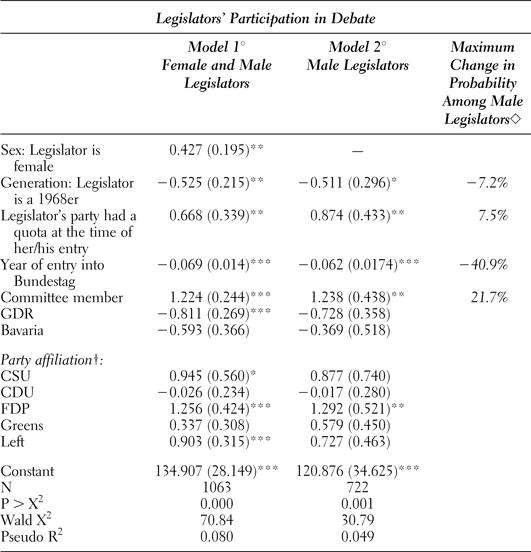
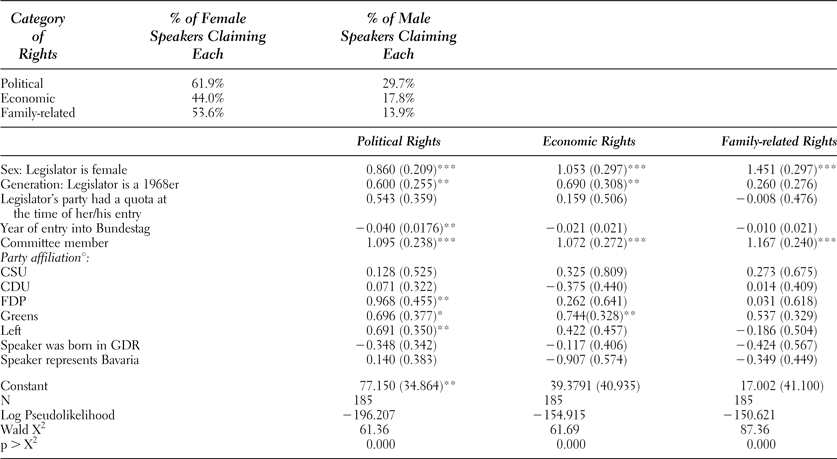
Tables 2 and 3 present the results of statistical analyses. Both sets of models include the following independent variables addressed in previous sections: the legislator's sex, whether he or she is a 1968er, whether his or her party had a quota at the time of first election into the Bundestag, the year in which he or she first entered (this variable accounts for both professional seniority and the duration of the legislator's service in the Bundestag), and whether he or she is a member of the Family Committee. These models also include controls for having been raised in the former German Democratic Republic because the generations presented (above) are not expected to apply to legislators from the GDR as well as controls for representing a Bavarian constituency because Bavaria is markedly more socially conservative.Footnote 16, Footnote 17
Logistic Regression Models of Whether Legislators Participated in Bundestag Plenary Session Debates on Women's Issues Legislation (1998–2009)
Notes: Entries are unstandardized coefficients from a logistic regression model with robust standard errors.
°Link tests and Hosmer-Lemeshow tests show these models fit the data well (Model 1: p > X2 = 0.274; Model 2: p > X2 = 0.1754).
***p < .01; **p < 0.05; *p < .10.
◊Predicted changes in probability of participating are based upon Model 2. Probabilities shown in the table were calculated for men in the SPD, setting all continuous independent variables not under consideration at their means and dummy variables at their modes. The changes in probability reflect the independent effects of each variable of interest on the dependent variable, varying it from its minimum to its maximum. The earliest year of entry for a male legislator was 1967, and the latest year of entry was 2009.
†SPD membership is the comparison category for these party affiliation dummy variables.
Negative Binomial Regression Models of Claims to Women's Rights in the Bundestag: Debates about Women's Issues Legislation (1998–2009)
Notes: Entries are negative binomial regression coefficients with robust standard errors. ***p < .01; **p < 0.05; *p < .10. °SPD membership is the comparison category for these party affiliation dummy variables.
Table 2 presents a logistic regression model of whether each legislator in the Bundestag 1998–2009 participated in at least one debate on legislation relating to women and gender. Of the 1,064 legislators, 185 participated. These speakers comprised 14.0% of male legislators (101 speakers) and 24.6% of female legislators (84 speakers). Table 3 presents negative binomial regression models of claims to women's political, economic, and family-related rights, respectively. These are basic negative binomial models because the dependent variable is a count. Likelihood-ratio tests for alpha show that this is preferable to a Poisson model due to the data's level of dispersion. Vuong tests show that speeches that do make claims to women's rights are not so rare as to require a zero-inflated model (Cameron and Trivedi Reference Cameron and Trivedi1998; Long Reference Long1997).
In all models in Tables 2 and 3, membership in the Family Committee is a statistically significant covariate of greater rates of WSR. This salience of committee membership reflects plenary practices for constructing speaker lists. Members of committees that worked on a given law are procedurally the main pool of speakers. Accounting for this key procedural factor, Hypotheses 1 and 2 stated that female legislators would be more likely to engage in WSR than their male counterparts. These statistical models support this expectation. All other things being equal, female legislators are more likely to participate in debates on women's issues than their male counterparts. Female speakers are also more likely to make claims about all three categories of women's rights. Indeed, Table 3 shows that 61.9% of female speakers made claims about the importance of women's political rights (as compared to 29.7% of male speakers), 44% of female speakers made claims about women's economic rights (as compared to 17.8%), and 53.6% of female speakers made claims about women's family-related rights (as compared to 13.9%). Models in Table 3 demonstrate that these stark differences are statistically significant, controlling for a range of other variables.
Hypotheses 3–5 formulated expectations regarding legislators’ party affiliation. Hypothesis 3 stated that, all other things being equal, left-leaning legislators would be more likely to participate in debates on women's issues than members of right-leaning parties. The logistic regression of whether legislators participated in debates on women's issues (Table 2) does not support this expectation. In this participation model, the SPD (large center-left party) is the comparison category for the other party dummy variables. The model shows that membership in the CSU, the FDP, and the Left party all correspond with a greater likelihood of participation than membership in the SPD. Contrary to expectations, the CSU and the FDP are both considered more right-leaning than the SPD. There are several possible explanations for this finding. The CSU, FDP, and Left parties do not share much in common except for their relatively small size, meaning that it may be the case that these parties are overrepresented on the Family Committee, the key procedural factor behind participation. Similarly, the fact that each party group has the opportunity to speak in each debate may overrepresent these smaller parties on speaker lists. In political systems with different procedures for speaker selection, party affiliation might well more closely conform with the literature's expectations.
Hypothesis 4 stated that, all other things being equal, right-leaning speakers were more likely to incorporate claims to women's family-related rights into their arguments than their left-leaning counterparts. The negative binomial regression in Table 3 shows no support for this expectation. Instead, party effects seem eclipsed by the finding that female legislators and members of the Family Committee are consistently more likely to make claims about family-related rights. This result may reflect the salience of balancing work and family in contemporary German gender debates. As the website of the Family Committee states, “One of our areas of emphasis is supporting children and family as well as the balance of family life and careers.” This issue of balance cuts across age groups and parties and is highly publicized as unresolved.
Hypothesis 5 stated that left-leaning speakers were more likely to incorporate claims to women's political and economic rights than their right-leaning counterparts. This expectation finds some support in Table 3. As in all of the models, the SPD (large center-left party) is the comparison category for the other party dummy variables. Here, membership in the Greens and in the Left party corresponds with greater rates of political rights claims. Both parties are considered left of the SPD. In the negative binomial regression model of economic rights claims, Green party membership corresponds with greater rates. In order to test whether these effects only obtained in comparison to the SPD, separate negative binomial regression models were run that replace the series of party dummy variables with a single party variable in which parties are ordered from right to left (not shown). The covariates for this continuous party variable are positive and statistically significant for both political rights claims and economic rights claims.
Hypotheses 6 and 7 address the question of gender quotas. Hypothesis 6 stated that legislators who were first elected into the Bundestag as members of a party with a gender quota were more likely to participate in women's issue debates than their counterparts who first entered the Bundestag in a nonquota context. The first logistic regression model in Table 2 shows support for this hypothesis. All other things being equal, entrance into the Bundestag in a quota context shows signs of socializing legislators into engagement in this form of WSR.
However, this quota effect is more complicated than it first appears. A second logistic regression model in Table 2 focuses on the factors behind male legislators’ participation in debates. This model shows that being elected in the context of a gender quota promotes male legislators’ engagement in this form of WSR. A separate model of the participation of female legislators shows no statistically significant effect for quotas (not shown). In other words, it is possible that a gender quota socializes male legislators but not their female colleagues, who were arguably more likely to engage in WSR in the first place. This result warrants drawing a cautious connection with research showing, for example, that U.S. male politicians who have daughters vote more progressively than their counterparts without daughters (Washington Reference Washington2008). While much previous research on gender quotas’ substantive effects has focused on the election of women, quotas may have the potential to shape male legislators’ WSR activities as well.
Hypothesis 7 stated that speakers who were first elected into the Bundestag as members of a party with a gender quota were more likely to integrate claims to women's political and economic rights into their arguments than legislators first elected prior to (or without) a quota. The models in Table 3 show no support for this hypothesis. Separate models of male and female speakers’ rights claims, respectively, also show no statistically significant effects of quotas (not shown). Nonetheless, it was important to control for this variable both to maintain consistency with Table 2 as well as to identify whether quota cohort membership alters the effects of generational membership, to which this discussion turns next.
Hypothesis 8 stated that 1968ers were more likely than post-1968ers to participate in debates on women's issues. Table 2 shows that generational membership is a statistically significant covariate of likelihood of participation; however, the direction of this relationship is negative, such that 1968ers are in fact less likely than their younger counterparts to speak in these debates. One possible explanation for this finding lies in the correspondence between membership on the Family Committee and greater rates of WSR. It was discussed earlier how “soft” legislative committees are often considered less prestigious (Heath, Schwindt-Bayer, and Taylor-Robinson Reference Heath, Schwindt-Bayer and Taylor-Robinson2005). Thus, it is likely that more senior legislators have advanced to more prestigious committees. T-tests show that Family Committee members are statistically significantly less likely to be 1968ers than their non-committee member counterparts, and committee members entered the Bundestag two years later on average than their nonmember counterparts.Footnote 18 All other things being equal, however, legislators who have served in the Bundestag longer are more likely to participate in these debates. These findings point to a possible selection effect that these models do not capture.
Hypothesis 9 stated that 1968ers were more likely to incorporate claims to women's rights (in all three areas) into their arguments than post-1968ers. Table 3 shows partial support for this expectation. 1968er generational membership promotes rates of claims to women's political and economic rights but not family-related rights. All other things being equal, 1968ers are more likely than their younger counterparts to make claims about women's political and economic rights in debates on women's issues (i.e., this effect holds among women and men as well as across parties) whether legislators are members of the Family Committee, etc.
CONCLUSIONS
This article aimed to establish whether two types of cohorts to which legislators belong—generations and “quota cohorts”—play a role in shaping individuals’ engagement in WSR, measured as (1) legislators’ participation in plenary debates on women's issues and (2) speakers’ claims to women's rights in debate. Principal findings highlight the importance of procedural constraints on legislators’ opportunities to engage in WSR, and results corroborate previous studies of WSR in showing that female legislators are more likely to engage in WSR than their male counterparts. However, results regarding the roles of party affiliation, generational membership, and gender quotas are mixed and point toward future research.
In the Bundestag, participation in plenary debates on women's issues does not appear to be structured by left-right ideological differences. Instead, members of smaller parties (the CSU, FDP, and Left) stand out as more likely to participate. As noted, this may be an artifact of the rules for constructing speaker lists. In terms of whether speakers make claims to women's rights, left-leaning party members emphasize women's political and economic rights at greater rates than their right-leaning counterparts, while speakers across the party spectrum are equally likely to make claims to women's family-related rights.
Gender quotas play a limited role in shaping WSR as measured in this study, but one result merits further elaboration. Entrance into the Bundestag as a member of a party with a quota seems to promote male but not female legislators’ participation in women's issues debates. Participation in debates is just one of many forms of WSR, but this finding suggests quotas’ potential to shape male legislators’ representational activities. This should encourage future studies to focus more closely on establishing whether gender quotas foster attention to women's rights among men in a way that the literature cannot yet account for.
Finally, results regarding generational membership are mixed. In this study, post-1968ers are more likely than their 1968er counterparts to participate in debates on women's issues. As discussed, this may well relate to patterns in committee membership, because professional seniority allows legislators to move to more prestigious appointments. This effect is likely to obtain in any legislative setting, such that the influence of cohorts on WSR will be refracted through professional advancement. In terms of advocacy for women, generational membership appears to play its theorized role in shaping attention to women's political and economic rights: 1968ers are more likely to make claims about these rights than their younger counterparts.
Of the three categories, only rates of claims to women's family-related rights are unaffected by generational membership. This suggests that generational replacement of 1968ers in the Bundestag may reduce attention to women's political and economic rights without reducing attention to family issues. Similarly, quota cohort and party affiliation have no effect on rates of advocacy for family-related rights. Although a shared focus across cohorts and parties on the family is not antifeminist per se, it will not shift the status quo for disadvantaged women who need the state to address socioeconomic sources of powerlessness.
In sum, these findings point in three main directions for further inquiry. Studies do not typically investigate how legislative rules and procedures constrain engagement in WSR, and this study's findings suggest that they should. Second, there is some evidence that a party's implementation of a gender quota signals an increase in male legislators’ advocacy for women, but there is no corresponding effect for women. Further research can illuminate the dynamics of this effect. Finally, this study's measures of WSR are just a subset of possible representational activities. This analysis should encourage greater attention to the consequences of generational and quota cohort membership for women's advocacy in other areas and venues.
APPENDIX A
Bills Included in the Study
These are the 24 pieces of proposed legislation whose entries in the Stand der Gesetzgebung des Bundes (GESTA, federal registry of legislation, available online at http://www.bundestag.de/dokumente/standgesetzgebung/) referred to women and/or to gender in this period. The following truncated terms were used as search terms: Diskrimin*, Geschlecht*, Frau*, and Gleichberecht. The GESTA code for each law is noted in parentheses.° Per Bundestag procedure, each of these bills is formally presented in the plenary three times, where the third time typically consists of a vote (i.e., two substantive debates are typically undertaken on each law) (Ismayr Reference Ismayr2001).
14th Legislative Period (1998–2002)
Gewaltschutzgesetz (C129): Protection Against Violence
Soldatengesetz (H003): Soldiers
Schwangerschaftsabbruch (M030): Abortion
Aufstiegsfortbildungsförderungsgesetz (K009): Training Support for Career Advancement
Prostitution (I010): Prostitution
Teilzeit- und Befristungsgesetz (G055): Part-time and Temporary Work
Altersvermögensgesetz (G059 & G061): Care for Senior Citizens
Seuchenrechtsneuordnungsgesetz (M020): Communicable Diseases Reform
Grundgesetz - Frauen in Bundeswehr (C069): Basic Law–Women in the Armed Forces
Anti-D-Hilfegesetz (M024): Hepatitis-D Treatment
Gleichstellungsdurchsetzungsgesetz (I011): Implementing Equal Treatment
15th Legislative Period (2002–2005)
Zuwanderungsgesetz (B003): Immigration
Sexualstraftat (C004 & C019): Punishment for Sexual Assault
Nachhaltigkeitsgesetz (G033 & G034): Sustainability
Soldatinnen- und Soldatengleichstellungsdurchsetzungsgesetz (H005): Implementing Equal Treatment for Female and Male Soldiers
Antidiskriminierungsgesetz (I012): Anti-discrimination
16th Legislative Period (2005–2009)
Kindergeld (I001): Support for Children
Unterhaltsvorschussgesetz (I002): Child Support Payments
Elterngeld (I003 & I004): Support for Parents
Stalking/Opferschutz (C136): Protection For Victims of Stalking
Schwangerschaftskonfliktgesetz (I019): Resolving Inconsistencies in Abortion Law
Bundesverfassungsgerichter (C162): Appointment of Justices to the Constitutional Court
Antidiskriminierungsgesetz (C022): Anti-discrimination
Gleichbehandlungsgesetz (C064): Equal Treatment
Versicherungsaufsichtsgesetz (D026): Insurance Oversight
°Codes for standing legislative committees: