Introduction
A band of sea ice encircles the Antarctic continent, reaching at it greatest seasonal extent hundreds to thousands of kilometres wide depending on the region, and associated with that habitat is a unique fauna. One member, though not a year-round obligate like several species of seabirds and pinnipeds, is the Antarctic minke whale (AMW; Balaenoptera bonaerensis Burmeister), the only baleen whale to be included in this pagophilic fauna (Ribic et al. Reference Ribic, Ainley and Fraser1991 Ainley et al. Reference Ainley, Ballard, Ackley, Blight, Eastman and Emslie2007, Tynan et al. Reference Tynan, Ainley, Stirling, Thomas and Dieckmann2010, Ballard et al. Reference Ballard, Jongsomjit, Veloz and Ainley2012). AMW presence in the pack ice is facilitated by its slim body form, small appendages, thus allowing negotiation of narrow leads among floes, and very sharp rostrum, used to break breathing holes in newly formed sea ice (Tynan et al. Reference Tynan, Ainley, Stirling, Thomas and Dieckmann2010, Friedlaender et al. Reference Friedlaender, Goldbogen, Nowacek, Read, Johnston and Gales2014).
The AMW's foraging ecology has been well studied in the relatively ice-free waters off the Antarctic Peninsula (e.g. Friedlaender et al. Reference Friedlaender, Halpin, Qian, Lawson, Wiebe, Thiele and Read2006, Reference Friedlaender, Lawson and Halpin2009, Reference Friedlaender, Johnston, Fraser, Burns, Halpin and Costa2011, Reference Friedlaender, Goldbogen, Nowacek, Read, Johnston and Gales2014), with less effort being expended on occurrence patterns (Dominello & Sirović Reference Dominello and Sirović2016, Lee et al. Reference Lee, Friedlaender, Oliver and deLiberty2017; though see a large-scale view in Branch Reference Branch2006). On the other hand, in the Ross Sea, its seasonal occurrence patterns and habitat associations have been well studied (Ainley et al. Reference Ainley, Jongsomjit, Ballard, Thiele, Fraser and Tynan2012, Reference Ainley, Lindke, Ballard, Lyver, Jennings and Toniolo2017, Ballard et al. Reference Ballard, Jongsomjit, Veloz and Ainley2012, Murase et al. Reference Murase, Takashihakamada, Matsuoka, Nishiwaki and Naganobu2013) - and to a lesser degree in the waters off East Antarctica (Konishi et al. Reference Konishi, Isoda, Bando, Minamikawa and Kleivane2020) - but its foraging behaviour is not well known, despite investigations on the effects of apparent trophic competition with co-occurring Adélie penguins (ADPEs; Pygoscelis adeliae Hombron & Jacquinot; e.g. Ainley et al. Reference Ainley, Ballard and Dugger2006, Reference Ainley, Dugger, Toniolo and Gaffney2007, Reference Ainley, Ballard, Jones, Jongsomjit, Pierce, Smith and Veloz2015, Saenz et al. Reference Saenz, Ainley, Daly, Ballard, Conlisk, Elrod and Kim2020). In the south-west Ross Sea, AMWs are known to feed principally on crystal krill (Euphausia crystallorophias Holt & Tattersall) and, to a lesser degree, Antarctic silverfish (Pleuragramma antarctica Boulenger; Ichii et al. Reference Ichii, Shinohara, Kujise, Nishiwaki and Matsuoka1998, Lauriano et al. Reference Lauriano, Vacchi, Ainley and Ballard2007, Murase et al. Reference Murase, Takashihakamada, Matsuoka, Nishiwaki and Naganobu2013), the two main prey species for upper-trophic-level predators in the south-west Ross Sea food web (La Mesa et al. Reference La Mesa, Eastman and Vacchi2004, Smith et al. Reference Smith, Ainley and Cattaneo-Vietti2007, Ballard et al. Reference Ballard, Jongsomjit, Veloz and Ainley2012, La Mesa & Eastman Reference La Mesa and Eastman2012). The studies of penguins referenced above indicate that with arrival of AMWs, the penguins' foraging trips increase in duration and they feed more on fish. The question is, why the change?
Herein, we report results of an effort to answer the above question by further investigation of the interspecific competition, especially the degree to which AMWs alter the availability of prey to their competitors. It involved placing satellite tags and time-depth recorders (TDRs) on AMWs foraging in McMurdo Sound, south-west Ross Sea, where the food web related to ice edges is broadly known (reviewed in Smith et al. Reference Smith, Ainley and Cattaneo-Vietti2007, Reference Smith, Ainley, Arrigo and Dinniman2014). Although minimal (three satellite tags, one with a TDR), this has been the only such research effort for AMWs away from the Antarctic Peninsula, where a different preyscape is based on Antarctic krill (Euphausia superba Dana) and where competition with humpback whales (Megaptera novaeangliae Borowski) is prevalent when waters are mostly free of sea ice (Friedlaender et al. Reference Friedlaender, Lawson and Halpin2009). This competition is not an issue in the Ross Sea due to an absence of humpback whales (Ainley Reference Ainley2010). Instead, in the south-west Ross Sea, AMWs compete with ADPEs (Ainley et al. Reference Ainley, Ballard and Dugger2006, Reference Ainley, Ballard, Jones, Jongsomjit, Pierce, Smith and Veloz2015), as well as other predators (Smith et al. Reference Smith, Ainley, Arrigo and Dinniman2014). Off East Antarctica, Konishi et al. (Reference Konishi, Isoda, Bando, Minamikawa and Kleivane2020) investigated AMW movements, but not foraging behaviour.
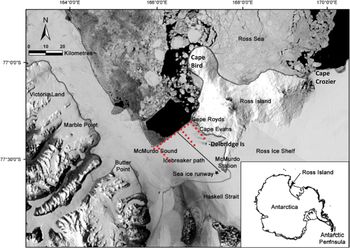
Among various foraging strategies, AMWs exploit openings (e.g. leads and polynyas) within the pack ice (Tynan et al. Reference Tynan, Ainley, Stirling, Thomas and Dieckmann2010, Konishi et al. Reference Konishi, Isoda, Bando, Minamikawa and Kleivane2020). AMWs reach the McMurdo Sound Polynya, Ross Sea, and its marginal ice zone (MIZ) in late December, moving westward in accord with the westward retreat of the Ross Sea Polynya MIZ (Fig. 1); as the MIZ continues to retreat, AMWs increasingly appear in McMurdo Sound through January (Ainley et al. Reference Ainley, Lindke, Ballard, Lyver, Jennings and Toniolo2017).
McMurdo Sound Polynya (centre) and Ross Sea Polynya (upper right). Red dots indicate approximate locations of 2014–15 stations where the SCINI remotely operated vehicle was deployed in holes drilled through the fast ice in order to quantify the preyscape and water column properties.

In the present study, in addition to AMW foraging behaviour (and that of ADPEs), the dynamics of the preyscape were investigated, using an acoustically equipped, remotely operated vehicle (ROV; Saenz et al. Reference Saenz, Ainley, Daly, Ballard, Conlisk, Elrod and Kim2020). The ROV also collected information on other water column properties, such as temperature, salinity, chlorophyll concentration and turbidity. In this ‘natural experiment’, we quantified prey prevalence by depth along the fast-ice edge as it retreated during late spring and summer, and compared the ice edge prey distribution to that under the interior of the fast ice. Prey were accessible to the whales and penguins at the ice edge, but prey under the interior fast ice were beyond the breath-holding capability of the whales, and even more so of the penguins. Our study was a small-scale version of the approach of Brierley et al. (Reference Brierley, Fernandes, Brandon, Armstrong, Millard and McPhail2002; < 10 km vs 30 km either side of ice edge), who also investigated predator–prey dynamics.
Methods
Comparability of data
The initial plan for this project was to investigate predator (penguin, whale, seal) effects on the preyscape (spatial and temporal patterns in abundance of forage species) in McMurdo Sound for two summers (2012–13 and 2013–14). Biologging of whales and penguins occurred during the first year, but data on the preyscape from the ROV were incomplete due to transducer failure on the echosounder. More importantly, we could not conduct research during 2013–14 due to a US government shut down, and hence we received no logistical support. We renewed our efforts in the following summer, 2014–15, when AMW prevalence was assessed, satellite tagging of penguins but not whales was accomplished and a full suite of preyscape data were gathered. Despite the temporal mismatch, the whale foraging data gathered by telemetry in 2012–13 remained relevant to what was observed for the preyscape in 2014–15, for the following reasons: 1) the sea-ice regime was the same in both years (cf. Kim et al. Reference Kim, Saenz, Scanniello, Daly and Ainley2018, results below), 2) the infusion of phytoplankton into the study area followed a well-known annual pattern in both years (cf. Barry & Dayton Reference Barry and Dayton1988, Saenz et al. Reference Saenz, Ainley, Daly, Ballard, Conlisk, Elrod and Kim2020, results below), 3) AMW abundance and prevalence as determined by censuses was the same in both years (cf. Ainley et al. Reference Ainley, Lindke, Ballard, Lyver, Jennings and Toniolo2017, results below), 4) fish-eating killer whales (Orcinus orca L, type C), a potential competitor, showed no difference in abundance/distribution among the years (Ainley et al. Reference Ainley, Lindke, Ballard, Lyver, Jennings and Toniolo2017, Pitman et al. Reference Pitman, Fearnbach and Durban2018), 5) ADPE abundance and foraging behaviour showed no difference in both years (consistent with patterns evident in several previous summers; Ford et al. Reference Ford, Ainley, Lescroël, Lyver, Toniolo and Ballard2015, Saenz et al. Reference Saenz, Ainley, Daly, Ballard, Conlisk, Elrod and Kim2020), and, finally, 6) the seasonal change in penguin diet was the same, upon whale arrival, as in all previous years studied (Ainley et al. Reference Ainley, Ballard and Dugger2006, Reference Ainley, Dugger, La Mesa, Ballard, Barton and Jennings2018; see below).
Whale prevalence and tagging
Owing to the lack of a vessel or aircraft that could fly over water, we were not able to conduct line transects to estimate the absolute abundance of whales in the study area. However, we derived an index (count in limited area) for the number of whales in the MIZ by visual observations conducted by telescope and binocular once or twice per day, weather permitting, from a 30 m-high coastal hill adjacent to where the fast-ice edge typically intersects Ross Island at Cape Royds, as described previously (Ainley et al. Reference Ainley, Ballard and Dugger2006, Reference Ainley, Lindke, Ballard, Lyver, Jennings and Toniolo2017; Fig. 1). We did not conduct sessions during blowing snow or winds > 20 knots. Each observation period lasted for 1 h. We could effectively scan out to ~3 km, including adjacent open or pack ice-covered waters. Observations were made from 20 November 2014 to 26 January 2015, with gaps during 22–26 December, 29 December–9 January and 19–25 January. As sea-truthing, we also flew by helicopter along the fast-ice edge at varying intervals from mid-November to mid-January, weather permitting: 20 November; 2, 8, 22, 23, 27 and 30 December 2014; and 1, 10 and 14 January 2015. A similar observational routine occurred in 2012–13 (shown in Fig. 2).
An index for Antarctic minke whale (AMW) prevalence comparing 2012–13 with 2014–15. The peak number of AMWs per day observed along the fast-ice edge from a hill top at Cape Royds, augmented by occasional helicopter surveys along the fast-ice edge (*) in the eastern McMurdo Sound. Days when hilltop surveys were done but AMWs not seen are not shown, but survey frequency was close to daily.

During 3 and 4 January 2013, one SPLASH satellite transmitting tag (Mk10-a, Wildlife Computers, Redmond, WA; PTT 121383) and two SPOT tags (AM-S240C, Wildlife Computers; PTT 121392, PTT 119498) were deployed on AMW individuals foraging along the McMurdo Sound fast-ice edge. Both types of tags were manufactured in the limited-impact minimally percutaneous (LIMPET) configuration and were deployed on AMW dorsal fins using a crossbow (details in Andrews et al. Reference Andrews, Pitman and Balance2008). While the SPOT tags returned only position information via Argos satellites, the single SPLASH-tagged individual also returned both a TDR feed (75 s intervals; shorter intervals would drain batteries prematurely), as well as a behaviour log recording the maximum depth of dives. To further conserve battery life, tags were duty cycled on for 20 h, followed by off periods of 28 h (PTT 121383) and 100 h (PTT 121392, 119498). Estimated bathymetric depths shown in association with dives were sampled from the Global Multi-Resolution Topography Data Synthesis (v3.0, https://www.gmrt.org/GMRTMapTool) at the estimated locations returned by the Argos service using a Kalman filter algorithm (Lopez et al. Reference Lopez, Malardé, Royer and Gaspar2013).
Quantifying the preyscape
From early December 2014 to mid-January 2015, we assessed the temporal and spatial variability of the preyscape by making three ‘passes’ over a grid of stations in a 10 × 30 km study area encompassing the fast-ice edge and interior (Fig. 1) using a tethered acoustic-capable ROV (Cazenave et al. Reference Cazenave, Zook, Carroll, Flagg and Kim2011, Barker et al. Reference Barker, Kim, Saenz, Osbourne and Daly2016): pass 1, 16 November–2 December; pass 2, 3–19 December; pass 3, 20 December–7 January. A station involved drilling a 25 cm-diameter hole through the fast ice through which the ROV and a sensor package were deployed; ice edge stations (14), 3 km apart, were located within ~50 m of the ice edge. The remaining stations (28) were 1 km apart along three ~10 km-long transects from the edge southward into the fast-ice interior. We report on the latter two of these passes (grid samplings) as they overlap with whale (and penguin) satellite telemetry efforts and surveys (i.e. 3–19 December (few whales present along ice edge) and 20 December–7 January (whales reach seasonal peak in abundance)).
Analytical processes are detailed in Saenz et al. (Reference Saenz, Ainley, Daly, Ballard, Conlisk, Elrod and Kim2020), but in summary: zooplankton and fish were sampled acoustically and visually beneath the fast ice using the tethered ‘SCINI’ ROV (Submersible Capable of Under Ice Navigation and Imaging; Cazenave et al. Reference Cazenave, Zook, Carroll, Flagg and Kim2011). SCINI contained cameras and thrusters and towed a sensor package consisting of a WET Labs fluorometer (ECO-AFL/FL) and a single-beam Biosonics 120 kHz DT-X echosounder (Barker et al. Reference Barker, Kim, Saenz, Osbourne and Daly2016). Visual targets were identified to the lowest taxonomic classification possible to verify acoustic signals. The echosounder was deployed with a downward-facing transducer operating at a nominal ping rate of 1 ping s-1. The general profile of a dive included a surface transect of ~300 m in length, as well as a dive to ~120 m if conditions allowed. Given an effective transducer range of ~100 m (resolving -80 dB targets), krill and fish prevalence in the upper 200 m of the water column were well characterized. Raw acoustic data were analysed using Echoview (version 5.3) and were saved to a depth no deeper than 300 m; background noise was removed using the methods of DeRobertis & Higginbottom (Reference DeRobertis and Higginbottom2007). All acoustic aggregations > 4 pings in width were manually delineated, and the acoustic energy of the aggregations was integrated into bins of 6 s wide by 1 m in depth. These were classified as krill or silverfish based upon ROV visual identification, or where no visual targets were encountered, by comparing aggregation target strength, shape, density, texture and depth to a set of aggregations with positive visual classification. Acoustic returns are presented as integrated acoustic energy (volume backscattering strength (Sv), in units of dB re m-1), averaged for 10 m-depth bins.
Penguin diet and foraging behaviour
At Cape Royds, we viewed the food being passed from parents to chicks during feeding sessions by using binoculars, with additional details provided in Ainley et al. (Reference Ainley, Dugger, La Mesa, Ballard, Barton and Jennings2018). Smooth, grey material was fish and more granular, pink material was krill (see photos in Ainley et al. Reference Ainley, Dugger, La Mesa, Ballard, Barton and Jennings2018). We tallied results for 3–4 day periods, determining the proportion of feeds of fish vs krill. SPLASH tags smaller than those attached to whales were deployed on 18 ADPEs nesting at Cape Royds during the periods of late December to mid-January 2012–13 and 2014–15, totalling 50 foraging trips (additional details in Saenz et al. Reference Saenz, Ainley, Daly, Ballard, Conlisk, Elrod and Kim2020; see also Ford et al. Reference Ford, Ainley, Lescroël, Lyver, Toniolo and Ballard2015).
Results
Whale occurrence
During 2012–13, AMWs were first seen along the McMurdo Sound fast-ice edge from Cape Royds on 10 December, were not seen again until 27 December (sparse occurrence was confirmed by helicopter surveys) and were seen almost daily thereafter (excluding days when there was no census effort). The increase in abundance after 27 December was also observed in helicopter surveys (Fig. 2). One to two AMWs were seen on any given sighting, but three were seen on 29 December (and 18 January), seven on 9 January and five on 10 January. The temporal pattern was similar in 2014–15, with whales first seen on 1 December, next seen on 27 December and then seen daily thereafter on days when sighting sessions occurred (Fig. 2). Most sightings were of 1–2 individuals, with a higher total of up to 10 individuals observed in the helicopter surveys.
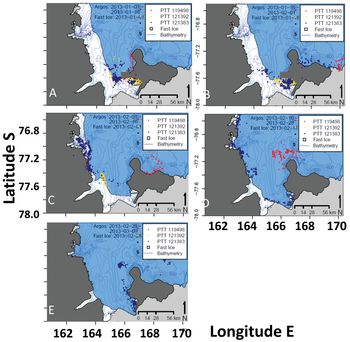
Collectively, the satellite tags affixed to AMWs (n = 3) displayed median telemetry error radii of 1132 m based on a Kalman filter algorithm implemented by the Argos service. On average, these tags returned 44 location fixes during each 20 h period that the tags were duty cycled on; however, the periods when the tags were duty cycled off resulted in substantial spatial gaps in the record of each individual's movement. These three AMW individuals remained within the SCINI sampling area of McMurdo Sound through the middle of January (contemporary with whale sightings from Royds) (Fig. 3a & b). One of the three individuals (PTT 119498) then moved out of McMurdo Sound, travelling to the east side of Ross Island and eventually moving out into the Ross Sea (beyond the geographical scope of Fig. 3a–e). The two tagged whales remaining within McMurdo Sound (PTT 121392 and 121383, the latter also making a rapid, brief visit to the east side of Ross Island) continued to forage near the fast-ice edge, especially in newly available patches of open water in the eastern McMurdo Sound as the fast ice began to retreat southward around mid-January. In February, they continued to exploit waters along and beneath the retreating patches of fast ice occurring along the Victoria Land coast to the north-west of the SCINI sampling area (Fig. 3c & d). PTT 121392 ceased transmitting by 3 February. From 25–31 February, PTT 121383 returned to eastern McMurdo Sound following the edge of the remaining fast ice (Fig. 3e).
a.–e. Argos daily positions logged by three Antarctic minke whales by half-month, January into early March, after tagging at the McMurdo Sound fast-ice edge on 3–4 January 2013. Note the fast-ice edge shown in each plot corresponds to the beginning of each half-month segment.

Whale diving
The one AMW tagged with a position and dive recording SPLASH tag (PTT 121383) dived consistently to depths exceeding 90 m near (and likely under) the fast-ice edge while it remained within the SCINI sampling area (Fig. 4; the blue individual of Fig. 3). When this tag was duty cycled on during this period of spatial overlap (3–22 January 2013), this whale reached a mean depth of 72 m, with 90% of dives falling between 19 and 130 m. Subsequently, when AMW PTT 121383 moved to western McMurdo Sound (Fig. 3c) and then spread its efforts north along the retreating fast ice of the Victoria Land coast, the mean dive depth reached 50 m, with 90% of dives falling between 15 and 138 m. The maximum depth reached on the vast majority of dives occurred within a narrow range to a depth at or just below the dense phytoplankton cloud (lower edge ~60 m) that typically flows into McMurdo Sound from the central Ross Sea (Fig. 4 and see below). A diel pattern in diving depth emerges, with dives tending to be shallower during crepuscular periods when McMurdo Sound was shaded by Mount Erebus (3800 m high; Fig. 5), a period when silverfish and crystal krill are known to migrate higher in the water column. Bottom topography appeared to have little influence on most of AMW diving (Fig. 6a & b), indicating that their interest was mostly in the surface layers of the water column. The seemingly rugged bottom topography shown in Fig. 6 is indicative of the terrain among the Delbridge Islands of the eastern McMurdo Sound, an area where mini-polynyas appear before deterioration of the fast ice at a larger scale. Such polynyas are within reach from the fast-ice edge (1–2 km) by the whales with one long breath hold (the longest we measured from Cape Royds was 11 min), and AMWs were observed in them.
Continuous diving by Antarctic minke whales tagged at the fast-ice edge on 3 January 2015, with days since tagging shown. Gaps are the result of duty cycling of the tag, in order to save battery power, and not absence of diving; green shading shows depth of phytoplankton cloud (mean chlorophyll: 10.8 mg chl a m-3, range: 1.5–42.4 mg chl a m-3), at least as determined through the first several days of January by SCINI, averaging both ice-edge and interior remotely operated vehicle stations.

Antarctic minke whale dive depths arranged by time of day, overlain by curves representing solar elevation angles above (positive) and below (negative) the horizon over the lifespan of the tag PTT 121383.

A comparison of depths of Antarctic minke whale foraging dives vs bottom topography: a. a single 24 h period, 15–16 January 2013, and b. dives over 2 weeks, 15–30 January 2013 (gaps indicate no sampling owing to duty cycling of tag).

Penguin diet change
The ADPEs nesting at Cape Royds (population ~2500 pairs) did not change the distance of their foraging trips over the course of the chick-feeding periods, travelling 10–12 km from the colony during both 2012–13 and 2014–15. Previous research indicated that the penguins increase the duration of foraging trips over the chick-feeding period, but that could not be measured in the current study. Neither, as noted above, did the Cape Royds penguins increase the depth of their dives over time, other than in response to the diel movement of prey. Dives ranged from 20 to 60 m (mean 51 m) near the ice edge during 2014–15. Despite no changes in the foraging behaviours being measured in this study, the ADPE diet initially was almost entirely krill, but as time progressed contained an increasing prevalence of fish. By around 1 January, within a few days of AMW occurrence becoming constant, the ADPE diet became ~50% fish (Fig. 7).
Proportion of krill vs fish in the diet of Adélie penguin adults feeding chicks at Cape Royds by 3–4 day periods in 2012–13 and 2014–15; numbers along the top of each graph represent sample sizes of meal observations. Prevalence of fish χ2 = 2.21E-10, of krill χ2 = 6.18E-08; P > 0.05.

Changes in the preyscape
Data from SCINI sampling between 3 December 2014 and 10 January 2015, which includes when AMWs first arrived and then became a regular presence at the fast-ice edge, indicate the potential influence of whale foraging. Crystal krill at the ice edge were subject to whale and penguin foraging; consequently, they were far less abundant down to 80 m than in the fast-ice interior, especially down to ~60 m (Fig. 8). In contrast, the opposite was true of Antarctic silverfish (i.e. relative abundance in surface waters at the ice edge was higher compared to that in the interior). Within each prey species, these differences were significant (P < 0.05), as shown in Fig. 8. Note that the acoustic backscattering strength values were not quantifiably comparable between the two prey species owing to different target strengths, although they were comparable within species.
The relative abundance (strength of acoustic signal) by 10 m depth increments of crystal krill and silverfish at the ice edge compared to non-edge remotely operated vehicle stations during the period of December 2014 to the first week of January 2015; a less negative Sv indicates higher prevalence. The green area indicates the depth at which chl a exceeded 16 mg m-3, averaging all ice-edge and non-ice-edge stations; at deeper depths, the chl a concentration was much lower, ranging from 0 to 8 mg m-3.

During the 2012–13 season, crystal krill first appeared visually in ROV footage on 6 December; by 19 December, crystal krill were visible throughout the water column, both deep and shallow; and by 27 December, Antarctic silverfish started appearing in ROV camera images. The latter were mostly in small groups near the surface, but also scattered individuals at depth, including near the sea floor. The pattern at both ice edge and fast-ice interior locations was similar in 2014–15.
Discussion
Despite logistical issues beyond our control (disruption of our second season), we fulfilled our original intent of obtaining a dataset recording alteration of the MIZ preyscape, a change likely driven by predation. In addition, we significantly increased the sample size of AMWs whose foraging movements have been quantified (see below). The sample size, however, remains small because the species does not easily lend itself to tagging, especially by researchers standing on the ice edge of McMurdo Sound (our only recourse). Particularly in pack ice-covered waters, just fleeting exposures of AMWs occur, which was our experience with the whales being constantly on the move. This species, at least in the Ross Sea, spends much less time lounging at the surface than other baleen whales, but rather dives almost constantly. Whether it is pursuing prey on each dive requires additional study, but we assume that most dives involve foraging and, as such, we get the distinct impression that prey are thinly dispersed. We also assumed that the diving behaviour of one whale that we succeeded in tagging with a TDR was representative of the majority of AMWs present, as its behaviour was consistent with how the preyscape changed (i.e. krill becoming less abundant to the depth that AMWs foraged (deeper than penguins)). In turn, the responses of competing penguins to those changes became evident (further discussed below). Clearly, that one tagged whale could not have changed the preyscape by itself. Had we not possessed several years of contextual data (in the study area: AMW seasonal prevalence, aspects of competitor responses), we would have had much less to say in terms of interpreting such observations. Equally importantly, we obtained information around which future efforts can be devised to follow how AMWs change the preyscape and interact with competitors in the Ross Sea MIZ.
Typical of most biologging and telemetry results, we view the behaviour of a tagged individual without having any information on whether it is acting alone or within a group, or potentially competing with other species. In other words, there is little in the way of inter- or intra-specific context. Analysis of 14 years of shore-based counts of AMWs at Cape Crozier (eastern corner of Ross Island), Cape Bird (north-west corner) and Cape Royds (south-west corner; Fig. 1) provides some context to the telemetry that we did accomplish (from Ainley et al. Reference Ainley, Lindke, Ballard, Lyver, Jennings and Toniolo2017). Those observations indicated a seasonal progression of AMW presence, also evident during the years of our study. As the MIZ shifted westward, so did the whales, first appearing at Cape Crozier, within the edge of the Ross Sea Polynya MIZ, reaching a peak there in mid-December; then they and the MIZ shifted west, to Cape Bird (consistent with decrease at Cape Crozier); and finally, by the beginning of January, they shifted south into McMurdo Sound, appearing in numbers off Cape Royds, with a decrease off Cape Bird. The satellite tagging in the present study indicated that this seasonal spatial progression continues well past our observational records, which cease seasonally in late January. First, the tagged whales concentrated their presence in the eastern McMurdo Sound (consistent with Cape Royds observations and Ainley et al. Reference Ainley, Lindke, Ballard, Lyver, Jennings and Toniolo2017), then moved to the western McMurdo Sound along the ice edge, followed by frequenting the fast-ice edge further north in the western Sound and southern Victoria Land coast. However, even within a sample of three individuals there was considerable inter-individual variability, with one AMW leaving the fast-ice edge and returning to more open-water habitats east of Cape Crozier following its tagging at the fast-ice edge. One whale left the fast-ice edge twice to make an excursion, but each time returned, presumably responding to the receding ice edge and renewed preyscape. Despite the disparity in the timing of the AMW tagging and our investigation of the preyscape using SCINI, changes in the preyscape that occurred with the arrival of the whales indicated less krill high in the water column, seemingly due to whale and penguin foraging, but higher krill abundance at deeper depths, possibly due to movement to avoid predation (Saenz et al. Reference Saenz, Ainley, Daly, Ballard, Conlisk, Elrod and Kim2020). Penguin diet changed accordingly: with less shallow krill available they fed more on fish, which remained sufficiently abundant at shallow depths. The diet change with the arrival of AMWs had been observed previously (Ainley et al. Reference Ainley, Ballard and Dugger2006, Ford et al. Reference Ford, Ainley, Lescroël, Lyver, Toniolo and Ballard2015, Saenz et al. Reference Saenz, Ainley, Daly, Ballard, Conlisk, Elrod and Kim2020). That is, to continue to prey on krill, the penguins would have to dive deeper, which takes more energy, and the penguins opted not to do that. The change in diet by the penguins is not totally necessary. While chicks grow faster and fledge heavier when raised on fish (Ainley et al. Reference Ainley, Dugger, La Mesa, Ballard, Barton and Jennings2018), parents can make up for less fish by increasing the feeding frequency of krill to chicks (Chapman et al. Reference Chapman, Hofmann, Patterson, Ribic and Fraser2011). ADPEs feed opportunistically, and it is the foraging by AMWs that reduces the availability of crystal krill and forces the penguins to switch to silverfish. A ‘mini-natural experiment’ was witnessed in 2019–20 and was detailed in Saenz et al. (Reference Saenz, Ainley, Daly, Ballard, Conlisk, Elrod and Kim2020) in which the penguins switched back to a diet of almost 100% krill upon a huge section of fast ice breaking out, exposing a large area that had been protected from penguins and whales.
Judging from the movement pattern and dive behaviour of the one TDR-tagged AMW, we hypothesize that AMWs may progressively deplete their forage, especially krill close to the surface, as they move to different areas, concentrating in one location for several days before moving to the next area that has dense prey patches. Similar movement along the edge of consolidated sea ice was also noted by Konishi et al. (Reference Konishi, Isoda, Bando, Minamikawa and Kleivane2020). In regard to our study, considering that the tag was duty cycled (hence there were periods of no data), we note that the tagged whale undertook dives nearly continuously during the entire 2.5 month dive record. We assume that in most cases it was diving in order to forage. Extremely high foraging effort appears to be characteristic of AMWs, over a range of dive depths that were found to include feeding lunges (Friedlander et al. Reference Friedlaender, Goldbogen, Nowacek, Read, Johnston and Gales2014). Additionally, Ainley et al. (Reference Ainley, Ballard and Dugger2006) reported that AMWs locate polynyas that occur well inside the fast ice in years when fast ice is abnormally extensive (see Kim et al. Reference Kim, Saenz, Scanniello, Daly and Ainley2018), and they conjectured that these whales must possess local knowledge of the area in order to, first, know that it is worthwhile to search for a mini-polynya, and second, to actually accomplish finding one. In years of extensive fast ice, this requires that they use the narrow shore lead (10–30 m wide) to penetrate as far as the polynyas. In the more typical ice conditions of 2012–13 and 2014–15, the one TDR-tagged whale found the polynyas in the vicinity of the Delbridge Islands in the eastern McMurdo Sound (Fig. 3a & b & Fig. 66). The AMWs' breath-holding capability may be great enough to allow them to reach these mini-polynyas, 1–2 km from the larger-scale fast-ice edge, at a swimming speed of ~30 km h−1 (Ford & Reeves Reference Ford and Reeves2008; 11 min was the longest dive duration recorded by us, while a 9.4 min dive duration was reported by Friedlaender et al. Reference Friedlaender, Goldbogen, Nowacek, Read, Johnston and Gales2014). Getting to these internal fast-ice polynyas would provide opportunities similar to finding untapped prey patches that become available as the fast-ice edge retreats. The whales' continual search for easily accessible prey is consistent with the observations of Friedlaender et al. (Reference Friedlaender, Halpin, Qian, Lawson, Wiebe, Thiele and Read2006), who showed that at the regional scale of the western Antarctic Peninsula (WAP) AMWs are more prevalent where prey are the most available.
It has also been found previously that the arrival of AMWs in the waters off Ross Island corresponded with changes in ADPE foraging behaviour and diet. As is evident in many seasons of study, the penguins increase trip duration, sometimes distance, and also depth, as well as catching less krill compared to fish (Ainley et al. Reference Ainley, Ballard and Dugger2006, Reference Ainley, Ballard, Jones, Jongsomjit, Pierce, Smith and Veloz2015, Reference Ainley, Dugger, La Mesa, Ballard, Barton and Jennings2018; Ford et al. Reference Ford, Ainley, Lescroël, Lyver, Toniolo and Ballard2015; this study). This specific pattern was observed at the very large penguin colony at Cape Crozier, where, by using an acoustically equipped glider in 2012–13, it was found that shallow krill disappeared near to the colony (i.e. were depleted), hence the change in penguin foraging behaviour and diet: deeper, more distant dives resulted in a diet including more fish. At Cape Royds, an analogous effort to quantify the preyscape (Saenz et al. Reference Saenz, Ainley, Daly, Ballard, Conlisk, Elrod and Kim2020) found no change in foraging behaviour (foraging distance or diving depth) by the penguins (consistent with previous biologging there; Ainley et al. Reference Ainley, Ballard and Dugger2006, Ford et al. Reference Ford, Ainley, Lescroël, Lyver, Toniolo and Ballard2015), but nevertheless the penguin diet changed to include more fish when the whales arrived (as in Ainley et al. Reference Ainley, Ballard and Dugger2006). Quantification of krill availability shows a possible reason for this diet change: foraging by AMWs (added to that of penguins and fish) decreased krill nearer to the surface that were easily accessible to penguins. Lending further support for this argument, whale presence was the sole predictor of penguin diet in a companion study (Saenz et al. Reference Saenz, Ainley, Daly, Ballard, Conlisk, Elrod and Kim2020, see also Ainley et al. Reference Ainley, Ballard and Dugger2006). It appears, however, that the tiny Royds penguin colony has sufficient availability of fish at shallow depths throughout the chick provisioning period that the penguins did not have to change foraging behaviour and thus incur greater energetic costs (i.e. dive deeper and farther away as at Cape Crozier) (cf. Ainley et al. Reference Ainley, Ballard, Jones, Jongsomjit, Pierce, Smith and Veloz2015, Saenz et al. Reference Saenz, Ainley, Daly, Ballard, Conlisk, Elrod and Kim2020). As detailed in Saenz et al. (Reference Saenz, Ainley, Daly, Ballard, Conlisk, Elrod and Kim2020), the fact that silverfish-consuming emperor penguins and Weddell seals vacated the ice edge during the period after the first SCINI pass may well have increased the availability of silverfish to ADPEs. We doubt that AMWs would have targeted silverfish, given that silverfish density under the ice is low (1 fish every 2–4 m; Fuiman et al. Reference Fuiman, Davis and Williams2002) and thus not conducive to efficient AMW foraging compared to krill.
Our effort to investigate AMW foraging behaviour was limited to three whales satellite tagged in 2013, including one with a TDR with which we could quantify diving frequency and depth while the whale foraged along and beneath the McMurdo Sound fast-ice edge. These offered a significant increase in AMW biologging data; Konishi et al. (Reference Konishi, Isoda, Bando, Minamikawa and Kleivane2020) also had a small sample size (three whales in each of two summers), but only to track movements and not diving. Friedlaender et al. (Reference Friedlaender, Goldbogen, Nowacek, Read, Johnston and Gales2014) investigated the behaviour of two AMWs foraging for Antarctic krill within the pack ice-covered waters of the WAP, the only other AMW tagging results of which we are aware. The difference in whale behaviour between studies was stark, but educational in the comparison, from several aspects. First, the WAP whales in general foraged nearer to the surface, diving on average to 18 m, compared to 72 m in our study. In those shallower dives, the WAP whales made as many as 22 feeding lunges per dive. However, the WAP whales at times also made dives equivalent to depths that were the norm of the McMurdo Sound whale, in which they also accomplished ~20 feeding lunges. Clearly, in our study, the depth of highest crystal krill density must have been a factor that determined how deep the whales foraged, and that was apparently ~30–80 m. That was the depth to which AMWs caused diminution of krill abundance. Second, it also appeared possible that the very dense surface layer of phytoplankton that extends to 60 m depth throughout McMurdo Sound could also have affected turbidity and AMW visual foraging ability, perhaps a condition that the whales sought to avoid by foraging beneath or in the less dense, lower portion of the phytoplankton cloud. Difficulty in seeing within that cloud is confirmed by human divers who can see no more than 1–2 m (Kim, personal observation 1988–2003). The surface depth and thickness of this bloom is characteristic of elsewhere in the south-west Ross Sea (e.g. Smith & Nelson Reference Smith and Nelson1985). The phytoplankton are initially dominated by diatoms, but later in the season showed an increased prevalence of the colonial alga Phaeocystis antarctica Karsten, which intrudes into McMurdo Sound from the Ross Sea (Barry & Dayton Reference Barry and Dayton1988). Finally, the AMW diving to the substrate of submerged peaks and valleys in our study (Fig. 6) could also have been in search of crystal krill, as the latter have been observed to occur in dense swarms at the bottom where they apparently forage on phyto-detritus (Deibel & Daly Reference Deibel, Daly, Smith and Barber2007, p. 304; also observed by our ROV).
We agree with Friedlaender et al. (Reference Friedlaender, Goldbogen, Nowacek, Read, Johnston and Gales2014) that, for a species that has been extensively hunted in the Southern Ocean (e.g. Gales et al. Reference Gales, Kasuya, Clapham and Brownell2005), precious little is known about the foraging ecology of AMWs. We agree as well that they are not easy to investigate owing to their infrequent exposure at the surface and rapid travel. Investigation is all the more important given the species' purported effect on the foraging of competing species, such as penguins, in an age when researchers and the wider public are concerned with population trends of charismatic species in the face of climate change and fishing.
Acknowledgements
Whale tagging was approved by NOAA Southwest Fisheries Science Center's Animal Care and Use Committee (SWPI2010-02) and was authorized under NOAA Fisheries Office of Protected Resources permit #782-1719 and Antarctic Conservation Act (ACA) permit 2004-009 M#2; penguin work was conducted under Oregon State University's Institutional Animal Care and Use Committee (ACUP 3672, 4130) and ACA permit 2011-002. Field assistance was provided by J. Pennycook, M. Elrod, M. Hynes, L. Barker, D. Baetscher, C. Collins, P. Malloy, E. Stackpole, H. Broadbent, D. Mahon, D. Szuta and P. Chung. Jefferson Hinke, Max Czapanskiy and three anonymous reviewers provided important comments that improved our presentation.
Author contributions
DGA, KD, BS, RLP and SK developed the concepts and approach. SK, BS, TWJ and DGA performed data extraction and analysis. All co-authors participated in data collection and writing and editing the manuscript.
Financial support
Funding was provided by National Science Foundation grants ANT-0944511, -0944694 and -0944747 and OPP-0338428. In-kind support, in the form of logistics, was provided by the US Antarctic Program through Antarctic Support Associates. Additional funding was received from the National Geographic Society, US Marine Mammal Commission, NOAA's Southwest Fisheries Science Center and from H.T. Harvey & Associates.
Details of data deposit
Except where otherwise noted in the text, all data for this paper are hosted at Biological and Chemical Oceanography Data Management Office (BCO-DMO), in project ‘Food web dynamics in an intact ecosystem: the role of top predators in McMurdo Sound’ (http://www.bco-dmo.org/project/665131). Data on penguin foraging and whale censuses are available at California Avian Data Center (CADC) hosted by Point Blue Conservation Science, and metadata are registered with the ‘Antarctic Master Directory’ (http://gcmd.nasa.gov/KeywordSearch/Home.do?Portal = amd&MetadataType = 0). Data are and will be available at CADC (http://data.prbo.org/apps/penguinscience).