Intermedial presence, b-boying, and The Marionette
One of the longest-running b-boy shows in South Korea, The Marionette is a seventy-minute-long non-verbal performance revolving around the relationship between a Puppeteer and his puppets, and his rivalry with a character called the Magician. Along with a choreography designed to give the impression that the Puppeteer is controlling the puppets (all played by other b-boys wearing masks) on visible and invisible strings, the show employs pre-recorded video and black light costumes and props to create a variety of intermedial effects. The show's central motif of puppetry lends particular significance to these intermedial interactions – most notably the kinetic interplay between the Puppeteer's video recording and his puppets onstage – as the highly integrated relationship of the two seems to allow a positive reassessment of the relationship between the live and the mediatized. In this article, and understanding presence in the ‘strong’ sense of the word – namely as ‘the actor's ability to occupy and command space and to attract the spectators’ undivided attention’ as opposed to the ‘weak’, physico-temporal sense of occupying the same space at the same time – I will argue that human performers and technological media can cooperate with each other to create a presence effect.Footnote 1 This claim will be substantiated by the model of intermedial presence in The Marionette where body and media work together as equal partners rather than as rivals competing for the audience's undivided attention – a common characterization in intermedial performance scholarship.
Below, I will open my discussion with a brief history of Korean b-boying and The Marionette with a focus on their relationship with media, not only to suggest the broad cultural context of the show's intermedial aesthetics, but also to show how media are implicated in the development of Korean b-boying and popular culture at large. The essay then goes on to analyse the show in light of contemporary discourses of presence and intermediality. The performance analysis is based on my viewing of the show at three different venues: 63 Art Hall in Seoul on 1 March 2015; Harmonia Art Center in Daegu on 5 February 2016; and Daegu Cultural Center for Students on 25 March 2016.
Korean b-boying, media, and the making of The Marionette
Considered to be one of the four original elements of hip hop along with MC-ing, graffiti and DJ-ing, b-boying, also known as ‘breaking’, is a type of street dance that originated in Harlem, New York, in the 1970s. ‘B-boying’ derives from the verb ‘to break’, which originally referred to the spontaneous, freestyle dance performed during a ‘break’ – the instrumental segment in the middle of a song – in the early days of hip hop. It was the legendary DJ Kool Herc who called the young men who danced to the DJ's breakbeats ‘b-boys’, a shortened form of ‘break boys’.Footnote 2 Although b-boying began as a subcultural dance genre in economically deprived urban areas, it took only about a decade to become a major youth culture phenomenon in many parts of the world, including South Korea.
As in the case of American hip hop and b-boying, media played a central role in dissemination of the form and its styles among Korean youths in the 1980s. According to hip hop historian Jeff Chang, in conjunction with music videos and television, it was films such as Flashdance (1983), Beat Street (1984) and Breakin’ (1984) that ‘kicked the “breakdance” fad into high gear’ in the US.Footnote 3 Similarly, the Korean ‘b-boy boom’ of the 1980s was ignited by Michael Jackson's songs and music videos, American hip hop films, and other mass media events such as Rock Steady Crew and New York City Breakers’ performance for the second inauguration of President Ronald Reagan, which was internationally broadcast on television in 1985.Footnote 4 The strange but jaw-dropping moves of the b-boys enthralled a large number of Korean youths, who formed amateur groups and practised together for hours every day with the dream of becoming professional b-boys.
According to Woosung Lee, who created The Marionette with his Expression Crew in 2005, and who has continued to serve as its director and producer ever since, while Moon Night Club in Itaewon, Seoul, was the cradle of Korean b-boying culture as well as the hip hop superstars of the 1980s and early 1990s, early dancers like him had to rely on imported videotapes and recordings due to the lack of teachers. Lee recollects that the Michael Jackson CD his father gave him for a birthday gift opened his eyes to the world of hip hop and b-boying when he was a teenager. His father also showed him video recordings of Japanese b-boys and bought him a video camera so that, since no one was willing to share their hard-earned performance knowledge, he could record dance performances at Moon Night and practise the moves for himself.Footnote 5 Thus the inception and development of Korean b-boying culture would have been almost impossible without electronic media such as television, film and the video recorder, for they were the first-generation b-boys’ primary means of instruction. In a similar context, Gigook Kim ascribes the rapid growth of b-boying culture in Korea to the country's advanced Internet infrastructure, which has allowed youths easy access to online video clips.Footnote 6 It is in this media-oriented cultural context that both Korean b-boying and The Marionette were born and have been appreciated by the public.
Of course, the flourishing of b-boying in Korea cannot be reduced to the single factor of media. Generally speaking, Koreans, being not very tall, have a relatively low centre of gravity, which is conducive to learning the so-called power moves. Many Korean dancers also have a strong sense of rhythm and teamwork developed by folk performance traditions such as the outdoor show called madang nori (literally, ‘yard play’), the mask dance and the shaman ritual called gut. On top of these physical and cultural factors, Korean b-boys’ full-time commitment and intensive training further distinguish them from their foreign contenders, most of whom only dance on the side or as a hobby. Another important sociocultural factor is the Korean youths’ rebellious spirit, which is nourished in opposition to an oppressive social and educational environment. Korean society, fundamentally Confucianist, has traditionally emphasized hierarchy and conformity at the expense of individuality and freedom of expression. Many of those who feel oppressed in school and society find in b-boying an outlet for their youthful passion and energy and a means of resistance.Footnote 7 As will be discussed below, this conflict between social and individual values is one of the main themes in The Marionette.
Despite the Korean ‘b-boy boom’ of the mid-1980s, it was very difficult for the b-boys to make a sustainable career due mainly to low income and conscription – still a major stumbling block for most Korean b-boys today. Many b-boys gave up their dream because they found themselves ‘too old’ to dance after returning from their three-year military service, or in order to get a more stable job to feed their families.Footnote 8 The majority of those who remained worked as backing dancers for a living, and b-boying was only recognized as a legitimate dance genre in mainstream culture at the beginning of the ‘Korean hip hop Renaissance’ in 1995.Footnote 9 Thereafter, some of the b-boys became members of popular dance groups such as Seo Taiji and Boys, Deux, R.ef, and Jinusean, who dominated popular culture in the 1990s; meanwhile, Soo-yong Kim's Hip Hop (1997–2004), a cartoon serial dealing with the dreams and struggles of Korean b-boys in their late teens, sold over a million copies and even became a ‘textbook’ for many Korean b-boys. It was also about this time that several underground b-boying crews were formed who conquered the four major international b-boying competitions in the 2000s: Battle of the Year (BOTY), the UK B-Boy Championship, Red Bull BC One, and Free Style Session. One of these groups is Expression Crew, the first Asian team to win BOTY, the World Cup of b-boying held in Germany, in 2002.
In 2007, these outstanding achievements by Korean b-boys led to the birth of R16 Korea, now the fifth major international b-boy tournament on a par with the four mentioned above, which is sponsored by the Korea Tourism Organization and the Ministry of Culture, Sports, and Tourism. The government's investment in b-boying to promote it as part of the Korean Wave coincided with the eruption of many b-boy shows in the 2000s: The Ballerina Who Loved a B-Boy (2005), Jukebox B-boy Musical: Good Morning B-Boy, B-Boy Korea (2006), Fantastic Hip Hop Variety Show: B-Show, Snow White Princess in the B-Boy Garden, and Crossover B-Boying: Girls and B-boys (2007). These shows are credited with creating the now legitimate performance genre called ‘b-boy show’ or ‘b-boy performance’ in Korea. While most of the early shows are no longer performed and other new ones have come and gone, the two oldest and most successful of them, The Ballerina Who Loved a B-Boy and The Marionette, continue to be performed and have also undertaken successful international tours. Ballerina, a romantic comedy about a female ballet dancer who falls in love with a b-boy and eventually becomes a b-girl, is the most popular Korean b-boy show, having been seen by over two million people from 130 countries to date. However, The Marionette is arguably the more interesting case in terms of intermedial presence as it is the only b-boy show produced thus far in the country in which the complementary movements between live and mediatized performers serve as a core element of representation.
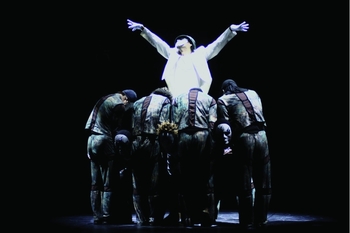
Publicity image of The Marionette showing the Puppeteer and his puppets. Photograph by Expression Crew. Courtesy of Woosung Lee.

The cumulative audience of The Marionette amounts to 200,000, the annual average being about 30,000 people – not a small number considering that the show, unlike b-boy shows managed by a production company, including Ballerina, is entirely produced by Expression Crew themselves.Footnote 10 The Marionette not only has been commercially successful but also was officially invited to the renowned CLSA Investor Forum held in New York and Hong Kong in 2006 as a potential investment item, and has been performed in several other countries, such as Austria, Japan, Jordan, Taiwan and Thailand. Since wrapping up its four-year run at 63 Art Hall, Seoul, in July 2015, Expression Crew have been touring nationally, performing for general audiences and students at various venues. In May 2016, they teamed up with a famous hip hop dancer, Poppin’ Hyun Joon, for a new version of The Marionette that won second place in the Korean regional championships for World of Dance 2016.Footnote 11 Although they failed to win the championship in the global final held in Los Angeles in July, the international competitiveness of the show, in addition to its longevity, attests that The Marionette is an ongoing phenomenon.
As in the history of Korean hip hop and b-boying briefly charted above, mass media played a crucial role in the conception and marketing of The Marionette. According to Lee, the show's central motif of puppetry and a significant part of the plot derive from animations and films such as the original Star Wars trilogy (1977–83), Ghost in the Shell (1995), Bicentennial Man (1999) and A.I. (2001).Footnote 12 These futuristic explorations of the uncanny resemblance or blurred boundary between humans and machines, which profoundly influenced The Marionette’s intermedial aesthetics, show how deeply technology had infiltrated the popular imagination. Digital technology was also the show's initial medium of reception by the general public. The first version of the show, then only eight minutes long, was uploaded to the Internet and registered nearly two million views in seven months, which, along with the crew's fame as the 2002 BOTY winner, made for large audiences at live performances of the extended version on Daehakro (a.k.a. Korean off-Broadway). Expression Crew also increased their public exposure by appearing twice in Star-King, a popular Korean television show on a major channel, and starring in a Burger King commercial in 2009. Considering that it was these media appearances that brought the majority of audience members to the show, The Marionette may seem to substantiate Philip Auslander's claim that today ‘live performances are economically tied to mediatization’.Footnote 13 According to Lee, however, the economic relationship between live performance and digital media is complex and cannot simply be understood as the former's dependence on the latter. As early as 2007, he foresaw the imminent demise of the ‘b-boy boom’ due mainly to b-boys’ overexposure on television. Unfortunately, his prediction came true, and the popularity of Korean b-boys indeed went downhill from 2007, when the number of b-boy shows being performed began to plummet.Footnote 14 In 2007, Lee published an illustrated storybook of the show with an eponymous title to solidify his copyright ownership, but so far has no plan to make a film version of the live performance for sale. Although The Marionette is media-friendly, it resists complete mediatization.
Media combination and intermedial presence in The Marionette
It is in light of this integral role of media in the development of b-boying on the one hand, and medial distinction on the other, that established The Marionette as a performance of ‘media combination’ where conventionally distinct media come together to constitute a performance event.Footnote 15 According to Lee, what distinguishes the show from other regular dance performances and b-boy shows, which generally use upbeat, fast-tempo pop songs, is its use of sentimental music (mostly from Yann Tiersen's soundtrack for the 2001 French romantic comedy Amélie) and incorporation of video and subtitles.Footnote 16 In an interview with the author, Lee explained that he had two motivations for his use of video, which he shot and edited himself.Footnote 17 First, since the performers do not speak, he needed to find a way to tell the story to the audience, domestic and foreign, and his solution was the projection of slides providing cartoon-style illustrations and subtitles in English, Japanese, Korean and Chinese at the beginning of each act. Deeply moved by the power of written words in Makoto Shinkai's animated science fiction story Voices of a Distant Star (2000), he also hoped that his subtitles would touch the hearts of audiences with similar poetic lyricism. Second, human bodies and visual media, in his view, offer different affective experiences for spectators, so he wanted to integrate the two in The Marionette, although he believes that it is ultimately the passion and sweat of live dancers that the audience appreciates the most. Lee initially received harsh criticism from his b-boy peers, who denounced the use of video in live performance as ‘cheating’ – that is, gain without pain.Footnote 18 However, that was apparently not the way the show was received by the general public, as demonstrated by its popularity. To begin with, the use of video did not seem to bother a contemporary audience deeply immersed in digital culture, many of whose members first saw the video clip of the show on the Internet. Also, the video projection is always combined with live dancing, which in itself requires a great deal of physical effort and concentration.
The show is performed against a black screen on a dimly lit and almost bare proscenium stage with a few large wooden gears suggestive of a puppet mechanism on both sides. It features three acts of breathtaking dance moves – including popping, head-spins, flares and windmills – and visual spectacles, which are often followed by loud cheers from spectators. In Act I, a boy, who is fond of puppets, grows up to become a popular puppeteer, and the people of his village build a theatre for him. One day, one of the puppets has his string cut off by accident during a rehearsal. He finds he is able to move nonetheless, and this unexpected ‘freedom’ causes a disturbance amongst the group and disrupts the choreographic harmony. Then, a Magician appears with a ‘false’ promise of freedom and cuts the strings to turn the puppets against their master. Shocked and heartbroken, the Puppeteer tries to leave, but then experiences a mysterious moment of epiphany in which two white-gloved hands suddenly appear on screen to encourage him to go back and reconcile with his puppets. He returns to the theatre and begs the puppets to forgive him, saying, ‘we have to understand each other for true harmony’, and his sincerity moves them to return. Here, puppetry is introduced as an art of mutual empathy and collaboration rather than dictatorial manoeuvre – an interesting twist on Edward Gordon Craig's über-marionette, which he believed should replace the living actor, who was too much at the mercy of accidents and the whims of ego and emotion.Footnote 19
Lee, a devout Christian, originally conceived of the show as a metaphor of the human relation to God; as the Puppeteer is to the puppets, God is the source and overseer of human life, and conflict arises when humans dream of a ‘free’ life apart from Him.Footnote 20 While this brief explanation of Lee's own may give the impression that the Puppeteer and the puppets form a simple hierarchy, their relationship betrays more complex power dynamics since it alludes to the theological conundrum of free will, which contradicts the absolute sovereignty of God. In logical terms, the Puppeteer's power over the puppets and the puppets’ freedom cannot both be true at the same time, unless there are limitations on both counts. The show seems to make this concession since the Puppeteer only has limited control over the puppets, who are portrayed as half-machines that possess free will and emotion. In my view, these dynamics show their ontological interdependence, since the Puppeteer's power presupposes the existence of the puppets – otherwise, power over what? – and the puppets’ freedom, conversely, is only conceivable when there is someone controlling them in the first place. Despite their apparent hierarchy, the conflict between the Puppeteer and the puppets reveals the reciprocal nature of their relationship.
However, the Christian underpinning of the plot is not very obvious in actual performance as there are no overt religious references or symbols to induce such an interpretation. Rather, the narrative would be more likely to appeal to many Korean audience members as a story about the aforementioned tension between the social system and individual freedom in Korean society, where the latter is often suppressed in favour of the former. Lee himself welcomes the secular reading, admitting that the relationship issues are applicable to those that commonly happen at workplaces and more immediately to his own experience as team leader of Expression Crew. He briefly told me about the conflict he had with some of the former crew members who thought he was too dictatorial, and left the team. This painful experience became a main source of The Marionette’s plot as well as the metatheatrical wisdom that the kernel of performance is teamwork between all the artists involved rather than the decisions of one overseer. Another significant way the ordeal affected the show was the use of masks. Lee did not want the audience to notice and be bothered by member changes, and the masks also seemed to have the effect of making the audience concentrate on the group choreography by effacing individual differences. For Lee, The Marionette is a group-oriented ensemble performance that belongs to Expression Crew as a whole; just as luxury brands such as Chanel, Gucci and BMW maintain their craftsmanship and reputation regardless of their staff changes, so The Marionette is still performed by the same Expression Crew who won the 2002 BOTY – a body corporate, in the most literal sense.Footnote 21
As mentioned above, puppetry serves as an apt motif to represent the theme of collaboration since neither the Puppeteer nor the puppets can perform without each other. What adds another layer to their live interaction is the incorporation of video. At the beginning of the rehearsal scene mentioned above, the upper body of the Puppeteer – played by Lee, who also portrays the Magician and the brokenhearted puppet in Act II – appears on screen to move the puppets with his hands. This intermedial interaction is different from the ‘blending of the physical and the digital’ that Edward Scheer and Rosie Klich identify in works such as Escape Velocity (1998) by Company in Space and the OpenEnded Group's Ghostcatching and BIPED (1999), where real-time video relays are projected onto the performers themselves or the motion-capture recording of dancers’ movements is projected on the scrim.Footnote 22 Nor is it the same as the hybridization and fragmentation of the body due to ‘an integration between the performers and technologies’ in what Jennifer Parker-Starbuck calls ‘cyborg theatre’, which challenges traditional notions of the body as subject/object/abject.Footnote 23 In The Marionette, the video image is not a digital double or an extension of its live counterpart. Rather, it is an ‘other’ – a discrete performer in its own right that appears to lead the live performers’ movement, moment by moment. The video image resembles what David Saltz describes as ‘Media as Actor’, to which the live performers relate ‘as an autonomous agent, a subject in its own right with sentience and volition’.Footnote 24
This particular sequence provides a good example of presence as an effect of intermedial symbiosis. The puppets’ skilful moves, though very impressive in themselves, would not make sense or be equally interesting if they did not proceed in sync with the cues of the Puppeteer video, and vice versa. The puppetry motif makes the intermedial interaction a fundamental element of the choreography and it is the spectacle and tension created by their synchronization that achieve what I see as a ‘strong’ presence effect (sometimes called ‘stage presence’ or ‘auratic presence’).Footnote 25 While there is no general consensus about exactly what it is and how it happens, I agree with Steve Dixon and Barry Smith's opinion that ‘reduced to its essence, presence is about interest and command of attention, not space or liveness’.Footnote 26 In other words, ‘strong’ presence could be described as the spectator's experience of being fixated on an electrifying performer or something else onstage, whether live or mediatized, that compels their attention. In my experience, it is mainly the intermedial collaboration that grabs the audience's attention in this way in The Marionette, rather than the video or live dancers alone. During the three performances I attended, the audiences watched the interaction intently and in absolute silence, as if holding their breath. As an audience member, I was initially drawn to the scene by the peculiar beauty of the intermedial choreography, with the moment intensified by the knowledge that at any time in the sequence, the timing could go out of sync.
The notion of intermedial presence suggests an alternate model to the antagonistic binary of the live and the mediatized in the discourse of intermedial performance, which is succinctly captured by Steve Wurtzler's explanation that the traditional notion of the live ‘is premised on the absence of recording’ while ‘the defining fact of the recorded is the absence of the live’.Footnote 27 Ironically, even recent studies that set out to challenge the polarizing discourse resort to the dichotomy when discussing ‘strong’ presence. For instance, Klich and Scheer, who propose intermediality as an approach ‘based on the perception that media boundaries are fluid and recognising the potential for interaction and exchange between the live and the mediated, without presupposing the authenticity or authority of either mode’, briefly remark in their case study of Lightwork's Sarajevo Story (2008) that Skype was used to ‘disrupt the effect of “stage presence” by introducing the liveness of telephony’.Footnote 28 Here, they see presence and media technology such as Skype as mutually exclusive. Claudia Georgi invokes the same binary logic when she discusses the presence of Mary Oliver and her prerecorded video double who ‘compete for the spectators’ attention’ in Wednesday, Wednesday and Never Work.Footnote 29 With the notable exception of Russell Fewster, who first used the term ‘intermedial presence’ to describe the amplification of live performers’ presence by their mediatized doubles in The Lost Babylon, similar opinions have been expressed by Roberts Blossom, Dixon and Smith, and Chris Salter, who see mediatized images as ‘screenal interlopers’ by which ‘the human actor is displaced’.Footnote 30 In this competitive view, presence is fundamentally a matter of ‘either–or’ and the live actor and their digital image are destined to vie for the audience's attention throughout the performance. However, what if the tension arising from such interaction is exactly what draws the spectators’ attention? And what if the two move in choreographic harmony as the live bodies and the video image do in The Marionette? Watching the show, I did not feel compelled to choose whether to give my full attention either to a live performer or to the video projection. In my comprehensive view of the stage, I was most intrigued by the interaction between the two, which rather forced me to keep the stage in perspective in order to follow the fast-paced movement sequence as a whole, rather than switch my focus back and forth.
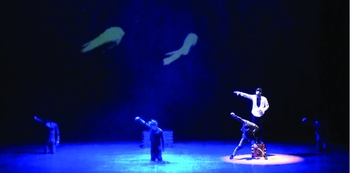
It is also important to note that presence in the show is an effect of ‘hypermediacy’ rather than ‘immediacy’, since the presence effect is not so much a result of the fusion between live dancing and media as an effect of their constant interplay based on the spectator's ontological distinction between the two.Footnote 31 Right after the video manipulation of the puppets described above, the Puppeteer enters the stage to resume the rehearsal in person, changing the mode of interaction from video-body to body-body. This transition is further complicated by the introduction of two white gloves on screen as a virtual character, which becomes the meta-controller of the tripartite choreography (see Fig. 2); the puppets move in sync with the Puppeteer's onstage manipulation, which in turn appears subject to the direction of the gloves on screen. These transitions keep the audience aware of the distinct mediality of the video against the live performers for two main reasons. First, there is the irony that, while all the video is prerecorded and therefore lacks agency, those following the cues of the video onstage are live dancers who might refuse to go along with the video. Second, the video and live dancers are not always – and cannot be – in perfect sync; although it is mostly not to a significant degree, there are several moments when the timing is slightly off, especially during the trilateral sequence. Although the white gloves are supposed to be the conductor of the entire ensemble, the Puppeteer's moves sometimes precede it, creating an unintended disconnect between the moves of the three different parties. The irony and slippage, I argue, remind the audience of the ontological difference between human and media, and this hypermedial awareness is pivotal to their experience of intermedial presence since there would be no tension and suspense without it.
The tripartite interaction between the screen, the Puppeteer, and the puppets. Photograph by Expression Crew. Courtesy of Woosung Lee.

This observation about the show's hypermediacy challenges what I would call the assimilationist view of intermedial performance in which live and mediatized elements ‘merge’ to lose their distinct mediality. For instance, Auslander saw Pôles by Pps Danse of Montreal, a live performance featuring the interaction between two dancers and their holographic projections, as ‘a fusion that we see as taking place within a digital environment that incorporates the live elements as part of its raw material’ concisely expressed by the formula ‘Dance + Virtual = Virtual’.Footnote 32 Klich makes a similar argument that ‘the efficacy of intermedial theatre is based on the audience's perception of the integration and interdependence of the live and the mediatised’.Footnote 33 As far as The Marionette is concerned, however, I believe that such ‘efficacy’ rather hinges on the distinguishability between the live actors and the video, in agreement with Georgi's claim that ‘intermedial phenomena increase rather than decrease the awareness of the mediality and materiality of their respective components’.Footnote 34 In The Marionette, neither the video nor the live action subsumes the other to become the metamedia or the master frame. The two are not fused, either, but play alongside each other as two separate but interdependent performers. In short, The Marionette is an art of difference as well as of collaboration, where the two distinct performers of human and media are conjoined to produce a presence effect.
This hypermedial awareness is further augmented by the performers’ direct interactions with the audience. The b-boys often break the fourth wall to ask the audience to applaud and cheer in recognition of their virtuosity, and to invite the ‘red-hat girl’, a female spectator who is assigned a designated seat in the front row before the beginning of the performance, to the stage. This is part of a romantic plotline that develops in Act II, when one of the puppets becomes enamoured of a girl wearing a red hat in the audience. He dreams of becoming her knight in shining armour even though he knows he can never be her lover. Although his feeling for her painfully reminds him of the unbridgeable chasm between the human and the non-human, her occasional visits to the theatre are the main source of his happiness. With the passing of time, however, the girl grows old and one day stops coming to the theatre because she has passed away. The puppet is broken-hearted, expressing his sadness with a slow-tempo popping dance. More time elapses, and one day he sees a girl who resembles the girl with the red hat again, revealed to be her granddaughter, much to his great joy. Their ‘unconsummated’ relationship can be compared to the hypermedial dynamics between the live dancers and the video described above. While the puppet and the girl are energized by their performer–fan feedback loop, they remain different and separate, and it is this distance that creates and maintains tension in the narrative.
Another significant feature of the second act is intermedial choreography involving black light instead of video: an instance of ‘media as costume’ which, in Saltz's terms, we might say is ‘coextensive with the performer’.Footnote 35 After the conclusion of the story of the red-hatted girl, the stage is blacked out and the b-boys wear glow-in-the-dark masks and costumes. Following the Magician's hand signals, the masks held by the other b-boys disperse and then congregate centre stage to create the illusion of merging into one mask, and this sequence is repeated a few times. While the Magician's black-light performance interrupts the flow of the narrative, it amuses the audience with various spectacles and optical illusions, including a battle between a monster spider and Optimus Prime – an intermedial reference to the Hollywood blockbuster Transformers, itself a transmedial adaptation of the popular children's toy line – and the Magician's enchanting laser beam solo dance. Although this intermedial relationship is different from the body–video interaction in the previous act, the presence effect here again is mainly produced by the combination of group choreography and the technological media of black light.
The final act shows the cultural significance of these intermedial aesthetics. The Magician begins to steal the Puppeteer's audience with his magic tricks until he finally takes over the theatre. The Magician grants the Puppeteer's last wish to mount his final show there, and The Marionette closes with the Puppeteer's farewell performance with the puppets. Lee said that the last act, in which the Puppeteer is ousted by someone who has a different, and possibly more stimulating, type of technology at his disposal, is about the unstoppable passage of time which demands constant renewal. At the same time, it is a reference to his own situation, for he believes he is bound to be surpassed and looked down upon by the younger generation of b-boys and performers.Footnote 36 It is probably this awareness that kept The Marionette evolving. In addition to the several visual and narrative changes that have been made over the last decade, including the incorporation of black light and more emphasis on the love story of Act II, he is now preparing to integrate three-dimensional hologram images into the show. Even though b-boying is still a popular dance genre on its own as an art of the human body, Lee believes that it is important to catch up with the latest technology since media constitute an indispensable part of our lives today and people are sensitive to change; as the fate of the Puppeteer suggests, the show cannot go on when it falls behind.
Conclusion
Intermingling live b-boying and media technologies such as video and black light, The Marionette exemplifies a conceptual model of presence constituted by human bodies and media technologies that work together in choreographic harmony while retaining their medial distinction. The show's intermedial aesthetics are above all indebted to the developed media infrastructure of South Korea, which introduced b-boying to young people and, more fundamentally, to the broader cultural context where intermediality has become a cultural given. Besides its spectacular nature, what makes the intermedial dynamics of The Marionette appealing to Korean spectators of all ages is the narrative in which it is embedded, as the conflict between the Puppeteer, the puppets and the Magician touches on common relationship issues that many Koreans experience in school or at work on a daily basis. The central message underlying these relationships is their interdependence: none of these characters, whether live or mediatized, can perform alone, and the collaboration and tension between these different elements renders The Marionette a tour de force.
From the intermedial perspective, this non-partisan understanding of media combination troubles the antagonistic binary of the live and the mediatized as well as the assimilationist position, or what Tobin Nellhaus calls Auslander's ‘technological determinism’.Footnote 37 With the ceaseless appearance and development of new media and technology, the number of possible media combinations increases daily. In this milieu, performance practitioners have been experimenting with new media to further complicate the already unstable notion of intermediality and challenge the conventional humanist view of presence. We might soon be living in an age of intermedial presence where the presence of the actor is unthinkable without the involvement of technological media. My analysis of The Marionette has shown that, even if that happens, that does not mean that we have to renounce the distinct ontology of the human body or that we are subordinated to media. Technology still needs us, and we can choose to collaborate with it as a partner rather than as contender for the spectators’ attention.