


The purpose of the present study was to examine the relationship between perceived worry and self-efficacy among school counsellors, and determine whether school counsellors in different job roles differ in perceived worry and self-efficacy. Working at the frontline of mental health services for young people, school counsellors have a crucial and developmental role (Borders, Reference Borders2002). Often called in to deal with critical incidents, school counsellors are also expected to foster resilience in their student clients, equip them with skills to avert difficulties in the future, and facilitate personal, social and emotional growth (Bagrodia & Bhatia, Reference Bagrodia and Bhatia2019; Sharma & Sharma, Reference Sharma and Sharma2004).
The NSW Department of Education (DoE) employs approximately 1100 school counselling staff working across a diverse range of school settings (Preschool to Year 12) in metropolitan, regional, rural and remote areas (NSW DoE, 2022). There are four categories of school counsellor: Senior Psychologist Education (SPE), School Counsellor (SC), School Psychologist (SP), and the School Counsellor in Training (SCIT). There are notable differences in the roles and daily duties of the SPE when compared with the SC, SP and SCIT.
SPEs coordinate and supervise a team of school counsellors to deliver psychological services to school communities (NSW DoE, 2022). SPEs develop and implement models of clinical supervision for school counselling service staff, including group supervision and facilitating peer consultation. SPEs are required to demonstrate professionalism to support a culture of integrity within their school counselling team, lead and facilitate productive discussions, and show sensitivity and understanding in resolving conflicts and differences (NSW DoE, 2021).
While SPEs provide professional leadership and clinical supervision to their school counselling team, school counsellors are required to work across a variety of primary and high school settings, providing face-to-face specialised psychological assessment, counselling and intervention services. The SCs, SPs and SCITs work directly with students, helping them with issues related to learning, peer and family relationships, and managing emotions such as depression, anxiety, worry or isolation. School counsellors hold registration as a psychologist or are working towards registration with the Psychology Board of Australia (NSW DoE, 2022). A crucial part of the role for counsellors in schools is their frontline responsibility to manage students who engage in at-risk behaviours such as self-harm and/or suicidal ideation (Christianson & Everall, Reference Christianson and Everall2008; Dowling & Doyle, Reference Dowling and Doyle2017).
With their twofold expertise in education and mental health, counsellors in schools are often the preferred choice to offer support and intervention to students (Suldo et al., Reference Suldo, Friedrich and Michalowski2010). The need for counselling services within schools is constantly increasing due to the exponential rise in students presenting with mental health difficulties (Bagrodia & Bhatia, Reference Bagrodia and Bhatia2019). Managing the diverse priorities across different school settings and the plethora of complex presenting issues can be challenging and can place the school counsellor in highly stressful situations (Paisley & McMahon, Reference Paisley and McMahon2001).
Considerable weariness, frustration and worry is experienced within the school counselling profession, particularly in relation to students who present with severe psychopathology, the nature and quality of caseloads, and the protracted therapeutic progress with certain cases (Sciberras & Pilkington, Reference Sciberras and Pilkington2018). In addition to stress, psychologists working in the counselling setting report increased levels of anxiety, depression and emotional exhaustion when compared with research psychologists (Radeke & Mahoney, Reference Radeke and Mahoney2000). When stress and worries are left unaddressed, or not managed effectively, there can be negative long-term implications, whereby professional functioning can be adversely impacted, hindering effective delivery of service (Wise et al., Reference Wise, Hersh and Gibson2012).
Working effectively within the school setting is an important objective for the school counsellor, particularly when considering this sector is the most common source of mental health services for children and adolescents (Schiele et al., Reference Schiele, Weist, Youngstrom, Stephan and Lever2014). One in five students will experience at least one mental health problem prior to turning 18, highlighting the proliferation of psychopathology within the school system (Cleverley et al., Reference Cleverley, Lenters and McCann2020). To address the need for a psychological service delivery charter for schools, the Australian Psychological Society (APS) delivered the Framework for the Effective Delivery of School Psychological Services (APS, 2013). The document specifies a model of school psychological service delivery that outlines the main roles and tasks of the school counsellor: to facilitate psycho-education programs for students, diagnostic assessment, mental health intervention, collaboration (e.g., referral to external agencies), and management such as administration, supervision and record keeping (Campbell & Colmar, Reference Campbell and Colmar2014).
Barriers towards effective service delivery reported by school counsellors include insufficient training and personal mental health problems (Suldo et al., Reference Suldo, Friedrich and Michalowski2010). Counsellors in the school setting report that an extensive clinical caseload can result in feelings of being overwhelmed, particularly in relation to not being able to provide ongoing support to students in need; often having to cease counselling treatment after only three or four sessions (Suldo et al., Reference Suldo, Friedrich and Michalowski2010):
At some point, I have to cut kids loose after three or four sessions with a phrase like, you know what, you seem to be doing better, but I am still concerned about you. However, since I’m only here a little bit and there are a lot of kids, how about I put the ball in your court and if you need to see me, if you’re stressed out, you make sure you come. (p. 365).
Moreover, the nature of counselling as an itinerant role can lead to a reduction of accessibility and availability: ‘You are in a school two days a week [and] you cannot schedule someone’s crisis [to be] on Monday’ (Suldo et al., Reference Suldo, Friedrich and Michalowski2010, p. 365). In seeking to address the challenges and daily stressors faced by school counsellors, Schiele et al. (Reference Schiele, Weist, Youngstrom, Stephan and Lever2014) argue that more attention needs to be given to counsellor self-efficacy.
Counselling Self-Efficacy
Within the mechanisms of personal agency, none is more vital than self-efficacy; that is, an individual’s belief about their capacity to exert control over situations that affect their lives (Bandura, Reference Bandura1986). More recently, Bandura wrote that an efficacy belief system is the basis of human agency, stating that unless an individual believes they can generate desired effects by their behaviours they have minimal incentive to act or to persevere despite difficulties (Bandura, Reference Bandura2004). ‘Counselling self-efficacy’ refers to one’s beliefs or judgments about one’s capacity to effectively counsel an individual (Larson & Daniels, Reference Larson and Daniels1998). It is reported as being more robust in individuals with considerable counselling experience, as opposed to those who have modest experience (Tang et al., Reference Tang, Addison, LaSure-Bryant, Norman, O’Connell and Stewart-Sicking2004).
The construct of self-efficacy is broadly considered to be a crucial precursor to competent and proficient professional clinical practice (Schiele et al., Reference Schiele, Weist, Youngstrom, Stephan and Lever2014). Counsellors are agents, creating their unique counselling environment while concurrently adapting their actions, judgments and feelings based on feedback from their own actions and from their clients (Larson & Daniels, Reference Larson and Daniels1998). School counsellors with high self-efficacy report feeling calmer, thinking more flexibly, and operating in a more sinuous manner during the execution of their counselling sessions (Larson & Daniels, Reference Larson and Daniels1998). School counsellors who report higher levels of self-efficacy within the scope of school counselling show greater efficiency in their service delivery (Ernst, Reference Ernst2012).
In their cross-sectional study of graduate and undergraduate students, Goreczny et al. (Reference Goreczny, Hamilton, Lubinski and Pasquinelli2015) reported an increase in self-efficacy among students as they progressed in their training. This may reflect the beneficial effect of training and the potential for self-efficacy to increase with more counselling experience. As students assess their own behaviours, believing that they can execute counsellor tasks (that previously may have intimidated them), they start to positively appraise their skills. That is, as an individual develops and involves themselves in behaviours and skills expected of them, they start to foster the cognitive self-schema to facilitate growth and enhanced performance (Goreczny et al. (Reference Goreczny, Hamilton, Lubinski and Pasquinelli2015).
Considering counsellor performance, Schiele et al. (Reference Schiele, Weist, Youngstrom, Stephan and Lever2014) state that affirmative self-evaluations and lower levels of perceived worry are associated with counselling self-efficacy. Several factors can negatively impact self-efficacy in counsellors. Significant gaps between the mental health needs of students and the accessibility of counselling services to meet such demands may result in increased worry and stress for the school counsellor (Schiele et al., Reference Schiele, Weist, Youngstrom, Stephan and Lever2014). Of note, counsellor’s higher perceived levels of stress and worry have been found to lead to a reduction in levels of clinical judgment and performance (Urbani et al., Reference Urbani, Smith, Maddux, Smaby, Torres-Rivera and Crews2002).
Worry
While anxiety or stress are comparatively familiar concepts (Beck et al., Reference Beck, Emery and Greenberg2005; Lazarus & Folkman, Reference Lazarus and Folkman1984), worry is less well known and relatively overlooked in clinical research (Davey et al., Reference Davey, Hampton, Farrell and Davidson1992). The terms ‘worry’ and ‘anxiety’ are often used interchangeably, but they should be treated as separate constructs (Davey et al., Reference Davey, Hampton, Farrell and Davidson1992). Worry is associated with a problem-solving style, whereas anxiety is associated with negative affect (Zebb & Beck, Reference Zebb and Beck1998). Gana et al. (Reference Gana, Martin and Canouet2001) concluded that the association between worry and anxiety was not bidirectional. Using data from their study of French adults (N = 509), they detected that there was a significant positive effect of worry on anxiety, but no effect in the opposite direction. Worry is defined as a sequence of thoughts and images that are adversely affect-laden and mostly uncontainable; a process associated with a desire to employ cognitive problem-solving strategies regarding an issue where the outcome is uncertain (Borkovec et al., Reference Borkovec, Robinson, Pruzinsky and DePree1983). Worry principally encompasses verbal thought activity, serves as a form of cognitive avoidance, and involves an intolerance of uncertainty (Borkovec et al., Reference Borkovec, Ray and Stober1998; Bredemeier & Berenbaum, Reference Bredemeier and Berenbaum2008).
Recent literature indicates a connection between executive control and the experience of worry (Hirsch & Mathews, Reference Hirsch and Mathews2012). In ‘worriers’, there can be a bias in the processing of emotional information and reduced executive control of attention. Evidence indicates that these biases have their genesis in both biological and environmental bases (Hirsch & Mathews, Reference Hirsch and Mathews2012). Worry seems to vie for limited processing resources, subjugating cognitive resources that would otherwise be apportioned to attentional control (Barker et al., Reference Barker, Munro, Orlov, Morgenroth, Moser, Eysenck and Allen2018). Individuals who engage in worry will search for effective solutions to problems but will lack confidence in their own problem-solving capabilities (Hong, Reference Hong2007). Three processes seem to merge to maintain worry: emotional processing biases, diminished attentional control, and the propensity to perceive adverse outcomes in verbal form (Eagleson et al., Reference Eagleson, Hayes, Mathews, Perman and Hirsch2016).
Speculating on why worry is a verbal process, Eagleson et al. (Reference Eagleson, Hayes, Mathews, Perman and Hirsch2016) reported that verbal thoughts tend to be mostly abstract and generalised, raising various ambiguous possibilities; albeit lessening the chance of resolving them because they are not visibly delineated. In worriers, there is a diminished capability to constrain troublesome thoughts and a reduced ability to shift to a nonthreatening subject; thus, the worry process is maintained (Hayes et al., Reference Hayes, Hirsch. and Mathews2008). Although anticipation of possible threat is adaptive, it is unknown why excessive worry endures when it frequently triggers distress and is of limited benefit (Stokes & Hirsch, Reference Stokes and Hirsch2010). A skill considered essential to being an effective counsellor is being able to control attention and being cognitively responsive to the client; suggesting a possible inverse relationship between counsellor proficiency and worry (Greason & Cashwell, Reference Greason and Cashwell2009).
Present Study
Self-efficacy as a personal resource has been implicated in the development of burnout among school counsellors — particularly in relation to unmanageable caseloads and an imbalance between job demands and the availability of resources (Bardhoshi & Um, Reference Bardhoshi and Um2021). Thus, investigating factors that may have an impact upon school counsellor self-efficacy are warranted. To date, there has been no objective quantitative study investigating the relationship between worry and self-efficacy in NSW DoE school counsellors. The aim of this study was to examine the relationship between perceived worry and self-efficacy among school counsellors, and determine whether school counsellors of different job roles differ in their levels of perceived worry and self-efficacy. The following hypotheses were made:
H1: There would be a negative relationship between reported levels of perceived worry and self-efficacy in NSW DoE School Counsellors.
H2: There would be a difference in reported worry and self-efficacy as a function of job role. Specifically, we predicted that more experienced school counsellors (SPEs and SC/SPs) would report less worry and greater self-efficacy than those less experienced (SCITs).
Method
Participants
Participants were NSW DoE employees, recruited via personal social media networks and the NSW School Counsellors Information Hub Facebook page (a private group with approximately 700 members). Participants could click on a URL link to a survey generated by Qualtrics software (qualtrics.com). The survey provided a Participant Information Sheet that explained the aims and methods of the research. Responses were submitted online and were analysed using Qualtrics software. Participation in the survey was voluntary and no identifying information was collected beyond gender and age.
Assuming a critical alpha of .05, and a target power of .80, a power analysis using G*Power 3.10 (Faul et al., Reference Faul, Erdfelder, Lang and Buchner2007) indicated a minimum of 82 participants would be required for the total sample group. The cross-sectional sample size was N = 98, aged from 26 to 69 years (M age = 44.97, SD age = 10.89; 92% female). This encompassed approximately 9% of the total number of school counsellors employed by the NSW DoE. Participants’ responses were distributed across job role as follows: SPE (n = 4), SC (n = 66) and SCIT (n = 28). No SPs responded to the survey. This study received ethical approval from the University of Wollongong Social Sciences Human Research and Ethics Committee.
Measures
Demographics. A demographic questionnaire assessed age, gender and job role. Participants identified as either SPE, SC or SCIT.
Penn State Worry Questionnaire (PSWQ; Meyer et al., Reference Meyer, Miller, Metzger and Borkovec1990). The PSWQ is the most commonly used self-report scale to assess worry; its strengths being its brevity, ease of use, reliability and validity (Chelminski & Zimmerman, Reference Chelminski and Zimmerman2003). The PSWQ contains 16 statements relating to worry, which participants rate from 1 (not at all typical of me) to 5 (very typical of me); this results in a single total score. Possible scores range from low (16–39), moderate (40–59) to high (60–80). The PSWQ evaluates the propensity, intensity and uncontrollability of worry (Fresco et al., Reference Fresco, Heimberg, Mennin and Turk2002). Some of the sample items include: ‘When I am under pressure I worry a lot’; ‘I worry about projects until they are all done’. Items 1, 3, 8, 10 and 11 are negatively worded items and were reverse scored in the IBM Statistical Package for the Social Sciences (SPSS, Version 27; IBM Corp, 2020). The PSWQ has high internal consistency, good convergent validity, good discriminant validity and is a useful tool for nonclinical populations (van Rijsoort et al., Reference van Rijsoort, Emmelkamp and Vervaeke1999; Yao et al., Reference Yao, Sripada, Klumpp, Abenson, Muzik, Zhao, Rosenblum, Briggs, Kaston and Warren2016). Construct reliability was assessed using Cronbach’s alpha and deemed acceptable (α = .74).
Psychologist and Counsellor Self-Efficacy Scale (PCES; Watt et al., Reference Watt, Ehrich, Stewart, Snell, Bucich, Jacobs, Furlonger and English2019). The 31-item PCES is designed to assess psychologists’ and counsellors’ confidence in their abilities to deal with matters related to a five-factor subscale structure: Research (3 items), Ethics (5 items), Legal matters (4 items), Assessment and measurement (3 items), and Intervention (16 items). Statements ask how confident the individual feels to carry out certain tasks. Some of the sample items include: ‘How confident are you that you have the ability to motivate client engagement?’; ‘How confident are you that you have the ability to identify client’s strengths?’ A series of exploratory analyses, established through confirmatory factor analyses and Rasch analysis, identified the PCES as a valid scale. Good fit was found for all five subscales. The Person Separation Index (PSI), a reliability index, indicated good reliability for all scales (PSIs > .73) (Watt et al., Reference Watt, Ehrich, Stewart, Snell, Bucich, Jacobs, Furlonger and English2019). In the present study, a single total score was analysed (α = .05), created by averaging all items. In the present study, Cronbach’s alphas were satisfactory: Total PCES scale α = 96, Research α = .90, Ethics α = .77, Legal Matters α = .83, Assessment and measurement α = .80, and Intervention α = .94.
Data Analysis
Data were scored and analysed using SPSS (Version 27). To assess H1, a bivariate Pearson’s product-moment correlation coefficient (r) was calculated using the total scores for the PSWQ and PCES. To investigate H2, a multivariate analysis of variance (MANOVA) was used — with role as the independent variable (with three levels), and with worry and self-efficacy as dependent variables. Tukey’s HSD was used for post-hoc analyses.
Results
Assumption Testing
Visual inspections of histograms showed that the sample data was approximately normally distributed for both: PCES (M = 103.80, SD = 17.59) and PSWQ (M = 42.55, SD = 11.00). A nonsignificant Shapiro-Wilk statistic for PCES (W = .990, p = .703) and PSWQ (W = .977, p = .083) confirmed the data was approximately normally distributed. Box’s M was non-significant at α = .01, indicating homogeneity of variance-covariance matrices could be assumed. Means and standard deviations of PCES and PSWQ scores across roles are shown in Table 1.
Means and Standard Deviations of Psychologist and Counsellor Self-Efficacy Scale and Penn State Worry Questionnaire

Note: SPE, Senior Psychologist Education; SC, School Counsellor; SCIT, School Counsellor in Training; PCES, Psychologist and Counsellor Self-Efficacy Scale; PSWQ, Penn State Worry Questionnaire.
Main Analyses
H1: There will be a negative relationship between levels of perceived worry and levels of self-efficacy. Bivariate Pearson’s product-moment correlation coefficient demonstrated a significant association between scores on the PCES and scores on the PSWQ, r(96) = -.24, p = .018.
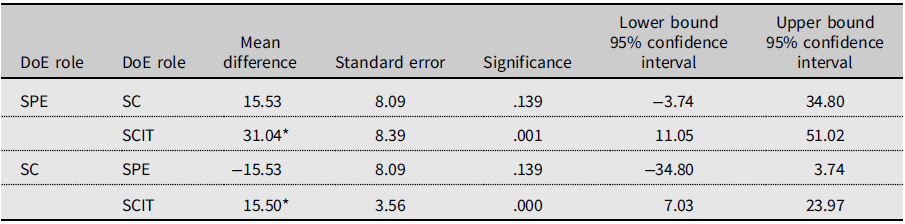
H2: There will be significant differences in reported worry and self-efficacy as a function of job role. As all the underlying assumptions were supported by the data, and there was a correlation between the dependent variables, MANOVA was the most appropriate test. Findings demonstrated a significant effect of job role (SPE/SC/SCIT) on the combined dependent variables, F(4,184) = 7.26, p < .001; Wilks’ λ = 0.746. Multivariate effect size was estimated at .14 (partial η2), suggesting 14% of the variance in the canonically derived dependent variable was accounted for by role. To determine how the dependent variables differ for the independent variable, we examined the univariate analyses of variance (ANOVAs). Examination of the between-subjects effects (using Bonferroni correction) demonstrated that role had a statistically significant effect for the PCES, F(2, 95) = 12.70; p < .001; partial η2 = .21) but not for the PSWQ, F(2, 95) = 4.21; p = .18; partial η2 = .08. Post-hoc analyses for self-efficacy showed higher mean PCES scores for SPE compared to SCIT (p = .001) and SC compared to SCIT (p = .0005); with no difference between SPE and SC (p = .139; see Table 2).
Mean Differences in Psychologist and Counsellor Self-Efficacy Scale Scores Across Job Roles

Note: DoE, Department of Education; SPE, Senior Psychologist Education; SC, School Counsellor; SCIT, School Counsellor in Training.
* The mean difference is significant at the .05 level.
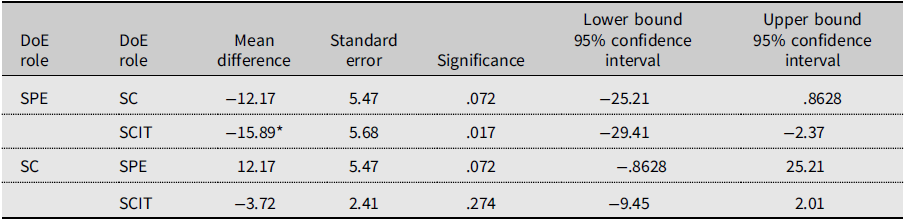
For worry, SPEs reported significantly less worry (lower PSWQ scores) compared to SCIT (p = .019); with no difference between SPE and SC (p = .097) or SC and SCIT (p = .297; see Table 3).
Mean Differences in Penn State Worry Questionnaire Scores Across Job Roles

Note: DoE, Department of Education; SPE, Senior Psychologist Education; SC, School Counsellor; SCIT, School Counsellor in Training.
* The mean difference is significant at the .05 level.
Discussion
This is the first study to examine the relationship between perceived worry and self-efficacy in NSW DoE school counsellors. Results showed a weak negative association between levels of worry and self-efficacy, such that greater worry was associated with less self-efficacy. While this supports our first hypothesis that there would be an inverse relationship, the degree to which the findings have practical significance is uncertain. Because the correlation was weak, it is reasonable that it cannot confidently be concluded that higher levels of self-efficacy are in fact associated with lower levels of worry.
A significant effect of job role (SPE or SC or SCIT) on the combined dependent variables was found, although the multivariate effect size was small, indicating that only 14% of the variance was accounted for by role. This suggests that there may be other factors, not just job role, accounting for perceived levels of worry and self-efficacy. Examination of the univariate ANOVAs using Bonferroni correction supported the hypothesis that role had an effect regarding levels of self-efficacy, but not for levels of worry. Considering the differences in results between SPEs and SCs or SCITs regarding perceived worry and self-efficacy, this could in fact be related to the diversity of tasks and responsibilities in the job roles. Future studies should consider other variables, such as personality traits, that may account for any differences (Mullen & Lambie, Reference Mullen and Lambie2016). Crucially, any interpretation of the pairwise comparisons in this study should be made cautiously due to the small SPE sample size.
Regarding self-reported worry, there was a difference of significance between PSWQ scores between SPE and SCIT (p = .017). For the beginning school counsellor, mean worry scores were higher than those reported by the SPE but only slightly higher than levels of worry reported by SCs. Campbell (Reference Campbell2020) suggests beginning school counsellors experience dissonance between their university informed expectations, and their actual day-to-day responsibilities, perhaps increasing their apprehension. Atli (Reference Atli2020) states that the beginning school counsellor is more vulnerable to difficulties when compared with their more experienced colleagues. According to Hill et al. (Reference Hill, Roffman, Stahl, Friedman, Hummel and Wallace2008), when counsellors in training encounter more challenging situations, their confidence reduces.
The higher self-efficacy scores on the PCES rated by SPE and SC compared to SCITs could be associated with increased self-reflection and a mindful approach to facilitating one’s own growth (Kozina et al., Reference Kozina, Grabovari, De Stefano and Drapeau2010). Self-efficacy influences the school counsellor’s clinical functioning, modifying their cognitive, affective and behavioural responses as they interact with the student (Lent et al., Reference Lent, Cinamon, Bryan, Jezzi, Martin and Lim2009). Individuals with a high sense of counselling self-efficacy are more likely to interpret their worries and concerns as motivating, more likely to establish realistic goals and more likely to have thoughts that are adaptive (Larson & Daniels, Reference Larson and Daniels1998). Larson and Daniels (Reference Larson and Daniels1998) theorise that counsellors in training can have goal expectations that are too high relative to their level of skill development. Furthermore, they report that for many counsellors in training, their counselling self-efficacy is considerably less than their actual functioning would indicate. It could be that counsellors in training are assessing their performance by focusing on what went wrong, rather than what was done well (Larson & Daniels, Reference Larson and Daniels1998).
Clinical supervision on a regular basis may alleviate possible negative interpretational biases perceived by the SCIT (Kozina et al., Reference Kozina, Grabovari, De Stefano and Drapeau2010). Investigating dynamics that support or weaken self-efficacy development across abilities identified within peak body competency documents could be a beneficial strategy to bolster self-efficacy (Watt et al., Reference Watt, Ehrich, Stewart, Snell, Bucich, Jacobs, Furlonger and English2019). Comparing perceptions of self-efficacy and actual evidence of competence could be achieved from filming counselling sessions (with parent or carer permission) or from engaging in role-play activities during Team Supervision (Kozina et al., Reference Kozina, Grabovari, De Stefano and Drapeau2010). Furthermore, educating the SCIT to self-monitor their positive interactions with a student during a session may be of benefit to increase their self-confidence (Larson & Daniels., Reference Larson and Daniels1998). Considering self-confidence, Goreczny et al. (Reference Goreczny, Hamilton, Lubinski and Pasquinelli2015) reported an increase in self-efficacy as graduate students progressed, emphasising the positive effects of training. While SPEs and SCs rated themselves higher in self efficacy, more research is needed to ascertain the factors contributing to the higher scores.
Limitations and Directions for Future Research
The correlational design and reported results likely do not lend support to a conclusion of causality. Causal conclusions are considered questionable in correlational research contexts (Reinhart et al., Reference Reinhart, Haring, Levin, Patall and Robinson2013). Recommendations for educational practice from correlational data should be made with caution — a better option is to rely on aggregated findings that produce consistent results across a variety of studies (Robinson et al., Reference Robinson, Levin, Schraw, Patall and Hunt2013).
Social responsibility bias was considered in the design of this study and thus the data was collected anonymously. Despite the anonymity, self-report surveys are vulnerable to social desirability bias (Kwak et al., Reference Kwak, Ma and Kim2021). Social desirability bias can distort the means and variances of research variables and be a threat to the validity of a study (Kwak et al., Reference Kwak, Ma and Kim2021). Responses might not be representative of actual practice and interpretations (Suldo et al., Reference Suldo, Friedrich and Michalowski2010). Similarly, self-perceived competencies are not always representative of actual competencies (Watt et al., Reference Watt, Ehrich, Stewart, Snell, Bucich, Jacobs, Furlonger and English2019).
A core limitation exists in the sample population: caution should be used regarding the representativeness of the sample and the degree to which the findings can be generalised to the overall population of the NSW DoE school counselling service. The recruitment process did not stratify by potentially relevant factors such as years of experience, location (rural, regional, metropolitan) or schools with high or low socioeconomic status. Gathering more comprehensive subjective and demographic information would be useful to gain a better understanding of the cohort and provide opportunities for further analysis (Watt et al., Reference Watt, Ehrich, Stewart, Snell, Bucich, Jacobs, Furlonger and English2019). In future, a more rigorous and wide-ranging recruitment process that delineates relevant demographical factors should be used to strengthen the practical significance of the study. This would better guide interpretation regarding whether other influential factors such as years of experience (not just job role) contributes to differences in levels of self-efficacy and worry.
While appropriate corrections and analyses were undertaken, the uneven group sizes impacted the validity of the analysis. Further, the small sample size of four SPEs when compared to 66 SCs indicates that interpretation of the results should be made cautiously. Future studies should aim to recruit equal sample sizes to more clearly pinpoint strengths and weaknesses, particular to each population. Additionally, the differences in job roles could be a crucial contributor to the variability of participant responses.
Limitations notwithstanding, the results of this study provide tentative empirical support for future study into the association between levels of worry and self-efficacy in the NSW DoE School Counselling Service. Tools to measure worry and self-efficacy via individual or team-based activities or data collection could be useful to ascertain the wellbeing of school counsellors as they carry out their daily tasks and duties. Self-evaluation instruments, such as the PCES and PSWQ, along with the skills to mindfully examine one’s own perceptions of one’s abilities, could be a focus of supervision.
Conclusion
The school counselling role within the NSW DoE is demanding and multifaceted. Senior psychologists provide supervision and guidance to a school counselling team while counsellors in schools meet face to face with students who present with complex needs, requiring psychological assessment and mental health support. Findings from this study shed light on the level of school counsellors’ perceived worries and how confident they feel to execute their duties with higher levels of self-efficacy and lower levels of worry reported by counsellors in roles of seniority. While there was some indication that the association of worry and self-efficacy varies across job role, this premise would benefit from additional investigation. By and large, this study provides scope for future research into the association between worry and self-efficacy and contributes to the literature regarding counsellors in the school setting.
Financial support
This research received no specific grant from any funding agency, commercial, or not-for-profit sectors.
Conflicts of interest
None.
Ethical approval
This study received ethical approval from the University of Wollongong Social Sciences Human Research and Ethics Committee.