INTRODUCTION
Most people learn from childhood that eating is essential for survival and physical well-being, but food can also have other implications. Food and eating are embedded in our everyday social lives: at home with family members and as part of social interactions with friends, colleagues, etc. Food and eating habits are shaped by routines, traditions, and rituals, all being part of our sociocultural and/or religious background (cf. Logue, Reference Logue2004; Jastran et al., Reference Jastran, Bisogni and Sobal2009).
For people with progressive life-limiting conditions that are admitted to specialist palliative home care, however, eating is often obstructed (Potter et al., Reference Potter, Hami and Bryan2003; Borgsteede et al., Reference Borgsteede, Deliens and Beentjes2007). Eating deficiencies are part of the body's decline that comes with the dying trajectory, illness progression, and treatments, and Hopkinson et al. (Reference Hopkinson, Wright and McDonald2006) concluded that eating-related concerns are present in all stages of a person's illness trajectory toward dying.
The concept of an “eating deficiency” is not well defined in the literature. In the present article, eating deficiencies refer to illness-related symptoms and signs of hampered eating (also previously described in Wallin et al., Reference Wallin, Carlander and Sandman2013). Among those most frequently reported are loss of appetite and weight loss (Hopkinson et al., Reference Hopkinson, Wright and McDonald2006; Tan & Fearon, Reference Tan and Fearon2008). These are often related to cachexia, which is a wasting syndrome frequently seen among persons with cancer (Teunissen et al., Reference Teunissen, Wesker and Kruitwagen2007), as well as other progressive life-limiting diseases (Plata-Saláman, Reference Plata-Salamán2000; Marks et al., Reference Marks, Butler and Turner2003) that hamper the ability to assimilate food and induce metabolic muscle breakdown. Other examples of physical symptoms/signs that are known to contribute to decreased food intake are smell and taste alterations (Potter et al., Reference Potter, Hami and Bryan2003; Bernhardson et al., Reference Bernhardson, Tishelman and Rutqvist2008), nausea, vomiting, constipation (Borgsteede et al., Reference Borgsteede, Deliens and Beentjes2007), and such mouth problems as candidiasis (Wilberg et al., Reference Wilberg, Hjermstad and Ottessen2012) and dysphagia (Roe et al., Reference Roe, Leslie and Drinnan2007).
Food and eating have multiple meanings in people's lives (Jastran et al., Reference Jastran, Bisogni and Sobal2009; Sutton, Reference Sutton2010). From a holistic point of view, physical symptoms and signs are not sufficient to define eating deficiencies, or at least the meaning of such. In relation to age-associated conditions (Andersson & Sidenvall, Reference Andersson and Sidenvall2001; Kullberg et al., Reference Kullberg, Björklund and Sidenvall2011), dysphagia after stroke (Westergren et al., Reference Westergren, Ohlsson and Rahm Hallberg2001, Klinke et al., Reference Klinke, Hafsteinsdóttir and Thorstenseinsson2013) and various chronic conditions such as chronic obstructive pulmonary disease (Odenkrants et al., Reference Odenkrants, Ehnfors and Grobe2002) and chronic heart failure (Jacobsson et al., Reference Jacobsson, Pihl and Mårtensson2004), the complexity of eating deficiencies and obstructed meal conditions are reflected in the nursing care literature. These studies illustrate how certain aspects related to mealtime environments (e.g., buying food ingredients and mealtime assistance) influence well-being negatively or positively, depending on the situation and how it is experienced. However, within the context of people who live with progressive life-limiting conditions and the knowledge of impending death, the meanings of eating deficiencies from the perspective of the ill persons themselves has been less well researched.
It is reasonable to assume that eating deficiencies are distressing for persons with progressive life-limiting conditions, and the previous studies that we have found indicate this. For example, attempting to stop ongoing weight loss or attempting to gain weight without success has been outlined as stressful (McClement et al., Reference McClement, Degner and Harlos2004; Whitworth et al., Reference Whitworth, Whitfield and Holmes2004; Souter, Reference Souter2005; Hinsley, Reference Hinsley2007; Reid et al., Reference Reid, McKenna and Fitzsimons2009a ), and feeling unable to control weight loss can be experienced as a personal failure (Orrevall et al., Reference Orrevall, Tishelman and Herrington2004; Hopkinson & Corner, Reference Hopkinson and Corner2006).
It has also been described that anxiety around severely ill family members' decreased food intake may induce tensions within the family (Shragge et al., Reference Shragge, Wismer and Olsson2006; Reid et al., Reference Reid, McKenna and Fitzsimons2009a ; DelRio et al., Reference DelRio, Shand and Bonati2012; Wallin et al., Reference Wallin, Carlander and Sandman2013). In turn, these ill persons may respond to their own anxiety and pressure from family members around eating deficiencies by using various strategies. Orrevall et al. (Reference Orrevall, Tishelman and Herrington2004) and Hopkinson & Corner (Reference Hopkinson and Corner2006) described how some admitted to palliative home care relied on nutrition supplements or sought assistance to optimize their eating. A study by Reid et al. (Reference Reid, McKenna and Fitzsimons2009b ) demonstrated that when emotional tensions over food arose in a family, the ill person made an extra effort to eat or even lied to their family about what they had eaten in order to avoid further conflict. Orrevall et al. (Reference Orrevall, Tishelman and Herrington2004) reported that parenteral nutrition support gave participants a sense of relief from the pressure of eating, as the nutrition support made them feel secure that their nutritional needs were being fulfilled.
A recent study by McGreevy et al. (Reference McGreevy, Orrevall and Belqaid2014) found that, for their participants, living with eating deficiencies meant reduced enjoyment gained from eating. Other studies suggest that some persons who are severely ill lower their ambitions around food and eating, trying to focus on enjoyment rather than the decreasing amount food eaten (Hopkinson & Corner, Reference Hopkinson and Corner2006), and accepting their hampered eating capabilities in order to avoid distress (Strasser et al., Reference Strasser, Binswanger and Cerny2007, Muir & Linklater, Reference Muir and Linklater2011).
Previous studies about eating deficiencies from the perspective of persons with progressive life-limiting conditions have contributed useful knowledge, though, as a recent review (Oberholz et al., Reference Oberholzer, Hopkinson and Baumann2013) shows, this is sometimes limited and more often focused on the perspective of family members. In-depth studies focusing on the meaning of living with eating deficiencies for persons who are spending the final phase of their lives in their own homes could therefore enhance our knowledge about this situation and perhaps enable healthcare professionals to provide better support and promote everyday well-being for people living out the final phase of their lives in their own homes. The aim of our study was to explore the meanings of living with eating deficiencies at the end of life in patients admitted to specialist palliative home care.
METHODS
Interpretive description was chosen to generate experience-based and applicable knowledge of relevance for specialist palliative home care teams and other healthcare professionals who encounter people with eating deficiencies and life-limiting progressive conditions. This method recognizes that reality can only be studied holistically since it is complex and subjective (Thorne et al., Reference Thorne, Kirkham and Flynn-Magee2004; Thorne, Reference Thorne2008).
Participants and Setting
A total of 12 persons (5 men and 7 women aged 36–80) from an urban area of a large Swedish city were purposefully selected and agreed to participate in our study. This purposive sampling was aimed at capturing a variety of experiences of eating deficiencies, according to the principle of representative credibility (Thorne, Reference Thorne2008). The participants were recruited based on the following inclusion criteria: being admitted to specialist palliative home care; having documented eating deficiencies; and being able to communicate in Swedish without interpretive assistance. The participants were invited via a request made by the assistant head nurses of two specialist palliative home care units. Those who were interested were sent written information about the study by post, and were later contacted by telephone by the first author.
Of the 12 participants, 10 had metastasized cancer (breast, esophagus, gynecological, lung, pancreas, peritoneal carcinoid, prostate, synovial), one had amyotrophic lateral sclerosis (ALS), and suffered from a renal disease (ren cysticus). All participants had decreased appetite, changed taste and food preferences, and various gastrointestinal symptoms (nausea, abdominal pain, constipation, diarrhea). Some persons were also discomforted by smell and dry or painful mouth, and had swallowing or breathing problems that hampered their eating.
All participants lived in apartments with a husband/wife/partner, and two had children under the age of 18 years living at home. The regional ethical review board of Karolinska Institutet (Stockholm) approved the study prior to its commencement (no. 2012/881-31/1).
Data Collection and Analysis
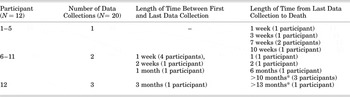
The first author collected the data in 2013 through repeated individual interviews in the form of conversations. The number of interviews was determined by the participants' will and strength to participate. A total of 20 interviews were performed (see Table 1 for details), all in the homes of participants. The interviews lasted between 20 and 112 minutes (most commonly about 60 minutes) and were recorded and transcribed verbatim by a professional transcriber.
Overview of data collection

* Still alive as of July 2014.
The interviews began with an introductory question about participants' current illness status followed by open-ended questions related to food and eating (e.g., “Can you please tell me what it has been like for you to eat during your illness trajectory?” and “What does food mean to you?”). To stimulate developed descriptions, situation-related questions were asked: “Can you please tell me about a situation when your eating deficiencies influenced your everyday life?” Probing questions such as “How did you experience that?” or “Can you tell more about that?” were employed to expand the descriptions. The pre-formulated thematic areas of “own descriptions of eating deficiencies” and “meanings of food and eating in everyday life and related to illness” guided the interviews.
After concluding each interview, the recording was listened to and notes were made about areas and topics that needed clarification in a subsequent interview. This procedure was inspirational for reflexive questions in the repeated interviews (and in subsequent interviews with new participants) (cf. Thorne, Reference Thorne2008), which focused on themes such as “pressure around food and eating” or “successful eating.”
Listening to and reading the transcribed interviews to obtain a sense of the whole constituted the first step of our analysis (Thorne, Reference Thorne2008). Units of text (one or several sentences) that contained descriptions related to eating deficiencies were identified, after which they were coded and formulated broadly according to their content: “descriptions related to eating for others” or “eating related to survival.” A broader coding, according to Thorne (Reference Thorne2008), stimulates a more coherent analysis than sorting and combining vast quantities of small data units. Memos about ideas and preliminary interpretations were documented as questions or comments next to the text units, and were used to assist in the process of broad coding and interpretation of data. During the analysis, the researchers continuously discussed the considered interpretations and alternatives to ensure that no premature closure occurred. The process of interpreting the data and disclosing the meanings of eating deficiencies involved identifying patterns and their inherent variations. In order to enhance a developed understanding of the data, which is also the purpose of using interpretive description (Thorne, Reference Thorne2008), this process was guided by a parallel reading of related literature.
RESULTS
Our results disclose the meanings of eating deficiencies that involve a multitude of existential and psychosocial challenges related to illness, bodily decline, and awareness of impending death: (1) resisting death by eating, (2) struggling with social gatherings around food, and (3) eating to please and unburden others. They are presented separately, even though, in the participants' descriptions of everyday life situations, they were intertwined. In the text, fictitious names and genders have been employed to somewhat “personify” the results and facilitate illustrations, but still guarantee anonymity.
Resisting Death by Eating
During their illness trajectory, the significance of eating for well-being and (prolonged) survival had become more apparent to participants. This was related to awareness of bodily decline and, above all, loss of body weight, which they described as the most obvious marker of impending death. Food became a mediator for resisting death, rather than being something tasty and filling that they ate for enjoyment. Participants said that they had to eat because they were not ready to die.
Pushing oneself to eat despite eating deficiencies was described as: “just switching on the autopilot and eating,” despite former signals of hunger, taste, or longing for food now being absent. Some seven weeks before dying of lung cancer, one participant named Ruth described how she experienced changes in taste and decreased appetite and was discomforted by smell. She was fed up with the sip feed, so she decided to eat ordinary food instead, even though it “tasted like paper,” because she realized she needed the calories: “It won't do otherwise—you have to eat to survive (. . .) so I just had to decide to do it.” Thus, for Ruth and other participants, the desire to prolong life was a driving force to eat.
During the interviews, participants often talked about eating in order to preserve as much of their healthy body functions/parts as possible. Cathleen, in an advanced stage of gynecological cancer and suffering from decreased appetite, taste alterations, and nausea, said,
Well, it is, of course, a feeling of kind of (. . .) I'm going to die of this, you know. The cancer just carries on eating up my body, but so far, there are quite a lot of parts that haven't been filled with cancer. The more I lose weight, the less there is of me that is healthy. So there's kind of a resistance (. . .) being able to kind of keep (. . .) hold of [life].
Thus, Cathleen and other participants attributed to food the capacity to postpone death. Nevertheless, they disclosed ambiguous thoughts about their capability to influence their illness progression and described being ready to try almost anything—searching for and trying different alternatives (e.g., special diets or naturopathic drugs). Some participants even tried illegal preparations (e.g., marijuana or other unauthorized drugs) that they hoped would help them regain their appetite and thereby keep death at bay. At the same time, they talked about being fully aware that death was inevitable, and about their eating deficiencies and the weight loss as clear markers of this, metaphorically illustrating it as “heading toward a dangerous limit” or “hearing a ringing alarm bell.” Another patient, Paul, suffering from amyotrophic lateral sclerosis, had lost his appetite and had major swallowing problems. He could only manage to eat a few bites every day with the assistance of others, and he knew that death was imminent: “And I know that time isn't that far off, but so far it works. And it feels like a little victory each time—being able to eat.” Thus, being able to eat even a small amount of food maintained some hope for him.
Participants also talked about improving well-being, for example, improving wound healing or gaining energy to be physically active, by eating more food. Anna, who was diagnosed with skeletal cancer several years ago, had experienced many critical stages. She described how, during these years, she had suffered from various troubles that had hampered her eating: “Yes, that's really the only thing you can do when you're so ill (. . .) use your diet to somehow speed up and improve or (. . .) yes, make the situation better.” Anna described how she made herself eat, despite a changed sense of taste and lack of appetite, because she hoped to improve well-being.
Struggling with Social Gatherings Around Food
Participants talked about meals (and meal preparation) as usually, in their “normal” everyday life, enabling valued opportunities for social interaction and community with family members and friends. This had changed during their illness trajectory. Because of their eating deficiencies, participants often found social gatherings that included food and eating to be a struggle, as they often needed to modify the circumstances around their participation. Sometimes, they even found these situations so troublesome that it was easier to avoid them entirely. The challenges depended on the nature of participants' eating deficiencies, illness, and social circumstances (e.g., eating in a family member's home or in a public restaurant). Examples included: going to a restaurant when they needed food in a modified form or having real food replaced by artificial nutrition support (meaning not eating food from a plate like others, but receiving it via a feeding tube). For Paul, suffering from ALS, immobilization and dysphagia illustrated this. He and his wife used to share meals, but his wife now had to feed him with enteral nutrition through a feeding tube at the same time as trying to finish her own meals:
It's a matter of deciding then—is she going to eat while her food is hot, will we do it afterwards, at the same time and so on. It depends a little on what we want. (. . .) Yes, and there's never really a feeling of togetherness in that—there just isn't.
As described by Paul and others, something was lost when the opportunity to share the same dish at mealtimes disappeared. It meant the experience of the situation as a whole was not fully shared, including small talk about the meal itself (e.g., what it tasted like). Additionally, the natural flow of everyday conversation that used to take place at the dinner table was much diminished and missed.
Participants often described their self-imposed avoidance of social gatherings around meals as the least complicated way of coping with their eating deficiencies. They felt that their particular needs, troubles, and preferences around food and eating made them feel different, both in relation to others and in relation to how they used to be before the illness. They had a picture of how they wanted to be perceived around meals and described failing to live up to their own expectations. Curt, who had renal disease and had lost his appetite and suffered from constipation, reported,
We had guests for lunch here, and, I suppose, I was keeping up okay with the soup, but then when we got to the main course I wasn't hungry anymore. (. . .) And the company wasn't any good either—it looks like I don't think the food is any good.
These experiences could occasionally lead to complete avoidance of situations where participants would risk being expected to share a meal with someone. Although this withdrawal from social situations was self-imposed, it made them feel lonely and separated from the life they had lived as healthy people.
Eating to Please and Unburden Others
Participants described how they often tried to eat, despite their various eating deficiencies, in order to please and acknowledge other people's efforts (e.g., healthcare professionals giving advice and support or family members preparing specially adapted meals). Moreover, their attempts to eat or eat more were in order to release friends and family members from the burden of awkwardness or anxiety in facing the ill person's declining illness trajectory.
In shared situations with friends or family members around meals, the participants often described eating more food than they wanted or eating food that they otherwise would not have chosen. This was illustrated by Cathleen, who had decreased appetite and stomach pain due to gynecological cancer. She talked about her experiences of having her anxious parents visiting and bringing sweets: “Yes, of course, it makes you feel obliged to eat those things you don't want to eat, to please other people and make them happy.”
Similar situations and feelings of being obliged to eat, acknowledging the efforts of people who loved and cared for them, were also confirmed by other participants. They described how troublesome their illness trajectory was to the persons who supported them, and this became particularly visible around food and mealtimes, due to the eating deficiencies.
Participants were concerned about the burden on family members that came with their illness and were aware of all the effort, worry, and love the latter invested in the role of being caregivers and trying to assist with matters surrounding the eating deficiencies. Participants perceived food and eating to have a certain potential to influence emotions and reactions, and struggling to eat as much as they could was one way of doing so. Thus, eating to please and unburden others meant putting themselves aside for the benefit of others, but this was described as somewhat satisfying. It gave participants opportunities to show their appreciation toward family members and healthcare professionals and consider their well-being. Edward, for example, who could only eat very small amounts of food because of all the troubles related to his pancreas, expressed the following:
She's taken over [responsibility for food] completely. I'm really grateful for that; otherwise, eating would have been completely disorganized. If I had lived alone I would have been dead by now. I'm pretty sure of that.
Accordingly, to Edward and other participants, eating was a way of expressing gratefulness for all the well-intended support around their eating deficiencies.
DISCUSSION
The results from our study outline meanings entailing eating deficiencies as markers of a threatened existence, and the meanings of eating deficiencies related to social values of food and eating. These two dimensions are thematically separated in three distinct patterns. However, Schütz (Reference Schütz1967) stated that people always exist in sociocultural contexts where they overlap and affect each other's lifeworlds. In the context of our study, this means that all everyday activities, including social interactions, both shaped the participants and in turn were shaped by their experience of illness and by other people's responses to their eating deficiencies. The patterns are thus deeply connected.
The dying trajectory has been outlined as the most utterly existential border situation that a person can be exposed to (Jaspers, Reference Jaspers1970). The results from our study demonstrate the profound existential loading of eating deficiencies, and how food can be a powerful mediator for severely ill persons' sense of being able to “back out” of this existential border situation by eating. This struggle to resist death and the ways in which participants talked about enhancing well-being and even avoiding death by forcing themselves to eat, trying alternative foods, etc., and at the same time being insightful about their impending death, corresponds with what Salander (Reference Salander, Bergenheim and Henriksson1996) has described as a “creative illusion.” Creative illusions are, rather than denial, a way of handling thoughts and insights about the disease and its prognosis so that they can protect themselves from “emotionally drowning” in the awareness of dying. It is a way of maintaining a sense of order in a life-threatening situation. This can be done by diminishing the significance of the death threat by using various strategies—in this case, related to overcoming eating deficiencies and using food and eating as a means (e.g., rationalization, distortion, or positive thinking) and, when needed, letting the threat recede into the background (Salander, Reference Salander, Bergenheim and Henriksson1996).
An alternative but related way of looking at this is through the lens of hope. In their elaboration on hope, Benzein et al. (Reference Benzein, Norberg and Saveman2001) argued that a person can “in hope” or “hope for” improved well-being, cure, etc., at the end of life. It is difficult to distinguish between these two aspects, and since we did not explore this, we cannot make any such interpretative claims in relation to our participants. What we do know for certain is that they hoped for enhanced well-being, and that forcing themselves to eat was one way forward. Struggling to eat in hope of improvement has some correlations with the results found by Jacobsson and colleagues (Reference Jacobsson, Pihl and Mårtensson2004).
Participants in our study described the various strategies they employed for handling food and eating in everyday life, often in relation to other persons and social gatherings around food. The literature is replete with examples of ways that people handle illness and impending death, how difficult it may be to maintain ordinariness in everyday life with illness and dying, and how the severely ill and dying make efforts to care for and protect their family members. However, fewer examples are found of the two patterns revealed in our study: “eating to please and unburden others” and “struggling with food in social life.” These have a particular focus on the symbolic value of food and eating, both forming an existential and a psychosocial point of view, and which now merit discussion.
Participants in our study described their self-imposed withdrawal from social gatherings around food, and did so for two reasons. The first was to protect themselves from situations in which they felt demands of them to be “normal” (e.g., by eating despite a lack of appetite or joining a dinner table despite only getting nutrients via a gastrostomy) when instead their eating deficiencies made them feel alienated and out of place. Difficulties around social interaction that include food and eating have been reported previously in various chronic illness contexts, even when life was not threatened (cf. Rosland, Reference Rosland, Heisler and Piette2012; Hakanson, Reference Hakanson2014).
The other reason was protecting others from being exposed to their impending death through the eating deficiencies. In the palliative literature, the concept of “social death” has been utilized. This has been recognized as a form of mental “shutdown,” resulting in withdrawal from social activities and relationships, following illness and body decline (Lawton, Reference Lawton2000).
In one of our recent studies (Wallin et al., Reference Wallin, Carlander and Sandman2013), in which we explored family members' (partners') experiences of living with a person who had eating difficulties, the partners shared the existential load of food and eating and made great efforts to try to get the ill person to eat, hoping to be able to postpone death. Moreover, they wished to maintain ordinariness in everyday life and around meals to protect themselves from an ill person's impending death. It is reasonable to assume that a person who is severely ill can feel pressured by family members and friends, who, in their distress about losing the person, “try too hard” to influence the situation and overcome the eating deficiencies. Moreover, social withdrawal and avoidance of participating in social gatherings around food in or outside the home can be a way of avoiding tensions within the family (cf. Hopkinson, Reference Hopkinson2007; Reid et al., Reference Reid, McKenna and Fitzsimons2009a ) and of concealing their own distress in order to protect family members (Byrne et al., Reference Byrne, Ellershaw and Holcombe2002).
For our subjects, not participating in social gatherings around food, whether self-imposed or not, meant being separated from their former life, and this brought about feelings of loneliness. This corresponds with previous studies about eating difficulties and progressive life-limiting conditions (cf. Reid et al., Reference Reid, McKenna and Fitzsimons2009a ) and also other contexts, for example, chronic gastric (Bennell & Taylor, Reference Bennell and Taylor2013) and head-and-neck (McQuestion et al., Reference McQuestion, Fitch and Howell2011) illness.
Everyone has their own unique way of handling difficult situations, and no one strategy is better than the rest (Lazarus & Folkman, Reference Lazarus and Folkman1984). Our participants have shared ways of handling eating deficiencies that may be different from those of other people. For example, Hopkinson and Corner (Reference Hopkinson2007) described how their study participants found new ways to handle their eating deficiencies, using humor to overcome emotional strains around low food intake and related tense situations.
STRENGTHS AND LIMITATIONS OF THE STUDY
A sample that captures multiple variations of the phenomenon under study is important (Thorne, Reference Thorne2008). One obvious limitation with our study is that it excluded people who were unable to communicate in Swedish and those who could not eat at all. Furthermore, the assistant head nurses recruiting participants may have been “gatekeeping” by choosing participants they found to be the most suitable in terms of being talkative, socially well established, etc.
Repeated interviews have been described as contributing to the richness of our dataset, first to give participants and researchers time for reflection between interviews, and second because some participants did not have the strength for long conversations, so a second interview provided opportunities for further sharing of experiences. Moreover, participants may speak more freely when a relationship between participant and researcher has been established (cf. Lowes & Gills, Reference Lowes and Gill2006; Carlander, Reference Carlander2011). Regardless of the abovementioned limitations, however, we believe that our study has enhanced our knowledge about the meanings of eating deficiencies among people with progressive life-limiting conditions.
CONCLUSION AND IMPLICATIONS
This study has shown that eating deficiencies among people with progressive life-limiting conditions are existentially loaded markers of impending death. Even though the nutritional value of food and eating may not always be of physiological/medical significance during the last period of a person's illness trajectory toward dying, finding ways to overcome declining food intake and hampered eating may be still be valuable in order to sustain feelings of being able to influence their own well-being, and to remain hopeful. The results also outline how eating deficiencies may influence relationships and social interaction in ways that hamper the possibilities of sharing valuable moments together with friends and family members during the final period of life. Efforts to minimize the distress that people experience in relation to the challenges they face with eating deficiencies are important for well-being at the end of life. Person-centered approaches to acknowledge and support individuals' own ways of experiencing and dealing with their eating deficiencies are recommended that include a multidimensional perspective on food and eating.
ACKNOWLEDGMENTS
The authors thank the Erling Persson Family Foundation and Ersta Sköndal University College for funding our study, and the participants for generously sharing their time and experiences during the interviews.