About the Artist
Dunya Ramicova was born in the former Czechoslovakia in 1950, and immigrated to the United States in 1968. She received a B.F.A from The Goodman School of Drama and an M.F.A. from The Yale School of Drama. Her first professional work as a costume designer was done for the Williamstown Theatre Festival's 1977 production of Anton Chekhov's Platonov, starring Joel Grey. She has since designed costumes for more than 150 productions of opera, theatre, dance, ballet, film and is a long-time collaborator of director Peter Sellars. Her costume designs for the Sellars directed production of John Adams’ opera Nixon in China, which was broadcast on Great Performances by PBS, earned her an Emmy. Her work has been showcased at venues such as the Metropolitan Opera, the Lincoln Center for Performing Arts, the Royal Opera House in London, the Salzburger Festspiele and many others. As an educator, Ramicova has taught at: The Yale School of Drama, Harvard University, University of California, Los Angeles and University of California, Santa Barbara. She recently retired as Distinguished Professor from University of California, Merced, where she was founding faculty, and where she taught courses in such topics as the History of Clothing, the History of Ethnic Costumes and Theatre and Social ResponsibilityFootnote 1 .
The Project
This project is a multi-faceted one in that we are archiving and preserving the physical objects, we are digitizing the physical objects and creating metadata in order to make the drawings publicly accessible and findable and we are ensuring that the digital objects are properly archived and preserved. We are also actively promoting both the physical collection and the digitized objects, and are confident that our efforts will encourage researchers interested in costume design, fashion design and clothing history to engage with these objects. We know, as well, that researchers interested in the staging and history of theatrical, operatic and other kinds of performing arts will also find this collection valuable.
Because of the collection's incredibly rich and diverse informational points of departure, it presents us with an opportunity for continual refinement and expansion. As such, it is an organic, on-going project. We certainly don't imagine that the possibilities of this collection will be exhausted any time in the near future. Because of this, it occupies a central and important space in the UC Merced Library's Special Collections.
The Drawings
In the spring of 2014, the UC Merced Library began the process of receiving as a gift the costume designs of Dunya Ramicova. This collection of drawings, now called The Dunya Ramicova Costume Design Collection, totals some 2,000 drawings, comprises her life's work and is currently housed in the Library's Special Collections. The drawings, all done on various types of paper across a variety of media, are currently in the process of being catalogued. A finding aid will be created when the cataloguing is complete, and will be made available via the Online Archive of California (http://www.oac.cdlib.org). The physical collection of drawings is publicly accessible and available to researchers upon appointment.
The drawings in the collection are grouped by the productions for which they were created, and each drawing is identified by a production number and drawing number. The number of drawings per production range from the singular to the hundreds, and the sizes range from around A6 to as large as A1. The colour profiles of the drawings range from single-colour pencil drawings (as in Doctor Atomic) to richly coloured mixed media (Alcina). Their physical presence moves from simple sheets of drawing paper to drawings with fabric swatches and reference photos attached (Nixon in China and The Mikado), and further into more elaborate objects that resemble strange codices complete with typographic designs (The Indian Queen).
Of particular interest are the ways in which some of the drawings notate the creative and practical processes involved in their creation. While some of the drawings bear little to no additional annotations beyond the character names, others are incredibly descriptive with information such as: performer name, fabric types and colour, acts and / or scenes for which the individual drawing is intended and suggestions for the individuals responsible for the actual manufacturing of the costumes. These notes breathe into the drawings an additional kind of life.
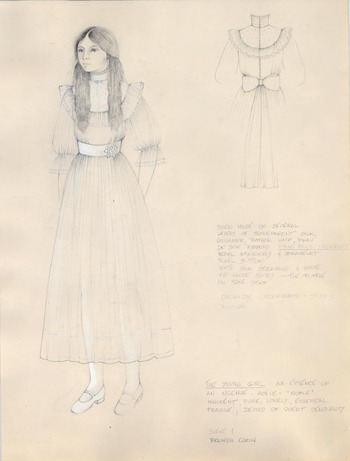
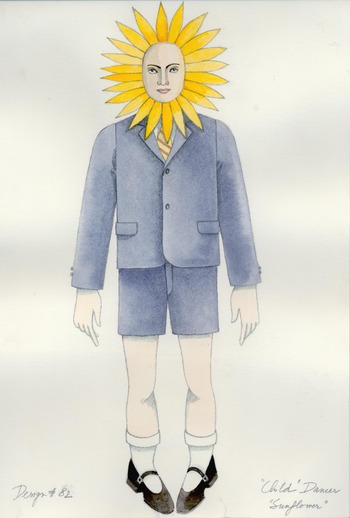
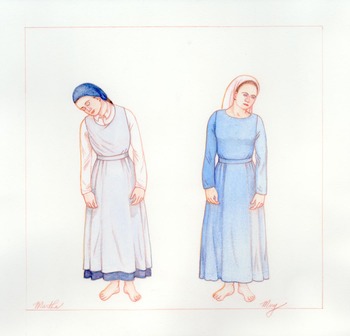
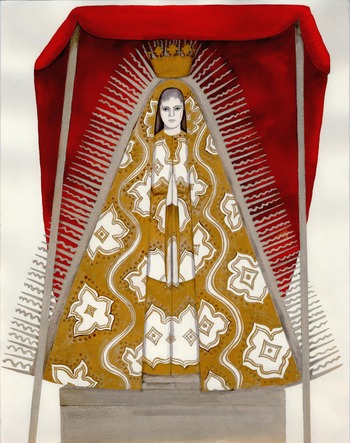
We at UC Merced count ourselves fortunate to be in the possession of this physical collection. As it represents the complete work of a single designer, not a design firm or collective, it is truly unique among collections of costume design. It also stands as one of the few collections of its kind held by an academic institution. It is this aspect of the collection that I think presents to researchers a remarkable opportunity—the chance to trace the development and evolving vision of one of the most respected costume designers working today. This has surely been one of the more enjoyable experiences in working with this collection. To see Ms. Ramicova's work move from the loose drawings of her early work, as seen in the designs for Ghost Sonata (Fig. 1 and Fig. 2) and Tales from the Vienna Woods, to the softer, cleaner lines of the later work in The Gospel According to the Other Mary or An American Tragedy (Fig. 3), has been a joy. It is impressive to see how the sophistication of her overall design sensibility has developed over her career. Indeed if one follows the designs chronologically, a wholly informed aesthetic emerges—an obvious sensibility of how to make meaning with fabric, shape and colour. It is easy, I think, for those of us not immersed in the world of costume design to not fully appreciate the extent to which costume directs the visual character of a performance, and how much that visual character helps shape the meaningfulness of the production as a whole. It's easy to get lost in the surface aesthetics of costume, and not see how much the bodies of the individuals in performance are illuminated by what they are wearing (Fig. 4).
“The Young Girl” from Ghost Sonata, staged 1977. Image courtesy UC Merced Library.

“Sunflower” from The Fairy Queen, staged 1995. Image courtesy UC Merced Library.

“Martha and Mary” from The Gospel According to the Other Mary, staged 2013. Image courtesy UC Merced Library.

“Queen Isabella” from The Voyage, staged 1992. Image courtesy UC Merced Library.

The Digitization Project
The goal of digitizing this collection was established from the outset, and we began preparing for digitization shortly after the first batch of drawings arrived in the Library. A large format scanner was purchased (we used a Contex HD iFLEX scanner, which I think reproduced the drawings very well), and we worked on scanning the objects and creating object metadata concurrently. Each object was scanned using the U.S. Federal Agencies Digitization Guidelines Initiatives (FADGI) specifications as a guideline. Colour targets were included in each of the initial, or master, scans. These colour targets were then cropped out for the access copies, which would ultimately be made available online.
When Ms. Ramicova delivered her drawings to us, she also supplied us with PDF files containing descriptive information for each drawing, as well as information for each production that the drawings were for. The information provided included such things as drawing title (usually the depicted character's name), drawing medium, drawing size, the name of the production, the production team (director, stage designer, lighting director) as well as the production venue. Supplying this information certainly saved us a great deal of time.
Since UC Merced doesn't maintain its own institutional repository or DAMS, we relied on the University of California Libraries Digital Collections (UCLDC) DAMS, which is managed by the California Digital Library (CDL). The UCLDC DAMS currently uses Nuxeo as its file management software, with the Calisphere website (http://www.calisphere.org) as its public interface. Without these resources, I doubt that UC Merced would have been able to make these items available to the wider public. In addition to using the UCLDC DAMS to manage the digital files, we are using the CDL provided Merritt data preservation system to ensure that the integrity of the digital files will be maintained well into the future. Another significant benefit of having the digital files available through Calisphere is Calisphere's status as a Digital Public Library of America (DPLA) content hub. This ensures that these digital files will reach an even wider potential viewing public.
In celebration of the “official” launch of the collection, which coincided with the launch of the new Calisphere website, the Library, the UC Merced Center for the Humanities, and the Merced Multicultural Arts Center sponsored an exhibit of the physical drawings during the Fall of 2014. I worked with Ms. Ramicova in curating, framing and preparing the drawings that were included in the exhibit. I also prepared a companion website for the exhibit that provided more information on the productions for which the costumes were designed. Along with production information, the website included personal reflections by Ms. Ramicova about her experiences working with such luminaries as Phillip Glass, David Pountney, Peter Sellars, Gronk and Francesca Zambello. Also included, where available, were images from the live performances, which provide for a unique chance to see the costume designs as they were finally constructed. In addition, the title cards for the exhibit were imprinted with QR codes that linked to each production's respective webpage (the website is still viewable via http://ramicova.ucmerced.edu). For the public opening, I prepared a talk discussing the overall project, and Ms. Ramicova answered question during a Q & A session. A couple of days after the opening, during a local event called Merced Art Hop, the Peter Sellars directed The Marriage of Figaro was shown throughout the evening for exhibit attendees.
Future Plans and Goals
As the physical collection occupies a significant presence in our Special Collections, it will undoubtedly be a collection that we will continue to promote and exhibit, both at UC Merced, and the world outside our campus borders. Another possible avenue to explore is the creation of educational and pedagogical resources for those interested in costume design, fashion design, as well as those interested, again, in the wider histories of performing arts. Potential pedagogical resources could also explore the relationships costume and fashion have to wider cultures of dress and everyday life. Indeed, what such a collection offers is potentially boundless, and is only inhibited by our imagination.
One of the pleasures in maintaining a digital collection is the ability to continuously adjust, alter and enhance that collection. Going forward, one area we hope to continue building upon is collection metadata. Though we were provided with very useful information for each production and for each individual drawing, we feel that we can continue to enhance the informational quality of the collection. This can happen by both building upon what we were already given, as well as doing original research into the various contexts surrounding the pieces and productions. One refinement to the metadata currently underway, for example, has been to pull the “director” information from the original “production team” grouping and make it its own element. We are also, where applicable, performing original research and are including composers, librettists and authors. The provided titles are also being reformatted in order to enhance readability and their informational value. If the opportunity presents itself in the future to explore something like linked data, we imagine that being able to link elements across other collections within the UCLDC DAMS, and beyond, would prove beneficial in expanding the context, and findability, of these remarkable drawings. Beyond these metadata enhancements, we are also exploring the addition of new items to the collection. Plans are underway to include Ramicova's process notebooks, as well as other materials from the original productions. We are hopeful that the inclusion of such materials will provide users with a more holistic understanding of the designs, their creation, and the worlds they occupy.
Conclusion
This collection certainly holds a special sway over me. It was a project that was entrusted to me shortly after I arrived at UC Merced, and for that I am very grateful. I have been fortunate to been able to work with Ms. Ramicova on the various aspects of this project, and being able to curate with her the exhibition of her drawings was a rewarding experience. I hope to be able to continue working on this collection in a way that the collection deserves, and in a way that helps the public experience these drawings as fully as I have been able to.